




Abstract
This article analyses the challenges of controlling short-term rentals (STR) in an era of intermediation by digital platforms, focusing on the process of regulatory enforcement. Drawing on evidence from large European cities, it investigates how public authorities identify and tackle STR deemed illegal, how operators of illegal STR seek to escape detection, and the relationships between city governments and digital platforms in the process of regulatory enforcement. The article shows what digitalisation and ‘platformisation’ do to the possibility of (local) state regulation of housing informality and illegality in the European context. As platforms have been reluctant to release individualised STR listings to local authorities, the latter have had to rely on imperfect, ‘DIY’ methods of data gathering in the physical and digital worlds, in the context of attempts to regulate STR for public interest objectives such as the protection of the long-term residential stock.
Keywords
Introduction
A holiday apartment in Lisbon or Berlin is not the first thing that comes to mind when thinking about urban informality and illegality in Europe. Those terms conjure up images of squatted buildings, makeshift camps or ‘beds in sheds’ sheltering vulnerable, low-income populations. By contrast, short-term holiday rentals are usually located in legally constructed, good-quality buildings and attract guests who can afford to travel for leisure. Such rentals are advertised via online platforms that have gained ubiquitous status, like Airbnb or Vrbo. Yet, as vividly stated on posters that were put up by the Barcelona city government on the walls of touristic neighbourhoods in 2016 (Figure 1), ‘just because this bed has 2,519 positive reviews doesn’t mean it’s legal’.
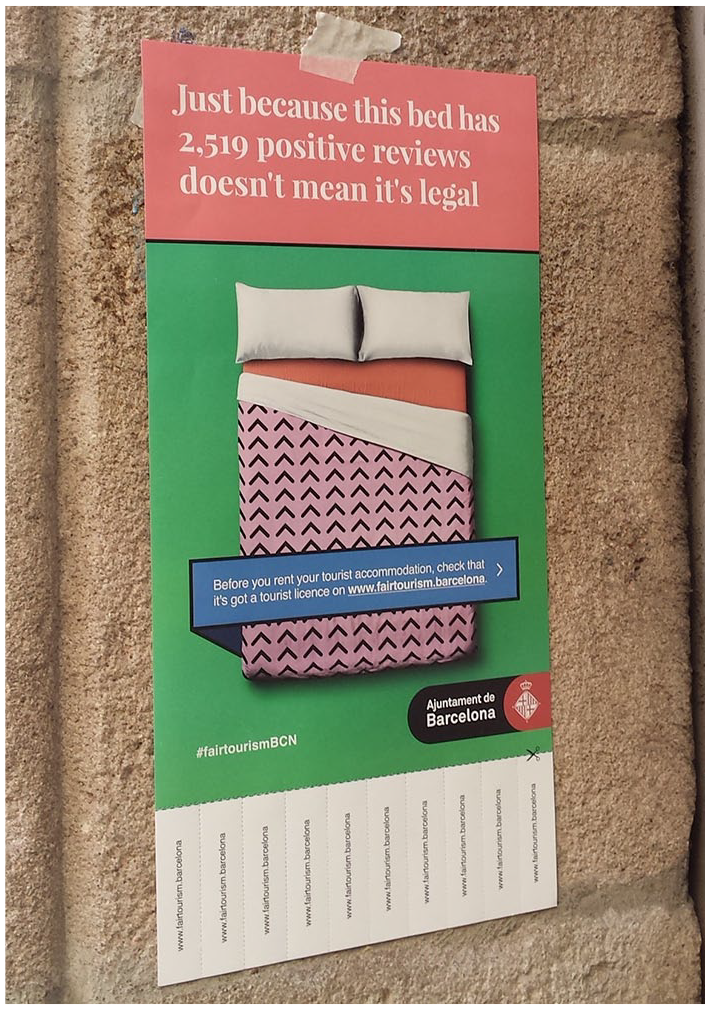
Communication campaign from the city council of Barcelona about the (il)legality of short-term rentals, 2016.
Over the past decade, short-term rentals (thereafter STR) have become a contested ‘public problem’ in many European cities (Aguilera et al., 2021). Recent studies have found that the proliferation of STR in specific neighbourhoods has contributed to increasing tensions between residents and visitors, a decline in the housing stock available for long-term occupation, and an increase in rental prices (summarised in Colomb and Moreira de Souza, 2021: 23–27). Such concerns have led various city governments to enact regulations that produce new demarcations between what is legal and illegal in the short-term use of a housing unit. Any regulation, however, is only as good as the possibility of its effective implementation. Yet the challenges and practices of regulatory enforcement are comparatively less addressed in European urban, housing and planning studies.
In this article, we focus specifically on what happens after new STR regulations have been adopted. We draw on a study of 12 large European cities to address 2 objectives. First, we seek to identify the challenges shared by many city governments in enforcing STR regulations. Are such challenges simply mirroring long-standing issues associated with regulatory enforcement in the fields of planning and housing, or are there new challenges associated with the digitally mediated nature of STR practices? As powerfully argued by Ferreri and Sanyal (2018: 3355), ‘emerging digitally mediated uses of space usher in both new urban regulations and unexpected challenges to their enforcement, raising wider questions about the role of information technology companies in transforming city governance across the globe’. Second, we aim to analyse what kind of formal and informal practices the different actors involved in operating and regulating STR deploy once new regulations have been put in place: How do public authorities identify, control and stop STR deemed illegal? How do operators of illegal(ised) STR seek to escape detection? What are the relationships between city governments and digital platforms in the process of regulatory enforcement?
The article aims to contribute to three strands of scholarship in urban, housing and planning studies that are briefly reviewed in the first section, respectively, on (1) housing informality and illegality in the global North; (2) regulatory enforcement in planning and housing; and (3) the digitalisation and ‘platformisation’ of housing and real estate. In the second part of the article, we introduce the methodology of the study, the objects of regulation under scrutiny (i.e. STR and their mediation by digital platforms) and the multiple ways in which they can be described as (il)legal and (in)formal. In the third section, we present our empirical findings on the challenges of enforcing STR regulations in the physical and digital worlds of large European cities, before concluding by outlining how the findings contribute to the above-mentioned strands of scholarship.
Enforcing planning/housing regulations and controlling illegalities in a digitally mediated era
Beyond the ‘informality of need’ in European urban and housing studies
Until recently, few writers ‘conceived of illegal or nonconforming urban development in the global North as examples of informality’ (Harris, 2018: 272), but a growing body of research has thrown light on various forms of informal and/or illegal housing in North America (Durst and Wegmann, 2017; Harris, 2018; Mukhija and Loukaitou-Sideris, 2014), Australia (Gurran et al., 2021) and Europe (Aguilera, 2017; Chiodelli et al., 2021; Hilbrandt, 2021; Lombard, 2019; Martínez-Lopéz, 2020; Schiller and Raco, 2021; Vasudevan, 2015). In many cases, those studies show that informal and/or illegal housing is occupied by households unable to access other forms of accommodation due to social exclusion, discrimination or lack of resources. There is comparatively less scholarship on informality and illegality in housing associated with non-poor, non-marginalised actors in the global North. Yet middle- and upper-class households and investors do engage in informal and illegal housing practices, for example, through the unauthorised construction of second homes in coastal areas of Italy (Chiodelli et al., 2021; Zanfi, 2013) or of ‘secondary suites’ in the United States, Canada or Australia (Gurran et al., 2021). Devlin (2018) has thus invited researchers to distinguish between ‘informality of need’ and ‘informality of desire’: the ‘differences between acts undertaken by the urban poor to meet basic needs and those engaged in by more well-off residents for convenience, efficiency, or creative expression’ (p. 570).
A growing number of authors have associated STR with the notion of ‘informality’ (Devlin, 2018; Ferreri and Sanyal, 2018, 2021; Guttentag, 2015; Kovács et al., 2017; Shabrina et al., 2017; Shrestha et al., 2021; Söderström and Mermet, 2020), though not always clarifying in what precise ways STR can be regarded as ‘informal’ (something we will discuss later on). Some authors note that a number of households have engaged in STR practices out of need. In European countries affected by the post-2008 crisis, or in cities with high housing costs, lower and middle-income homeowners and tenants have sometimes used STR as an income maintenance strategy (see Semi and Tonetta, 2020, on Turin; Balampanidis et al., 2021, on Athens; Söderström and Mermet, 2020, on Reykjavík; Maier and Gilchrist, 2022, on London). However, in many localities, a significant proportion of STR is operated by middle-class homeowners with economic and cultural capital (Mermet, 2021), and increasingly, by professionalised landlords who run several properties. 1 This comprises small-scale amateur landlords who operate one flat (e.g. in Vienna, see Kadi et al., 2022), multi-property landlords (see Gil and Sequera, 2022, on Madrid; Amore et al., 2022, on Athens, Lisbon and Milan), and more recently, real estate investors and wealth and asset management companies (see Cócola Gant and Gago, 2021, on Lisbon). The STR market has thus shifted ‘from an individual, unregulated, informal practice to a large-scale, strategic management of real estate property’ (Balampanidis et al., 2021: 224), involving different types of actors who are more or less ‘professionalised’ in their practices. While the degree of professionalisation could be described as a ‘formalisation’ of the activity, it does not mean that the activity is systematically legal, as discussed later.
Regulatory enforcement in planning and housing: old problems, new technologies
As will be briefly introduced in the next section, many European city governments have, since the mid-2010s, enacted new regulations that seek to formalise, monitor and control the STR offer (Aguilera et al., 2021; Nieuwland and Van Melik, 2020) – sometimes with the help of new regional or national legislation. While STR regulations can belong to different policy fields, many local authorities have used their competences in land use planning and housing to influence the phenomenon. The effectiveness of new regulations, however, lies in the capacity of public authorities to enforce them.
In the fields of planning and housing, enforcement activities seek to ensure that the design, use and occupancy of buildings and dwellings conform to a variety of regulations and policies. Regulatory enforcement – the sharp edge of regulation – has attracted comparatively less attention in planning scholarship (Harris, 2015). Effective enforcement is influenced by several factors. First, a multiplicity of political variables may shape the intensity and character of regulatory enforcement (see Short, 2021, for a review), for example, the potential influence of elected officials and interest groups. Second, there are differences in the human and financial resources at the disposal of authorities (Alterman and Calor, 2020; McKay, 2003). Third, while enforcement activities must abide to bureaucratic protocols (Gurran et al., 2022; Harris, 2015; McKay, 2003), they also entail spaces of discretion and informality, as long shown by anthropologists of the state, legal geographers, sociologists and political scientists. Those in charge of controlling and enforcing compliance – the inspectors who represent ‘the hard hand of the state’ (Van de Walle and Raaphorst, 2019) – are ‘street-level bureaucrats’ who have a degree of discretion in their interactions with citizens, ‘because the accepted definitions of their tasks call for sensitive observation and judgement’ (Lipsky, 2010: 15). Formal systems of rules always include room for exceptions (Harris, 2010, 2021) and discretion in interpretation. There are always ‘pragmatic politics’ involved in regulatory enforcement (Coslovsky et al., 2011), and inspectors often have to exercise judgement when deciding to pursue particular cases (Gurran et al., 2022; Maalsen, 2020; McKay, 2015; Van de Walle and Raaphorst, 2019).
Fourth, planning and housing enforcement is a knowledge-based activity relying on multiple sources of information, data and expertise, such as complaints by residents and on-site inspections (Harris, 2011, 2013). Deception and fraud are an inherent response to inspections (Van de Walle and Raaphorst, 2019), for example, when landlords seek to conceal evidence of housing misuse (Kelling, 2021; Shrestha et al., 2021). In that context, local governments often cross-reference different sources of administrative data and/or cooperate with various departments or agencies to detect infractions (Barry Born, 2021; Nasreen and Ruming, 2021; Schiller and Raco, 2021). Some have turned to new sources of data and information technologies to identify breaches of planning and housing regulations (e.g. in the English case, close-circuit television footage, images from Google Earth/Street View, and aerial photographs obtained via drones or police helicopter flyovers; Harris, 2015). More recently, some local authorities have contracted data scientists to develop software that predicts the location of unlicensed ‘houses in multiple occupation’ (Barry Born, 2021).
Recent Anglophone studies of the digital transformation of state practices in the context of housing enforcement tend to take a critical view of the role of the local state, often portraying it as the promoter of hostile surveillance practices, for example, through ‘machine learning algorithms that render calculable and governable informal, precarious migrant urbanisms’ (Barry Born, 2021: 622). But the local state is not a uniform actor driven by a single coherent political rationale. On the one hand, within a single local authority, different politicians or departments may pursue varied and contradictory agendas. On the other hand, in a European comparative perspective, one cannot assume that all local authorities uphold ‘hostile’ agendas such as those witnessed, in some cases, in the context of housing and immigration enforcement in England. In our analysis, we offer a different take on the ‘transformation of the state and politics in an age of algorithms and big data’ (Barry Born, 2021: 610): one that stresses the local state’s attempts to govern for ‘public interest’ objectives and socially progressive ends (e.g. in the case of STR, the protection of the housing stock for long-term residents), and the relative weakness of state actors in the face of new private companies that control crucial data (digital platforms). As we will show, city governments ‘try to obtain data they do not control and this lack of control, the fact of being outside the game, makes public regulation very difficult’ (Söderström and Mermet, 2020: 6).
The challenges created by the digitalisation and ‘platformisation’ of housing and real estate
Planning and housing scholars have recently started to address the ways in which local regulations have responded to platform-mediated STR (Ferreri and Sanyal, 2018, 2019; Gurran, 2018; Gurran and Phibbs, 2017; Holman, 2019; Holman et al., 2018), showing that traditional zoning and planning instruments are not very effective in curbing the phenomenon. This is because, as Leshinsky and Schatz (2018) argue in one of the few published studies on the enforcement of STR regulations (in Australia), enforcing regulations on the ground is very challenging. Just like other kinds of informal housing uses considered problematic (e.g. overcrowded rental housing), STR are ‘dispersed unevenly, interwoven with formal housing topography, and often physically undetectable viewed from the street or above’ (Barry Born, 2021: 613). However, in contrast with informal rental housing that often involves ‘cash-in-hand sublet arrangements’, STR are mediated by digital platforms and are thus part of ‘datafied middle-income rental markets’ (Barry Born, 2021). Such platforms are for-profit tech companies that organise interactions between market agents and take a commission for intermediation. Their value lies in network effects (Srnicek, 2017 [2016]) and data collection, accumulation and analytics (Sadowski, 2020; Shaw, 2020).
In the field of STR, following the creation of Airbnb in 2008 (now the market leader), mergers have consolidated the role of a small number of national and international platforms, which have ‘dramatically reduce[d] the establishment, search and transaction costs associated with holiday home accommodation, exponentially expanding their potential market’ (Gurran, 2018: 299). In that context, a key question emerges: what does the digitalisation/platform intermediation of STR do to regulatory enforcement? It has a paradoxical effect: it makes the offer visible to a global public, but not necessarily to the public authorities in charge of enforcement. Listings do not mention the real name of the operator and exact address of the property until a booking payment has been made – sometimes not even. Many platforms have, until recently, not agreed to share individualised, geo-localised data with public authorities. This has generated what Hoffman and Schmitter Heisler (2020) have, in the US context, called ‘data wars’ between city governments and platforms (in the European context, see Söderström and Mermet, 2020, on Reikjavik, and Holman, 2019; Holman et al., 2018; and Ferreri and Sanyal, 2018, on London).
More recently, a number of authors have classified STR platforms as part of a growing ecosystem of ‘platform real estate’ (Fields and Rogers, 2021; Shaw, 2020), a concept that refers to the increasing automation and digital intermediation of housing demand and supply, property management, real estate transactions and investments. Scholars have started to investigate how this generates ‘urban big data oligopolies’ (Boeing et al., 2021), how this affects the power relations between the actors of housing and real estate markets (Ferreri and Sanyal, 2022; Fields and Rogers, 2021; Goodchild and Ferrari, 2021; Maalsen et al., 2022; Sadowski, 2020; Shaw, 2020), and how this facilitates property-led financial accumulation strategies (Fields, 2022; in the case of STR, see Cócola Gant and Gago, 2021). Ferreri and Sanyal (2022: 3) make the hypothesis that ‘in stark contrast to the developmental imaginaries of both “Global North” technological innovation and smart urbanism [. . .] digital platforms and platform real estate are enabling the expansion of informality within the housing sector’. They propose the term ‘digital informalisation’ to ‘examine how digital platforms are engendering new and opaque ways of governing housing’ (p. 1). They do not argue that such practices ‘are either “informal” in terms of the spatial categorisation of the dwelling, or that they exist without contractual agreements’, but instead employ informality ‘as a metaphor . . . to think about the disruptive effects of platform real estate as well as their opaque operations’ (p. 7). The state is central to the process of ‘digital informalisation’ (Ferreri and Sanyal, 2022: 14), they argue, by supporting the activities of corporate platforms in a variety of ways – as in London where planning rules around short-term letting were relaxed by the national government to foster the development of the digital economy (Ferreri and Sanyal, 2018). But the state is also, as we will show, the first ‘victim’ of the process of ‘digital informalisation’. Within the growing scholarship on informality and illegality in European urban, housing and planning studies, more research is consequently needed on the challenges of regulatory enforcement in a context of digital intermediation by platforms.
Investigating the enforcement of short-term rental regulations: methods, definitions and the multi-faceted meanings of il(legality) and (in)formality
Our analysis draws on a broader study of STR regulation in 12 European capital or second-largest cities: Amsterdam, Barcelona, Berlin, Brussels, Lisbon, London, Madrid, Milan, Paris, Prague, Rome and Vienna. The empirical research, inspired by sociological approaches to public action tested by Aguilera et al. (2021), was carried out between 2018 and 2021. It combined an analysis of policy and legal documents, media articles and interest group statements with semi-structured interviews with around 50 representatives from city governments, citizens’ movements, the hotel industry, home-sharing clubs and professional organisations of STR operators, all of whom have been anonymised (for more details, see Colomb and Moreira de Souza, 2021). Within the context of this study, we were only able to gather detailed evidence on the nitty-gritty activities and challenges of enforcement in a smaller sample of cities: those where (1) there has been a strong political impetus to invest in enforcement and (2) we were able to interview some of the key actors involved. Most empirical examples used in the following analysis thus relate to Amsterdam, Barcelona, Berlin, London and Paris, with occasional references to the other seven cities. 2 In one city (Barcelona), we were given the opportunity to follow an inspector in charge of controlling suspected illegal STR during a half-day round in May 2018.
Our study distinguished between three types of STR that are often treated differently in regulatory attempts: (1) the professional short-term rental of an entire property not used as a primary residence; (2) the occasional short-term rental of a dwelling normally used as a primary (or secondary) residence; and (3) the short-term rental of a room in a primary residence (so-called ‘home-sharing’ in a strict sense). In this article, we do not focus on the details of the regulations in the 12 cities per se (see Colomb and Moreira de Souza, 2021), but on the challenges raised by their implementation and enforcement. The landscape of regulations ranged, at the time of writing (summer 2022), from relative laissez-faire (Milan, Prague, Rome) to partial prohibition or strict quantitative controls (Amsterdam, Barcelona, Berlin, Lisbon, Madrid) of STR Type 1 in particular, with other cities exhibiting ‘middle-ground’ approaches. The regulations sought to control, in various combinations, the visibility and existence of STR; their quality; their overall quantity and/or geographical distribution; the balance between the different types of STR; the taxation of STR-generated income; and the practices of platforms. Some city governments were broadly supportive of STR practices and simply tried to make them ‘visible’, legally defined and formalised – for example, through a registration system – in order to better tax them (see Artioli, 2020, on Milan) or to ensure minimum standards of health and safety. By contrast, other city governments tried to control the overall quantity and/or location of STR through stricter regulations that created new distinctions between legal and illegal STRs. As we will see, this was accompanied, in a number of cities, with increased investment in enforcement activities to crack down on what became defined as ‘illegal’.
In this context, we use the term ‘illegal’ to refer to the non-compliance of a STR operator with one or more regulatory provisions in force in a given city. This can be due to a lack of awareness of the rules, or to a deliberate choice based on the perceived high cost of compliance or low risk of penalty (Durst and Wegmann, 2017; Harris, 2018). In the case of STR, the relevant regulations can emanate from different tiers of government and policy fields (housing, planning, tourism, economy, safety, taxation, etc.), meaning that the illegality of a STR can manifest itself in different ways: lack of a registration or permit for the activity, lack of compliance with specific provisions (e.g. time limits) or tax evasion (Kovács et al., 2017). In any of the three above-mentioned categories of STR, an operator might comply with some aspects of regulation (e.g. have the right authorisation) but not others (e.g. not declare the income to the relevant tax authorities). 3 In some cases, interviewees used the word ‘a-legal’ to refer to ‘grey areas’ of uncertainty, where practices such as the renting of a room in one’s home were not legally defined or regulated, nor prohibited.
Beyond illegality in a strict sense, as mentioned in the previous section, some authors have associated STR with the term ‘informality’. This term can refer to a lack of legal definition of the activities concerned, and/or to their invisibility to public authorities. More broadly, as some of our interviews revealed in an anecdotal manner, the existence of STR can rely on, and facilitate, a variety of informal practices – some clearly illegal or criminal. In cities like Barcelona and Lisbon, there were reports of informal intimidation on, and formal evictions of, long-term tenants in order to convert housing units into STR (practices described in Spanish law as ‘real estate harassment’, see Ajuntament de Barcelona, 2020: 23–29). In other cases, property owners were tricked by tenants who signed a long-term rental contract but exploited the dwelling as STR. We also heard stories of STR being deliberately rented for law-breaking activities (drug dealing, prostitution or during the COVID-19 pandemic, large parties during lockdowns). Additionally, the daily operation of STR often entails informal labour, both the unpaid labour of individuals who rent out their home (Bosma, 2022; Spangler, 2020) and the paid labour of precarious workers who might operate in the shadow (undeclared) economy to clean and service STR (Cañada and Izcara Conde, 2021) – an aspect not investigated in our study.
To those various meanings of ‘informality’ in relation to STR, we would like to add another, drawing on the above-mentioned scholarship on the ‘spaces of discretion’ and challenges of evidence-gathering that lie at the heart of regulatory enforcement. In this article, we understand informality as including ‘both social practices on the fringes of the law or uncertain response from the state as well as state practices and their negotiations with regulation in everyday enforcement’ (Haid, 2017: 290, our emphasis). Informality, therefore, is not just about the informality of STR, but about the practices of all actors involved in regulation and enforcement.
The challenges of regulatory enforcement: inspections, data production and (in)formal practices in the digital age
No matter what type of regulation has been enacted, research interviews revealed huge difficulties, common across all cities, with the detection and control of suspected illegal STR. In order to be regulated – which means to be ascribed to a specific category of land use or economic activity distinct from others – the STR phenomenon first has to be geo-localised and associated with a physical/legal entity. There are two main ways this can be done: (1) through street-level observation and inspections, often based on reports from local residents and, where it exists, supported by the STR registration/licence database; (2) through access to the digital data held by the private platform companies that mediate STR supply and demand. In what follows, we analyse the formal and informal tactics deployed by city governments and targeted actors – STR operators and corporate platforms – respectively in the physical and digital worlds of regulatory enforcement.
Street-level inspections: ‘If you can’t find us, you can’t fine us’ (Cox and Haar, 2020: 12)
Most of the 12 city administrations have inspectors in charge of controlling aspects of the legality of STR, who are often responsible for monitoring other types of illegalities in parallel. The departments in which they are located vary – planning, housing, business licensing or tourism (see Tables 5.1–5.12 in Colomb and Moreira de Souza, 2021). Our research showed considerable differences in the resourcing of inspection teams. As of mid-2018, there were approximately 70 street-level inspectors in Amsterdam; 30 in Barcelona (backed by up to 40 employees solely performing online searches on platform websites); 63 in Berlin (mostly at district level); 35 in Paris; and 22 in Madrid. In cities where there was no specific planning or housing regulation of STR at the time of writing, tax, tourism or trade, licensing inspectors could perform some controls (e.g. Lisbon before 2018, Prague, Milan and Rome), though this was infrequent.
In some cities – most notably Amsterdam, Barcelona and Paris – from the mid-2010s onwards there was a clear political drive by the local government to invest into the expansion and strengthening of enforcement teams (Aguilera et al., 2021), in response to residents’ concerns over STR impacts on neighbourhoods and local housing markets. Following the victory of a new political force (Barcelona en Comú) in 2015, the Barcelona city council launched a ‘shock plan’ for STR detection and enforcement at a cost of 1.35 million EUR per year (Ajuntament de Barcelona, 2016). By contrast, other local governments have been heavily constrained in their enforcement efforts by a lack of financial resources. In London, since 2010 central government cuts to the funding of English local authorities have led to significant reductions in the staffing of the Borough Councils’ planning departments (responsible for controlling whether units rented short-term more than 90 days a year have permission). An officer from an inner London borough explained that in 2018, they only had four staff to control all types of suspected breaches of planning regulations, leading to virtually no ‘planning contravention notices’ served in relation to STR (see also Ferreri and Sanyal, 2018; Holman et al., 2018). Additionally, local authority interviewees from Amsterdam and London stressed that the effective enforcement of STR regulations should, in theory, cut across administrative departments: this requires a coordinated response between services in charge of local tax, housing, business licensing, planning, environmental health, fire protection and the police, something that is often difficult to organise in practice.
The actual capacity of an inspector to physically locate, reach and enter a suspected STR unit is highly constrained. Unlike other regulatory fields (Van de Walle and Raaphorst, 2019), there is often no direct social interaction between the inspector and the inspectee, and part of the enforcement work entails identifying the physical or legal person owning a unit in the first place. As a Barcelona inspector explained, at the beginning of their daily round, they are given a list of properties suspected of being illegally used as a STR. This list is made of different sources. The first comes from complaints by local residents. Several city governments have created channels for third parties to report suspected illegal STR by phone, e-mail or online (e.g. in Amsterdam, Barcelona or Berlin). In Barcelona, in 2016, a communication campaign in three languages was launched and a controversial letter was sent to all the city’s residents, urging them ‘to help combat illegal tourist accommodation’ by reporting suspect STR. 4 In cities with active citizen movements mobilised around the issue, like Barcelona and Madrid, city authorities have been helped by residents’ associations and activist networks who have proactively reported suspected illegalities. In cities that have a system of registration or licensing for STR, complaints are then checked against the relevant register. If the unit does not have a registration or licence, the inspector has to find tangible evidence of its use as a STR to prove the nature of the illegality.
The second source of intelligence about suspected illegal STR, as explained by the Barcelona inspector, are online advertisements specifically flagged by employees contracted to screen individual listings on platforms (an activity further described in the next section). As platform-mediated listings do not disclose the exact address of a property – only an approximate location – inspectors then have to walk in the streets and visually search for clues spotted in online photographs (e.g. window shape, curtain colours or appearance of the building) to identify and locate STR, a painstaking and uncertain practice. This kind of informal search for visual clues, rooted in tacit knowledge and experience, is present in other types of housing inspection activities, for example, when inspectors look for evidence of the illegal ‘multiple occupation’ or overcrowding of houses in UK cities.
Control visits to a STR unit are not notified in advance. In densely built continental European cities, STR are usually located in apartment blocks whose street-level entrance is locked. As reported in Barcelona and Paris, once at the foot of a building, an inspector presses the buzzer of the flat to be visited, hoping that the occupants will reply, or might try to ring the neighbours to get access to the building. If the inspector manages to reach the door of the apartment, and if the occupants do open the door, the inspector asks them to explain in what capacity they are in the flat and to produce evidence of a booking/financial transaction for a STR. Often, there might be no answer or a refusal by the occupants to open the door. Inspectors do not have a warrant to enter a private property. In some cities, inspectors do benefit from the collaboration of other agencies with more powers: in Amsterdam, the fire brigade can inspect and immediately shut down a housing unit if it does not comply with fire safety regulations, a technique that has been used to crack down on ‘illegal hostels’ (residential flats crammed with bunk beds for rental to groups of travellers).
The chances of success of street-level inspections have been made harder by the tactics of detection avoidance and concealment devised by the operators of illegal STR. Interviewed inspectors and public officials mentioned several examples. The operator (or their representative) may typically ask guests, when welcoming them into the flat, to not answer the bell, or to tell any inquisitive neighbour that they are ‘friends’ visiting the host. As witnessed during our observation of an inspector’s round, guests themselves can respond angrily to the inspector, with or without prompt by the host, by refusing to open the door, asking for a warrant or rudely telling the inspector they have no right to control the property. Another reported tactic was the use of decorative personalised items – books on shelves, photographs of people on walls, clothes in cupboards – to make the flat look like it is someone’s primary residence. This happens in cities where there are different regulations distinguishing between permanent and occasional STR (e.g. through annual time limits applying to the latter). In some cities, guests may be given a fake contract (e.g. above 31 days) to show to a potential inspector, but are in fact staying for a shorter period. Additionally, over the past years, STR operators removed the small key safe boxes that were once visibly present near the street-level entrance of apartment blocks and started using less visible mechanisms for the handover of keys to guests (e.g. leaving them at a nearby café). Those informal practices of guest behaviour management and physical concealment echo those described by other scholars working on STR (Leshinsky and Schatz, 2018; Mermet, 2021; Nieuwland and Van Melik, 2020) or on other forms of illegal housing (see, for example, Spencer et al., 2020, and Kelling’s, 2021, account of concealment practices prior to inspections of ‘beds in sheds’ in London).
Consequently, inspection efforts are painstaking: it takes repeated visits, piecemeal observations and street-level interactions to obtain the necessary evidence that will be held valid by courts as proof of illegality (i.e. the repeated presence of fee-paying short-term guests in a housing unit). If access to a flat proves impossible, inspectors might talk to the immediate neighbours to gather evidence on observed activity patterns (e.g. recurring movement of people with luggage; noise). As noted by other scholars (Van de Walle and Raaphorst, 2019), in their mundane activities street-level inspectors constantly combine formal and informal methods and tacit knowledge learned from experience. They rely heavily on informal social monitoring: a resident from a central London borough explained that when he reported a suspected illegal STR to the Council, he was told to keep a diary of every time he saw someone arriving or leaving the flat, and commented that ‘people should not need to be doing that in order to get enforcement done’. Even in cities like Amsterdam or Barcelona that have comparatively well-resourced enforcement teams, interviewees stated that human resources were never sufficient to comprehensively monitor large numbers of properties, as illegal STR constantly close down and open in new locations. Because inspectors have, in most cities, to deal with other types of illegalities, they often choose to focus on cases where there is blatant evidence of repeated violations of the rules, or of serious harm to people (e.g. overcrowded houses unfit for human habitation). As in other fields, STR enforcement practices thus ‘entail discretion about what, how much and when to enforce’ (Alterman and Calor, 2020: 154) by inspectors. Besides, enforcement activities are also intensified at certain points in time for public relations purposes, so that local governments are visibly seen to address the problem, as with ‘opérations coups de poing’ in Paris (Henry, 2017).
Once an inspector has gathered evidence, it may take months for the administrative or legal proceedings to be concluded, leading to a cessation order and/or a fine. But a judge can reject the case if the evidence is considered weak. Knowing that – and wary of the risk of appeals against the local authority – inspectors may exercise discretion in deciding whether to pursue legal action based on the severity of offence, the robustness of evidence and the perceived chance of winning (see Holman et al., 2018: 621). If a STR is judged to be illegal, the fines imposed to individual hosts vary hugely (in our sample, the fines applied to individual operators ranged from approx. €2500–4000 in Lisbon, €20,000 in Amsterdam, €30,000 in Barcelona, €50,000 in Paris (€80,000 if dissimulation) and up to €500,000 in Berlin). Landlords or operators can (and often do) appeal against such decisions with the help of specialised lawyers. In Berlin, when a highly restrictive new regulation was passed by the city government in 2014 (later amended and softened), small holiday rental businesses that had legally operated for years became illegal overnight, a retroactivity condemned by the representative of an organisation of holiday apartment operators as a ‘criminalisation’ of their activities. For some non-professional individual hosts, fines have had a devastating impact. In Barcelona, an association named ‘Citizens Affected by the Conflict between the City Council and Airbnb’ (ACABA) was created to represent 300 individuals who received fines of 60,000 EUR for occasionally renting out their primary homes on Airbnb. They have campaigned against such sanctions on the ground that We are not mafia. We are not speculators. We are not ‘vulture funds’. We are not big property owners. We are not companies. . . . We are residents of Barcelona, individuals, who rented their home (usual residence) sporadically, and in some cases, only placed an ad. We did it out of economic necessity and not for speculative purposes. . . . [we] have been disproportionately sanctioned as a result of the conflict between Barcelona City Council and Airbnb. (ACABA, 2022)
Unusually, this association has not just fought against the city council’s decision to fine them, but has also heavily criticised Airbnb for enticing and misleading ‘normal citizens’ to advertise their homes without making it clear that they needed to comply with local rules. In an unprecedented move in Europe, they have lodged a legal challenge against Airbnb, accused of ‘let[ting] citizens publish their flat without a license’ (ACABA, 2022).
In some cases, fines are not a deterrent because the very high profits to be made from STR mean that ‘unscrupulous operators familiar with regulatory frameworks . . . were known to continually reoffend, preferring to pay a fine and resume operations’ (Gurran et al., 2022: 26). Interviewees from Barcelona’s city administration explained that by 2021, small-scale STR operators or individual hosts who rented their home occasionally without a licence had mostly been scared off by the first waves of fines in 2016/2017, but that a small minority of multi-property operators or even criminal networks had come up with increasingly cunning strategies of concealment and fraud to continue operating illegal STRs (e.g. by accumulating long-term rental contracts and fraudulently using the rented units for intensive use as STR without the landlord’s knowledge). This led the city government to modify the system of fines, lowering those for minor infractions and increasing those for severe cases of ‘multi-infractions’.
It is worth noting, by contrast, that the STR operators who do want to comply with new regulations and thus demarcate themselves from the illegal offer have taken practical steps to make their activity more socially acceptable. In many cities, there are organisations representing the professional managers of commercial STR (such as Gastvrij Amsterdam, the Short-Term Accommodation Association in London, the Asociación de Apartamentos Turísticos de Barcelona (APARTUR) or the Associação do Alojamento Local em Portugal (ALEP) in Lisbon). Their representatives declared themselves favourable to light forms of regulation (e.g. for quality standards or taxation purposes), but opposed tougher interventions that would restrict the size and growth of the STR market. Distinct from those professional organisations, new associations of hosts or ‘home-sharing clubs’ have also emerged in several cities to represent ‘non-professional’ STR hosts. Both types of organisations give guidance on how to be a ‘responsible host’ and sometimes provide legal advice to their members if they are sued for regulatory non-compliance.
Digital ‘data wars’ and ‘DYI’ practices of data assembly
To overcome the significant challenges with street-level control, interviewees from city authorities all stated that the data held by digital platforms is the only source that would allow them to know exactly who is offering a STR, at which location and for what amount of time. Until recently, most platforms did not agree to supply public authorities with listings of non-anonymised data, though aggregate data – which is not helpful for enforcement purposes – has sometimes been released. 5 Several city governments have explicitly asked platforms to give them individualised data listings, through a working group negotiating with platforms (Barcelona), formal legal requests in court (Berlin) or with the backing of a new national law that requires platforms to release such data (Paris). In some cases (Vienna, Prague, Madrid, Barcelona, Rome and Milan), pressures on platforms for data sharing have also come from national and/or local tax authorities.
Interviewed city representatives explained that the national Airbnb office, when contacted, referred them back to the company’s European headquarter in Dublin and invoked the EU General Data Protection Regulation as an impediment to data sharing (although it need not be, see Colomb and Moreira de Souza, 2021: note 31). Eventually, only two city governments in our sample managed to secure an agreement to obtain regular, detailed listings from the biggest platform, Airbnb, after several years of negotiations. In Barcelona, in May 2018, Airbnb agreed to supply a monthly list of detailed host data (Ajuntament de Barcelona, 2018b). In Paris, since December 2019, a French national law requires all platforms to supply, on an annual basis, detailed data for ‘full-unit’ STR (Type 1 and 2) in cities that have introduced a registration scheme. In both Barcelona and Paris, however, public authorities reported that the first sets of data transmitted by Airbnb were incomplete, with approximately 60–70 per cent of listings displaying missing or incorrect addresses in Barcelona, and 7 per cent in Paris (Cox and Haar, 2020: 20–21). In other cities like Vienna or Berlin, similar requests made by city governments for systematic data sharing had not succeeded yet at the time of writing (though a ruling by the Berlin administrative court in June 2021 confirmed that district administrations can require platforms to release personalised data if there is ‘justified initial suspicion’ against a STR landlord).
In several cities of our sample, interviewees reported that most platforms, however, have agreed to pass on individualised data for a limited number of listings about which public authorities have provided evidence of an illegality, 6 and to remove such listings when requested – though not always. In Barcelona, in 2017, the city government found an agreement with Booking, Homeaway, Tripadvisor and Rentalia, which committed to remove unlicensed STR listings from their website. Airbnb subsequently agreed to follow suit in 2018. Yet in December 2020, the city government still identified more than a thousand illegal listings on Airbnb and formally requested the platform to remove them (La Vanguardia, 2020). The city of Vienna prohibits STR in its municipal housing stock: while most platforms removed public housing units from their websites after they were requested to, it took until the autumn of 2021 for Airbnb to commit to do so (The Local AT, 2021).
In the cities where a STR registration or authorisation scheme has been set up, authorities have asked platforms to include an online field requiring hosts to enter their registration number. Some platforms agreed to implement that measure rapidly; others took time to do so or did not. In November 2016, the Barcelona city government started proceedings to fine Airbnb and Homeaway €600,000 each for repeatedly advertising STR listings without a licence number. Both platforms subsequently introduced a field for the registration number a few years later. In early 2019, the Paris city government started proceedings against Airbnb to fine the platform €12.5 million for advertising 1010 unregistered listings. Cox and Haar (2020) estimated that 80 per cent of Airbnb listings in Berlin, and 60 per cent in Paris, did not display the required registration number at the end of 2020. In the EU legal context, in line with the provisions of the 2000 E-Commerce Directive and 2022 Digital Services Act, platforms do not have an obligation to monitor the content of the listings they publish and therefore do not verify the validity of registration numbers supplied by ‘hosts’. This explains why platforms continue to publish illegal listings (i.e. that have an invalid number, or no number). Cross-checks have to be carried out by the responsible public authority against the relevant register. 7 A platform can only be held liable for illegal content if it fails to remove listings after being presented with evidence of an illegality.
In some of the cities where a time limit has been set up to distinguish between occasional ‘home-sharing’ and professional STR, some city governments have managed to secure an agreement with large platforms, such as Airbnb and HomeAway, to automatically suspend listings that exceed the threshold of 90 days in London and 60 days in Amsterdam until 2019. However, after the Amsterdam city government voted to reduce the cap from 60 to 30 days in 2018, Airbnb (2019) refused to apply the new limit of 30 days per year, which led to the suspension of the agreement previously signed between the company and the city government. By contrast, in Berlin, platforms do not enforce the 90-day cap for the STR of second homes nor do they provide any data on the corresponding listings to the city authorities.
Altogether, interviewed city officials repeatedly stressed that effective enforcement is impossible without the collaboration of platforms. To circumvent the lack of access to platform-owned data, interviewees mentioned a number of strategies that city authorities have deployed to get a better sense of the overall quantity, geography and typology of the STR supply, and to attempt to locate individual STR. Several city governments have resorted to ‘web scraping’, namely the process of extracting data from a website. This can be done manually, but more often through the use of software (including open-source) or of a custom-made script/programme that harvests the data in an automated way. The data – in this instance, the publicly available content of STR listings advertised on a platform’ website – is saved into a spreadsheet for ulterior analysis or use. Such processes of web scraping require some programming skills but are not overly complicated. The data gathered, however, do not usually contain any precise address, and hosts’ names may be pseudonyms. Some local authorities have commissioned commercial firms to do web scraping and analyse the data for them. AirDNA is one of the largest data analytics companies that scrapes data available on the Airbnb and HomeAway websites for a variety of clients. Smaller European start-up companies have also offered STR data scraping and monitoring services to city governments (e.g. the Spanish company Talk and Code, commissioned by some London boroughs). 8 A few local authority representatives have also mentioned using (or commissioning) data produced by not-for-profit ‘data activists’, in particular the Inside Airbnb project. 9 To identify more precisely individual STR suspected of being illegal in a proactive way, a few city governments (e.g. in Amsterdam and Barcelona) have contracted employees doing ‘data scraping’ in-house and scrutinising each listing to find details that would help inspectors localise the dwelling. In 2016, the Barcelona city council temporarily hired 40 so-called ‘visualisers’ to perform such detailed online searches. They scanned 17,000 ads on 140 websites in 3 years (Ajuntament de Barcelona, 2019).
As a response to the increased monitoring of STR platforms by public authorities, some operators were reported to resort to practices of ‘digital concealment’. For example, a flat illegally rented out as STR may be advertised as a series of independent rooms via different ads (where room rental is allowed). In Barcelona, the city government estimated that at the end of 2020, 445 rooms advertised on digital platforms were in fact unlicensed STR flats. In cities where a time limit has been set up to cap occasional, non-professional STR (type 2), some operators of professional STR (type 1) seek to appear as type 2, deactivate their listing when bookings have reached the time limit, and then recreate a new listing with slightly different photographs under a different name, on the same platform or another.
The glossy design, ubiquity and user rating systems of platforms give a varnish of trust and apparent legality, which means most unsuspecting consumers do not ask themselves whether the existence of, or access to, the service they are about to purchase is ‘legal’. This is vividly illustrated by the slogan shown in Figure 1, which was part of a communication campaign launched by the Barcelona city government to alert tourists to the illegal nature of many STR, and caution them to verify the status of their holiday accommodation via an online official register. 10 This attempt to address the consumers of STR was a unique one within our sample of cities.
As discussed elsewhere (Colomb and Moreira de Souza, 2021), corporate STR platforms, especially the largest one, Airbnb, have played a significant role in the politics of STR regulation, seeking to influence regulatory arrangements that affect the services they mediate, their own functioning and the potential growth of their markets. They do so before and after the enactment of new regulations, through communication campaigns, lobbying at various tiers of government, ‘grassroots mobilising’ of their users (Culpepper and Thelen, 2020; Yates, 2021) and legal challenges against new STR regulations, e.g. in Barcelona against the STR regulatory plan (the so-called PEUAT). This mirrors what other scholars first observed in the US context, where Airbnb has since the mid-2010s invested significant resources in trying to prevent more stringent regulations, for example, in San Francisco (McNeill, 2016). Emerging scholarship on Europe also points to similar trends (Aguilera et al., 2021; Boon et al., 2019; Ferreri and Sanyal, 2018; Van Doorn, 2020). A significant development that cannot be explored in this article relates to the current political and judicial struggles around STR regulations in the context of the European Union’s legal framework. Professional associations of STR operators and platforms have invoked the EU E-Commerce and Services Directives to fight local regulations in courts (European Holiday Homes Association (EHHA), 2016), while EU city leaders have mobilised to demand more support from EU policy-makers in their quest to access platform-owned STR data and demand platform accountability (Eurocities, 2020) (Colomb and Moreira de Souza, 2021).
Conclusion
Many of the practical challenges encountered by the public authorities of the large European cities studied in this article, when seeking to control STR to verify their compliance with relevant local regulations, are similar to those they face for other types of building and housing uses. Insufficient resources for the control of suspected illegalities are compounded by various informal practices of evasion by operators of illegal units (e.g. guest behaviour management, physical and digital concealment). This leads street-level inspectors to exercise discretion and ‘muddle through’ with imperfect sources of data in order to identify illegal STR and gather evidence that will stand in court. Despite those difficulties, enforcement efforts are not ineffective. Those city governments that have significantly increased their control and enforcement capacity have managed to significantly reduce the illegal STR offer, though at a high cost. According to the Barcelona city government, the number of illegal STR identified on platforms was cut from 5875 in 2016 to 1714 in June 2018 (Ajuntament de Barcelona, 2018a). A total of 2176 flats were deemed to have returned to long-term occupation by the end of 2020 (La Vanguardia, 2020). The Berlin Senate estimated that 2500 flats were returned to the long-term rental market in 2014–2016 (see also Duso et al., 2020). These are modest but not insignificant achievements in cities marked by an acute housing availability and affordability crisis. They are also politically important, as city governments try to signal proactive public action on this front.
The intermediation by for-profit digital platforms adds a layer of challenges to regulatory enforcement. Platforms own the precise data that is needed for the development of informed public policy choices, the design of new regulations and the monitoring of regulatory compliance. While some European city governments, after years of negotiations and legal battles, have succeeded in getting platforms to partially release individualised data, to suspend some illegal listings and to include STR registration numbers, the relationship between cities and platforms remain fraught, oscillating between collaboration and conflict (Aguilera et al., 2021). As noted by Gurran (2018), ‘this form of hybrid or cooperative regulation whereby government and online firms negotiate around rules and their implementation represents a significant shift for planning practice’ (p. 301). Despite public statements that express their willingness to cooperate with public authorities, some platforms have failed to self-regulate, ‘by ignoring or blocking regulations, threatening to and engaging in excessive litigation, withholding data and knowingly shielding illegal activity’ (Cox and Haar, 2020: 6).
Building on Ferreri and Sanyal’s (2022) argument, we presented empirical evidence on how the ‘schism between regulation and enforcement is opening up new digitally mediated spaces of informal practices in cities’ (p. 1), thus contributing to the expanding research on digital technologies and ‘platform real estate’ as ‘a crucial terrain of struggles over housing’s place in contemporary capitalism’ (Fields, 2022: 160; Fields and Rogers, 2021). In the second section of the article, we defined three types of informality in relation to STR: the lack of legal status or definition of certain STR practices in the absence of, or prior to, regulation; the informal practices that may accompany the operation of a STR activity; and the informal practices that actors involved in STR regulatory enforcement – or responding to it – resort to. Our analysis focused on the latter, showing that in the absence of access to platform-owned data, city authorities have had to rely on a variety of creative, ‘DYI’ processes of data search and assembly in both the physical and digital worlds. There is thus a degree of informality, experimentation and ‘bricolage’ in the search for relevant evidence and data necessary for regulatory enforcement. This throws light on an aspect that is less emphasised in the recent scholarship on housing informality in Europe.
The difficult access of public authorities to privately generated data necessary for policy-making and the role of large digital technology companies in contemporary processes of urban governance are part of broader debates on the politics of ‘data-driven urbanism’ (Kitchin, 2017) and the reshaping of power geometries between corporates and the state in the wake of ‘platform urbanism’ (Caprotti et al., 2022). Focusing on the enforcement activities of the everyday local state (Hilbrandt, 2019) in an age of digital intermediation, our study hopefully adds nuances to existing, rich studies of ‘the proactive state’ that analyse, in a dystopian view, how new digital technologies are often used by the local state to oppress the ‘working class or racialised other’ (Barry Born, 2021: 613). While this may be the case in some locales and in some policy fields, it is equally important to underline that agents of the local state (e.g. elected officials, planners or housing officers) are often trying to regulate private practices mediated by digital companies in the name of public interest objectives that critical urban scholars would deem ‘progressive’ (e.g. the protection of the housing stock, which has been an explicit justification used in the framing of new regulatory measures taken by many European city governments).
Footnotes
Acknowledgements
The broader comparative research project on which this article draws has been developed in collaboration with two colleagues working on the cases of Paris, Milan and Rome: Dr Thomas Aguilera (Sciences Po Rennes, Laboratoire Arènes) and Dr Francesca Artioli (Université Paris-Est Créteil, Ecole d’Urbanisme de Paris/Lab’Urba). Many arguments presented in this article have been refined in conversation with them, for which they are warmly thanked. We would also like to thank Murray Cox for our conversations about the Inside Airbnb data. We are grateful to the anonymous reviewers for their comments and to Francesco Chiodelli and Sabina Maslova for the organisation of two workshops in 2021 on ‘The rules and institutions of housing illegality/informality in Western countries’, during which draft versions of this paper were presented. We received constructive feedback from the participants, whom we all thank.
Declaration of conflicting interests
The author(s) declared no potential conflicts of interest with respect to the research, authorship and/or publication of this article.
Funding
The author(s) disclosed receipt of the following financial support for the research, authorship and/or publication of this article: Some of the field work was supported by a small research grant from the Property Research Trust ( , formerly RICS Research Trust) in 2018–2019. The responsibility for the content of this article is solely the authors’ own.