




Abstract
While research on the spatial variation in populist right voting focuses on the role of “places left behind”, this paper examines the spatial distribution of populist right voting in one of the fastest growing capital cities of Europe, Vienna. Combining detailed electoral data of the 2017 national elections at the statistical ward level and the location of municipal housing units, the paper examines why the populist right “Austrian Freedom Party” (FPOE) performs better in the former bulwarks of socialism, in the municipal housing areas of “Red Vienna”. The paper links the socio-demographic development of Vienna and its municipal housing policy with election results and explores three possible reasons for elevated FPOE shares in municipal housing areas: rising housing costs pushed an increasing number of socially and economically vulnerable into the municipal housing sector and so increased the FPOE voter pool in those areas; European Union accession and changes in regulation allowed foreign citizens to apply to and obtain municipal housing flats triggering a backlash from Austrian municipal housing residents; and municipal housing is located in disadvantaged neighbourhoods further enhancing the FPOE voter pool. The paper demonstrates that higher FPOE vote shares in areas with high municipal housing shares are due primarily to higher shares of formally less educated residents, neighbourhood context and they are marginally elevated in those municipal housing areas experiencing a larger influx of foreign residents.
Keywords
Introduction
While research on populist movements has long been the domain of historians and a selected group of political scientists (Mudde, 2016; Mudde and Kaltwasser, 2013), the recent surge of populist right parties and agendas in European countries injected new vigour in the debate on the drivers of populism (Mair, 2013; Mouffe, 2018; Mudde, 2016; Müller, 2016). The surprising outcome of the Brexit (the withdrawal of the United Kingdom from the European Union (EU) and the European Atomic Energy Community on 31 January 2020) vote, Donald Trump’s presidency of the United States (20 January 2017–20 January 2021) and rapidly rising vote shares of populist parties in Europe during recent election cycles has compelled economists and economic geographers to examine the link between changing economic conditions for people and regions and the rise of populism (Autor et al., 2017; Dijkstra et al., 2020; Essletzbichler et al., 2018; Gordon, 2018; Rodriguez-Pose, 2018; Rodrik, 2018). They argue that uneven regional development, the focus on striving core cities and neglect of the “places left behind” (Rodriguez-Pose, 2018) has produced a “geography of discontent” (Dijkstra et al., 2020; McCann, 2018) where people feeling abandoned by ruling elites vote against traditional and for populist parties and candidates. Economic geographers thus complement the work of political scientists and their focus on individual characteristics to account for the impact of regional differences in economic fortunes on rising populist vote shares. This work focuses on between-region differences, differences between rural and urban areas and between structurally declining and expanding areas (Rodriguez-Pose, 2018), but glosses over differences in the vote within regions and cities.
This paper contributes to this literature as follows: the paper examines the variation of the populist radical right vote shares in 1290 statistical wards in the city of Vienna. Focusing on a city “not left behind” illustrates that regional decline is neither a necessary nor a sufficient condition for rising populist vote shares and that urban growth may generate a different set of challenges and resulting “geographies of discontent”; and in addition to the well-known individual and geographical variables influencing voting behaviour, the paper examines whether increasing pressure on welfare services through immigration influences populist radical right voting shares (Cavaille and Ferwerda, 2017; Rodrik, 2018). More specifically, the paper examines if voters perceive increased immigration from non-EU countries as competition for a specific local welfare service, municipal housing, that may prompt them to vote for the populist radical right “Austrian Freedom Party” (FPOE). Vienna’s high share of residents in municipal housing units, legal changes in access criteria for municipal housing and the rapid increase in foreign nationals over the last 20 years makes Vienna an interesting case study of the role of competition for welfare services to explain within city-variation in the populist vote.
The paper is structured as follows: the second section reviews the literature on the economic and cultural drivers of rising populist vote shares, the geography of discontent as well as recent literature on the role of immigration into social welfare states as possible explanatory variable for the rise of the populist right; the third section will briefly summarize recent demographic, political and legal changes, the impact on the Vienna housing market and its implications for the municipal housing sector. In particular, accession to the EU forced the city of Vienna to open up its municipal housing sector to EU and third country nationals apparently producing conflict between the “native” Austrian residents and “foreign” newcomers; the fourth section discusses the methodology and empirical operationalization of the theoretical drivers of populist right voting; the fifth section provides the empirical results; and the sixth section concludes the paper.
Populism and the geography of discontent
Explanations for the decline in centre party and rising populist party vote shares fall into those emphasizing the demand for populist parties, the supply of populist political programmes, messages and parties and the institutional context in which those parties operate (Mudde, 2007). The empirical focus of the literature is on demand side explanations separating into those emphasizing the role of economic and those emphasizing the role of cultural changes as the main cause for the rising demand of populist agendas (Inglehart and Norris, 2016).
One influential argument is based on the idea that recent economic developments and processes such as skill-biased technological change, globalization, de-industrialization, rising inequality and an increasing share of insecure and precarious work practices generated a new group of Modernisierungsverlierer (losers of modernization). These Modernisierungsverlierer include the low-skilled, poorly educated, blue collar working class whose jobs are under threat from digitalization, outsourcing and competition from cheap immigrant labour (Autor et al., 2017; Betz, 1994; Inglehart and Norris, 2016; Rodrik, 2018). Facing unemployment, the fear of unemployment or deteriorating economic conditions in the form of declining absolute or relative wages, unskilled or low-skilled workers are expected to vote against centre parties and for populist parties (Eribon, 2009; Golder, 2016).
Rather than focusing on the economic impacts of recent changes to explain the rise in the populist vote, a second set of explanations interprets the rise of the populist right vote as a cultural counter-revolution against the rise of progressive values including increased tolerance towards same-sex marriage, lesbian, gay, bisexual, transgender, queer (or sometimes questioning), and others rights, ethical norms, open-mindedness towards migrants, refugees, foreigners, multicultural life-styles, food and travel, cosmopolitan support for international cooperation, humanitarian assistance, multilateral agencies, environmental concerns, race and gender equality and human rights (Inglehart, 1990, 1997; Inglehart and Norris, 2016; Norris and Inglehart, 2009). Those in favour of progressive social change and humanistic values tend to be economically secure and better educated. Traditional values are held supposedly by the old, men, and those with little formal education, the group that also tends to lose economically. In this view, xenophobia, hostility and intolerance towards migrants, ethnic, religious and racial minorities are only part of a wider cultural backlash against social and cultural change. Empirically “culture” is measured as educational attainment, trust in governance, anti-immigrant sentiments, authoritarian values or rightwing ideology (Inglehart and Norris, 2016).
As economic and cultural changes interact and overlap, it is difficult empirically to reduce explanations of the rise in the populist vote to either economic or cultural explanations. What emerges from the empirical literature is that voters with relatively low levels of formal education (Essletzbichler et al., 2018; Gordon, 2018; Hobolt, 2016; Lee et al., 2018), older workers (Ford and Goodwin, 2017; Goodwin and Heath, 2016; Gordon, 2018; Hobolt, 2016; Rodrik, 2018) and those on lower incomes (Ford and Goodwin, 2017; Goodwin and Heath, 2016; Hobolt, 2016; Rodrik, 2018) and/or unemployed (Los et al., 2017) tend to vote for populist right parties for economic and/or cultural reasons. Furthermore, recent work on populism illustrate that explanations need to be formulated in the institutional contexts in which elections unfold. One of those institutional contexts entering explanations of populist voting are differences in the role and structure of national welfare systems (Cavaille and Ferwerda, 2017; Manow, 2018; Rodrik, 2018). Rodrik (2018) argues that deteriorating economic conditions of the (native) working class coupled with perceived competition from immigrants for increasingly scarce welfare services generates existential fears that can be exploited by populist radical right parties to mobilize against immigrants to increase their vote share. According to Rodrik (2018) national differences in welfare state systems thus explain the rise of right rather than left populism in countries with generous and easily accessible welfare services such as those of Central and Northern European welfare states. Once immigrants are able to enter these countries legally, they gain access to those services. The Austrian populist radical right Freedom Party (FPOE) stokes those fears and has a history of exploiting “welfare chauvinism” as part of its anti-immigration party program (Fallend, 2013; Marquart, 2013; Pelinka et al., 2008).
While political scientists and economists have focused on the temporal changes of populist voting at the individual or nation state scale, the spatial variation in the Brexit vote, the election of Donald Trump as president of the United States in 2016, and persistent regional variation in the populist vote in Italy and France reignited the interest of geographers (Agnew and Shin, 2017, 2020; Dijkstra et al., 2020; Essletzbichler et al., 2018; Gordon, 2018; Lee et al., 2018; Los et al. 2017; McCann, 2018; Rodriguez-Pose, 2018). Political geographers have long argued that voting preferences do not form in a vacuum but are shaped by highly localized social networks (Agnew and Shin, 2020; Zuckerman, 2005) such that local social and cultural practices that have evolved over time exert a locally specific influence on the formation of individual voting preferences. Building on the theoretical work discussed above, economic geographers have complemented the individual level drivers of the populist vote with region-specific characteristics expected to influence the regional vote share of populist parties, globalization and/or EU discontent. McCann (2018) have coined the term “geography of discontent” to describe the dissatisfaction experienced by people who live in stagnating or declining regions (usually rural or declining old industrial regions) offering few opportunities and development prospects that pushes them to vote against the established parties and for populist parties (Rodriguez-Pose, 2018). A number of territorial factors have been identified to account for rising populist vote shares. Immigration has been mobilized by populist right parties to exploit economic and cultural cleavages. On the economic side of the argument, the fear of job loss to immigrant workers or increased competition for increasingly scarce social welfare services have been brought forward (Autor et al., 2017; Dörre, 2016; Manow, 2018; Rodrik, 2018). On the cultural side of the argument, the increase in the share of Muslim and Roma migrants is associated with a loss or dilution of local and/or national identity and traditions prompting native populations to vote for populists (Ford and Goodwin, 2017; Hobolt, 2016). In addition to immigration, long-term economic, industrial and/or population decline have been identified as important territorially-specific explanatory factors of populist vote shares (Dijkstra et al., 2020; Essletzbichler et al., 2018; Lee et al., 2018; Rodriguez-Pose, 2018; Rodriguez-Pose et al., 2020).
Geographical differences in the populist vote shares are then expected to be the result of the unequal geographical distribution of individuals with different characteristics (compositional effects) and differences in the spatial context in which those individuals reside (contextual effects). First, the educated, young and high-skilled professionals shown to be less likely to vote for populist parties may be overrepresented in cities while the unskilled, uneducated, old and unemployed unable to move to dynamic places are “stuck” in the countryside and old industrial regions. 1 Second, after controlling for those compositional effects, voters in regions characterized by population decline, economic decline or industrial decline have been shown to vote for populist parties and agendas (Dijkstra et al., 2020; Essletzbichler et al., 2018; Rodriguez-Pose, 2018). Geographers focus on regional differences, on urban–rural, North–South comparisons, on “places left behind” and those surging ahead (Agnew and Shin, 2017, 2020; Essletzbichler et al., 2018; Rodriguez-Pose, 2018). The work is important but tends to ignore the drivers and underestimate the extent and spatial variation of the populist radical right vote in large cities “not left behind”.
This paper attempts to fill this gap and exploits detailed information at the ward level in one of the fastest growing European capital cities, Vienna. The analysis of the populist vote in a fast-growing city such as Vienna focuses our attention on the political–economic challenges of growth rather than decline and enables us to explore the drivers of radical right populism in an urban context. The main challenges of rapid urban growth are rising housing costs and pressure on the adequate supply of local amenities and welfare services (Cavaille and Ferwerda, 2017). Populist radical right parties can take advantage of resulting rising discontent if they are able to link possible negative effects of growth with rising immigration.
“Red Vienna”, municipal housing and the rise of the populist right vote
Vienna appears, at first, an unlikely candidate for electoral success of populist right parties feeding on existential insecurity. The city prides itself on topping Mercer’s “most livable city” table 2 for years in a row and its long history of municipal socialism endowed it with 220,000 municipal housing flats providing affordable accommodation for more than a quarter of Vienna’s population. The city offers an outstanding public transportation system for one Euro a day, good public health care, a relatively equal distribution of income and a diverse economy offering jobs to the skilled and unskilled. Nevertheless, the FPOE vote share in Vienna climbed above 20% in 1994 and, with some exceptions, has remained above 20% since then. Within Vienna there is significant spatial variation between statistical wards ranging from a low of 5.4% to a high of 51.6% in 2017 (see also Figure 1). There is little systematic research on the detailed spatial variation in the FPOE vote in Vienna, but evidence from surveys and qualitative case studies suggests that the FPOE vote is significantly higher in the former bulwarks of socialism, in the municipal housing complexes of “Red Vienna” (Cavaille and Ferwerda, 2017; Reinprecht, 2012, 2018; Rosenberger and Permoser, 2012). This paper aims to fill the research gap and explain the spatial variation of FPOE vote shares in general, and the higher vote shares in wards with high tenant shares in municipal housing, in particular. In order to get a better understanding about why the FPOE vote share may be higher in municipal housing districts it is necessary to offer a brief discussion of the recent socio-demographic, political and regulatory changes altering the tenant composition of and relationship between the municipal and private housing sectors.
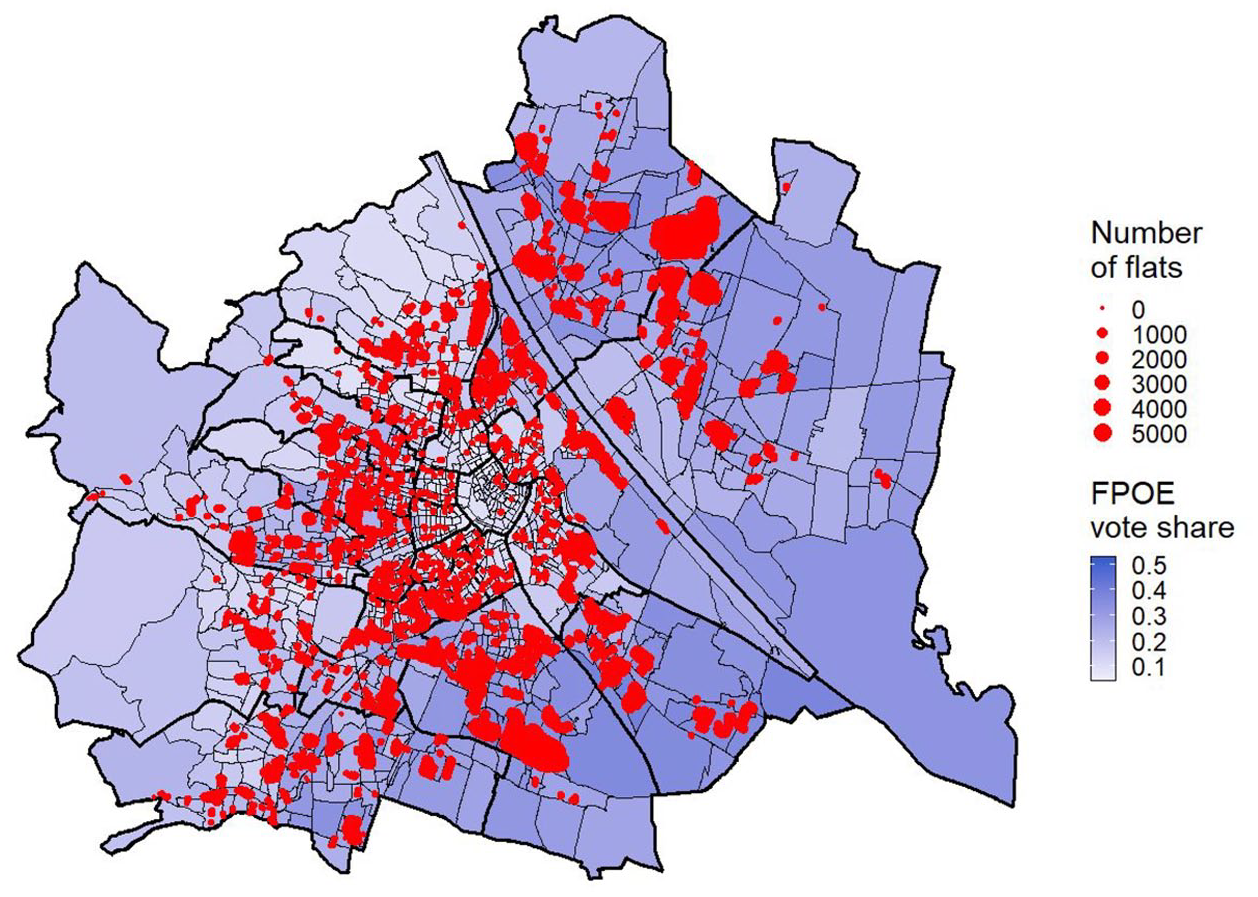
FPOE vote share in the 2017 national elections and location of municipal housing.
The provision of high-quality and affordable housing, physical and social infrastructure (outdoor pools, green spaces, and public transportation) is rooted in the prolonged experiment with municipal socialism – better known as “Red Vienna” (Kadi, 2015; Matznetter, 2002, 2019; Novy et al., 2001). Following on from those policies, approximately 220,000 or 26.3% of all housing units are owned by the municipality of Vienna. 3 Not surprisingly, as the provision of affordable and high quality public housing for the working and aspiring middle classes provided a key cornerstone of Social Democratic policy in Vienna in the post-war period, municipal housing tenants have made up one of the core voter bases of the Social-Democratic Party (Rosenberger and Permoser, 2012). However, this changed in the late 1980s/early 1990s.
Up to the late 1980s, population decline, a high share of poor quality housing stock in the regulated private rental housing sector, 4 expansion of high quality municipal housing stock, and high maximum income thresholds for access to the public housing sector 5 made the publicly rented sector attractive for Austrian citizens while foreign residents were excluded from the public housing sector all together. These trends resulted in a socially diverse but ethnically homogeneous municipal housing tenant population, which entailed that the shares of the formally less educated and unemployed were only marginally higher in municipal housing wards and cultural conflicts with or economic threat from foreign residents made impossible through the legal exclusion of foreign citizens from municipal housing. But since the early 1990s, social diversity declined while citizenship diversity in the public housing sector increased for the following reasons.
First, demand for cheap accommodation was driven up by rapid population growth. Vienna’s population increased from 1.53 million in 1982 to 1.90 million in 2019. Over this period the number of Austrian citizens fell slightly while the number of foreign citizens increased 6 from 116,255 or 7.6% of the population in 1982 to 572,834 or 30.1% of the population in 2019 (Statistik Austria, 2021). Second, a series of changes to the strict rental laws in the regulated privately rented housing sector in 1982, 1986 and 1994 opened up a rent gap that made private investment in this segment of the housing market suddenly attractive (Kadi, 2015; Kadi and Verlic, 2019; Matznetter, 2019). Because of those changes, rents in the private housing sector doubled between 1985 and 1993 (Novy et al., 2001: 136). Between 2001 and 2010 sales prices rose by 153% in the private housing sector 7 and rents in the (now less) regulated private sector rose by 67% (in comparison to 37% for all rental types). Third, the Great Recession deflated housing price bubbles in United States and United Kingdom metropolitan real estate markets but had the opposite effect on Vienna’s private housing market where investors continued to perceive rent gaps. Between 2008 and 2017, rents increased by 53.3% in the privately rented housing sector and by 20.5% in the public housing sector. The trends opened up a significant gap between privately and publicly rented accommodation costs. In 2016/2017 rental prices were 8€/square metre for municipal housing flats and 11.40€/square metre for flats in the private sector (Kadi and Verlic, 2019; Reinprecht, 2019; Tockner, 2017). Fourth, accession to the EU meant that the public housing market had to be opened to EU citizens in 1995 and to all foreign citizens with permanent residence cards in 2006.
In combination, those changes meant enhanced attractiveness of the public housing sector in comparison to the privately rented housing sector but also longer waiting lists, longer waiting times 8 and higher eviction rates in the public housing sector. The steep rise in accommodation cost and hence, decreasing accessibility of the privately rented sector for those on lower incomes, required Wiener Wohnen, the organization in charge of distributing available municipal flats and managing the municipal housing stock, to focus more intensely on those more vulnerable, those in insecure and precarious living and working conditions, less educated and poorer segments of society when flats become available. As a result, the relative economic situation and social status of those renting from the municipality relative to private renters and owners in a district worsened considerably. Social diversity in wards with high shares of municipal buildings has declined while citizenship diversity increased between 1991 and 2019 as the share of those without formal education, the unemployed, those threatened by absolute poverty, and third-country 9 foreign residents increased substantially (see Figure 2 below) (Simons and Tielkes, 2020). The rapid rise of foreign citizens in previously ethnically homogeneous social housing complexes allowed the FPOE to generate feelings of insecurity and fear (Marquart, 2013; Wodak and Forchtner, 2014) and exploit conflicts between old and new residents by narrating lines of conflict along, almost exclusively, ethnic lines (Reinprecht, 2012; Rosenberger and Permoser, 2012).
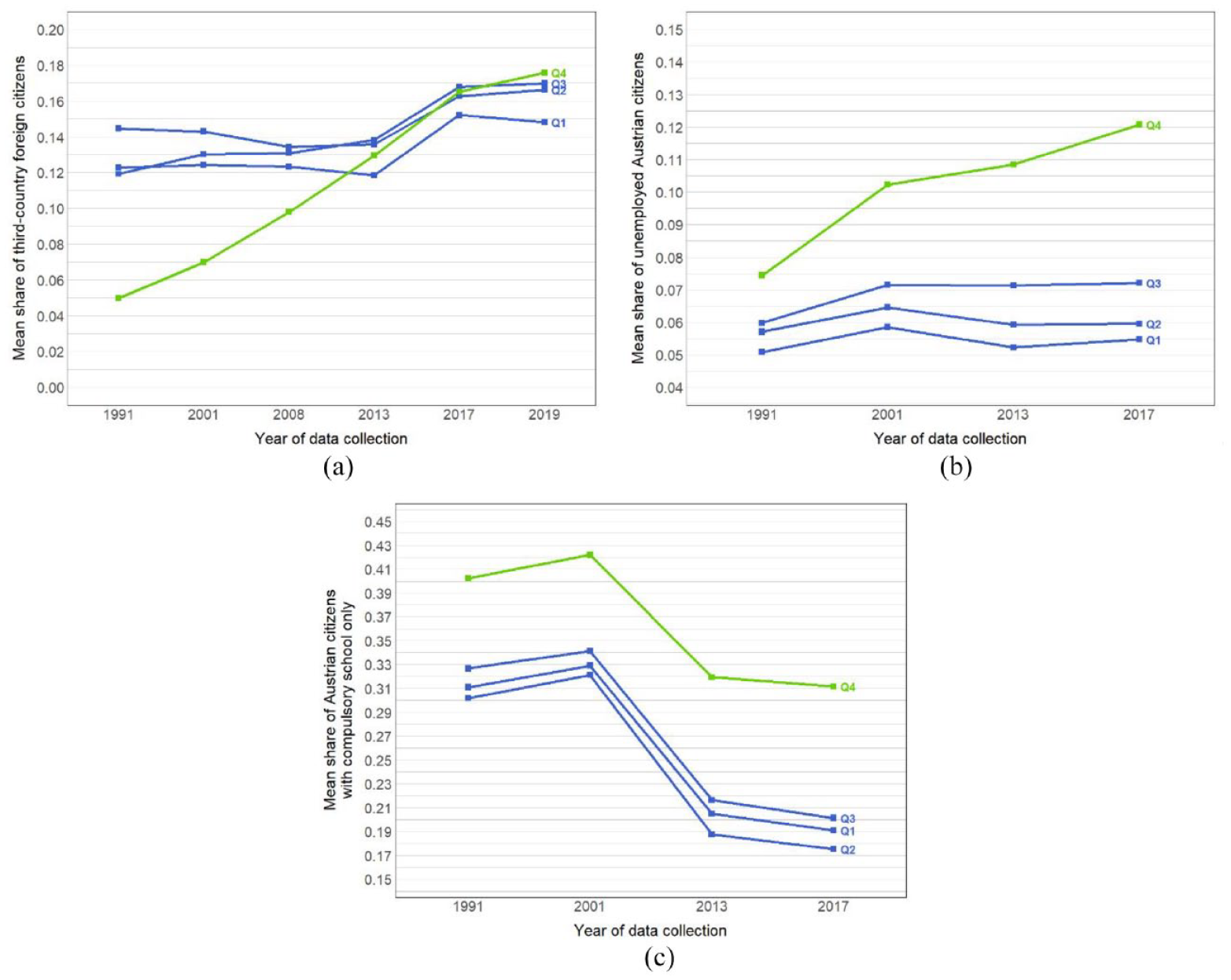
Share of non-European Union (EU) foreign citizens, rate of unemployment of Austrian citizens and share of Austrians with compulsory education only, 1991–2019: (a) share of non-EU citizens; (b) unemployment rates; and (c) compulsory education.
As a result of those changes and in accordance with the literature on the geography of discontent, FPOE vote shares in wards with high shares of municipal housing could be explained as follows: differences in FPOE vote shares could be the result of sorting of individuals with different characteristics into different wards. In this case and following the literature discussed above, those wards with a high share of old, unemployed, unskilled voters would be expected to depict higher FPOE vote shares. Because those groups of voters are now overrepresented in municipal housing units, this may explain entirely higher FPOE vote shares in wards with large shares of municipal housing units. If, in addition to those compositional effects, local contextual effects influence FPOE vote shares, then we would expect those wards with larger increases in foreign population shares as well as those with higher rates of population growth and growth in unemployment (as indicators of the economic deterioration of the neighbourhood) to exhibit higher FPOE vote shares. As argued above, growing cities exhibit different challenges than declining regions and hence, if pressure on local amenities exist, then local population growth, not decline (as argued in studies examining regional differences in populist vote shares) should increase local discontent; and higher FPOE vote shares in wards with high shares of municipal housing tenants coupled with fast increases of foreign residents could be an indication of a distributional conflict between native and foreign residents (Cavaille and Ferwerda, 2017; Rodrik, 2018).
We thus ask the following questions: Which factors identified by the literature on “the geography of discontent” are driving populist right voting in the fast-growing city of Vienna? Is the anecdotal evidence of higher FPOE vote shares in municipal housing units (Permoser and Reinprecht, 2012) substantiated by our research after controlling for compositional and contextual effects? Is the rapid increase in the share of non-EU citizens a driving force of populist right voting in Vienna? Based on the literature on the “competition for welfare state services”, is a large increase in the share of non-EU citizens in municipal housing wards responsible for higher populist right vote shares in those wards?
Method and data
In order to evaluate the impact of composition, context and competition for municipal housing, the following cross-sectional model was estimated as given by Equation (1):
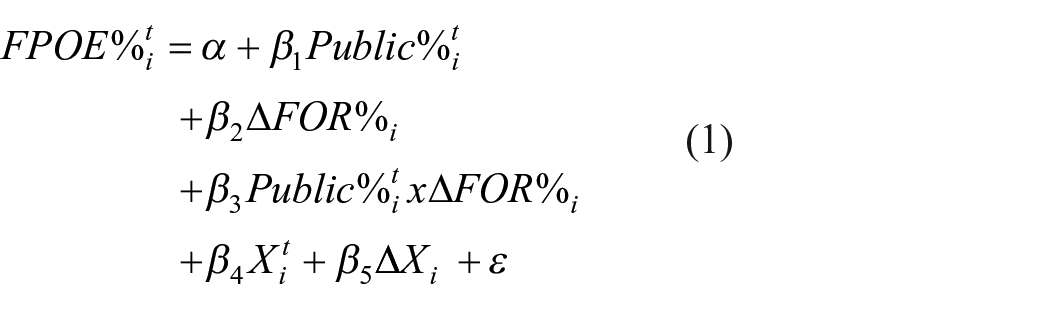
where FPOE% denotes the FPOE vote share (in per cent) in the year t = 2017 national elections in statistical ward i, Public% refers to the percentage of municipal housing units, ΔFOR% refers to the percentage change in non-EU foreign residents between 1991 and 2017, Public% x ΔFOR% refers to an interaction term between Public% and ΔFOR%, X is a vector of other variables that have been identified in the literature to increase the populist vote and, following the discussion above, include age, education, unemployment, the share of foreign citizens, ΔX is a vector capturing neighbourhood population and employment change, α is a constant term and ε is the error term with the usual assumed properties. We estimate different combinations of this model to measure the relative impact of those variables on the FPOE vote shares. We compare the parameter estimates of our contextual and compositional variables to those found in the literature discussed above to evaluate their relevance in an intra-urban, growing city context. Our main focus is on the variables Public% and ΔFOR%. We want to establish whether FPOE vote shares are significantly higher in wards with a large share of municipal housing residents, if rising shares of foreign citizens influence the populist right vote (independent of social/private tenant composition) and if there is an additional effect of rising shares of foreign citizens in municipal housing wards. We then examine if the effects persist after controlling for compositional and contextual effects. If Public% remains positive this would confirm qualitative case studies on the higher prevalence of populist right voting in municipal housing complexes. If ΔFOR% remains significant (but Public does not remain significantly positive), we would attribute this result to cultural and economic fears of Austrian voters in general, rather than municipal housing residents in particular. If the interaction effect is statistically significant and positive, we interpret the result as consistent with the “welfare state service competition thesis” discussed above (Cavaille and Ferwerda, 2017).
The data for the empirical analysis come from various sources. Information on the detailed electoral outcomes of the 2017 national elections at the electoral ward level, our independent variable, are available from the website of the City of Vienna. 10 Data for national, local, presidential and European elections are available from 1995 to 2019. Unfortunately, electoral ward boundaries change frequently and the implementation of those changes is unsystematic as the availability of voting locations or the number of eligible voters will change. Electoral ward boundary maps are only available from the local elections of 2005. Therefore, elections prior to 2005 cannot be matched to statistical wards. Because of those data limitations this paper focuses on the 2017 national elections when the populist right FPOE party won 21.35% of the vote. After 1999, this constitutes the highest vote share obtained by the FPOE in Vienna. Ideally, we would have liked to compare the results for the 2017 election with elections in the early 1990s in order to get a better understanding of the impact of the described socio-demographic and economic changes on electoral outcomes. Unfortunately, without historical boundary data for electoral wards we cannot examine long term differences in the spatial pattern of the FPOE vote shares. National elections are chosen to avoid idiosyncratic local electoral issues such as cycle path construction, new developments, park space reductions or tree planting that are often important issues for local elections. Although information at the block group level would have been preferable, statistical wards are the smallest geographical units for which socio-socioeconomic information is available. Moreover, as socio-economic and socio-demographic information was provided by the Division of Economy, Work and Statistics (MA23) of the Vienna City Government, ward data were only available for wards within the administrative boundaries of the City of Vienna. We define all individual variables in turn:
Public%: The percentage of residents in municipal housing flats in 2011, the last census year for which this variable is available. We would expect this variable to be positively related to the FPO vote share.
ΔFOR%: The percentage point change of the share of non-EU foreign citizens between 1991 and 2017. We chose non-EU foreign citizens, as this is the group that is targeted by the FPOE to stir anti-immigrant sentiments (Cavaille and Ferwerda, 2017; Marquart, 2013) and expect this variable to be positively related to the FPOE vote share.
FOR%: The percentage of non-EU foreign citizens in 2017. We include the levels of immigration because two hypotheses on their influence on populist right voting exist. The share of non-EU foreign residents may lead to an increased probability of conflict between Austrian and foreign citizens such that a higher share of foreign citizens should result in higher FPOE vote shares. However, the contact hypothesis (Allport, 1954) states that increased contact with foreign residents reduces prejudice and increases mutual understanding and respect which should translate into lower FPOE shares. It is thus useful to distinguish between the share of foreigners and the increase in foreigner shares in an area. In line with Essletzbichler et al. (2018) we would expect this variable to be negatively related to the FPOE vote share.
Unemp_AUT%: The unemployment rate of Austrian citizens in 2017 in per cent. The variable captures economic insecurity of eligible voters.
Unemp%: The ward level unemployment rate (for all residents in working age) in 2017 in per cent. Contrary to Unemp_AUT%, Unemp% is interpreted as a contextual variable, a proxy for the economic conditions of a ward. We would expect both of the variables to be related positively to the share of the FPOE vote.
Educ_AUT%: The percentage of Austrian citizens with compulsory education only. We expect this variable to be positively correlated with the FPOE vote share.
Educ%: The percentage of all residents with compulsory education only. We consider this variable as proxy of the social class/milieu of a ward.
Age%: The percentage of the ⩾ 60 years old population. Unfortunately, we do not have this variable separated for Austrian and non-EU citizens and hence, can only use the share of the older population for the ward population as a whole. According to the cultural cleavage theory, we would expect this variable to be related positively to the radical right vote share, but according to the election survey after the 2017 national elections, the share of the FPOE vote was higher among those who were 16–29 years old (30%) than among those who were ⩾ 60 years old (19%) (SORA/ISA, 2017) . We are thus uncertain about the sign of the parameter estimate.
ΔUnemp_ij%: Spatially weighted average rate of change in unemployment between 1991 and 2017 in per cent. We consider the variable as proxy for deteriorating economic conditions at the neighbourhood level. Extending the formal definition of the neighbourhood beyond individual wards assumes that voters are reacting also to economic conditions beyond their immediate wards of residence and that they are more likely to respond to conditions in close geographical proximity rather than to average conditions at the level of districts or the city as a whole. Using spatially weighted data (rather than individual ward information) also has the advantage that the variable does not correlate excessively with unemp_AUT%. We expect this variable to be positively related to FPOE vote shares. Neighbours are defined through queen contiguity (q), ten nearest neighbours (k10) and twenty nearest neighbours (k20) methods. The resulting spatial weights matrices are row standardized and include the main diagonal.
Unemp_ij%: Spatially weighted unemployment rate. Spatial weights are calculated as above. We expect this variable to be associated positively with the FPOE vote share.
ΔPop%: Spatially weighted rate of population changes in per cent, 1991–2017. We expect this variable to be related positively with FPOE vote shares as, everything else equal, population growth exerts pressure on local amenities and services (parks, doctors, schools, public transport, and housing) that could lead to frustration and hence, a higher propensity to vote for the FPOE. It is a measure of rising demand for local services that may or may not be met by an increase in supply. Unfortunately, we do not have information on levels and changes in the supply of local amenities. Spatial weights are calculated as above.
Because data on elections (our independent variable) are available at the electoral ward level and socio-economic information (our independent variables) is available at the statistical ward level, we had to merge geographically the two data sources by allocating vote shares of electoral wards to statistical wards based on the share of an electoral ward area located in a statistical ward area. The allocation of voting data to statistical wards was carried out with ArcGis. The result is a consistent dataset for 1290 statistical wards.
Empirical analysis
Figure 1 illustrates substantial spatial variation in the FPOE vote as well as the distribution of municipal housing across the city.
The FPOE vote ranges from 5.4% to 51.6% while the share of municipal housing residents ranges from 0% to 99.8% (see also Table 2 in the Appendix). A first glance at the map suggests a relationship between the share of public housing and the FPOE vote share. The unstandardized parameter estimates are reported in Table 1. Table 1 confirms the positive relationship between the share of municipal housing residents and FPOE vote shares (Model (1)). We explore whether this positive relationship persists after controlling for rising shares of non-EU citizens, compositional and contextual effects next. Given the demographic trends, the rise in housing costs and regulatory changes described above, we would expect a faster increase of the non-EU citizen shares in wards with large municipal housing shares. Also, as a result of rising housing costs we now would expect a higher share of the economically vulnerable, the unemployed and those with little formal education, to live in wards with large municipal housing stock compared to earlier years. Figure 2 shows that to be the case.
Ordinary least squares regression results (non-standardized coefficients) for determinants of FPOE vote shares (electoral ward results, 2017 national elections).
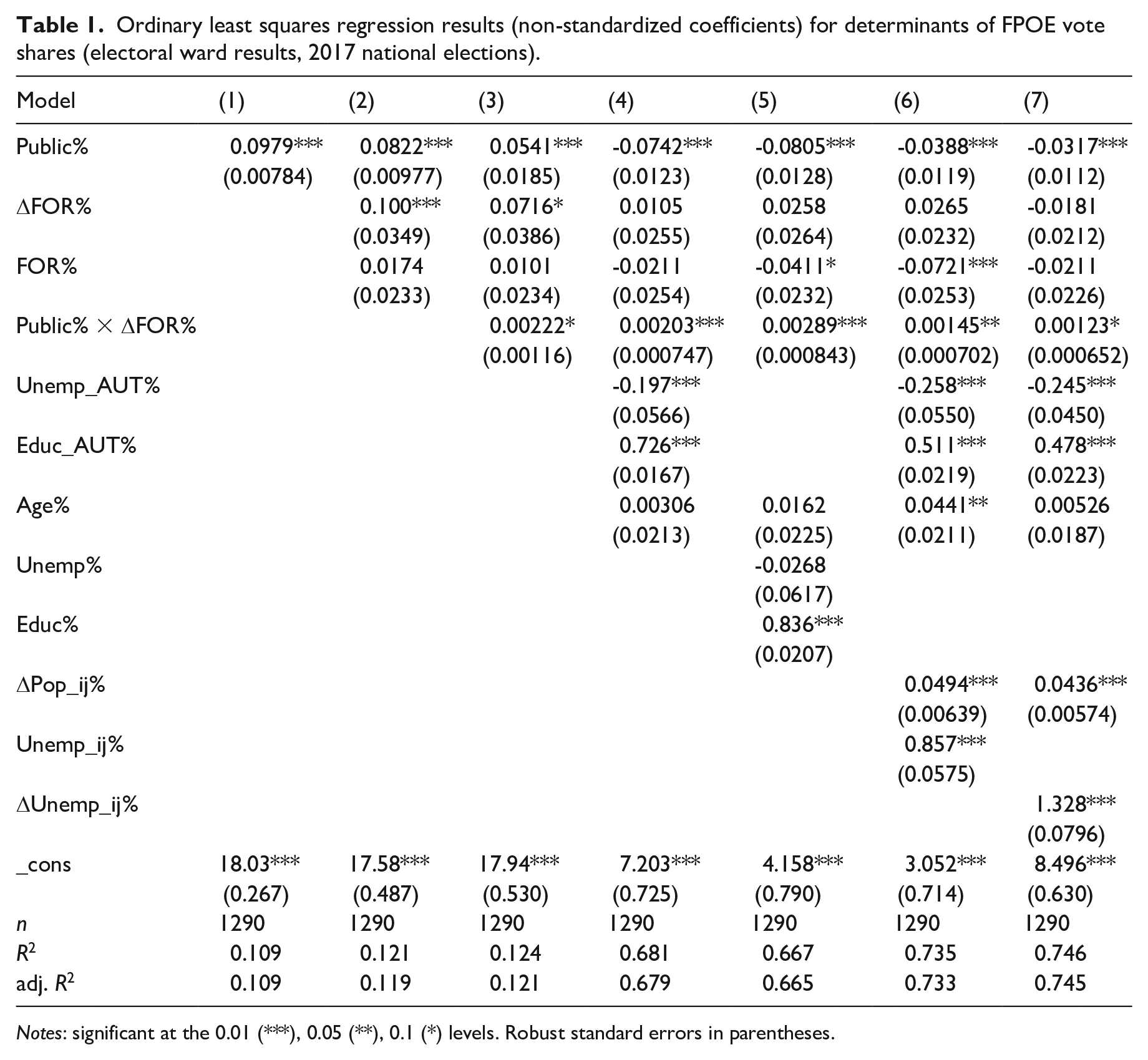
Notes: significant at the 0.01 (***), 0.05 (**), 0.1 (*) levels. Robust standard errors in parentheses.
Figure 2(a) depicts a general rise of non-EU citizens across the whole city of Vienna, but this increase is larger in wards with higher shares of municipal housing residents. Figure 2(b) and (c) depict the trends for unemployment rates and compulsory education shares of Austrians. While unemployment rates and compulsory education shares were already higher in 1991, unemployment rates among Austrian citizens increased substantially in municipal housing wards while the general decline of those with compulsory education only was substantially lower in wards with high municipal housing shares. These trends are consistent with arguments about the socio-economic residualization of the public housing segment and with survey-based information on changes of the social and ethnic composition of the municipal housing sector (Simons and Tielkes, 2020). They point to the need to control for compositional effects in order to establish whether higher FPOE shares in public housing wards are simply due to the fact that they house a larger share of economically vulnerable and culturally left behind segments of the population.
We augment Model (1) with the percentage of non-EU citizens (FOR%) and the percentage change of non-EU citizens (ΔFOR%) in Model (2) and include an interaction term between the percentage of municipal housing residents and the change in non-EU citizens (Public% x ΔFOR%) in Model (3). Models (1) to (3) appear to be consistent with our expectations that FPOE vote shares are higher in wards characterized by higher shares of public housing residents and a faster increase in non-EU citizens as well as the “welfare sector service competition” hypothesis that expected FPOE vote shares in wards with more municipal housing residents coupled with faster increases in non-EU citizens. However, as these models are likely to suffer from omitted variable bias we control for the social and economic composition of voters in (Model (4)), a ward’s socio-economic context (Model (5)) and voter composition and context in Models (6) and (7). Including unemployment, education and age in Model (4) illustrates that higher FPOE vote shares in wards with high percentages of municipal housing residents reflect the over-representation of unemployed and formally lower educated voters in these wards. Including these variables leads to an increase in the adjusted R-Square from 0.124 to 0.681.
Replacing the unemployment rates and education levels of Austrian voters with those for the population as whole produces comparable results suggesting that those variables are highly correlated (r Unemp, Unemp_AUT = 0.94 and r Educ, Educ_AUT=0.98). In order to enter voter-specific and neighbourhood effects together, the spatially weighted values of unemployment and population change are added in Model (6) and the rate of change in neighbourhood unemployment and population change in Model (7). Adding these variables improves the model fit and we thus focus our discussion on the parameter estimates of Model (7) and compare them with those of Models (4) to (6).
In those model versions, the percentage of municipal housing residents exhibits a negative and statistically significant parameter estimate. Everything else equal and in the case of zero change in non-EU residents, a shift from 1.5% (quartile 1) to 27% (quartile 3) of residents in municipal housing wards would result in a 0.82 percentage point decline in the expected FPOE vote share. Shifting from a ward with 0% to a ward with 100% of municipal housing residents would reduce the expected FPOE vote share by 3.2 percentage points. Shifting from wards with 1.5% in municipal housing residents and 0.5%-age point increase of non-EU citizens (quartile 1) to wards with 27% municipal housing residents and 10%-age point increase of non-EU citizens (quartile 3) is associated with a 0.65 percentage point decline in the expected vote share, that is, the expected decline of the FPOE vote share in wards with high shares of municipal housing residents is dampened by higher non-EU citizen share increases. However, as the interaction effect is significant only at the 0.1 level, the impact on mediating the relationship between the share of municipal housing residents and radical right voting is modest at best. The positive interaction effect also tends to disappear in models where we bin Public% and/or ΔFOR% (see OA2 and OA3 for these robustness checks in the Online Appendix). 11
With few exceptions, the parameter estimates for the share of non-EU citizens, the share of the older population and the rise in non-EU citizens are insignificant. Somewhat surprisingly the rate of unemployment among Austrian citizens is negatively related to the FPOE vote share, but this is likely the result of the high correlation with education (r = 0.64). 12 The most important variable linked to high FPOE voter shares is the low formal education of voters. Everything else equal, a shift from wards with 12.8% to 29.7% of voters with compulsory education only (from 25th to 75th percentile) is associated with an 8.1 percentage point increase in the expected FPOE vote share. Confirming other studies, education is the most important explanatory factor to explain geographical differences in radical right vote shares (Ford and Goodwin, 2017; Gordon, 2018; Hobolt, 2016; Lee et al., 2018).
After education, neighbourhood context exerts the strongest impact on the FPOE vote share. Both, the rate of unemployment in the neighbourhood (Model (6)) and the rate of change in unemployment (Model (7)) exhibit a positive and significant impact on FPOE vote shares. A neighbourhood with a one percentage point higher unemployment rate is expected to be associated with a 0.86 percentage point higher FPOE vote share, while a neighbourhood with a one percentage point higher rate of unemployment change is associated with an expected 1.32 percentage point higher FPOE vote share. 13 This may indicate that voters react more strongly to the economic situation in their neighbourhood rather than their personal economic circumstances (cf. Manow, 2018). The positive effect of population growth on the FPOE vote shares suggests that pressure on local services through local population growth (higher house prices, crowded parks and public transportation, fewer school places, etc.) may result in voter dissatisfaction that the FPOE can capitalize on. Population growth in the neighbourhood in general rather than the growth in non-EU citizens appears to drive the FPOE vote.
Conclusions
While recent work in economic geography has focused on high populist vote shares in “places left behind” (Rodriguez-Pose, 2018), this paper examined the spatial variation in populist right vote shares in Vienna, a fast-growing city in one of the most prosperous EU countries. Since the national elections of 1995, the vote share of the populist right party, FPOE, exceeded 20% in Vienna and 50% in individual statistical wards. The arguments linking globalization with regional decline and rising populist vote shares (Rodrik, 2018) appear, at first sight, inappropriate to explain intra-urban variation in populist right voting in a dynamic and rapidly growing city.
However, explanations on the link between economic and cultural changes, emerging cleavages and rising levels of insecurity among those with little formal education and the unemployed expected to increase the demand for populist messages, parties and leaders should hold across all geographical contexts including growing cities and regions even if the specific mechanisms generating grievances vary. Dynamic cities, such as Vienna, are characterized by rapid population growth exerting pressure on housing markets and social services. In the case of Vienna, the population increase was due entirely to an increase in the number of foreign citizens, a fact easily exploited by the FPOE (Marquart, 2013). The link between immigration and (perceived) resulting pressure on welfare services has been identified as a distinctive feature of populist right voting (Manow, 2018; Rodrik, 2018). We thus examined the relative importance of those factors for explaining the spatial variation in the FPOE vote.
Our analysis suggests that first, the share of Austrian citizens with compulsory education or no formal education is the most important factor to explain the spatial variation in the FPOE vote share. This suggests that intra-urban variation in populist voting is associated with sorting processes where those with relatively low education and consequently, low income and higher probability of unemployment, are forced to concentrate in neighbourhoods with lower housing costs including wards with large shares of municipal housing units. Second, neighbourhood economic conditions have a significant impact on the populist right vote share and appear more important than the economic conditions of individual voters (Manow, 2018). Neighbourhoods with relatively high levels and/or increases in unemployment are associated with higher populist right vote shares. Third, discontent in a rapidly growing city appears to originate from neighbourhood population growth, not decline. This suggests that pressure on neighbourhood amenities triggers discontent that can be exploited by radical right parties. Fourth, contrary to expectations (Cavaille and Ferwerda, 2017; Rodrik, 2018), we cannot find robust support for the argument that competition for municipal housing generates support for the FPOE. Once we control for the economic and social characteristics of residents as well as the economic conditions and population growth in the neighbourhood, the share of municipal housing residents is negatively associated with FPOE vote shares. The positive relationship between municipal housing and populist right voting emerges because of higher shares of economically and culturally vulnerable populations in those wards, in the case of Vienna, a result of rapid socio-economic and demographic change.
Given the exploratory nature of our analysis, these conclusions are tentative. In order to disentangle the impact of the changing socio-demographic and socio-economic composition of municipal housing wards from the impact of increasing ethnic competition for municipal housing units, we would require longer panels going back to the 1990s, a time when municipal housing was closed to foreign citizens, or access to block level or individual level data. Unfortunately, this information is not available.
Supplemental Material
sj-pdf-1-eur-10.1177_09697764211031622 – Supplemental material for “Red Vienna” and the rise of the populist right
Supplemental material, sj-pdf-1-eur-10.1177_09697764211031622 for “Red Vienna” and the rise of the populist right by Juergen Essletzbichler and Johannes Forcher in European Urban and Regional Studies
Footnotes
Appendix
Descriptive statistics.
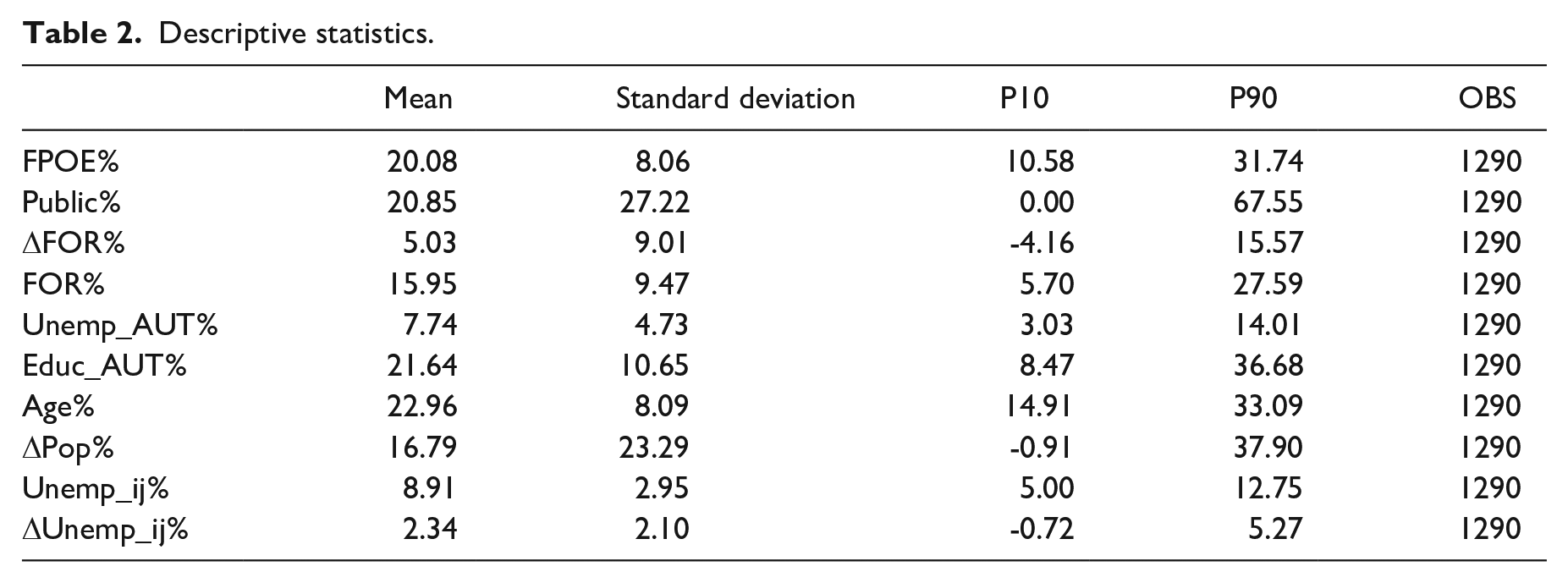
| Mean | Standard deviation | P10 | P90 | OBS | |
|---|---|---|---|---|---|
| FPOE% | 20.08 | 8.06 | 10.58 | 31.74 | 1290 |
| Public% | 20.85 | 27.22 | 0.00 | 67.55 | 1290 |
| ΔFOR% | 5.03 | 9.01 | -4.16 | 15.57 | 1290 |
| FOR% | 15.95 | 9.47 | 5.70 | 27.59 | 1290 |
| Unemp_AUT% | 7.74 | 4.73 | 3.03 | 14.01 | 1290 |
| Educ_AUT% | 21.64 | 10.65 | 8.47 | 36.68 | 1290 |
| Age% | 22.96 | 8.09 | 14.91 | 33.09 | 1290 |
| ΔPop% | 16.79 | 23.29 | -0.91 | 37.90 | 1290 |
| Unemp_ij% | 8.91 | 2.95 | 5.00 | 12.75 | 1290 |
| ΔUnemp_ij% | 2.34 | 2.10 | -0.72 | 5.27 | 1290 |
Acknowledgements
We thank the editor, Professor Andreotti and two anonymous referees for their constructive criticism and suggestions for improvements on an earlier draft of the paper. We thank Klemens Himpele and Wolfgang Remmel from the Division of Economy, Work and Statistics (MA23) of the Vienna City Government for providing the socio-demographic data for this research and Mathias Moser for discussions of the empirical results. The conclusions and any remaining errors are the sole responsibility of the authors.

Supplemental material
Supplemental material for this article is available online.
Notes
References
Supplementary Material
Please find the following supplemental material available below.
For Open Access articles published under a Creative Commons License, all supplemental material carries the same license as the article it is associated with.
For non-Open Access articles published, all supplemental material carries a non-exclusive license, and permission requests for re-use of supplemental material or any part of supplemental material shall be sent directly to the copyright owner as specified in the copyright notice associated with the article.
