




Abstract
Over 20 years ago a series of papers identified a strikingly dominant economic cluster – the UK’s Motorsport Valley (MSV) – which led to MSV becoming an international exemplar of concepts such as agglomeration, clusters and knowledge-driven systems of regional development. Utilising an evolutionary perspective on cluster development, this paper asks ‘whatever happened to MSV?’. Drawing on the framework of strategic cluster coupling, four cluster development episodes are conceptualised that each depict the dynamic evolution of the cluster’s multi-scalar institutional environment, strategic coupling trajectories and economic development outcomes. Reflecting the emerging synthesis between evolutionary economic geography and geographical political economy, the paper describes an extended case study of cluster development, an evolutionary process of strategic cluster coupling and, ultimately, an example of cluster resilience. Through a focus on strategic cluster coupling, the paper provides further understanding of cluster evolution and path development mechanisms at key moments of cluster reconfiguration – and an empirical update and continuation of the economic story and cluster lifecycle of MSV.
Introduction: Whatever happened to Motorsport Valley?
Either side of the 2000s, a number of colleagues jointly wrote a series of papers around the historical growth of the UK motorsport industry and its spatial clustering (Henry et al., 1996; Henry and Pinch, 2000; Pinch et al., 2003; Pinch and Henry, 1999). These papers used ‘Motorsport Valley’ (MSV) as an empirical exemplar that provided a window to a series of theoretical and conceptual debates in economic geography, urban and regional studies and related disciplines around new forms of geographical capitalism (Amin and Thrift, 1992; Castells and Hall, 1994; Cooke and Morgan, 1993; Morgan, 1997; Scott, 1988a, 1988b; Storper, 1995; Storper and Scott, 1989). Such concepts included, amongst others, agglomeration and clusters, SMEs (small- and medium-sized enterprises) and global production networks (GPN), institutionalist perspectives and knowledge communities and knowledge-driven systems of industrial organisation.
Subsequently, MSV was to become the staple diet for many undergraduate economic geographers across the world as it entered a series of major disciplinary text books as a striking and engaging example of clustering in the face of ‘flat world’ arguments for the impact of recent periods of globalisation (see, for example, Bryson et al., 1999; Coe et al., 2020; Daniels et al., 2012; Knox et al., 2014; MacKinnon and Cumbers, 2011). The term also became a registered trademark for the UK’s Motorsport Industry Association (MIA) and has been used as part of the sector’s understanding of its characteristics and dynamics and as a global marketing brand (for example, Henry et al., 2007; MIA, 2002; UKTI, 2015). It is somewhat surprising, then, to find that since this rise to recognition there has been little research or academic publication thereafter on MSV and its subsequent continued successful development. 1 In contrast, in the intervening years, the theoretical concepts and explanations used by economic geographers and others to understand clusters and regional and global economic development have advanced apace (for some notable examples, see Amin and Cohendet, 2004; Bathelt and Gluckler, 2011; Boschma and Martin, 2010; Coe and Yeung, 2015; Hassink et al., 2014; MacKinnon et al., 2019; Trippl et al., 2015).
This paper revisits the cluster case of MSV to initially ask ‘whatever happened to MSV?’. In short, the empirical answer is that over 20 years on, MSV has successfully ridden two global recessions and continues to flourish as it has evolved – in the new regional language it has demonstrated ‘economic resilience’ (Christopherson et al., 2010; Evenhuis and Dawley, 2017; Gong and Hassink, 2017; Webber et al., 2018). Seeking to understand this continued story of successful cluster development, the paper turns for insight to the growing synthesis between evolutionary economic geography (EEG) and geographical political economy and, in particular, the recent work on regional path development and the institutional conditions within which key evolutionary moments are made (see, for example, Martin and Sunley, 2015; Hassink et al., 2019; Mackinnon et al., 2019). Drawing on the emerging concept of ‘cluster strategic coupling’ (Hassink, 2020), the paper aims to contribute to a fuller understanding of cluster evolution and lifecycles and the explanation of path development mechanisms at key moments of cluster reconfiguration (Harris, 2020).
In what follows, firstly, the paper sets the scene with a short reminder of the MSV cluster and the theoretical and conceptual debates to which its previous empirical investigation has contributed. Secondly, the paper moves to current debates on understanding evolution in the economic landscape and the particular arguments for, firstly, the explanatory potential of the ‘fusion of economic evolution and development’ (Martin and Sunley, 2015) concerning the processes of industrial path development, and, secondly, to the insistent calls that such fusion should recognise the role of institutional processes and social agency in mediating development processes (Hassink et al., 2019; Mackinnon et al., 2019). Within such debates, recent work has turned especially to the analytical concept of ‘strategic coupling’ (Yeung and Coe, 2015) and agents of change (Grillitsch and Sotarauta, 2020) in seeking to understand key moments of regional path creation. Thirdly, the paper draws from these regional path development insights in order to understand evolution in a further key relational geographical unit in the economy, namely clusters; to do so we utilise the concept of ‘strategic cluster coupling’ (SCC; Hassink, 2020). Contributing to overcoming what Harris (2020) has termed as stagnation in cluster lifecycle and evolution debates, the conceptual framing of the institutional processes of strategic coupling and agents of change is applied to provide an empirical update on the economic life of MSV. The paper sets out how the cluster has passed through a series of four evolutionary episodes, each of which demonstrate a distinct multi-scalar SCC and concomitant development trajectory (see, also, Fornahl et al., 2015; Hassink et al., 2019; Trippl et al., 2015). Fourthly, and finally, in setting out the development story of MSV, the paper ends by asking what MSV’s recent empirical development implies for our understanding of cluster evolution, cluster strategic coupling, economic resilience and regional development.
Empirically and methodologically, as a long-term (or cross-time, see Pike et al., 2016) extended case study, the paper draws on more than a dozen pieces of funded economic and policy research and evaluation studies undertaken by the authors in the intervening years. Akin to what Peck and Theodore (2010) have described elsewhere, quoting Larner and Laurie (2010), as ‘thickening’ methodologies, these studies provide a combined exploration of how emergent geographies are socially constructed and spatially constituted (through time) (see also Gong and Hassink, 2017; Mossig and Schieber, 2016). These studies have comprised a substantial array of mixed methods – ‘grey’ literature reviews; primary business surveys; secondary data analysis of existing sector relevant surveys and UK Companies House data; market assessments and scenarios; membership of industry and policy steering and working groups at national and regional levels; industry conferences and roundtables (observation and participation); trade show presentations; academic field trips 2 ; ‘Chatham House rules’ 3 industry lunches; business case studies; and close to 150 semi-structured interviews with key informants, stakeholders, CEOs and other senior management positions in motorsport and related businesses. In most cases, published reports have been at least one of the outputs (for example see Henry et al., 2003a), although in a few instances reports have remained confidential to UK government Whitehall departments.
Motorsport Valley and economic geography: A recap
Henry et al. (1996) noted that in a period of identification of ‘New Industrial Spaces’ (Scott, 1988a, 1988b), including an explosion of the literature on industrial districts (Becattini, 1990; Bellandi, 1989; Camagni, 1991), few examples of industries demonstrating such characteristics were to be found in Britain. What they proposed was that the British motorsport industry (BMSI) – whose geographical concentration they subsequently dubbed ‘MSV’ – might be one such generally ignored example. They depicted a group of technologically advanced SMEs geared to small batch production, at very high rates of product turnover within a vertically disintegrated production system, financed by global investment. Henry et al. (1996) suggested that the BMSI displayed all the trademarks of the regional concentration of a new industrial space. Their initial mapping of the industry showed a ‘MSV’ of manufacturers and suppliers stretching through a 100-mile arc in England from Cambridge to Surrey, centred around Northamptonshire: a regionalised production system combining vertical disintegration and horizontal agglomeration. They provided evidence also as to how this cluster was the primary dominant node in a global production system including the largest global automotive manufacturers – drawing on the work of Amin and Thrift (1992) to demonstrate MSV as a ‘neo-Marshallian node’ (Henry and Pinch, 2001).
This body of work on MSV argued that whilst the traded dependencies, external economies and reduced transaction costs of close (and close knit), flexible and innovative SME supply chains were evident, a greater explanation for the region’s clearly demonstrable global competitive advantage was its centrality to, and definition of, the global industry’s ‘world of production’, and an understanding of MSV as a regional ferment of untraded interdependencies (Storper, 1995). In a series of papers, a world of shared technological trajectories (especially through regulation), common conventions and an industry in Britain – rather than of Britons – was empirically described alongside high rates of geographically concentrated labour mobility, specialist global labour pipelines, frequent spin-offs, organisational churn and firm family trees. Ultimately, the dynamic mechanisms of a ‘spatialised knowledge community’ were demonstrated that took the MSV region as the organisational infrastructure and geographical contour of the industry – rather than the specific unit of the firm (Henry and Pinch, 2000).
Notwithstanding the need to place this cluster within the critiques of new regionalism (Hudson, 1999; Lovering, 1999), gendered understandings of regional development models (Hanson and Pratt, 1995; Henry and Massey, 1995; James, 2017) and ecological challenges (Donald and Gray, 2019), the work on MSV became widely cited within economic geography – and subsequently within strategic management (Huff and Jenkins, 2002; Jenkins and Tallman, 2016; Pinch et al., 2003; Tallman et al., 2004). Yet, essentially, bar a restatement of the situation, a global mapping of the growing motorsport industry (Henry et al., 2007) and a few other international examples of ‘motorsport clusters’ (Mitchelson and Alderman, 2011), there has been little academically published work on the development story of MSV. Whilst it is by no means the aim of this paper to re-ignite some of the grander claims made for MSV as an ‘a priori norm’ for regional economic success – especially given the contemporary reality and need to contextualise the region as a specifically Western economic model within global economic diversity (Hassink, 2017) – we argue that the story of its continued economic vitality should usefully continue to be told and understood. To do so we turn to recent theoretical developments in the continuous desire to understand regional economic change and evolution.
Towards understanding the evolution of Motorsport Valley
In 2015, reflecting on the rise of EEG (Boschma and Frenken, 2006, 2018; Boschma and Martin, 2010), Martin and Sunley (2015) posited the emerging synthesis of EEG with existing regional development theory in what they described as two disciplinary fields taking their respective ‘evolutionary’ and ‘developmental’ ‘turns’. Recognising the potential, and potential dangers, of synthesising EEG more explicitly with theoretical traditions, such as geopolitical economy or institutional economic geography, they were keen to stress the value of an evolutionary perspective as a ‘way of thinking’ (about the unfolding and transformation of economic landscapes over time) and a contribution to epistemological pluralism in economic geography and regional development. Further setting out the implications of a developmental turn for EEG (see especially their Table 3), Martin and Sunley (2015) skilfully demonstrated how the ‘evolutionary’ might be considered with the ‘developmental’ to enrich respective analytical frameworks, jointly extend the ‘analytical toolkit’ and that ‘a fusion of economic evolution and development might release substantial analytical and empirical energy’ (p. 724) within regional development studies.
Following Martin and Sunley (2015), one area of released analytical energy has been in the development of explanation of key moments of regional path development. Gong and Hassink (2019), for example, have highlighted the existing concept of ‘co-evolution’ afresh (see Berg, 2015, also), whilst Hassink et al. (2019), and authors like Isaksen and Trippl (2016), have viewed such synthesis as allowing for broader conceptualisations of new regional industrial path development able to capture ever more fine-grained types of regional evolution (for example, forms of path creation as entirely new and radical, branching, based on related and unrelated variety, importation and renewal). Critically, much of this synthesis has been advanced by the incorporation of sociological and institutional perspectives to support the explanation of key regional path moments, including placing much greater weight on the importance of studying the evolution of non-economic systems and factors. Focus is placed on the role of institutional elements, conditions and dynamics in the process of path development that leads to both a multi-actor and multi-scalar approach and that directs attention to critical roles such as institutions, agency and leadership at different scales in the formation of new regional industrial paths (Sotarauta et al., 2021). Thus, the work by Mackinnon et al. (2019) on regional path creation in which they argue too that an especially underplayed aspect in understanding path development is that of the role of (often) non-firm and knowledgeable (institutional) actors, operating within multi-scalar institutional environments connected to the broader dynamics and relations of uneven development.
Strategic coupling, regional evolution and strategic cluster coupling
In bringing forward more institutional approaches as part of the synthesis of evolutionary and developmental approaches, these authors and others have turned to the potential of ‘strategic coupling’ as an existing concept in the analytical toolkit of regional development studies. Embedded in the GPN framework, strategic coupling refers to the matching processes that can take place between regional (territorial) assets and the (powerful) industrial dynamics of GPN (Coe et al., 2004; Yeung, 2009, 2015). Such coupling is strategic in nature, mediated through a range of actors (such as firms and non-firm institutions) exhibiting a variety of possible change agency roles, at different spatial scales and dynamics. Within GPN, strategic coupling necessitates continual interactions between the ‘twin motors of regional development’ (territorial assets and GPN) to ensure the making and articulation of complementary interactive effects (such as regional assets and advantages). What an institutionalist perspective emphasises is how these territorial assets are the pre-existing political and social institutions of previous periods and histories of development: …historically and geographically specific such that they cannot be easily reproduced and transformed within a relative short period of time. In other words, we expect a certain degree of mutual path dependency in this unique combination of regional institutions and assets that define, albeit not determine, regional development trajectories. (Yeung, 2015: 4)
Put another way, strategic coupling is an evolutionary process itself (coalitions temporarily fixed as moments in time–space), as one of numerous evolutionary processes in regional development (see Dawley, 2014; Dawley et al., 2019; Mackinnon, 2012).
When enacted, strategic coupling involves a range of processes with, for example, Yeung (2015) drawing on Mackinnon (2012) to discuss a number of modes of strategic coupling: functional, such as through international partnerships, is argued to be prevalent where a region’s position within the division of labour of its GPN is strongly articulated; organic, such as indigenous innovation, involves coupling through the co-evolution of regional assets and emerging or global lead firms from the same region; and structural entails strong host region dependency on GPN akin to early work on branch plant economies and the New(er) International Division of Labour (NIDL). Today, and invariably focused on (powerful) lead firms in GPN, there exist a growing number of empirical studies of strategic coupling across the continents of the globe (see Hassink, 2020; Mackinnon, 2012; Yeung, 2015), yet three recent developments have sought to extend further the potential and contribution of strategic coupling.
Firstly, as mentioned earlier, is the work by Mackinnon et al. (2019) on a pluralistic geographical political economy. Focused especially on regional path creation and its diversity, they argue for the explanatory ability of the relations of strategic coupling to move beyond GPN alone – couplings may, and do, entail broader sets of intra-regional and extra-regional assets and networks beyond GPN to fix institutional and evolutionary moments: …redefined to refer to the dynamic processes by which regional actors seek to harness and match regional and extra-regional assets to multiple mechanisms of path creation, principally, diversification, transplantation, and indigenous creation. This broadens the concept of strategic coupling beyond GPNs and transplantation, based on the understanding that path creation depends on the matching of regional assets to a number of mechanisms that connect different actors, including local small and medium enterprises (SMEs) and institutions that may not be active within GPNs, to broader processes of uneven economic development. (Mackinnon et al., 2019: 121)
Secondly, and building on this pluralistic geographical political economy, is the expanding focus on the ‘change agency’ of different types of actors within the process of regional change more broadly and strategic coupling in particular (Hassink et al., 2019; MacKinnon et al., 2019; Sotarauta et al., 2021). Neffke et al. (2018), for example, have argued for the need to identify the most significant actors and the roles that they play, utilising a resource-based view of the region to identify these actors, their roles and the ‘most efficient’ agents of change in regional transformation. Similarly, Grillitsch and Sotarauta (2020) have proposed a holistic conceptual framework for the analysis of agency in emerging regional path creation or new path development, identifying what they call the ‘trinity of change agency’ (p. 718). Based upon distinct theoretical roots they describe three types of agency: Innovative Entrepreneurship driven by the Schumpeterian drive for innovation; Institutional Entrepreneurship that recognises both the role of institutions in regional change processes and whether or not they act in a risk-taking and opportunity-driven manner; and Place Leadership, whereby certain individuals use their power and resources to orchestrate actions to benefit both their individual objectives and those of the region. In turn, Sotarauta et al. (2021) further developed the typology of the trinity of change agency, identifying a further four roles: Visionary, Support, Mentor and Critic (see Table 1, p. 5). A Visionary has the imagination to see, and even set, the big picture, a Support actor encourages and facilitates change through their actions, a Mentor advises, coaches and encourages the (key) actors and a Critic holds the main actors to account, forcing them to reflect on their assumptions and change criteria.
Motorsport Valley, adaptation and multi-scalar coupling – an evolutionary path to resilience?.
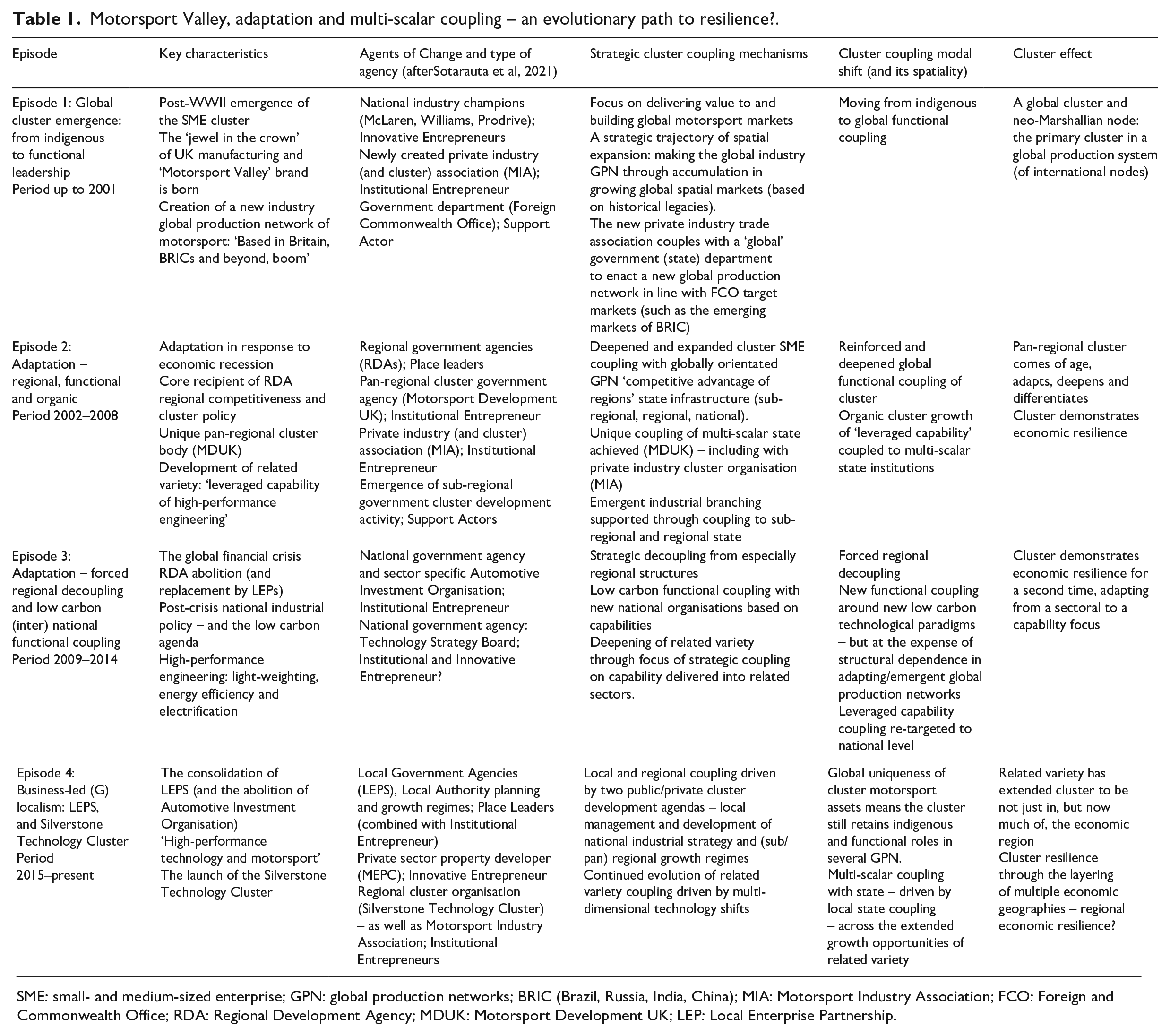
SME: small- and medium-sized enterprise; GPN: global production networks; BRIC (Brazil, Russia, India, China); MIA: Motorsport Industry Association; FCO: Foreign and Commonwealth Office; RDA: Regional Development Agency; MDUK: Motorsport Development UK; LEP: Local Enterprise Partnership.
A third development in the potential contribution of strategic coupling is Hassink’s (2020) argument that whilst the concept of strategic coupling has been developed to theorise regional development in times of globalisation, in fact, much of the literature citing the concept is about clusters’ (in regions) development rather than regional development per se (he cites Yang, 2009, as an example). He argues that in a number of instances it would be more appropriate to write about SCC than about strategic coupling and regional development – essentially arguing that the concept of strategic coupling is as equally applicable to the economic unit of analysis of the cluster as to the regional economy. Developing this point, and reinforcing the evolutionary basis of strategic coupling, he goes on to argue that just as the concept has been used to discuss coupling, decoupling and increasingly broader paths of creation and development in regional economies, so such evolutionary moments of development can equally be identified and analysed through strategic coupling within the economic unity of the cluster and, in his terms, ‘cluster repositioning’: The concept of strategic cluster coupling provides a research framework for analyzing the relationships between cluster change in global production networks, on the one hand, and cluster policies needed to support this repositioning process, on the other hand. (p. 2)
Yet here, once again, the argument of Mackinnon et al. (2019) can be applied – that the explanatory ability of cluster strategic coupling should move beyond the ‘straightjacket’ of GPN alone – utilising, where appropriate, evidence of couplings of broader sets of intra-regional and extra-regional assets, agents and networks beyond GPN in order to fix institutional and evolutionary moments in cluster evolution (and repositioning). Indeed, such a position is reflected in the recent work by Harris (2020), whose starting point is precisely to produce a synthesis between the cluster evolution literature and recent advances in evolutionary and institutional economic geographies, including through analysis of the changing institutional arrangements, actors and change agents in the evolution (‘lifecycles’) of clusters.
So what happened to Motorsport Valley? Of episodes, strategic cluster coupling and evolution
Utilising the conceptual basis and analytical framework of SCC set out above, the remainder of the paper recounts and updates the recent cluster development story of MSV. It does so through the identification of a series of multi-actor and multi-scalar SCCs – time–space episodes – that have fixed key institutional and evolutionary moments, trajectories and repositionings in MSV’s economic development. Table 1 summarises these four episodes in the recent economic history, evolutionary lifecycle and economic trajectory of MSV. In each episode, the cluster is seen to bring forward new modes and trajectories of SCC and agents of change. In combination, these episodes depict a long-run process of path dependent cluster evolution and an economic story of continued global leadership and growth for nigh on half a century. In the following we take each episode in turn.
Episode 1 (up to 2001): Global cluster emergence – from indigenous growth to functional leadership
The indigenous growth of the UK’s MSV was first recognised as the development of a world-leading economic cluster of motorsport and high-performance engineering businesses in the 1990s (Aston and Williams, 1996; Henry, 1999; Henry et al., 1996), with cluster guru Michael Porter describing MSV as a ‘jewel in the crown of British engineering’ 4 and MSV benchmarked as unequivocally the premier site in the world for motorsport production (Beck-Burridge and Walton, 1999; Foreign and Commonwealth Office (FCO), 2000; Henry, 1999). In an industry of already global reach, one notable statistic was that 75% of single seater racing cars used in more than 80 countries worldwide were British-built.
The growth of the UK motorsport industry can be traced to the post-WWII era (Henry et al., 1996). Drawing on the organisational form of the ‘network firm’, the UK garagisti 5 SMEs transformed the technological and organisational framework for building motorsport cars – using a vertically disintegrated production system of extensive sub-contracting and the combination of existing components, assembled in garages and yards – to beat the vertically integrated factory teams of mainland Europe, such as Alfa Romeo and Ferrari. Cooper was a ‘racing entrepreneur’, building a car production business based upon prize money and selling racing cars and, by 1959, Cooper had become the world’s largest manufacturer of pure-bred racing cars with a staff that barely ever exceeded 35 employees. In the 1950s, UK companies Lotus, Lola, Chevron and Mallock were founded and became the training ground for the UK challenge at the pinnacle of the sport, Grand Prix or Formula 1. Vanwall was the first British firm to win the Formula 1 World Championship for Constructors in 1958. In 1959 and 1960 it was the turn of Cooper. Since then, as at the end of 2020, 73% of constructors to have won the F1 World Constructors Championship have done so from a location within MSV. In fact, only Ferrari has won the Formula 1 World Championship from a production base fully outside of MSV.
If the post-WWII era witnessed the growth of the UK commercial racing car industry based upon a closely linked network of SMEs, it was the inward investment of automotive original equipment manufacturers (OEMs) and the rise of global sponsorship markets that drove MSV to the global scale (Henry et al., 2003b). To have a (winning) presence in world motorsport, large numbers of OEMs sought out the network of UK SMEs in MSV as the suppliers of and/or production centre for their racing cars. In 1995, for example, a supply chain analysis of the world’s four most prestigious international motorsport championships (F1, CART, F3000, WRC) noted that all the winning cars were UK-assembled and the UK share of components exceeded 60% in three cases and reached a third in the remaining case (Henry et al., 2003b). In 2000, the first ever National Survey of Motorsport Engineering and Services was carried out for the UK-based MIA, funded by national government. The survey discovered that total annual turnover for the sector in 2000 was put at £4.6 billion, total employment estimated at 38,500 persons across over 4300 firms engaged in some form of motorsport activity and exports of £2 billion accounted for 43% of annual turnover (Henry et al., 2001). Thus, at that time, we described MSV as sitting: …at both the heart and the apex of a global industry financed by the OEMs and commercial sponsorship. . . . The vertically disintegrated nature of the UK industry whereby British racing specialists deliver innovative, world class products to global companies with large investment capacity (technology spend and media spend) has remained as the industry has matured and professionalised. . .These combined investment streams have been critical in keeping Motorsport Valley at the forefront of the industry’s development as it has attracted the major proportion of world-wide international motorsport investment. It has been
Yet, what was significant also at the time was how MSV was being ‘imagined and sold’ abroad. The ‘jewel in the crown’ of UK manufacturing, motorsport (and MSV) became the ultimate vehicle for selling UK manufacturing abroad. This was not led by the Department of Trade and Industry but by the Foreign and Commonwealth Office (FCO), and epitomised in its glossy publication Britain’s Motorsport Industry: playing a leading role in the global motorsport business (FCO, 2000). With the FCO only promoting a select few UK industries worldwide, this programme included official receptions, trade visits and funded market research studies aligned with the globalising world of motorsport events – especially across the emerging economies of Pacific Asia, Middle East, BRIC (Brazil, Russia, India, China) and Eastern Europe. It coupled the sector’s avowedly entrepreneurial, anti-regulation (and anti-state) industry champions – or in the language of change agency, innovative entrepreneurs – with a world of economic, trade and cultural policy. In 1994, the private MIA was born. Soon after, and as this new actor rapidly enacted a process of institutional entrepreneurship, so too was the indigenous cluster of MSV ‘born’ – or rather institutionalised – branded and made a global cluster as the MIA strategically coupled with government foreign/trade policy to develop a cluster-based global production network through a strategy based on global growth in emergent (spatial) markets. Over the period 1990–2000, the top 50 UK motorsport engineering firms experienced an (unadjusted) growth in average turnover of some 523% and growth in employment of some 227% (Henry et al., 2001).
Episode 2 (2002–2008): Adaptation – regional, functional and organic
If the 1990s were a period of boom for the UK motorsport industry, then the 2000s are seen as an era when MSV both moved to maturity and saw its competitive advantage challenged on a number of fronts by emergent, or growing, global competitors – and the 2000–2001 ‘dot-com bubble’ recession in the USA and Europe.
By 2002, many of the sector’s leading companies had experienced job losses representing around 5% of total employment (although job loss was not restricted to the UK industry alone), international UK circuits such as Silverstone and Rockingham were experiencing redundancies and high-profile motorsport engineering companies such as TWR and Reynard had entered into receivership. Furthermore, analysis of the supply chains of winning cars in the leading four global motorsport series (F1, CART, F3000, WRC) showed a worrying trend. By 2002, none of the winning cars were now UK-built and the overall UK average percentage share of the declared supply chain stood at 33%, down from 39% in 2000 and 62% in 1995 (Henry et al., 2003b). Notably, these declining shares were driven by the renewed competitiveness of the traditional competitor industries of Italy, France and Germany rather than those new ‘developing economy’ entrants who had purchased a global motorsport event and been the strategic focus of UK trade policy. Given such decline, there were two major developmental responses: a renewed drive for ‘cluster (regional) competitiveness’ and a ‘leveraging capability’ approach at a period in time when economic geographers were developing new developmental concepts around ‘related variety’ (Frenken et al., 2007). These responses were evident in and reflected by a new round of strategic institutional coupling by the cluster.
In England, this was the era when the Regional Development Agencies (RDAs) achieved their greatest prominence, budgets and powers (Bellini et al., 2012). Intrinsically modelled around a regional development model based upon ‘the competitiveness of regions’ (Bristow, 2010; Martin, 2005; Turok, 2004), this was the zenith of cluster policy in the UK, including the first ever national mapping of clusters (Department of Trade and Industry, 2001). The ‘jewel in the crown’ MSV cluster spanned four RDAs (EEDA in the East; EMDA in East Midlands; SEEDA in the South East; WMDA in West Midlands) and became a focus of regional development activity for all four. Yet, driven by its earlier framing, MSV was also viewed as a ‘national cluster’ – and one losing international market share – and that, ultimately, saw a unique institutional response in the governance of economic development by UK government.
In 2003, the national department for Business, Enterprise and Regulatory Reform (BERR) convened the year-long Motorsport Competitiveness Panel, co-chaired by the Minister of State for Trade and Industry and a major historical sporting figure and industrialist in the sector, Sir Jackie Stewart. Through a series of intervention recommendations it led to the creation of Motorsport Development UK (MDUK) in 2005 (GHK, 2009). MDUK was set up as a pan-regional cluster development unit funded by four RDAs and BERR. Similarly, the period saw the first ever Motorsport Cluster Development Strategy published by the MIA that sought, through industry match funding with government (MDUK), several million pounds to sustain and further develop the sector’s global competitiveness in response to a changing global climate for the UK motorsport industry. Major activities included research and development (R&D), skills and education, business development, inward investment, trade and exports in to expanding global markets, as well as interventions aimed at the sport of motorsport itself. Whilst MDUK’s life was troubled, this example of institutional entrepreneurship was unique in being administered by one RDA (EMDA), which drew up unique governance agreements with the other RDAs such that it could sign off their expenditure for MDUK activities. Put another way, these regional organisations accepted the principle of their expenditure outside their regional boundaries (requiring altered Terms of Reference), signed off by another organisation, but because it occurred in a ‘pan-regional cluster’ would see benefits accrue to their own region given the agglomeration and spillover arguments put forward in cluster development models. Given the RDAs’ broader development – and regional place leader – model of globally competitive exporting regions, MSV became part of a multi-scalar strategic coupling between region, pan-region and nation. This was led by a new and unique governance form of multi-scalar strategic coupling between national (BERR) and regional (RDA) industrial policy institutions and a private industry association that had achieved a key role in national industrial policy.
Moreover, to this was added a second response of adaptation and strategic coupling. In setting out the programme of activity for MDUK, the Motorsport Competitiveness Panel identified three intertwined development paths for the sector – business development within motorsport manufacturing; support to the sport of motorsport, including global hosting of racing events; and growing recognition of the performance engineering capabilities of motorsport and the potential for application of such capabilities to enhance technological developments in UK manufacturing (what was termed ‘leveraged capability’). This latter pathway reflected both recognition of the technological sophistication and project management capabilities of UK motorsport in ‘finding engineering solutions’ and an industry desire for greater diversification from the often volatile markets of global motorsport. 6 Placed at the centre of a ‘UK high-performance engineering star’ (Figure 1), arguably what was written into strategy was the now familiar concept of ‘related variety’ – or in the language of the strategy, ‘leveraging capability’. Subsequently, sector business development activities pioneered by the continued entrepreneurship of the MIA and funded by the state included ‘Motorsport. . . to Marine’, ‘Motorsport. . .to Aerospace’ and ‘Motorsport. . .to Defence’ as well as the launch of the Energy Efficient Motorsport (EEMS) project, aimed at new technological developments in low carbon transport (and argued by many to be the early precursor of the new global racing championship of Formula E).
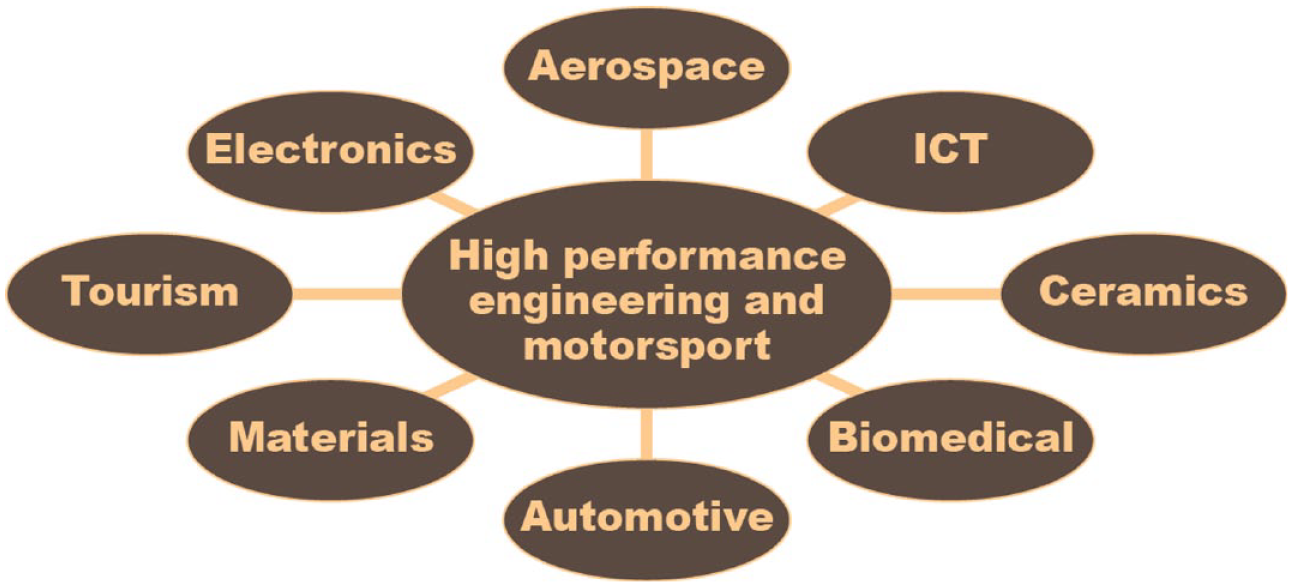
Related variety and leveraged capability: The UK high-performance engineering star.
Furthermore, it was such differentiation ‘from motorsport towards high-performance engineering’ that gave room both for each English RDA in the pan-regional cluster to subtly inflect their particular specialisation within MSV and for a further tier of sub-regional state actors to develop – and support – sub-regional motorsport development strategies based around the specific assets and capabilities of their local economies. Thus, for example, Northamptonshire (within EMDA) branded itself as at the ‘heart of Motorsport Valley’ – reflecting its dominance of motorsport engine builders, widest breadth of motorsport circuits in the UK and racing history (Henry et al., 2003a; MRA/Matters of Fact, 2006), while the Coventry, Solihull and Warwickshire (CSW) partnership, within WMDA, defined itself as ‘The Gateway to Motorsport Valley’, including its particular position as a hub of automotive and performance engineering given its historical automotive and automotive design industries (Henry and Angus, 2005). The multi-scalar strategic coupling was, then, deepened even further both sectorally and geographically. 7 By 2005, MSV had ‘bounced back’; the size of the UK industry now stood at £6 billion or 0.5% gross domestic product (GDP; a greater share of GDP than in any other national economy), which accounted for a 50% share of the key global companies (‘constructors’) and continued to dominate global supply chains (Henry et al., 2007).
Episode 3 (2009–2014): Adaptation – forced regional decoupling and low carbon (inter) national functional coupling
In 2008–2009, the cluster faced its second shock in a decade – the global financial crisis and its repercussions. Global corporations across the world, including OEMs, retrenched, and one of the major investment drivers of motorsport – global sponsorship – dried up. Whilst the abolition of the RDAs in the previous year was commented upon in ironic fashion in England, given the need for regionally engaged economic development institutions to respond to deep recession, for MSV it had substantially lost its strategic coupling lynchpins, and the national machinery of government was in, at best, a state of flux and, at worst, a state of shock.
Yet, as industrial policy was re-imagined – at the level of the nation state, and towards trading the nation out of debt through sectoral ‘rebalancing’, ‘the march of the makers’ and targeted sectors (Berry, 2016) – so MSV built on its previous platform of high-technology world class performance engineering to reposition itself once more and drive a new episode of strategic coupling. In 1996, Henry et al. (1996) identified how a shift in technological paradigm in engineering had created a ‘locational window of opportunity’ (Scott and Storper, 1987) that had seen MSV wrench global and locational leadership from Italian motorsport post-WWII. In a similar manner, in the face of the disruptive challenge of ‘low carbon technologies’, MSV was reimagined as part of the global challenge transition to a low carbon economy and, specifically, as intrinsic to supporting the low carbon transition of the UK’s automotive and transport sectors (including the engineering methodologies of light-weighting, energy efficiency and electrification).
Firstly, UK Trade and Investment (UKTI) launched several substantially funded sector-based investment organisations targeted at inward investment, R&D investment and supply chain development, including exporting. This included the Automotive Investment Organisation (AIO) and its three R&D priorities of ‘advanced propulsion (hybrid and electric)’, ‘lightweighting’ and ‘intelligent mobility’. Reflecting the previous episode’s leveraging capability success of ‘motorsport to automotive’ and the MIA’s drive to re-engage motorsport with mainstream automotive R&D (as well as just marketing spend), at its launch the AIO placed motorsport as central to each of its three priorities (Figure 2), making itself an institutional entrepreneur for the cluster. Fifteen years on from the FCO document extolling the virtues of UK motorsport, AIO launched its own glossy brochure, Ahead of the curve: How UK motorsport technology and innovation can benefit your company, which directly positioned UK motorsport R&D capabilities as a competitive advantage within the global TRL (Technology Readiness Level) system of automotive and mobility R&D. 8
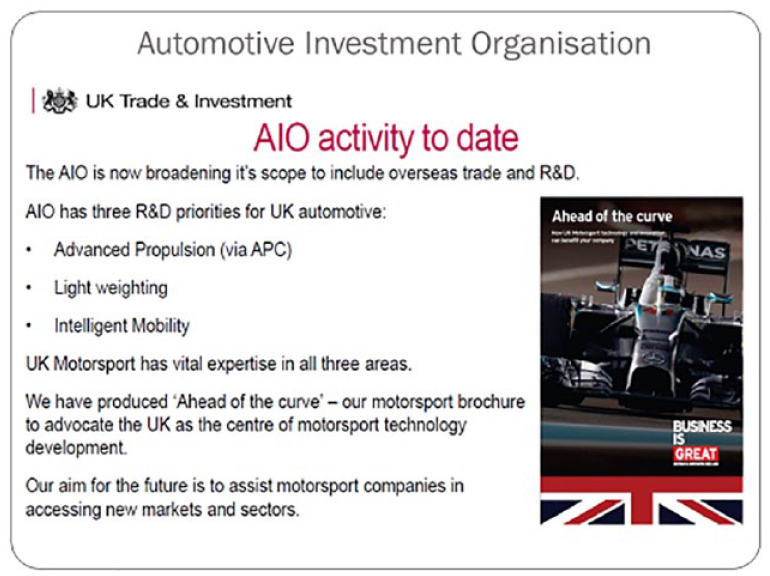
Low carbon, automotive strategic coupling and Motorsport Valley. AIO: Automotive Investment Organisation; APC: Advanced Propulsion Centre; R&D: research and development.
A second institutional and innovation-driven response, and replacing at least some of the regional investment and support of the now defunct RDAs and MDUK, saw the 2013 Motorsport Valley Launchpad – a ‘national’ R&D intervention led by the national government quango Technology Strategy Board. 9 Critically, and picking up even more so on the leveraged capability of the performance engineering star, this national institution articulated motorsport and its performance engineering at the centre of ‘technology-driven related variety’ ranging from new materials such as carbon fibre, composites and nanotechnology through new forms of composites, high temperature, fabrication and digital manufacturing to low carbon, energy efficient transport, including charging technologies, distributed power systems, (kinetic) energy recovery systems and non-combustion engine powertrains. This initiative reflected how ‘low carbon motorsport’ became deeply intertwined in a broader ‘leveraged’ cluster offer of prototyping and testing capabilities to accelerate the development of low carbon, energy efficient technologies for the global automotive sector and beyond. Thus developments in MSV at the time included the following: spin-off firm Flybrid, subsequently acquired by Torotrak, and whose F1 Kinetic Energy Recovery Systems technology was sold to Volvo and put in vehicles such as London buses, trams and JCB diggers; the 2014 global launch of Formula E all electric racing, with its global base at Donington Park in MSV 10 ; a Williams Hybrid Power engine winning the Le Mans 24 Hour Race for Audi; new partnerships in aero/space, defence and special vehicles; energy (Ecofisk); health and well-being (GSK); and, in 2012, 43% of surveyed MIA members reporting selling into ‘other’ sectors, such as energy, electrical and medical, and over half stating that ‘energy-efficient, low-carbon technologies will be at the heart of future growth’ (Henry et al., 2013).
Remarkably, a ‘dipstick test’ of the largest 10 non-F1 MSV motorsport companies showed that by 2012 they had already bounced back from the global financial crisis with their highest combined turnover ever, and significantly higher employment than in 2009 (Henry et al., 2013). Moreover, by 2014, in its core markets, and in the face of the global financial crisis and disruptive technological transition, MSV had both retained its historical market dominance and captured significant shares of new technology markets and investment. A supply chain mapping identified a continued global Formula 1 UK share of between 70% and 75% of supply chain value and, in addition, a 40–60% global share of supply chain value of the new Formula E based on electric power and a 40% share of the transitioning Endurance Sports Car market (Jenkins et al., 2014). Thus, a global mapping of all three supply chains showed that whilst Europe, Japan and to a lesser extent the East Coast of the USA were strongly represented in these three supply chains, a total of 72 of 151 (48%) firms in these growing high-value global supply chains resided in the UK alone and MSV in particular (see Figure 3).
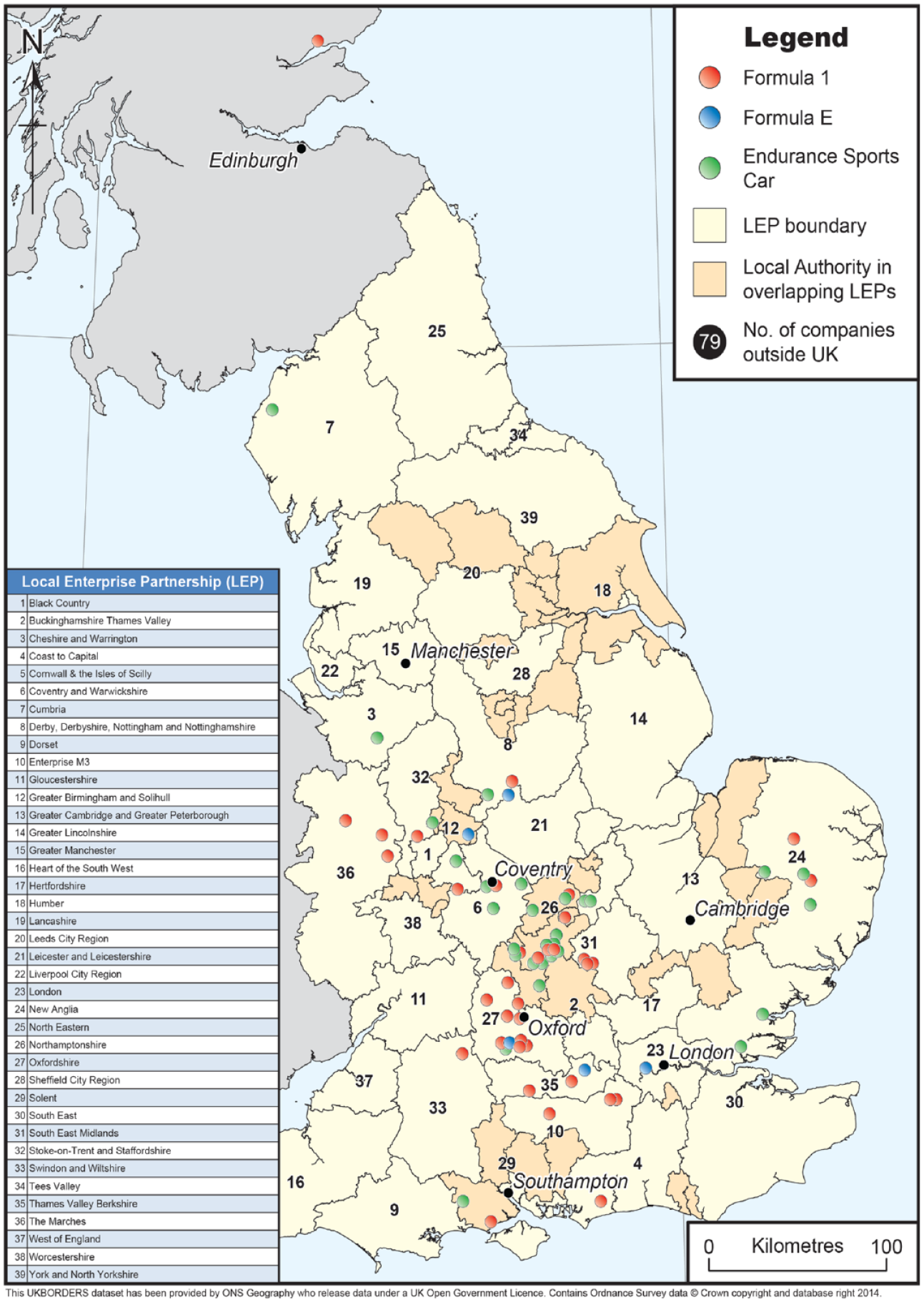
Motorsport Valley, the LEPs and high-value motorsport supply chains.
Forced regional decoupling from the RDAs had seen a strategic cluster recoupling to a new national agenda (and organisations) that turned the locational threat of a disruptive low carbon ‘window of opportunity’ into renewed cluster growth. In essence, through a further adaptation of the mode of indigenous coupling, the cluster articulated an extension of its functional coupling – but, in parallel, placed it more directly in a structurally dependent position as the R&D lab for the global automotive/mobility industry. By 2014, 50 years after MSV had emerged, the cluster was as large by economic value as it had ever been, employed more people than ever before and exported to more countries than ever before.
Episode 4 (2015–present): ‘Business-led (g)localism’ – local enterprise partnerships and the Silverstone Technology Cluster
To this now multi-layered cluster may be added a further, most recent, period of strategic coupling, reflective of the continuous evolution of the cluster as it has sought to maintain its global competitive advantage. In 2011, with the RDAs gone, the governance of English economic development saw its latest institutional innovation, Local Enterprise Partnerships (LEPs). Business-led, still configured around enabling the ‘competitive regions’ model of trade, investment and exports, and often staffed by ex-RDA and local sub-regional partnership employees, on finding their feet the local LEPs have moved to continue their support to and earlier sub-regional recognition of MSV. Centred on Silverstone Circuit in MSV (‘the home of F1’) and comprising no less than six contiguous LEPs (see Figure 3, numbers 2, 6, 21, 26, 27, 31) and two District Councils, the High Performance Technology and Motorsport Group was born. 11 Reflecting the traditional core geographical footprint of MSV its title was, however, noticeable, both drawing on the motorsport and performance engineering ‘heritage’ and combining the sector with its broader leveraged capability incarnation (‘high technology’). 12
In 2016, this Group was instrumental with MEPC Ltd, the new owners of all the land around Silverstone Circuit, in commissioning a consultancy report, ‘The Evolution of the High Performance Technology and Motorsport Cluster’ (Green et al., 2016). In a report that encapsulated and summarised the rounds of development experienced by ‘the MSV cluster’ (Figure 4), the entrepreneurial actions of this Group, MEPC Ltd and the consultancy report have combined to ‘fix’ a new strategic and powerful coupling for MSV, including within another overlapping geographical economic footprint.
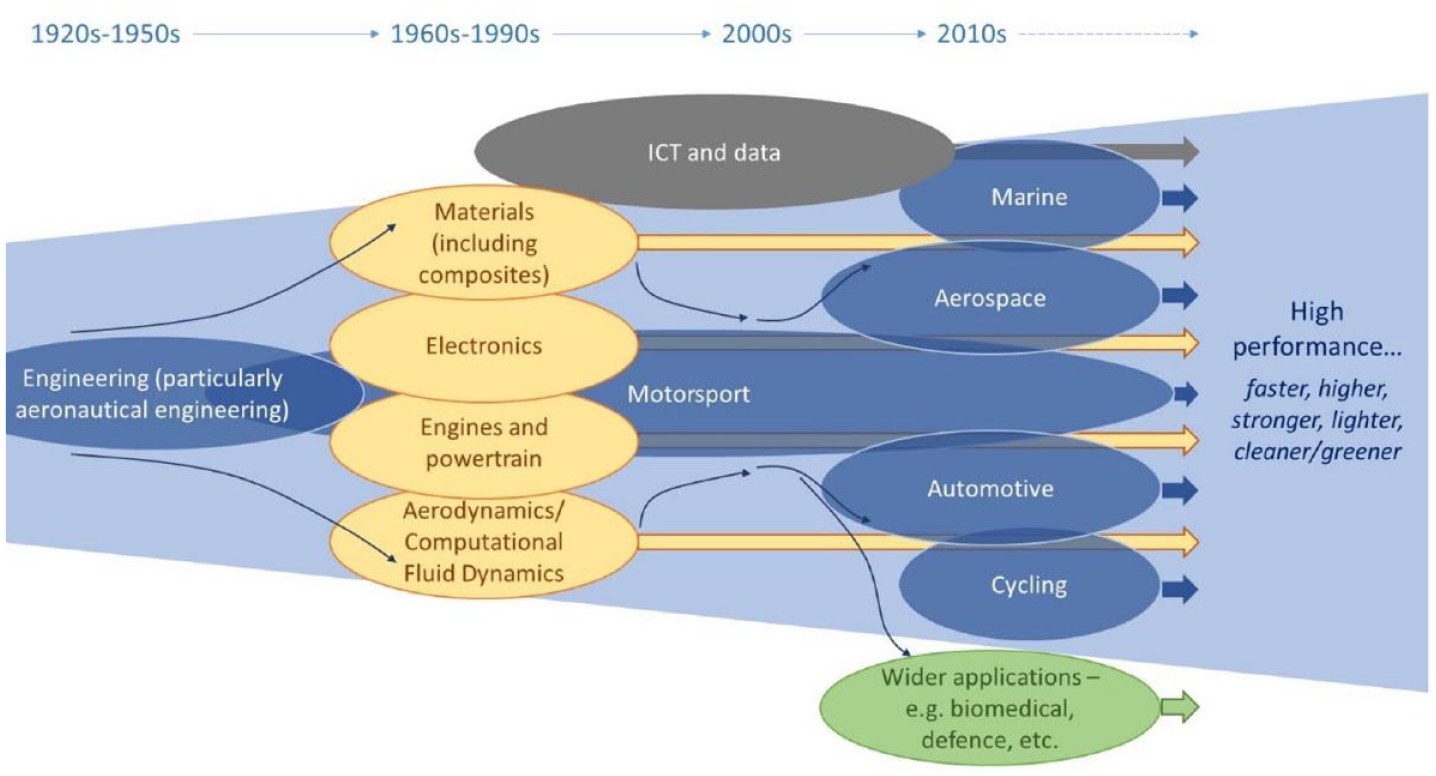
‘The Broad Evolution of the HPTM [high-performance technology and motorsport] in indicative sectoral terms’.
Firstly, this coupling remains geographically centred on Silverstone Circuit and its brand of motorsport, but through a now private sector driven institutional fix. In comparison to the historical and publicly funded cluster organisation MDUK, and alongside the historical MIA, a new private business membership organisation has been launched and rapidly grown. The Silverstone Technology Cluster aim is ‘to support the growth of the high-tech cluster and attract investment to the region’. 13 Working alongside MEPC Ltd, the organisation explicitly references its origin and evidence base as the launch of the commissioned report.
Secondly, as ‘motorsport’ has become ‘high-performance technology and motorsport’ (HPTM), which has become the ‘Silverstone Technology Cluster’, this has reflected the broader sectoral branding desired by an industrial property developer and also the broader development objectives (and Strategic Economic Plans) of the original LEP group and a further spatially constituted strategic coupling for the MSV cluster. This group, and the proposed cluster geography, covers a set of local economies and ‘larger urban areas’ such as Milton Keynes, Northampton and Banbury, which have experienced significant economic growth independent of the cluster including, for example, in the emerging industrial paradigms of low carbon and big data. The Green et al. (2016) study detailed how these seemingly independent industrial dynamics and labour markets are adding yet a further layer of fusion, dynamism and synergy to ‘the cluster’: The HPTM cluster is evolving. It is ‘mature’ in relation to motorsport but ‘developing’ in relation to mainstream high performance technology. The latter has substantial growth potential in the context of a fast-emerging paradigm. This is being driven by regulatory changes in the ambit of carbon emissions and big data, and is focused around cleaner/greener, low carbon and energy efficient products and solutions with applications across automotive, aerospace, marine, defence, medical devices, etc. . .An adaptive and knowledge-rich cluster with the opportunities, challenges and momentum of a fast growing region ought to be a cocktail for future success. (Green et al., 2016: 70)
Encapsulating the latest incarnation of English economic development institutions – business-led, local, place-based, yet still beholden to national strategy – MSV has added a further strategic coupling to its portfolio, and its leveraged capabilities have become entwined and valued within local and regional imaginaries of the nationally identified growth region of the South East Midlands. 14
Evolution, adaptation through strategic institutional coupling and cluster resilience
Today, 60 years after its emergence, the MSV cluster continues to flourish and hold global economic primacy in its core activity of motorsport production and much further beyond through its ‘leveraged capabilities’. Episodic in its evolution, avoiding lock-in and following a developmental path of motorsport-related variety, MSV has ridden two global recessions, continued to be a global technological leader (in ‘old and new’ technologies) and demonstrated substantial economic resilience – to economic shocks and (structural) technological change. It remains a cluster comprising a dense and critical mass of numerous interdependent local and globally networked specialists in high-value, technologically led testing and development, small batch production, low volume manufacturing and aspects of servitisation (such as around agile production systems and big data). Through a narrative of the development of a set of (inter- and extra-cluster) spatially constituted, multi-scalar strategic institutional couplings and associated agents of change, this paper has described how the cluster has substantially adapted, evolved and repositioned in order to maintain its global position and retain, even build, its economic resilience.
Yet, to understand and view the cluster solely ‘as aggregate’ is to underplay its dynamics and the continued basis of its economic resilience. The spatially constituted, multi-scalar strategic couplings outlined in this paper are signifiers also of the layering of multiple, overlapping and co-present time–spaces of inter-related production networks whose shared functional economic footprints are, today, what comprise MSV 15 and its resilience. Today, the MSV cluster can be understood as, at least, the following.
UK Motorsport Valley: a production network rooted in its traditional heartland, the route of global investment and inexorably following the global expansion of (forms of) motorsport in new spaces of capitalist development and urbanisation. 16
Low carbon automotive (and mobility): a production network reflecting ‘motorsport as R&D lab’, expanding the long-run relationship with the world’s automotive producers and newer breed of ‘mobility’ firms, the particular automotive and transport manufacturing heartland of the UK West Midlands 17 and world-leading developments around low carbon, energy efficient and hybrid technologies and transport solutions.
Silverstone Technology Cluster: a production network representing the high-performance technology and performance engineering star of related variety in automotive, aerospace, defence, marine and health, amongst others and, most recently, the emergent co-presence possibilities of ‘greener, lighter and data-driven’.
It is through this understanding that the cluster’s capacity for economic resilience may potentially be further unpacked. For example, arguably it is such interdependence that drives the continued possibilities for economies of scale and scope in high-value markets, and for varied routes of innovation – infusion, fusion and synergy – into and within the cluster. Similarly, these production networks are inter-related and geographically overlapping (‘the cluster’), but nevertheless can be seen to be serving distinct markets with their own differentiated temporalities of space and time. Such differentiation has been seen to provide adaptive possibilities in response to shocks to (particular parts of) the production network – one market and production network may falter for a time but other linked, even counter-cyclical, markets and networks may respond. In addition, all of this activity may be supported by the evolving set of strategically coupled institutions of the cluster, including in some instances their state-mandated role to respond in the face of shocks.
Conclusion
This paper has set out to provide at least some of the story of ‘whatever happened to MSV?’. It has done so by drawing on the recent concept of SCC, a concept that reflects the emerging synthesis between EEG and geographical political economy in understanding pathways of economic development, including those of cluster evolution and lifecycles.
Illustrating the increasingly recognised potentials of extended case studies, the paper has demonstrated how SCC, through the actions of agents of change, can be seen as one of the dynamic processes by which a range of cluster actors can seek to harness and match intra-regional and extra-regional assets to support economic path development (Harris, 2020; Mackinnon et al., 2019).
There remains more to be investigated around the processes of strategic coupling (Yeung, 2021) and even more so for SCC, but the paper has provided one of the first extended attempts to utilise this concept in seeking to understand the recent development path and lifecycle of one of the world’s iconic clusters.
We would conclude with the belief that – just as with its namesake strategic coupling – SCC does both resonate with and provide analytical power to incorporate sociological and institutional perspectives to support the explanation of key regional path moments or, more specifically in this case, the evolutionary moments of cluster development and repositioning. Firstly, our account of the recent economic history of MSV has demonstrated how SCC exemplifies once more the institutional processes by which path dependency is laid down in regional development trajectories. SCC is an evolutionary process itself – of coalitions temporarily fixed as moments in time–space that set developmental impulses and trajectories. Second is the point that in time–space the evolution of strategic coupling, by the MSV cluster, is a story of the deliberate movement by agents of change between and across scales, and especially the achievement of multi-scalar configurations in order to enter, expand, fix and exit investment and market possibilities at home and globally. Thirdly, our account is focused especially on MSV’s operation of SCC through multi-scalar institutional environments connected to the broader dynamics, relations and (unintended) consequences of uneven development. The account depicts how the inordinate success of MSV in directly holding the attention of UK policymakers over time – and especially those concerned with industrial and economic development policy – has led to two decades of substantial coupling reconfiguration and positioning as the policy system within which it has managed to embed itself so well has undergone departmental and spatial reconfigurations in response to the UK’s political economies of economic development (Pike and Tomaney, 2009).
Finally, we end with economic resilience. Discussion of regional and cluster development trajectories and lifecycles has turned to the mechanisms of adaptation and, most recently, the ability to show resilience in the face of a growing ‘menu of shocks’. Resilience has not been the conceptual focus of the paper but is demonstrated as an empirical reality of MSV in the face of a range of shocks over the recent decades. What makes clusters resilient over a long period of time is, clearly, a question of substantial theoretical and policy interest. Here the concluding suggestion would be to suggest that SCC does have a role to play in explanation (but more direct discussion will need to wait, given space constraints); nevertheless, such an investigation would seem to imply both an extended case and comparative case study approach. Given its long-run resilience, MSV would seem a likely candidate for such further analysis – and to continue to know ‘what has happened’ – given early evidence of positive adaptation to the most recent shocks of Covid-19 and Brexit and, more subtly, MSV’s increasing embeddedness and coupling in, rather than of, the (South East Midlands) region that might raise future challenges of empirical distinctiveness and identity for the cluster.
Footnotes
Acknowledgements
We would like to acknowledge directly the highly valuable advice and ‘push for more’ provided by the three reviewers for this paper, and EURS editor Adrian Smith.
Funding
The authors disclosed receipt of the following financial support for the research, authorship and/or publication of this article: This work draws on empirical material generated over the last 20 years from over a dozen projects funded almost entirely by a range of national, regional and local public sector bodies in the UK – such as Government Whitehall departments and units, regional and sub-regional development agencies and various tiers of local authorities. A very small proportion has been funded through private sector ‘match funds’; no project has been funded or led solely by private sector organisations.

1.
Subsequently, our work was developed further through a fusion with strategic management literatures (Huff and Jenkins, 2002; Jenkins and Tallman, 2016; Pinch et al., 2003; Tallman et al., 2004).
3.
A ‘rule or principle according to which information disclosed during a meeting may be reported by those present, but the source of that information may not be explicitly or implicitly identified’.
5.
6.
Many Championships are ‘single make’. One supplier (and supply chain) wins the tender to supply all the cars (for that year or several). In this scenario winner takes all and loser takes nothing, with the success of each commercial year often defined by a series of such forms of contract.
7.
In retrospect, these sub-regional activities arguably hinted at the growing impulse to ‘localism’ in economic development and the subsequent introduction of LEPs (see Bentley et al., 2010).
8.
TRLs are a measurement system developed by NASA to assess where a particular technology sits on a scale of maturity. Motorsport companies effectively specialise in the testing and production of low numbers of prototypes, which happens to match TRL 4-7. TRL 4-7 is well known as the ‘valley of death’ between R&D and scale production.
12.
It should be noted also that in 2017, the AIO and Institutional Entrepreneur of the previous episode closed.
14.
Indeed, in the most recent developments this spatial imaginary has been extended further – to incorporation in the long-touted Oxford–Cambridge Arc, including its labelling as a ‘super-cluster’.
16.
Formula E, for example, is deliberately targeted at the new (younger consumer) markets of cities (Pace, 2020).