




Abstract
This paper presents a study about studentification in the medium-sized university town of Goettingen, Germany. While many studentification studies focus on the transformation of owner-occupied houses into houses of multiple occupation, this study is about displacement in the rental housing market. I argue that within this context, the displacement of marginalised social groups takes place through rental prices and private landlords’ preferences for students of higher education. Hence, I focus on how landlords extract high rents from their property without making serious investments and investigate landlords’ strategies for increasing their return on investment via higher education student tenants. I explain their strategies, grounding this research in semi-structured interviews with landlords, property managers and real estate agents, complemented by statistical data. I show that different rental strategies landlords apply lead to the separation of different social groups. Hence, this paper argues that the strategies of landlords have an important impact on urban segregation and urban development in cities. Therefore, a deeper investigation of these strategies would help us achieve a better understanding of how the process of studentification proceeds and how displacement takes place.
Introduction
For several years, rising rents in large cities such as Berlin, Frankfurt, Hamburg and Munich have been the subject of public discussion in Germany. In particular, gentrification, along with social and spatial segregation processes, have been the focus of these debates (e.g. Helbrecht, 2018). Beyond these urban centres, rents in medium-sized university towns, such as Heidelberg, Jena and the investigated Goettingen, are also increasing (e.g. German Economic Institute, 2017: 7). Even though students are not the most solvent social group, rents for student flats increased in large cities and medium-sized university towns by 25 per cent between 2010 and 2016 (German Economic Institute, 2017). Hence, rising rents seem to be an important driver of the ‘generalisation of gentrification’ (Smith, 2002b; cf. Lees et al., 2016) in Germany. Thus, it is quite likely that the processes of gentrification in the form of studentification occurs even in medium-sized university towns.
Given the massive expansion in the number of higher education students (hereinafter referred to as students), they have become an important driver of urban change (Chatterton, 2010). This is reflected in an emerging body of studies examining the consequences of spatial concentrations of students within cites (e.g. Chatterton, 1999; Hubbard, 2009; Kinton et al., 2016; Munro et al., 2009; Smith and Hubbard, 2014). The consequences of this on urban segregation and the displacement of former residents have been particularly focused on in the analysis (most recently by Kinton et al., 2018). Due to the housing morphology in British university cities, the literature mainly has focused on the conversion of (owner-occupied) single-family houses into student housing (e.g. Hubbard, 2008; Kinton et al., 2018; Smith, 2005) or on new, purpose-built student accommodations (Kinton et al., 2016; Smith and Hubbard, 2014). Few studentification studies have addressed students moving into rental apartment buildings, and the accompanying displacement of long-standing tenants. For example, the study by Sage et al. (2012) explores the growth of student housing in a former social-rental housing estate in Brighton. Due to the right-to-buy scheme, social-rental housing was transformed into privately owned homes first, and then into houses of multiple occupation.
This study presents findings on studentification in a very different context. Firstly, compared to other countries, the German housing market is characterised by a high proportion of rental housing (Wijburg and Aalbers, 2017b). Therefore, conversion of owner-occupied houses into student housing does not play an important role. Instead, students compete with other social groups (families, pensioners, benefit recipients, etc.) for rented flats. Secondly, small-scale property owners dominate the German rental housing market; they own 57 per cent of the rented flats in Germany (Federal Institute for Research on Building, Urban Affairs and Spatial Development [BBSR], 2015). In addition, more than 60 per cent of privately owned apartment buildings have fewer than six flats. Three-quarters of these small apartment buildings are owned by individual investors (BBSR, 2015). Thirdly, sharing accommodation has a long tradition among German students. Around 30 per cent share their accommodation with others (Association of German Student Service Organisation [AGSSO], 2017), the highest level of all European countries (Hauschildt, 2018). Fourthly, while new students in Britain usually move to self-segregated university residence halls (Smith and Hubbard, 2014), the Association of German Student Services Organisation (AGSSO) (2018) provides accommodation for only 9.6 per cent of all students. Therefore, the overwhelming majority of German students find accommodation in the private rental market.
In their study on the segregation of educated youth, Smith and Hubbard identified ‘the need to take more seriously the geographic patterns of student housing and populations within understandings of wider processes of segregated societies’ (2014: 99). This paper takes this conclusion as a starting point, and investigates studentification in the context of a rental housing market. In addition, because Harvey argues that ‘rent has to be brought to the forefront of the analysis’ (2010: 183) and that the power of landowners ‘has been much underestimated’ (Harvey, 2010: 182), this paper focuses on the strategies used by landlords in the rental housing market to increase rents in university towns, and how these strategies promote urban segregation. This paper argues that the property owners exploit the high housing demand of students by increasing the rents in the rental housing market, and prefer student tenants over families, benefit recipients and foreigners. This displacement of marginalised social groups is a contributing factor to urban segregation in the medium-sized university town of Goettingen. On a more theoretical note, this shows the importance of landlord strategies in rental housing markets, translating high demand into actually increasing rents and closing the ‘rent gap’ (Smith, 1979). Hence, landlord activities are an important driver for gentrification and urban development in medium-sized cities.
To consider this argument, this paper first explains the link between studentification and gentrification, as well as the role property owners play in urban segregation. Secondly, the paper elucidates the specificities of the German student housing market. Then, based on secondary data and qualitative interviews, the paper explores housing market developments in Goettingen and shows the strategies property owners use to increase rents by having student tenants. Following this, the paper explains how landlord strategies lead to urban segregation. Finally, the paper concludes with some important remarks on the consequences of landlords’ letting or renting strategies for understanding the urban process in segregated societies.
Gentrification, studentification and the role property owners play in urban segregation
Studentification is a process of ‘contradictory social, cultural, economic and physical changes resulting from an influx of students within privately rented accommodation in particular neighbourhoods’ (Smith, 2002: 6), which is accompanied by urban segregation (Smith, 2005). For this reason, studentification is discussed in the literature as a ‘mutation of gentrification’ (Lees et al., 2008: 129). This section, therefore, provides an overview of the connection between gentrification and studentification.
While gentrification was a ‘dirty word’ (Smith, 1996: 28) for a long time, nowadays its ‘perception is no longer about rent increases, landlord harassment and working-class displacement’ (Slater, 2006: 737). Slater (2006), together with Lees and Curran (Slater et al., 2004), pleads for a revival of critical perspectives in gentrification studies. In particular, the rent gap theory by Neil Smith (1979, 1996) and landlord strategies ‘to “milk” the property, extracting rent from the tenants yet spending the absolute minimum to maintain the structure’ (Slater, 2017: 119), are important. Smith argues that the gap between ‘the potential ground rent level and the actual ground rent capitalized’ (1979: 545) is the main factor driving investors to invest in an area, and that this leads to urban segregation due to the potential to increase rents. Following the rent gap theory, ‘rehabilitation began, where the gap was greatest and highest returns available’ (Smith, 1979: 546).
As gentrification has become a ‘global urban strategy’ (Smith, 2002: 427), Lees et al. (2016: 208) argue that ‘planetary gentrifications are complex’ and have descended ‘down the urban hierarchy’ (Lees, 2006: 91). For Atkinson (2003) and Atkinson and Bridge (2005), gentrification has, since the 1990s, become a hallmark for the colonisation of new spaces by the middle classes. All these studies point towards an argument made already in the 1980s by Beauregard (1986: 57), as well as Rose (1984). Gentrification is a complex phenomenon that some researchers call ‘chaotic’ (Rose, 1984), and that needs to be disaggregated. As Clark (2005) emphasises, this does not mean that gentrification is a contingent process, but that it can occur content-dependently in different places. Hence, Beauregard’s and Rose’s work can be interpreted as a plea to understand the links of different forms of gentrification to the roots of the process, the commodification of space and polarised power relationships (Clark, 2005). In line with this argument is Rose’s (1984) analysis of neighbourhood developments as expressions of interactions of changes in production and reproduction. Beauregard (1990), for example, emphasises the interaction of local neighbourhood groups, on the one hand, and actions of property agents, finance, governments and households, on the other. In this paper I will shed some light on another form of gentrification: studentification. I will focus on the role students play in processes of gentrification in university towns and the strategies of landlords.
In his initial paper on gentrification, Neil Smith (1979: 546; cf. 1996) identified three kinds of developers who are important in gentrification processes: firstly, professional developers, who buy property, develop it and resell it for profit; secondly, occupier developers, who purchase, develop and inhabit the property; and thirdly, landlord developers, who rent the rehabilitated property to tenants. Regarding landlord strategies, which are very important in the context of Germany, Smith argues, that the landlord ‘receives his return mainly in the form of house rent, and under certain conditions may have a lesser incentive for carrying out repairs [than owner occupiers] so long as he can still command rent’ (Smith, 1979: 544). Other landlord strategies identified by Smith (1979), such as blockbusting, redlining and abandonment, are not of special relevance in German university towns.
In her analysis on loft living, Sharon Zukin also identifies different investment conditions and strategies that promote the investment of middle-class money into the loft market (2014: 128–131). She identifies the low amount of money needed for investments in apartment houses or lofts as a primary characteristic of loft investments. Secondly, investors sometimes use lofts as a tax shelter. Thirdly, she found that declining profit rates in other urban real estate markets lead to investments in the loft market. The fourth strategy is the conversion of loft living from subsistence housing to housing for luxury residents. A fifth strategy Zukin found was that retail investors can operate on a shoestring and do not engage in increasing the value of their properties. Sixthly, she shows that some retail investors try to initiate a rapid turnover of tenants in order to increase rents. Finally, some retail investors increase profits by selling the space in their loft buildings on a floor-by-floor basis, usually without improving the lofts. Zukin (2014: 137) also found that nearly all loft investors aim for the upper-class and middle-class housing markets. For Smith and Zukin, these strategies of landlords, retail investors and developers are an important driver for urban segregation and the displacement of low-income households.
Findings from more recent studies support this conclusion, as outlined in the following. Fields (2017: 589) argues that under conditions of a financialised real estate market, landlords can be found ‘subjecting tenants to harassment, displacement and unsafe living conditions’. Drawing on the example of Blackstone’s investment in Madrid, the study by Janoschka et al. (2020) identified abandonment, contractual uncertainty, atomisation and individualisation, selected evictions and renegotiation of contracts as strategies for maximising rents and, therefore, displacing less affluent households. While international financial investors are relevant in the case study by Janoschka et al., the student housing market in medium-sized university towns of Germany is characterised by many small-scale and local investors. The strategies of local investors and their consequences for spatial segregation have barely been investigated.
The growing literature on studentification emphasises the important role that students play in housing markets in university towns, and the consequences that follow for urban segregation. Universities and other higher education institutes have always had significant impacts on the spatial development of university towns (Glasson, 2001; Hubbard, 2009), as well as in larger cities (e.g. Davison, 2009). Often they play an active role in the process of studentification, for example, when there is collaboration with private developers (Macintyre, 2003). Nevertheless, studentification is the outcome of broader societal transformations, including the growing importance of the ‘advanced capitalist education sectors’ (Thiem, 2009) in a knowledge economy (Revington et al., 2018), the expansion of higher education (He, 2015) and the accompanying boom in the number of students (Allinson, 2006; Hubbard, 2009), as well as the ‘commodification’ (Gregory and Rogerson, 2019) and ‘neoliberalisation of student life’ (Chatterton, 2010: 510). Due to the increasing number of students, higher education institutions cannot provide the predominant part of accommodation for students anymore, resulting in the recent growth of the privately rented sector for students (Hubbard, 2008; Kenna, 2011; Munro et al., 2009). Students tend to want to live close to their places of education in order to minimise travel costs (Rugg et al., 2002: 292). This results in the districts near universities, especially those within walking distance of the campus (Charbonneau et al., 2006), seeing a high student demand in the housing market and studentification. Formerly owner-occupied single-family houses are let to students living together (e.g. Hubbard, 2008; Kinton et al., 2018; Smith, 2005). Due to the accompanying conflicts between the different social groups, studentification has become an important issue in town planning (Revington et al., 2018).
Studentification has been intensively investigated in Britain for a long time (e.g. Chatterton, 1999; Hubbard, 2009; Kinton et al., 2016; Munro et al., 2009; Smith, 2005; Smith and Hubbard, 2014). In addition to this, there is evidence of studentification beyond Britain (e.g. Garmendia et al., 2012; He, 2015; Moos et al., 2019; Pickren, 2012). In what follows, this paper will first shed some light on the fundamental findings in the British context. Afterwards, it illuminates the main findings from other countries and, finally, it explains how property owners increase their return on investment by having student tenants.
Studentification studies in Britain emphasise that the usual residential life path of students is characterised by first moving to university residence halls and then into shared, privately rented housing as a part of students’ transition to adulthood (Holdsworth, 2009; Smith and Hubbard, 2014). Students moving into a neighbourhood engenders distinct social, economic, cultural and physical effects, such as downgrading and conflicts with established households. This can often lead to the displacement of long-standing residents (Hubbard, 2008; Smith, 2005) and is closely linked to gentrification. It was for these reasons that local politicians and planning departments in Britain enabled the development of purpose-built student accommodations in other parts of the towns, hoping to reduce conflicts in studentified areas and to stop displacement and, in fact, sometimes leading to the de-studentification of formerly studentified areas (Kinton et al., 2016).
The literature on studentification recently emphasised the diversification of the geographies of studentification (Sage et al., 2012). This strand of research emphasises an important issue: the local conditions, which determine the studentification variations. For example, He (2015) shows that student choosing to live in off-campus apartments is an attempt to escape from the rigid control experienced in university dorms or residence halls. The study by Sage et al. (2012) illustrates how studentification occurs in former social-rented housing, whereas another study demonstrates that the expansion of higher education students and institutions reshapes cities in the Global South (Gu and Smith, 2019). Prada’s (2019) study on Concepción (Chile) shows, for example, that unlike in other cities, the arrival of students improved the image of the investigated neighbourhood, and students, therefore, functioned as gentrifiers. The studies on post-socialist urban transformations and studentification show contradictory trends: as the socio-cultural diversity of a studentified district increases, this engenders conflict (Fabula et al., 2017). The case study in Poland, by Grabkowska and Frankowski (2016), explains why studentification has negative impacts on the quality of urban spaces. Studies from Portugal highlight the new international dimension of studentification, relating it to the homogenisation of education in Europe since the Bologna reform and the accompanying increase in the number of international students (Carvalho et al., 2019; Malet Calvo, 2018).
Against the broader findings of studentification studies, this paper turns towards the important role of landlords’ strategies to increase their return on investment, via having student tenants, in urban segregation. The high student demand for accommodation and changing student lifestyles generate new demands for shared and small apartments in the private rental market. For these reasons, Hubbard (2009: 1904) states ‘that studenthood itself is now being effectively gentrified, with institutional investors identifying students as part of that group which possess a “metropolitan habitus” and is hence willing to pay a premium for inner city living’. As there is a shortfall of student accommodation in British university towns, coupled with the expectation of an ongoing demand for individuals with a higher education in the private sector, developers have become increasingly involved in the student accommodation market, and student housing is promoted as the ‘fastest growing sector of the property market’ (Levene quoted in Hubbard, 2009: 1907).
At this point, the strategies private landlords and property owners apply to increase returns on their investment are important (Smith, 2005: 76). As the growing number of students ensures high demand, investment in student housing became lucrative (Hubbard, 2009: 1907f.). For this reason, some property owners transform the land where residents had their homes into off-campus housing apartment complexes (Pickren, 2012). Darren Smith argues on a conceptual level that processes of studentification are not only related to the rise of student demand, but also to the ‘re-commodification of single housing or a repacking of private rented housing to supply HMO[s] [houses of multiple occupation] for HE [higher education] students’ (2005: 74). In this argumentation, the existence of privately owned property is a prerequisite for studentification (Smith, 2005: 80).
Hence, ‘the production of an HMO and the realisation of long-term rental income from multiple students per annum can be viewed [. . .] as a closure of the rent gap’ (Smith, 2005: 78). Studentification studies emphasise that property owners could usually earn more rent from four or five students sharing a five-room flat than they would from renting the same accommodation to a family (Hubbard, 2008; Rugg et al., 2002; Smith, 2005). For this reason, the production of houses of multiple occupation is a lucrative investment strategy (Hubbard, 2008: 325). Furthermore, studentification literature agrees that property owners can maximise their profits by letting to students (Hubbard, 2008, 2009; Rugg et al., 2000, 2002; Smith, 2005).
Hubbard’s (2009) analysis of purpose-built student accommodation shows movement in the housing market from houses of multiple occupation towards purpose-built accommodation (see also Kinton et al., 2016). The studies by Rugg et al. (2000, 2002) also emphasise the important role that local private investors play in the niche market of student housing. The authors found that many property owners read about the high returns possible from renting to students. For this reason, property owners have been encouraged to buy properties in areas preferred by students. Furthermore, student market property owners apply letting strategies that are specifically modelled upon student tenants. For example, as students are able to pay higher rents than families, property owners charge deliberately high rents to this group, attuning the rent to the level that students can afford (Rugg et al., 2000: 21). Furthermore, as students usually leave their flats after one or two years, there are few repossession problems (Rugg et al., 2000: 22).
To summarise, due to high student demand, the rent gap in university towns seems to have increased, and investment in student accommodation has become a lucrative strategy. Hence, this paper takes Slaters’ (2017) idea to focus on property owners’ strategies to milk the property as a starting point, and investigates landlords’ and property owners’ strategies to increase rents for student tenants. Furthermore, this paper shows why these strategies contribute to urban segregation under the conditions of a rental housing market. However, before we move to the empirical evidence, we will briefly explore the developments in the German student housing market.
Developments in the German student housing market
Real estate investments in Germany increased massively after the global economic crisis. Additional reasons for this shift include the internationalisation and financialisation of the German housing market (Wijburg and Aalbers, 2017a, 2017b) and the dismantling of the German welfare state since the 1980s (Brenner, 2004). The latter led to a responsibilisation of much of the population for risks of life (Heeg 2016). Metropolitan areas and large cities, in particular, such as Berlin, Cologne, Hamburg, Munich and Stuttgart, have become the focus of investments (BBSR, 2016). For this reason, real estate prices and rents rose in large cities (Schürt, 2013). Due to this increase, investment profit rates and rent gaps began to shrink in large cities and, therefore, investors also began to focus more on smaller cities, especially medium-sized university towns (Fehlberg and Mießner, 2015). In addition, student housing has become a lucrative investment (Deschemeier and Seipelt, 2016: 62) in recent years (Henn et al., 2015: 1). Hence, rents for student living increased between 2010 and 2016 (Deschemeier and Seipelt, 2016). The rents for student accommodation grew the greatest in Berlin (37 per cent) and the least in Heidelberg (8 per cent). Due to this, one of the few scientific studies on the German student housing market argues that such developments may also lead to studentification in Germany (Glatter et al., 2014: 393).
Student housing has been primarily investigated by five different types of studies. Firstly, the AGSSO (2017) publishes a long-range survey on student issues every three years, including student living and housing; secondly, there are studies from market research institutes (e.g. Bulwiengesa, 2017; CBRE, 2014); thirdly, there are studies that investigated the situation of supply and demand in the student housing segment of the housing market for different cites (e.g. Glatter et al., 2012; Mossig and Tkaczick, 2010; Wiest and Hill, 2004); and, fourthly, Mühlenberend (2017) published his PhD thesis on student living strategies. Finally, Glatter et al. (2014: 388–389) investigated three different types of university towns concentrating on the student demand component (see also the scoring by CBRE, 2014).
Similar to Britain, private purpose-built student accommodation was of little relevance for a long time in Germany (Henn et al., 2015), with only local companies focusing on this type of accommodation (Glatter et al., 2014: 390). Recently, demand for accommodation has increased rapidly in many university towns (Bulwiengesa, 2017), while places in residence halls operated by the public AGSSO have declined. For these reasons, student housing has become a ‘lucrative and competitive market’ (Deschemeier and Seipelt, 2016: 62). In 2000, 6 per cent of the places in residence halls were provided by private sellers, with their share growing to 16 per cent in 2015 (Henn et al., 2015). Nevertheless, the focus of financial investors is mainly on the student housing market in large cities, while reports of financial investment in medium-sized university towns are seldom (e.g. Marlow and Mießner, 2019). These medium-sized cities are still dominated by small-scale and local investors and property owners.
It is, therefore, not surprising that rents and prices for condominiums in university towns have increased above the national average (F+B, 2013). Consequently, students’ spending on housing increased from 276 euros per month in 2009 to 323 euros per month in 2016 (AGSSO, 2017: 49). In particular, privately let apartments in residence halls are very expensive (Henn et al., 2015). However, rents for a single occupied flat increased very little when compared to other kinds of renting, such as flat sharing or public residence halls (AGSSO, 2017: 50). Flat sharing has generally been less focused on in the research, although a study (Hein, 2017) recently found that the rents for flat sharing increased from 287 euros per month in the summer semester of 2012 to 361 euros per month in the winter semester of 2017. Due to this, and because sharing flats is also an important opportunity for rent savings, Hein argues that ‘shared flats are an essential sub-market’ (Hein, 2017). Given these facts, it is important to ask how property owners increase their rents for student tenants and what the implications of this are for urban segregation. This paper delves into these questions, utilising the example of the German medium-sized university town of Goettingen.
Investment strategies in student housing in the university town of Goettingen
This section explains the strategies landowners used to increase rents for student tenants in Goettingen. Therefore, I provide a brief overview of the broader developments in the town. Secondly, I show the price trends in the rental housing and land markets. Finally, I focus on an important feature of studentification in Goettingen, investors’ strategies to increase rents for student tenants.
To examine the link between landlord strategies and urban segregation, I draw upon findings from a wider study of studentification and urban segregation in Goettingen (Marlow and Mießner, 2019; Mießner, 2019; Mießner, 2017; Mießner and Klinge, 2017). Quantitative and qualitative methods were applied to understand the dynamics in the housing market of Goettingen. This methodology follows other research on studentification that is based on interviews with stakeholders (Allinson, 2006; Rugg et al., 2002), as well as census and secondary data (Garmendia et al., 2012; Hubbard, 2008; Munro et al., 2009). For analysing the rent price developments, I collected data from online flat rent advertisements on the real estate portals of Immoscout24 (www.immoscout24.de) and Immonet (www.immonet.de) 1 in June and July of the years 2013–2017. Along with this, secondary data was used, in particular, from the statistical information system (Göttinger Statistisches Informationssystem (GOESIS)) provided by the city administration of Goettingen.
In order to understand the strategies employed by landlords to increase their rents, a total of 25 qualitative in-depth interviews with landlords, real estate agents, investors, real estate departments of local credit banks, experts from the local Committee on Property Values, representatives of the city building authority and local politicians responsible for real estate development were conducted and analysed. In addition, three interviews with Germany-wide and international student housing investors were analysed to obtain broader background information on investment strategies in student housing. The semi-structured guideline interviews were conducted between 2014 and 2018, coded and analysed with QDA-Software.
The university town of Goettingen
There are 134,212 inhabitants living in Goettingen, of which 22,103 are students (GOESIS, 2018a). Hence, 16 per cent of the inhabitants are students. This illustrates the important role that students play in city development and especially in the housing market. The development of the city is very much influenced by the Georg-August University of Goettingen (Leuner-Haverich, 2012). Around 25 per cent of the employees in Goettingen are (directly or indirectly) employed in research and teaching (Leuner-Haverich, 2012). In addition, 830 million euros were invested in the knowledge economy sector in 2010.
Goettingen is a major regional centre and is the most important town in South Lower Saxony (Cassing, 2013). In comparison with other regional centres in Germany, the economic strength of Goettingen is below average. Nevertheless, the growth rate of 4 per cent exceeds the national average (Fehlberg and Mießner, 2015: 32). This prosperous development also appears in the size of the population (GOESIS, 2018a). Since 2010, the population of Goettingen increased by around 6000 people, mainly due to an increase of students over this time period. This development caused some problems in student housing. Therefore, it is a subject of wide public discussion and of political struggle (Marlow and Mießner, 2019). In addition, it has consequences for the housing market, as is shown in the following sections.
General developments in the rental housing market
Similar to the German housing market – and different from the British student housing market – the Goettingen housing market is characterised by rented single- and double-family houses and small-scale apartment houses of up to six flats. Only 12 per cent of the houses contain more than six flats (GOESIS, 2018b). Accordingly, the rental housing market is characterised by small-scale landlords, with only a few big investors (Malottki et al., 2017). In addition, more than 70 per cent of the flats are rental apartments (Hatje and Feßler, 2013). Hence, the rental housing market is very important for developments in the housing market.
The average supply rent 2 in Goettingen was 9.98 euros per square metre in 2017 (own survey). Between 2013 and 2017, this rose by approximately one quarter (own survey). The average rent varies among the town districts between 6.14 euros per square metre in Holtensen and 11.93 euros per square metre in Nordstadt. Figure 1 shows a wedge with high rent prices of more than 10.51 euros per square metre from north to south (Weende, Nordstadt and Innenstadt), followed by Oststadt and Suedstadt, which have rent prices similar to the Goettingen average. The further away the other districts are from the centre, the lower the rent prices. The high-price districts are located close to the two main university campuses that are situated in Nordstadt and Weende. Hence, it is not surprising that the student density in the districts of Weende, Nordstadt and Innenstadt is very high, followed by Oststadt and Suedstadt (see Figure 1).
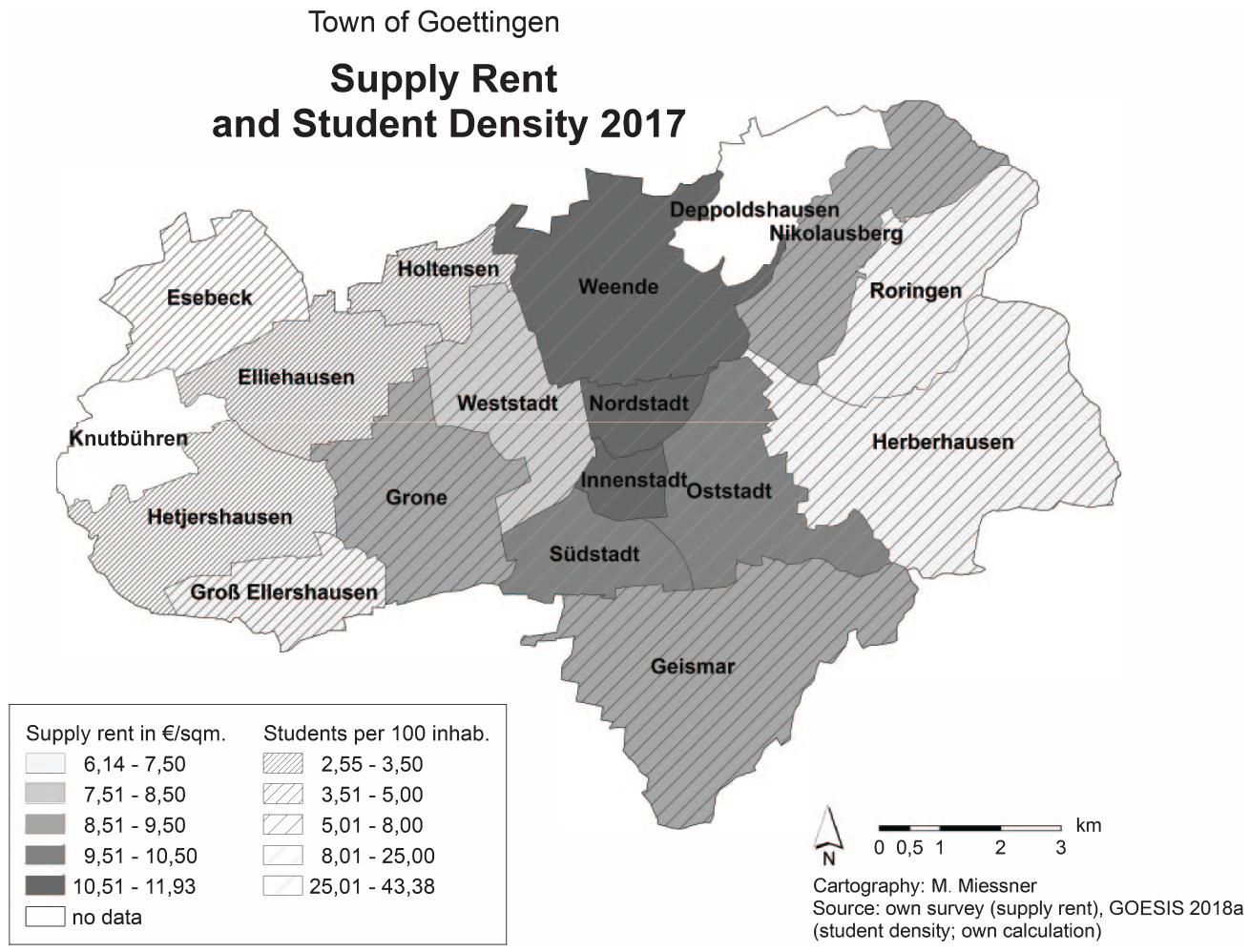
Supply rent and student density in Goettingen 2017.
Not only have rents increased in Goettingen, but also land prices, although this is differentiated by district. Innenstadt and Oststadt have particularly high, and rising, land prices. Nordstadt, Weende, Geismar and Suedstadt follow them. These districts have fairly high prices that are increasing slightly (Mießner and Klinge, 2017: 122). In contrast, Nikolausberg, Grone, Weststadt and the districts further away have lower and stagnating land prices (Mießner and Klinge, 2017). The rising land prices are an indication of the growing interest of investors in Goettingen. In accordance with this diagnosis and due to anticipated opportunities to increase rents, supra-regional (and even some international) investors have increased their presence in the real estate market of Goettingen (Fehlberg and Mießner, 2015). Likewise, investments in student housing in Goettingen have become more attractive for supra-regional investors recently (Frieling et al., 2020; Marlow and Mießner, 2019; Mießner, 2019), even if we are still only talking about individual cases. The new attractiveness of student housing in Goettingen highlights the importance of investigating more deeply how landlords and property owners increase rents for student tenants, especially because students are not the most solvent social group. This paper will explain this puzzle in the following section.
How property owners increase their return on investment in the student housing segment
As a high prevalence of rental housing characterises the Goettingen housing market and small-scale property owners are very important in this segment, the strategies of small-scale landlords are of special interest for understanding the studentification process. In the interviews conducted, investors explained that they calculate which level of rent the property owners could ‘enforce’ in the local market before they buy real estate or property (e.g. private landlord [PL II], 2017: l. 92–94; Europe-wide operating investor for student apartments [EISA], 2018: l. 10-11). The analysis of the interviews conducted shows, first of all, that the high student demand gives landlords a powerful position from which to extract high rents for flats of even a low standard. Secondly, similar to the findings by Rugg et al. (2000) and Zukin (2014), this strategy is facilitated by the high fluctuation of students, which makes it easy to increase the rent with every tenant change. Thirdly, the analysis shows that student preferences for their own flats enables landlords to obtain high per square metre rents for small apartments. Lastly, the students’ coping strategy of sharing flats to save money puts landlords in a strong position to earn high rents, even for large flats. These findings illustrate the importance of landlords’ strategies that transform student demand into increasing rents.
Exploitation of high student demand
Due to good economic development, the population in Goettingen has grown within recent years (GOESIS, 2018a). At the same time, due to a lack of building land, construction activity has been very low and the social housing stock has shrunk (GEWOS, 2016). In addition, after the global economic crisis, as the rent gaps in German metropolitan regions and large cities began to shrink, Goettingen as a second-tier city came to the focus of real estate investments (Fehlberg and Mießner, 2015). It is for these reasons that the Goettingen housing market is very tense. On the one hand, there is a high demand for real estate from real estate investors willing to pay rising prices and, therefore, applying strategies to increase rents (Mießner, 2017), accompanied by a shortage of the low-price housing segment (Mießner, 2020). On the other hand, the population growth leads to a rising demand from families, students, pensioners, etc., for a stagnating rented housing stock (Mießner, 2020). In this situation, property owners are in a strong position on the housing market to increase rents. Their strategies to increase rents from student tenants under these conditions are the focus of this section.
The overall situation is also reflected in the interviews, particularly the rising demand for rented housing. They show that the demand for rented housing is increasing rapidly due to population growth (e.g. Germany-wide operating real estate investor I [GREI], 2015; PL II, 2015). The interviewees explained that there is a very high demand for housing from students (Employee in the department of real estate business/city administration of Goettingen [CAG], 2014; Real estate department of a local credit bank I [LCB I], 2014), along with a rising demand for residential property, for family apartments (CAG, 2014) and for housing for wealthy seniors (Local real estate agent [LREA] II, 2014). Due to the generally high demand, ‘the tenants are essentially obliged [. . .] to take what they get, what is offered on the market, and they do not have many alternatives’ (Local property management company I [LPMC I], 2014: l. 254–256).
In the student housing segment, the situation is even more severe. As indicated previously, a large share of the population growth is due to an increase in the number of students (c.f. CAG, 2014; LCB I, 2014; LPMC I, 2014; LPMC II, 2016). The high student demand manifests itself in a demand for student residences from the Goettingen Student Services Organisation (GSSO); at the beginning of the winter semester 2017/2018, 799 rooms were offered and accepted, while a further 2222 applicants were placed on a waiting list (Böhm, 2017).
The interviewees explained that the high student demand leads to many landlords and property management companies focusing on letting to students (e.g. LREA II, 2014; PL II, 2014). As a result of the high student demand, the student housing market is labelled a ‘landlord-market’ (Employees of a local housing cooperative I [LHC I], 2014: l. 474; LCB I, 2014: l. 115), which means that the property owners can choose tenants and ‘dictate’ (LCB I, 2014: l. 135) the rent. As the semester usually starts in October in Germany, many new students look for a flat in autumn. Therefore, during this time, demand massively exceeds supply (LCB I, 2014: l. 121–135), and the situation is more severe. For this reason, the GSSO offered temporary shelters and hired cheap hotel rooms in recent years, as many students struggled to find accommodation (Lieske, 2015).
In such situations, as the analyst of an international real estate investment management firm (REIM, 2017: l. 74–78) argued, students have no choice: Students do not have any choice of real estates or flats, which are offered. Accordingly, they are dependent on being offered anything and would, therefore, accept options, which have a slightly higher price; and the prices in student residences are so high, that students actually do not want to pay them. But [they do] because they have no other alternatives [. . .].
For this reason, a private landlord explained, property owners ‘make use’ of their position ‘exorbitantly’ (PL I, 2017: l. 40). As students are happy to ‘live within four walls, which are stable and [. . .] where rain does not get in’ (PL II, 2014: l. 162–163), the flats rented out are not always in a very good condition. For example, in an online rental offer the former tenants wrote: The flat has five rooms. From these three are usable. The other two have to be renovated urgently. [. . .] The bathroom heaters are considerably undersized and an additional electric heating should be used in winter. [. . .] The uninhabitable rooms do not have insulation in the sloping roof. Furthermore, the ceiling is not completed. [. . .] The cistern of the toilet is missing [. . .]. (Student tenant, 2015)
Surely, this is an extreme example, but it shows that some flats let to students are in really bad condition. However, due to demand pressures, even such flats can be let.
There is another facet of the high student demand. A private landlord argued that he has the impression that there are ‘sufficient students coming from wealthy homes’ (PL I, 2017: l. 62–63). This impression is confirmed by the data that is regularly collected by the AGSSO (2017). It shows that German students’ average income increased from 789 euros per month in 2009 to 918 euros per month in 2016 (AGSSO, 2017: 39). Furthermore, the proportion of students with an income of more than 1000 euros per month rose from 21 per cent in 2012 to 31 per cent in 2016 (own calculation based on AGSSO, 2017: 41). It is this development, in particular, and the accompanying possibility of receiving higher rents that makes student housing attractive for investors and landlords. For example, an international investor referred to this data and explained that the increasing number of prosperous students is ‘a group we are keeping an eye on’ (EISA, 2018: l. 81).
Due to the highly constant student demand, investors think that investments in student housing are ‘lasting’ (German-wide investor and management firm for student apartments [GIMSA], 2017: l. 27). In particular, cities with large universities are considered to be places for safe investment, where investors can achieve significant rent increases (German-wide investor and management firm for student apartments [GIMSA], 2017; PL I, 2017).
High fluctuation allows rent adjustments
The turnover of tenants in flats among students is usually very high, and allows landlords to increase rents with every change of tenant, as the study by Rugg et al. (2000) showed more than 15 years ago. It is the same in Goettingen; the fluctuation rate 3 is over 55 per cent among those between the ages of 18 and 21, and around 40 per cent for people between 21 and 25 years of age. In comparison, the fluctuation rate is 20 per cent and less among younger age groups (under 18) and the older age spectrum (over 30; see Figure 2). The employees of a local housing cooperative (LHC II, 2017) report that they experience this in their housing stocks, as student tenants change every two to three years.
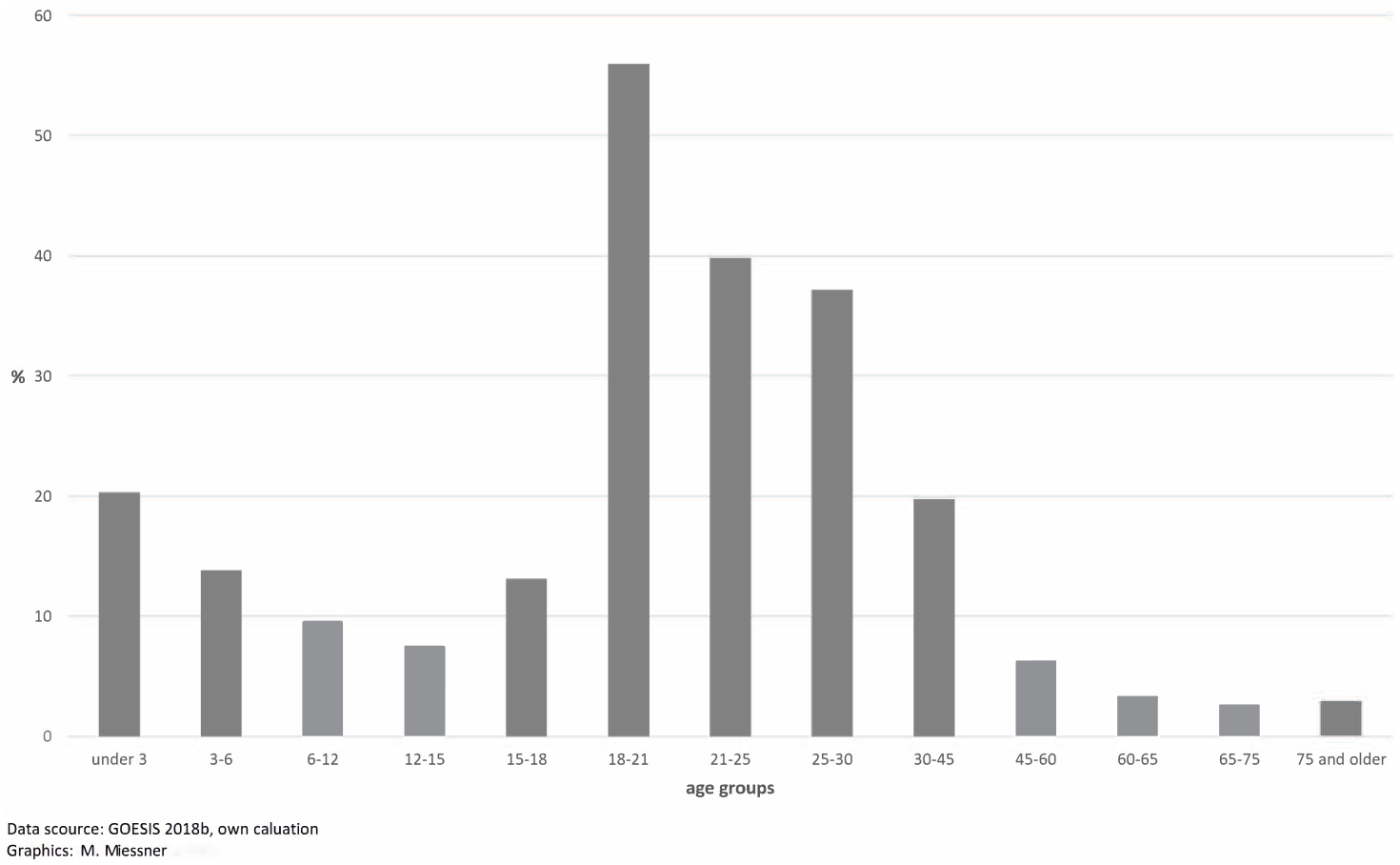
Fluctuation rate by age group in per cent in 2017.
The interviews conducted underline that high fluctuation has both advantages and disadvantages for property owners. Landlords are particularly concerned with the physical damage that can accompany moving in and out (LPMC I, 2014). Furthermore, fluctuation entails administrative expenses (REIM, 2017) and insecurity that stems from not knowing whether the new tenant is trustworthy and, for example, will pay the rent on time (LPMC I, 2014).
On the other hand, the change of tenants enables property owners to adapt the rent to recent market developments (EISA, 2018; LPMC I, 2014; PL II, 2017). This means that the investor tries to ‘adjust the rents upwards’ (REIM, 2017: l. 119), especially in times of a tense rental housing market. The advantages of fluctuation, explained the analyst of an internationally operating real estate investment management firm, is that it is much easier to raise the rent prices after a change of tenants than to increase rents in long-term rental agreements (REIM, 2017). Furthermore, the administrative costs of high fluctuation are usually added to the rents in student residences. Consequently, he adds, ‘students pay much more’ (REIM, 2017: l. 140–141).
In addition, the administrative expense related to moving out of and into a flat is reduced in areas with many students, because it is often very easy to find a new tenant. A private landlord explained that he does not need to advertise because the former tenant ‘immediately takes a new tenant’ and, therefore, he calls the search for future tenants a ‘sure-fire success’ that works ‘in no time’ (PL I, 2017: 47–50). The employees of a local housing cooperative (LHC II, 2017) report similar circumstances.
This shows, under conditions of high demand and a tense housing market, that the advantages of high fluctuation within student tenants exceeds the disadvantages. Landlords especially exploit the situation in order to increase rents with every change of tenant to extract a higher return on their investment.
Small apartments allow for high rents per square metre
This section shows that an increasing proportion of students prefer to live in their own apartment. Private landlords utilise this preference as a means to receive higher rents per square metre in small flats than in larger flats.
Many interviewees explained that they have the impression that students prefer to live in small apartments over flat sharing. For example, a large local property management company (LPMC I, 2014: l. 388–390) stated that most students ‘[. . .] prefer to have their own room, their own domain, [and] shut it’. The GSSO, too, reports an increasing student demand for single-room apartments for their housing stock (Magull, 2019). Due to this high demand for small apartments, private investors try to build new apartment blocks near the two main university campuses. A private landlord, who built a new apartment block with 31 one-room apartments of 14–34 square metres each explained that his apartments are this size because it is ‘a question of money’ (PL I, 2017: l. 116–119) of how much the students are able to pay in total for rent (REIM, 2017). This is another similarity to the findings of Rugg et al. (2000), which show that landlords try to attune rent to a level students can afford. However, in the case of Goettingen, the small-sized apartments allow private investors to offer low total rent prices, while the price per square metre is very high. Some property owners of small apartments receive up to 30 euros per square metre (LREA III, 2016). This was also shown in the author’s own survey of supply rents for this research. The average per square metre supply rent for a single-room apartment was more than 13 per cent above the overall average.
Therefore, it is lucrative to build new apartment blocks with small apartments. On the other hand, a property owner can divide large flats into smaller ones to establish small flats. The interviewees did not mention this strategy, which may be because such a restructuring process may be difficult and expensive; it is especially complicated to build new and separated bathrooms.
Due to the possibility of obtaining high rents per square metre with small flats, student apartments have become a very interesting investment, yielding high returns (EISA, 2018) for private landlords (PL I, 2017) and even financial investors (GIMSA, 2017). For this reason, capital investors, as well as small-scale private landlords, invest in small apartments, especially in Goettingen (LCB II, 2016; c.f. Marlow and Mießner, 2019).
Shared flats enable landlords to receive high rents
Flat sharing gives students the opportunity to cope with high rents. This section shows that landlords exploit this student coping strategy to extract high rents from large flats in a university town.
As small apartments are limited in Goettingen and compared to flat sharing more expensive, students also look for multi-bedroom apartments for flat sharing (c.f. LCB I, 2014). In Goettingen, flat sharing allows students to save more than 40 euros per month, compared to renting a one-room apartment (Hein, 2017). Flat sharing is a really important market in Goettingen, with a market share of nearly 50 per cent (Hein, 2017).
In addition, flat sharing allows students to cope with high rents, as the collective form of raising money enables students to pay much more (Mießner, 2017: 48). This allows landlords to obtain high rents even with larger apartments and is, therefore, a very lucrative business model. A local real estate agent (LREA IV, 2016: 516–557) provided an example of this. One of his clients, a painter and interior fitter, bought an old house. He rebuilt the three floors to create shared flats. He renovated the rooms with cheap construction material and to a low standard. Afterwards, he let the rooms of between 10 to 15 square metres for a basic rent of 300 euros each. Based on this data, the real estate agent demonstrates that the property owner gets a return of about 12–13 per cent. Admiringly, he added, ‘this is a nice model [. . .], is a business model’ (LREA IV, 2016: l. 549). The real estate agent was responsible for finding tenants. He stated that it was no problem to find them, ‘quickly the shared flats [. . .] have been let’ (LREA IV, 2016: l. 541). It is for this reason that landlords favour renting flats to students sharing the flat over families. Hence, they try to establish flat footprints that are suitable for flat sharing. For example, the flats should not have living rooms with more than one door or access rooms.
While studentification studies have shown the transformation of owner-occupied houses into houses of multiple occupancy, the findings of this section show that in the rental housing market, owners can let large flats to students sharing flats and receive a high rent. Therefore, this is a strategy to close the rent gap.
How landlord strategies encourage urban segregation
With this background information on the strategies landlords apply to increase their return on investment, we move on to discuss how these strategies encourage urban segregation in Goettingen. While studentification studies very often focus on student choices and preferences to explain urban segregation and displacement (He, 2015; Smith, 2005), they pay little attention to the actors who allow them to rent an apartment. Therefore, this section focuses on property owner preferences and strategies and their consequences for urban segregation. Hence, this section illustrates the ongoing process of urban segregation and explains the importance of landlord preferences for student tenants as a means to understand urban segregation in Goettingen.
Urban segregation
The aforementioned developments in the rental housing and real estate markets also have consequences for urban segregation. In this section, I argue that due to high rents, benefit recipients and low-income households are displaced from the districts with high rents and housing prices.
The income and, therefore, the possibility to pay high rents determines where people can live, as the employee of a large local property management company explained: The question of the image of a location [. . .] is always a question of the price. Therefore, those who earn a lot of money, professors or doctors or whoever, naturally put emphasis on location, because they can afford to do so. So, that’s the top. The usual citizen or average earners, and so on, cannot pay these locations. [. . .] But they have to compromise to reasonably accommodate their families. (LPMC II, 2016: l. 363–368)
This shows that it is much harder for low-income people to find a suitable home, because they have a weak position in the competition for flats. This estimation is supported by the analysis of statistical data that show high-income households tend to live in districts with high land prices and rents, whereas benefit recipients concentrate in low land price and rent areas (Mießner and Klinge, 2017). Therefore, urban segregation intensifies. This spatial development is intensified by the spatial concentration of students. In areas with a high proportion of students (see Figure 1), the number of benefit recipients shrank from 2014 to 2017. For example, in Weende the number shrank from 991 to 888 and in Nordstadt from 717 to 658. The numbers of benefit recipients increased in Weststadt, which already had an existing high proportion of benefit recipients and few students (see Figure 1), from 1936 in 2014 to 2068 in 2017 (GOESIS, 2019). This also takes place in town sub-districts; for example, in the town quarter of Theodor-Heuss Strasse, a sub-district of Nordstadt, which is near the main campus of the University of Goettingen, the share of students of the total number of inhabitants increased by more than 15 per cent between 2008 and 2016 (Mießner, 2019: 26). In the same time period, the share of benefit recipients decreased by more than 2 per cent (Mießner, 2019).
However, it is not only benefit recipients and low-income households that were displaced from districts with a high proportion of students. In addition, an increasing proportion of middle-class families are not able to pay the rising rents (Mießner, 2017). It is for this reason that the share of families in the outskirts of Goettingen increased, while it shrank by 2 per cent in the city between 2010 and 2015 (Mießner, 2017). Due to the lack of large apartments even in the outskirts, middle-class families are obliged to switch to the villages outside of the city (Mießner, 2019).
Hence, urban segregation is an outcome of the displacement of benefit recipients, low-income households, middle-class families and even pensioners. This is mainly due to increasing rents as well as land prices and less because of conflicts between students and long-term residents (Mießner, 2019). It is, therefore, important to investigate more deeply how this process unravels and, in particular, how landlords’ strategies encourage urban segregation.
Landlords prefer students sharing flats over families
According to high demand and rents in the segment of student housing, flat sharing is one student strategy for coping with these circumstances. As mentioned previously, flat sharing enables students to pay high rents. Very often, these high rents are not affordable for families (Mießner, 2017: 48). As the landlords are keen on getting the highest return on their investments, they favour students sharing flats over families. This is one of the central drivers leading to urban segregation in Goettingen.
A senior employee in the real estate department of a local credit bank explained how students sharing flats is one factor that is pushing families to larger flats or houses in Goettingen: There is a certain number of apartments [. . .] for students in Goettingen. That is not enough for all students. What do students do? [. . .] they have to live in a slightly larger flat. And, therefore, they have to live in a two- or three-room [. . .] flat, partially as flat sharing, and thereby they push a little bit, like in a cascade, from below the families to slightly larger flats or houses [. . .]. And because the families are obliged to [. . .] live in larger flats or houses, there is ultimately a demand pressure in the kinds of real estates which are not demanded by students. (LCB I, 2014: l. 248–270)
The employee continued by explaining that due to the competition between students and families, the families have to live in other flats or in (semi-)detached houses. However, this is only one side of the coin. On the other side, the landlords decide whom to let flats to. As students sharing flats offers the opportunity to receive higher rents than many family tenants could afford, property owners often prefer letting to students over families. For example, a local politician reported that landlords prefer students sharing flats, hence the displacement of families through students (politician I, 2017;politician II, 2017). It is for this reason, as a private landlord explained, that it is hard for families to live in the inner city, even if there is a demand from families for inner city apartments (PL II, 2014). Therefore, many families are obliged to search for affordable flats and houses on the city outskirts, as well as villages outside of Goettingen (LCB I, 2014). Hence, the higher rents affordable for students sharing flats, on the one hand, and the landlords favouring student tenants over families, on the other hand, are drivers for urban segregation.
Landlord preferences for homogenous tenants
This return on investment-driven preference of property owners for students is accompanied by another strategy that encourages urban segregation. Landlords try to reduce conflicts between tenants and, therefore, prefer homogenous inhabitants in their buildings. For example, a private landlord explained: If you have professionals among [the tenants], well, it is actually really bad [. . .], if you have shift workers [. . .], and students, who have a completely different rhythm of life, this always causes trouble: Yes, and [. . .] I always try to avoid this. (PL II, 2014: l. 175–179)
Also, the employee of a local property management company stated that they do not offer flats to pensioners or benefit recipients in houses where students live, because this ‘naturally leads to problems’ (LPMC I, 2014: l. 129–130). He reported of trouble with keeping the night-time peace. The employees of a local housing cooperative (LPMC I, 2014) reported problems between students and elderly people concerning cleaning staircases in turn. It is for this reason that the private landlord tries to buy houses with similar sizes and layouts of flats: I consciously avoided to mix small and large flats within a house. Especially in old houses the wooden ceilings sway [. . .]. And if little kids ride their bobby-cars and so on and underneath somebody wants to study for an exam and so on, that always brings about trouble. (PL II, 2014: l. 69–74)
Hence, the private landlord (PL II, 2014: l. 69–74) lets to students and maybe young academics, but not to families. Another interviewed local property management company has a wider portfolio, but also tries to ensure that they have homogenous inhabitants within a property (LPMC II, 2016). For this reason, families and low-income households are not only in a worse position than students in the competition for rental flats because of the high rents, but also because landlords prefer homogenous inhabitants, especially student tenants. This additionally restricts housing options for low-income households and families, especially in inner-city areas. Therefore, the landlords’ preference for homogenous inhabitants (especially students and young urban professionals) is another important factor for urban segregation.
Benefit recipients and foreigners get what remains
Until now I have shown how even middle-income families have been displaced due to high rents and landlord preferences for homogenous inhabitants, which encourages urban segregation. Now I move to investigate the situation of marginalised groups. In this section, this paper shows that it is very hard for benefit recipients and foreigners to find affordable homes under the conditions of a tense housing market.
Firstly, the situation of marginalised population groups is worse than the situation of middle-class families. Often landlords do not want to let to benefit recipients and foreigners, especially if they are living in large families (LREA V, 2014). A real estate agent explained landlord prejudices against benefit recipients as follows: [. . .] there are a lot of prejudices, of course. Will I get my money? Additionally, usually a mentality is implied [. . .], that they deal with property in a different way [. . .]. We do many people wrong [. . .]. But there are a lot of property owners who have had bad experiences once and therefore say, ‘no, I am not doing this anymore’. These are, I would say, nearly [. . .] sixty to seventy per cent. (LREA II, 2014: l. 236–252)
It is because of these prejudices that a large proportion of the rental flats is not assessable for marginalised people. For this reason, benefit recipients as well as foreigners usually find flats only in districts with an already high concentration of similar people. This is especially the case if the rental market is tense and demand exceeds supply (LREA II, 2014). This explains the aforementioned increasing concentration of benefit recipients in Weststadt (cf. Mießner and Klinge, 2017). In addition, many foreigners live in flats that are in a bad condition and still expensive, as the example of the observations of a private landlord regarding foreigners shows: [. . .], and you see also, how these [flats] are in a worse segment. [They] were not modernized [. . .]. These are let to foreigners, right. Or look next door, there are only Koreans sitting. [. . .] You would not let it to students anymore. [. . .] in the house next door, it is, yes actually in danger of collapsing. Hence, this is completely scrapped. And there are still people living with a coal heating, yes, they have a cooker, it’s a small oven, and they chop wood and stick it into there and the roof is leaking and I do not know what else. And they are living there. (PL II, 2014: l. 538–607)
This quotation highlights two aspects of the segregation process. Houses in bad condition and in which foreigners often live are usually in locations side by side. For this reason, the decision of some landlords against foreigners as tenants encourages the concentration of foreigners to specific areas. Secondly, even though there are reports from other geographical contexts (e.g. Rugg et al., 2000) of the poor quality of the accommodations some students live in, the quotation shows that some flats are in such a bad condition that even students do not live in those apartments. Nevertheless, these apartments are frequently the only housing options for foreigners. Usually, the property owners’ strategy for these houses is letting them to students without making investments for improvements first, which leads to downgrading. When even students will not live in these houses anymore, they let them to foreigners, who are forced to rent what they get.
Urban policies and segregation
After explaining how landlord letting strategies encourage urban segregation, we move now to the question of how urban policies handle this impact of studentification. While urban policies have the potential to slow down gentrification (Shaw, 2008), the policies in Goettingen do not have this intention and effect, as is briefly outlined in this section.
Studentification has become an important issue in urban planning in other contexts (e.g. Revington et al., 2018), but this is not the case in Goettingen, as the applied urban policies there do not directly target studentification (Marlow and Mießner, 2019). Furthermore, the city administration makes no use of effective policies against displacement (Mießner, 2020), such as the social milieu preservation statute (Soziale Erhaltungssatzung), a German urban planning regulation tool that hampers the replacement of a social milieu within a district. Instead of addressing issues of displacement, the policies target the construction of apartments. This policy focus is due to the report of a private research institute, commissioned by the city administration, on housing market developments (GEWOS, 2016). The report argues that the increasing population and student numbers lead to a shortage of housing. Therefore, urban policy focuses on designating new residential development areas and the building of new housing on vacant plots in the city (Mießner, 2020). Nevertheless, these newly developed buildings do not hamper urban segregation. On the contrary, they encourage urban segregation, as this new housing is affordable for middle-class or high-income households but not for low-income households.
On the other hand, the city administration at-tempts to save affordable housing for benefit recipients. Therefore, the administration has tried to extend or purchase tenant control agreements (Belegungsbindungen) for 2500 flats (City of Göttingen, 2018). Mainly companies with large and often cheap housing stock, in which low-income households and benefit recipients are already concentrated, sign these agreements. For this reason, the policy saves affordable housing, but promotes urban segregation at the same time.
Conclusion
This study has presented findings from a new context for studentification studies: the German student housing market. The findings of this paper allow us to draw conclusions about some indications for the broader discussion in urban studies. Firstly, while Harvey (2010) claimed to bring the property owner strategies to the forefront of analysis, there are only a few studies that took him up on this invitation, especially for studentification studies. However, the findings of this paper urge that besides focusing on huge investment projects, we pay more attention to the role landlords’ strategies play in urban segregation. As property owners decide who will rent an apartment or house, they significantly influence the spatial distribution of people in cities. This paper shows that they use this strong position, especially under conditions of a tense housing market, for letting to people from whom they get the highest return on their investment with the smallest effort, or to whom they have the least prejudices.
Secondly, Neil Smith’s rent gap theory is a suitable starting point for understanding the investigated urban process. Nevertheless, the findings of this paper suggest an extension of Smith’s analysis. While Smith (1979) argues that gentrification and displacement occur when the rent gap is wide enough and reinvestment takes place, the case of studentification in Goettingen shows that reinvestment is not a necessary prerequisite. Under conditions of a high demand pressure and under circumstances of a strong rental housing market, property owners have the possibility to increase rents and therefore ‘milk the property’ (Slater, 2017: 119) without investment (cf. Smith, 1979; Zukin, 2014).
Thirdly, financialisation and its consequences for urban development have become an important research strand in urban studies (Christophers, 2015). Many studies focus on the connections between financialisation and housing markets (e.g. Wijburg and Aalbers, 2017b), and on large international financial investors (e.g. Janoschka et al., 2020). While financial investments have a huge impact on urban development in large cities, the findings of this paper show that small-scale and local investors have an important effect on spatial developments in medium-sized cities. Hence, the understanding of small-scale and local landlords’ activities is important for understanding urban development, at least in medium-sized cities.
Fourthly, this paper seeks to make a point on the political implications of all of this. While previous studies on studentification (e.g. Garmendia et al., 2012; Hubbard, 2008; Kinton et al., 2018; Smith, 2005) have focused on conflicts that emerge when students move into established neighbourhoods, this German case study sheds light on studentification under conditions of a high degree of rental housing. This displacement may not trigger direct conflicts between students and other social groups, as in other countries. For this reason, studentification in tense rental housing markets may not obtain broader media attention and not be addressed by planning policies as in other countries (e.g. Kinton et al., 2016). Nevertheless, marginalised groups will still be displaced, and because this marginalisation under conditions of a tense rental housing market takes place without open conflicts, local governments will seldom address this issue.
Fifthly, the findings in this paper show that property owners play an important role in processes of studentification and the accompanying displacement of marginalised groups, while this issue has barely been focused on in the studentification literature. The findings of this study indicate that the property owners decide who is allowed to rent an apartment. The case of studentification in Germany suggests some issues of property owners’ strategies that may also be of relevance for studentification in other contexts. Property owners let to students in order to receive the highest return on their investment. For this reason, they favour students over families or marginalised groups. In addition, landlords prefer homogenous inhabitants to avoid trouble regarding noise, etc. These letting strategies, accompanied by property owners’ prejudices against foreigners and benefit recipients, cause houses within a short distance of university campuses to be barely accessible for renting for families and, in particular, benefit recipients and foreigners. Hence, the property owners are a crucial factor for transforming high student demand into increasing rents and into urban segregation and displacement. Therefore, the findings of the paper suggest that a deeper investigation of property owner strategies would help to understand, more deeply, how the process of studentification proceeds and how displacement in studentified cities takes place.
Footnotes
Acknowledgements
I want to thank my colleagues of my former institution, the Institute of Geography at the Georg-August-University of Goettingen, for their helpful feedback on former versions of this paper and their support. Furthermore, I would like to thank Thomas Wieland, who allowed me to use his data collection of online flat rent advertisements for 2013. Moreover, I thank the students who collected the online flat rent advertisements for the years 2014 to 2017 during a course on applied geography at Goettingen University. I also want to thank the students who conducted the interviews. Finally, I would like to thank my student assistant Robin Marlow for transcribing the interviews.
Authors’ Note
Michael Miessner is now affilated with Technical University Dresden, Germany.
Declaration of conflicting interests
The author(s) declare no potential conflicts of interest with respect to the research, authorship, and/or publication of this article.
Funding
The author(s) received no financial support for the research, authorship, and/or publication of this article.
