




Abstract
Residential developers have found footholds in university-adjacent neighborhoods, though the extent of this trend is unclear. We examine rental construction near 168 major U.S. universities with neighborhood data covering 2000 to 2018. We find that more rental units were built near larger universities with growing enrollments and limited dormitory capacity. University-adjacent rental development varied widely across urban contexts, and was most common in low-mid-rent neighborhoods with similar precedents. More large-scale rental housing was built in medium-sized cities with higher housing prices yet slower rising rents. Findings suggest the importance of municipal and university roles in residential development, including local regulations and dormitory investments.
Keywords
Introduction
In recent decades, developers have established footholds in university neighborhoods, building modern, highly amenitized apartments (Caulfield 2020; Hiller 2021; Revington and Wray 2022). These rental developments are positioned to attract students seeking off-campus housing and other young professionals seeking dynamic urban neighborhoods (Ellis-Young and Doucet 2021), redefining local multi-family residential markets (Kinton et al. 2018; Perry and Wiewel 2005; Revington and August 2020). Local reporting and emerging case study research spotlight examples of university-adjacent development in a variety of contexts across the United States, from dense urban settings to communities with fewer precedents, such as Champaign, Illinois, Columbia, SC, and Salisbury, MD (Pendall et al. 2022; Velazquez and Swann 2019; Waldrop 2017). Similar shifts have been documented in the United Kingdom and Canada as part of conversations around “studentification,” a term broadly used to describe neighborhood transitions as students move into university-adjacent areas, altering their identities and market characteristics (Kinton et al. 2018; Moos et al. 2019; Revington and August 2020).
While the phenomenon of university-adjacent development appears to be widespread, data limitations have so far prevented quantitative analysis of the scope and scale of this development. An overview of in-depth case studies suggests some commonalities in university-adjacent development—surging enrollments, limited dormitory construction, and the financialization of student housing as factors in the construction of large-scale amenitized superblocks—yet the broader patterns of university-adjacent development remain underexplored. Questions remain about the links between university dynamics and nearby development, and how these relate to the urban processes of redevelopment, densification, and neighborhood change.
In this paper, we analyze the volume and scale of rental housing development in campus-adjacent neighborhoods surrounding major U.S. universities between 2000 and 2018, using data from the National Center for Education Statistics and the U.S. Census Bureau to describe the institutional, neighborhood, and metropolitan contexts of development. Our analysis addresses three research questions:
In pursuing these questions, we interrogate the siting of rental development near universities—not as a causal analysis or an assessment of developer or market-level drivers, but as a descriptive overview of the development patterns and dynamics related to this trend.
We develop a database representing neighborhoods within a 1-mile radius of the main campuses of major universities across the United States, using the Integrated Postsecondary Education Data System (IPEDS) to identify an analytic sample of 168 universities with enrollments above 10,000 full-time local students. We augment institution-based IPEDS data on enrollments and dormitory capacity with neighborhood-level estimates of rental development, derived from 2000 Census and 2014 to 2018 American Community Survey (ACS) data.
This research contributes a nuanced understanding of the institutional, neighborhood, and metro-level factors that feed into campus-adjacent housing development. We find that rental development was more intense near some universities than others: over half of units (56%) were built in just one quarter of campus neighborhoods. Our key takeaways include: (RQ1) more large-scale rental housing was built near more research-intensive universities, while more small-scale rental housing was built near less research-intensive universities. Rental housing development at all scales was positively associated with enrollment growth. Universities that built less dorm capacity during the study period experienced more nearby rental development, especially in higher rent neighborhoods. (RQ2) In terms of housing market conditions, the most rental development occurred near universities located in low-to-mid-rent neighborhoods. Large-scale rental projects were more often built in metros with higher baseline rent levels, yet both small-scale and large-scale rental development occurred less often in metros with rising rental prices. (RQ3) The patterns of rental development appear in some ways to extend the existing urban fabric, appearing in neighborhoods that already had higher shares of renters, and both small-scale and large-scale rental developments were built in neighborhoods that already had more similarly scaled development. At the metro level, small-scale rental development was less likely in larger urban centers rather than smaller college town environments. However, large-scale rental development was not most prevalent in larger urban centers, but rather in minor urban centers and larger college towns, a somewhat unexpected finding. These findings help build an understanding of the broad patterns of university-adjacent rental development, and have implications for planners and policymakers, university leaders, and developers as they grapple with future development in university neighborhoods.
Background
The story of housing in campus-adjacent neighborhoods is multi-faceted, positioned at the intersection of higher education and housing discourse. We explore the existing scholarship to provide a foundation for examining large-scale rental housing development within the context of university neighborhoods, beginning with the higher education trends that inform housing demand and supply.
Higher Education Institution (HEI) Dynamics: Strong Enrollment Growth Meets Limited Dormitory Capacity
The large Millennial generation pushed HEI enrollments far higher than previous generations: while only 26 percent of 18 to 24 year olds enrolled in college in 1970, 41 percent of 18 to 24 year olds pursued college degrees in 2010 (Snyder, de Brey, and Dillow 2016; U.S. Department of Education 2011). This groundswell, coupled with the expansion of international student enrollments, pushed undergraduate and graduate student enrollment into unprecedented territory. Between 1999 and 2009 alone, postsecondary enrollment grew by 38 percent, expanding from 14.8 to 20.4 million students (U.S. Department of Education 2011). This upward shift in demand at HEIs signaled additional changes for nearby neighborhoods, as new populations arrived with demands for housing and services.
While we might assume that dormitories absorbed some of this demand, existing research largely dispels this notion. Historically, data suggest that surprisingly few undergraduates live on campus. Among all U.S. college students between 2000 and 2016, approximately 15 percent lived on campus, while upward of 55 percent lived off-campus in surrounding neighborhoods and the remainder lived with family (Kelchen 2018). Even among first-year undergraduates attending four-year institutions, Kelchen demonstrates that dormitory life is less common than we might expect: during the 2015–2016 academic year, he found approximately one-third (at public HEIs) to one-half (at private, non-profit HEIs) of first-year students lived on campus.
Some of these living arrangement choices may stem from HEIs’ struggle to match increasing enrollment demands with dormitory capacity. Between 2000 and 2010, dormitory housing expanded somewhat across most U.S. states, but the overall share of dorm-housed students still fell (Arbury 2012). Dormitory expansion has been constrained by limited land availability and fiscal strains on public institutions (Sackett 2015), as well as the obsolescence of dormitories built during the 1960s construction boom. The conflicting dynamics of rising enrollments alongside limited dormitory capacity and construction inform our research question about the links between university change and rental development nearby. We expect more rental development near universities where enrollments—and theoretically housing demand—are growing, and there may also be a substitution effect between university-built and -operated dormitories on campus and private rental development nearby.
The Urban Context of Rental Development
University-adjacent development does not happen in a vacuum: the manifestation of HEI and student impacts on neighborhoods may depend upon the urban context at both the neighborhood and metro scales. University neighborhoods do not fit a single mold, but span low-density, small neighborhoods to highly urbanized blocks situated within the largest U.S. cities and beyond (Ehlenz and Mawhorter 2020). And these urban contexts shift over time, not only as a result of university-related housing demand and supply. For instance, a study of U.S. college towns identified meaningful shifts in neighborhood typologies over time, including gains in the number of wealthy neighborhoods, declines in middle-class neighborhoods, and increases in “mix/renter” neighborhoods with higher rates of rental housing and non-family households (Foote 2017).
The most relevant dynamics of neighborhood change during the study period are redevelopment and upgrading of centrally located urban neighborhoods with aging housing stocks and low housing prices (Brueckner and Rosenthal 2009). In many cases, redevelopment occurred not in the lowest-priced neighborhoods, but in neighborhoods with relatively low housing prices adjacent to higher priced neighborhoods (Liu and O’Sullivan 2016). Taken together with urban agglomeration models, this suggests that low-priced neighborhoods near major employers such as universities could also be considered ripe for redevelopment (Spivey 2008). Beyond the neighborhood scale, this process of redevelopment of urban neighborhoods was fed by a surge in demand for rental housing as the large generation of Millennials came of age—the same force fueling the university enrollment surge (Lee 2020; Myers 2016). And these demographic shifts in housing demand played out in the context of the economic divergence of more and less prosperous metropolitan regions, a process intimately connected with the knowledge economy and higher education (Berry and Glaeser 2005; Diamond 2016), and which extends to capital flows in real estate investments (Daams et al. 2023). Even though neighborhood and metro change research often focuses on education and the knowledge economy as indicators, these literatures seldom engage directly with universities as place-based entities influencing urban development processes.
Housing Market Dynamics in University-Adjacent Neighborhoods
As students seek lodging in campus-adjacent neighborhoods, research has shown that HEIs and student-led housing demands have contributed to neighborhood change over time, as have emergent investment preferences grounded in university-adjacent real estate. Studentification has been used to describe the process by which students (and other young people) concentrate within and change urban neighborhoods (Smith 2005), while the broader off-campus rental market—which may extend beyond campus-adjacent areas and into the larger region—has been called the urban dormitory (Revington et al. 2020). Conventionally, studentification referred to a downgrading process, wherein small-scale landlords subdivided previously owner-occupied housing into rental units to accommodate student housing demand; this process led to changes in neighborhood character that, over time, lowered overall housing quality (Munro and Livingston 2012; Sage, Smith, and Hubbard 2013; Smith 2008).
More recently, conceptions of studentification have expanded to engage with new housing development trends, including luxury and/or large-scale multi-family housing projects (Nakazawa 2017). These residential developments can embody multiple formats, from more conventional multi-family units with twelve-month leases to purpose-built student accommodations (PBSA) tailored toward student demands, including per-bed and academic year leasing models, furnished rooms, roommate matching, and other features one might expect from a traditional dormitory model (Ballinger 2022; Campus Advantage 2018; Hubbard 2009; Kinton et al. 2018; Revington et al. 2020). In other instances, these projects align with broader revitalization efforts that seek to spark dense multi-family projects in strategic locations, such as university neighborhoods with transit access (Ellis-Young and Doucet 2021; Revington et al. 2020).
In recent years, many HEIs have turned to partnerships with private developers to provide student-friendly housing options—like PBSAs, relieving the HEI of construction and management responsibilities. These projects generally produce highly amenitized housing options that can help attract potential students—for instance, featuring entertainment lounges, fitness centers, outdoor patios with grills and/or pools, reservable community kitchens, and coffee bars—yet are often more expensive than dormitory options. Meanwhile, these projects can also substantially change the local housing stock, introducing higher densities of student-focused multi-family housing in alignment with institutional and municipal development aims (Pendall et al. 2022; Revington 2022).
The expansion of PBSA has been observed in Canadian, U.K., and European contexts, where scholars have pointed to the expansion of investor-led interest in multi-family development in the wake of the single-family mortgage crisis (August and Walks 2018; Revington and August 2020; Sanderson and Özogul 2022). These scholars argue that rental housing around universities is being developed, managed, and monetized as an asset class, fundamentally shifting the market in some neighborhoods (Newell and Marzuki 2018; Pillai, Vieta, and Sotomayor 2021; Revington and August 2020). Since 2010, PBSA has grown into a worldwide asset class, increasing to more than $16 billion across the United Kingdom, Canada, and the United States (Revington and August 2020). Through the development of novel databases that include property ownership structures, bed count, and location, alongside interviews and content analysis of real estate reports, Canadian scholars argue that real estate actors view PBSA as an investment vehicle in university towns (Revington and August 2020). Scholars contend the physical development of multi-family projects in university-adjacent neighborhoods is decoupled from HEI-induced demands and better explained by asset management and diversification strategies alongside HEI trends that leverage international student demand, local development plans, increased professionalization of operators, and HEI budgetary changes that move them into an entrepreneurial space (Newell and Marzuki 2018; Pendall et al. 2022; Pillai, Vieta, and Sotomayor 2021; Revington and August 2020).
Scholars suggest the more recent influx of units bifurcates the student-driven housing market: one segment possesses an increased appetite (and wallet) for higher end accommodations, including larger bedrooms, well-appointed kitchens, and upgraded fixtures; meanwhile, more cost-constrained students continue to seek out more affordable options in older, converted housing (Kinton et al. 2018). Even absent the downgrading component of studentification, however, research largely suggests that newly built, rental housing in university neighborhoods does not address primary concerns of existing residents or soak up housing demand (Sage, Smith, and Hubbard 2013). Instead, the conversation largely finds that HEI-induced housing production is amplifying existing housing market pressures and the commodification of housing (Pillai, Vieta, and Sotomayor 2021; Revington et al. 2020), while leaving a subset of students out of the market (Evans and Sotomayor 2023; Sotomayor et al. 2022).
Connecting Residential Development Trends with HEI Trends
The commodification of private-market rental housing in university neighborhoods, and resultant market pressures, dovetails with institutional trends. At the institution level, HEIs are increasingly engaged in an “arms race,” as they strive to offer competitive, amenity-rich environments to attract the strongest applicants (McClure 2019; Rickes 2009; Selingo 2013). They are also confronted with housing shortages amid constrained budgets (e.g., Fawaz 2023). In response, HEIs are increasingly engaged in the “marketization” of the institution, including entrepreneurial partnerships with real estate actors and professional housing operators to address housing demands in a competitive housing market (Evans and Sotomayor 2023; Pillai, Vieta, and Sotomayor 2021). These investments extend not only to HEI-owned campus facilities, but to the institution’s larger “front porch,” spilling into adjacent neighborhoods as HEIs pursue strategies intended to revitalize the area for existing, future, and potential users, including residents unaffiliated with the university (Ehlenz 2017). Research finds that these anchor strategies tend to privilege place-based investments, including housing and commercial development strategies, that can spur private investors to enter the market and capitalize upon a vibrant, college-forward atmosphere. They are also contentious, pushing forward narratives of residential displacement catalyzed by HEI actions and constituencies, including emergent studentification issues (Bose 2015; Etienne 2012; Silverman et al. 2018).
A Case for Broadening the Research Inquiry
Existing case study research—particularly in a Canadian and U.K. context—suggests that, in recent decades, investors and developers have found a niche in rental construction near universities, capitalizing on the demand from students and other young people for a campus-adjacent lifestyle. Far from the mom-and-pop landlords of earlier eras, they represent national and international firms with replicable multi-family products that can be implemented in university neighborhoods across countries. Still, research currently falls short of building a broad picture of institutional-neighborhood rental development trends. Instead, we have several conversations focused on particular contexts—a single university, a neighborhood, a city, or a metro area—that may help suggest trends. But we do not yet have research that is generalizable across university, neighborhood, and metro contexts, nor do we have an explicit examination of rental development that engages with overall volume and project-level size. We seek to contribute new, broad-reaching insights to these conversations, introducing questions that respond to the diversity of university-adjacent neighborhoods found across the United States.
Data and Methods
To address our research questions about rental housing development in relation to university dynamics, housing market conditions, and the urban fabric, we analyze rental housing development in the neighborhoods surrounding major universities throughout the United States from 2000 through 2018. Importantly, our study examines development patterns across various types of university neighborhoods in different contexts; it does not compare university neighborhoods versus non-university neighborhoods in a causal framework. As a preliminary step, we develop a method to systematically identify university campus boundaries, create spatial definitions for the adjacent neighborhoods, and interpolate and merge neighborhood- and metro-level data with institution-level data.
We select the analytic sample using IPEDS, a dataset from the National Center for Education Statistics that provides detailed annual data on every U.S. HEI participating in federal financial aid programs, including the enrollment and dormitory capacity measures we use in our analysis. We first identify doctoral universities—a designation that denotes institutions that exceed minimum research standards and convey doctoral degrees, but does not indicate a lack of undergraduate degrees—with enrollments above 10,000 students, excluding online students who are least likely to have geographic ties to local neighborhoods (Carnegie Classifications 2019). Given their size and broad student body (inclusive of undergraduate and graduate programs), these HEIs represent institutions with the potential for substantial student housing demand in surrounding neighborhoods. In total, our analytic sample consists of 168 large universities located across the United States.
We use a shapefile of U.S. college and university campuses from the Homeland Infrastructure Foundation-Level Data (2019) to identify campus boundaries. The raw shapefile includes not only main campuses, but also a number of small outlying properties (e.g., an off-site research or administrative building, a satellite institutional facility, or university-owned property). These discontiguous properties present a challenge for accurately defining campus boundaries and especially surrounding neighborhoods, in some cases extending the buffer zone far beyond a reasonable distance from the main university campus. We use the ArcGIS “eliminate polygon part” geoprocessing tool to systematically identify and remove outlying properties consisting of less than 5 percent of the overall campus area, after visual inspection to determine an effective threshold to remove outlying properties without distorting the main campuses.
We then establish a 1-mile radius surrounding the main campus, intended to capture areas within walking distance of campus, erring on the side of inclusivity. 1 While admittedly imperfect, the 1-mile radius approach allows for a consistent definition of the area surrounding university campuses, and also is large enough to encompass many census tract boundaries. Of course, some university-serving development may extend beyond this 1-mile radius, while other developments within this 1-mile radius may be unrelated to the university. However, the question here is not whether universities are the (implicit or explicit) cause of development—in other words, the causal why question, but about describing the patterns of rental development across a broad range of university neighborhoods.
For neighborhood-level estimates of the rental housing stock and recent development, we use the 2000 Census and 2014 to 2018 ACS data. We interpolate 2000 Census data to 2010 census tract boundaries using the Longitudinal Tract Database. Census tracts are irregularly sized and shaped, so simply selecting the census tracts adjacent to or surrounding university campuses would create highly inconsistent areas across our sample universities. To address this potential limitation, we develop a system to interpolate census tract-level data to more consistent 1-mile areas surrounding university campuses, which we call the Campus-Adjacent Tracts (CATs) database.
CATs is constructed by spatially interpolating census tract data using weights from finer-grained census block group data. Census tract data, while geographically imprecise, include the detailed categories needed for our key variable: a cross-tabulation of structure size with year built and housing tenure. Census block group data are more geographically fine-grained, but only includes year built by housing tenure, lacks a cross-tabulation with structure size, and introduces larger margins of error. To address this discrepancy, we spatially interpolate the detailed census tract-level data to the 1-mile areas around campus using census block group-level data. We illustrate our multilevel data assembly process with Figure 1, which shows a university campus, a 1-mile boundary for adjacent neighborhoods, census tract and block group boundaries, and the census block centroids, that we use to interpolate census tract data within these 1-mile zones. We use census block group centroids to determine which census block groups have the majority of housing units located within 1 mile of campus. We then calculate estimates of rental development (and other measures) by first estimating the share of a tract’s recent rental development that occurred in the block groups located within the 1-mile zone and subsequently allocating the rental units built in structures by building size.
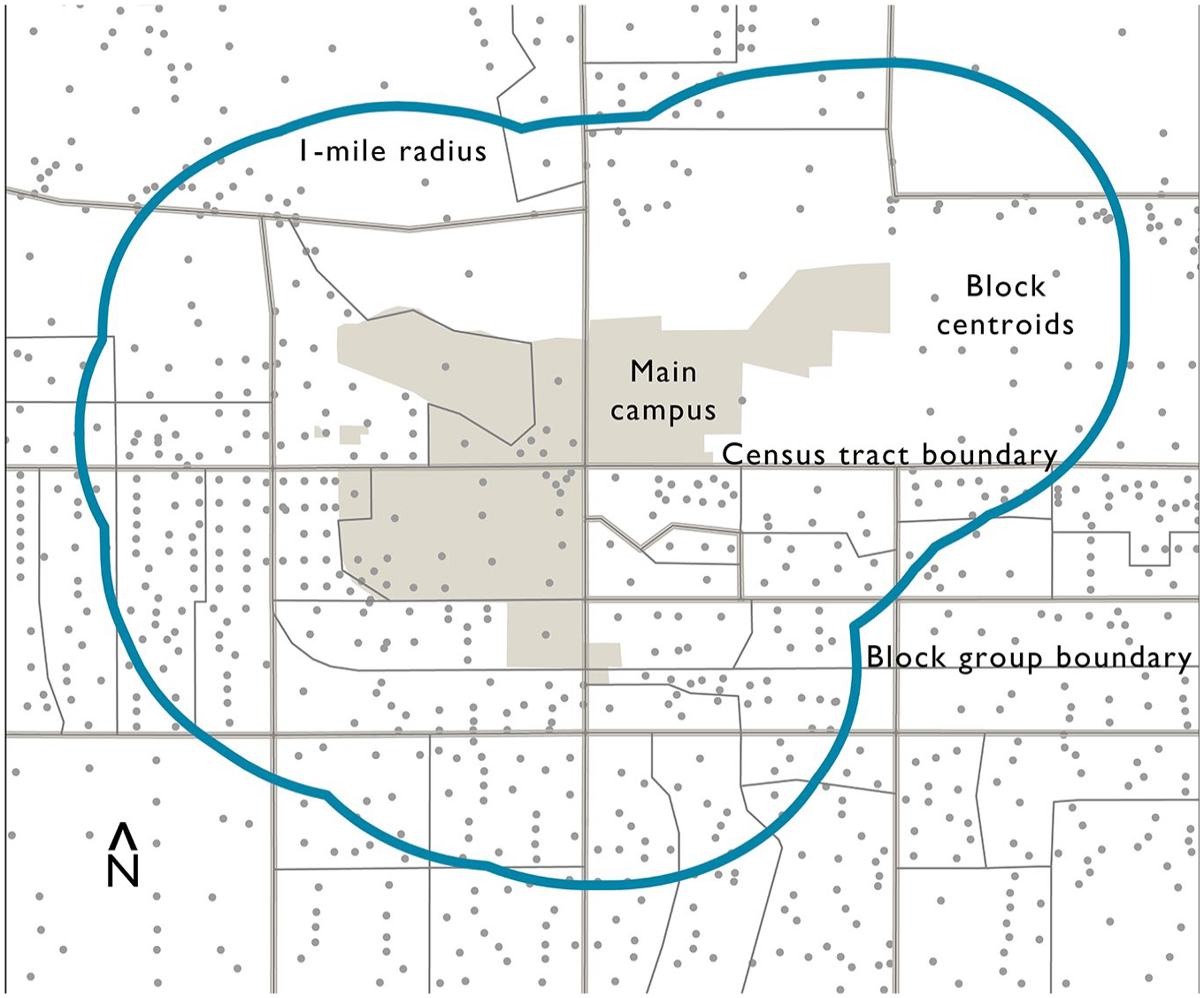
Campus-adjacent tracts data setup example: university campus and 1-mile surrounding area boundary, census tract and block group boundaries, and census block centroids (Arizona State University).
Analytical Strategy
To analyze the amount of rental development by scale, we measure the number of rental units built in university neighborhoods from 2000 to 2018 by building size: one to nineteen unit buildings, twenty to forty-nine unit buildings, fifty or more unit buildings, and the total across all building sizes. 2 Table 1 shows descriptive statistics. These measures—our dependent variables—are skewed count variables, so we ran the Stata countfit command and determined that negative binomial regression models (rather than Poisson or zero-inflated models) have the most appropriate functional form suited to their distributions. Since the dependent variables are unadjusted counts, we control for the baseline number of occupied housing units within a 1-mile radius of the university. We also remove outliers with extremely large campus neighborhoods by this definition, excluding New York University and Columbia University. Since both universities are located in Manhattan, an exceptional environment for rental development, excluding them helps our multivariate analysis better represent nationwide development trends. We cluster standard errors by metro area to take unobserved metro-level correlations into account.
Descriptive Statistics for Outcomes and Model Covariates.
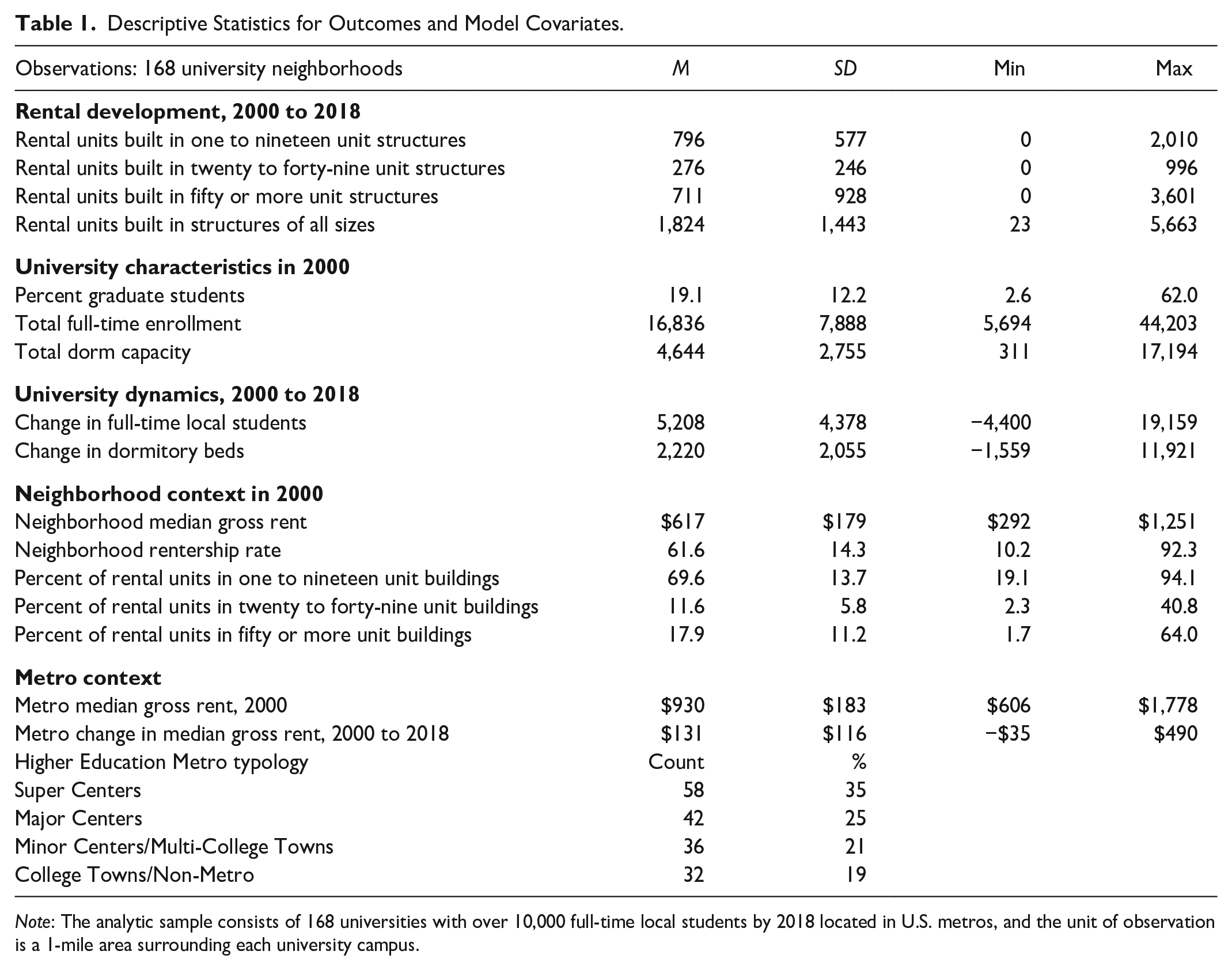
Note: The analytic sample consists of 168 universities with over 10,000 full-time local students by 2018 located in U.S. metros, and the unit of observation is a 1-mile area surrounding each university campus.
Measures
Model covariates include baseline university characteristics at the start of the study period in 2000 and enrollment and dorm dynamics during the study period from 2000 to 2018, as well as measures characterizing the neighborhood and metro contexts. Given the small size of our analytic sample, we include a parsimonious set of covariates.
As a key university characteristic, we include the baseline percent graduate students, which serves as an institutional indicator of research intensity, resources, and prestige that may attract development. Since dormitories are more often provided for undergraduate rather than graduate students, universities with more graduate students may also generate more demand for off-campus housing. We include university enrollment size, measured by the total number of full-time local students, to assess whether more rental housing is built in neighborhoods surrounding larger universities. Dormitory capacity represents the extent to which a university provides housing for its students in the baseline year. A higher dorm capacity indicates a more residential campus, especially when interacted with enrollment size.
Institutional dynamics include changes in enrollment, measured as the change in full-time local students between 2000 and 2018, and dormitory construction, measured as the change in dormitory beds between 2000 and 2018. We expect that increases in enrollment may have fueled demand for off-campus housing and were associated with more rental development. Our expectations around dormitory construction are less clear. On one hand, more dormitory construction might have soaked up student housing demand, serving as a substitute for off-campus development. Conversely, universities that built more dormitories may also partner with and encourage off-campus construction by private developers (Martin and Allen 2009); the two types of development may be complementary in some contexts.
Housing market-related measures include the baseline neighborhood median gross rent. Note that the average rent levels for these university neighborhoods is $617 per month, well below the metro average of $930 per month: most major universities were located in neighborhoods with relatively low rents at the start of our study period. The metro median gross rent is included as well; we expect that university neighborhoods with relatively stronger regional rental housing markets experienced more rental development. We also include the metro change in rents over the course of the study period.
We characterize the neighborhood urban fabric at the start of the study period by measuring the percent renters and the share of rental units in structures with one to nineteen, twenty to forty-nine, or fifty or more units. These measures give a sense of the initial prevalence and scale of the rental housing stock, indicating whether a university is located in more urban versus suburban environments at baseline. Both variables serve as proxies for university proximity to downtown cores, many of which experienced waves of infill and redevelopment during the period since 2000 (Birch 2002; Sohmer 1999; Sohmer and Lang 2001). We expect the share of rental units in similarly sized structures to be especially telling, indicating a precedent that may signal developer willingness and ability to pursue additional projects. As mentioned above, we do not assume that all developments in campus-adjacent neighborhoods are specifically related to university presence; university neighborhoods may be caught up in broader urban trends.
We define the metro context using the Higher Education Metro (HEM) typology (Ehlenz and Mawhorter 2020), which defines metro areas by the scale, structure, type, and quality of HEIs. Our analytic sample contains major universities, often located in larger metros with many HEIs. Over a third are located in Super Centers, which are large, dynamic metros with the greatest concentration of HEIs. Another quarter of our sample is located in Major Centers, which are somewhat smaller, but still contain a wealth of HEIs. A fifth of universities are located in Minor Centers, which tend to have several HEIs, or Multi-College Towns, with several HEIs where one or two large colleges or universities dominate. Another fifth of universities are located in College Towns, which focus around a single HEI, or outside of metro areas.
Analysis and Results
Our first task is to assess the extent and scale of rental housing construction near university campuses from 2000 through 2018. Figure 2 shows the total number of rental units built around each university on the x axis, and the number of those rental units which are in large buildings with fifty or more units on the y axis. A university neighborhood’s position on the scatterplot conveys both the overall amount of rental housing development during the study period and the relative share of rental units which were built as part of large buildings.
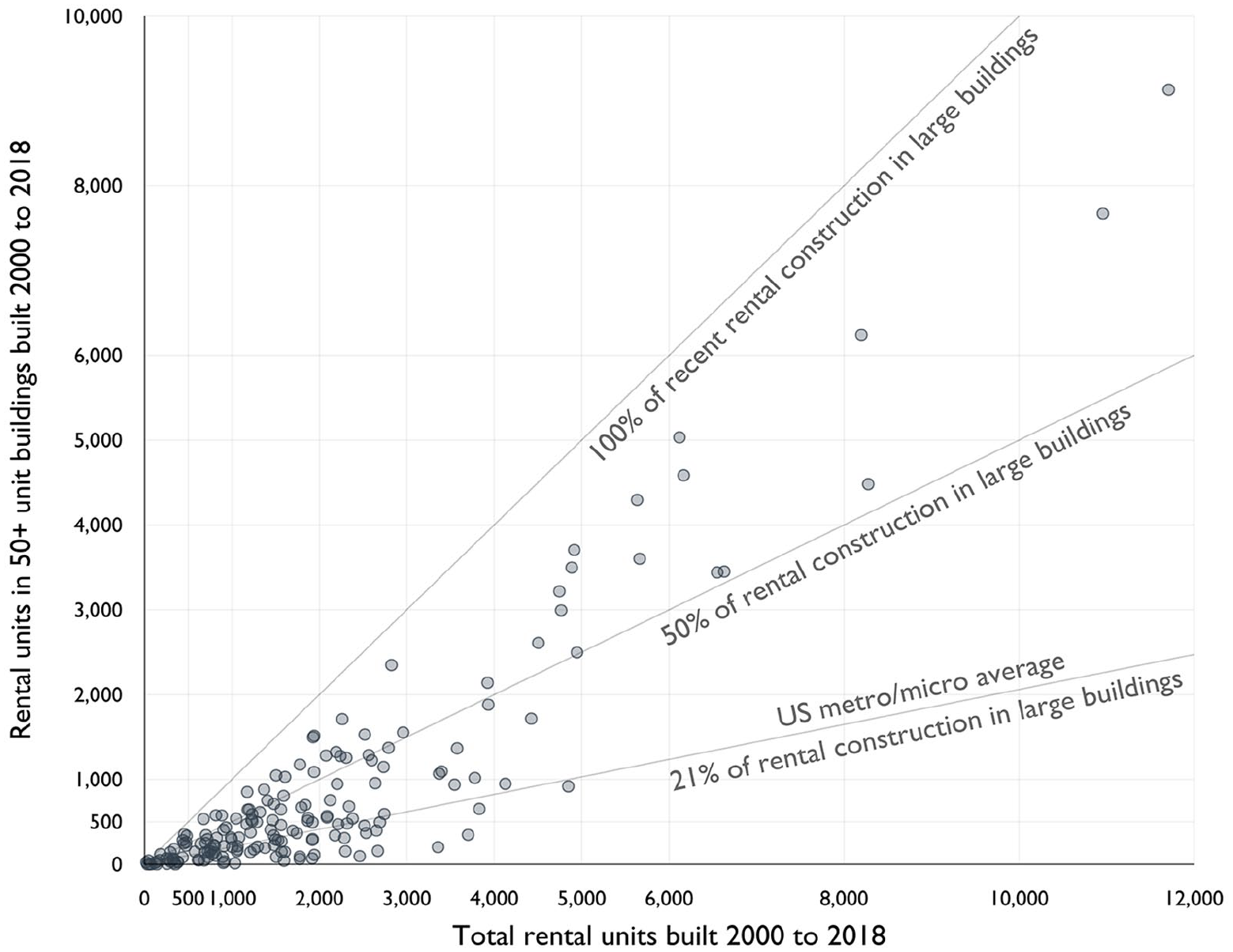
Scatterplot comparing total number of rental units built 2000 to 2018 (x axis) and the number of rental units built 2000 to 2018 that were in structures with fifty or more units (y axis).
On average across the entirety of U.S. metropolitan and micropolitan statistical areas, 21 percent of all rental units built between 2000 and 2018 were in buildings with fifty or more units. Around a third of campus neighborhoods fell below this average. These campus neighborhoods also tended to have less rental development overall. As examples, the University of California Santa Cruz, the University of Massachusetts Amherst, and George Mason University had limited rental housing built nearby, mostly in smaller buildings. Other universities, such as Iowa State University, Temple University, and the University of North Carolina Charlotte, had fairly strong rental housing development nearby, but mostly in smaller buildings.
Another third of campus neighborhoods fell between the U.S. metro/micro average and a 50 percent benchmark, where half of rental construction occurred within large buildings. In the final third of university neighborhoods, the majority of all newly built rental units were in large buildings. These included campus neighborhoods with some of the highest levels of rental housing development, as well as some with more limited rental construction. Universities such as Georgia State University, the University of Minnesota, and Portland State University saw substantial rental housing development in surrounding neighborhoods, nearly all in buildings with more than fifty units—indicative of substantial shifts over earlier development patterns. Figure 3 shows that rental units built between 2000 and 2018 tended to be in larger buildings compared to the scale of rental housing in 2000.
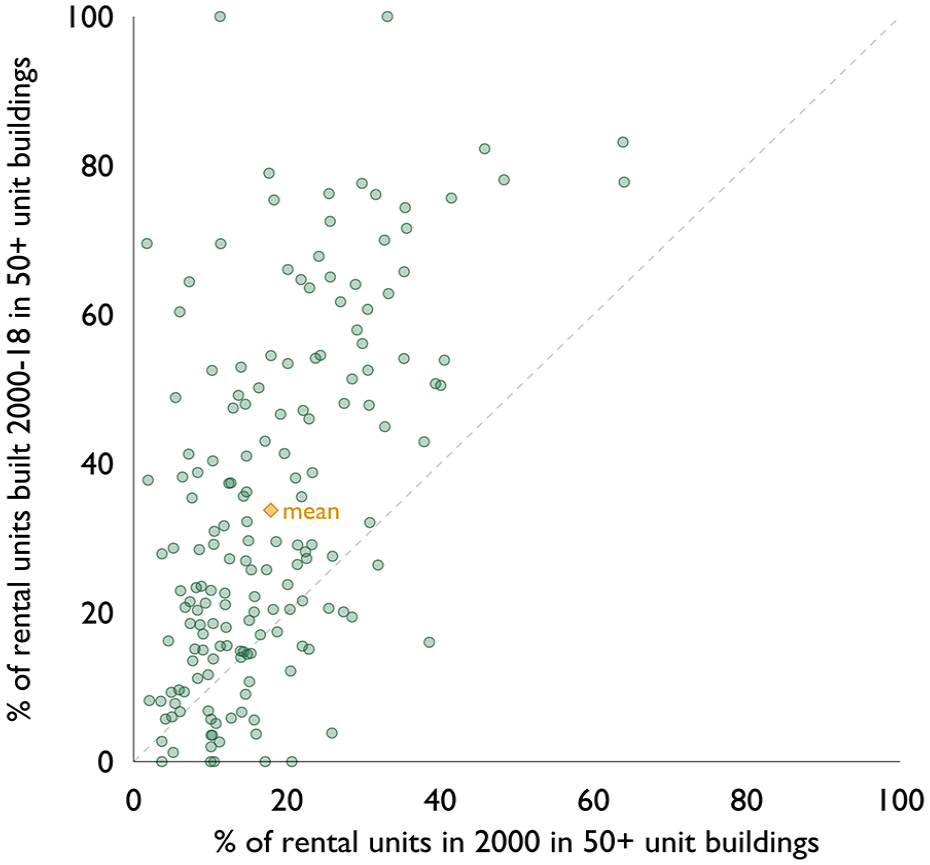
Scatterplot comparing the percent of rental units in structures with fifty or more units in 2000 (x axis) and the percent of rental units built in 2000 to 2018 that were in structures with fifty or more units (y axis).
Still, these results introduce another initial takeaway: while many campus neighborhoods experienced large-scale rental housing construction between 2000 and 2018, a good number of other campus neighborhoods did not. This heterogeneity may be expected among campus neighborhoods located across a wide variety of U.S. urban contexts; still, this indicates that large student-oriented rental housing development is as variable as HEI neighborhoods themselves. Our subsequent models delve further into this variation, seeking to understand the metro and neighborhood conditions that may predispose HEIs to more (or less) rental development.
Multivariate Analysis
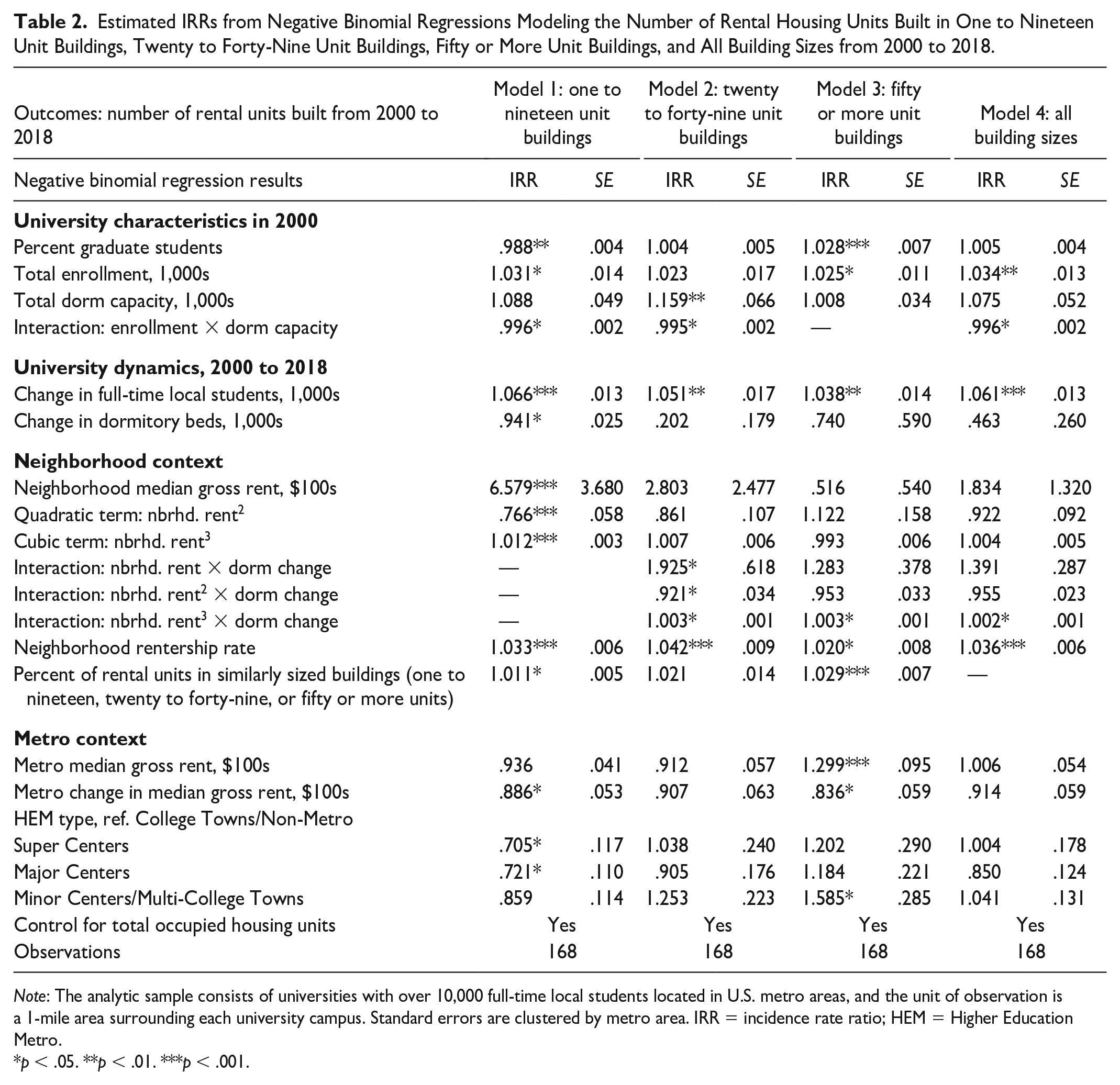
We use negative binomial regression to model the number of rental housing units built in campus neighborhoods between 2000 and 2018, as related to university characteristics and metro and neighborhood contexts. Table 2 lays out the results as incidence rate ratios (IRRs); IRRs greater than one indicate a positive relationship with large-scale rental development, whereas IRRs lower than one indicate a negative relationship. Model 1 analyzes rental units built in small buildings (one to nineteen units), model 2 analyzes units built in midsize buildings (twenty to forty-nine units), model 3 analyzes units built in large buildings (fifty or more units), and model 4 analyzes the total rental units built across all building sizes.
Estimated IRRs from Negative Binomial Regressions Modeling the Number of Rental Housing Units Built in One to Nineteen Unit Buildings, Twenty to Forty-Nine Unit Buildings, Fifty or More Unit Buildings, and All Building Sizes from 2000 to 2018.
Note: The analytic sample consists of universities with over 10,000 full-time local students located in U.S. metro areas, and the unit of observation is a 1-mile area surrounding each university campus. Standard errors are clustered by metro area. IRR = incidence rate ratio; HEM = Higher Education Metro.
p < .05. **p < .01. ***p < .001.
Universities with a higher percentage of graduate students—representing research intensity, funding, and prestige—saw less rental development in small buildings, and more large-scale rental development. On the whole, universities with larger enrollments at the baseline of the study in 2000 saw more development in surrounding neighborhoods. Yet in the case of small, midsize, and overall development, this relationship is mediated by dorm capacity, as shown in Figure 4. Residential universities with higher dorm capacity tended to have low to medium levels of rental development nearby, mostly independent of enrollment size. In contrast, among universities with low dorm capacity, universities with larger enrollment sizes had far more rental housing built in nearby neighborhoods.
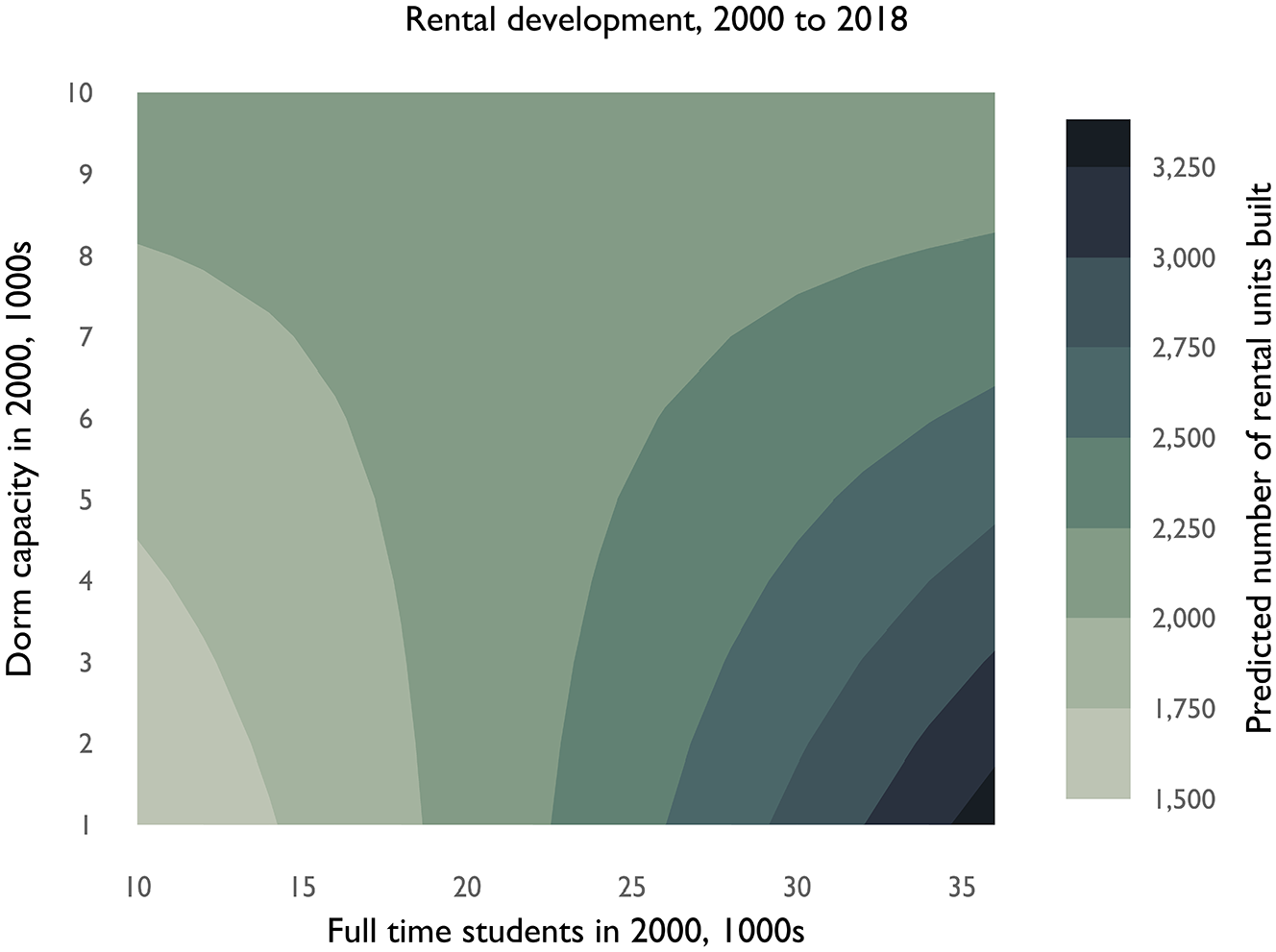
Predicted number of rental units built from 2000 to 2018 by total enrollment and dormitory capacity in 2000, estimates from model 4.
Likewise, increasing university enrollments were associated with more nearby rental development across the board. This signals a relationship between university-led demand increases and nearby development. As expected, there was an inverse relationship between changes in dormitory beds and rental development—at least for small buildings—suggesting that there is substitution going on between dorm construction and private rental development beyond campus. A similar relationship appears for midsize, large, and all development, yet in these cases the relationship between changes in dorm capacity and rental development depends on the neighborhood context, revealed in an interaction term between the change in dormitory beds and the neighborhood median gross rent. Because the relationship between neighborhood rent levels and rental development takes a cubic form, the coefficients with the interaction included are difficult to interpret from the table. 3 Figure 5 represents the estimated amount of overall rental development based on the interaction between the neighborhood median gross rent in 2000 (x axis) and changes in dormitory capacity from 2000 to 2018 (y axis).
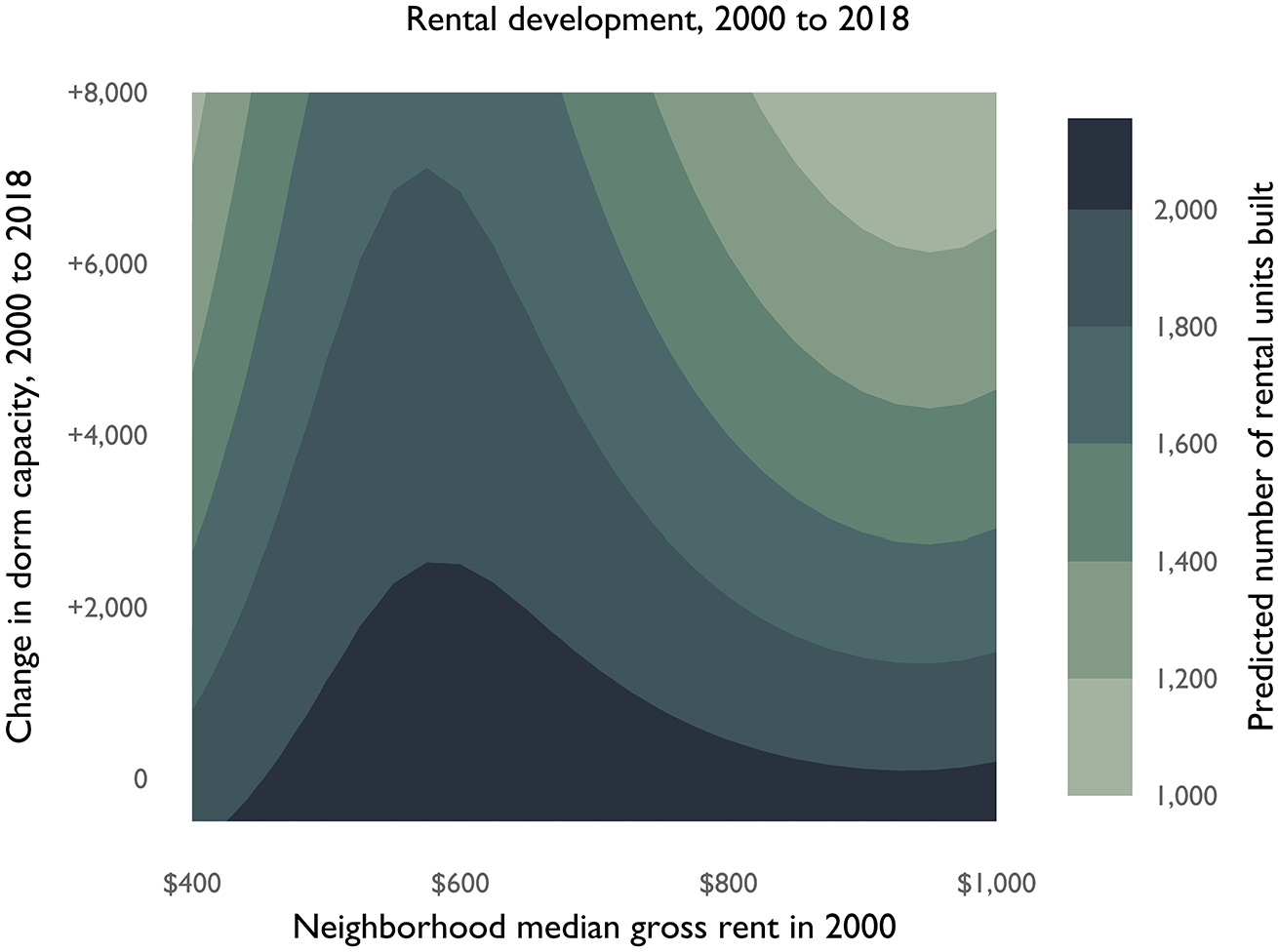
Predicted number of rental units built by neighborhood median gross rent in 2000 and change in dorm beds from 2000 through 2018, estimates from model 4.
The most rental development occurred in university neighborhoods with mid-to-low rent levels around $600 per month. In neighborhoods with higher rents or lower rents, the inverse relationship between changes in dorm capacity and rental development appears even stronger. The highest levels of rental development occurred in somewhat lower rent neighborhoods with limited dorm construction, and the least rental development was built in the highest rent neighborhoods with higher levels of dorm construction.
Universities in metros with higher median gross rents had more large-scale rental development nearby, yet this relationship does not hold for small-scale, mid-scale, and overall rental development. And metro-level changes in rents during the study period were negatively associated with both small-scale and large-scale rental development. This somewhat endogenous relationship could be a signal of broader development constraints: in metros where construction was more limited (including but not limited to university neighborhoods), rental prices would be expected to rise faster.
More rental housing at every scale was built in neighborhoods that had higher rentership rates at the beginning of the study period. And more small-scale and large-scale rental development was built in neighborhoods which already had higher shares of buildings at those sizes, in a continuation of the existing urban fabric.
In terms of the HEM typology, we see that more small-scale rental housing was built near College Town/Non-Metro universities as compared with Major Center and Super Center universities. There is no clear relationship between HEM type and mid-scale rental development. More large-scale rental development was built near Minor Center/Multi-College Town universities as compared with College Town/Non-Metro universities. No statistically significant difference appears between how much large-scale rental development was built between College Town/Non-Metro universities as opposed to Major Center and Super Center universities. With these opposing trends in rental development at different scales, model 4 shows no measurable difference in the overall amount of rental housing built near universities located in different types of metros.
Discussion
Our analysis assesses the patterns of rental development across various types of universities and urban settings across the United States. At the highest level, our study demonstrates that rental development has not followed a single playbook across all university neighborhoods. In alignment with the varied stories presented in case-level research (e.g., Ellis-Young and Doucet 2021; Evans and Sotomayor 2023; Pendall et al. 2022; Revington et al. 2020), our national-level study validates there is variation in rental development around universities. We observe that the type (and amount) of rental development was related to several factors from existing residential context to institutional enrollment growth and on-campus housing capacities.
Our results show how rental development around universities was more likely in neighborhoods surrounding universities with larger student bodies, as well as around universities with enrollment growth during the study period. This suggests a fairly straightforward relationship between student populations and housing demands. Our findings became more nuanced, however, as we considered other factors that may amplify or reduce student demand for off-campus housing. Universities with higher shares of graduate students were more likely to see large-scale multi-family development in their neighborhoods, rather than smaller scale growth. This aligns with what we would expect to see, as university housing stock generally targets undergraduate students and graduate students are far more likely to pursue off-campus options (Kelchen 2018).
Our analysis also revealed a substitution effect between institutional dormitory capacity (and development) and private housing development trends. For larger enrollment universities, we saw that higher levels of dorm capacity were aligned with lower rates of small, midsize, and overall multi-family development in adjacent neighborhoods between 2000 and 2018. Conversely, larger universities with less dorm capacity also saw more rental housing growth in nearby neighborhoods.
The relationship between dormitory capacity and off-campus multi-family development becomes even clearer when we consider the rent levels within nearby neighborhoods. Multi-family developers were most likely to build in mid-to-low rent neighborhoods (peaking around $600 per month in 2000) where there was limited dormitory construction (Macintyre 2003). This suggests that developers saw unmet housing demand, as students had limited on-campus housing choice, and neighborhood market conditions were likely favorable toward multi-family construction (e.g., Evans and Sotomayor 2023; Hubbard 2009; Sage, Smith, and Hubbard 2013). And, even when there was a growing supply of dormitory units in these mid-to-low rent neighborhoods, the development climate still suggests it was favorable to build more multi-family units. Conversely, developers were least likely to build new multi-family projects in the highest rent neighborhoods with growing dormitory capacity. This suggests that the high-cost market conditions did not readily support multi-family construction, perhaps due to land availability and/or high development costs; in this instance, institutionally supported dorms are likely attempting to mitigate tight housing market conditions for students (e.g., Sood and Vicino 2023). At the other end of the spectrum, the neighborhoods with the lowest rents in 2000 were also likely to see lower multi-family development (though not altogether absent) with an inverse relationship to dormitory construction.
Finally, two other relationships emerge between neighborhood or metro conditions and multi-family development trends during our study period, suggesting that pre-existing conditions matter. Where neighborhoods already had high rentership rates, we saw higher levels of multi-family development during the study period. Similarly, the neighborhood’s built environment matters with more small- and large-scale rental projects built in neighborhoods that already had higher shares of that building type. Collectively, our data demonstrate how multi-family rental construction often amplified existing conditions within a neighborhood, perhaps signaling a neighborhood’s tolerance is, in part, rooted in what it already knows and/or what policymakers have already vetted (e.g., Pendall et al. 2022). At a metro level, however, there appears to be more variation among the types of HEI metro context and the multi-family construction. As we would expect, smaller College Towns and Non-Metro HEIs were more likely to have small-scale rental construction than the more dense, higher cost Super Center or Major Center metros. And Minor Centers and Multi-College Towns were more likely to see larger scale rental construction than the College Towns and Non-Metros. But the signals are quite varied across the metro types and seem to suggest that the metro dynamics are less impactful than the neighborhood-level conditions.
Conclusion
Our research goes beyond the existing discourse to engage with broad development patterns across institutional, neighborhood, and metro-level contexts. We can now see that university-adjacent rental construction is happening in many different neighborhoods and at many different building scales; the story is not dominated by a single circumstance or development type. There are limitations to our approach. In examining nationwide trends, the tradeoff is that we cannot engage with the nuances of specific cases within our sample, including the motivations behind and factors driving individual stakeholders and/or projects. Furthermore, the ACS does not offer a complete picture of the approaches taken with individual rental projects, such as ownership structures or detailed amenities. Another limitation is that our focus on large universities (a practical choice based on our need to visually inspect the campus boundaries) may overlook emergent development trends around other types of HEIs, leaving avenues for future research.
Our results do extend our existing knowledge of university-neighborhood housing market dynamics, painting a nuanced picture of their interactions. From one perspective, universities draw students and young professionals to neighborhoods, contributing to housing demand that helps substantiate rental development, particularly in neighborhoods that already have an established precedent for rental housing of various scales and where universities are unwilling (or unable) to meet pent up housing demands on campus. This aligns with case studies that highlight the roles of university leadership and local government stakeholders who leverage university-adjacent housing demand to transform neighborhoods (e.g., Ellis-Young and Doucet 2021; Pillai, Vieta, and Sotomayor 2021; Revington 2022). From another perspective, universities may benefit from locations in vibrant urban neighborhoods with strong potential for development of the urban dormitory. Whether the university or the urban environment is seen in the leading role, both stories are consistent with our results.
What is clear is that in certain campus neighborhoods, the confluence of university dynamics and urban housing market conditions can be aligned with substantial new rental development. This analysis validates case study researchers’ findings on the emergence of large-scale residential developments alongside the financialization of these products, yet underscores that this is context-dependent (Pendall et al. 2022; Revington et al. 2020). Our findings can be understood together with research on young adults’ roles in the revitalization of urban neighborhoods, often termed “youthification” (Moos 2015; Myers 2016; Lee 2020). This study suggests that the role of urban universities should be considered front and center in future research on young adults’ neighborhood choices, as in Revington et al.’s (2021) study.
This highlights an opportunity for institutional and local decision makers to gain generalizable insights into the relationship between a university and its surrounding housing market. For instance, we demonstrate how private developers can fill housing shortfalls via rental construction when university enrollments expand without corresponding investment in dorm construction. Is this the best option? Younger college-aged students may benefit from coordinated efforts to increase on-campus housing with more supportive services—a housing solution that local residents may also prefer over living alongside those same students as neighbors. Alternatively, a segment of the graduate student population may be more appropriately housed in multi-family projects located along strategic corridors with access to mixed uses and campus proximity; others may benefit from university-affiliated family housing options, which can be difficult to find and/or afford in the local rental market. This represents just one opportunity for university and municipal stakeholders to jointly consider the tradeoffs of jurisdictional regulations versus institutional capital improvement plans and budgets, informed by neighborhood and metro-level housing markets.
Collectively, these institution-based pressures introduce critical questions about the future of current rental housing stock in campus-adjacent neighborhoods—for university leadership, developers, students, and local residents alike. Will university-affiliated students continue to generate sufficient demand for additional rental housing near campuses—particularly for luxury-style units? How will older rental stock (especially in less convenient locations) fare as demand changes and new units enter the market? If enrollments decrease, as projected, and fewer students require off-campus housing, which segments of a local rental market will thrive or suffer? And, importantly, how might other non-student renters—unaffiliated with the institution, but seeking a vibrant, youthful neighborhood—factor into these changes (e.g., Ellis-Young and Doucet 2021; Revington 2022)? Our research, and the future research questions it evokes, underscores the importance of local land use and zoning regulations to consider not only short-term appetites for housing development, but also longer term implications for neighborhood markets. Planning and policy responses could help shape the ways neighborhoods experience university-adjacent housing development moving forward, and the overall impacts on local rental markets.
Footnotes
Acknowledgements
The authors thank Rolf Pendall and Kathe Newman for their generative insights and conversations about student housing, which helped to shape this paper. They also appreciate the insights from the anonymous reviewers and editorial support from JPER.
Declaration of Conflicting Interests
The author(s) declared no potential conflicts of interest with respect to the research, authorship, and/or publication of this article.
Funding
The author(s) received no financial support for the research, authorship, and/or publication of this article.
