




Abstract
Globally, cities have been experiencing neoliberal urbanization processes since the 1970s, while also contributing to the production of the neoliberal condition per se. The neoliberal state plays a core role in such processes, which have deepened the commodification of urban space via various mechanisms such as the privatization of public land and key urban infrastructure. This article critically investigates the direct involvement of the neoliberal state in the commodification of urban space by focusing on its triple role as a restructuring mechanism, a land developer and a volume housing developer in Turkey. The research develops and applies a theoretical framework based on Lefebvre’s production of space and Gramsci’s theory of hegemony. The paper examines the development of branded housing projects, which are private neighbourhoods, by analysing national legislative and organizational changes leading to the production of this type of development and illustrates this using four example projects in Istanbul. The paper contributes to the international evidence of the variegated characteristics of the neoliberal state in relation to urban development, and the neoliberal state’s role in the accumulation of capital in contemporary capitalism.
Introduction
Since the early 1970s, neoliberalization has become a global phenomenon and assumed hegemonic status as the contemporary phase of capitalist development (see Brenner and Theodore, 2002; Harvey, 2007; Peck et al., 2009). Neoliberalization has been produced and contested globally in urban areas (Boyle et al., 2008; Peck et al., 2013); therefore, the contemporary dynamics of the production of space (Lefebvre, 1992) are intrinsic to neoliberalization processes per se. Brenner et al. (2010) stress that, despite many differences, neoliberalization practices share the common aim of deepening and expanding the realm of commodification (cited in Aalbers, 2013). Given urban space’s role in the survival of capitalism (see Lefebvre, 1992), it plays a critical role in developing and reproducing neoliberalization through expanding the commodification of urban space.
The neoliberal restructuring is far from being a product of the so-called laissez-faire. It is deliberately constructed by the hegemonic classes as an ideological project, which Harvey (2007) points out as a defining feature of neoliberalization. The production of the neoliberal state per se is a major part of this restructuring. Aalbers (2013) points out that the neoliberal state adopts the ways of corporations within the state apparatus rather than being non-interventionist in relation to markets. In Gramsci’s terms, ‘new spaces’ or a ‘new model’ of development are central to the processes of capitalist restructuring and help to create a new institutional and spatial fix. It is within this context of social regulation and promoting capital accumulation that the development of private neighbourhoods this paper focuses on should be viewed (Harvey, 2005).
The article examines the role of the neoliberal state in the contemporary commodification of urban space through the case of private neighbourhoods, called branded housing projects, and developed by public–private partnerships in Istanbul, Turkey. The case of Turkey provides a valuable milieu for such an investigation because of its neoliberal restructuring and expansive urban development in the last two decades. Aligning with global trends, since the early 1980s Turkey has been experiencing dramatic neoliberal restructuring. The country was hit with an economic crisis in 1999 while under this restructuring and responded to the crisis with even more widespread neoliberalization, which has continued since then. The neoliberal state plays two key roles in deepening the commodification of urban space in this case: as the main regulatory mechanism in restructuring modes of production and allocation of resources, and as a direct player in urban development (as a land developer and a volume housebuilder).
This paper is based on a multifaceted research project analysing the development processes of branded housing projects, their discursive formation and the spatial practice that the projects produce in order to investigate the deepening of the commodification of urban space under neoliberalism. The wider research applied a mixed methods strategy by conducting document analysis (of grey literature such as reports and publications by public agencies and professional associations, master plans and enacted laws and regulations), a critical discourse analysis on mass media content regarding these projects and interviews with residents and non-residents of these projects. The data was collected during two periods of fieldwork in Istanbul in 2014 and 2015, which included data collection visits to relevant institutions (e.g. state developers – TOKI and Emlak Konut REIT, Istanbul Greater Municipality), archival work at the Istanbul Observatory of French Institute for Anatolian Studies and site visits to 28 branded housing projects (developed in partnership with Emlak Konut REIT) in Istanbul. This paper, however, focuses only on the development processes aspect of this wider research. Therefore, the paper discusses the state’s role in the development of branded housing projects in Turkey, and thus in urban development more widely, by focusing on three key aspects: as a regulating and restructuring agency, as a land developer and as a volume housing developer. Firstly, the state’s role as a regulating and restructuring agency is discussed through the lens of the neoliberal restructuring of the legal and regulatory framework for urban development in Turkey and the transformation of TOKI and Emlak Konut REIT into state developers equipped with extensive authority over urban development processes. Secondly, the article discusses the state’s role as a land developer by focusing on the accumulation of an extensive land portfolio in the hands of these state developers as an example, introducing public land into the real estate market as a function of the neoliberal state and discussing the privatization of public land through the branded housing projects developed in partnership with private developers. Thirdly, the article discusses the state’s role as a volume housing developer by focusing on the provision of housing units for the housing market by the state and the private provision of services through this practice, thus privatizing municipal services. Finally, the paper concludes that the neoliberal state plays a crucial role in the contemporary commodification of urban space by shaping the regulatory mechanisms in favour of commodification and by privatizing formerly public land and key urban services via its direct involvement with the private housing market. As a result, it becomes a key apparatus for fostering capital accumulation via urban development.
A nuanced approach to understand contemporary commodification of urban space
While cities are ‘major basing points for the production, circulation and consumption of commodities’, they are also intensively commodified, as many prominent scholars agree upon (Brenner et al., 2009: 178). Despite this consensus on the commodity character of urban space, the dynamics behind it are not fully understood and are worthy of exploration. This paper seeks to contribute to this on-going debate. The key aspect to consider for this exploration is the drive behind commodification as capital accumulation. In order to explain the relationship behind commodification and capital accumulation, Harvey (2003) returns to Marx’s original concept of primitive accumulation and redefines it as a continuous process, calling it ‘accumulation-by-dispossession’.
While Marx defines primitive accumulation as the starting accumulation for capitalist production relationships, for Harvey (2007), ‘accumulation-by-dispossession’ defines the capital accumulation processes as continuous dispossession. The primitive accumulation / accumulation-by-dispossession is a process of realization of capital accumulation by transforming something into a market commodity. To illustrate, when the public privatizes health or education facilities, it is dispossessed of these facilities, whilst these facilities enter the market as commodities and contribute to the accumulation of the capital in the hands of private enterprises. Harvey (2005) identifies four elements of primitive accumulation/accumulation-by-dispossession: privatization, financialization, management and manipulation of crisis and state redistributions. Although these four are relevant in the context of neoliberal urbanization practice, this research focuses on two key aspects: state redistributions and privatization.
Exploring the dynamics behind the commodification of urban space via state redistributions and privatization requires a framework integrating the dynamics of the production of (urban) space and the state’s role in them. In order to shed light on these, the paper bridges two influential approaches and develops a theoretical framework based on Lefebvre’s production of space and Gramsci’s theory of hegemony. Bridging these two theories contributes to a wider and deeper understanding of the contemporary commodification of urban space, the role of the neoliberal state in this commodification and, therefore, capital accumulation through urban space. We recognize and note that other theoretical approaches, such as state theory, may be helpful as a framework for analysis (for a good summary of the main approaches, see Jessop (2001)). However, for the purposes of this paper, we argue that this bridging provides a nuanced approach by expanding our understanding to include intrinsic relationships among various dynamics of production of space while factoring in the state’s role in building hegemony in relation to these dynamics. Therefore, via this bridging the research proposes a multi-layered approach including the examination of the various dynamics behind the process of commodification of urban space and discussing political society’s different roles in facilitating and promoting the commodification of urban space.
The main idea behind Lefebvre’s conceptual framework is that ‘(Social) space is a (social) product’ (Lefebvre, 1992: 26). Lefebvre (1992: 85) summarizes the intrinsic relationships behind the production of space as ‘a unity of the forces of production and their component elements (nature, labour, technology, knowledge); structures (property relations); superstructures (institutions and the state itself)’. The framework should acknowledge the power dynamics among aspects of hegemony building, rather than domination of the state as an absolute power. In this respect, Gramsci’s theory of hegemony provides a perspective on the state’s role in building hegemony while acknowledging its relationships with other aspects, particularly civil society. Kipfer (2002: 119) refers to the potential of this bridging to develop ‘an understanding of the reorganization of capitalism by extending recent middle-range analyses of “urban hegemony” from state theory and urban political economy to everyday life’. Taking its cue from Kipfer’s original suggestion, this research develops a fuller theoretical discussion of this bridging of Lefebvre and Gramsci, and applies it to an actually existing empirical case study in order to understand the contemporary commodification of urban space further.
According to Gramsci, political society corresponds to ‘a sphere of “domination”, the organ or instrument of the oppression of one class by another’ (Gramsci, 2000: 429). While instruments of domination are mechanisms of the state, consent-producing institutions such as religious institutions, schools and media are institutions of civil society (Kumar, 2007). Civil society is ‘the sum of social activities and institutions which are not directly part of the government, the judiciary of the representative bodies (police, armed forces)’ (Gramsci, 2000: 420). This theoretical framework acknowledges the role of civil society together with its interrelations with representational space (see below) as another key set of dynamics behind contemporary commodification, 1 while focusing on the role of political society in the commodification of urban space in this paper.
Lefebvre (1992) elaborates on the dynamics of the production of space with the triad of representations of space, representational space and spatial practice. While representations of space are the space that the experts interpret with their various frames and reproduce, spatial practice is ‘physical form, real space, space that is generated and used’ (Elden, 2004: 190), and representational space embodies ‘complex symbolisms, sometimes coded, sometimes not, linked to the clandestine or underground side of social life’ (Lefebvre, 1992: 33). In this paper, we focus on the roles of representations of space and spatial practice in the commodification of urban space by interrelating these with the position of political society under neoliberalization.
In the following sections, this article presents the results from applying this framework to the case of Turkey. We firstly present the changing structure of the neoliberal state through its role as a regulating and restructuring agency. We secondly discuss political society as a sphere of domination for facilitating capital accumulation and producing an apparatus that enables the commodification of urban space (by changing the regulatory framework, creating TOKI and privatizing public land) and private provision of municipal services (through branded housing practices). We thirdly present the development processes of four example projects, which show the role of centrally produced master plans in these processes. Therefore, the effects of changing the regulatory framework and centrally produced master plans show the role of representations of space in the commodification of urban space as part of political society’s practice, while the private provision of services through branded housing practices shows how changing spatial practice contributes to the commodification of urban space by expanding the commodity realm into everyday life.
The neoliberal state as a regulating and restructuring agency
In this section, we discuss the changing role of the state in urbanization in Turkey as a regulating and restructuring agency following recent deepening in neoliberalization. The section discusses this through a brief overview of neoliberal state formation in Turkey, and the creation of a central apparatus for the state’s involvement in urban development by transforming TOKI from a mass housing institution into a key state developer. This is an illuminating example regarding the neoliberal state’s role in fostering accumulation of capital and power.
The restructuring of the neoliberal state in Turkey goes back to the early 1980s. Turkey went through a severe economic crisis in the late 1970s. A neoliberal restructuring programme was launched in 1980 to respond to this crisis (Yilmaz, 2006). This was the first programme of Turkey’s neoliberalization, led by the International Monetary Fund (IMF) and World Bank, and the start of integrating Turkey’s economic system with the global neoliberal economic order (Cosar, 2012). The programme proposed a structural change from an import-substitution industrialization economic model to an export-oriented market economy (Pamuk, 2008). It was followed by a military coup d’état 2 in 1980 and the technocratic government founded by the coup immediately adopted this roll-back neoliberal programme (Bayirbag, 2010). As a result of this transformation, the post-1980 period was a milestone for redistribution policies and accumulation of capital in the country (Balaban, 2013).
The 2001 economic crisis hit during this restructuring processes. This crisis was defined as a demarcation of a new phase for political economic history in Turkey, a major accumulation crisis (Kuyucu and Unsal, 2010) and a breaking point for further neoliberalization of the country (Eraydin and Tasan-Kok, 2013). Since the late 1990s and early 2000s, neoliberal restructuring deepened with further IMF agreements in 1998 and 1999 (Ataay, 2006), which led to the second structural adjustment programme in 2001 (Balaban, 2013). This was a roll-out neoliberalization programme (Bayirbag, 2010), which was enacted by the ruling government as a response to this 2001 economic crisis.
Since 2001, successive governments have followed the same path for further neoliberalization (Ozdemir, 2012) and continue to implement this roll-out neoliberalization programme. In this period, the regulations that were imposed by the IMF for this restructuring were implemented at a greater pace than during the 1990s (Onis and Senses, 2009). The neoliberal policies were enacted by means of expansion in Turkish export markets, foreign investment and privatization (Keyman and Gumuscu, 2014), as well as the foundation of independent regulatory agencies (Marois, 2018). The programme aimed to privatize public assets to generate income (Balaban, 2013). By the end of the 1990s, the regulatory framework had been transformed in order to enable privatization (Atiyas, 2009) and continued to be amended in favour of privatization in the 2000s as well (Bugra and Savaskan, 2014). The revenue from privatization started to increase starkly after 2004 (Bugra and Savaskan, 2014). Within the 10 years following 2002, 34 billion US dollars-worth of privatization were realized (Keyman and Gumuscu, 2014).
This brief summary of neoliberalization in this country shows that the formation of the neoliberal state is far from being a process of creating a non-interventionist state. By rolling out successive programmes, state interventions were transformed in favour of the market and capital accumulation.
Since 1980, cities and urbanization have become central areas for the accumulation of capital (Bayirbag, 2010). While manufacturing investments have decreased, the urbanization of capital in Turkey has increased, starting with public and private sector investments in energy, communication, housing and construction (Bayirbag, 2010). In the last four decades, mega-projects (e.g. mass housing projects, big infrastructure projects) have been developed (Kaygalak, 2009), and house-build starts have outnumbered the increase in households (Turel, 2004).
In the 2000s and 2010s, there had been a construction boom in cities in Turkey. Balaban (2012) defines this as an increase in the volume of construction activity, as reflected in the unprecedented rise in the construction sector’s share of gross domestic product (GDP), in the share of the construction sector in employment and in financial and capital investments in construction during the years 2001–2007. The number of new construction companies founded per year doubled in this period, while also foreign direct investment in construction and the real estate sector dramatically increased from US$ 6 million to US$ 987 million between 2004 and 2008 (Balaban, 2012). The expansion of construction has been continuing, with fluctuations (TUIK, 2013) 3 ). The total area of buildings that was granted building permits increased almost fivefold between 2002 and 2012. In this period, investment in the housing sector has also increased, and capital movement from other sectors (e.g. tourism or textiles) into the housing sector has been documented (Perouse, 2013).
Moreover, the number of urban development projects, such as mega-projects, private neighbourhoods and (so-called) social housing projects, has risen, and project-based development became the mainstream way of development in the post-2001 period (Balaban, 2013). Kuyucu and Unsal (2010) stress the neoliberal character of these projects and define large urban redevelopment projects as the main mechanisms for neoliberal restructuring in urban governance and housing markets in Turkey. Through these projects ‘a neo-liberal system is instituted in incompletely commodified urban areas’ (Kuyucu and Unsal (2010: 1479). No statistics are produced documenting the project-based developments; therefore, their total number is not fully known. The volume of this increase can be traced by focusing on some particular types, such as housing projects. To illustrate, a fairly comprehensive web portal for housing projects in Turkey – Yeni Projeler (New Projects) – lists 2115 projects located in Istanbul by June 2018 (Yeni Projeler, 2018).
In the 2000s and 2010s, neoliberal restructuring became more visible in Turkey’s urban space not only through the construction boom and piecemeal project-based developments, but also particularly through the development of private neighbourhoods called ‘branded housing projects’. The projects have been designed as segregated areas within the city by being gated and walled. These private neighbourhoods have been providing key urban services privately and exclusively for their residents within their confines, including social facilities, open green spaces and sport facilities. The projects have been produced under certain brands, which became a defining feature of these developments. The projects have been clustered particularly in Istanbul as the largest metropolitan area and the financial centre of the country. The number of branded housing projects built in Istanbul by 2014 was documented by EVA Real Estate as 852, which corresponds to 7.7% of the total housing stock in this city (Milliyet, 2014). For such developments there is neither consensus on the terminology in the literature on urbanization in Turkey, nor a legal definition, although there have been attempts to classify them (see the typologies proposed by Kurtulus (2005) and Akgun and Baycan (2012), and Tasan-Kok (2012) for a broader classification of patterns of segregation in Istanbul, including gated communities). As a result, various terms are used interchangeably, including private town (Candan and Kolluoglu, 2008), gated community (Baycan-Levent and Gulumser, 2004), gated residential compound (Candan and Kolluoglu, 2008), closed residential complexes (Perouse, 2005) and gated schemes (Aydin, 2012; Genis, 2012; Perouse, 2011). Due to the lack of records and a legal definition, Akgun and Baycan (2012) point out the difficulty of working on private neighbourhoods in Istanbul. Despite the variation, private provision of services and facilities exclusively for the residents remains a defining feature of these projects. The term ‘branded housing project’ is used in everyday language and by mass media outlets in Turkey, referring to recently developed branded private neighbourhoods, and is not differentiated as a particular version in the academic literature. In this paper (and in the wider research that this paper is based on), we use the term ‘branded housing project’ to refer to the developments we investigate.
The production of private neighbourhoods goes back to the 1980s (Kurtulus, 2005), which Altun (2012) relates with the early neoliberal restructuring process in Turkey. Genis (2007: 773) argued that in Turkey ‘the emergence and spread of gated communities has been facilitated by the neo-liberal policies of the state’ in addition to major developers that promote ‘gated communities as a “modern” solution to a city’s housing problem and disorderly development while supporting extensive commoditisation, privatisation and transnationalisation of housing provision’. The key difference between the branded housing projects developed in the 2000s and the earlier private neighbourhoods, which are mainly referred to as gated communities in the literature, is the fact that the state plays a direct role in the development of the former, 4 whilst private neighbourhoods in the 1990s were mostly developed by private developers. This involvement makes a difference in their development processes and land acquisition (and allocation) practices, which is discussed further in this paper. The effect of this role is that, since the early 2000s, branded housing projects have expanded over Turkey’s cities and can now be found at different scales (from projects accommodating a couple of hundred houses to thousands – e.g. Evora Istanbul, which aims to accommodate 20,000 people (Evora Istanbul, 2018)). This extensive provision of housing via branded housing projects makes the phenomenon itself worth exploring, in addition to political society’s engagement in their promotion and privatization of public land via these projects. It is also worth exploring what they offer within their confines to fully understand their role in the privatization of municipal services. All of these overall provide a picture of the role of the state in neoliberal urbanization of this country.
The state has played a key role as a restructuring agency by changing the whole legislation in favour of urban development. This, in general, fostered the commodification of urban space in Turkey by eliminating the legal and regulatory obstacles to more construction and transforming the regulatory framework into an enabling one for even more construction. To illustrate, between 2002 and 2007, in Turkey 78 laws and 10 by-laws that are related to the built environment, urban planning and development control were completely or partially changed or enacted (Balaban, 2012).
With the deepening of neoliberalization in Turkey, TOKI, the Mass Housing Administration of Turkey, was transformed to become an apparatus for the state’s direct involvement in construction and fostering accumulation of capital vis-à-vis urban development. The transformation is a remarkable example of the development of centralized tools for top-down neoliberalization of urban development. TOKI was founded as a mass housing agency with responsibility for credit provision for general housing production in the 1980s (Bugra and Savaskan, 2014), when policies fostering accumulation of power in the centre were implemented along with neoliberalization (Bayirbag, 2010). Through TOKI, the state became involved in mass housing production mainly by funding housing cooperatives. In 1985, the Mass Housing Fund financed 31% of total housing investments (Tekeli, 2010). However, in 1988 the income from the Mass Housing Fund started to be transferred to the national budget (Tekeli, 2010), and gradually TOKI lost its transformative role in urbanization and housing until it was restructured for a new role in the post-2001 period. The post-2001 transformation has turned TOKI into a leading actor in the construction industry (Balaban, 2013), which corresponds to deepening of neoliberalization in Turkey as a response to the 1999 crisis. The authority of the institution was expanded drastically. This restructuring has been realized incrementally since 2001 and follows the restructuring of the legislative framework, equipping the central institutions with a level of authority that fosters the accumulation of power (see Table 1 for details of the expansion of TOKI’s authority and remits). TOKI became a massive organization that controls credit provision for urban development, makes plans at various scales, develops any type of urban development project and realizes all of these centrally without any control over these practices by local authorities. The expansion of the planning remits of TOKI is a key example of this transformation, showing that in the post-2001 period planning authority has been accumulated in the hands of central state institutions (Tasan-Kok and Penpecioglu, 2017).
Expansion of TOKI’s authority since the start of its restructuring in 2001 (source: authors’ original).
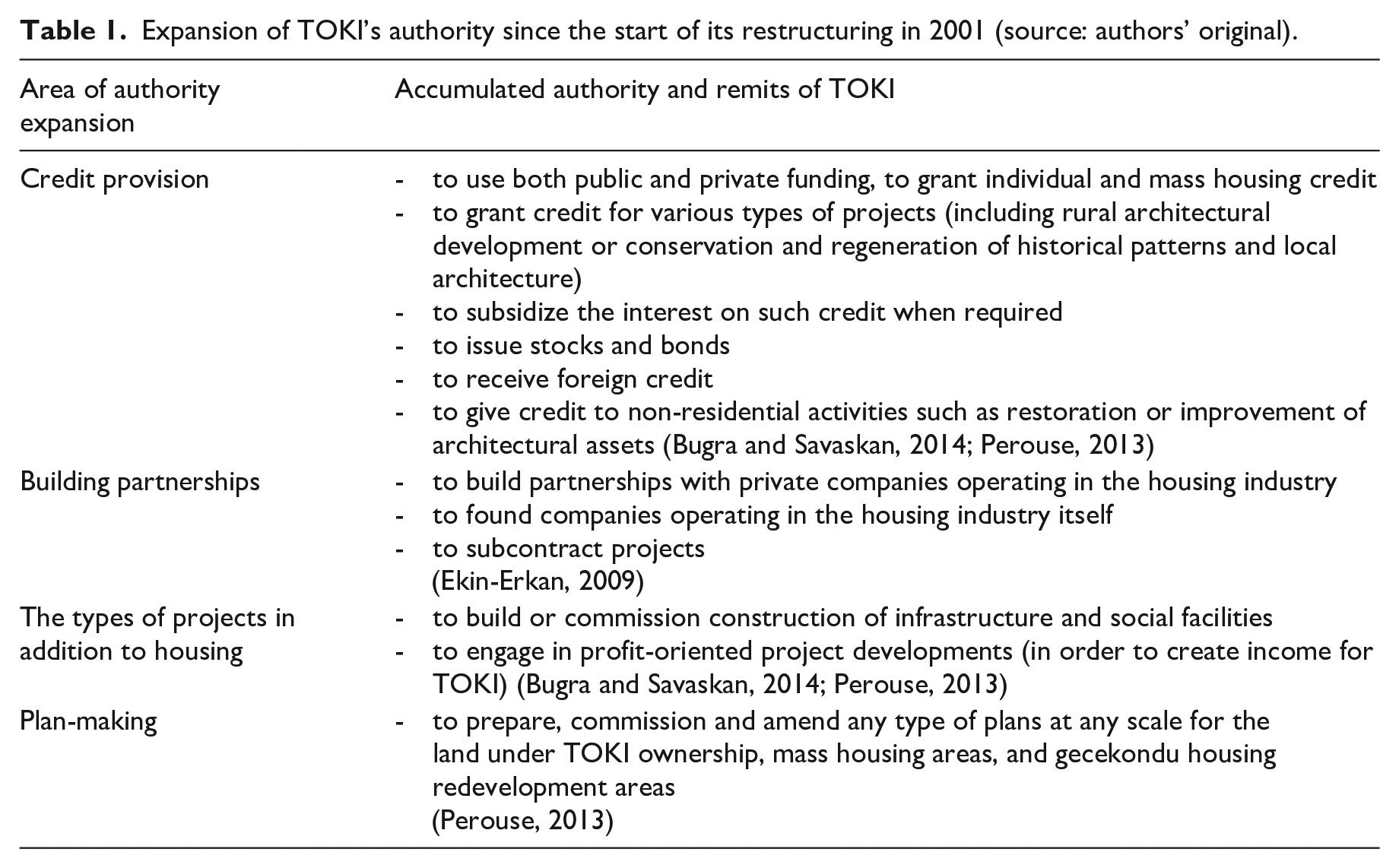
This transformation overall demonstrates the role of political society (Gramsci) in fostering commodification of urban space through restructuring of the legal and regulatory framework in favour of the accumulation of power. These authorities and legal remits accumulated in the hands of central institutions foster the accumulation of capital, through the following roles of the state as a land developer and the state as a volume housing developer, as we will see next. In addition, the expansion of the planning remit is a critical example of the production of representations of space (Lefebvre) via the central state rather than leaving this to local authorities.
The neoliberal state as a land developer and privatization of public land
In this section, we discuss the neoliberal state’s land developer role in the privatization of public land and how TOKI was operationalized by being transformed into one of the biggest landowners in Turkey (Perouse, 2013).
Through this restructuring, the state has been able to introduce public land from the portfolios of several public institutions into the private housing market by accumulating publicly owned land in the hands of TOKI. Competencies, public land, assets and real estate belonging to some public institutions (such as Emlak Bank and the Urban Land Office) were transferred to this institution’s portfolio (TOKI, 2015). In addition to direct transfers, the law enacted in 2003 (Law no 4966) granted TOKI the authority to demand the transfer of public properties to its use free of charge 5 (Ekin-Erkan, 2009). This, therefore, gives TOKI the authority to develop on any public land, and it has started to play a crucial role in reintroducing urban land into the real estate market (Perouse, 2013). TOKI started to develop explicitly profit-oriented residential projects for private ownership by higher middle-income groups, thus opening public land to the development of private housing units. 6 TOKI and Emlak Konut REIT as its enterprise operate in many cities where public land is available to develop, although this research focuses on the projects developed in Istanbul by the latter.
This institutional transformation became a direct intervention in the land ownership pattern and property ownership in the country. As Lefebvre emphasizes, this process is a part of the production of space through structures (as property relations) and superstructures (as institutions and the state itself). From a Gramscian perspective, the practice is a clear example of political society’s direct role in fostering capital accumulation through the commodification of urban space. By using its monopolistic power over public land, the state fosters accumulation-by-dispossession (Harvey, 2005) by privatizing public land via developing these projects on it.
The neoliberal state as a volume housing developer
Through the restructuring discussed in the previous sections and having directly entered the real estate market, the state played a core role in the recent increase in the volume of construction activity in Turkey. In this section, we firstly discuss the creation of Emlak Konut Real Estate Investment Partnership (Emlak Konut REIT) as an establishment of TOKI, which extensively produces branded housing projects. We narrow down to the practice of Emlak Konut REIT, as its restructuring has made the institution the most functional enterprise of TOKI (Perouse, 2013). Secondly, we discuss the revenue-sharing model that is implemented to develop branded housing projects with the private developers. Thirdly, we discuss the private provision of key urban services via branded housing projects, as this has become an extension of the commodification of urban space via the practice of branded housing projects. The private provision of key urban services by these projects expands the commodification of urban space to key urban services.
Emlak Konut REIT has undergone a comprehensive restructuring, from being a bank to becoming a real estate investment partnership with 49.34% of the total shares belonging to TOKI, while 50.66% of the shares are open to the public (Emlak Konut REIT, 2015a). Emlak Bank (meaning Real Estate Bank) was founded in 1926 as Emlak Etyam Bank, in order to provide funding for new development (Adam et al., 1981). In 1946, the bank was converted into a housing-specialized bank aiming to support homeownership and was rebranded as Emlak Kredi Bankasi (meaning Real Estate Credit Bank) (Adam et al., 1981). Although one of the objectives in the government programme of 1974 was that Emlak Kredi Bankasi would produce affordable and mass housing, according to Adam et al. (1981) this institution has never been a funding body for low-income groups. In 2001, the institution underwent further transformation as its banking responsibilities and holding savings were terminated (Perouse, 2013), and the banking activities of the institution were transferred to two public banks (Ziraat Bankası and Halkbank), while its assets and real estate were transferred to TOKI (2015). Through this transformation, Emlak Konut REIT became a TOKI enterprise and one of the largest real estate investment partnerships in Turkey (Perouse, 2013), with its value reaching US$2.2 billion by 2015 (Emlak Konut REIT, 2016).
For the branded housing projects, a partnership model called the ‘revenue-sharing model’ 7 was developed and implemented. The model 8 is based on sharing profits generated by the projects among the public and private partners. While the public partner provides land for the project, the private developer develops and realizes the projects, and the institutions share the generated revenue (Table 2). Emlak Konut REIT defines this model as a way to ensure ‘high profitability and fund flows’ (Emlak Konut REIT, 2015c: 25) and the ‘most important model in terms of generating income’ (Emlak Konut REIT, 2015c: 25). By 2014, Emlak Konut REIT had developed 43 branded housing projects in Istanbul alone through applying this model, while valuable land owned by the institution has been developed as income generation projects since 2004 (Sayistay, 2013). 9
Summary of the revenue-sharing model (source: Emlak Konut REIT, 2015b).
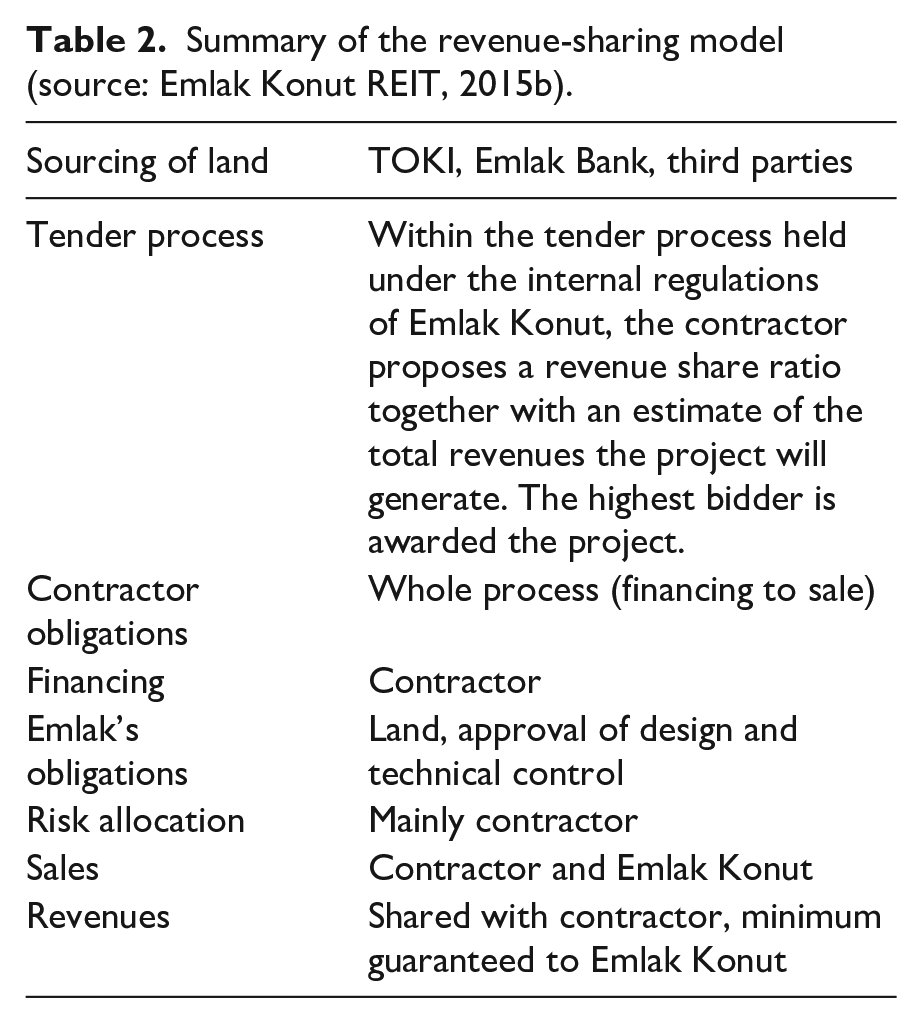
An analysis of Emlak Konut REIT projects developed in Istanbul showed that the ratio of revenue that Emlak Konut REIT received from the development of the projects is around 30% in return of the land provided by the public. This ratio itself is controversial considering the ratio of the cost of land in the total construction cost of housing projects in Turkey in land-scarce areas. Whilst Yuksel (2006) states that the actual ratio of the cost of land is above 50% of the total construction cost of housing, Pakdemirli (2006) mentions that this ratio is even higher and has reached up to 70% of the total construction cost (cited in Coskun, 2015).
Further insights into the development processes of branded housing projects by Emlak Konut REIT were gained through the examination of four selected projects located in Istanbul, which are presented here to illustrate and detail the more generic process described heretofore. This examination also demonstrates how the representations of space is produced through political society.
The four projects were developed using the revenue-sharing model and selected from the two districts where Emlak Konut REIT projects are clustered due to the availability of vacant public land at these locations. Two projects (Agaoglu My World Ataşehir Project and Kent Plus Ataşehir) are located in Atasehir District in the eastern part of Istanbul and two in Ispartakule District (Ispartakule Project and Bizim Evler 4) in the north-western part of the city (Figure 1). The two districts are similar in that they are close to the main connector roads, but different in terms of their surroundings. While the mass housing area at Ataşehir is surrounded by existing urban fabric, Ispartakule District is located on the periphery of Istanbul.
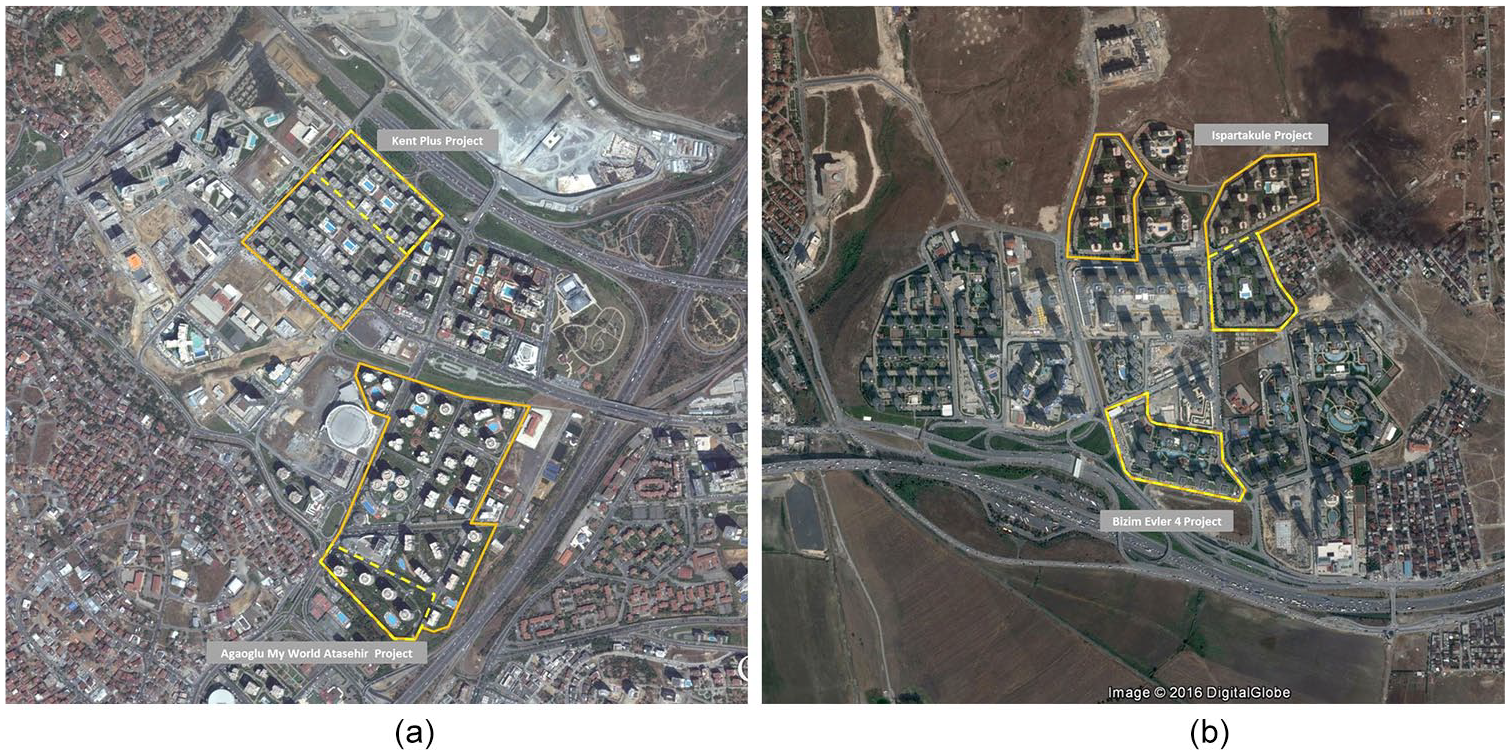
Selected branded housing projects and their relationship with the surrounding environment: (a) Ispartakule Area; (b) Ataşehir District. Source: The authors | Aerial Image Source: Google Earth.
The first project, Agaoglu My World Ataşehir, started in 2004 and was completed in 2010 (Emlak Konut REIT, 2014). The second project, Kent Plus Ataşehir, was started in 2004 and completed in 2008 (Emlak Konut REIT, 2014). The land on which the projects were developed had been transferred to Emlak Konut REIT as part of the restructuring of this institution (Mimarlar Odasi, 2012), which is discussed in the previous sections. The development of the projects in this location was a top-down process, which shows the accumulation of power in the centre through the already discussed expansion of TOKI’s various remits. It started with a master plan approved by the Ministry of Public Works and Settlements in 2004, which led to objections from non-governmental organizations (NGOs) and professional bodies including the Chamber of Architects in Turkey (Mimarlar Odasi, 2009) and the Chamber of City Planners (Sehir Plancilari Odasi, 2008). Subsequent master plans were produced by TOKI, which has become the key apparatus for top-down development processes as discussed, and approved by Istanbul Greater Municipality (Mimarlar Odasi, 2010), despite these objections.
The third project, the Ispartakule Project, was started in 2006 and completed in 2009 (Emlak Konut REIT, 2014), and the fourth project, Bizim Evler 4, was started in 2010 and completed in 2012 (Ihlas Holding, 2016). The land on which the projects were developed was also owned by Emlak Konut REIT (2015d). Again, a top-down process was implemented by the Ministry of Public Works and Settlements carrying out master planning revisions for this area. The Ispartakule area was declared a mass housing zone, whereas it had been a tree plantation zone in previous plans (Sehir Plancilari Odasi, 2005), which exemplifies the land use allocation practice implemented by the neoliberal state apparatus, fostering capital accumulation. Due to objections from the Chamber of City Planners to this change and the insufficiency of the proposed social facilities, the plan was terminated (Sehir Plancilari Odasi, 2005). However, it was replaced by another master plan again developed by the Ministry. In this revised plan, the area was once again declared a mass housing area (Ministry of Environment and Urbanism, 2013), and the development started. In 2013, master plans for the area were revised again by the Ministry of Environment and Urbanism (2013); however, these have not changed the designation of the area for volume housing development.
The examination of the four project development processes demonstrates the representations of space and the political society’s domination in their production. It firstly shows top-down development processes led by the central institutions as the master plans were prepared by the Ministries and TOKI, in which local authorities were ignored. In addition to equipping TOKI as a central institution with planning authority, the accumulation of power in the centre and top-down processes are facilitated by other institutions as well such as direct planning by the Ministries. On the other hand, the cases show that although the central authority accumulates massive power in the centre, the process was challenged by various groups. The planning processes were objected to by NGOs and professional associations due to the problems in the master plans. However, the central authority followed a path of excluding these actors from the planning processes and passed the plans with minor changes. The aforementioned processes demonstrate that political society is not a unitary body. It involves various institutional structures, including central and local institutions. These processes also demonstrate that despite this extensive centralization of authorities and their remits, total consent has not been produced within the political sphere.
Secondly, these cases show that the projects were developed on public land while ignoring the problems of the location areas in favour of capital accumulation. This resulted in the allocation of these areas for private housing production rather than social and municipal services. To illustrate, public green space (public parks and gardens) in Istanbul only accounts for 1.5% of the total area of the city, whereas in London the corresponding percentage is 38.4% (BOP Consulting, 2014). The projects located in Ataşehir District are surrounded by a high-density urban environment with a scarcity of public open spaces. Instead of using this public land to create public open spaces within a dense urban environment, it was introduced into the real estate market. All projects led to a significant number of housing units being sold, from 859 in Bizim Evler 4 to 3383 in Agaoglu My World Ataşehir, with large related amounts of capital turnover. This practice demonstrates a clear example of the neoliberal state prioritizing capital accumulation by privatizing these lands, therefore, contributing to the commodification of urban space – ‘a state apparatus whose fundamental mission was to facilitate conditions for profitable capital accumulation’ (Harvey, 2007: 7). It also demonstrates an example of the neoliberal state as a redistributive instrument for capital in favour of the capitalist class by implementing the revenue-sharing model, where the income generated is shared by the state and private developers.
The examination of the case study projects demonstrates that the representations of space (Lefebvre) have been appropriated by state developers via exclusive master planning processes, which is crucial in the production and reproduction of urban space and ultimately capital accumulation. Therefore, the case of branded housing projects shows that political society (Gramsci) under neoliberalization is increasingly involved in urbanization processes, including making plans, developing the area, selling the units and collecting profits. However, the objections by the NGOs and professional organizations demonstrate that although these projects may be hegemonic, they are neither without controversy nor, importantly, contradiction.
Private provision of key urban services
The practice of provision of key urban services via branded housing projects produces another result that expands the commodity realm further. This result overlaps with the neoliberalization agenda as being part of withdrawal of social state from providing these services. The research this paper is based on analysed land uses of branded housing projects developed by Emlak Konut REIT in Istanbul between 2003 and 2014. According to this analysis, there are 43 projects developed by Emlak Konut REIT in partnership with private development companies and the research identified the services and amenities provided and managed by private management companies within the confines of these projects as follows: recreational areas (e.g. parks, playgrounds, recreational pools, walking tracks, etc.); open air and enclosed carparks; social and sport facilities (e.g. social rooms, sport centres, swimming pools, basketball pitches, etc.); some shopping facilities (e.g. restaurants, dry cleaner, car wash, etc.); upkeep and beautification of the open and built spaces (e.g. cleaning services of the buildings, landscaping, garbage collection, etc.); and security and surveillance (Figure 2).
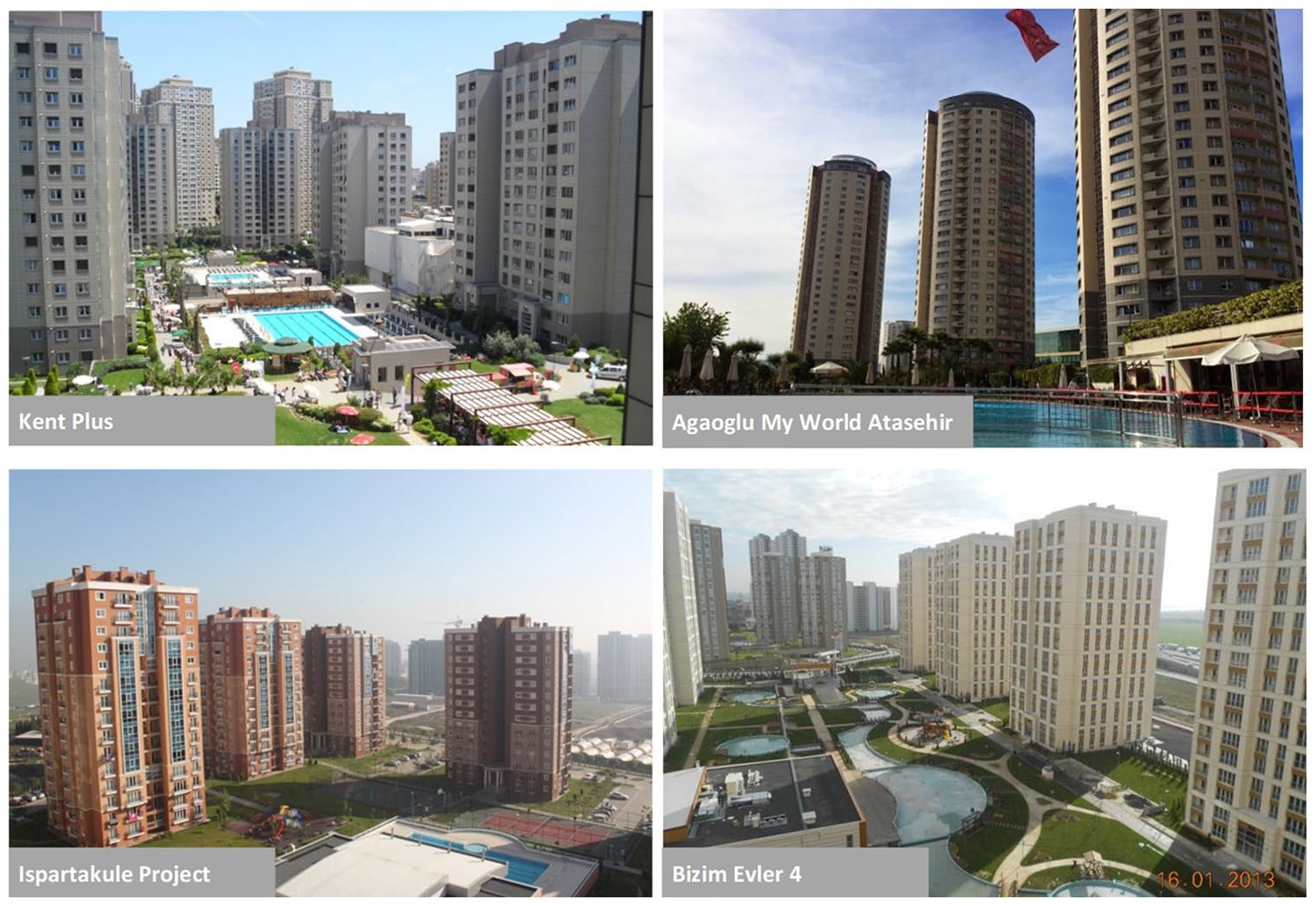
General view of selected branded housing projects. Source: The authors; (Image Source: Google Earth Images).
Most of these private management companies are enterprises set up by the private developers of the projects. After selling the residential units, the developers continue their engagement with the project areas through their management. The practice creates a constant cash flow to development companies through service charges paid by the residents for the management of the private neighbourhoods. Therefore, the developers continue to collect profits via service charges paid by the resident in return for access to services and amenities. This practice raises questions about the commodification of access rights to key urban services. Moving into a branded housing project (as a homeowner or renter) grants these access rights to the residents. It opens another area for accumulation-by-dispossession via commodification of the rights to access these services, most of which are usually provided by the local authorities. To illustrate, parks and playgrounds are the main open space elements of the branded housing projects. These amenities are made exclusive to residents by locating them within the confines of the projects. In addition, their upkeep is privatized through private management practices within the projects. Key urban infrastructure is, therefore, made available only to a particular group of society who can afford to live in these projects and pay service charges. In addition, in this practice, public land that could have been allocated for provision of these services publicly is instead allocated for the development of branded housing projects. Therefore, this allocation plays a part in providing such services privately and exclusively. Such resources were allocated for the sake of capital accumulation and for the use of the capitalist class. Through this allocation, the state plays a key role in promoting the private provision of urban infrastructure and, therefore, its commodification.
As a result, the analysis of the practice of branded housing projects demonstrates that spatial practice (Lefebvre) overall was transformed by changing the method of production of land uses and their spatial formations. A critical aspect of this transformation is political society’s key role (Gramsci), as the process itself is far from laissez-faire, but rather a top-down state intervention towards the neoliberalization of the production of urban space. This spatial practice (Lefebvre) also demonstrates the embeddedness of this neoliberalization starting from the land development processes to the provision of key services within the project areas.
Conclusions
As Harvey (2007) argues, neoliberalization is an ideological project produced by hegemonic classes. Within the last half century, since it was rolled out, it has shaped and been shaped in various areas of everyday life deliberately in order to create and foster this hegemony. Wacquant (2009) shows how it took masses under control though restructuring the incarceration in the USA, while Wright et al. (2020) argues how dismantling the welfare state and replacing it with the neoliberal universal credit system create behavioural changes by sanctions targeting the unemployed. These show the core role of the state per se in the neoliberal restructuring processes. Within this broader role of the state in neoliberal restructuring, the article discusses this role in terms of neoliberal urbanization processes that foster the commodification of urban space. It uncovers the intrinsic relationship of restructuring of the neoliberal state with neoliberal urbanization. It shows how the state becomes a key apparatus for fostering capital accumulation via urban development under neoliberal urbanization, and how neoliberal urbanization was facilitated by the state acting as a regulatory mechanism, a land developer and a housebuilder.
The research reveals mechanisms for the allocation of resources in favour of capital accumulation by political society (Gramsci). The case demonstrates that in Turkey, political society (Gramsci) is fostering and enabling the commodification of urban space under neoliberal urbanization through restructuring the regulatory framework and representations of space (Lefebvre). Through new laws and regulations, political society (Gramsci) has allocated public land for the production of new private housing market units. In addition, public housing institutions have been transformed into state developers and have become agents for the commodification of urban space via their newly assigned remits. Expanding their remits from land development to master planning is a critical move for intervening in the production of space through the representations of space (Lefebvre).
The case of branded housing projects also demonstrates that the engagement of political society (Gramsci) with commodification, and therefore capital accumulation, is not limited to transforming the regulation and the privatization of formerly public land. It expands to indirect privatization of the urban infrastructure by promoting the private and exclusive provision of services and amenities within these private neighbourhoods. The practice overall transforms spatial practice (Lefebvre) and, therefore, produces a permanent condition for this commodified way of production of urban space and service provision.
Bridging the two influential theories of Lefebvre and Gramsci contributes to the exploration of these characteristics of the contemporary commodification of urban space, while also acknowledging the role of civil society in building hegemonic ways of this production. 1 In addition to this theoretical contribution, within its empirical element, this article acknowledges the path-dependent characteristics of the practice analysed in this case study by discussing the development of neoliberal urbanization in Turkey. This case, therefore, shows variegated characteristics of contemporary neoliberal urbanization. It demonstrates the state’s increasing role in the direct provision of housing in this context, while in many cases elsewhere the state and public sector have withdrawn from this direct provision (e.g. England’s ‘right-to-buy’ experiment and diminishing direct provision of housing by political society). However, considering the long-standing integration of this country with the global neoliberal economy, this case is also illuminating in helping one to understand the role of political society (Gramsci) and representations of space (Lefebvre) in the commodification of urban space under neoliberal urbanization elsewhere regarding regulation and land allocation in favour of commodification. In other words, it shows how the neoliberal state intervenes in the housing market by further regulation and allocation of resources in favour of capital accumulation. Therefore, the results of this research can help to underpin nuanced understanding of neoliberal urbanization and contemporary commodification of urban space elsewhere.
Footnotes
Declaration of conflicting interests
The author(s) declared no potential conflicts of interest with respect to the research, authorship, and/or publication of this article.
Funding
The authors disclosed receipt of the following financial support for the research, authorship, and/or publication of this article: This study was supported with funding from the French Institute for Anatolian Studies (Short Term Grants).

1.
The following article argues that expansive commodification of urban space requires consent by society. It discusses the role of civil society in producing this consent via the case of representation of branded housing projects in mass media in Turkey.
2.
In this respect, Turkey’s restructuring towards a neoliberal system has much in common with cases throughout the Global South (e.g. the coup in Chile in 1973) as a top-down process including coercion by a coup.
3.
The most reliable data for the number of constructed buildings since 2000 is the figures provided by Building Permits Reports (published by the Statistics Institute of Turkey), because the building census has not been made available. While in 2002 the number of residential building permits given for dwelling units was 161,431, this number was increased to 767,426 in 2012 (TUIK, 2013).
4.
It should be noted that there are also private neighbourhoods, or branded housing projects, developed in the 2000s without state developers’ direct involvement.
5.
These transfers are co-decided by the Ministry of the Treasury and Minister of Development and approved by the Prime Ministry.
6.
It should be noted that TOKI also develops so-called social housing projects that are to provide more affordable units for low-income groups. These houses are developed by TOKI mostly on public land and sold. These projects are not within the scope of this research. However, even if their target income groups are different, the two development practices play the same role in transforming public land into private property.
7.
The terms ‘revenue-sharing projects’ and ‘income generation projects’ are used interchangeably in TOKI’s documents.
8.
The revenue-sharing model is applied by various public bodies in Turkey, including TOKI, Emlak Konut REIT and enterprises of Greater Municipalities (e.g. KIPTAS), for profit-oriented residential development projects.
9.
By 2016, TOKI had 43 on-going revenue-sharing projects across Turkey, including branded housing projects such as Spradon, Divan Residence and Olimpiakent (TOKI, 2016), which are developed in addition to the ones developed by Emlak Konut REIT. TOKI claims that developing projects via this model is a tool for accumulating capital for developing social housing projects (TOKI, 2014). However, the projects that TOKI claims to be social housing are based on homeownership and ignore the rented social housing model. They are, therefore, criticized for not targeting, and not being affordable for, the most disadvantaged groups in society. According to Perouse (2013), due to the payment models and conditions for the so-called social housing projects, the housing units are not affordable for ‘poor’ and low-income groups, and not even 10% of the housing units that TOKI has produced can be classified as social housing. Similarly, according to Adanali (2014), only one fourth of the total housing stock TOKI developed is for lower income groups, and the income band that TOKI set as maximum to access this housing corresponds to three times more than the minimum wage in Turkey (cited in Güner, 2014). As a result, in practice, so-called social housing projects are only relatively affordable housing projects where residents buy the housing units by paying back lower interest housing credit that is arranged for them through a partnership between TOKI and a specific bank. In addition, the housing units from these projects enter the private housing market a very short time after their transfer to the property owner, even though there are restrictions on selling the units within a certain time period. These legal time restrictions are sometimes avoided through dealing on the black market (Perouse, 2013).