




Abstract
Recently proliferating ‘smart city’ building efforts have lent themselves well to interpretations through the lens of the policy mobilities literature. Applying this perspective, studies have insightfully shown how policymaking centred around smart cities is at once a messy, networked process stretching across scales, while also manifesting itself in concrete practices shaped by territorial–regulatory contexts. Informed by empirical research on smart city policies in Hungary and the Netherlands, this paper argues that the policy mobilities approach tends to overemphasize the global and the local. Notwithstanding the transnational circulation of smart city ideas, the national scale continues being reproduced by these ideas as a relevant scale of urban regulation, discursive framing and strategy-making under globalization. To acknowledge this, and to move towards a more decidedly multiscalar perspective on actually existing smart urbanisms, it is suggested that we incorporate the national scale, understood as a relational set of practices and discourses, more explicitly into our analysis. Insights from the Hungarian and Dutch case studies are used to illustrate the manifold ways in which the local embedding of the globally mobile smart city concept is shaped by the national scale, as well as how the national itself is being renegotiated in this process.
Introduction
In the past 15 years or so, a new urban policy hype has swept across the globe, spurring cities to become ‘smart cities’. Although ‘smart city’ can be and has been variously (re)interpreted in different contexts (Angelidou, 2014; Joss et al., 2019), the concept has commonly been invested by industry, government and international organisations to propagate urban development strategies that rely on digital technologies to enhance urban economic growth while addressing social and environmental challenges (Luque-Ayala and Marvin, 2015; Verrest and Pfeffer, 2018). In critical scholarship, the smart city (and, by extension, ‘smart urbanism’) has primarily been regarded as a global(izing) policy discourse (Joss et al., 2019) and sociotechnical imaginary (Sadowski and Bendor, 2019) that further advances the prevailing tendencies of the technocratic decision-making and corporatization of city management under neoliberal capitalism (see e.g. Hollands, 2015; Kitchin, 2015; Vanolo, 2014).
Given the smart city’s worldwide appeal and its diverse implementation across the ‘Global North’ (e.g. Cowley et al., 2018; Crivello, 2015; Shelton et al., 2015) and ‘Global South’ (e.g. Datta, 2015; Ho, 2017), the discourse of smart urbanism has lent itself well to scholarly interpretations through the lens of policy mobilities, an increasingly influential strand of literature highlighting how globally circulating urban policy ideas become embedded in concrete regulatory contexts (McCann, 2011; Peck and Theodore, 2010; McCann and Ward, 2010). From this perspective, the ‘smart city’ is a globally mobile policy concept propagated by global tech giants like IBM (Söderström et al., 2014; Wiig, 2015) and Cisco (Sadowski and Bendor, 2019), and enacted through the place-specific assemblage of actors, ideologies and technologies (Shelton et al., 2015). Studies on the ‘actually existing smart city’ (Shelton et al., 2015) from a policy mobilities perspective (e.g. Cowley et al., 2018; Crivello, 2015; Joss et al., 2019; Wiig, 2015) have shown well how visions of smart cities ‘dovetail with local and global political economies, and [that] how they unfold in practice [varies] between places’ (Kitchin, 2015: 133).
While discussing the findings of our own respective research on smart city policies in Hungary and the Netherlands, however, we discovered a shared sense of discontent about how existing studies tend to ignore the way in which the national scale makes a difference to smart city building. Some studies do refer to national frameworks and organizations, and acknowledge the relevance of the national institutional–discursive setting (e.g. Crivello, 2015), but few of them pay in-depth attention to how the national matters to the embedding of globally mobile smart city ideas. Informed by empirical fieldwork in the above countries, the present paper’s aim is to start filling this gap and to show, by drawing on processual and practice-oriented understandings of scale (Mansfield, 2001; 2005; Moore, 2008), that ‘the national’ should be more decidedly part of the analysis of smart cities, not only as a pre-given regulatory framework (see e.g. d’Albergo, 2010; van den Berg et al., 2007), but also as a contested terrain of policy-making and an idea around which actors – including mobile ‘transfer agents’ who are assumed to play a key role according to policy mobilities scholars (McCann, 2011) – negotiate their strategies. By developing this argument, we address the tendential bias of the policy mobilities literature towards ‘global–local dualism’ (Prince, 2017) as well as its inclination to foreground ‘neoliberalization’ as an explanation. Furthermore, we wish to advance the multiscalar understanding of smart urbanism (Smigiel, 2018).
Actually existing smart urbanism through the lens of policy mobilities
The recently emerging literature on policy mobilities proposed ‘to think differently about public policy and its formation in place in a globalized and neoliberalized world’ (Cochrane and Ward, 2012: 8) and to overcome the national state-centred approach of the traditional policy transfer literature (McCann, 2011; McCann and Ward, 2010). Following Prince (2012), three more or less separate strands of policy mobilities research can be distinguished. The first strand has developed as an extension of political economic scholarship discussing the ‘neoliberalization’ of the state in terms of geographically specific processes of institutional restructuring (Peck, 2001). Here, ‘fast-moving policy models’ and best practices (Peck, 2012; Peck and Theodore, 2012) are seen as instrumental in maintaining the global hegemony of neoliberalism as they engage a range of policy actors across different institutional–scalar contexts and provide frameworks for aligning policy interventions with the neoliberal imperatives of competitiveness, efficiency and creativity (Peck, 2012; Peck and Theodore, 2010, 2012). The second body of work similarly interpreted the mobilization of policies as an aspect of neoliberal globalization (McCann and Ward, 2013) but has emphasized – by drawing on the relational geographies of Harvey (1982) and Massey (1991, 2005) – that, although urban policy-making remains territorially shaped, it also has an increasingly transnational, networked character (McCann, 2011; McCann and Ward, 2013). This networked character has been linked to the networking of various transfer agents – policy experts and consultants, city officials, academics, activists, and other urban actors – who position local policies in wider scalar contexts (McCann, 2011). From this perspective, urban policies are simultaneously relational and mobile, yet also fundamentally territorialized (McCann, 2011; McCann and Ward, 2010). Finally, a third strand has paid distinctive attention to aspects of sociomateriality and how cities are being created through the heterogeneous assemblages of humans and nonhuman materials such as standards, funding formulae and maps (e.g. McGuirk et al., 2016; Müller, 2015).
Smart cities research has variously drawn on these different – overlapping and occasionally conflicting (Prince, 2012) – understandings of policy mobilities to get a grip on how the smart city policy idea mutates as it meets institutions, policy frameworks, actors’ strategies and physical–infrastructural characteristics in given contexts. For Vanolo (2014: 894), the smart city is a ‘political assemblage’, involving the mobility of policy ideas in global circuits of knowledge, as well as locally specific geometries of power and social positionalities. Similarly, Shelton et al. (2015) regard smart city interventions as assemblages of actors, ideologies and technologies, and stress that these policy assemblages have both relational and territorial dimensions. Wiig’s (2015) account of IBM’s smart city policymaking and Cowley et al.’s (2018) study on smart city projects in the UK both agree that the globally mobile concept of the smart city is always selectively reworked as it becomes embedded locally.
Overall, empirical accounts of smart cities employing the policy mobilities lens show how policy-making centred around ‘smart cities’ is at once a messy process stretching across scales, while also manifesting itself in local socio-technical practices in concrete territorial–regulatory contexts. To date, however, studies applying this lens have stressed the aspect of global flows of people, ideas and money on the one hand, and the grounding of these flows in particular places on the other hand (Joss et al., 2019; Shelton et al., 2015; Wiig, 2015). Scales tend to figure as inert backdrops to smart city developments, and even if the relevance of institutional-discursive settings is more explicitly mentioned (e.g. that of the national setting, see Crivello, 2015), no attempt is made to pin down in more detail, both empirically and in conceptual terms, how scales other than the global and the local – and most notably the national scale – matter to the impact of globally mobile policy ideas.
Bringing (the national) scale back into the study of globally circulating policy ideas
By showing how the emergent, globalizing geographies of urban policies are co-constituted through different, ‘local’ sites of policy-making, the policy mobility literature can also be seen as a response to the so-called ‘scale debate’ in human geography (cf. Prince, 2013). At the risk of oversimplification, this debate revolved around the usefulness of the concept of scale, where some proposed to eliminate it because of its supposedly inherent reifying tendencies (Marston et al., 2005), while others stressed the need to retain it, albeit in a reconceptualized form alongside other (relational, networked, territorial) spatial grammars 1 (see e.g. Jessop et al., 2008; Jonas, 2006; Leitner and Miller, 2007). Arguably, existing policy mobilities studies have not been very successful in simultaneously conveying a relational sense of policy-making while also taking notice of how power-laden institutionalized practices ‘at’ multiple scales both shape the circulation of policies and are also being (re)produced by them. In Peck and Theodore’s (2010) understanding of ‘cross-scalar mobility’, for example, the national seems to be downplayed as a result of the emphasis on ‘the accelerating transnationalization of policy norms and practices’ (p. 169) and, although they acknowledge the ‘(shifting) organizational and political fields’ (p. 170) in which policy actors operate, these fields are pictured as being heavily intermediated by the interests of the (transnational) ‘policy transfer business’. McCann and Ward (2013: 7) do note that the ‘national state should be a focus of any research into policy mobilities’; yet, their focus mostly remains on how policy ideas produced in the global-relational context are being transferred from place to place (McCann and Ward, 2010: 176). Furthermore, although scales are recognized as politically shaped, relational constructs, it seems to be assumed that the territory and scale at which globally circulating policies become embedded is already ‘there’. Peck and Theodore (2010: 171) speak of ‘the interconnectedness of policy regimes between places and across scales’, thereby suggesting a view of scales as rather distinct givens. McCann and Ward (2010: 177–178) state that ‘people, frequently working in institutions, mobilize objects and ideas to serve particular interests’ and that transfer agents ‘make the territorial embedding of globally-circulating policies and programs not just possible but probable’ (p. 183).
In contrast to the above, Prince (2017) takes a topological approach that is omitting scale altogether; as he points out, ‘policy is not just an urban phenomenon but a regional, national and international one’, and the territory of cities or countries is not something the policy assemblage ‘sits on’ but it is part of the assemblage (p. 337). In doing so, Prince effectively addresses one ‘geographical problem’ of the policy mobilities literature, that is, its local–global dualism. However, by being primarily concerned with ‘disaggregat[ing] apparent overwhelming structural power’ (Prince, 2013: 62), he seems – akin to Marston et al. (2005) – to focus on the ‘becoming’ of power relations, at the expense of acknowledging how these also are in place (cf. Jonas, 2006; McKinnon, 2011) to influence the mobility and enactment of policy concepts at any particular moment.
Similar to Prince (2013), this paper aims to overcome the limited focus on ‘the “local globalness” of urban policymaking’ (McCann, 2011: 120), yet it aligns with Häkli (2018: 279) in assuming that scale continues to ‘effect in the myriad social practices that constitute the geopolitical world’ and thus should not be abandoned. Rather, drawing on previous propositions, this paper takes a practice-oriented approach to scale by regarding it as ‘a diverse array of material and representational practices, shot through with power’ (Leitner and Miller, 2007: 119). It is thus presupposed that some scalar configurations solidify, and others can become challenged in the course of scalar politics (Leitner and Miller, 2007) as actors think, make claims and act in scalar terms (cf. Moore, 2008: see also Mansfield, 2001). Scales are thus the product of the complex interplay of structure and agency, where scales exert a differential and structural (but non-deterministic) influence on agency, and where agents’ practices (re)produce scales of action.
Applying this to smart cities, practices through which smart projects become implemented do not occur ‘at’ particular scales but have multiple scalar dimensions that can only be separated analytically. For example, in European Union (EU) member states, the technical and administrative design and realization of smart grids brings various local regulations, national and international laws, as well as the claims of different actors acting on behalf of different scales, into play. Here, no clear distinction is made between different scales (Mansfield, 2005); rather, scales are thought of as a relationally constituted set of institutions, rules, frames, governmental techniques and physical infrastructures that help the embedding of some policy concepts (in particular ways) but not of others. Furthermore, agents are assumed to be ‘thrown into’ a field of complex scalar configurations that can never fully determine the identity of agents, or their ability to act (cf. Glynos and Howarth, 2008); thus, agency makes a difference in negotiating scalar relations and in making or disrupting the connections that allow policy ideas to travel. Ideas of ‘smartification’ focusing on efficient energy propagated by EU policies co-exist, for example, alongside nationally dominant smart city ideas concerning the improvement of public transport, or locally prominent smart city discourses related to public security. Agency plays a role in how actually existing smart cities are the result of fundamentally political decisions about prioritizing particular ‘smart objectives’ against others; smart cities are thus ‘always constituted by exercises of power and are always marked by certain forms of exclusion’ (Glynos and Howarth, 2008: 164).
Against the above backdrop, the present paper is concerned with the national scale, agreeing thus with Mansfield’s point that ‘we should [. . .] interrogate the national anew, rather than ignore it in favour of other, seemingly more exciting, scalar arrangements’ (Mansfield, 2005: 472). The focus on the national is not meant to replace one scalar bias by another one, and certainly not to suggest a view of the national as a static umbrella for local policy choices or as a level exerting top-down influence. Rather, this paper zooms in on a rather neglected dimension of the relational multiscalar policy landscape that mediates globally circulating policy ideas about the smart city, and that is at the same time a contested aspect of smart city developments. This chimes with Mansfield’s nonessentialist perspective that regards (the national) scale as both a regulatory framework and an idea around which people build political strategies (Mansfield, 2005: 460).
Smart city development in Hungary and the Netherlands
Notes on the original research projects and methodology
The case studies serving as a basis for this paper have not formed part of a single, pre-designed research project. Empirical data for each case were collected during iterative phases of desk research and fieldwork. The material of the Hungarian case stems from an (ongoing) research project on the impact of the smart city concept on urban development policy and practice in Hungary. The desk research has comprised the in-depth analysis of national and local policy documents, reports, guidelines, legal texts, websites of relevant institutions, as well as articles on smart cities in the professional press. Furthermore, this article draws on eleven in-depth interviews conducted with key figures of the smart city policy-making field (national and local policy-makers, ‘smart city experts’, as well as policy consultants and civil society actors 2 ) between April 2017 and September 2018. For the Dutch case, insights were drawn from a research project about smart city governance practices, risks and mitigation strategies in the five largest Dutch cities (Amsterdam, Rotterdam, The Hague, Utrecht and Eindhoven). Eleven interviews in total were held with smart city professionals (project managers or strategic advisors involved in city-wide smart programmes) as well as with project managers of smart citizen projects from civil society organizations in each of the above cities between February and July 2017. 3 Moreover, participant observation was conducted during ten meetings and presentations about smart city developments in the five municipalities that were attended during the above period. 4 Prior and parallel to fieldwork, relevant policy material (strategic documents, implementation programmes, council letters and progress reports) from the five municipalities were collected and studied. To more explicitly consider the relevance of the national scale, a further round of document analysis was carried out in preparation for this article with a focus on national policy documents, the websites of relevant (national) actors and the professional press.
While discussing our respective research, we have noted several parallels. Prior to the very appearance of the smart city label, imaginaries of more liveable cities thanks to Internet of Things technology gained ground both in Hungary and in the Netherlands, with two mid-sized cities in each country pioneering (what later became heralded as) smart city building, as well as – soon thereafter – showcasing its pitfalls. 5 Also, and confirming previous studies (e.g. Söderström et al., 2014), from the second half of the 2000s leading multinational ICT companies’ global advertisement campaigns have played a key role in nurturing aspirations to become a ‘smart city’. In Hungary, IBM Hungary (the local subsidiary of IBM), initiated a dialogue with Hungarian cities on how smart technologies could be harnessed to enhance urban liveability (MTA RKK NYUTI, 2011); in the Netherlands, Cisco, IBM and Philips do the same with various Dutch cities (Ministerie van Infrastructuur en Milieu, 2015). Furthermore, in line with interpretations through a policy mobilities lens, it appeared that mobile public officials and policy experts have provided important input to the emerging smart city policy field based on personal experiences and interpretations of smart city policies elsewhere. As a smart city expert of Debrecen, the second largest city and a frontrunner in smart city development in Hungary noted in an interview: ‘We keep our eyes open, read a lot and participate at international conferences’ (see Uzoni, 2017). Reports on international smart city conferences – such as the 2017 and 2018 Smart City Expo World Congress in Barcelona – attended by smart city experts of the Lechner Knowledge Centre (which, as it will be discussed below, has assumed a key role in shaping the understanding of the smart city in Hungary) have regularly discussed the latest trends in smart city development. Also, in 2017 the Centre launched a (continuously extended) online inventory of international best smart city practices. 6 In the Netherlands, ‘the adaption of knowledge and services from abroad’ (Wamelink, 2017: 86) has also been a key concern, and according to a regularly updated overview published by central government, municipal actors regularly participate in smart city related exploratory study trips. 7 The imperative of being mobile was nicely expressed by the smart city manager of the city of Rotterdam: ‘you shouldn’t stay in office, but you need to go out, [. . .] and experience!’
However, the most striking parallel – and one which did not fit existing analytical frameworks of mobile policies – was the observation that the national dimension mattered to the embedding of smart city ideas. We re-interrogated the ‘raw data’ of each case through a specific focus on the relevance of ‘the national’ for smart city practices. Given the overlap in the original research projects’ focus, their shared adherence to a relational ontology and to an iterative research strategy, as well as their reliance on similar qualitative methods, 8 they were considered suitable for such an ex-post, focused re-interpretation. This re-interpretation entailed the close, individual (re-)reading of the interview transcripts, key policy documents and research findings of both projects, followed by a coding process during which labels denoting different aspects of the national were assigned to the texts. The independently established labels were then compared, refined and brought together in one single overview, to be discussed in the next section.
How the national matters to smart city development
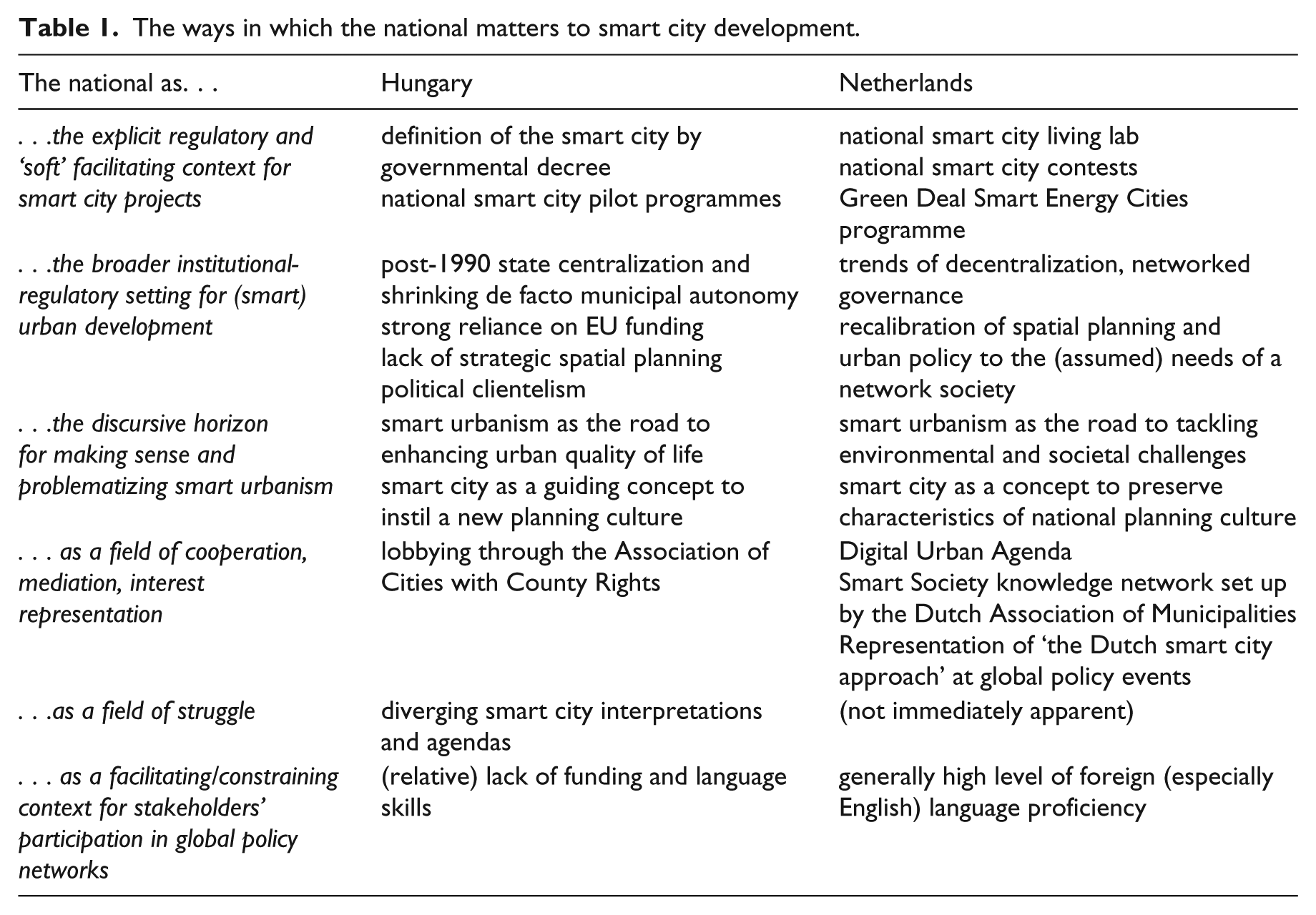
Table 1 summarizes the jointly established labels signifying the main ways in which the national can matter to smart city building, as well as some examples (further discussed below) of how this relevance manifests itself in the Hungarian and Dutch contexts. Rather than drawing comparisons, our aim has been to enhance our reflexivity with regard to the continuing relevance of the nation-state in urban policy-making and to show how this relevance has played out in the two countries. Importantly, following the relational perspective applied in this paper, the Hungarian and Dutch contexts are not conceived of as distinct containers but as (partly overlapping) networked discursive–material entities that become variously contested in the process of smart city building. Furthermore, the overview does not pretend to be exhaustive and the aspects discussed are assumed to be closely interlinked.
The ways in which the national matters to smart city development.
The national as the explicit regulatory and ‘soft’ facilitating context
The significance of the national scale is most obvious if we consider centrally steered or guided national smart city pilot programmes, living labs or national smart city contests. In Hungary, the Department of Spatial Planning and Urban Management of the Prime Minister’s Office (DSPUM) wanted to capitalize on the emerging smart city hype (from the mid-2010s) to stimulate a move from a(n EU) funding-driven local urban development towards a strategic, integrated approach. National coordination was deemed necessary as Hungary’s local government structure was ‘not [considered to be] prepared to manage integrated development processes that involve multiple stakeholders, data and technological solutions’ (Rab and Szemerey, 2016: 150). Also, there were fears that resource scarcity might make municipalities more susceptible to adopting a narrow, technology-oriented view on smart urban development promoted by private investors. As the Head of Department of the DSPUM noted at a 2017 conference concerning the elaboration of a legal framework and hands-on guidelines for smart city development: ‘we [at the DSPUM] imagine this explicitly in a technology-independent way and so that no economic lobby activities overshadow this process’ (Kolossa, 2017). In 2016, the Lechner Knowledge Centre, a background institution of the DSPUM in the fields of architecture, spatial planning and related IT services was tasked (by governmental decree) with the national coordination of the introduction of smart city services. To guide municipal smart developments, the Knowledge Centre published a package of hands-on documents including a smart city knowledge platform methodology proposal, a city evaluation and monitoring system methodology proposal and an online inventory of best practices (see http://lechnerkozpont.hu/). Furthermore, the Centre played a key role in devising a definition of smart cities 9 that became included in the 2017 revision of the 2012 government decree on local-level planning documents. Aiming to ‘disseminate “smart city” technology in Hungary’, 10 another government decree from the same year tasked the Ministry of Interior (MI) and the Ministry of National Economy (MNE) to realize a smart city pilot in Monor (a town near the capital Budapest), that is meant to be the testbed of the centralized platform of smart city services that was announced by a government decree in 2018. 11 Also, in 2017 a government decree 12 stipulated on the extension of the ‘Digital Welfare Programme’ (DWP), 13 launched in March 2015 to align with the ‘Digital Agenda for Europe’ (Commission of the European Communities (CEC), 2010). Under the DWP 2.0 (Government of Hungary, 2017), an education programme has been launched to sensitize public servants to smart city development, and a smart city working group was established to put to effect the ‘smart city approach’ of the Lechner Centre and to oversee and advise smart city and area pilots, as well as to measure ‘client satisfaction and efficiency’. 14 To this end (although this does not reflect the Centre’s approach) a ‘smart city marketplace’ is being set up: a centrally managed assessment, quality control and validation system of smart city products. As the smart city expert of the DWP noted, ‘similar to the accreditation of higher education programmes, in connection with smart city solutions the state has also a key role to assume with regard to quality assurance and, if you like, consumer protection’ (Gál, cited by Schopp, 2018).
In the Netherlands, the national smart city policy field has had a (much) ‘softer’ character, resulting from a bottom-up process and a broad recognition among Dutch cities (from around 2000 on) that existing databases and ‘smart’ technologies should be better exploited to foster economic development and to improve the management of urban problems. As the smart city project leader of the municipality of Utrecht put it: ‘Our assumption was [. . .] that we have a lot of data – also as a municipality – but we underutilize that data. So, we get insufficient value out of the data.’ Upscaling soon (re)appeared as a key task (see Van Winden and van den Buuse, 2017), and an increasing need was felt for greater inter-city exchange and cooperation. As a Rotterdam municipal policy official noted regarding a project on the control of the legitimate use of social benefits, ‘at a G6 meeting, with the 6 largest municipalities, it was discussed how we all do this, but could do so much smarter’. In 2011, the G4 (the four ‘big cities’, i.e. Amsterdam, The Hague, Rotterdam and Utrecht), the G32 (a network of municipalities with over 100,000 inhabitants), alongside the NICIS research institute and Stedenlink, an urban ‘knowledge network’, signed the Digital City Agenda (Digitale Steden Agenda) (2011–2015) to foster innovation in the fields of education, health care and public service provision through the application of digital technologies. ‘Smart city development’ has also become a key subject of newly forming ‘city deals’ signed by collaborative networks including national and regional authorities, knowledge institutions and private parties with the aim of pooling (financial and legal) resources and expertise to work on sustainable urban solutions. Most notably, the programme Green Deal Smart Energy Cities (2014–2019), initiated by the Ministry of Economic Affairs, has focused on the upscaling of ‘smart energy’ concepts developed earlier in twelve urban living labs. Furthermore, since 2015 the national government, municipal governments and other stakeholders have signed city deals within the framework of the Urban Agenda (Agenda Stad) to help boost economic growth, quality of life and innovation in Dutch cities. Several City Deals have addressed the issue of climate adaptation and a transition to low-energy urban futures through the use of digital technologies. 15
The Digital City Agenda and the Urban Agenda have been the breeding ground for a more explicitly smart city centred cooperation that resulted in the National Smart City Strategy (Wamelink, 2017) that was drawn up in a process of co-creation by 140 representatives of municipalities, businesses and academia, and was presented to Prime Minister Mark Rutte in January 2017. The Strategy emphasized the (further) ‘need for national inter-city exchange, initial subsidies and coordination to enable the upscaling of smart projects’ (Wamelink, 2017: 8). The five largest municipalities (the G4 and Eindhoven) have taken the lead in self-assigned fields of priority 16 and agreed to let other municipalities benefit from their frontrunner experiences. 17 Furthermore, in 2017 the National Smart Living Lab Programme was launched by the Netherlands National Institute for Public Health and the Environment with the participation of seven municipalities, each bringing in its own experimental case related to healthy urban living. From 2019, the Programme will enter in its second phase with a new group of cities, and it will provide sensor equipment, project support, access to other projects, and workshops to participating municipalities.
The national as the broader institutional–regulatory setting for (smart) urban development
The national has also mattered to the embedding of the smart city concept more broadly as an institutional setting and regulatory framework. In Hungary, the path-dependent system of self-governments, ongoing state centralizing tendencies and the reliance on EU funding (which is allocated following a national framework) in particular have pointed to the structuring force of the national. Although the persistence and further strengthening of state centralizing tendencies have been observable throughout the post-1990 period (Pálné Kovács, 2012), analysts have converged on interpreting the local government reforms following the landslide victory of Fidesz in the parliamentary elections in 2010 as the significant hollowing out of local autonomy (Hegedüs and Péteri, 2015; Pálné Kovács, 2019). Justified by arguments of cost saving and public service quality control in the wake of the 2008 crisis, these reforms considerably curtailed the tasks of local governments and their capability to develop complex smart city projects. The appeal of the smart city concept has been moderated by the fact that, due to a lack of awareness of the concept among planners involved in elaborating the national allocation framework of EU funding, no funding became dedicated to smart city development for the 2014–2020 programming period. 18 Furthermore, centralizing moves of the Fidesz government have limited the room for manoeuvre of municipalities in smart city building. For example, the state-owned National Mobile Payment Plc. (NMP) launched a single system for parking fees and highway tolls throughout the country via mobile phones (extended later to all transportation-related fees) in 2014, with the declared aim to provide simple, convenient, cost-effective and safe access to public services through mobile payment (https://www.nemzetimobilfizetes.hu) and in line with the ‘good state’ concept introduced by the Fidesz government (see National Public University (NKE), 2015). The introduction of the National Mobile Payment System, within which the NMP has acted as the sole collector of fees and companies that offer mobile payment services have acted as resellers, has caused an important revenue loss to public parking service providers (including municipalities). 19
Overall, the Knowledge Centre has also lacked the political leverage to fulfil its coordinating ambitions and municipalities have not shown much appetite to apply its smart city methodology. As the smart city expert of one of the major cities noted: ‘If there are no funds attached, why should we comply with it?’ At the same time, the national-level ‘smart city policy field’ has become more and more fragmented as the Prime Minister’s Office, the Lechner Centre, the MI, the MNE and the Digital Welfare Non-profit Ltd (operating under the auspices of the newly established Ministry of Innovation and Technology 20 ) have become engaged – to refer to a representative of one of the above actors – in a ‘quasi-territorial fight in the field: on who is doing what, from what resources’. Prevailing tendencies of political clientelism and a lack of transparency concerning smart city related measures – several respondents, in particular consultants and smart city experts (partly) working outside the public sector have alluded to the role of political connections in devising pilot locations – have arguably also weakened such efforts.
In a rather contrasting fashion, but similarly underlining the relevance of the national scale, in the Netherlands smart urban development has become inscribed into an increasingly decentralized, ‘entrepreneurial’ urban policy-making field (Gerrits et al., 2012; Kokx and Van Kempen, 2010; Uyterlinde et al., 2017), where the state acts as a facilitator for innovative municipal initiatives. Newly forming collaborative networks of government, knowledge institutes, and business and societal actors geared towards smart city building, such as that of the Digital City Agenda and the Urban Agenda, have become added to the Netherlands’ shaping ‘networked’ (urban) governance (Scherpenisse et al., 2017). More concretely, municipalities have variously used smart city projects to prepare for the Environment and Planning Act (Omgevingswet), which will be in effect from 1 January 2021 and will entail a decentralization of spatial planning. For example, a smart city programme manager from Utrecht noted the following: ‘The Omgevingswet is coming up – how can we think of innovative projects that prepare us for it?’ Although one can observe some inter-city competition for (EU) funding (especially within the framework of Horizon 2020 21 ) and for (inter)national smart city awards, 22 overall, a cooperative approach among cities seems to be taken for granted. As a policy officer of the city of Eindhoven recounted: ‘an alderman of the municipality of Eindhoven and an alderman of Amsterdam said [. . .] let’s make some rules on collecting data in public space together’.
The national as the discursive horizon for making sense and problematizing smart urbanism
The way in which smart city ideas are practiced has also been greatly formed by how smart urbanism is taken up into nationally specific discursive frames of (urban) policy-making. In the Netherlands, smart city development emerged as a field of action where ‘transition challenges’ (transitieopgaves) can be simultaneously addressed by stakeholders in the (related) fields of energy, sustainability, urban development, economic competition and digitalization, among others (see Scherpenisse et al., 2017). ‘Smart solutions’ have come to stand central to the ever-more ambitious climate policies of consecutive national governments – currently aiming to outperform targets set by the EU – to reduce greenhouse gases through a large-scale transformation of energy supply, housing and industry (Confidence in the Future, 2017; Ministry of Economic Affairs of the Netherlands, 2016). The National Smart City Strategy also expressed the need for concerted efforts to embed smart city innovations in the country’s export portfolio. For instance, it states that ‘the Netherlands cannot miss this battle, because creating sustainable urban environments generates demand for new products, businesses and jobs. Cities no longer operate solely as a city, but also as a metropolitan region, knowledge cluster or even under the national flag’ (Wamelink, 2017: 26). This aim resonates with the broader ambition of national energy transition policies to economically exploit the growing worldwide demand for new technologies and smart solutions by relying on the Netherlands’ innovative potential (Ministry of Economic Affairs of the Netherlands, 2016). While these issues have also figured in Hungary’s smart city discourse, there the trope of ‘(digital) welfare’ has come to dominate (and arguably, to depoliticize) smart city developments.
Importantly, however, the national should not merely be seen as structuring force, but (also) as an (incoherent) dimension of smart city (and more broadly: urban) policy-making that is being contested as these concepts become embedded. Although the limited room for manoeuvre and the reluctant attitude of local policy-makers towards strategic planning appear as ‘given’ Hungarian national characteristics, these traits have been critically addressed, most notably by the DSPUM and the Lechner Knowledge Centre. Explicitly drawing on the smart city framework of the British Standards Institute and the ‘smart city standard’ of the International Organization for Standardization (ISO), 23 as well as the principles of the EU’s (informal) Urban Agenda, the Centre’s ‘smart city model’ has been permeated by the long-standing concern of Hungarian academics and planners (see e.g. Lados, 2001; VÁTI, 2009) with moving away from a(n EU) funding-driven) approach towards a ‘European-style’, i.e. long-term oriented, participative planning culture that also takes into account the specificities of the Hungarian context. As a ministerial respondent put it: ‘On our side, we want to achieve that we strengthen settlements’ self-reflexive, conscious decisions – this goes very slowly, while the market and life are moving fast, and projects pop up from the ground.’ Furthermore, at the DSPUM, the technological component of smart city development has been seen as a potential panacea to the fragmentation of the local government system – a legacy of the 1989/90 turn that overvalued municipal autonomy (Pálné Kovács, 2008) – and the problems of small municipalities. 24 As a DSPUM policy official noted: ‘I regard the smart city, especially its technological leg, as facilitating the networking of small settlements.’ Similarly, ‘the national’ has also exerted influence on actually existing smart urbanism through the perception of/reflection on the (desired) national planning culture and way of governing cities in the Netherlands. ‘Dutch smart city building’ has become commonly seen as fundamentally different from the business-dominated efforts in the Anglo-Saxon world and the state-led efforts in Asia. In some cases, this even results in a rejection of the smart city label: ‘We say there are no dumb cities. Which city calls itself dumb? And we want to start from a smart society, from the community’ (Municipality of Eindhoven). As the National Smart City Strategy puts it, the Netherlands has a strong potential for social and economic development, given strengths such as ‘an open culture for iterative innovations’ and the country’s ‘highly educated, empowered and active inhabitants that think along in a bottom-up way’ (Wamelink, 2017: 42).
The national as a field of cooperation, mediation, interest representation as well as struggle
The relevance of the national as a field of cooperation is especially apparent in the Netherlands where there has been a shared understanding, also expressed in the National Smart City Strategy, that smart city building is ‘an ongoing process of learning and improving together’ (Wamelink, 2017: 2). As already discussed above, collaborative policy networks have played an important role in mobilizing actors for smart city development on the national scale; they have helped forging interest coalitions, as well as representing them internationally. For example, the Smart Society knowledge network set up by the Association of Dutch Municipalities aims to ‘bring together expertise, encourage the development of standards, promote cooperation and support the articulation of questions and the placing of key items on the agenda for Central Government’ (VNG, 2018b: 6). Furthermore, in 2018 the Association published ‘the principles for the digital city’ drawn up by frontrunner smart cities Amsterdam and Eindhoven (VNG, 2018b). As the Association noted in a letter to its members: ‘That we can stand on the shoulders of Eindhoven and Amsterdam is a nice example of the idea behind Organizing Together’ (VNG, 2018a). Overall, a sense of agreement seems to have formed about the existence of a ‘Dutch smart city approach’, as illustrated by the National Smart City Strategy’s reference to ‘the export of our smart city products, services and experiences’ (Wamelink, 2017: 86, emphasis added).
Importantly, the promotion of the Dutch smart city brand has gone hand in hand with a structural national governmental backing of the participation in global policy networks. Under the banner of the Dutch Trade and Investment Board (DTIB), a public–private body supporting international entrepreneurship, the Ministry of Economic Affairs has taken the responsibility of coordinating the participation of different stakeholders in trade missions, including those related to smart city development. 25 Furthermore, on behalf of the Ministry of Foreign Affairs, the Netherlands Enterprise Agency 26 (RVO) has supported trade missions of municipalities to events like the Barcelona Smart City Expo World Congress – Europe’s biggest smart city related event – so that they can present their own projects and learn from other cities. At the 2018 Barcelona Expo a Holland Pavilion was installed and more than two-hundred Dutch delegates (representatives of government, companies and knowledge institutes) participated ‘to strengthen the international position of the Netherlands as a smart city region’ (alderman of the Municipality of The Hague).
In contrast, in Hungary the lack of concerted action in the field of smart city development seems to confirm earlier observations concerning the low level of (the willingness of) inter-municipal cooperation in Hungary (e.g. Somlyódyné Pfeil, 2014). Bigger cities have had both the material and human resources to participate in international networking, for example through Horizon 2020 and URBACT 27 projects, or via the Open and Agile Cities initiative (https://oascities.org/). Somewhat paradoxically, it is often broader programmes co-financed by the EU that have served as a catalyst for national inter-city exchange. However, although several cities with county rights 28 have included their smart city plans in the ‘Modern Cities Programme’, 29 apart from some lobbying through their Association for more facilitating national policies they have not engaged in (notable) cooperation. Also, in Hungary there has been a lack of national coordination concerning participation at international (smart city) events. Although a smart city expert of the Lechner Knowledge Centre mentioned plans regarding a joint Hungarian delegation to the next Smart City Expo (in 2019), it remains to be seen whether and how this will be realized.
The national as a facilitating/constraining context for stakeholders’ participation in global policy networks
Finally, the national has also exerted a more indirect facilitating/constraining influence on policy actors’ opportunities to become plugged into global circuits of policy knowledge. Although in the policy mobilities literature it has been acknowledged that policy actors have a differential, institutionally conditioned access to such circuits (McCann, 2011: 121), there has been little, if any, explicit consideration of this aspect. While in Hungary, some actors – such as the young, internationally oriented staff of the Knowledge Centre – have played a significant role in ‘mobilizing, brokering, translating and introducing policy ideas’ in their ‘home’ contexts (cf. McCann and Ward, 2010: 183), barriers to participation posed by budget constraints and the lack of language and professional (planning) skills have prevented civil servants (especially from smaller cities) from becoming genuine ‘transfer agents’. Certainly, these latter two factors have been (far) less limiting for Dutch policy-makers. As to language skills, it is indicative that, according to Eurostat data, in 2016 the proportion of the population aged between the ages of 25 and 64 reporting that they knew one or more foreign languages was 86.4% and 42.4% in the Netherlands and Hungary, 30 respectively. As to professional planning skills, a policy official of the DSPUM noted that ‘compared to the situation the Netherlands and Germany, there is a lack of professionals in local planning [. . .] spatial development concepts are elaborated by those who happen to have the time’. Also, as another respondent noted, due to high political volatility and the fact that municipalities’ capacities are taken up by their mandatory tasks, municipalities find themselves ‘in a closed domestic political ecosystem’; ‘they do not learn from each other, let alone from abroad’. In the Netherlands, an increasingly internationalizing national (spatial planning 31 ) education landscape (Nuffic, 2018) has indirectly facilitated participation in global policy networks by equipping (future) policy actors with the necessary skills set, and a relatively less politicized urban policy field has also provided a solid basis for it.
Concluding remarks
There is now an expanding body of scholarship interpreting ‘actually existing smart cites’ in terms of the embedding of globally circulating policy ideas in situated practices. Building on this literature, the present paper argued that there is a need to include ‘the national’ into the analysis as an important dimension of smart city practices. The mobility of smart city concepts is arguably rooted in their successful propagation, often by business actors, as universal, transferable solutions to urban challenges. However, the ‘smart city’ is not only a globally mobile policy concept, but also an ‘open’ one (see Kooij et al., 2014), lending itself to multiple interpretations. Actors involved in smart city building find themselves in a field shaped by multiple structural forces and none of these fully determines the ability of actors to pursue a particular course of action related to smart city development. This also explains why different Hungarian and Dutch cities have developed a different approach to smart city development and why it is that bigger and better endowed cities do not necessarily have a more elaborate smart city programme. Nonetheless, as this paper demonstrated, the national contributes to family resemblances among smart cities in one country and, eventually, to specific forms of national smart urbanism. Urban problems and the smart ‘solutions’ to these are shaped through the way in which actors (partly) operating within national institutional settings problematize and address nationally defined (urban) policy issues. Though actual local ‘solutions’ may be divergent, the national is shaping the embedding of mobile policy concepts in crucial ways.
In some cases, this is more obvious than others. In Hungary, similar to other Central Eastern European countries, the nation state has been more important than in the established democracies in the West (Maier, 2012) and since 2010, the country has reportedly demonstrated a ‘backward slide’ in the face of international trends of growing local autonomy (see Ladner et al., 2016). In this light, the clearly observable tendency toward the forming of an ever-extensive, centrally managed smart city policy-making framework is hardly surprising. In contrast, in the case of the Netherlands, which has been characterized by relatively high levels of local autonomy (Ladner et al., 2016), a gradual decentralization of spatial planning from the 1990s (Gerrits et al., 2012) and a dominantly bottom-up approach to smart city building (Angelidou, 2016), pointing to the persisting role of the national might appear as counterintuitive. However, at a closer look we can recognize the subtle ways in which myriads of government-related organizations (such as the DTIB and the RVO) are implicated in strengthening the Netherlands’ economic position 32 in (amongst others) the smart city field. Furthermore, if we regard the national more broadly, as a historically evolving, relational set of discourses, actors and practices that give meaning to and shape how (parts of) national space is (are) being ordered, transformed and used – as opposed to a narrow understanding in terms of a top-down structuring force emanating from national-level bodies and regulations – then it becomes possible to recognize the continuing relevance of the national as a mediating dimension that influences policy developments in a more indirect fashion.
On this basis, our paper aimed to advance the understanding of urban policy mobilities under globalization by addressing two earlier signalled shortcomings of policy mobilities scholarship. First, although the policy mobilities literature has usefully conveyed a dynamic sense of the networks and assemblages that constitute policy (Prince, 2013), it remains ‘haunted by the local–global binary’ (Prince, 2017: 335) as it tends to stress the transnational aspect of geographies of governance and aspects of local embedding. However, rather than trying to address this bias through a topological perspective that omits the notion of scale (cf. Prince, 2017), we contend that attention should be given to how different scales co-constitute the embedding of policy concepts, and to how inherently power-laden processes make connections between particular policy meanings, (transfer) agents and agendas (im)possible.
Second, our findings show the necessity to approach (smart) policy mobility in a more open-ended way, that is, not ‘filtered through heavily theoretical lenses (e.g. neoliberalization) – which are heavily normative too in many cases’ (Clarke, 2012: 39). Such a ‘filtering’ has been especially apparent in the first two strands of policy mobilities research discussed earlier. This might seem a misplaced critique, given explicit references in that research to ‘the messy realities of policymaking’ as well as to ‘politicized processes of networking and mutation’ (Peck and Theodore, 2010: 170, 173). Nonetheless, the focus often remains on how mobile policy frames have been ‘enabling, sustaining and normalizing [. . .] neoliberal urbanism’ (Peck, 2012: 464) and on how they have helped to perpetuate ‘the current neoliberal policy orthodoxy’ (Ward and McCann, 2010: 182–183). Moreover, even policy (mobilities) failure is interpreted in terms of neoliberalization – that is, as the latter’s limits (Peck and Theodore, 2010). By suggesting that the (im)mobility of policy concepts primarily revolves around neoliberalization, policy mobilities accounts often oversimplify the politics of contemporary urban policy-making. Such a bias is also discernible in recent accounts propagating a multiscalar approach to smart cities (Smigiel, 2018) that – although providing a welcome extension to analyses of actually existing (‘local’) smart urbanisms – put rather too much emphasis on smart city approaches being part of national pro-growth strategies and processes of state re-scaling.
However, despite the prevalence of urban competitiveness arguments, urban policy change (including attempts at smart city building) cannot be adequately captured by a political–economic view solely concerned with neoliberal capitalist restructuring (Le Galès, 2016). The National Smart City Strategy of the Netherlands explicitly states that the national state should bear the initial costs of upscaling local smart initiatives, provide a supportive regulatory environment and assume responsibility – with cities – for creating more liveable and sustainable cities (Wamelink, 2017: 8). In Hungary, smart city policy-making has been played out along various (partly diverging) views concerning the desired role of actors ‘at’ different scales and some actors’ claims about smart city building have been undergirded by concerns with the perceived problems of post-1990 state–territorial organization and urban development. Rather than seeing the circulation and embedding of mobile (smart) policy concepts as a straightforward implication of a ‘neoliberal scale politics’ where cities have assumed ‘(downloaded) responsibilities’ (see Peck, 2012: 473), we should thus inquire into how policy mobilities and enactment, and the contestation and (re)production of scales – including that of the national – are inherently interlinked. Such an inquiry can productively draw on Laclau and Mouffe’s poststructuralist discourse theory (Laclau, 1990; Laclau and Mouffe, 2001) and on the logics of critical explanation framework that Glynos and Howarth (2007) have elaborated on discourse theory’s ontological premises for the analysis of (policy) practices (see also Howarth, 2010). From this perspective, any (forming) order or regime is seen a result of articulations: neoliberal(ized) logics of smart city building become sedimented as they contextually articulate with other (political, social, and fantasmatic) logics (see Glynos and Howarth, 2007; Phelan, 2014). By incorporating a nuanced view of agency into our analysis of actually existing smart urbanisms, this perspective creates room for effectively countering hegemonic smart city discourses and allows avoidance of the tendency toward reifying neoliberalism as a monolithic force (see Phelan, 2014).
All in all, we suggest that the policy mobilities literature and that of actually existing smart urbanism would benefit from applying a processual, practice-oriented notion of scale to take into account the multiple logics shaping smart city building, and to acknowledge how amidst transnationalizing policy processes, the national scale continues being reproduced as a relevant yet also contested scale of regulation, discursive framing and strategy-making under globalization. This will not only enhance our understanding of the complex politics and geographies of contemporary urban policy practices – within the ‘smart city’ realm and beyond – but also offers a better basis for well-informed engagement and critique.
Footnotes
Acknowledgements
We would like to thank Nick Henry and two anonymous reviewers for their constructive comments on an earlier version of this paper.
Declaration of Conflicting Interests
The author(s) declared no potential conflicts of interest with respect to the research, authorship, and/or publication of this article.
Funding
The author(s) received no financial support for the research, authorship, and/or publication of this article.
