




Abstract
In recent years, the Smart City has become a very popular concept amongst policy makers and urban planners. In a nutshell, the Smart City refers to projects and planning strategies that aim to join up new forms of inclusive and low-carbon economic growth based on the knowledge economy through the deployment of information and communication technologies. However, at the same time as new urban Smart interventions are being designed and applied, insufficient attention has been paid to how these strategies are inserted into the wider political economy and, in particular, the political ecology of urban transformation. Therefore, in this paper we critically explore the implementation of the Smart City, tracing how the ‘environment’ and environmental concerns have become an organising principle in Barcelona’s Smart City strategy. Through an urban political ecology prism we aim to critically reflect upon the contradictions of the actually existing Smart City in Barcelona and how Smart discourses and practices might be intentionally or unintentionally mobilised in ways that serve to depoliticise urban redevelopment and environmental management. The paper stresses the need to repoliticise the debates on the Smart City and put citizens back at the centre of the urban debate.
Introduction
Every city wants to be a Smart City nowadays. Some years ago, urban planners, policy makers and academic gurus were claiming that any city that wanted to be economically competitive and socially inclusive should base their strategies on attracting talent (i.e. of the creative class) and foster creativity and innovation (Florida, 2008; Krätke, 2011). Today, this is not enough. Cities should be Smart, that is incorporate in their strategies and projects information and communication technologies (ICT) solutions that will also foster low carbon emission economies. 1 According to Caragliu et al., ‘a city can be defined as “smart” when investments in human and social capital and traditional (transport) and modern (ICT) communication infrastructure fuel sustainable economic development and a high quality of life, with a wise management of natural resources, through participatory governance’ (Caragliu et al., 2009: 50). Thus, the Smart City concept can be seen as a synthesis of hard and social infrastructures (Batty et al., 2012; Caragliu et al., 2009). Through new hardware and software solutions, combined with the availability of real-time big data (Kitchin, 2014), smart interventions aim to open up new ways of managing the city in an integrated manner. These new visions will theoretically lead to more efficient and cost-effective solutions to urban problems, ranging from mobility, energy use, CO2 emissions and resource use efficiency. For instance, The Climate Group (2008) argued that ICT would be a key sector for the curbing of greenhouse gas emissions by 15% at a global level by 2020.
This idea that ICT solutions can solve urban dilemmas has been mostly uncritically celebrated by the academic, policymaking and think-tank literature (see, for example, Campbell (2012) and Deakin and Al Waer (2012)). There is, however, an emerging critical engagement with urban smart solutions. The latter set of literature argues that the Smart City is a rather empty and ambiguous concept that is being deployed more on an imaginary and discursive level, rather than materially (Hollands, 2008; Söderström et al., 2014; Vanolo, 2014a). As Pow and Neo (2013) recognise when appraising the implications of eco-cities, one of the problems of analysing the Smart City concept is that, in most cases, it either remains at the discursive level (i.e. blueprints, policy documents, etc.) or the actual developments respond to small-scale pilots or fragmented initiatives. This can also be explained, by the novelty of the concept and its recent adoption – at least on paper – by city councils. Nonetheless, recently, more empirically based studies on the implications of Smart Cities in urban strategies at the European level have blossomed (see, for instance, Crivello (2014) and Vanolo (2014b)).
In parallel to the Smart City phenomenon, there has also been an emergence of a critical literature on new urbanism and smart-growth politics (see, for instance, Adams (2010), Gibbs et al. (2013), Pow and Neo (2013) and Tretter (2013)), mainly from a North-American perspective. 2 All in all, these new urban models, the authors argue, imagine a rupture with cities past by means of displaying ‘grand visions of future urban utopias’ as well as a ‘rhetoric of ‘practical vision and plain “common sense” language’ (Gibbs et al., 2013: 2151). The upshot, as the same authors point out, is that although ‘the smart growth agenda may have progressive potential, it is also in danger of being used as a means to discipline cities and their populations, reducing sustainability and the urban question to a technical discourse’ (Gibbs et al., 2013: 2156).
Indeed, the shift from urban discourses and initiatives based on cyber, digital or intelligent cities to the Smart City shows the integration of concerns for a more inclusive and sustainable urban environment. Yet, do these new smart propositions embody a radical shift in urban planning or, in contrast, are they a new set of disciplinary mechanisms through which private capital can subordinate cities to their profit motives? This paper examines these questions by engaging with Gibbs et al.’s (2013: 2156) call to further ‘explore how to accrue and equitably distribute the benefits of smart, sustainable cities.’ In doing so the paper critically explores the central role of ‘the environment’ in articulating Smart City policies and its insertion in a wider political economy and ecology of urban transformation and urban services provision.
With these goals in mind, we depart from an urban political ecology (UPE) perspective (Heynen et al., 2006; Keil, 2003; Loftus, 2012), according to which the urban environment can be conceptualised as a socio-natural hybrid that embodies and expresses the (power) relations through which it is produced and coevolves with technological artefacts (Kaika, 2005; Swyngedouw, 2009b). Infrastructure, networks and flows, which naturalise and hide the socio-ecological relationships that make urban life possible, are used in UPE to understand the workings of power though urban ecology (Gandy, 2002; Kaika and Swyngedouw, 2000; Lawhon et al., 2014; Loftus, 2012; March, 2013). From this perspective we can conceptualise the Smart City as a set of complex socio-ecological, technological and economic processes, which are not only infused by, but also reshape, power relations in the city.
To reflect on these issues, we focus on the case of Barcelona (Spain), which has recently embraced the concept of the Smart City. Barcelona’s shift towards the Smart City paradigm is framed in a broader discursive reimagining of the city and the urban environment that aims to create new relational and organisational arrangements between (environmental) flows, objects and citizens, under the name of the ‘Self-sufficient city’. This is perfectly captured in the academic work by the city’s chief architect, which we briefly present in the second section. Then, we observe the translation of such a discourse in three specific expressions of the Smart City in Barcelona at different urban spatial levels in the third section: the building (Media-ICT building), the network (district heating and cooling) and the block (illes autosuficients [self-sufficient blocks]). In section four we discuss the actual outcomes of the implementation of the Smart City in Barcelona in these three cases. Specifically, we focus on three contradictions: those related to the production of Barcelona’s strategy as Smart sustainable fix (Keil and Boudreau, 2006); the contradictory use of citizens in legitimising and implementing such a project; and the problem of upscaling these initiatives from pilot experiences to the city scale. Finally, in the last section, we critically reflect on how Smart City discourses and practices might be intentionally or unintentionally mobilised to depoliticise urban redevelopment and urban environmental management. By shedding light on the contradictions of such a project, the paper stresses the need to repoliticise the debates on the Smart City and, in doing so, put citizens back at the centre of the urban debate.
The Smart City paradigm: Imagining Barcelona as a Smart and Self-sufficient City
All the cities in the world want to be the protagonist of [the smart transformation], and Barcelona, the city where Cerdà invented and implemented modern urbanism, has the chance of converting this need for change into the economic engine for the creation of wealth and welfare for its citizens… the new smart cities across the world offer an unique opportunity to apply solutions in which Barcelona can be the laboratory and leader at the same time (Barcelona City Council, 2012a: 2–3).
After the celebrated Barcelona Olympic Model (Busquets, 2006; Marshall, 2004) and a decade attempting to transform Barcelona into a knowledge city (Charnock and Ribera-Fumaz, 2011; Charnock et al., 2014), the new mayor (elected in May 2011) decided to turn Barcelona into a world benchmark for the Smart City. According to its deputy mayor (Vives, 2012), Barcelona has to become ‘the platform for innovation in the century of cities, to become a Smart City based on the principles of efficiency, quality of life and social equity’. This has already implied the reshuffling of the whole planning and economic strategy of the city towards this goal. 3 Indeed, the first step taken by Barcelona City Council (BCC) was to merge the planning and infrastructure, housing, environment and ICT departments into a single department called Urban Habitat. This department aims to deal with the ‘new challenges of a city that moves forward toward sustainability at the local and global scale… to become a city of neighbourhoods at the human scale, interconnected and eco-efficient, in the context of a high speed, hyper-connected, energetically self-sufficient, renaturalised and regenerated metropolitan area’ (Habitat Urbà, 2013). 4 Under the labels of the Smart and Self-sufficient City, the environment emerges as the key dimension behind urban planning and the attraction of capital and business.
Key to these changes towards a new urban model for Barcelona is the vision of Barcelona’s chief architect, Vicente Guallart (appointed in 2011), captured in many reports and books by the Institute for Advanced Architecture of Catalonia (IAAC) (see for instance, IAAC (2010)). It is in the book La ciudad autosuficiente [The Self-sufficient City] where the city’s chief architect extensively lays out his understanding of Barcelona and the direction to be taken by twenty-first century urbanism (Guallart, 2012). While focusing its narrative around ‘self-sufficiency’ this vision and meta-narrative is placed within the Smart City paradigm and is used to contextualise ongoing ICT and environmental urban solutions and strategies. In this regard, Guallart’s narrative conceives the city as a ‘system of systems’ that exposes some ‘urban pathologies’ (i.e. unsustainable twentieth century planning for twenty-first century challenges), which can be ‘cured’ through the ‘obligatory passage point’ of ICT and self-sufficient solutions (cf. Söderström et al., 2014: 308).
Guallart’s theories on the anatomies of cities combine developments close to what is known as urban and industrial ecology with concepts from the literature on the networked society. In this effort to gain new understandings of urban phenomena, cities are described and analysed as if they were organised following Internet topologies. For Guallart, this topology is a ‘network created by data-store and computing nodes, connections that pass information, an environment where [nodes and connections] are developed and protocols governing them’ (Guallart, 2012: 36). Following this scheme, it is argued that the geographies of the city are made out of the combination and interaction between different nodes (home, block, district, neighbourhood, city, metropolis, etc.) and networked flows (information, environmental, people, transport, objects, etc.) leading to a ‘multiscalar city [… that] spreads from the household to the entire planet’ (Guallart, 2012: 26). 5
With this topography in mind, it is argued that cities currently have most of those networks organised in centralised and hierarchical ways, that is, by a logic corresponding to a modernist planning rationale. In contrast, the Self-sufficient City should be developed as a distributed network – like the Internet – connecting different nodes of similar entities and reducing the dependency on big production and transport infrastructure (Guallart, 2012: 41–44). A new urban configuration ‘that change[s] the essence of the energy and information exchange system with the environment in which we live’ (Guallart, 2012: 47) is therefore envisaged. In this architecture, as in the Internet, code (i.e. software), sensors and protocols have a critical role in reprogramming urban life following a model of networked habitats and integrated and distributive management of the different urban flows. According to the city’s chief architect this ‘means rewriting the lines of code of our daily actions, so that they can be done in a more effective way, using fewer resources, managing less information… while promoting social cohesion’ (Guallart, 2012: 54). This new model of networked Self-sufficient City, where ICT plays a prominent role, is only worthwhile if it ‘allows people to have more control over their own life’ (Guallart, 2012: 53). Thus, central to the Self-sufficient City is the vision of empowering citizens through technological improvements.
In sum, the project envisions integrating ICT and Internet topologies as the key ordering principles of the city that will empower citizens, while improving efficiency and opening new urban economic paradigms. In fact, against this theoretical understanding of the city of tomorrow there is a very precise roadmap for the city of Barcelona, which the city council has started to put into motion (Figure 1): in the coming years the city should mutate towards an informational city by means of digital technologies, first by means of pilot projects and then by applying them to the whole city. This model should lead to a self-sufficient city (in energy terms), endowed with an economy based on local production and global exchange of global services, solutions and designs. The chief architect pleads for ‘a new model of networkedcities, with self-sufficient and productive neighbourhoods at a human speed, within a hyper-connected, zero emissions city’ (Guallart, 2012: 31). Or in other words, as the new mantra of the city council says ‘many slow cities within a smart city’ (idem).
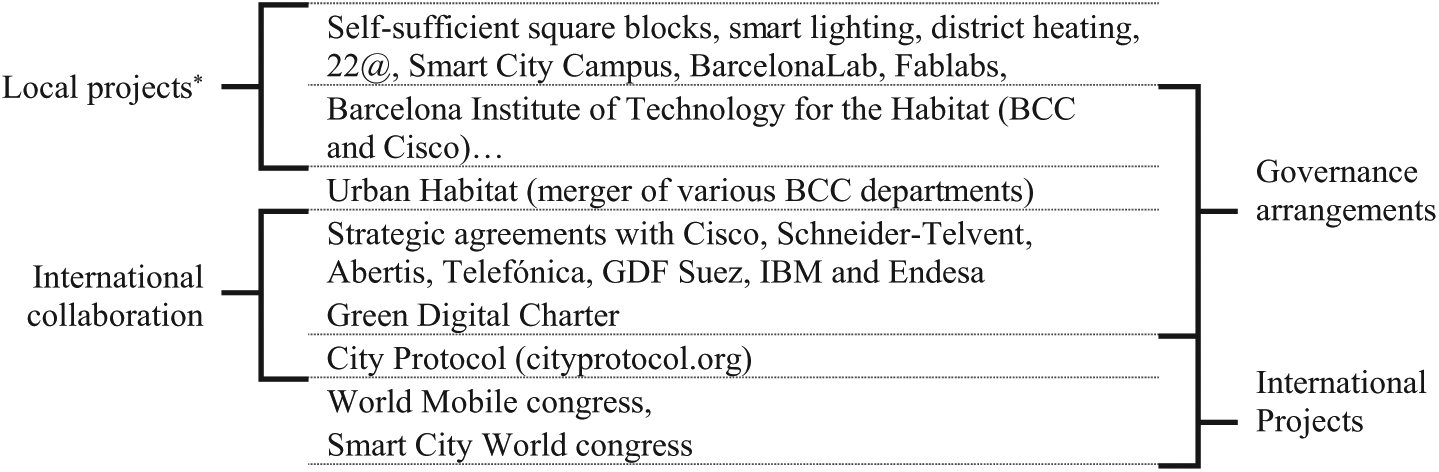
Barcelona’s smart strategy: Public and Public-Private partnerships.
From imaginaries to design: Developing the Smart City in Barcelona
The shift towards a new urban model for Barcelona is not only an abstract discourse with sophisticated arguments found in print, policy papers or exhibitions. Despite being in an incipient stage, it is possible to locate interventions in the city at different spatial levels, characterised by the intensive use of ICT and new forms of organising both environmental flows and social processes under the label Smart City. In what follows, we focus on two existing urban interventions framed by the Smart City paradigm: the Media-ICT building (in March 2014 rebranded as the Barcelona Growth Centre) and the district heating and cooling network in district 22@. In addition we also discuss a third development that is not yet a reality, but has been planned: the self-sufficient block. While this paper does not focus on all the ongoing Smart City projects in the city, we argue that these cases, combined with the discursive analysis provided in the previous section, help to empirically capture the essence of the Smart City paradigm in Barcelona and shed light on its implications and contradictions.
The smart building: Media-ICT
Opened in the 22@ digital district of Barcelona (the former working-class neighbourhood of Poblenou) in September 2010, the Media-ICT building was commissioned by the public developer Consorcio de la Zona Franca and designed by the architect Ruiz-Geli’s local team CLOUD 9. On 3 November 2011, the World Architecture Festival (WAF) named it ‘World Building of the Year 2011’ (WAF, 2011). In the words of Paul Finch, director of the WAF, it won this award because of ‘the scale and degree of difficulty of its ambition, and because it was a symbol of an emerging movement in the city of Barcelona’ (WAF, 2011). The jury, made up of internationally renowned architects, acknowledged that the building was located in ‘22@Barcelona, an experimental district in the city’ and the jury members ‘were extremely interested in the digital city model based on information, communication and technology, with the idea of a city where what matters is knowledge, added value and patents’ (WAF, 2011).
The building was designed to house ‘a citizens’ forum and a meeting point for companies and organisations in the information and communication technology sector in Barcelona, as well as the audiovisual and media sector’ (22@Barcelona, 2010). It was therefore very important to create spaces for interaction. As Barcelona Metrópolis, the BCC city magazine points out, ‘much of the building is given over to “incubators”, hothouses for the development of projects by young technology specialists’ (Fontova, 2009) alongside research centres, big companies and public administration. Media-ICT’s challenge, according to Serra, is ‘to open up, to democratise the creation of audiovisual content’ (Serra 2011: 35, authors’ translation). In sum, the building is ‘a centre that, without a doubt, will shortly lead the world of bits and pixels, hertz and megahertz, image and sounds. Media-ICT… combines sustainability and innovation, research and a strategy to drive towards a new knowledge economy’ (Albiñana, 2011:13, authors’ translation).
According to the former socialist mayor of Barcelona, Jordi Hereu, ‘the Media-ICT building embodies the Barcelona [that the city council is] striving to create during the decade 2010–2020: an innovative and creative city as well as an engine for a sustainable economy’ (Hereu, 2011: 4, authors’ translation). The building, he adds, ‘[would] become a worldwide benchmark for intelligent and sustainable architecture’ (Hereu, 2011: 4, authors’ translation). According to the former mayor, ‘the building demonstrates that BCC’s commitment to sustainability is a win–win practical and economic application’ (Hereu, 2011: 4, authors’ translation). The building itself becomes the sustainable agent through which (theoretically) a new and participatory economy could emerge.
With the political change in the BCC and the recent shift towards the Smart City paradigm, the Media-ICT building has become an iconic image of Smart Barcelona, representing a ‘new wave of green architecture, with energy as its principal argument’ (Ruiz-Geli, 2011: 44). According to its architect, ‘Media-ICT is not a CUBE but an information BYTE: 40 × 40 × 40’ (Ruiz-Geli, 2011: 41, authors’ translation) whose structure ‘acts as a network’ (Ruiz-Geli, 2011: 42, author’s translation). By means of its connection to the district heating, its smart sensors, solar panels and ethylene tetrafluoroethylene (EFTE) cushions (see Figure 2), the building aims to be an (almost) zero-net-emissions building (87–92% less CO2 emissions than a regular building). This fully resonates with the discourse presented in the previous section.
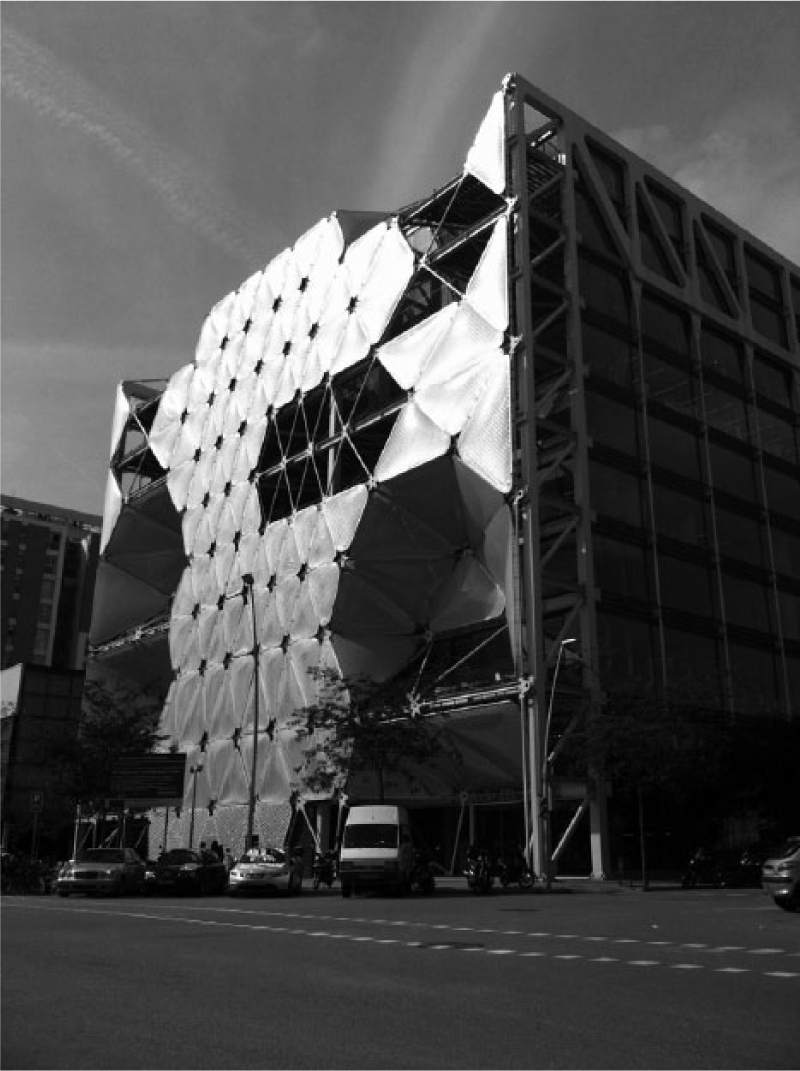
Media-ICT building.
A central point is how the building is given agency to self-regulate itself through this entanglement of smart sensors, distributed intelligence and smart technologies. Its architect summarises this agency as follows: ‘Who governs this? It is not the user who plays with this performance, but the interior energy law of the building. It is the building that decides. The building creates and coordinates a vertical cloud to filter the sun… and repeats it over and over again’ (Ruiz-Geli, 2011: 37, authors’ translation). The building rationale resonates with the chief architect’s meta-narratives on the city and the role of ICT, the Internet, citizens and nature. Through its self-regulating agency, the building is equated with a living organism instead of a simple infrastructure to inhabit. Thus, not only does the building mediate new relationships with environmental flows (energy or water); it also follows the idea that natural systems and distributed processes should become a guiding principle in twenty-first century architecture and urbanism. This fact points to the depoliticisation of urban planning and environmental management under the Smart City paradigm: algorithms and sensors on the one hand, and natural process on the other (both of which are socially mediated and thus embodied with power relations), are given agency to orchestrate urban life.
The network level: District heating and cooling in 22@ district
Media-ICT smart sensors control, among other things, the correct temperature of the building. However, the building does not produce the heat or cooling needed to reach the desired temperature itself, but is connected to the district heating network. At first glance the district heating appears to be nothing more than a water network, with large pipes laid underneath the 22@ district. However, the service provided is not tap water but British thermal units (BTUs), 6 in other words heat energy or cooling, delivered in a more ‘efficient’ and ‘sustainable’ way. District heating and cooling in Barcelona is argued to use 35% less electricity, improving energy efficiency by 50% and reducing emissions by 50% compared to conventional heating/cooling solutions. In a very simplified way, energy is recovered from metropolitan waste incineration and serves to heat/cool the water that circulates through the network. Additionally, conventional gas and electricity can be used to cover peaks in demand. Every building connected to the network has a substation containing heat exchangers.
In 2012 the district heating and cooling system supplied 78 buildings (mainly office buildings) through a 14.4 km-long network in which more than 17 million litres of water are heated to 90°C or cooled down to 5.5°C by two plants with a capacity of 73 MW for producing cooling and 51 MW for producing heat. The system prevented the emission of 17,127 tonnes of CO2 in 2012, and by 2020 it is forecasted that this figure will increase to 19,200 tonnes (Districlima, 2012, 2013).
According to the councillor for Urban Habitat, ‘the district heating network developed by Districlima is an example of the energy efficiency that we want, and clearly represents the direction the BCC wishes to take, which will permit progress to position Barcelona as a world benchmark for Smart Cities’ (Districlima, 2012: 4, authors’ translation). In addition, the president of the company and the CEO of Districlima argue that the district heating system in Barcelona may become the most important energy project in the city and an example of a new energy paradigm, thus making Barcelona a global Smart City model (Districlima, 2012). In addition, quotes about citizens’ participation revolve around citizens’ key role in these new energy models (Cultura Energètica, 2011). Thus, the CEO of Districlima argues that the users of the system (or, in other words, citizens), ‘are the key actors of the present and the scriptwriters of the future… they are the engine of a new energy paradigm to outdo our exhausted model with [the use of] smart solutions’ (Districlima, 2012: 6, authors’ translation). In those narratives, the ‘citizen’ is substituted by the ‘user’, who is entrusted with the duty of being the ‘scriptwriter’ of the urban future.
It is interesting, therefore, to analyse the governance schemes of the district heating system in order to shed light on the political economy of smart infrastructure and to disclose to what extent the ‘users’ might be the ‘scriptwriters’ of the future or rather just plain passive observers. The network was built and is currently managed by Districlima, a public–private partnership established in 2002, with Cofely (a company that forms part of GDF Suez) as the main partner (with over 50% of its shares in 2012). Other partners include the local state-owned company Tersa, the water company AGBAR (Suez Environnement), the Spanish Institute for Energy Diversification and Savings (IDAE) and the Catalan Institute of Energy (ICAEN). The company’s first project, under a 25-year concession, was the development and operation of a district heating and cooling network in the new urban development around the 2004 Universal Forum of Cultures. 7 In 2005 the company won a 27-year lease to expand the network towards the 22@ district (Districlima, 2012, 2013). Although Districlima appears to have low revenues (over 8 million Euros per year, according to early 2012 data (Rodríguez and Pérez Pineda, 2012)) compared with other ventures such as urban water supply, we suggest that the project’s economic interests may go beyond the revenue that the company collects. We contend that the project is framed around the growing interests of GDF Suez (and also Suez Environnement) in Barcelona as a partner to design and develop ‘the city of tomorrow’ (GDF Suez, 2013), whereby different smart solutions are being designed and progressively implemented in different cities. Barcelona wants to become a benchmark Smart City in the twenty-first century, and international utilities do not want to miss the opportunity to use the city as a platform and test case for business expansion elsewhere.
The block level: The illes autosuficients and Fab Labs
Between the building and the district scales, in Barcelona we observe the emergence of a new scale of socio-environmental planning: the block (illa in Catalan; manzana in Spanish). The concept of the self-sufficient block has replaced the former local government’s eco-neighbourhood planning schemes. In 2008, the BCC, then under the control of the Socialist party, presented a plan to develop the first eco-neighbourhood in Spain in one of the most deprived areas of Barcelona. The plan included the construction of some 2000 apartments, following environmental and energy guidelines and including the use of local resources and low carbon emissions. Although this €322 million development should have started in 2013, the plan has been frozen, allegedly because of the economic crisis (El Punt-Avui, 2012). This initiative was conceived and structured around the notion of the eco-city and Agenda 21 for sustainable development.
Since abandoning the project, BCC, now controlled by CiU, a Catalan conservative party, has adapted and downscaled some of its ideas and drafted the illes autosuficients planning scheme. The BCC’s rationale is ‘to promote a new model of construction and rehabilitation of buildings following new principles of design, management and financing of urban networks, based on local production and energy self-sufficiency at the building or block scale, and in a more efficient and sustainable management of resources’ (BCC, 2012b: 1, authors’ translation). While the information concerning this project is rather limited, in 2012 the BCC released a press note on the two pilot sites in Barcelona where two brand-new self-sufficient blocks will be developed and managed under a public–private partnership. To attain self-sufficiency and zero net emissions these developments would include sustainable technologies (solar panels, district heating, water recycling systems and parking lots for electric vehicles) and smart management (see BCC, 2012b).
According to the city’s chief architect, this regeneration of Barcelona towards self-sufficiency at the block scale should go hand in hand with the progressive reinvention of labour and production within the city and the emergence of new forms of material relations adjusted to the knowledge economy: ‘networked firms will be physically structured in a discontinuous way’ argues Guallart (2012: 115, authors’ translation). Under the name ‘Fab Labs’, 8 the chief architect envisages networked places inserted into the physical structure of the blocks, combining education, research and production, and enabling open innovation and the emergence of new economic activities. For the chief architect, the final objective is to pass from these Fab Labs to the so-called ‘Fab Cities’ or, in other words, ‘cities whose production is structured along the new principles of sharing knowledge at the global level and producing goods locally’ (Guallart, 2012: 123, authors’ translation).
Smart contradictions: Grounding utopias in a city in crisis
The illes autosuficients planning scheme was presented in a press release in early 2012 (BCC, 2012b), but the scheme reappeared (unexpectedly and unintendedly) in the media some months later. In the context of the worst economic crisis in Spain’s history, one of the sites initially selected for the project (an empty old industrial site in the 22@ district) (BCC, 2013) appeared to be squatted in by some 300 homeless citizens (most of them undocumented migrants), who made a very precarious living out of informal waste recycling (waste generated by the redevelopment of the neighbourhood into a technological district) (Europa Press, 2012). Although the homeless residents received support from neighbourhood associations and political parties, they were evicted from the site in July 2013 and were offered alternative lodging (El Periódico, 2013). In a very similar vein, the second Barcelona Fab Lab in Ciutat Meridiana, a working-class neighbourhood hard hit by the economic recession, was occupied by the neighbours in the summer of 2013 and turned into a food bank to solve the neighbourhood’s pressing needs (El Diario.es, 2013). Despite being two extreme cases, these examples serve to illustrate that behind the great promises and ‘grand visions of future urban utopias’ (Gibbs et al., 2013: 2151) that the Smart City is said to bring about, we find some emerging and, until now, unexplored contradictions. As new urban smart interventions are being designed and applied, little has been explored about how they are inserted into a wider political economy and ecology of urban transformation. In what follows, and drawing on the discourses contrasted with the examples shown, we aim to elaborate further on these questions.
The smart sustainable fix and its contradictions
All the examples provided, and in particular the discourse of the chief architect and the narrative surrounding the Media-ICT building, depict a quite sophisticated (yet not fully coherent) discourse on the relationships between nature and society at the urban scale. The urban imaginaries brought to the fore in Barcelona imply a novel perspective on how environmental flows can be rethought following a distributed model similar to the workings of the Internet. In summary, these techno-urban utopias envision a new radical imaginary where society and the city are redefined epistemologically. This is critical, as it may hide the city’s very own social nature, and therefore the power relations that underpin it. This reconceptualisation of nature through the use of ICT, combined with discourses highlighting the urgent need to confront impending climate change and environmental and economic crises, may result in the depoliticisation of city planning and management, thereby uncritically paving the way for new modes of the urbanisation of capital.
In this sense, the rhetoric of the Smart City in Barcelona, intentionally or unintentionally, obliterates any deep reflection on how capital flows will sustain the project. Indeed, the debates shift from public/private management to good/bad management, and from the delivery of a flow (energy, water, etc.) to the provision of a service (e.g. ‘energy services’, ‘smart street lighting’, ‘heating/cooling’). We argue that such obliteration is not incidental, even if unintended. We observe that private capital is silently but relentlessly permeating into the different layers that structure the Smart City, from the ubiquitous sensors to the network level and beyond. The central point we want to make, rather than analysing how sustainable these systems are, is to show how new (depoliticised) techno-natures, under the disguise of ‘services’, can be produced and handed out to the private sphere without much debate, all for the sake of having a so-called more sustainable city. As a matter of fact, while the regional water supplier’s recent 50-year lease and the reconfiguration of the metropolitan water cycle have been very controversial and sparked widespread debate within civil society (March, 2014), the concession of the district heating network to Districlima (of which AGBAR and GDF Suez are shareholders) until 2032 has passed unnoticed by the population. While both infrastructures focus on the circulation of water through a network and make a profit out of this circulation, the former has been conceptualised as a basic urban flow (a citizen’s right) and the latter has been directly presented as a wise, new, privately led, more efficient service to reduce greenhouse emissions in a context of climate crisis and austerity. Thus, the (urban) environment, mediated through infrastructure and ICT, under the label of the Smart City, is increasingly being seen as a frontier forcapital accumulation and circulation. In other words, this new paradigm can be understood as an urban sustainability fix to overcome capital’s inherent contradictions (Keil and Boudreau, 2006; While et al., 2004) and, in so doing, is confronting the problems of sustained growth in the contemporary political and economic form of urbanisation in capitalism. In a crisis-ridden scenario with increasing processes of privatisation of urban infrastructures and services, both urban utilities (e.g. water, energy, etc.) and ICT companies are investing and expanding their interest in smart solutions to tackle urban problems (e.g. ARUP, 2010; Falconer and Mitchell, 2012; IBM, 2010; Suez Environnement, 2012). In that sense, as the chief architect of the city recognises, the term Smart Cities ‘emerge[s] simultaneously because of the will of cities to improve the efficiency of their infrastructures and also by the interest shown by the most capitalised companies in the world, from the sphere of ICT, in opening new spheres of economic activity’ (Guallart, 2012: 147, authors’ translation). As it has happened in many cities across Europe, BCC has flung open its doors to private capital to use the city as a lab to test and develop smart projects. Notwithstanding the vision of distributed management of socio-environmental flows at different scales with the participation of citizens, BCC’s actual policy is to seal agreements with big utility companies, opening up untouched areas of urban life to capital, and thus not contesting current hierarchical arrangements.
On the other hand, central to the deployment of Barcelona’s smart strategy is the conversion of urban land – through techno-environmental interventions – into self-sufficient urban land. For Guallart (2012), the self-sufficient city paradigm implies transforming nineteenth-century urbanism, where value was added to the city by means of converting farming land into urban land. Now, in the twenty-first century, value can be added to the city by transforming urban land into self-sufficient urban land. Thus, in a city densely built and with few green-field plots, buildings such as Media-ICT and initiatives such the self-sufficient blocks can represent, in a sophisticated manner, a way of revalorising land, and generating new monopoly rents. This is not new in Barcelona. During the 2000s, the city changed land zoning in the 22@ district of Poblenou. In that case, land exclusively designated for industrial use (22a in the city planning nomenclature) was transformed into 22@ land to carry out ICT and creative economic activities. This allowed the construction of office and retail buildings in what was previously reserved for manufacturing activities, thereby increasing the value of the land. The results of this change were firstly a strongly contested speculative production of place and gentrification, and then, with the arrival of the economic crisis, a severely compromised development of 22@ (Charnock et al., 2014).
In summary, the Smart City risks becoming – or at least being seen as – a project that mobilises the environment for the ‘legitimisation’ of urban redevelopment. The wider political economy is based on the capturing of new monopoly rents on the one hand, and on the other on securing an urban sustainability fix for the inherent problems of sustained growth in contemporary capitalism by utility and ICT companies.
Citizens’ participation and its contradictions
Against this backdrop, we argue that it is critical not to forget the central role that citizens should play in the collective production and administration of the city. While the Smart City in general, and Barcelona in particular, promises to foster inclusiveness and citizen empowerment, until now it is unclear how the interests of citizens are to be made compatible with the interests of private capital and of the urban political elites. The Media-ICT building is still far from being a centre for civic engagement or a space where regular citizens can participate in the social metabolism of the building. In contrast to its aim of becoming a place where all kinds of actors can be located and interact, the building is almost completely occupied by public (or para-public) institutions. In fact, at the time of writing, there was only one start-up firm in the eight-storey block. The heating and cooling network, with its rhetoric of a new energy model where the citizen is central, has reached public facilities and private office buildings but barely touches the residential sector. In addition, there are no citizens’ or users’ participatory mechanisms in its governance beyond organised visits to the district network. It remains to be seen how citizens are to be included democratically in the production and management of the city of the twenty-first century. According to Barcelona’s chief architect, this new urban model is only worthwhile if it ‘allows people to have more control over their own life’ (Guallart, 2012: 53, authors’ translation). However, the examples of the Fab Lab and the self-sufficient block, flagships of the new urban model in Barcelona, have already encountered the opposition of neighbourhood associations, and new urban infrastructures are far from being examples of democratic participation.
Scalar contradictions
Beyond these central issues, we might also want to critically reflect on the problems that Smart City projects may encounter when they are upscaled from pilot areas to the entire city. In the case of Barcelona, the three examples presented show that these interventions may encounter some obstacles to becoming valid models that can be upscaled to the city level. The Media-ICT building, despite its success in terms of institutional and academic visits from different countries, is a one-off building not being replicated elsewhere in the city. The district heating network has major barriers hampering its expansion beyond the 22@ district or in the urban redevelopment south of the city, where there have been, and still are, ongoing processes of urban renewal and conversion of industrial sites to office and residential spaces. In the already ‘built’ city it can only expand if the cost is reasonable to buildings that have centralised heating, which is not very common in Barcelona, and where the majority of the owners, if it is a residential building, agree to have it. Furthermore, as the network can only expand linearly, if a building is interested in being connected to the network but the neighbouring buildings are not, the company would probably not be interested in expanding the system to that address, given the investment needed compared with the potential revenues. Thus, even if a building wants to connect to the network, it might not be in the company’s interests, because costs may be too high (heating and cooling are not a basic urban service such as water or electricity). As the previous government’s failed eco-neighbourhood project shows, the economic crisis may also damage these initiatives. Beyond that, the new way of doing smart urbanism in the twenty-first century might still find some legal and political barriers, as the scales of operation do not always coincide with the administrative and political limits or with the legal requirements.
The need to repoliticise the Smart City
The analysis of the impact of existing smart urban solutions, and therefore the conclusions drawn, has a strong speculative character in many respects. Of course, it cannot be any other way, since actually existing Smart City projects are recent and still more remain in the form of blueprints rather than material realities. We argue, nonetheless, that assessing the metaphors and imaginations driving such visions through a critical prism matter as an indicator for their likely outcomes, that is, whether Smart Cities descend into a dystopian fantasy or forge a new cooperative relationship between the human and the non-human world. However, there is also an urgent need for more research on ‘actually existing’ Smart Cities that goes beyond the discursive analysis of smart visions. Faced with uncritical analysis of the benefits of technological solutions on the one hand and of those that ‘reduce’ Smart Cities to a mostly neoliberal discursive exercise on the other, we have tried to critically engage with these narratives, highlighting the need to not take this concept for granted and to open up discussion about their future implications. As the case of Barcelona shows, once we move from discourse to implementation, we can contrast and discover both the intended impacts of such transformations and some of the unpredictable set of consequences and contradictions behind Smart City projects.
The use and embedding of ICT in urban planning and city strategies could potentially be a tool to produce more sustainable, healthy, inclusive and emancipatory urban environments. Yet, the Smart City may also become a new strategy that, in the attempt to turn urban socio-environmental relationships upside down, reproduces existing urban socio-political and political-economic relations. Despite allegedly striving for more environmentally friendly cities, these developments may set up depoliticised visions of urban development and basic urban services delivery. While the Smart City concept appeals to the central role of the citizen and boasts of opening up new participatory mechanisms, behind these strategies there is an increasing presence of big ICT, consultancy firms and utilities that search for new business opportunities. The city ends up, as the Barcelona City Council acknowledges, being the ‘unique opportunity to apply solutions… the laboratory and leader at the same time’ (BCC, 2012a: 3, authors’ translation). Against this backdrop, there is a need for more detailed exploration of how cities are becoming laboratories for capital and what implications this has for its citizens. In other words, we have to ask whether smart interventions, even though boosting sustainability and economic growth, might not be as inclusive as they promise. If this is the case, they may become the dominant storyline for urban planners, bureaucrats and companies but will not be plausible for citizens. In other words, Smart Cities might become an empty, hollow signifier, as has already happened with other concepts such as the sustainable city or the resilient city (Vale, 2014), built in the image of capital and of the political elites.
In other words, building on the debates around the post-political, the city and the environment (Swyngedouw, 2009a), there is an urgent need to repoliticise the Smart City debate. Otherwise, the Smart City, can function to disguise entrepreneurial urban development and further privatisation of urban services delivery under the veil of a new hype of ecological and technological branding. In turn, and as Vanolo (2014b) argues, these views may result in considering the ‘urban question’ not as political or social issues but as a technological question that can be solved through technologies provided by private companies. Thus, it is necessary to take carefully into account the diversity of political and economic interests. Different actors may struggle to shape the Smart City in their own image and interests, and this has to be acknowledged in order to avoid implementing acritically new urban models under the rhetoric that everybody wins equally (environment, capital and citizens). Smart Cities, in other words, can intensify processes of ‘urban splintering’ (Graham and Marvin, 2001), resulting in the exclusion of parts of the city to new privately run infrastructures and services as they are deemed to be non-profitable. Vale (2014: 191), challenging the politics of resilient cities, raised the following critical question: ‘whose resilience and whose cities?’ Paraphrasing that author and also drawing on Vanolo (2014b), we argue that it is critical to reflect on ‘whose smartness and whose cities?’
Related to the previous point, it is also important to reflect on the importance of ‘not so smart’ urban infrastructure. Beneath the implementation of self-sufficient and smart ‘efficient’ solutions to the environment, such as the self-sufficient block or the Fab Lab in Ciutat Meridiana, lie clear examples of ‘the tendency to fetishize new pieces of gleaming infrastructure’, which ‘work[s] to obfuscate the continued importance of less glamorous and long-standing infrastructural circuits of the city’, as Graham (2010: 4) points out. In that sense, debates on the Smart City should not obliterate the provision of basic services for most of the population, which may not have a place under the Smart City umbrella. Those basic services, sometimes invisible and hidden underneath the urban fabric, make life possible in the city while structuring how everyday life is experienced in the urban fabric (Heynen et al., 2006; Loftus, 2012). It is thus necessary to confront how ultimately smart ICT-driven urban strategies are intertwined with and affecting processes – such as the provision of basic services – that might not be directly related with them.
Eventually, Smart City strategies are showcased as universal, transferable technological solutions. Yet Barcelona’s take on the Smart City explicitly shows how the concept in itself is imported,transformed and repackaged. It also shows how the intended solutions face problems in being appliedin different contexts or neighbourhoods. Thus, it is necessary to explore not only how Smart City projects are produced in place, but also how these ideas are mobilised, translated and replicated elsewhere in a comparative way (see Crivello (2014) for the case of Turin, Italy). In particular, it is relevant to inquire how the Smart City concept (a Global North concept) translates to the cities of the Global South and with what implications.
In summary, it is critical to further inquire as to whether Smart Cities are evolving in ways that shape more sensitive interventions in urban ecologies or in ways that might represent a new height of human hubris that gives way to Promethean attempts to exert domination over an externalised nature, opening the way for new forms of commoditisation, exclusion, control or injustice. It thus remains to be seen if the Smart City project is nothing more than a ‘utopia of spatial form’ where ‘the dialectics of social change – real history – are excluded while social stability is [seemingly] assured by a fixed spatial form’ realised ‘through the agency of either the state or capital accumulation, with both acting in concert being the norm’ (Harvey, 2000: 160 and 173, respectively). Indeed, as Pinder (2002) pointed out more than a decade ago, it is necessary to start to imagine and construct alternative urban utopias. These new imaginaries should go beyond the actually existing Smart City.
Footnotes
Funding
This work was supported by the Ministry of Economy and Competitiveness of Spain (grant numbers CSO-2010-16966 and JCI-2011-10709).