




Abstract
Keywords
Introduction
Moral courage is a valued personal characteristic and a virtue, with which nurses can promote quality of care and advocate for patients.1,2 It is defined as the courage to act based on individual or professional values in an ethical conflict, despite personal risks from the act.1,2 Nurses encounter ethical conflicts when they aim to fulfil their professional duty to do good for their patients3,4 and respect human dignity and autonomy. 3 Ethical conflicts can stem from differing views of professionals and patients or their next of kin or challenges in collaboration between professionals. 5 Also, organisational issues, such as the nurse shortage or the hierarchy in decision-making processes, can involve ethical conflicts. 6 According to the definition of moral courage, 1 ethical conflict and personal risk are always present when a nurse acts morally courageously.
Research on nurses’ moral courage, including concept analyses,1,2 literature reviews,7,8 and empirical studies, is increasing. Empirical studies have been conducted from the perspectives of nurses,9–16 nurse students,17–20 and nurse managers. 21 In empirical research, moral courage is described as a part of nurses’ ethical competence, highlighting its relation to professional nursing ethics.1,22 Sometimes nurses even go beyond their ethical responsibilities with morally courageous acts. 23 Associated factors include earlier life and work experience, 18 knowledge about and skills in ethics, 9 and ethical climate in organisations. 11
Despite increases, research focusing on nurses’ justifications for their morally courageous acts is still scarce. A nurse decides whether to act morally courageously based on ethical reasoning, forming a link between moral courage and ethical decision-making. 24 Ethical decision-making and acting in ethical conflicts can be based on nurses’ professional values and decision-making frameworks, including the ICN Code of Ethics for Nurses or the WHO Global Health Ethics Key Issues.3,25 Morally courageous acts can be justified individually, or with colleagues, co-workers, or patients. 26 After establishing a justification, nurses act morally courageously despite possible negative consequences for themselves. 24 Nurses often initiate discussions about ethical conflicts, acting morally courageously.22,27 Initiating a discussion or filing a note can be done inside the organisation, for example, with the closest manager. Also, nurses can inform someone outside the organisation, such as a trade union representative. 28 This study focuses on nurses’ justifications for their morally courageous acts. Describing justifications promotes learning from nurses’ experiences, which can support decision-making and potentially offer tools that strengthen nurses’ moral courage. 29
Objective and research questions
The objective of this study was to illustrate registered nurses’ justifications for acting morally courageously or not in ethical conflicts where they need moral courage.
The following research questions were set: 1. In which ethical conflicts do nurses need moral courage? 2. What are nurses’ justifications for acting morally courageously, or not, in ethical conflicts?
Methods
Research design
In a narrative inquiry, Lieblich’s holistic content approach was used. 29 This approach involves asking participants to talk about their experiences in an undisturbed narrative and analysing the transcribed narratives as a whole. Thus, the ‘narrative’ in this study refers to the contents of the participants’ narratives in their interviews. Each point of interest, according to the research questions, is followed throughout the transcription of each interview. The holistic content approach allows for the identification of ethical conflicts as context for morally courageous acts, and deep and broad meanings of the nurses’ justifications for whether to act morally courageously. The chosen approach also facilitates a meaningful and comprehensive presentation of the integrated findings from the participants’ narratives. 29 This report follows the Consolidated Criteria for Reporting Qualitative Studies (COREQ). 30
Sampling and context
Purposive sampling was conducted from a large Finnish nursing-themed online discussion forum, hoitajat.net, 31 to reach registered nurses with experience of ethical conflicts and the need for moral courage. 29 The discussion forum was chosen because it is accessible to all nurses and has a dedicated section for invitations to participate in studies. 31 The first author published an invitation for participation and information about the study as part of doctoral research with a link to a detailed information letter and a privacy notice. 32 To be included, participants had to be registered nurses, who had identified ethical conflicts in their work and had needed moral courage to solve these conflicts, whether they acted morally courageously or not. The nurses themselves determined whether they had the required experience to participate. Participants could join by contacting the first author by phone or email. Moral courage was analysed in relation to ethical conflicts. Thus, the research context was the ethical conflicts the participants had encountered in professional nursing in Finland. This paper describes the complex ethical conflicts as part of the holistic illustration of nurses’ justifications to facilitate a deep and broad understanding of the justifications.
Data collection
The participants’ age (years), work experience in healthcare (years), current and previous work roles, and fields of nursing were collected before the interviews with a short questionnaire either on paper or in a digital format, according to each participant’s wishes. Two pilot interviews were conducted to test the usefulness and clarity of the interview scheme. No changes to the interview scheme were made after the pilot. 30 The first author conducted individual open interviews, to appreciate the uniqueness of each participant’s experience. 29 The interviews took place between January and February 2023 either using the virtual meeting platform Zoom 33 or face-to-face, according to each participant’s wishes. The interviews were recorded with each participant’s written consent. Only the interviewer and the participant were present in the interview. The interview started with a request for the participant to share experiences of ethical conflicts in which they would have needed moral courage but did not act morally courageously. Then, the interviewer asked the participant to talk about ethical conflicts in which they had needed moral courage and had acted morally courageously. Each participant told varying examples in their narrative. After the participants provided the initial narrative, the researcher asked probing questions when necessary. 29 The interviewer would ask ‘What was the justification for acting or not acting morally courageously?’ to obtain more detailed information about the participant’s justification if the participant did not explain them initially. After each ∼25 to ∼90-min interview, the interviewer took notes to assist the data analysis. 34 The notes comprised the participant’s tone of voice, body language, and the emotions that their non-verbal communication could have represented. Recruiting participants and conducting interviews continued until theoretical saturation was reached. This was assessed continuously throughout the data collection. When no new knowledge regarding ethical conflicts, justifications, or morally courageous acts was identified in the interviews, theoretical saturation was deemed to have been reached. 32
Data analysis
The interview data were analysed using holistic content analysis, following Lieblich’s holistic content approach. 29 The field notes were used to revisit the atmosphere of each interview. This enhanced maintaining the holistic perspective during the analysis. Faithfully to the holistic content approach, each transcribed interview was handled as a whole instead of analysing it in pieces. The results of the analysis represent the researchers’ interpretations of the meanings of the data. 29 The first author was responsible for the analysis, which was regularly discussed within the research team (E.P., H.L-K, and R.S).
First, each participant’s narrative from their transcribed interview was analysed separately: then, the findings from all participants’ interviews were merged. The steps of the analysis 29 were: (1) Each text was read several times to gain a holistic idea of the text; (2) content in the narrative relevant to the study objective was identified: the ethical conflicts where nurses needed moral courage, the justifications for whether to act morally courageously, and what was the action taken; (3) areas of ethical conflicts and justifications were identified; (4) Steps 1–3 were repeated with each narrative; (5) nurses’ bases of justifications were identified from content that was identified repeatedly in the nurses’ justifications; (6) based on the similarities and differences in justifications for morally courageous acts, three perspectives of justifications were formed. The perspectives illustrate specific viewpoints for justifications in each ethical conflict, while the bases of justifications represent a broad general basis for nurses’ justifications in all ethical conflicts; (7) the ethical conflicts, relevant justification, and the morally courageous act were identified holistically, according to the bases and perspectives of justifications; (8) all nurses’ justifications and their perspectives for not acting morally courageously were identified and described together. The participants described their justifications for whether or not to act morally courageously with varying depth in their narratives. The identified bases and perspectives of justifications are the results of the analysis of the content of the initial narratives Supplementary Table S1. 29
Participants
Fourteen registered nurses participated. They had from seven to over thirty years of working experience in healthcare. The participants had worked in somatic, palliative, mental health and substance abuse care, inpatient hospital wards, outpatient clinics, and emergency services, with patients from all age groups. Additionally, some participants were currently working or had previously worked as staff nurses, nurse managers, or practical nurses.
Ethical considerations
Research ethics were followed. 35 Ethical approval was received from the Ethics Committee of University of Turku on 24 October 2022. This study deals with the moral activity of individuals; the topic is personal and can be perceived as sensitive. The participants were healthcare professionals, who had received information about the study and had given written informed consent before voluntary participation. Participants’ personal data were processed following the EU Data Protection Directive (679/2016). 18
Findings
First, the ethical conflicts described by the nurses in their narratives and their need for moral courage are presented. Second, the bases and perspectives of justifications for morally courageous acts are described. Finally, the justifications for not acting morally courageously are described.
Ethical conflicts in which the nurses needed moral courage
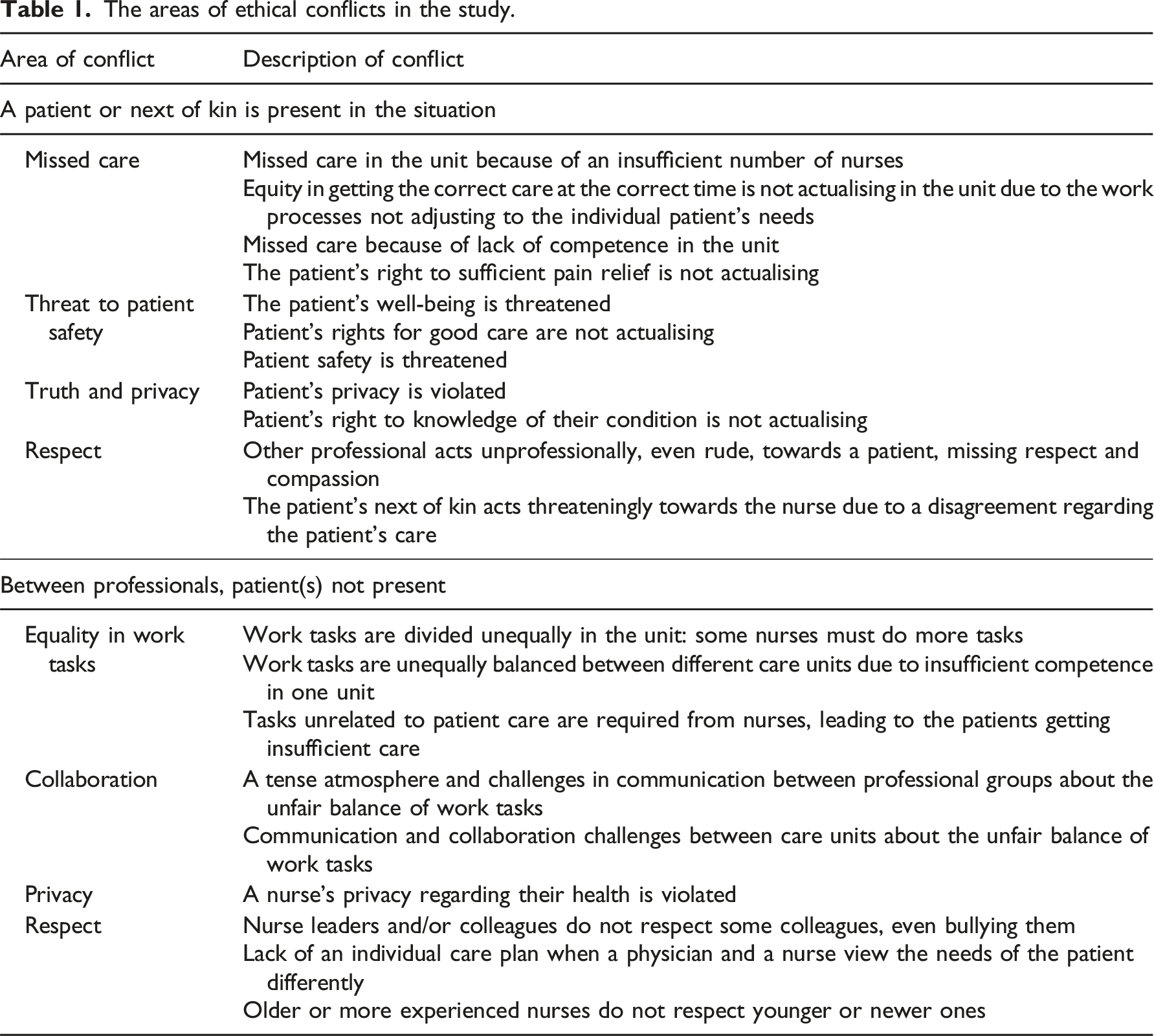
The ethical conflicts that the nurses described in their narratives either involved the patient or their next of kin or were situations that arose between professionals. Areas of conflict involving a patient or next of kin were missed care, a threat to patient safety, truth and privacy, and respect for others. ‘So there the unit’s nurses are holding the old patient down forcefully with both hands… so then the I.V. is in, and the drip is on… and… and this patient screams very loud… this old patient… and… these nurses say that the patient has dementia and therefore does not get to decide themselves…’ (Participant 6).
The areas of ethical conflicts in the study.
Nurses’ justifications for morally courageous acts
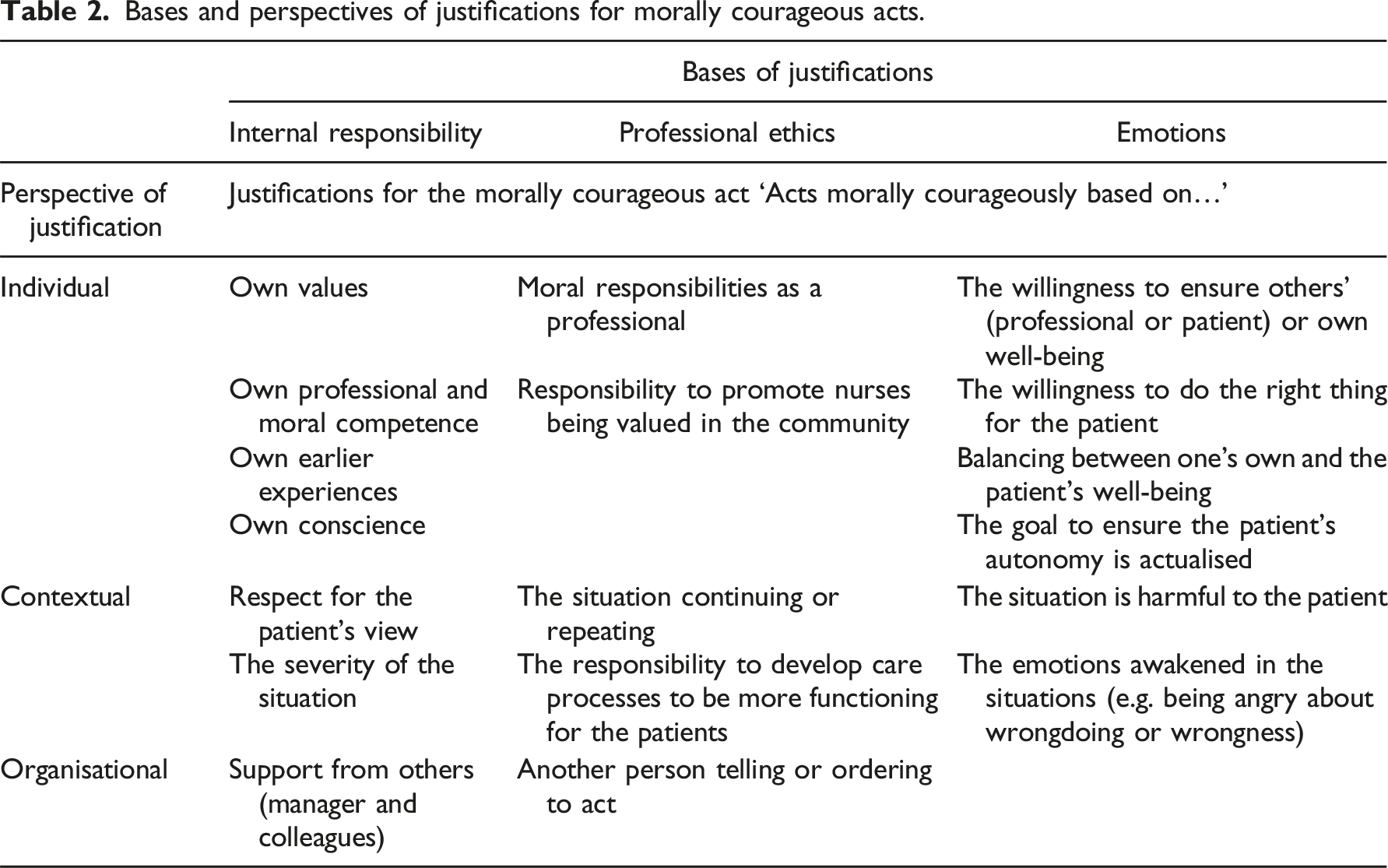
Bases and perspectives of justifications for morally courageous acts.
Bases of justifications
Internal responsibility as a basis of justification was related to the nurse’s values, competence, experiences, and conscience. ‘… something just… deep inside says that this is right, or this is wrong, and I always act according to what I feel is right’ (Participant 10). Professional ethics as a basis for justification was related to professional responsibilities, such as providing quality care with functioning processes. ‘… cos it’s my area of responsibility, so… of course, it’s that we have to battle a lot you know… on behalf of the patients’ (Participant 2). Finally, having emotions as a basis for justification was linked to the nurses’ willingness to make sure everyone was feeling well, willingness to do the right thing, and getting angry about the wrongness of a situation. They identified a violation of professional values, and, for example, got angry about it. Emotion was the driving force for acting morally courageously. ‘I mean, it was just the death of the patient then, the smaller things didn’t wake me up… and then I got angry’ (Participant 13) (Table 2).
Perspectives of justifications
In addition to the bases of justifications, the nurses’ justifications in each ethical conflict had an individual, contextual, or organisational perspective. The individual justifications were related to the nurses themselves and their viewpoints, while the contextual justifications were related to the severity, timing, and other attributes of the situation or the surroundings. The organisational justifications were related to other professionals and the organisational matters, such as a well-being strategy in the organisation (Table 2).
Holistic illustrations of the ethical conflicts, justifications, and morally courageous acts
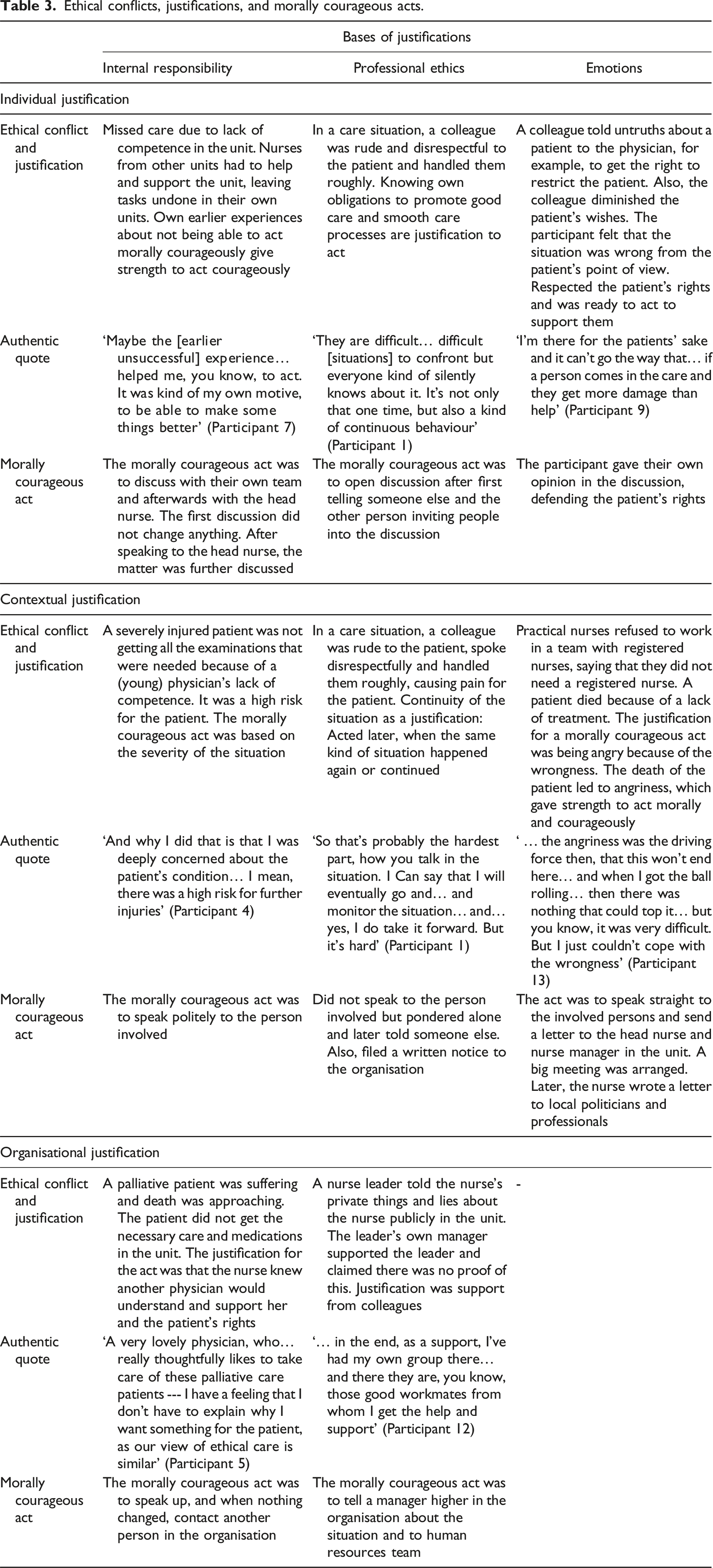
Ethical conflicts, justifications, and morally courageous acts.
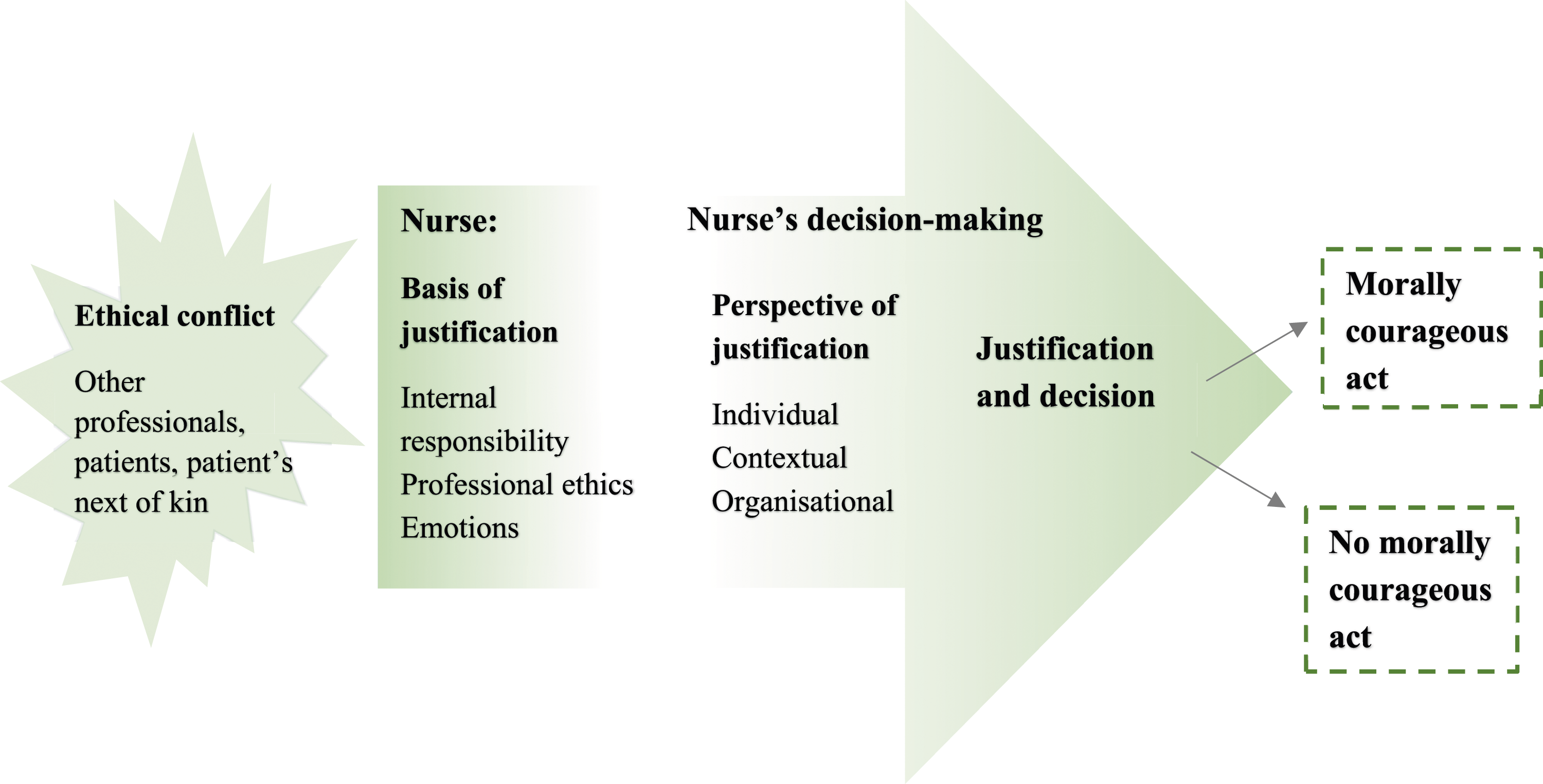
Nurse as a central actor in the decision-making process in ethical conflicts, leading to a morally courageous act.
Nurses’ justifications for not acting morally courageously
All participants’ justifications for not acting morally courageously.
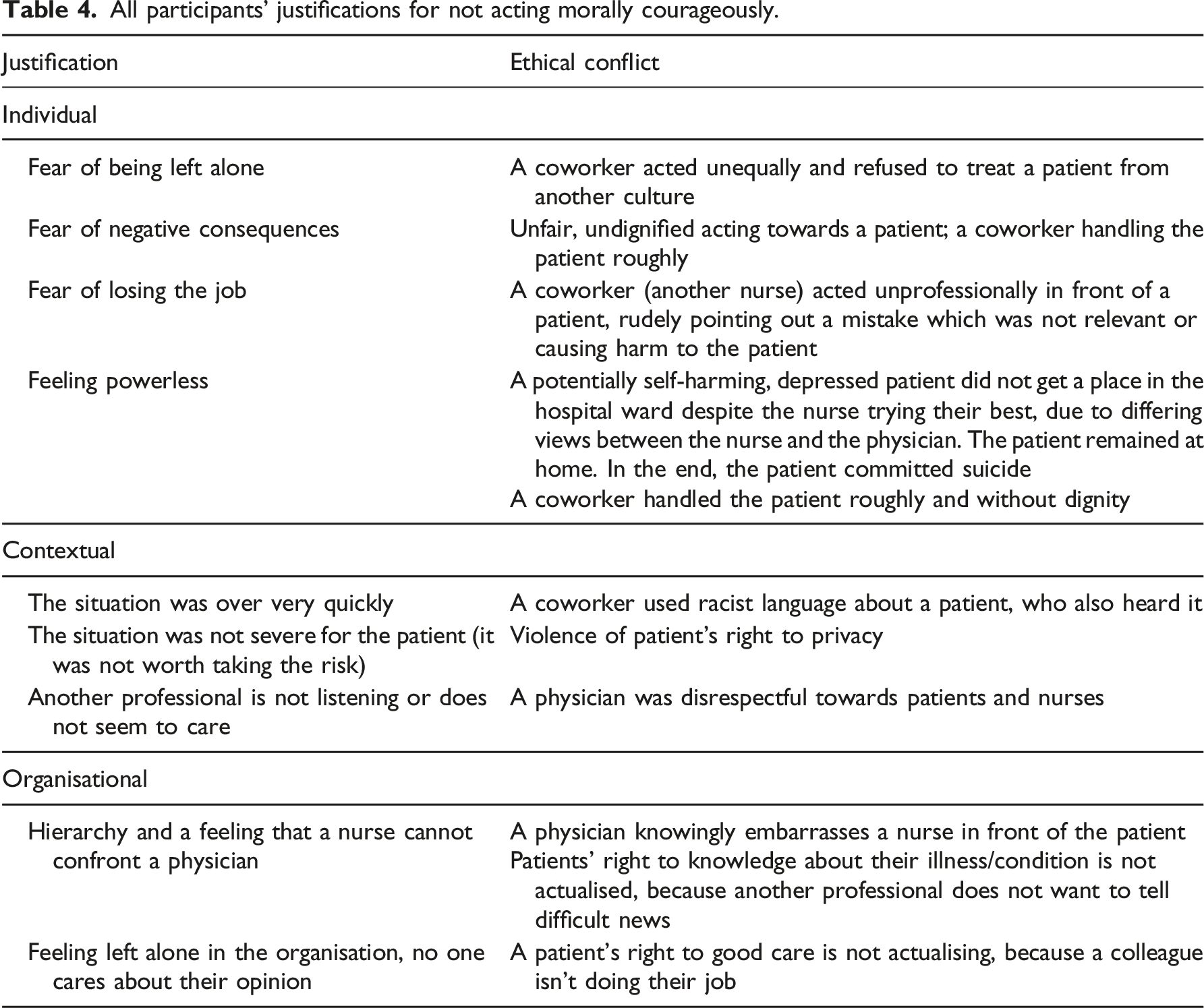
Individual justifications for not acting morally courageously were related to the nurses’ feelings and fears. For example, in a new workplace, a coworker spoke rudely about a small, non-hazardous mistake (that the nurse had done), in front of a patient. The justification for not acting morally courageously was the fear of negative consequences. ‘… I didn’t have the courage to say anything cos I was afraid that my work contract wouldn’t continue’ (Participant 8).
The contextual justifications were related to the severity, timing and other attributes of the situation. For example, a coworker used racist language about a patient, who heard it. The situation happened quickly, and it came as a surprise to the nurse, who did not act morally courageously. ‘… when the coworker said [the n-word] … so it just somehow came as a surprise for me, the situation that I didn’t even realise at the moment… that… what was really happening…’ (Participant 11).
The organisational justifications were related to other professionals and organisational matters, such as hierarchy. For example, in one case, the patient’s right to knowledge about their illness was not actualised, because a physician did not want to tell the difficult news. The justification for not acting morally courageously was a hierarchical decision and a notion that a young nurse could not confront physicians. ‘And then first you’re just that ok… the physicians are so experienced … and I assume they know what they are doing’ (Participant 3)
Discussion
This study provides new knowledge on ethical conflicts where nurses need moral courage, the bases, and perspectives of justifications for whether to act morally courageously, and the morally courageous acts they perform. The starting point of the study was that for moral courage to manifest, there has to be an ethical conflict and a personal risk for the acting nurse.1,2 The nurses provided rich and detailed information about their experiences in their narratives. They expressed how they thoughtfully and deeply pondered the ethical conflicts and their justifications for whether to act morally courageously, and they tried to fulfil their ethical responsibilities. 36 This illustrates the importance of moral courage for professional nursing ethics, as courage enhances acting according to what one considers to be right in an ethical conflict. 1
The recounted ethical conflicts had emerged in situations with a patient or next of kin present and between professionals, corresponding with earlier research.5,6 Internal responsibility, professional ethics, and emotions were identified as bases of justifications. These did not exclude each other, but each nurse had one basis for justifications that was more important to them. The bases and perspectives are handled separately in the text to allow a broad understanding of the nurses’ justifications. One basis of justifications could be the most important for one nurse while varying perspectives of justifications were applied in different ethical conflicts. This illustrates the complexity of ethical conflicts and nurses’ decision-making when justifying morally courageous acts. 36 The nurses mostly acted morally courageously in the ethical conflicts, which is promising and in line with earlier research.9,11,13–15 However, it is worth acknowledging that despite identifying the need for moral courage, the nurses sometimes decided to not act courageously. The justifications for not acting morally courageously add to the existing knowledge of inhibitors of moral courage. 37 Additionally, the results correspond with Rest’s Four Psychological Components Determining Moral Behaviour, which include moral sensitivity: identifying the ethical conflict, moral judgement: pondering about the possible solution and choosing a justification for whether to act morally courageously; moral motivation: based on the justification, choosing a way of acting; and moral character: acting morally courageously based on the justification and decision. 38 These four components illustrate moral courage as a fundamental part of an individual’s moral behaviour, essential to nurses regarding ethical competence and their actions in ethical conflicts. 2
Due to the complex nature of ethical conflicts, one solution or justification does not fit all situations. 39 Thus, nurses need the capability to justify their potentially morally courageous acts.24,26,36 Justifying acts in ethical conflicts is part of nurses’ value-based ethical decision-making, aiming to promote good and safe care. 36 There are always other professionals, the patient, or their next of kin present in ethical conflicts, highlighting the importance of good, respectful communication in solving these conflicts. 12 The ethical conflicts related to challenges in communication and collaboration in particular indicate that promoting respectful communication and collaboration between professionals can enhance nurses’ moral courage and the ethical conduct of professionals.36,40 This is at the core of nursing and nursing ethics: professionals working together for the good of the patient, based on the values of healthcare.3,11,36,41
It is notable that, even in similar areas of ethical conflicts, the justifications varied, illustrating the complexity of the ethical conflicts, nurses’ decision-making, and justifications.6,21,26,36 According to their narratives regarding their justifications for acting morally courageously, internal responsibility, professional ethics, and emotions were the bases of their justifications. 29 The detailed narratives have been interpreted into these bases and perspectives to describe the justifications as clearly as possible, despite the complex world of nursing and nursing ethics. 42
Nurses who felt internal responsibility as a basis of their justifications were aware of their values, and the justification for morally courageous acts often came from themselves. Their justifications indicate that they were committed to and willing to advocate for the patients. 1 This highlights the crucial role of a morally courageous nurse as an individual who maintains an ethical quality of care. 1 Professional ethics as a basis of justifications illustrated the nurses’ responsible conduct, following their professional ethical duties. 3 Based on their acknowledgement of professional responsibilities in ethical conflicts, the nurses seemed to have good knowledge of professional ethics, which has been associated with moral courage among nurses.2,9,10,15 Those who based their justifications mainly on emotions wanted everyone to be well. 36 Their pondering and weighing of the consequences for different persons involved in the conflict situation highlight their empathy and ethical decision-making skills. 36 Although the nurses purposefully decided to follow the values of nursing, 3 their justifications, confidence, and the boost to act came mainly from emotions, such as anger, that had arisen during the ethical conflict. This has previously been indicated in social psychology. 43
The nurses who used all bases of justifications repeatedly acted morally courageously despite the risk of personal negative consequences. Thus, although the bases and perspectives of justifications varied, the nurses held the capability to justify and conduct their morally courageous acts. Often, justification came from an individual perspective, without help or support from others, illustrating the nurses’ capability to justify acting morally courageously. This perspective of justification is in line with earlier research, where moral courage has been described as having a strong professional identity, ethical sensitivity, and competence.1,2,44 However, sometimes the nurses decided to act morally courageously based on the conflict situation, indicating their skills in identifying an ethical conflict and acting according to what they considered to be right.26,42
As for the situations in which nurses did not act morally courageously, individual justifications were related to fears and feelings of powerlessness. 37 These justifications sometimes prevented a nurse from acting morally courageously even when the situation was severe for the patient. The nurses could be afraid of possible negative reactions of other people. 37 Contextual justifications for not acting morally courageously were related to the severity or the timing of the situation, hierarchy, and nurses’ feeling that they had been left alone. Situation severity as a justification can indicate that, in non-severe situations, nurses might feel that acting morally courageously would not be worth taking a personal risk. 37 Regarding the justifications of hierarchy and nurses feeling left alone, it is relevant to acknowledge nurses’ right to a safe and positive work environment.24,45
To overcome hierarchical challenges and to promote moral courage among nurses, other professionals should show respect to nurses as professionals who can make moral decisions and act individually.36,37 Additionally, organisations should ensure strong and clear values to support nurses’ decision-making and actions in ethical conflicts.11,46 Furthermore, organisations can provide sufficient information, resources, and clear processes regarding ethical conflicts to support nurses who doubt their capabilities to act morally courageously or who cannot overcome their fears of negative consequences. 47 This support can promote morally courageous actions among nurses despite the personal risks. With moral courage, it is possible to build moral resilience to continue to act courageously. 48
Strengths and limitations
The strengths and limitations of this study are related to sampling, data collection, data analysis, and reporting. The chosen online discussion forum, hoitajat.net, can be considered a strength because, although not all nurses use it, it is publicly accessible. Also, as a large online community, it had the potential to reach nurses with experience of ethical conflicts and moral courage. Three of the authors (E.P., H.L-K, and R.S) have backgrounds in nursing, which facilitated an understanding of the contexts the participants described. Additionally, this gave a possibility to deeply discuss the ethical conflicts during the interviews. Moreover, following the analysis frame systematically, and discussing the analysis regularly with the research team, strengthened the credibility of the study.
According to Lieblich et al., the strengths and limitations of a narrative inquiry can be evaluated through the dimensions of width, coherence, insightfulness, and parsimony. 29 As a strength, the width of the interviews, the interpretation of the results, and their presentation can be identified from the quotations illustrating the participants’ unique voices. Additionally, the holistic content approach 29 and the rich data provide varying examples in the narratives. This, in turn, allows for forming a comprehensive understanding of the ethical conflicts, nurses’ justifications, and acts that were described. Coherence refers to parts of the results fitting together to form ‘a complete and meaningful picture’. 29 Another strength is that, regarding the ethical conflicts, the justifications for whether to act morally courageously and the acts themselves were presented holistically. However, the complexity of the holistic illustration can be considered a limitation. Furthermore, as a strength, coherence in relation to existing theories can be identified, 29 with these results corresponding to Rest’s Four Psychological Components Determining Moral Behaviour. 38 Insightfulness can be identified from the broader meaning and a greater comprehension 29 of the results, illustrating the decision-making based on, and from perspectives of the justifications. Finally, the parsimony was aimed for by using ‘a small number of concepts’. 29 However, as a limitation, the complex process of ethical conflicts and the bases and perspectives of justifications posed challenges to reaching parsimony. 29
Implications for further research
Further research could focus on the attributes of morally courageous nurses and their capability to justify morally courageous acts. The correlation between moral courage and moral resilience could also be explored to develop tools for maintaining and strengthening nurses’ moral courage. Additionally, it would be justified to develop functioning processes for solving ethical conflicts in healthcare organisations to promote nurses’ moral courage and ethical conduct. Finally, further research could identify possible ways to organise debriefings and analyse their outcomes when nurses experience, or are at risk of developing, moral distress or moral injury. This could support them in maintaining moral courage and developing moral resilience.
Further research could employ descriptive and exploratory designs to more deeply and widely understand moral courage among nurses. Also, action research involving nurses and healthcare organisations could be implemented to confirm the suitability of the interventions developed for the organisations’ needs and wishes. Using these research designs could add to the literature on nurses’ moral courage, which would deepen understanding and promote moral courage among nurses.
Conclusions
The identified bases and perspectives of the justifications the nurses described illustrate the complexity of decision-making for nurses in ethical conflicts. Although the decision-making process is complex and the justifications vary, nursing practice and research can implement these results to develop processes to promote nurses’ moral courage and to examine relationships between moral courage and other concepts, such as moral resilience. Promoting the importance of nurses’ moral courage through research can help nurses strengthen and maintain it in practice.
Supplemental Material
Supplemental Material - Nurses’ justifications for morally courageous acts in ethical conflicts: A narrative inquiry
Supplemental Material for Nurses’ justifications for morally courageous acts in ethical conflicts: A narrative inquiry by Elina Pajakoski, Helena Leino-Kilpi, Minna Stolt, Anto Čartolovni, and Riitta Suhonen in Nursing Ethics.
Footnotes
Declaration of conflicting interests
The author(s) declared no potential conflicts of interest with respect to the research, authorship, and/or publication of this article.
Funding
The author(s) disclosed receipt of the following financial support for the research, authorship, and/or publication of this article: This work was supported by the Emil Aaltonen Foundation [young researcher working grant for the first author] and Laura Bassi Foundation [editing service of the manuscript].

Supplemental Material
Supplemental material for this article is available online.
References
Supplementary Material
Please find the following supplemental material available below.
For Open Access articles published under a Creative Commons License, all supplemental material carries the same license as the article it is associated with.
For non-Open Access articles published, all supplemental material carries a non-exclusive license, and permission requests for re-use of supplemental material or any part of supplemental material shall be sent directly to the copyright owner as specified in the copyright notice associated with the article.
