




Abstract
Background
Behavior is known as misconduct when individuals do not adhere to ethical standards, rules, or regulations. Several factors lead to misconduct, including the lack of understanding of what misconduct is among undergraduate students. However, misconduct as a concept needs more clarity and specificity.
Objective
This study aimed to examine the concept of misconduct from the literature and establish an operational definition for application to nursing education.
Research design
A concept analysis using Rodger’s evolutionary view was used to analyze the literature from the disciplines of: academics, business, law, and religious perspectives.
Findings and discussion
An operational definition was developed based on the multidisciplinary concept analysis. A concept map was designed to help visualize the antecedents, attributes, and consequences and to assist in the conceptualization of misconduct. Implications for nursing science, administration, and education are provided.
Conclusion
Understanding misconduct is necessary for nurse educators to ensure ethical practice within the academic context.
Introduction
Dishonesty in the academic world is a global concern. Literature suggests that various factors may contribute to the prevalence of academic dishonesty. Multiple factors, social and structural, may motivate students’ academic dishonesty, including fears of failure, competitive behavior for high grades and grants, insufficient study time, and improper behavior displayed by educators and peers.1–5 Students are more likely to recognize and understand academic dishonesty policies in relation to formal examinations and assessments than when they pertain to other forms of academic dishonesty. Students recognize dishonesty in formal assessment because they are explained by faculty and written in the course syllabus. 1 For example, a lack of understanding plagiarism, one form of academic misconduct, could be a reason for the prevalence of plagiarism. 6 Enforcing policies and teaching students academic integrity may help decrease dishonest incidents. It is possible, however, that misunderstandings of what constitutes academic integrity causes students to unintentionally violate school policies. 1 Therefore, students need to learn the definition of academic integrity to prevent any form of academic misconduct.2,7,8
Nursing is one of the top professions in terms of honesty and trustworthiness, founded on ethics in its practice. Therefore, it is the nursing faculty’s responsibility to prepare students by upholding ethical standard and instilling values in students’ attitudes.6,9 The profession’s core is ethics, which makes breaching honesty in academic life unacceptable. Therefore, nursing education institutions cannot accept any form of dishonesty from the students, as this will be reflected in the profession and students’ practice when they become nurses. 6 Nursing students who engage in unethical behavior may end up providing unsafe patient care, and they may even lose their sense of ethical obligation as nurses.
However, a contributing problem to misconduct and potential unethical behavior is that students lack knowledge and the consequences of committing it. Students should be informed about what constitutes misconduct, the enforced policies, and the implications of their behavior. Educating students on misconduct will enhance policy enforcement and prevent academic dishonesty. 10 Therefore, an empirical approach is needed to explore the current state of the concept, misconduct and identify potential gaps in existing knowledge and practice.
Background
The prevalence of unethical behavior in the literature is discussed in several disciplines. Such behavior is known as misconduct when individuals do not adhere to ethical rules or regulations.11–13 Interestingly, each discipline discusses misconduct from its perspective and according to specific circumstances within its settings, which may result in a very abstract view of the concept. Misconduct as a concept is vague, making it difficult to analyze its meaning; therefore, it will be examined across the disciplines of academics, business, law, and religion to produce conceptual clarity.
Design and search method
Rodgers’ evolutionary method
Rodgers’ evolutionary method was employed to analyze misconduct. This method of concept analysis analyzes the changes in the development of a concept and how the use and definition of the concept have changed over time. Such a method helps trace the concept’s historical development. Through this process, nuances lost over time can be uncovered, and more profound meanings can be revealed. According to Rodgers’ evolutionary perspective, this concept can be clarified by identifying a concurrence meaning, investigating its background, and identifying areas of agreement and disagreement among different disciplines. 14 By applying inductive reasoning to a concept, Rodgers describes this approach as determining the current state of the art. In Rodgers’ process, appropriate literature samples are selected; conceptual data are collected; attributes, antecedents, and consequences are synthesized from the disciplines analyzed and identified in the concept map; a conceptual exemplar is designed and hypothesized as the model case, and implications for further concept development are determined.
Sample selection
A literature search was conducted using one search term ‘misconduct’. Inclusion criteria included only peer-reviewed articles in English, published between 1868 and 2022. Approximately 26,164 articles with misconduct in the title or in the text were identified in the electronic databases: the Cumulative Index of Nursing and Allied Health (CINAHL), Proquest, Pubmed, and Education and across several disciplines, including: academic, business, law, and religion. The articles were excluded if found not explicitly considering misconduct in text. Due to the large number of hits, the publication years were narrowed down to 2019–2022. The most recently published articles were retrieved to examine how the concept is used in the current timeframe and to determine how the concept is applied across different disciplines. As a result of the search conducted on CINAHL, only six articles showed up and five were retrieved.
A decision was then made to retrieve the first 45 articles with misconduct in the title or text from the remaining three databases, Proquest, Pubmed, and Education (2019–2022). As a result of the duplication of articles, 40 of the 140 were excluded. A further 20 articles were eliminated after an in-depth review showed they were not relevant to the purpose of the analysis. After reading and analyzing the remaining 80 articles, 23 were found to discuss the topic in a useful manner for the analysis. Many countries were represented in the articles including Brazil, the Netherlands, Saudi Arabia, Australia, the United States, Pakistan, South Korea, Hungary, Canada, China, Zimbabwe, and Malaysia.
Literature review
There are differences between the four disciplines in how misconduct was applied, indicating the degree of diversity among disciplines. Even so, observable similarities among the four disciplines have contributed to the formation of the definition of misconduct.
Academic
Academic literature revealed almost the same environment of misconduct within academic settings from five main regions of the world, the USA, Brazil, the Middle East, the Netherlands, Australia, and South Africa. Two studies focused on studying the factors linked to academic misconduct, for instance, Dorea-Bandeira et al. 15 explored the factors from medical students’ perspectives, revealing stress as the major antecedent for academic misconduct. Farahat 16 studied the factors from the perspective of undergraduate students of different disciplines from three countries, including Saudi Arabia, Egypt, and Jordan. Farahat’s study indicated laziness and lack of knowledge about academic integrity were the major antecedents for misconduct besides parents’ pressure to earn high grades. 16 Regarding attributes, Dorea-Bandeira et al. 15 and Farahat 16 indicated that unethical behavior and violation of academic integrity are common characteristics of misconduct. Both studies concluded that misconduct leads to the loss of credibility of the graduates and leaves students confused regarding the sense of professional ethics.15,16
In the Netherlands, Mol and van den Hoven 17 investigated the differences between males and females in committing academic misconduct and the type of unethical behaviors practiced by graduate students studying life science. The authors concluded that lack of time and knowledge were the major antecedents of misconduct. 17 Congruently with Dorea-Bandeira et al., Farahat, and Cocca and Cocca; Mol and van den Hoven indicated breaches of academic integrity as the explanation of misconduct.15–18
Following the same track, Kadayam Guruswami et al. 19 studied health professionals-students’ perceptions of academic misconduct and reasons for such behaviors. The findings indicated that academic workload and the pressure to earn high grades were the main antecedents that forced students to commit unethical behaviors (misconduct). 19 Fadlalmola et al. 20 conducted a literature review to summarize what is known about plagiarism in terms of prevalence, forms, students’ attitudes, predisposing factors, and solutions for such behavior. Fadlalmola et al. 20 explained plagiarism as unethical because of the lack of knowledge of the legal consequences of such actions and the lack of knowledge of referencing the data sources, which may lead to legal consequences. 20 Moreover, Gunning et al. 21 conducted a case study to explore students’ engagement and willingness to report any peers’ misconduct behavior. The researchers found students’ dissatisfaction with the teaching setting, availability for cheating chances, and lack of academic support as the main antecedents of misconduct behaviors. 21
Mutongoza and Olawale 12 defined cheating as “any action or attempt aimed at gaining an unfair advantage over other students by undermining the values of academic integrity” (p. 3). Mutongoza and Olawale 12 examined three South African universities’ attempts to maintain academic integrity during the COVID-19 pandemic. The researchers concluded that the prevalence of academic misconduct is high among students within online assessments due to one primary antecedent: the unpreparedness of universities to shift from usual practice to online assessment. 12 Congruently, McKee et al. 22 examined the relationship between the fear of missing out and unethical behaviors. McKee et al. 22 refer to missing out as the state of chronic feeling of being left out of enjoyable or exciting experiences that colleagues are enjoying. Concluding that fear is an antecedent for breaching academic integrity and committing cheating. 22
Literature from the academic world discussing misconduct shared common attributes of unethical behavior and breaching academic integrity. Antecedents discussed as factors of misconduct include lack of guidance, weak adherence to rules and regulations, pressure to earn high grades due to other reasons such as parents, or grant requirements, and peers and faculty dishonest behaviors. This literature revealed that the consequences of misconduct were penalties within academic institutions.12,15–22
Business
The business world views misconduct as a practice done throughout an entire organization or personal behavior. However, the attribute, antecedents, and consequences are almost similar between the business and academic views.
In the United States of America, Klimczak et al. 23 discussed various antecedents for corporations to practice financial infractions, which is an attribute of misconduct. Klimczak et al. 23 illustrated that a lack of resources and illicit financial schemes were the major antecedents that may lead to different legal penalties, such as incarceration and fines. On the other hand, Kosenkova 24 assessed the corporate financial misconduct risks in European tax havens. The author indicated that the illegal use of tax benefits is the main attribute of misconduct in financial corporation settings. However, the turbulence in the economy and unjust punishment were the antecedents of financial misconduct, which affected the global economy. 24
Ali and Saeed 25 investigated the effect of having gender diversity in the corporation to prevent accounting misconduct in Pakistan. The author used financial fraud as an attribute to misconduct due to a lack of resources and dependence on others. Loss of social legitimacy was the major consequence of misconduct in the corporation. 25 Similarly, in Hungary, Juhász, Kálmán and Tóth 26 examined the offenses committed by the employees, the penalties received, and the effect of these penalties on the workers. In Juhász, Kálmán and Tóth 26 study, violation of rules and misbehavior were the dominant attributes of misconduct, and unjust punishment was the antecedent. 26 In South Korea, Xiao et al. 13 assessed the effect of customers’ misconduct on employees’ emotions. Xiao et al. 13 used the term dysfunctional customer to describe the misconduct behaviors practiced by the customers. Moreover, the authors used unethical and illegal behavior as other attributes of misconduct due to customer dissatisfaction which is the antecedent in this case. 13
The business world shared common terms in describing misconduct; the common attributes were financial misuse, unethical behavior, and financial infractions. The antecedents were less resources, dependence on others, dissatisfaction, and unjust punishment. Business looks at probation, fines, and financial loss as the expected consequences of misconduct.13,23–26
Law
Literature from the law perspective views misconduct as a behavior that involves two parties, a person committing the behavior and a person or people confronting that behavior. The antecedents involve the power and authority of the person committing the misconduct, which is not seen in the academic and business literature.
Chingozha et al. 27 explored the depth of the antagonism between police officers and their community in Zimbabwe. The authors described attributes of misconduct as bad and unacceptable behaviors by police officers when they use their power (antecedent) to make misguided and illegal decisions, resulting in consequences such as a loss of confidence within the community. 27 On the other side of the world, in the United States of America, Cohen et al. 28 investigated lawyers’ honesty in disclosing information, which moral norms should guide. The authors concluded that the lawyers violate the rules and practice dishonest behaviors; the antecedent indicated a less ethical and moral mindset, ending with legal consequences. 28
In the United States of America, Vitro et al. 29 examined police attitudes against the black race. The authors discussed brutality and racial bias as the attributes of misconduct, which were dominant among police officers who demonstrate racism, resulting in consequences of domestic violence and loss of trust. 29 Similarly, Jain, Sinclair and Papachristos 11 analyzed the impact of potential officer crew members on allegations of misconduct and violence. The article indicated the disparities in arrests and complaints by civilians based on race as the major attributes of misconduct. Lack of experience and peer influence were the common antecedents for misconduct, consequently producing mistrust between the community and police. 11
The legal world shared common terms in describing misconduct; the common attributes were unacceptable behavior, dishonesty, brutality, and racial bias. The antecedents were the use of power and authority, less of an ethical mindset, racism, lack of experience, and peer influence. Loss of confidence, violence, loss of trust, and legal consequences were the expected consequences of misconduct.11,27–29
Religion
Like the field of law, misconduct in religion is mainly practiced by people with authority and power. However, misconduct could be practiced by other people who have no power or authority. For instance, Sham et al. 30 investigated the religious factor as a mediator in dealing with misconduct among adolescents at risk in Malaysia. Sham et al. 30 indicated extortion as the major attribute for misconduct among adults because of a lack of attachment to religiosity and dysfunctional families, which can be categorized as antecedents to misconduct. 30
Other literature on religion highlighted the misuse of authority, abusive behaviors, and breaking their vows among clergies as the main attributes of misconduct. The main antecedents of misconduct among the clergy were negligence and misuse of authority and power. However, the consequences may be seen mainly in people confronting the clergy’s misconduct in forms of betrayed trust and psychological and physical harm.31–34
It can be concluded that the religious world shared common terms in describing misconduct; the common attributes were extortion, misuse of authority, abusive behaviors, and breaking the vows. The antecedents were a lack of attachment to religiosity and dysfunctional families, negligence, and misuse of authority and power. Betrayed trust and psychological and physical harm were the expected consequences of misconduct.30–34
Results
Literature from the four disciplines showed commonalities in terms of attributes, antecedents, and consequences. On the other hand, minor differences were found among the authors, mainly in the use of synonyms for the words used, attributes, antecedents, and consequences. However, the findings aided the formulation of the definition of misconduct.
Common attributes
Reviewing the retrieved literature helped formulate two common attributes used in the definition of misconduct. Considering the retrieved attributes, it can be kept into two themes, unethical behavior, and violation of rules and regulations.
Unethical behavior
Unethical behavior is the umbrella term that covered all the words used by the authors to describe misconduct behavior despite the different use of the concept among the disciplines. Almost all disciplines described unethical behavior as a behavior that deprives the person of ethics, norms, or values, which is unacceptable behavior. Unethical behavior is always unacceptable if the person does not follow the profession’s ethical principles.
Violations of rules and regulations
Violation of rules and regulations concerning what constitutes the rules and regulations in those disciplines was described in most of the literature reviewed. Defiance of rules and regulations was seen in the academic literature as a violation of academic integrity. In business, it was the violation of financial rules and regulations, and laws. Violation of the law was also described in the law literature. From the religious perspective, the violation involved the law and religious beliefs and breaking their vows.
Common antecedents
Misconduct has two main antecedents, stress and lack of guidance. The occurrence of those antecedents helped define the concept of misconduct.
Lack of guidance
Lack of guidance is the main cause found within the retrieved literature of the four disciplines, law, business, academic, and religious, which contributed to committing unethical behaviors. All disciplines suggested that lack of guidance may be detrimental to dissatisfaction and underperformance, which lead to stress. Without guidance, individuals feel lost and confused, which can lead to making poor decisions and unethical behavior. Additionally, lack of guidance can lead to feelings of insecurity, lack of trust, and lack of support, which may result in increased levels of stress. Therefore, lack of guidance causes stress and eventually leads to misconduct.
Stress
The literature in academic, law, business, and religious disciplines related to misconduct shares several circumstances that keep a person under stress. In addition to the lack of guidance, stress has different causes whether personal or organizational that motivate to commit misconduct. The personal causes may include trying to reach difficult goals or competing with peers. Whereas, the organizational causes could be demanding rules and regulations making compliance too challenging.
Consequences
Misconduct consequences include legal consequences and loss of confidence and trust. The four discipline, academic, law, business, and religious, in the review process for the concept analysis presented the legal consequences as the end point of misconduct. Loss of confidence and trust is experienced by the person who commits misconduct in any profession or situation.
Legal consequences
Legal consequences include fines, imprisonment, and other forms of punishment. In addition, the reviewed literature agreed that it is crucial to consider the legal implications of misconduct before acting. This is because the legal system is in place to ensure that individuals do not take advantage of their position or authority and abuse others’ rights. It is essential to consider the legal implications of any decisions made to ensure that those responsible for misconduct are held accountable for their actions and that justice is served.
Loss of confidence and trust
People committing misconduct experience a loss of confidence and trust. This can lead to shame and guilt, which erode self-esteem and cause depression. It can also lead to a breakdown of relationships with those affected by the misconduct. Ultimately, it can damage the individual’s reputation and career prospects. This is because the individual’s behavior is seen as a violation of the profession’s values, standards, rules, or situations. It can also cause the individual to be ignored or excluded by peers or others in the profession or situation, which may damage their reputation and career prospects.
Related concepts
As part of the concept analysis method, Rodgers emphasizes the significance of substitutes and associated terms.
14
Illegal behavior was found to be the twin concept for misconduct as it indicates identical attributes. On the other hand, related terms, such as dishonesty and misbehavior, are attributes of misconduct. This is further highlighted by the fact that illegal behavior, dishonesty, and misbehavior are all forms of misconduct. Therefore, it is imperative to note the distinction between misconduct, dishonesty, and misbehavior when evaluating an individual’s actions. Misconduct is a much broader concept and can include many behaviors, from minor infractions to major criminal offenses. Understanding the differences between these related concepts is important to accurately assess an individual’s actions. For example, misconduct may involve violations of laws or regulations, whereas dishonesty typically refers to deceptive or fraudulent behavior. Misbehavior, on the other hand, is usually considered to be any action that is not appropriate for the situation or environment. Knowing the difference between these three concepts can help ensure that individuals are held accountable for their actions fairly. (Figure 1) PRISMA.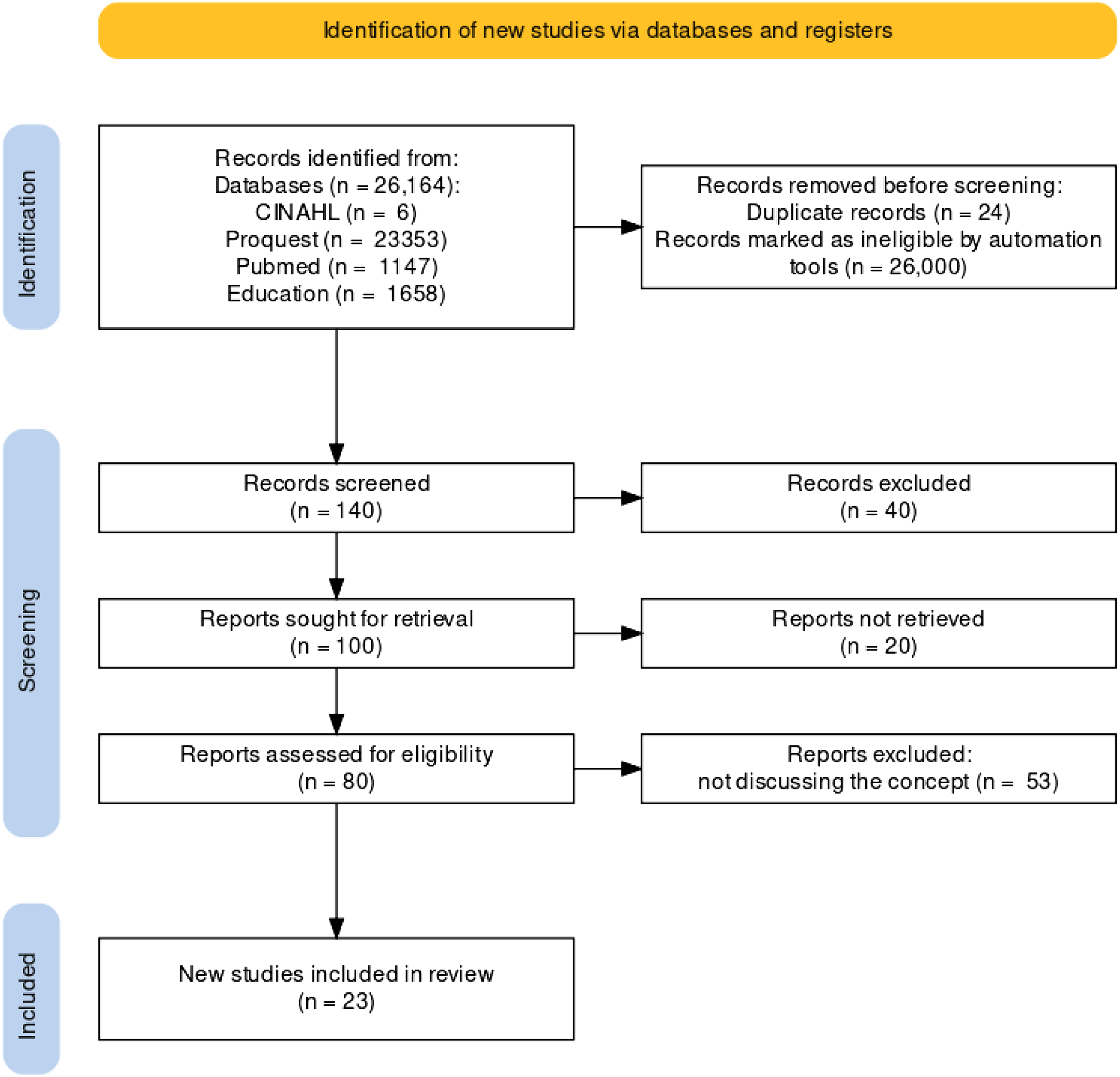
Concept map
Visualizing the concept map makes it easy and attractive to represent attributes, antecedents, and consequences of misconduct (Figure 2). The concept map starts with the two motorists driving towards their goal and reaching the city. However, the way to the city is complex and necessitates driving up the mountain before reaching the city. The hand image with the antecedents (stress and lack of guidance) pointing and trying to guide the motorists taking the illegal path, committing misconduct, and violating the rules and regulations. The misconduct road is monitored by the authorities, represented on the concept map by a police car. The decision to use the misconduct road is a result of the stress of driving up the mountain and lacking proper guidance to navigate the difficult way. Driving through the misconduct road is unethical and considered a violation of the rules and regulations, which are the attributes of misconduct. If caught by the authorities, the action may lead to the consequences of a loss of confidence and trust or, more serious finalities. Misconduct concept map.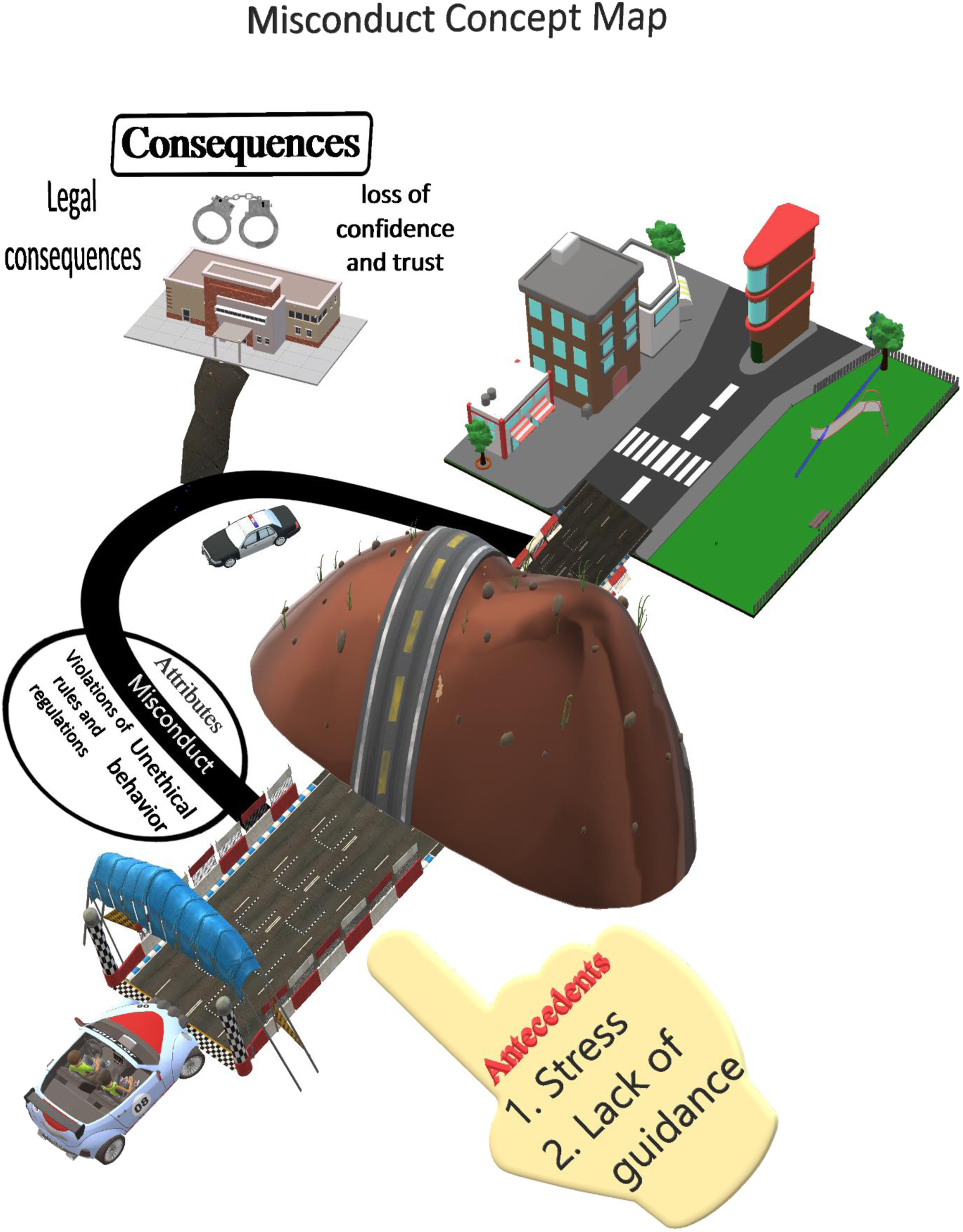
The new definition of misconduct
The chosen literature indicated unethical behavior and violation of rules and regulations were the common attributes of misconduct. The commonalities aided in defining misconduct in nursing academic settings. Based on the findings, misconduct can be defined as a behavior in defiance of rules, regulations, and ethics driven by stress and a lack of guidance which may result in legal consequences and loss of confidence.
Model case
According to Rogers the model case has the objective of clearly demonstrating the concept’s attributes, antecedents, and consequences in a meaningful context. 14 It is useful for ensuring that the concept is being defined and measured accurately and consistently and clearly illustrating the relationships between the concept and its attributes, antecedents, and consequences.
Students were given an assignment due in a week by a faculty member. As stated in the rules and regulations, this assignment must be the student’s own work that adheres to academic integrity standards. A student requested an extension of time for their assignment. The faculty agreed that the deadline would be extended by 2 days. The student was stressed because she had to study for finals and did not have time to work on the assignment. The student submitted the assignment and the faculty found that the student’s paper was almost identical to another paper submitted by another student, with a few minor differences. Upon discovering that the student violated the rules and regulations, the faculty confronted the student about the discovered unethical behavior. In compliance with the school’s ethical code of conduct, the student was dismissed from the school.
Discussion
Implications for nursing education
In the literature, it has been suggested that nursing students commit misconduct, including plagiarism, cheating on exams, and receiving assistance with assignments.4,5 Several factors have been demonstrated in the literature to explain why nursing students commit academic misconduct, including a fear of failure, a desire to achieve higher grades, and an inadequate amount of study time.4,5 In studies of academic integrity, researchers have found that formal training improves students’ learning, skills, and attitudes concerning academic integrity.8,35,36 As a result of this concept analysis, it may be that nursing educators will apply it to nursing education and students practicing in clinical settings since it demonstrates the antecedents of misconduct, emphasizing unethical behavior and violations of law. For example, teaching students to practice self-care for de-stressing prior to exams, may help with clearing the mind for the test, contributing to thoughtful and deliberate preparation resulting in less temptation for cheating. Role-playing, simulation of situations such as falsifying documents, breaking sterile technique but continuing to complete the skill or wrong medication administration may inform students of what they should and should not do in such difficult situations.
Understanding the antecedents leading to misconduct within the context of nursing education helps explore the factors that force nursing students and nurses to commit misconduct. Moreover, the educators shall be aware of the antecedents of students’ misconduct such as stress, and provide the guidance needed to facilitate and foster students on overcoming any situation leading them to commit misconduct. In addition, faculty may choose to teach the students possible legal and ethical consequences they might face as a result of misconduct either in the classroom or clinical settings. Consequently, nursing leaders shall understand the antecedents of nurses’ misconduct, which should foster the need to orient these nurses on available resources to support the nurses and alert them on the possible legal consequences of misconduct.
Limitations
Articles were selected based on the years of publication between 2019 and 2022; however, this was due to the large number of initial hits which was 26,164 articles. Moreover, other disciplines might have a different view of misconduct. However, the disciplines of law, business, academia, and religious were chosen because the majority of retrieved articles fell into those disciplines.
Conclusion
The literature encompasses misconduct as a global problem in academia. The antecedents, consequences, and attributes shown on the concept map may be generalized to many disciplines and for the aim of this analysis to nursing education. It is widely recognized that academic misconduct, which is also known as dishonesty, is an issue in nursing education. Factors social and structural may contribute to academic misconduct.1–5 Additionally, it is possible that students may unintentionally violate school policies due to misunderstanding of academic integrity. 1 It is uncommon for students to have educational opportunities to learn about academic misconduct within academic programs. 1 However, informing students about ethical infractions is necessary for developing an understanding of the concept, misconduct and to integrate ethical behavior into their worldview and ultimately their nursing practice. In addition, educating the student about the concept and enforcement of policies by all faculty may help reduce academic misconduct incidents. Applying this concept to nursing education may require further research, which will enhance the reputation of nursing science. Moreover, a deeper understanding of the causes and effects of misconduct could contribute to a more principled nursing profession and the maintenance of an ethically prepared nursing workforce.
Footnotes
Acknowledgements
We acknowledge Professor Mary Baumberger-Henry, School of Nursing, Widener University.
Declaration of conflicting interests
The author(s) declared no potential conflicts of interest with respect to the research, authorship, and/or publication of this article.
Funding
The author(s) received no financial support for the research, authorship, and/or publication of this article.
