




Abstract
Background:
Ethics stimulation in nursing education focuses on human, non-technical factors in a clinical reality. Simulation as a teaching method began in the 1930s with flight simulators. In the beginning of the 1990s, simulations developed further in tandem with other technological and digital inventions, including touchscreen and three-dimensional anatomical models. Medical science first used simulation as a pedagogical teaching tool. In nursing education, simulation has been used for approximately a hundred years. Teaching has mainly focused on medical-technical, patient-specific interventions and their management.
Objective:
The objective of this study was, from a caring science didactic perspective, to deepen the understanding of ethics simulation in nursing education.
Design:
Qualitative design and explorative, descriptive and hermeneutic approach of an inductive character.
Methods:
Semi-structured face-to-face interviews in 2016–2017 with six Norwegian nursing students who were encouraged to narrate about their experiences of ethics simulation in nursing education.
Ethical considerations:
Informed consent was obtained from the participants. Anonymity and confidentiality regarding data material were guaranteed.
Results:
Interpretation of the nursing students’ narratives resulted in the following meaning units: ethical being and ethos, nursing students’ formation process, bridge-building between theory and clinical practice, and teacher and ethics simulation.
Conclusion:
Through ethics simulation, nursing students can obtain an increased knowledge and a sense of being able to handle difficult ethical situations. Nursing students’ values, moral actions and ethical value base offer a positive point of departure, for both theoretical and practical ethics teaching, and an awareness of the unique human being, the patient, in clinical reality. The implementation of ethics simulation needs more attention in nursing education.
Introduction
Ethics simulation focuses on supporting nursing students’ professional growth and contributes to non-technical skills in facing ethical challenges in clinical practice.1,2 The use of virtual simulation in nursing education aims for good, safe, patient-centred and high-quality evidence-based clinical care. Simulation exercises take place within specific laboratory-like circumstances in a safe, controlled and repetitive manner.3,4 The integration of information technology and e-learning in the curriculum requires new pedagogic language and professional didactic skills. The curriculum is updated and revised to respond to future service structures and social changes.4–8
Simulation is a framed artificial teaching situation containing only the functions or social processes relevant to create an effective, fictive, interactive and playful representation of a specific realistic reality.34,9 The specific learning goal consists of an introductory briefing, scenario and debriefing.4,10 Simulation as a pedagogical tool is divided into different forms based on the degree of credibility: a high-fidelity human simulation exercise with high credibility is realistic or true to life, while one with intermediate fidelity or low fidelity is placed lower in relation to an attempt to recreate a clinical caring reality. Credibility is based on content, material and resources available during the implementation of a simulation exercise.11–14 Simulation is characterized by the presence of narration, either as an introductory story or as its frame. During ethics simulation, the teacher integrates nursing ethical problems in the simulated narration. The interpretation of narratives contributes to reinforcing students’ empathic and emotional professionalism.15–17
Nursing students’ ability to interactively cooperate in a team is central in simulation exercises so that they can later work in multi-professional teams, take on various tasks, solve problems, make important decisions and demonstrate leadership ability.9,18 Successful simulation bridges the abstract and theoretical and concrete practice. Ethics simulation enables students to understand caring ethics through experiencing and discussing ethically difficult situations. Difficult situations are marginal, complicated, recurring and part of the clinical caring reality. 19
The study’s theoretical perspective is based on Eriksson’s caring science tradition from Finland. Its didactic caring tradition developed in parallel with and as a sub-discipline of pedagogy in the late 1980s.20–22 Caring science and its didactics share the same ontology, epistemology, theoretical core and ethos. Ontology is concerned with entities about what reality is like. Epistemology deals with the nature, origin and being of knowledge, as well as methodology in relation to theory. The theoretical core is reflected in attitude, language and action and principally through the view of the human being. Caring science didactics, which is rooted in caring science and hermeneutic traditions, focuses on the whole understanding and meaning. It is characterized by an ethical responsibility for formation, whose ethos can be seen as an expression of pedagogical love. In this approach, there is space for dialogue, reflection and respect for the unique human being’s dignity.20,21
Ethos summarizes the central phenomena and stories in a nursing education. According to Eriksson, ethos and ethics belong together and become synthesized through formation, when theory is converted into ethos and realized through praxis. 22 Ethos is brought to the fore internally in nursing students and confirmed in a factual and evident course of action in an articulated pedagogical culture and work community in a clinical practice.20–22 Ethos creates the inner core and those basic motives that make the nursing education’s clinical practice a meaningful and important whole. Ethics simulation highlights the ethical dimension and human factors as well as allows nursing students to see the human being – the patient – as a dignified, unique individual and invited guest of honour to the clinical reality. 21
This study’s aim is to deepen the understanding of ethics simulation in nursing education from a caring didactics perspective. The results can be used to develop nursing education’s virtual ethics simulation operations and enable and present to students the professional work community in an artificial learning environment. This study is a part of a larger medical-technical simulation study. The research questions are as follows: How can ethics simulation support nursing students in clinical practice? What experiences do nursing students have from ethics simulation exercises?
Background
A major part of the examined caring science research focuses on clinical technical simulation interventions, pragmatic issues and approaches. The emphasis is placed on human medical conditions and medical technology, whereas the caring science tradition as well as the healthcare organization’s guest of honour, the patient, or caring ethics and the art of clinical nursing care have received less attention. Ethics simulation is implemented for the purpose of innovatively and experimentally developing teaching in clinical nursing practice. The learning objective is focused on knowledge building and managing complex cooperative relationships and patient interventions that test and evaluate nursing students’ strategies for action.23,24 Ethics simulation, debriefing and reflection are the most efficient ways to learn about ethical and legal issues and problems. Debriefing related to problem-solving offers space to reflect on fellow students’ opinions and values.11,25
Ethics simulation is a transformative experience and essential to understand the significance of ethics and apply an ethical attitude towards the nursing profession. It elicits empathy, understanding and increased competence, and can lead to changed behaviour in students.12,15,24 The exercises bring safety and a sense of confidence in real clinical situations. 26 Ethics simulation contributes to the development of skills in reflection, conversation, analysis and reasoning. It brings self-knowledge and moral insights and offers nursing students tools for being able to make ethical choices.27,28
The ethics simulation environment is activating and student-centred, which makes it an important tool in teaching. Environmental aspects are connected with patient safety in artificial and fictive exercises and are as important in ethical teaching as in the theoretical part. Ethics simulation in a controlled and safe setting is less stressing because the teacher can control the exercise and patient variables and supervise.4,26,27,29
The challenge with ethics simulation is that it cannot completely represent a real patient’s situation, uncertainty and reactions. Figure characters such as acting people and anatomical simulation dolls are artificial and adapted to the specific exercise.30,31 Ethics simulation should convey to participants a narrative experience or an interpretation of the meaning of the simulation, which simultaneously strengthens possible empathic and emotional experiences of the profession. Ethics simulation is also influenced by the figure character with whom the students identify in the description. The emotional experience can be focused on the interaction with other figure characters that play patients. Empathy has to do with the interpretation of credibility between those who act as patients. Heuristic fiction is required to create new and professionally meaningful experiences. In this way, it becomes possible to develop a shared space of imagining between participants in ethics simulation and debriefing.7,27
Cant and Cooper 32 and Harder 33 studied the importance of simulation in the formation process. Important conditions for digital, simulated learning are study environment, students’ personality, study results, and the social and ethical presence of the student community. Simulation exercises support students’ learning, boosts self-esteem, develops and expands professional competence, and represents a coherent understanding. Such exercises can be both demanding and more difficult than expected and the results can be surprising and unpredictable.4,25,32 High-fidelity human ethics simulation is a relatively new innovation in undergraduate nursing education; therefore, it is necessary to focus on the optimal timing and simulation level. 34
Informed by simulation studies, Keskitalo 27 claims that a formative simulation should include aspects of study integration determined by students’ learning goals, motivation and engagement in simulation, and it should focus on their studies. Simulations can be demanding: knowledge-related technological and practical challenges are continuously actualized. Pedagogical challenges are related to nursing students’ varied education levels, a limited confidence in being able to transfer the new ethical knowledge to practice settings and the appropriateness of the simulation in relation to different individuals.27,35,36
Fisher and King 29 and King et al. 3 discuss the importance of students being prepared for clinical practice. Recently graduated nurses need support in several areas in the clinical reality: being able to carry out decisions and react to stimuli, as well as having the capacity to initiative and the ability to evaluate the available resources.14,33 Ethics simulation enables students to care for patients and experience difficult clinical situations from a broad spectrum.
Contrasts or unfavourable experiences may exist among the students. A sense of lost autonomy, negligence and vulnerability may emerge from unfavourable emotions during the simulation exercise.32,37 The patient’s perspective is highlighted concretely and the students face the reality of the ethical problem’s complexity that cannot be ignored or put aside but must be dealt with. This problem entails reflection over the patient’s cause and the students’ own values.15,16 There must be a solution, and the most introvert students in the group are forced to participate. Ethics simulation provides insights into the complexity of ethical issues and difficult clinical situations.6,30
Empathic response can be influenced by the students’ personal and social factors as well as communication skills. Therefore, it is meaningful that teachers are patient and willing to allow students to linger in the uncertainty required by changes in empathic behaviour. Debriefing is a fundamental part of the whole of ethics simulation that requires correct action and competence by the teacher.2,15,27
Previous studies have opened the understanding of ethics simulation and its non-technical pedagogical importance for clinical nursing and nursing education development. This review can be understood as an overview of external structures in a basic research study such as this, where the hermeneutic understanding is emphasized. This understanding paves the way for further investigations on the subject matter.
Methods
The study’s methodology is hermeneutic, explorative-descriptive, ideographic and inductive. The hermeneutic interpretation is based on the caring science tradition. A penetrating exploration that is open in nature has contributed to supporting the achievement of the essence of ethics simulation and depth of caring didactics. The description shows caring science knowledge emerging through understanding and interpretation from the study as a whole. The ideographic shows how ethics simulation is viewed in the meaning context of clinical practice. The inductive enables a deepened level of understanding and experience in students. 38 The hermeneutic research approach is grounded in H-G Gadamer’s 39 philosophical hermeneutics. Gadamerian hermeneutics focuses on pre-understanding and prejudices or ontological knowledge, seeking questions about the nature of pre-understanding and the interpretive art of interpretation which is a substance-creating process. Gadamer’s infinite hermeneutic circle describes the whole-part interpretation of understanding. According to the principles of dialectics, the spiral movement of the hermeneutic circle contains questions and answers that, through interpretation, change and represent new understanding. 39 The study’s inductive empiricism is transformed into text that moves on the overlapping levels of abstraction in the interpretation process.
Data collection and participants
Based on the pre-understanding and research procedures, individual, semi-structured face-to-face interviews were conducted with six Norwegian nursing students from a strategically chosen nurse education institution from December 2016 to February 2017. This education institution is positioned as a university college. The information about the study was conveyed to the participants through the project in the healthcare faculty. The interviews were used to exploratively catch descriptions about the meaning content of ethics simulation for nursing education and deepen caring didactic understanding and knowledge. It is possible that the participants’ narratives can open for broader thought structures and new interpretations of the meaning content and knowledge retention continuously being built and not otherwise discoverable.39,40 A semi-structured questionnaire was constructed from the interviews by the researchers based on a pilot study with two students. The results of the pilot study and the chosen hermeneutic methodology controlled the choice and the number of participants. There is reason to believe that it was possible to attain saturation with the strategic choice of the number of participants because of the pre-understanding, the study’s methodological approach and the semi-structured questionnaire’s pre-testing.
Important inclusion criteria referred to the participants’ interest to participate. The participants should have basic caring science skills and clinical nursing knowledge dedicated in connection to nursing education. Third and last year students were the most appropriate to participate because they had taken part in the same number of simulation exercises on different levels, integrated the same clinical skills and knew the various phases of simulation. The participants were aged 20–25 years (average, 21.6 years) and consisted of one man and five women. The period of training for a nursing degree in Norway is 3 years and consists of 180 European Credit Transfer System (ECTS). The participants were invited to the study with the following question: What experiences have you had with ethics simulation exercises?
The interviews were conducted in the available premises of the nursing education. The interviews lasted an hour on average, but individual variations were considered. Demographic questions were first posed: the participants age and experience a number of simulations. The interviews were recorded. In the processing phase, the hermeneutic semi-structured interviews were transcribed into text.
The interpretive process of the hermeneutic text
Gadamer 39 emphasizes the importance of language to represent reality where the transcribed hermeneutic text from the interviews will be interpreted. The understanding and interpretation of the text are based on Gadamer’s notions of whole-part interpretation, pre-understanding, prejudices, ethos, experiences and the caring science perspective which in this study is tied to caring science didactics. The hermeneutic movement was linked to the participants’ narratives from semi-structured interviews and specifically called attention to the perspective of ethics simulation in nursing education. The meaning-bearing task in the interpretation was to describe the participants’ experiences in the narratives and thereby attain a deeper understanding. The interpretation was a circular hermeneutic event whose origin was found in the study’s research questions. 40
The hermeneutic text was repeatedly read to reach a deeper understanding of the object of study. In the first reading, the research phenomenon was defined and hence the inductive exploration was initiated. In the second reading, the text was divided into various hermeneutic meaning units that described the narratives. 38 This circular movement continued for the purpose of attaining a deeper understanding. The research phenomenon was inductively described by the research questions. In the last interpretation, the text was read as a whole and the meaning units were described in relation to the text. According to Gadamer, 39 the dialogue with the text leads to a fusion of horizons when the reality of the text becomes a part of the researcher. The hermeneutic dialogue’s results include a fusion of horizons, an interpretation and reflective connection to the caring science tradition, a discussion of the understanding between the study’s whole and parts, and a closing towards the theoretical core and pre-understanding. The results present the understanding and interpretation of the fusion of horizons that represents an image of ethics simulation in nursing education.
Ethical considerations
The permission to conduct this study was granted by the educational institution. The study was not notifiable because personal information was not collected from the participants. The participants signed an informed written consent. The consent includes ethical principles such as voluntary participation, anonymity, non-injury or suffering, maintenance of trust and the opportunity to interrupt the study without stating any reason. 41 The study has been conducted in accordance with good scientific practice, which means that it is ethically acceptable and reliable and its results credible. Research ethical guidelines, laws and codes have been taken into consideration 42 (Figure 1).
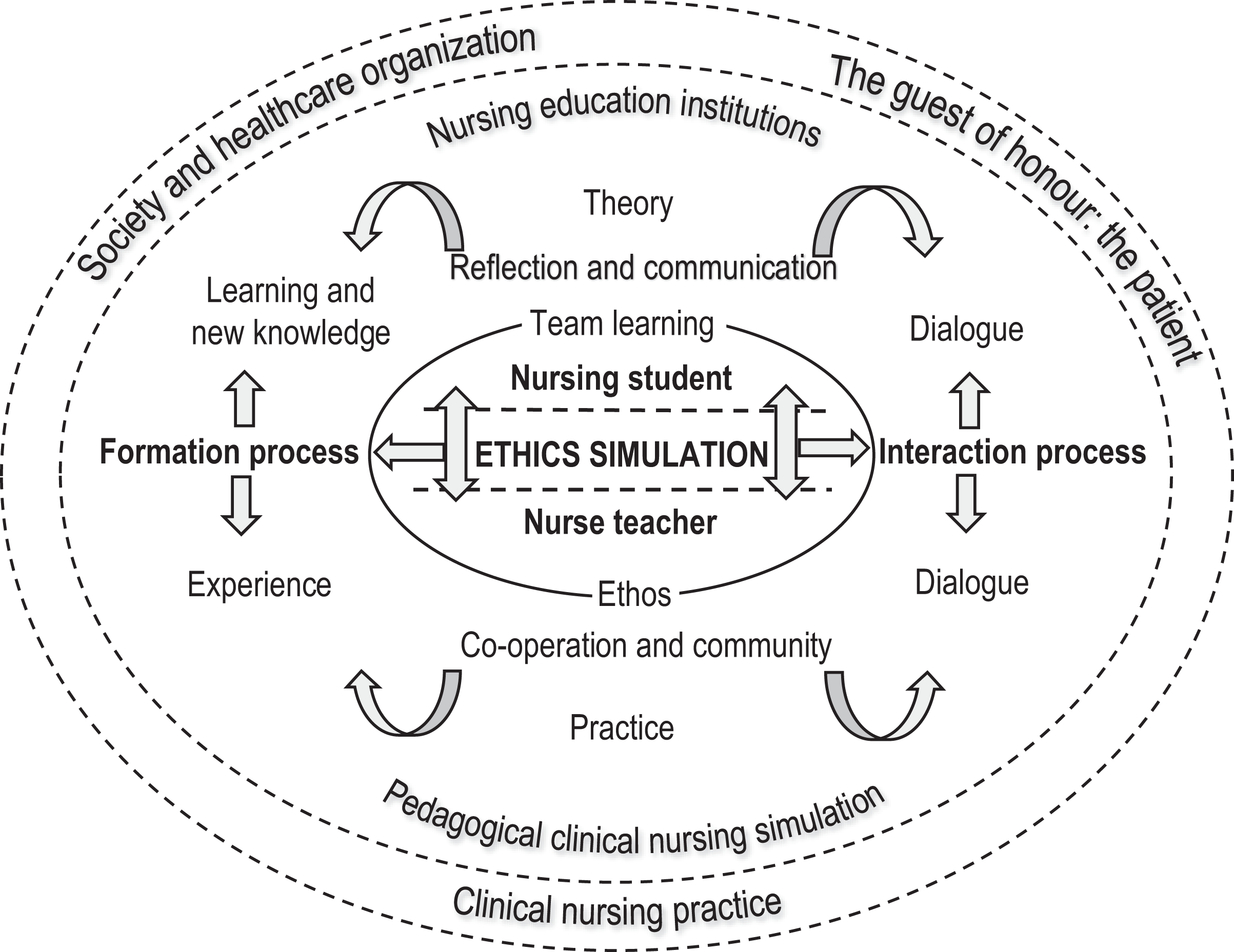
A didactic circle of ethics simulation in clinical nursing education: Ethics simulation bridges the abstract and theoretical and concrete practice. Ethics simulation enables nursing students to understand caring ethics through experiencing and discussing ethically difficult situations. Nursing students’ ability to interactively cooperate in a team is central in ethics simulation exercises. Ethos – the ethical value base – summarizes the central phenomena and stories in a nursing education. Ethos and ethics belong together and become synthesized through formation, when theory is converted into ethos and realized through practice.
Results
The results are presented in relation to the aim and research questions of the study. The results are based on the chosen theoretical perspective and previous research. The empirical picture interpreted is based on six nursing students’ narratives, which had a homogeneous language use in terms of words, concepts and response descriptions. The interpretation resulted in the following meaning units: ethical being and ethos, nursing students’ formation process, bridge-building between theory and clinical practice, and teacher and ethics simulation.
Ethical being and ethos
The ethics of caring supports nursing students to interpret, understand and structure situations occurring in the clinical reality. Emotions manifest in interactive situations, in verbal and non-verbal communication through human beings. The identification of different emotions calls for sensitivity, knowledge and willingness to see and hear the other and to look beyond self: Ethics for me means…respect, the good…do right, help…It is always in me but the nursing education has helped me to find words and concepts for what I mean… I intertwine ethics with morals…Being ethical is being moral… I can better understand the whole. The patient’s care and the patient’s world…ethical discussions have opened my eyes…Ethics is pretty complicated; one tries to care for the patient professionally…morals are there…to treat the patient as an individual and understand it. Ethical simulation exercises are good preparation for the clinical field practice, but they cannot replace the reality…Ethical problems in simulation exercises must correspond to what is expected to come in the field…Then it feels supportive and you are not so stressed that you don’t know anything…
Nursing students’ formation process
The formation process includes unique expectations, responsibilities, obligations and rights. The ethics of caring is highlighted in the students and in their encounter with the patient, collaboration with various actors, independent decision-making and reflections on the clinical practice: It is important that we are prepared for the practice. It could be with a small group and more often…to simulate before the practical training begins…One is too unprepared basically…We support each other in the learning process…Simultaneously, one is responsible for one’s own learning… It could be good if we could repeat some earlier ethics exercises…There could also be ethics simulations that are related to geriatrics, terminal care, psychiatric care and such…Then I would be much more certain how these ethical situations should be handled and with whom… Practical exercises are beneficial in that one thinks about ethics and such…That one knows in advance how it will be…it is possible in ethics simulation to see how others act and think. Then it is possible to have another perspective and start to think differently…reflect on others’ thinking… There are cameras at the simulation unit that film us during action…When you see yourself, it can be perplexing and surprising…how you act and how you talk…I have started to observe myself in a completely different way.
Bridge-building between theory and clinical practice
Simulation develops both technical and non-technical skills. Simulation supports the theoretical foundation provided by the nursing education and prepares nursing students for mastering clinical, practical and challenging situations: Ethics simulation and communication go together…I have acquired skills to meet next-of-kin who are mourning. I think more about what I say and how and what words I use…for instance ‘passed away’ or something similar is better than the D word. This is something non-technical that I have learned from ethics simulation. When you once have failed, you remember it next time…I have learned that never say to the patient or their next-of-kin that things will be ok. What if things go wrong? This is the good thing with ethics simulations… During ethics simulation one is forced to trust oneself and deal with challenging and unfamiliar situations…This makes one more confident…that one does not paralyze…We test things under supervision when we do the exercises, so it is better to practice beforehand and before one stands at the clinic with the nurse pin on one’s chest. Ethics simulation exercises put values in place…It is easier to understand ethical theories.
Teacher and ethics simulation
Structured and pedagogically constructed ethics simulations include three phases that meet the objectives of nursing education. Teachers who deviate from the pedagogical structure of ethics simulation by using other theories or methods can create confusion among nursing students. To minimize potential anomalies, simulation supervisors and teachers need to have pedagogical training in simulation: Best of all is, if the teacher has an additional training course on how ethical simulations should be implemented. We are not very often at the simulation unit…We are too many students and the expectations are high. The debriefing afterwards…when we discuss ethically problematic situations from the exercise…If the teacher is professional the ethics simulation is usually beneficial and if not, it has no value! The teacher must be able to explain and reflect on what is relevant for the teaching and the content. It is important that the teacher is there. They must master the simulation apparatus. The teacher needs to prepare the ethics simulation so well that there will be no ‘confusing and hurry up’ feeling that affects learning.
Discussion
This study aims to deepen the understanding of ethics simulation in nursing education. The caring didactic perspective of caring science has permeated the research process throughout. The theoretical perspective has given this hermeneutic study a basic structure from which the search for knowledge on ethics simulation has begun. A search for heuristic caring science knowledge has been rooted in a key humanistic thought tradition where the emphasis and resonance have been the absolute dignity of the human being and ethos.20,22
The methodological approach can be seen as a reflection of ethical knowledge with a focus on understanding the object of the study in a deeper way and by re-attaining new understanding through interpretation. The hermeneutic circle’s infinite spiral movement does not mean watertight partitions but continued open questions and answers as well as unsolved and unfinished explications regarding this study. Relevant caring science and caring didactic empirical studies that focus on ethics simulation have been challenging to find. Research that emphasizes general theoretical ethics education in nursing education, nursing students’ experiences from ethics teaching or technical medical simulation studies exists.
Nursing education’s learning paradigm has in the last decades been modified and modernized.6,7 The significance of ethics simulation is recognized in the core of clinical nursing, but education leadership and nurse teacher development have been left marginally behind.8,9 Many nursing education programmes strive to find appropriate internships in healthcare organizations where nursing students can use theoretical teaching and attain such clinical skills required for professional growth and authorization. After completion of studies, the systematic update and competence development continue in some form by internal healthcare organizational education and courses as well as further studies and university studies.43,44
The use of the Internet, new education technology and electronic digitalization has increased. The Internet’s and the society’s technological development has activated both patients and their next-of-kin and made nursing more effective. Nursing students are used to move themselves electronically in different interactive network environments.27,45,46 This has led to that nursing studies are problem-free when education technology supports study work. Therefore, the study foundation needs to be quick, direct and enable an obstacle-free interaction between teachers and different actors in nursing education and healthcare organizations where nursing students encounter the clinical reality.
The study’s reliability has been challenging because the criteria for the evaluation of ethics simulation are unique and non-standardized events. In this study, validity is emphasized in the nursing students’ narratives. The narratives represent ethical reflections and work community between nursing students. In the simulation exercises, the students encouraged each other to develop and grow professionally. Interest in the virtual patient’s life and health, interactivity and cooperation in terms of finding solutions to difficult ethical questions together challenge the nursing students to communicate and open for possible efforts that potentially may emerge later in the clinical reality.1,12 This study shows that nursing students understood that ethics simulations correspond to clinical practice.
It is possible to evaluate the study’s pedagogical validity through the participants’ experiences and narratives. One of the error sources or dilemmas of evaluation can possibly be teachers’ lack of knowledge or experience of ethics simulation and other clinical reasoning because the evaluation may be grounded in their theoretical simulation education, prejudices and a pre-understanding that is related to their own time as nursing students.
The central work activity of ethics simulation is debriefing which takes place after the finished simulation exercise. This study shows that the conditions for validity are the presence of the teacher, communication and supervision and the authenticity of the context and ethics simulation. It is important that teachers have immersed themselves in caring science research literature regarding ethical clinical situations and can encourage nursing students to find the connection between theory and clinical practice. Debriefing situations show that teachers need the support and cooperation of the nursing education to strengthen the validity in ethics simulation. Ethics simulation in nursing education presupposes collegial solidarity between supervisors and teachers. Nursing education is challenged to discuss, reformulate and define teachers’ internal and integrated educational ambitions to prepare them for clinical ethics simulations and eliminate existing prejudices about technical, virtual education teaching methods.
The number of nursing students who participated in the study can be seen as limited, but this is a conscious choice. The pilot study indicated that the number of participants was reasonable and precise so that the saturation was possible to obtain. The results show that this knowledge is sufficiently representative, credible and correct to attain saturation. 38 The results offer empirical and descriptive information on virtual ethics simulation in nursing education. The results represent the human and that which reflects the variation in uniqueness and that is transferable for universal generalization. This innovative information opens for the further development of existing theoretical knowledge.
There is an obvious need for continued caring science research on this topic. It is important that nursing education include different levels of ethics simulation in various nursing programmes and curriculum. Ethics simulation trains future nurses to better understand ethical dilemmas within clinical nursing. Nursing education can benefit from standardized and theoretically rooted instruments that measure the influence of empathic behaviour and theoretical ethics education, and can assess students’ clinical reasoning; however, measuring attitudes or ethical reflections represents a challenge. This study opens for future research with the aim of modernizing and developing debriefing discussions. Various digital solutions and the use of telemedical connections are necessary to consider when planning future simulations. Longitudinal design studies on the effects of ethics simulation, students’ ethical reflections and the connection between theory and clinical practice should be studied further. Virtual ethics simulations can support the learning process and open for complexity and authenticity.
Conclusion
Ethics simulation as an active learning method aims that the learning of evidence-based knowledge of caring ethics and its central focus is on nursing students’ professional development and increased levels of competence. Ethics simulation challenges nursing students to discovery, cooperation, dialogue and work community. Ethics simulation pedagogy is innovative and caring didactic learning is reflective, wondering, questioning and critical. New questions highlight knowledge and possibilities. Ethics simulation aims for a strong professional identity and ethical skills dedicated to patients in difficult ethical situations in the clinical practice.
The teacher’s supervision, pedagogical and caring didactic visions as well as different solutions encourage students to grow into reflective and innovative professional nurses. Teachers’ responsibility and the ethics of caring comprise dedication and integration of caring science knowledge.
Footnotes
Acknowledgements
Thank you to the nursing students who participated in this study.
Conflict of interest
The author(s) declared no potential conflicts of interest with respect to the research, authorship and/or publication of this article.
Funding
The author(s) received no financial support for the research, authorship and/or publication of this article.
