




Abstract
Nurses find themselves in a unique position - between patient and physicians, and in close proximity to the patient. Moral sensitivity can help nurses to cope with the daily turmoil of demands and opinions while delivering care in concordance with the value system of the patient. This article aims to reconsider the concept of moral sensitivity by discussing the function of emotions in morality. We turn to the ideas of historic and contemporary authors on the function of emotions in morality to expand our understanding of moral sensitivity. Ancient philosophers and contemporary psychologists uphold different strategies on the orientation of morality being (a) personal growth or (b) community living, and the primordial function of (c) reason and (d) emotions in the creation of judgements about good and bad. The theoretical discussion on the function of emotions in morality shows that by focusing on reason alone, one leaves out an essential part of morality. The concept of moral sensitivity should (1) include an initial judgment of good and bad based on emotions, (2) hold the ability to reflect on the initial judgement and the associated emotions, (3) include the ability to understand other stakeholders' perspectives based on the ideal-types and (4) include a personal decision on the right course of action.
Introduction
Moral sensitivity is an essential skill for nurses in healthcare practice. A developed level of moral sensitivity can help nurses feel confident in justifying moral decisions, feel prepared to deal with moral issues and feel confident about professional responsibilities and scope of practice regarding moral issues. 1,2 Ethics education and consultation in clinical settings focus primarily on the cognitive aspects of moral sensitivity while often leaving the emotional dimension undiscussed. 3 In this study, ethics refers to the philosophical and theoretical discourse on ethical theories. Morality is about living with regard to personal understandings of good and bad, based on upbringing, education, religion and other socialization processes.
The undervaluation of the emotional dimension is noticeable in the definition of moral sensitivity. Recent definitions focus on decision-making within current normative frameworks. James Rest 4 defines moral sensitivity through a deductive approach as ‘the perception that something one might do or is doing can affect the welfare of someone else either directly or indirectly (by violating a general practice or commonly held social standard)’ (p. 29). Lützén and colleagues 5,6 created a definition based on a grounded theory study of nurses’ moral decision-making. She first defines moral sensitivity 6 as ‘the ability to identify an ethical problem and understand the ethical consequences of decisions made on the patient’s behalf’ (p. 437). In a later work, 7 she includes an emotional element to her definition: ‘a personal predisposition guiding ethical decision making and comprising an emotional response initiating a cognitive process for moral agency, which may involve moral stress’ (p. 221). Lützén et al.’s 8 definition shows a connection between the experience of an emotion and moral agency, through a cognitive process. Although Lützén acknowledges the involvement of emotions in moral sensitivity, the exact function of emotions in moral sensitivity stays unclear. Here, Lützén relates moral sensitivity to moral stress.
Empirical research and ethics education also concentrate on the cognitive aspects of moral sensitivity. Cognition is the activity of mind that refers to the acquisition, storage, transformation and use of knowledge. 9 These studies focus mainly on the receptivity of medical and nursing staff towards moral issues concerning patient treatment and care – patient autonomy, patient well-being, treatment possibilities and conflicts between personal and professional values. 2,6,8,10 –13 The term ‘moral sensitivity’ is also used in the curriculum of nurse’s education to describe the necessary moral skills for the nursing profession. It dictates how nurses should be able to reflect methodologically on the ethical and moral aspects of their decisions, in relation to the values of the patients and other caregivers. 14 Again, the function of emotions in moral sensitivity is left undiscussed.
In this study, we will argue that emotions have a place in the philosophical discussion of morality and should therefore be included in our understanding of moral sensitivity in nurses. We use Nico Frijda’s definition of emotion. In short, Frijda understands emotions to regulate behaviour through an interactive process aimed to construct a relationship between the individual and his environment. Central to this interactive process are personal concerns. 15 We will continue this study by presenting the function of emotions in morality according to the works of Plato, Spinoza and Hume and discuss them in the light of contemporary psychological theories. We use these particular historic authors because of the emphasis on reason and/or emotions in their ideas on morality, and how reason and emotion affect moral acts. In this study, we use the term ‘moral acts’ in the philosophical discussion of the function of emotions in morality and the term ‘moral behaviour’ in the discussion of the contemporaries. Moral behaviour is to act according to one’s moral values and standards. People demonstrate prosocial and moral behaviour when they demonstrate the ability to care about others. 16
Plato on emotion, reason and morality
The Greek had no equivalent for the Latin word ‘emotion’. The word ‘pathos’ meaning ‘that which happens to a person or thing’ is often used to describe phenomena of the sort.
17
In Plato’s work Protagoras, Socrates and the sophists Protagoras, Hippias and Prodicus debate whether virtue, that which makes a person good, can be taught. During this debate, emotions in relation to human acts are briefly discussed. Socrates states, ‘Well, it’s not important, Prodicus’, I said: The point is this. If what has gone is true, will anybody in the world be prepared to go anywhere near what he fears, if he’s free to choose what he doesn’t fear instead? Or is that impossible, given what has agreed? It has been agreed, after all, that what a person fears, that he thinks as bad; and that nobody of his own accord goes anywhere near it or chooses it. (Prot. 358e2–7)
The emphasis on reason relates to the workings of the soul described in Phaedrus (246a5–e4) and Republic. Plato compares the soul to a pair of winged horses with a charioteer. Bourke explains that one horse symbolizes man’s desire for sensual satisfaction and the other represents man’s aspiration for success and fame. The charioteer is the individual who needs to determine where he is going, control desires and steer for the right thing. The driver stands for reason and forms the highest part of a man’s soul. 18 In Republic (Bk. VI, 431a–b1; 438d11–439d7), Plato makes a distinction between the rational and irrational part of physical activity. Bourke clarifies that physical is a term used by Plato to refer to mental processes in the human brain. The rational part reflects on acquired knowledge. The irrational part feels and desires. Reason, feeling and desire are all three considered to be part of the soul. To govern these irrational parts of the soul to do what is right, reason is essential. 18
Although for Plato reason plays a superior role compared to emotions in deciding what is right, emotions have a function in morality. According to the following passage in Protagoras, our actions are directed to the good because humans are drawn to pleasant things. Plato writes, So you agree that the pleasant is good, the painful is bad. I beg indulgence of Prodicus who distinguishes among words; for whether you call it ‘pleasant’ or ‘delightful’ or ‘enjoyable’, or whatever way or manner you please to name this sort of thing, my excellent Prodicus, please respond to the intent of my question.
Reason, and to some extent emotions, helps to attain what is good. For Plato, the aim of morality lies in becoming a good person. Frede demonstrates that Plato attributes a transcendent aim to morality in his theory of Forms. The aim of morality according to this theory is to become acquainted with natural Forms, such as righteousness, virtue and beauty, with Goodness as the ultimate Form to behold, which will result in ultimate happiness or well-being (eudaimonia). In Plato’s opinion, every person should strive for a certain goal. Virtues help to attain these goals. A person can be considered virtuous when he or she develops his or her talents to the utmost of being, such as being an excellent athlete, musician or mathematician. Plato aims at personal growth of morality. 19
Plato stresses on reason and believes that emotions should be controlled by reason. Although Plato argues for the superiority of reason, emotions do have a function for human moral life. In Protagoras, pleasant emotions are associated with good and unpleasant emotions with bad. These pleasant and unpleasant emotions also define human actions; fear initiates withdrawal, and joy initiates engagement. Emotions thus give information about judgements in terms of good and bad of external stimuli. In the context of healthcare and nursing, this means that emotions contain certain information about what is good or bad in nurses’ perception. Positive emotions contain positive perceptions, and negative emotions contain negative perceptions. For instance, pride is felt by a nurse when a patient after weeks of treatment is discharged, and shame arises when she makes a mistake in the distribution of medication.
Spinoza and Hume on the function of emotions in morality
The undervaluation of emotions within morality changes with Baruch Spinoza (1632–1677) and David Hume (1711–1776). Spinoza argues in his Ethics that reason and emotions can work cooperatively for humans to act morally. The term ‘emotion’ is mentioned only once by Spinoza in Ethics (5p2). In this fragment, he states that emotions are caused by our thoughts. Jonathan Bennett 20 shows that Spinoza uses the word ‘affect’ when he refers to an emotion. Spinoza himself writes, ‘By affect I understand the states of the body in which the body’s power of acting is increased or diminished, aided or restrained, and at the same time the ideas of these states’ (Eth. 3d3). Spinoza’s understanding of emotion also contains cognition (thoughts or ideas), feelings of certain kinds, bodily sensations, involuntary bodily sensations and overt expressions of various kinds, tendencies to act in certain ways, and an upset or disturbed condition of mind or body. 20
Spinoza relates emotions to morality by stating that people’s knowledge of good and evil is determined by positive and negative emotions. ‘Knowledge of good or evil is nothing but an affect of joy or sorrow in so far as we are conscious of it’ (4p8). ‘We endeavour to bring into existence everything which we imagine conduces joy, and to remove or destroy everything opposed to it, or which we imagine conduces to sorrow’ (3p28). Thus, emotions relate to morality in the sense that what one considers good presents positive emotions and makes one act in its interest, while what one considers bad presents negative emotions and makes one act against it. Two important concepts in Spinoza’s philosophical ethical work, conatus and salus, exemplify the contribution of emotions to moral acts and the relation between reason and emotions. We will first discuss the concept of conatus and then the concept of salus.
Spinoza writes that the essence of every being, the reason of existence, lies in the idea of conatus: ‘Each thing, as far as it can by its own power, strives to persevere in its own being’ (3p6). A modern understanding of conatus can be found in Looking for Spinoza: Joy, Sorrow and the Feeling Brain by Antonio Damasio. Damasio
21
explains Spinoza’s conatus as homeostasis – a state of being in which personal health and well-being are optimized and maintained. For each individual, the object of striving can be different. It depends on one’s own interests. Humans thus act according to a certain goal, which is determined by the individual themselves. This goal is good because it relates to the essence of being human: The more each one strives, and is able, to seek his own advantage, i.e., to preserve his being, the more he is endowed with virtue; conversely, insofar as each one neglects his own advantage, i.e. neglects to preserve his own being, he lacks power. (4p20)
With conatus, Spinoza not only formulates a personal moral goal for each individual, but he also formulates a more spiritual goal for humanity, namely, salus. Salus can be translated as salvation. In order to accomplish salus, knowledge and control over one’s emotions are essential. Since a personal, engaged God does not exist according to Spinoza, salvation cannot be given by God. Salus is state of being which a person should achieve on his or her own accord. Like the concept of conatus, it depends on the will and effort of the individual. Salus entails a repeated experience of happiness, which in turn increases the formation of a healthy and powerful mind. Salvation can be reached through two steps, in which reason and emotions play an essential role. The first step includes a virtuous life according to the rules of a democratic state, with special regard to nature. The second step includes the development of an intuitive receptivity for insights, based on extensive knowledge and reflection. Spinoza believed that in order to reach this second step of salvation, a person should be able to benefit from his or her emotions, that is, to control and influence them. Control over emotions can be obtained by having general knowledge about the workings of emotions and being aware of stimuli causing negative emotions. With this knowledge, one should be able to search for or create stimuli, resulting in positive emotions. Concentrating on and experiencing positive emotions will result in an intuitive understanding of human existence, together with a feeling of serenity which includes pleasure, happiness and delight. 22 –24 Positive emotions help mankind to persevere and achieve personal salvation. The aim of morality according to Spinoza is mainly to become a good person.
Spinoza shows that emotions do not only reveal personal judgements of good and bad but also give insights about a person’s well-being. In the context of healthcare, this means that nurses can benefit from knowledge about their emotions. Emotions reveal the joyful and sorrowful aspects of nursing care. By considering what makes a nurse angry, shameful or proud, one can optimize the positive elements and deal with the negative aspects of nursing care.
In Spinoza’s Ethics, emotions, acts (or tendencies to act) and cognitions are intertwined. It is therefore hard to say what follows what. In 4p8, knowledge itself becomes an emotion, and in 3d3, emotions are defined in terms of acts. If we are willing to acknowledge that emotions are part of moral sensitivity, then we should reconsider the sequence of cognitions, emotions and agency in the definition that Lützén et al. 7 propose: ‘a personal predisposition guiding ethical decision making and comprising an emotional response initiating a cognitive process for moral agency, which may involve moral stress’ (p. 221). It seems that according to Spinoza, cognitions and acts are part of an emotion.
It is remarkable that given the great emphasis on reason in his time, Spinoza developed a philosophy in which emotions play an important role in the realization of moral behaviour and the achievement of ultimate moral determined goals such as conatus and salus. In Spinoza’s complex philosophical theory on ethics, the biological aspect of moral acts becomes visible. Emotions together with cognitive abilities such as reflection and reasoning become essential for the development of morality. Spinoza brings the intuitive aspect of morality into view, which continues in David Hume’s work. Hume was familiar with Spinoza’s work and refers a couple of times to Spinoza in the Treatise of Human Nature (THN). 25 Although Hume and Spinoza differ widely in their views on the nature of God (Hume, in contrast to Spinoza, believed in a divine purpose of the world, a thought that Spinoza would have abhorred), both philosophers stress the importance of reason and emotions to derive what is just. 25
In the THN and An Enquiry Concerning the Principles of Morals (EPM), Hume explains his philosophy on the workings of the human will and morality. One of the key principles of morality is the emotional response to perceptions of the outside world. Hume believed that one makes a distinction between moral and immoral situations based on emotional responses; pleasurable feelings indicate moral approbation, and painful feelings indicate moral disapprobation. Hume even believed that emotions are in fact stronger than reason, an idea currently supported by Jonathan Haidt. Hume writes that ‘reason alone can never be a motive to any action of the will; and secondly, that it can never oppose passion in the direction of the will’ (THN, 413).
He explains the power of emotions over reason by making a distinction between two kinds of perceptions: impressions and ideas based on the ‘force and violence’ by which these perceptions encounter individuals. Impressions are sensations, passions and emotions, and ideas consist of faint images of these impressions in thinking and reasoning. Ideas have far less impact than impressions (THN, 1), and ideas and reason can only influence our actions by working together with impressions. When a person perceives a dangerous object, such as a burning house, it is not the idea of the object that will make him avoid it, but the emotion of fear that will make him avoid the object (THN, 413–414). Hume’s moral theory, in contrast to Spinoza, understands moral judgements as primary based on emotions instead of reason. Hume in addition shows that emotions also contribute to the interaction between people. Some emotions are other-oriented. Hume’s understanding of sympathy (in modern terms empathy) makes it possible to care for the other: The sentiments of others can never affect us, but by becoming, in some measure, our own; in which case they operate upon us, by opposing and encreasing our passions, in the very same manner, as if they had been originally derive’d from our own temper and disposition. (THN, 3.2.3)
Hume’s moral theory adds to our understanding of morality in nursing that judgements of good and bad do not primarily concern nurses’ self-improvement but are also directed towards others. These other-oriented emotions such as Hume’s idea of sympathy are essential for caring professions. Other-oriented emotions are crucial to the moral dimension of nursing care because they, for instance, help nurses to identify the perspective of the patient. Hume also states that moral judgements can be founded on emotions alone. Emotions lead directly to judgements without the conscious interference of reason and lead to actions. This would mean that a nurse would act based on emotions instead of reason. ‘Shame’ is, for instance, immediately followed by making up the mistake, and ‘pride’ by uttering a boast. The function of emotions in morality is still debated among contemporary cognitive psychologists. In the next paragraph, we will turn from the field of philosophy to psychology to create a better understanding of the moral behaviour on an individual psychological level. We will discuss the contribution of Elliot Turiel, Antonio Damasio, Jonathan Haidt and Nico Frijda. These authors made a valuable contribution to the discussion of the function of reason and emotions in moral behaviour.
The contemporaries
Elliot Turiel stresses the cognitive development of moral understanding from childhood to adulthood, in line with the structural-development approach by Piaget and Kohlberg. According to the structural-development approach, all aspects of human psychological functioning, whether intelligence or morality, develop through progressive stages and relate to age. 26 Central to Turiel’s thoughts on moral behaviour is the idea that moral understandings are learned from a young age and develop successively through adulthood. This cognitive learning process occurs through an interaction between the individual and his social environment. From a young age, children develop moral judgements based on extrinsic features like obedience and sanctions. 26 For instance, at the age of 2, children already show awareness that food or toys can be divided. At the age of 10 or 11, children consider factors such as merit, equality and benevolence. 26 According to Turiel, morality is learned by cognitive processes and develops through human life.
For Turiel, 27 people’s understandings of rights, justice, fairness and welfare also depend on the cultural and societal aspect of the world they live in. Although societal and cultural norms influence moral behaviour, this does not mean that two people from the same culture automatically apply similar moral judgements. Men and women in Saudi Arabia, for example, can disagree fundamentally on all sorts of moral issues, such as the right of a woman to drive a car alone. Societies and cultures are neither harmonious nor homogeneous. 28 When examining the workings of morality, we should consider that individuals interact with a multifaceted social world. Human beings are part of a culture, but also individuals; both aspects influence moral judgements on right and wrong. According to Turiel, reason is central to human moral behaviour because people apply and evaluate moral concepts in flexible ways. Although emotional processes influence human moral behaviour, emotions are thought by Turiel 28 to be merely guiding. Within the formation of judgements of right and wrong, emotions are not decisive: ‘emotions are subject to reflections and critical evaluations’ (p. 10).
Antonio Damasio adds a neurological point of view to the discussion on moral functioning. The main aim of morality according to Damasio 21 is to ensure the homeostasis at the group level: a balance in life to ensure survival and well-being for the individual. He explains this as follows: human life is regulated by natural and automatic devices of homeostasis, such as metabolic balances, appetites and emotions. All these devices promote the life and well-being of the individual. However, emotions do not only promote the well-being of the individual, but the awareness of these emotions makes us care for the other and act accordingly. ii As Damasio 21 puts it, ‘We do not only show compassion, as a bonobo, but we also know that we feel compassion’ (p. 167). Human life has become more complicated since the rise of larger communities due to agricultural development. To ensure homeostasis at this level, social conventions and ethical rules have been developed. Institutions such as religion and justice, and social and political organizations such as nongovernmental organizations (NGOs) and intergovernmental organizations (IGOs) promote the well-being of the individual, their social group and the whole of humanity.
Damasio 21 understands moral behaviour as a subset of social behaviours, which are found not only among humans but also in birds and mammals. Vampire bats and ravens, for instance, can detect cheaters amidst their group of food gatherers and punish them accordingly. 29 Damasio did extensive research on emotional functioning among people having acquired brain injury and concludes that emotions and feelings iii are essential for moral behaviour. 22 He found that people having prefrontal damage of the brain make unfavourable social decisions, even though their intellectual ability remained intact. These patients knew the conventions and rules of society; their IQ and logical reasoning abilities were similar to before; however, they stopped showing social and moral behaviour. This immoral behaviour could be explained by the fact that these patients could not feel or express emotions such as shame, sympathy and guilt. 21 The prefrontal part of the brain is apparently essential for human emotional functioning. Damasio’s research shows that in contrast to what Turiel holds, emotions are quite as decisive in making judgements on right and wrong as reason.
Damasio
21
therefore starts to stress the natural origin of moral behaviour through drives, emotions and feelings. He states that The embryo of ethical behaviours would have been another step in a progression that includes all the nonconscious, automated mechanisms that provide metabolic regulation; drives and motivations; emotions of divers kinds; and feelings. Most importantly, the situations that evoke these emotions and feelings call for solutions that include cooperation. (p. 162)
Haidt and Bjorklund 30 build on Damasio’s view that emotions play a significant role in moral behaviour. Haidt, a social psychologist, is, however, more outspoken on the role of emotions within morality. He defines morality as ‘moral systems are interlocking sets of values, practices, institutions, and evolved psychological mechanism that work together to suppress or regulate selfishness and make social life possible’ (p. 10). Haidt states that moral evaluations can occur without the interference of reason. Moral intuitions occur rapidly and automatically; perception of stimuli is automatically followed by moral emotions without the conscious awareness of reflections on the matter. Moral emotions provide the basis for intuitions about what is right or wrong. 30 In his theory, Haidt 31 incorporates John Bargh’s proposition that ‘mental processes fall along a continuum from fully automatic to fully controlled’ (p. 69). This idea of automacy is based on the Perception-Action Model of empathy in primate sociability. 32 Haidt concludes that reasoning does occur, but only after intuitions have already been formed. People use moral reasoning primarily to argue in favour of their moral judgements based on moral intuitions. 30,33
The power of emotions can be clarified by the idea of ‘control precedence’. Nico Frijda views emotions as multicomponent experiences. Emotions point to individual concerns. They reveal what is of importance to people, what they consider to be good or bad, and what people find worth pursuing. 15,34 There is an immediateness present in emotions that Frijda explains with the term ‘control precedence’. Control precedence entails that emotions are felt to interrupt ongoing thought or goal pursuit. They claim attention and control of the thought. 34 This property of emotion can be thought of as remnants of survival mechanisms, such as the innate fear of spiders immediately leads to a flight, fight or freeze reaction. 35 Thus, emotions have the property to claim immediate attention, which can lead to acute reactions.
The contemporaries hold opposing views on the function of emotions in morality. Turiel represents a cognitive psychology perspective, in which he claims that reason has the final word in deciding what is just. Damasio shows from a neurological point of view that emotions are essential to moral behaviour. Haidt argues that moral behaviour is primarily based on moral intuitions, which are created initially by emotions. The purpose of moral behaviour also differs between the authors. Damasio and Haidt stress the biological origin of morality. Moral behaviour promotes social order, and thereby survival. Turiel offers a more social design – moral behaviour allows humans to co-exist. For Frijda, ‘control precedence’ is an important feature that often accompanies emotional experiences to ensure the well-being of the individual.
Moral sensitivity revisited
Despite the historical emphasis on reasoning processes prior to moral acts, the importance of emotions in morality is undeniable. Emotions have a clear function in nursing; they include evaluations of good and bad, and they indicate individual concerns and sometimes directly lead to moral behaviour. The emotion sympathy, for example, includes a negative evaluation because the patient is suffering. Sympathy will likely lead to helping behaviour. The emotion anger also includes a negative evaluation when it arises because the family wishes to continue unbeneficial and painful treatment. Anger will probably lead to some form of confrontation. Emotions can also directly lead to behaviour without conscious reasoning. These immediate reactions are remnants of survival mechanisms, 35 which can also be present in moral behaviour. 15,33,34 If someone’s foot is stuck between the elevator doors, and that someone is crying out in pain, one will immediately try to open the doors and afterwards try to call maintenance or 911.
Emotions are essential to moral behaviour, but that does not diminish the importance of cognitions, including reasoning. Cognitions put emotions in a bigger context and help to act accordingly. 36 Emotions are not always helpful to nurses in deciding the right course of action. For example, helping a patient is not equal to relieving pain or other suffering. Sometimes a patient needs to undergo a painful treatment to regain his health. Feeling sympathy for the patient, combined with knowledge of the disease and benefits of the treatment, will make the nurse comfort the patient by being supportive, but will not lead to remove a painful, but essential intravenous treatment.
In addition to the function of emotions and reason, the contemporaries also add that each individual thinks, feels and acts in relation to his or her surroundings. From birth, people are taught how to behave according to certain values. They learn not to steal, to say ‘thank you’ or drive on the right side of the road. These norms make social life possible, but can also lead to conflicts because people endorse different understandings of what is good. Each individual upholds a different personal value–based belief system, founded on education, religion, personality and so forth. Cognitions and emotions relate to personal value–based beliefs. For instance, a feeling of intense joy and peacefulness during a hike in nature can make the individual value nature as an important part of his or her identity. With the help of reasoning, it becomes part of an individual’s value-based beliefs, leading to certain moral behaviours, such as vegetarianism. But emotions can also skip this personal value–based belief system, as Haidt explains. One feels disgusted by animal slaughter and immediately turns one’s face away, even if one normally appreciates a good steak during dinner.
The discussion on the function of emotions in morality shows us that morality includes several dimensions. Ancient philosophers and contemporary psychologists uphold different strategies on the orientation of morality being (a) personal growth or (b) community living, and the primordial function of (c) reason and (d) emotions in the creation of judgements about good and bad. If we use these dimensions in our theoretical approach of moral sensitivity, we can determine four ideal-types of moral sensitivity. Figure 1 depicts an overview of these ideal-types.
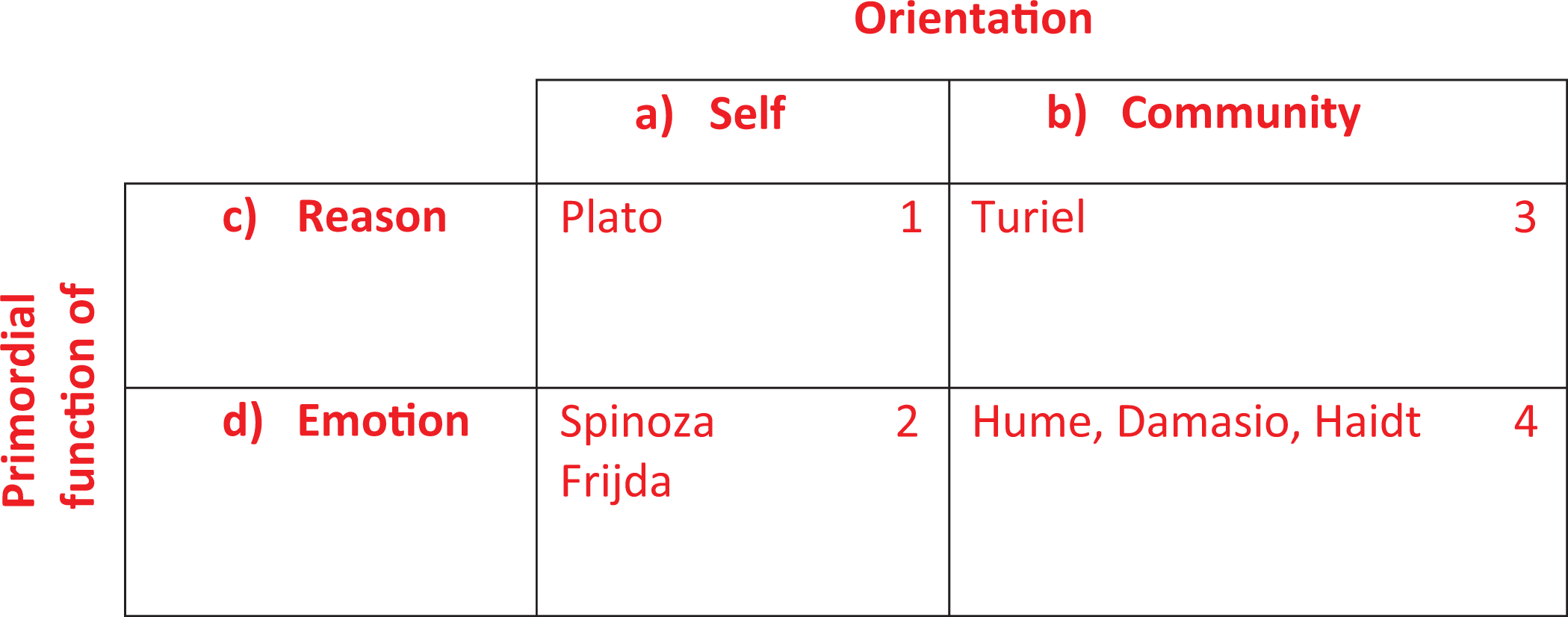
Four ideal-types of moral sensitivity.
Ideal-type 1: Moral sensitivity is about rational control. Cognitive abilities help to determine the ethical problem and define the perspectives of the stakeholders. The individual is able to understand the consequences of each decision, and ultimately makes a rational decision on the right course of action, and intends to act accordingly.
Ideal-type 2: Moral sensitivity is about control precedence. Emotion experiences include an evaluation of the ethical situation in terms of good and bad. The individual almost immediately acts according to what is felt to be just.
Ideal-type 3: Moral sensitivity concerns the well-being of the self. The ability to reflect on the self is central to this dimension. It aims to answer personal questions such as How do I become a good person? What is of importance to me? What defines the good for me? How should I behave accordingly?
Ideal-type 4: Moral sensitivity concerns the well-being of the group. Humans are social mammals. Group living provides individual protection. The counterpart of community living is that the individual must conform to the values and norms of the group and act accordingly. Otherwise, the person will no longer be protected.
In healthcare, these ideal-types of moral sensitivity can be found. Some nurses act more instinctively than others. They follow their ‘gut feeling’. Some nurses are more rational-oriented than others. They discuss the ethical perspectives of other stakeholders with colleagues and superiors, and consequently try to rationally define the moral course of action. Some nurses adopt a self-perspective; they, for instance, wonder what defines them as a good nurse in relation to the ethical issue. Other nurses conform mostly to group values and rules. They act according to the values and norms of the healthcare institution and tend to reflect less than others. Nurses probably use multiple ideal-types of moral sensitivity if confronted with an ethical issue. A combination of ideal-types is probably more effective in solving ethical problems. Further research should point out to what extent nurses use these ideal-types and whether they are effective in coping with moral issues.
Conclusion
We introduced this study be stating that emotions are undervalued in healthcare moral approaches. The ideas of historic and contemporary authors show that by focusing on cognition alone, one leaves out an essential part or morality. We argue that a definition of moral sensitivity should (1) include an initial judgement of good and bad based on emotions, (2) hold the ability to reflect on the initial judgement and the associated emotions, (3) include the ability to understand other stakeholder’s perspectives based on the ideal-types and (4) and include a personal decision on the right course of action.
Footnotes
Conflict of interest
The author(s) declared no potential conflicts of interest with respect to the research, authorship and/or publication of this article.
Funding
The author(s) received no financial support for the research, authorship and/or publication of this article.
