




Abstract
Objectives
As one of the most common hereditary diseases, thalassemia affects a large number of people in China. The aim of this study was to investigate the feasibility of a method based on next-generation sequencing (NGS) for screening of thalassemia carriers among high school students in the Shaoguan area.
Materials and Methods
The NGS-based method was performed using 25,910 high school students recruited from 38 schools. The screening yield was systematically analyzed. Before screening, a lecture on how the disease is inherited, the symptoms of thalassemia, and how to prevent it was given to 28,780 students.
Results
Implying successful delivery of information on the disease, 90.03% (25,910 of 28,780) of the students agreed to join this program for thalassemia screening. A thalassemia carrier rate of 15.99% (4144 of 25,910) was found. Also, 69 rare genotypes (28 of α-thalassemia and 41 of β-thalassemia) and 9 novel variants were identified.
Conclusions
This NGS-based method provided a feasible platform for high school population thalassemia screening. Combined with a clinical follow-up strategy, it could help eventually to prevent the births of affected children.
Introduction
Thalassemia is one of the most common hereditary disorders worldwide. 1 It is prevalent in China, especially in the southern regions. 2 In a study of 13,397 participants from the general population of Guangdong Province, 11.07% were found to be heterozygous carriers of α-thalassemia and β-thalassemia. 3 Carrier screening and prenatal diagnosis are still the most effective ways to prevent and control thalassemia. 4 To avoid the births of newborns with thalassemia major, many countries have started effective prevention and control programs.5–8
Increased awareness in school students is expected to facilitate the acceptance of preventive measures pre-pregnancy. 1 As is known, creating awareness is the key to the success of a control program. In a hemoglobinopathy awareness study among young students in Turkey, 87.0% of the students stated that they wanted to be educated about hemoglobinopathies at school and 81.6% wanted to learn their carrier status. 9 Similar results were observed in a study carried out on high school students in Antakya. 10 However, in a questionnaire study about β-thalassemia in north India, a large number of individuals had not heard about thalassemia, and >50% of individuals were not willing for premarital screening for β-thalassemia. 11 Creating awareness and early screening that targets high school students have been considered better modes of thalassemia prevention compared with antenatal screening. 12 The success of the prevention programs in the Mediterranean region relies highly on the widespread education effort for school students and healthcare workers. 13
For thalassemia screening, traditional methods of routine blood examination and hemoglobin electrophoresis analysis are still widely used. 9 In comparison, it has been demonstrated that an next-generation sequencing (NGS)-based method offers advantages in both sensitivity and specificity.14,15 To test further the feasibility of an NGS-based method for thalassemia screening, we report the screening results of a screening program of 25,910 high school students in the Shaoguan area.
Methods
Sample recruitment and screening strategy
The school screening program was undertaken as part of a large-scale population program in Shaoguan. Focusing on first-grade high school students, this study was undertaken in 38 senior high schools in Shaoguan. To investigate the attitude toward thalassemia screening, 28,780 students attended a lecture which was followed by a questionnaire. A total of 25,910 samples were tested using an NGS-based method (Figure 1). Informed content was obtained from all the participants or their guardians (for students under 16 years of age) before collection of the samples.
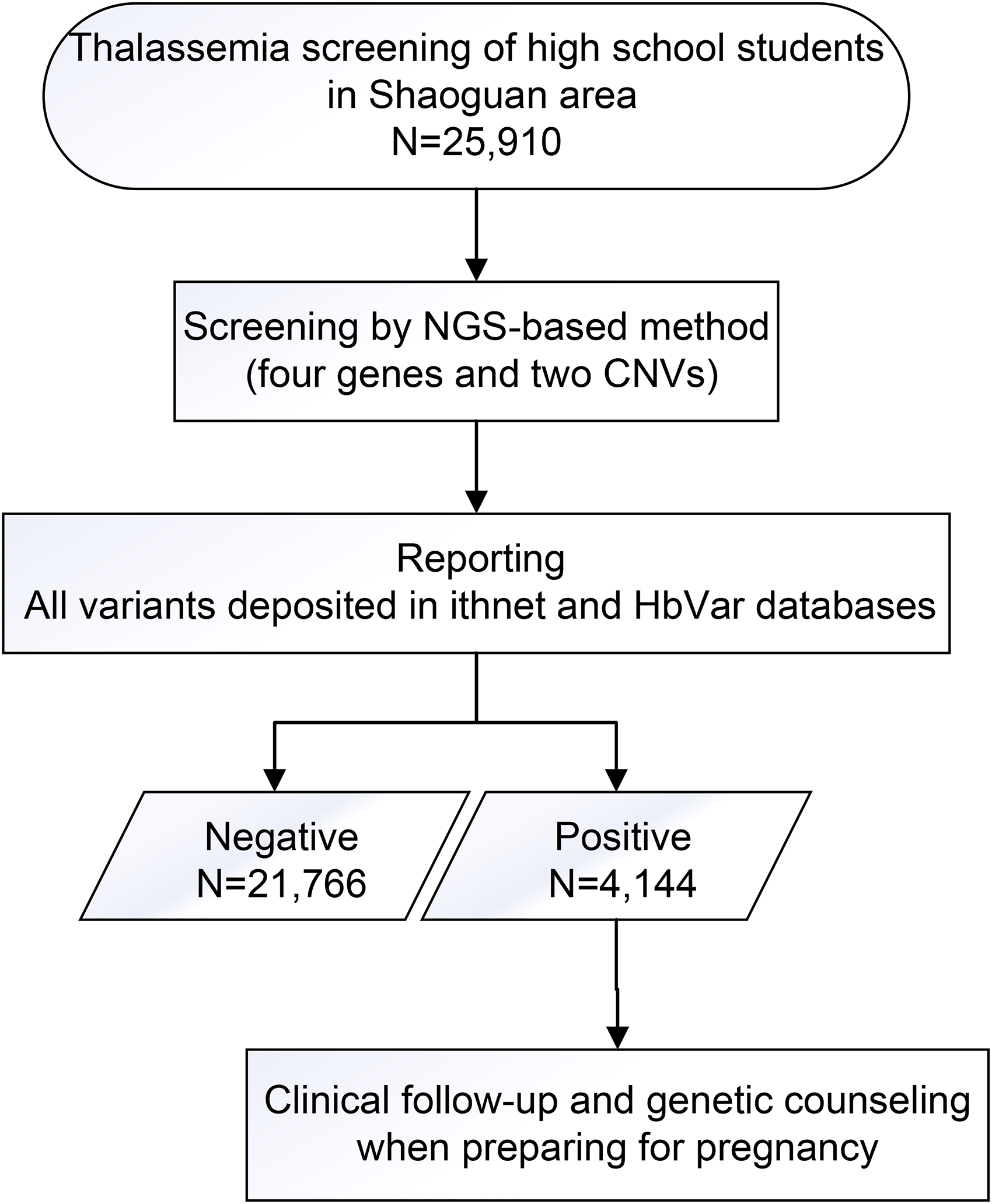
Study design. CNV: copy number variation.
The NGS-based method involves the detection of thalassemia variants using massive parallel sequencing technology. After sampling of oral exfoliated cells (using CJ005-100-01 preservation solution, Biocomma Ltd) from the participants, DNA extraction was performed using MagPure Buffy Coat DNA Midi KF kit D3537-02 (Guangzhou Magen Biotechnology Co., Ltd). The NGS-based test (library construction, sequencing, data analysis, and reporting) was then performed at BGI (BGI-Shenzhen) as reported before. 14 A report containing testing results is released for all participants. The report containing testing results for all 25,910 students was also deposited in the Shaoguan Minsheng Project Information System for future reference.
Results
Demographics of the students
Of the 28,780 students informed about this school screening program for thalassemia, 90.03% (25,910) agreed to join the program. All these high school students (aged 12–27 years) were recruited between January 13, 2022 and March 15, 2022 in the Shaoguan area, and included 13,164 boys and 12,746 girls (male to female ratio being roughly 103:100). The screening focused primarily on the first graders.
Carrier rate, genotypes, and mutations
Using the NGS-based method, we found that 15.99% (4144 of 25,910) of the school students were thalassemia carriers. Of these, 74.52% (3088 to 4144) were carriers of α-thalassemia alone, 21.62% (896 of 4144) were carriers of β-thalassemia alone, and 3.86% (160 of 4144) were carriers of a compound heterozygote of α-thalassemia and β-thalassemia.
In total, 3248 genotypes of α-thalassemia mutations were detected, in which αα/–SEA, αα/-α3.7, and αα/-α4.2 were the most common genotypes, and accounted for 53.85%, 25.06%, and 9.48% of all cases with α-thalassemia mutations, respectively. In addition, 1056 genotypes of β-thalassemia mutations were detected, in which βCodons 41/42 (−TTCT)/βN, βIVS−II−654 (C > T)/βN, and β−28 (A > G)/βN were the most common genotypes, and accounted for 32.48%, 29.64%, and 13.16% of all cases with β-thalassemia mutations, respectively (Table 1).
Genotypes detected in the 4144 thalassemia carriers.
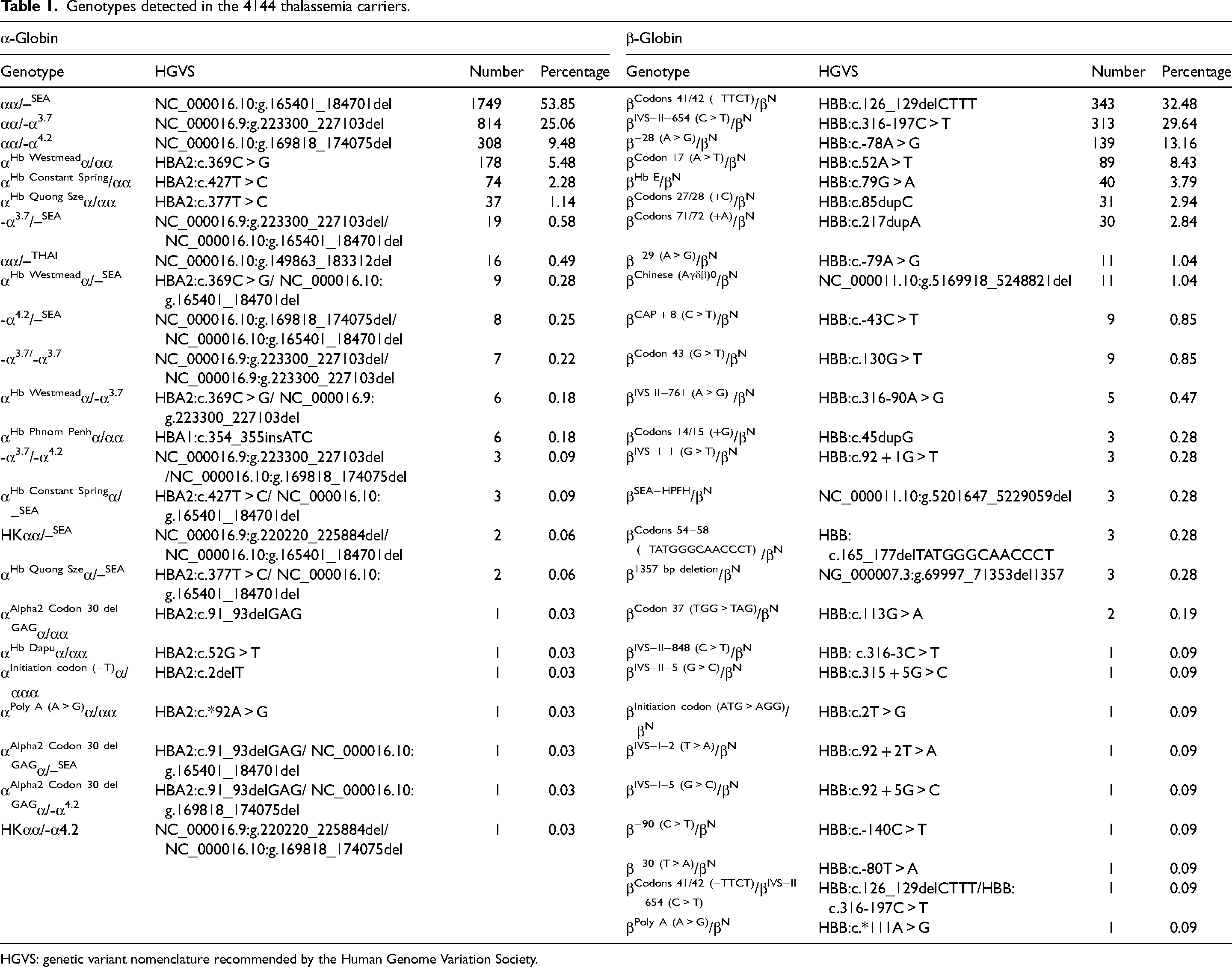
HGVS: genetic variant nomenclature recommended by the Human Genome Variation Society.
The Guidelines for the Establishment and Management of Thalassemia Gene Testing Laboratories, issued by the National Health Commission of the People's Republic of China in 2018, lists 23 genotypes that need to be tested (Supplemental Table S1), which are commonly reported in the Chinese population. In this study, other genotypes detected were defined as rare genotypes. In our cohort, 28 carriers with rare genotypes of α-thalassemia mutations and 41 carriers with rare genotypes of β-thalassemia mutations were detected (Supplemental Tables S2 and S3).
We also detected nine novel variants (Supplemental Table S4), never reported before. However, the pathogenicity of these novel variants has still to be investigated.
Discussion
The genotype distribution detected in our study was consistent with a previous report from Guangdong province. 16 The Shaoguan Municipal People's Government and Shaoguan Health Bureau played crucial roles in this program by providing broad guidance, continued support, resources and organization, which ensured rapid implementation and uninterrupted running of the program, and made broad coverage of the high school population possible.
Education is a crucial part of a genetic screening program, especially for school students. 13 Knowledge of how thalassemia is inherited, the symptoms of thalassemia, and how to prevent the disease should be delivered. In this program, the students attended a lecture before they could volunteer for screening. In general, the students understood that in order to prevent the births of affected children, future partners of positive carriers should be tested before planning pregnancy.
Clinical follow up
For future reference, the report containing testing results for all 25,910 students was deposited in the Shaoguan Minsheng Project Information System. The students (or their guardians) can download the testing results at any time, for example before marriage. Healthcare workers in the Department of Gynaecology and Obstetrics in the Shaoguan area were trained for genetic counseling. Any couple preparing for pregnancy in the Shaoguan area will be asked for the thalassemia screening results for genetic counseling. For carriers, free thalassemia testing can be performed for the partners.
Conclusion
In this study, an NGS-based method was used for thalassemia screening in high school students in the Shaoguan area. A carrier rate of 15.99% (4144 of 25,910) was detected. The results demonstrate the feasibility of this method for thalassemia screening in a school population. The clinical follow-up strategy should greatly improve the effectiveness of the genetic screening, and eventually result in prevention of the birth of affected children.
Supplemental Material
sj-xlsx-1-msc-10.1177_09691413231188069 - Supplemental material for Carrier rate of thalassemia among 25,910 high school students in Shaoguan area, China
Supplemental material, sj-xlsx-1-msc-10.1177_09691413231188069 for Carrier rate of thalassemia among 25,910 high school students in Shaoguan area, China by Yajun Chen, Rui Zhong, Xueqin Guo, Shiping Chen, Yan Wang, Jiufeng Li, Lichan Huang, Yi Li, Xiaoling Wang, Liting Wu, Mubao Huang, Xiaoyan Huang, Junbin Fang, Zhongjie Chu, Jun Sun, Zhiyu Peng and Yan Sun in Journal of Medical Screening
Footnotes
Acknowledgements
We thank all the participants for their invaluable contribution to this study.
Authors’ contributions
YS, YC, RZ, XG, and SC designed the research. YS wrote the first draft of the article. XH, JF, and ZC designed and performed the experiments. YS, YC, RZ, XG, SC, YW, JL, LH, YL, XW, LW, and MH performed data analysis. YC provided specimens. YS, YC, RZ, XG, SC, JS, and ZP contributed to drafting and revising the manuscript. All authors reviewed the manuscript.
Research ethics and patient consent
Written informed consents were obtained from all the participants or their guardians. This study was approved by The Institutional Review Board of BGI (NO. BGI-IRB 22036) and was performed in accordance with the Declaration of Helsinki.
Availability of data and material
The data of the clinical cases generated and analyzed during the current study is not publicly available as sharing them could compromise research participant privacy.
Declaration of conflicting interests
The authors declared no potential conflicts of interest with respect to the research, authorship, and/or publication of this article.
Funding
The authors received no financial support for the research, authorship, and/or publication of this article.

Supplemental material
Supplemental material for this article is available online.
References
Supplementary Material
Please find the following supplemental material available below.
For Open Access articles published under a Creative Commons License, all supplemental material carries the same license as the article it is associated with.
For non-Open Access articles published, all supplemental material carries a non-exclusive license, and permission requests for re-use of supplemental material or any part of supplemental material shall be sent directly to the copyright owner as specified in the copyright notice associated with the article.
