




Abstract
The COVID-19 pandemic has led to delays in cancer diagnosis, in part due to postponement of cancer screening. We used Google Trends data to assess public attention to cancer screening during the first peak of the COVID-19 pandemic. Search volume for terms related to established cancer screening tests (“colonoscopy,” “mammogram,” “lung cancer screening,” and “pap smear”) showed a marked decrease of up to 76% compared to the pre-pandemic period, a significantly greater drop than for search volume for terms denoting common chronic diseases. Maintaining awareness of cancer screening during future public health crises may decrease delays in cancer diagnosis.
Keywords
Introduction
The first peak of the COVID-19 pandemic prompted a decrease in timely cancer diagnoses, partially attributable to postponement of elective procedures, including a well-documented decrease in cancer screening.1–3 Interruptions in public attention to cancer screening may have lasting negative effects on participation. In a landmark Pew Research Center survey, 72% of US adults reported seeking health information online over the course of a year, and 77% started with an internet search engine. 4 Internet search engine volume may provide an indicator of public interest in cancer screening. We analyzed trends in Google search volume for cancer screening terms during the first peak of the COVID-19 pandemic and compared to selected non-screening medical terms.
Methods
This institutional review board exempt cross-sectional analysis of publicly available Google Trends data assessed historical search volume for keyword terms related to established cancer screening tests: “colonoscopy,” “mammogram,” “lung cancer screening,” and “pap smear.” We compared search volume for a control group of terms denoting common chronic diseases: “cancer,” “arthritis,” “diabetes,” “heart disease,” “hypertension,” and the generic search term “doctor.” Worldwide searches in English from 29 July 2018 to 22 August 2020 were queried on 29 October 2020, and data collection followed a widely used checklist for studies that utilize Google Trends data. 5 Absolute search volume was estimated using “Keywords Everywhere,” a commercial web browser plugin (Axeman Tech Pvt Ltd, Mumbai, India).
For purpose of analysis, search volumes were normalized to a relative percentage by dividing the weekly search volume by the peak volume during the queried time period and trends were plotted with the number of weekly new worldwide COVID-19 deaths. We assessed the percent change in absolute search volumes between pre-pandemic (29 December 2019 to 7 March 2020) and pandemic (8 March 2020 to 22 August 2020) periods based on the declaration of a global pandemic by the World Health Organization in early March 2020. Two-proportion Z-tests were performed comparing the percent change for each cancer screening search term to the average percent change for the combined control medical search terms.
Results
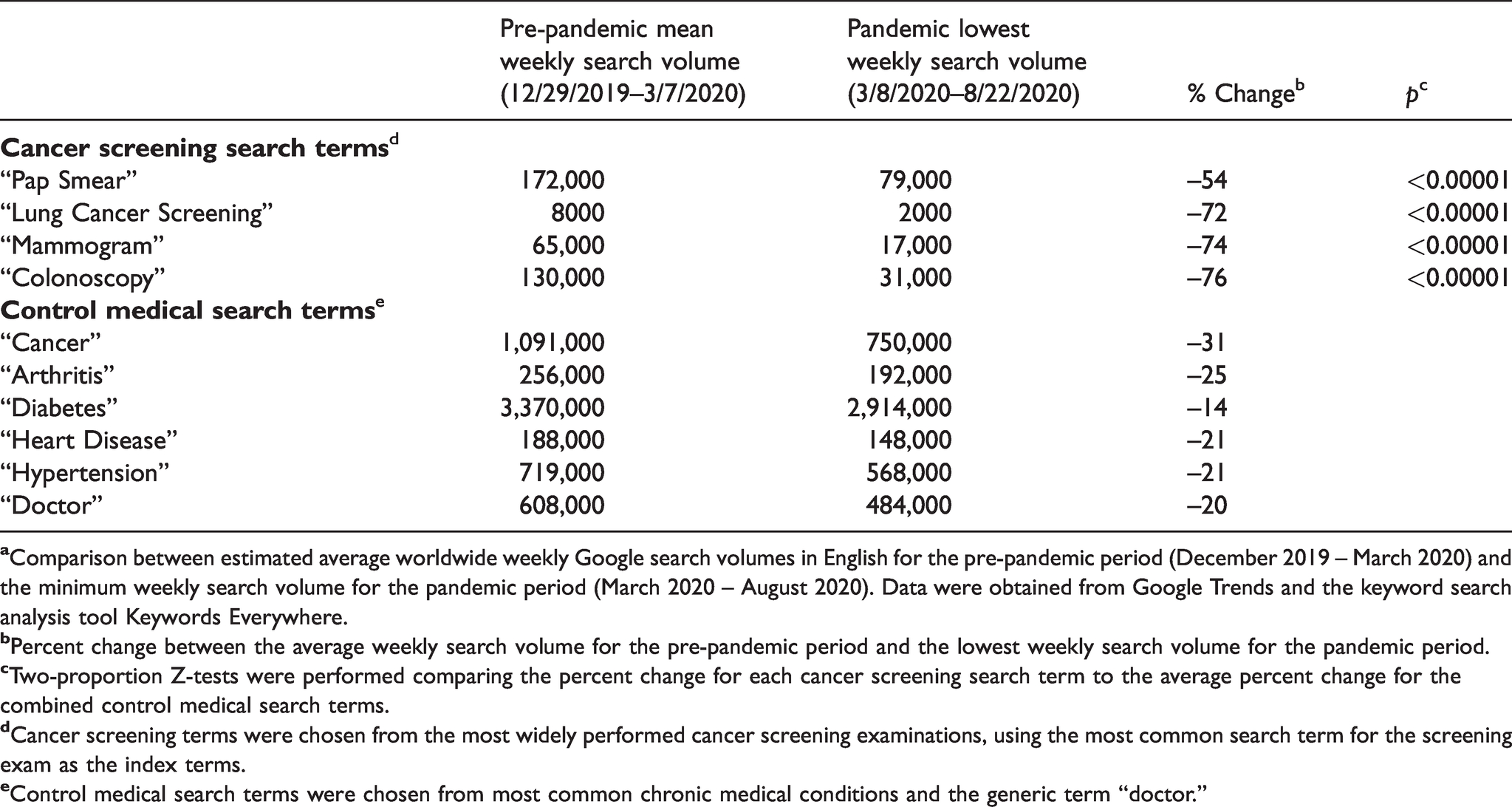
There was an overall decrease in relative search volume for all cancer screening terms during the first peak in global weekly deaths related to COVID-19 (Figure 1). During the pandemic period, there was a significant decrease in absolute search volumes for cancer screening terms [“pap smear” (–54.1%), “lung cancer screening” (–72.4%), “mammogram” (–74.3%), “colonoscopy” (–75.8%)] compared to the selected control terms [“cancer” (–31.3%), “arthritis” (–25.3%), “diabetes” (–13.5%), “heart disease” (–21.1%), “hypertension” (–21.0%), “doctor” (–20.3%)] compared to the pre-pandemic period (p < 0.00001) (Table 1).
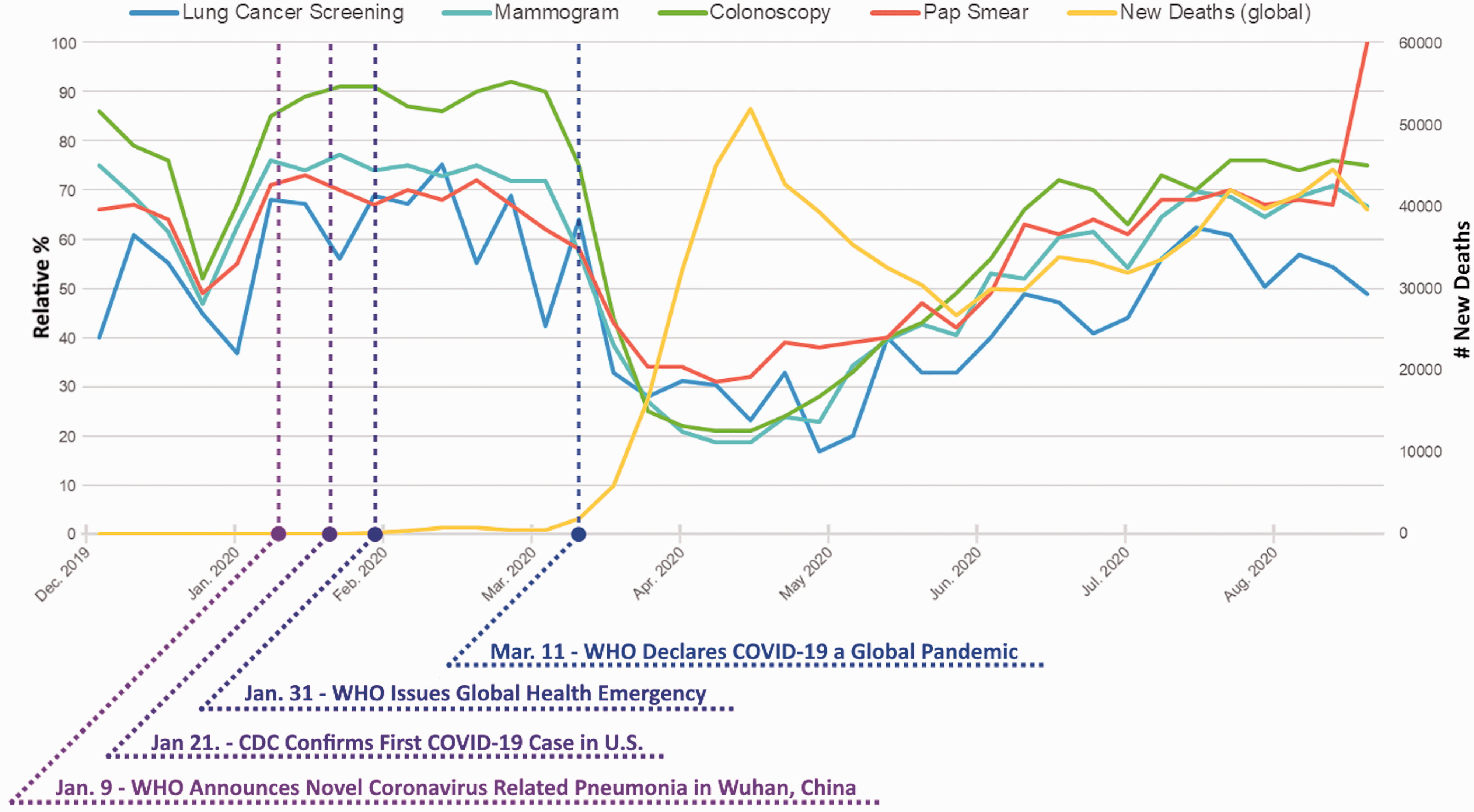
Worldwide weekly Google search volume for cancer screening search terms and weekly new worldwide COVID-19 deaths from December 2019 to August 2020. Percentages were calculated relative to the highest weekly search volume during the period 29 July 2018 to 22 August 2020. The resulting graphs were truncated to the period December 2019 to August 2020 for trend visualization. Weekly search volume in English was used for the analysis.
Comparison of worldwide Google search volume for cancer screening terms and control terms between pre-pandemic and pandemic periods.a
Discussion
Prior studies have documented decreases in cancer screening and cancer diagnoses during the COVID-19 pandemic,1–3 but have not specifically explored individuals’ interest in screening during this crisis. Internet search volume can be viewed as a measure of public interest in medical topics such as screening. Although other studies have found an increase in internet search volumes for certain health topics related to COVID-19, predominantly reflecting acute symptoms, 6 we found a significant decrease in searches for common cancer screening procedures during the first peak of the pandemic. This decrease in search volume for cancer screening terms might be explained by the postponement of elective visits during the first pandemic peak, as searches ordinarily might be initiated by discussions with providers or prompted by upcoming screenings.1,2 However, the significantly steeper decrease in searches for cancer screening terms compared to searches for chronic diseases may also reflect a hiatus in public attention to screening. Cancer remains one of the leading causes of death, and any interruptions in dissemination of information related to cancer screening may decrease adherence, compounding the tragedy of a deadly pandemic. Efforts to sustain public awareness of preventive health services and cancer screening during public health crises such as the COVID-19 pandemic may help decrease preventable mortality due to delayed cancer diagnoses.
Footnotes
Ethics approval
Exempt from institutional review board review – publicly available data.
Declaration of conflicting interests
The author(s) declared the following potential conflicts of interest with respect to the research, authorship, and/or publication of this article: Dr. Som is on the board of directors and is a co-founder and chief medical officer of a digital health company, CareSignal, unrelated to the current work. Dr. Succi is the executive director of 2 Minute Medicine, receiving equity and/or compensation, which uses Google search and analytics services, unrelated to the current work. Dr. Little receives royalties from Elsevier, Inc. for prior work as an academic textbook associate editor.
Funding
The author(s) declared no potential conflicts of interest with respect to the research, authorship, and/or publication of this article.
