




Abstract
James Haddow, or Jim as he was widely known, had a vision. Half a century ago he recognised the importance of public health and preventive medicine and was committed to see this widely accepted. As Associate Director of the Foundation for Blood Research in Scarborough, Maine, he brought together a highly effective local team including his wife Polly, George Knight, Glenn Palomaki, Ed Kloza, Joanne Beaudoin and Dwight Smith. The team combined expertise in medicine, diagnostic test development, statistics, epidemiology, genetics, education and information technology. The collective expertise, complemented with input from others, was used to integrate research, teaching and practice.
An example of the achievements of the team was producing a urinary cotinine test that showed that breathing other peoples’ smoke resulted in cotinine levels comparable to levels in active smokers who smoked up to about one cigarette a day. This helped persuade the US National Academy of Science to reach the conclusion that exposure to environmental tobacco smoke was a cause of lung cancer. Another example was the purification of alpha-fetoprotein (AFP) necessary for maternal serum AFP screening for neural tube defects – one of the first such tests in the world.
Of personal satisfaction to me was the opportunity I was given to work with Jim’s team for over four decades. The link started when I was in Oxford and continued throughout my time at Barts in London from 1983. AFP screening for neural tube defects, now standard care, was borne from that collaboration, as was the Triple Test for Down’s syndrome that included the essential input from Professor Jack Canick who proposed unconjugated oestriol as a screening marker which then formed part of the Triple Test. Jim brought Jack into the transatlantic collaboration.
Jim started the Scarborough Conferences in 1977 in Maine at the Atlantic House, a most delightful New England Inn on the Atlantic shore. The workshops attracted some of the world’s top scientists in their chosen field. There were six Scarborough Conferences, four on antenatal screening, one on the health effects of environmental tobacco smoke and one on the effects of low tar cigarettes.
The Conferences morphed into Intensive Screening Courses that set out the principles of screening and diagnostic testing as well as screening for birth defects and pre-eclampsia. The idea for the Course arose in a discussion which Jim and I had while enjoying an evening sipping Scotch on the deck of the Haddows’ home and looking out at the beautiful pond bordering on the house. The topics and suggested course teachers were scribbled on bits of paper. The first course was held in 1985 and over 50 courses took place, initially in Maine and later also in London at the Wolfson Institute of Preventive Medicine. There were about two a year. Jim and Polly came for the London courses and I went to the ones in Maine. Jack Canick took part as well, but the courses ended in 2013 after Jack’s death.
The courses filled a gap in the general understanding of medical screening and diagnostic testing. An example of the lack of general understanding came to light, as I was writing this obituary. Sarah Newey, a journalist for the Sunday Telegraph, wrote in the paper of 26 July 2020 the following in connection with a COVID-19 test: In general regulations ask for 80 percent sensitivity (at most 20 percent of tests return false positives) and 97 percent specificity (lower than three percent gave a false negative).
Jim was an Associate Editor of the Journal of Medical Screening since it began in 1994. Editorials he wrote for the Journal are available on the Medical Screening Society website via the following link: https://www.medicalscreeningsociety.com/james_haddow.asp. They demonstrate his firm view that screening should be conducted in an effective and efficient manner.
I confess it is hard for me to write this obituary. Jim and I have been close friends for over half my life and our families have spent many happy times together. Work and friendship were intermingled, welded together with a common aim to make medical research and practice better. In many discussions with Jim he reflected on the achievements he was part of and also the disappointment at the lack of progress in translating useful prevention into practice.
Jim was born on 16 July 1934 in Newport, Rhode Island and died on 13 June 2020, aged 85, in Portland, Maine. He graduated from Harvard where he majored in English. He studied Medicine at Tufts. He completed a residency in paediatrics at Boston City Hospital. In 1974, he moved to Maine. In 1977, Jim and Bob Ritchie set up the Foundation for Blood Research, widely known as FBR, where Jim was the Associate Medical Director. During its 27 years’ existence, FBR had a scientific and educational influence way beyond what might have been predicted for its size. In 2014, he became Professor at Brown University and Co-Director of the Division of Medical Screening and Specialist Testing at Women and Infants Hospital, Rhode Island.
In his career, Jim co-authored 307 original publications, 18 review articles, 35 books and book chapters, and 16 non-peer reviewed publications.
I cannot end this piece without expressing the monumental personal blow his loss was and will continue to be. My telephone conversations on research ideas, on the growth of our families, the political state of our two countries and accounts of Maine wildlife wandering onto his property in Standish will remain as treasured memories. Jim was in all respects a totally fair, honest and generous man.
Jim is survived by his wife Polly, their three children, James, Jon and Anne, and eight grandchildren, Hamish, Andrew, Sara, Sam, Max, Lauren, Ian and Mathew.
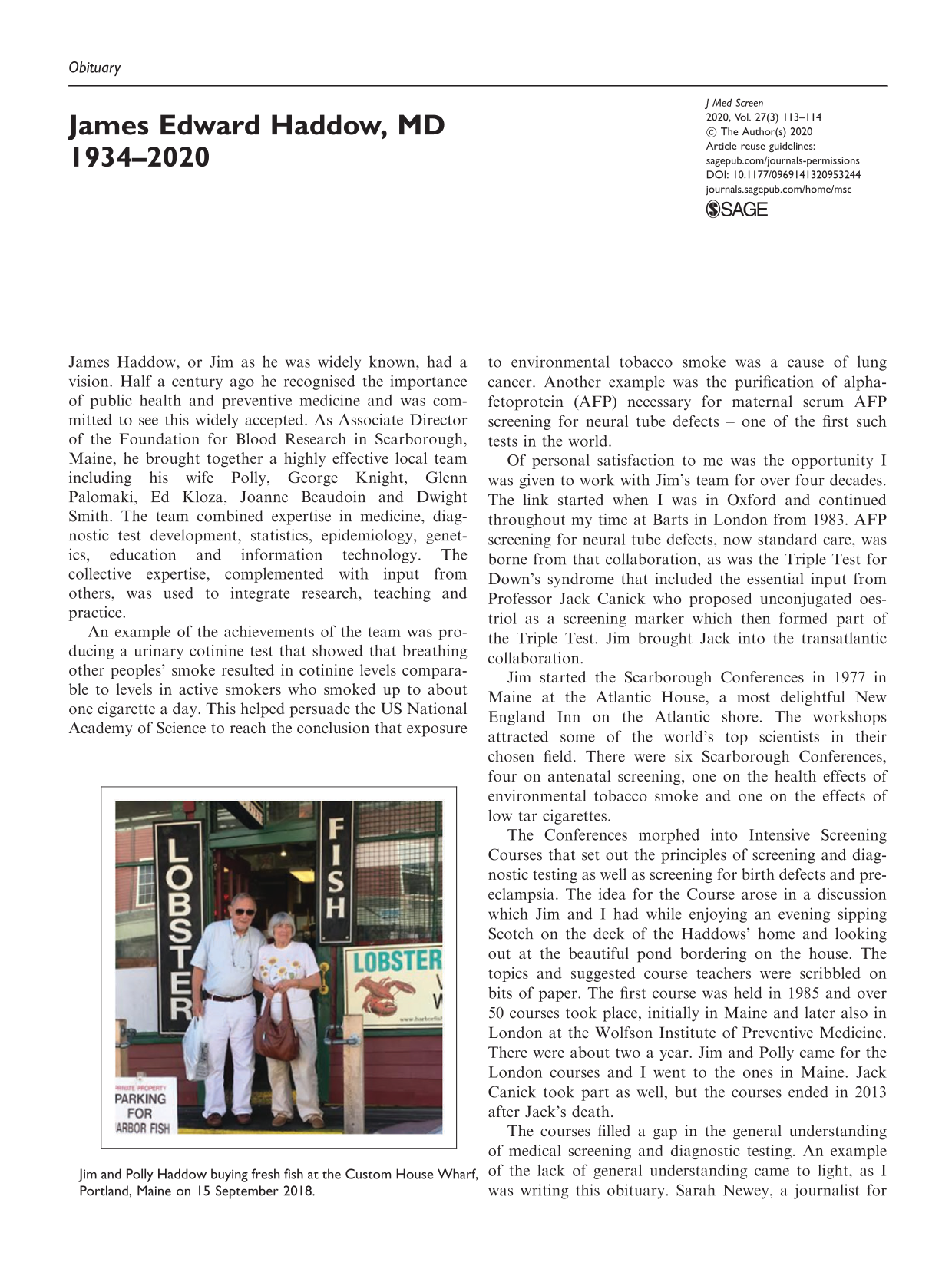
Jim and Polly Haddow buying fresh fish at the Custom House Wharf, Portland, Maine on 15 September 2018.
