




Abstract
Objective
To understand the usage and acceptability of a faecal collection device amongst participants in the National Health Service Bowel Cancer Screening Programme, with the aim of influencing future uptake.
Setting
Participants completing faecal occult blood test retests as part of the routine Bowel Cancer Screening Programme in Eastern England.
Methods
A faecal collection device and questionnaire were sent to all potential retest participants during a one-month period to collect information on prior stool collection methods and ease of use and usefulness of the enclosed faecal collection device.
Results
Out of 1087 participants invited, 679 (62.5%) returned their questionnaire. Of these, 429 (63.2%) trialled the faecal collection device at least once, 163 (38.4%) found the device made collecting their sample easier than previously, 189 (44.6%) found it made collection more difficult and 72 (17.0%) said it made no difference. Similar numbers reported finding that the faecal collection device made collecting the sample more pleasant (130, 31.5%), less pleasant (103, 25.0%) and no different (179, 43.4%) compared with previous collection without a faecal collection device.
Conclusion
Although a small proportion of participants found the faecal collection device helpful, a considerable majority did not or did not use it at all. Offering faecal collection devices is unlikely to produce a substantial increase in bowel cancer screening uptake.
Background
One of the biggest challenges to bowel screening programmes is promoting uptake. Numerous studies have identified the ‘ick’ factor, disgust at handling and storing their stool, to be one of the key concerns of potential participants,1–4 but few have investigated solutions to the problem.
The National Health Service (NHS) Bowel Cancer Screening Programme uses biennial guaiac faecal occult blood testing (gFOBt). In addition to a postal stool collection kit, participants receive written advice of potential methods for stool collection. The importance of not contaminating the sample with toilet water is stressed, although the need to avoid urine is not discussed. It is known that participants use a wide variety of methods to collect stool specimens, including retrieving stool from the toilet basin, using a household item such as a plastic food container, and newspaper or toilet paper. 5 One possible solution to this problem is the use of faecal/stool collection devices (FCDs). These aim to ease and improve sample collection through the provision of an external collecting container. A number of different devices are available, ranging from single use flushable paper-based products to reusable moulded plastic designs.
Two recent studies investigated the use of FCDs to increase screening uptake, with mixed results.6,7 We aimed to understand the usage of an FCD amongst participants in the NHS Bowel Cancer Screening Programme in England, specifically (a) the frequency of use and (b) the reasons involved in the decision making process.
Methods
Patients and setting
The gFOBt NHS Bowel Cancer Screening Programme in England invites men and women aged 60–74 who are registered with an NHS general practice to complete a gFOBt every two years. 8 Across England, the process of invitation and kit testing is managed by one of five Hubs, and the Eastern Hub is responsible for the initial management of participants in the East Midlands and East of England areas (total population ∼11.0 million). Participants found to have abnormal tests are referred to their local Screening Centre for further assessment, with most then undergoing colonoscopy. People with normal FOBT results receive written advice that they will be sent another kit in two years, provided they are still under age 75. Initial invitations and test kits from the Eastern Hub are dispatched externally; the hub dispatches repeat test kits for participants requiring additional testing due to weak positive results. Current screening practice utilizes the gFOBt process. Participants are posted a home testing kit, with instructions for returning six small stool samples from three consecutive bowel motions (details available http://www.nhs.uk/Conditions/bowel-cancer-screening/Documents/kit-instructions.pdf). No FCD is routinely included. Patients with strongly positive results (five to six out of six test windows positive) are referred for screening colonoscopy. Those with weak positive results (one to four out of six positive) are offered repeat gFOBt up to twice (screening algorithm available in online Appendix 1). All participants requiring a third test kit during October 2015 were included in this study. This allowed us to assess participants on both the FCD and comparison with the collection method used for previous kits. It is known that more than 90% of retest kits are returned. 9
FCD
All participants were sent three FCDs (Poo-Catchers, Alpha Laboratories part FC2010) with the kit (one for each of their three samples). At the time of the study, Poo-Catchers costed at £0.23 each (£0.69 per subject). The Poo-Catcher is a paper loop which fits over the toilet seat and collects the stool. A sample can then be collected before the device is torn at either side, allowing it to fall into the toilet and be flushed away (details available at https://www.alphalabs.co.uk/media/productfile/file/f/e/fe-col_flyer_final_jun17.pdf and images available in online Appendix 2).
Questionnaire
Accompanying the test kit, Poo-Catcher and invitation letter to complete the third kit, was a single-page questionnaire, designed to capture the views of participants on the usability and usefulness of the FCD (see online Appendix 3). The questionnaire could be returned with the completed test kit using the standard sample return process.
Analysis
A descriptive analysis of the survey results is presented below. Chi-squared analysis of independence for sex differences in survey responses was calculated. All analyses were undertaken using Microsoft Excel 2016, and a p value of <0.05 was considered statistically significant.
Approvals
No formal approvals for this study were required as this work was considered health service audit.
Results
Patient characteristics
During the study period, 1087 FCDs and questionnaires were sent; 1020 (93.8%) kits and 679 (62.5%) questionnaires were returned. The 679 questionnaires form the analysis sample. Similar numbers of returned questionnaires were received from males and females (n = 325 and n = 346) respectively (with n = 8 unknown).
Sample collection
Prior to the receipt of an FCD, the most commonly used method of stool sample collection was with folded toilet paper (491, 72.3%), followed by use of a disposable container (103, 15.2%) (see Table 1). With the provision of an FCD, 429 (63.2%) participants actually used the FCD for at least one of their three samples, with 181 (26.7%) using it for all three. Use by males and females was similar (60.0% and 66.2% ever-used, respectively).
Stool collection methods (all participants).
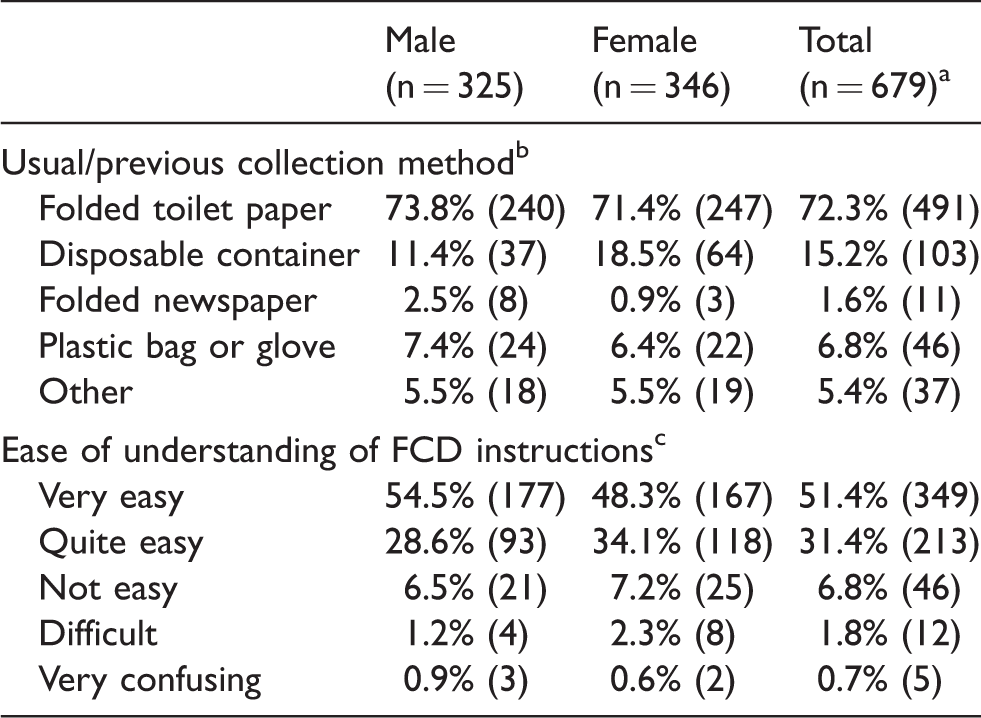
FCD: faecal collection device
Note: values are % of responses (number).
an = 8 participants of unknown sex.
bn = 7 returned with no response, note: total >679 as more than one response category allowed.
cn = 54 returned with no response, χ2 test of independence = 4.36, df = 4, p = 0.88.
Usability and usefulness
In general, participants found the instructions for using the FCD easy to understand, with 562 (82.8%) describing these as either ‘very easy’ or ‘quite easy’ to understand (83.1% and 82.4% for males and females, respectively, p = 0.88) (for full responses, see Table 1). Of those participants using the FCD (n = 429), 163 (38.4%) found that the device made collecting their sample easier than previously, 189 (44.6%) found it made collection more difficult and 72 (17.0%) felt that it made no difference (5 patients did not answer). There was a notable difference (χ2 p < 0.001) between males and females. More males found it easier (54.6% vs. females 24.4%) and more women found it more difficult (57.8% vs. males 28.9%). Similar numbers reported that the FCD made collecting the sample more pleasant (130, 31.5%), less pleasant (103, 25.0%) and no different (179, 43.4%) compared with previous collection without an FCD. A sex difference was again evident (χ2 p < 0.001, see Table 2). When asked about willingness to pay for an FCD, 424 (70.2%) said they were not willing, 136 (22.5%) were willing to pay <£1 and 44 (7.3%) would pay more than £1. A further 75 participants did not respond.
Use of the FCD among participants trialling the device.
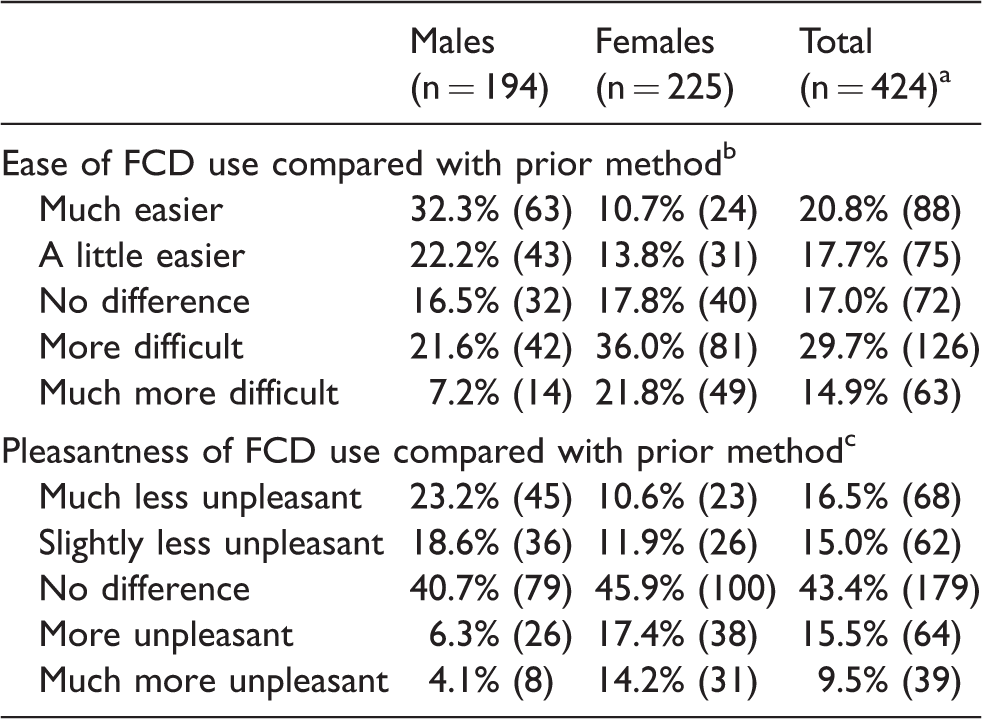
FCD: faecal collection device.
Note: values are % of responses (number).
an = 5 participants of unknown sex.
bn = 5 returned with no response, χ2 test of independence = 50.11, df = 4, p < 0.001.
cn = 12 returned with no response, χ2 test of independence = 26.70, df = 4, p < 0.001.
Comments
A total of 387 free text comments were received and were summarized as three broad themes: (i) positive comments regarding the helpfulness of the device, (ii) preference for the old method and that FCDs are not necessary and (iii) concerns around the device’s fitness for purpose. A selection of comments is included here. Comments were varied, with some positive ‘brilliant idea’, ‘I found it much easier than before, it is unpleasant to do but the device made it easier to do’. However, the majority of comments were negative ‘Tried glove, folded toilet paper, container and this device. I did not like your new idea at all. I prefer the container method’, ‘The collection device split when I used first one, went into toilet and would not flush away. I did not try the device again’, ‘Waste of time and money, toilet paper far easier and quicker’, ‘It is my opinion if people had to buy/pay they might not take part in the screening programme’, ‘Devices are a good idea but if you have a wee at the same time it’s no good, being a woman this happens most times’.
Discussion
Key findings
When the FCDs were provided free of charge to participants familiar with stool collection as part of the NHS Bowel Cancer Screening Programme, more than a third of participants were disinterested in trying the device, 63.2% were willing to try it, but the majority found that it did not improve ease of stool collection (either no difference (17.0%) or had a negative impact (44.6%)). There was a clear sex difference in the perceived ease and usefulness, with males being positive about the device and females negative.
Fit with existing literature
In the UK, White et al. found that the use of an FCD, alongside a Cancer Research UK endorsement, increased participation in the NHS Bowel Cancer Screening Programme from 43.4% to 45.1% amongst participants aged 60–69. 7 However, the FCD was part of a multi-faceted intervention, which included the addition of disposable gloves. In contrast, a study of over 10,000 people in the Netherlands found no difference in rates of participation in the national screening programme for participants randomized to screening with and without an FCD (uptake 52% in both groups). 6 This may, in part, reflect both the use of Faecal Immunochemical Test (FIT) in the Netherlands, which is easier to use, requiring only a single stool sample, and also anecdotal reports that the shape of European toilet pans (compared with those in the UK) is such that it makes stool collection easier. The difference in perception of usefulness by sex is potentially explained by females more frequently than males needing to void urine at the same time as passing a bowel motion, thus both contaminating the sample and weakening the FCD.
Strengths and limitations
The main strengths of this study relate to its high response rate (62.5%), a feature of the design that used participants who were both familiar with stool collection and had interest in completing their screening due to prior weak positive results. A weakness is the lack of detailed information on non-responders, such that external validity of the sample may be limited. However, we have no reason to believe that responders and non-responders at this stage of the screening programme are notably different. The addition of the questionnaire and FCD did not have an impact on screening participation, with the kit return rate of 93.8% consistent with that expected at this stage of the screening programme.
Conclusion
Although a small proportion of participants found the FCD helpful, a considerable majority did not, or did not use it at all. Offering FCDs is unlikely to result in much increase in bowel cancer screening uptake.
Footnotes
Acknowledgements
Thanks to Matthew Davis at Alpha Labs for support on the project, and Andrew Field for support with data management.
Authors’ contribution
JRM and AB performed the literature search. AB, CC and RFL designed the study. JRM and AB designed the analysis plan, prepared and analysed the data. JRM wrote the manuscript. All authors contributed to data interpretation, critically reviewed the manuscript, revised the manuscript and approved the final version.
Declaration of conflicting interests
The author(s) declared no potential conflicts of interest with respect to the research, authorship, and/or publication of this article.
Funding
The author(s) disclosed receipt of the following financial support for the research, authorship, and/or publication of this article: The faecal collection devices were purchased by the Bowel Cancer Screening Programme. JRM is supported by a four-year Medical Research Council Clinician Scientist Award.
References
Supplementary Material
Please find the following supplemental material available below.
For Open Access articles published under a Creative Commons License, all supplemental material carries the same license as the article it is associated with.
For non-Open Access articles published, all supplemental material carries a non-exclusive license, and permission requests for re-use of supplemental material or any part of supplemental material shall be sent directly to the copyright owner as specified in the copyright notice associated with the article.
