




Abstract

“£30 cancer tests on the NHS within five years” was the front page headline to an article in The Times on 28 March 2013, raising expectations that are, unfortunately, unlikely to be fulfilled. The article was based on a study identifying DNA variations (SNPs, single nucleotide polymorphisms) in 100,000 people with cancer of the prostate, breast, or ovary and in 100,000 people without cancer.
1–5
The article suggested that the tests would be useful in screening, stating that: “When all the [DNA] markers linked to prostate cancer were present, they increased a man's lifetime risk of contracting the disease five-fold from about 10 per cent to 50 per cent”. The press release from Cancer Research UK
6
that publicized the research also suggested that the findings would be useful in screening, but included a critical limitation. The press release stated that “Each (DNA) alteration raised the risk of cancer by a small amount, but the one per cent of people who have lots of these alterations could see their risk of developing prostate cancer increase to nearly 50 per cent and breast cancer to around 30 per cent”. The “one per cent” is the critical limitation; it means that the proposed SNP analysis would be a poor screening test. Although it would identify an increased likelihood of developing either cancer by about five-fold, it would do so in only a small minority (1%) of people, and most cases of the disease would arise in screen-negative individuals. This can be seen from a flow diagram (see figure), based on people who develop a hypothetical cancer X with an incidence of about 10% over a given time span, in which one percent of individuals have a five-fold increased risk relative to the remaining 99% (50% v 10%). The figure shows how 99 of the 104 cancers that arise would be missed by the SNP test although the risk of having the cancer given a positive result is high (50%).
Illustration of screening for a hypothetical cancer X with an incidence of about 10% (104/1000) over a given time span; 1% of individuals have a five-fold increased risk relative to the remaining 99% (50% v 10%).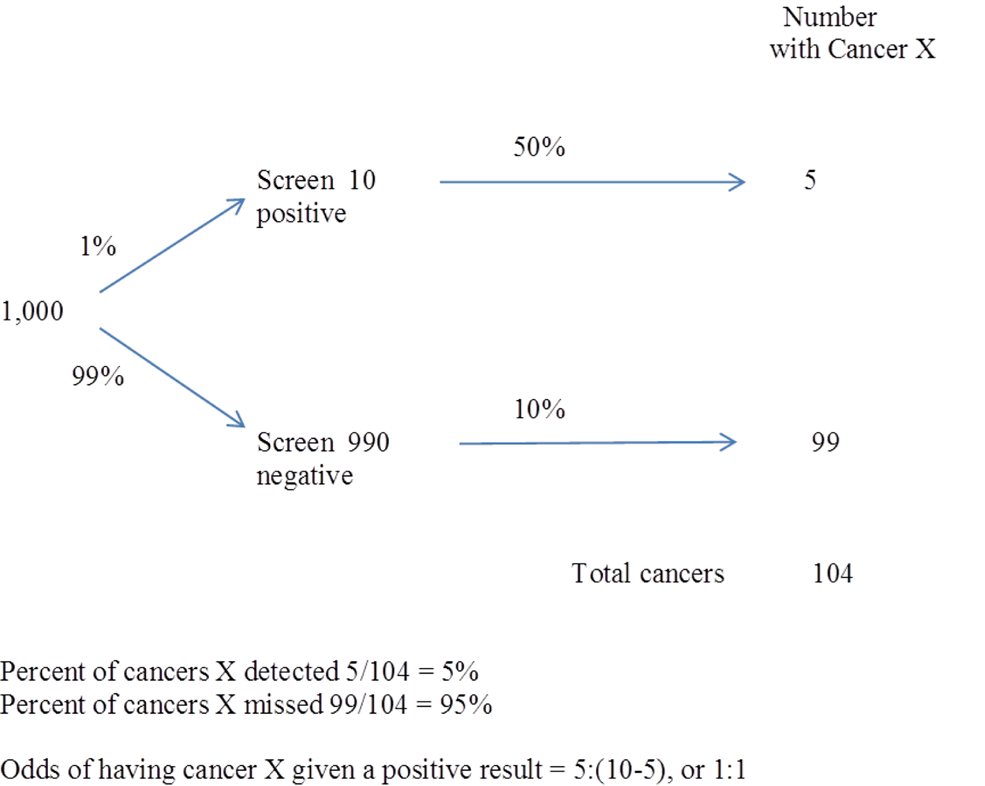
There is no evidence that such SNP testing would be a worthwhile general screening test for any of the three cancers that were the subject of the study. Relative risks of 10 or less are unlikely to be useful in screening, though this may appear counter-intuitive. This can be seen from the risk screening convertor on
It has been suggested that modest improvements in programme efficacy might be achieved by using polygenic risk (so-called “risk stratification”) in addition to age to determine the target population, or to vary the frequency of screening. 10,11 However, the potential gains are likely to be too small to justify the added complexity. A key element of a successful population screening programme is a simple system of eligibility and delivery.
The value of the study lies in showing the inherited etiology of some cases of these common cancers and that risk is influenced by many genetic variations, each with a small effect, with possible insights into the mechanisms that lead to cancer developing. The value does not lie in medical screening.
Organizations that support research need to avoid overstating the expectation of screening benefits arising from the research they support, so the press will have less opportunity to exaggerate the implications of the findings. The same concern, of course, applies to inferring harm from results showing epidemiological associations such as coffee drinking and, say, pancreatic cancer, when usually (including in this example) these associations are not causal. The limitations affecting the interpretation of research findings are often stated in the published reports, but these tend to be underestimated or ignored in the drive for publicity. They should be mentioned in press releases, together with the reference to the scientific paper concerned, so that readers can access the papers for themselves. This would help to improve the dissemination of scientific discovery to the public without raising unwarranted expectations.