



Abstract
From 1940 to 1944, a clandestine war raged in France, with agents and resistance networks being supplied by the Allies. This work brings together digital humanities methodologies, oral history, new archival sources and historiographical analysis to uncover the dangerous nature of wartime logistics and transportation that helped to liberate France. From the Section 61 packing units to N°. 161 (Special Duties) Squadron's Lysander and Hudson pilots, the existing scholarship is clarified and expanded. Moreover, this article cartographically plots French resistance transport operations, underlining the importance of Allied cooperation towards France's freedom from occupation.
The defeat of France in June 1940 came as a ‘violent shock to many hundreds of thousands of French men and women’. 1 According to Maurice Buckmaster, the head of the Special Operations Executive ‘F’ Section, one of the two branches of S.O.E. who were involved in organising clandestine operations in France, the shock gave way to resentment and bitterness which evolved to become acts of sabotage, propaganda and the formation of groups that attempted to hamper the Vichy regime and the Nazi occupiers. In Buckmaster's estimation, the early planning for clandestine activity was ‘theoretical rather than practical’, but, as the war developed, infrastructure and logistics solutions quickly became necessary to support efforts ‘to foster subversive activity by all means against the enemy’. 2
While resistance action in France, meaning political and paramilitary undertakings intended to hinder the German occupation of France or their relationship with the Vichy government, often took place in relative isolation from General Charles de Gaulle's Free French in London, some were inspired to act once they had heard of de Gaulle's British-supported venture. Resistance and the Free French cannot, therefore, be regarded as two separate entities. This article intends to show one of the principal aspects of this interconnectedness between the internal and external resistance movements – transportation.
Henri Frenay's experience shows the closely linked nature of resistance groups in France to the Free French in London. In 1940, Frenay was close to the corridors of French metropolitan power, as a captain in Vichy's Armée de l’Armistice who acted as a liaison officer with the Ministry of Foreign Affairs in Vichy. However, concurrently, he surreptitiously worked towards organising and supplying information to the British. Nonetheless, he was faced with the problem of raising money, in order to help grow his network, alongside Bertie Albrecht, his colleague in resistance. 3 Their movement, which stemmed from a clandestine publication and eventually became known as Combat, would go on to become the largest and richest of the internal resistance movement. In order to support groups like Combat, the British and the Free French sent arms, ordnance, money and agents as a means of channelling these French-grown movements towards activity that would disrupt enemy movements, communications and operations. By so doing, it was hoped that the occupier's attention and resources would be diverted away from enemy offensives elsewhere. However, how did these agents and ordnance get into France?
This article expands upon the work of A.W.M. Smith, which investigated the experience of pilots of 161 Squadron, the ‘service bus for the cloak and dagger racket’, who flew their resistance member passengers and accompanying packages to and from R.A.F. Tangmere, in West Sussex. 4 These aerial missions were the predominant method of infiltrating both agents and equipment into France. Buckmaster explained that ‘few amphibious operations were made’ by S.O.E. 5 This was large because many of the supplies that needed to be transferred included money, correspondences, electrical equipment, weapons and ammunition; none of which would have travelled well in the saline conditions on seabound infiltration operations. American sources have confirmed that landing operations were carried out on the Breton coast and they predominantly involved the transportation of agents and escapers, but that ‘it was inevitably by air that the real work was done’. 6 Despite their slow speed, ‘feluccas and submarines were used to carry men and materials to the south coast of France’ in periods of poor weather. 7 In 1942, 23 agents and a ‘fairly large amount of equipment’ were landed using the Gibraltar to France sea passage. 8 Frenay was among those who left France via the Mediterranean route, on 17 September 1942, having travelled alongside Emmanuel d’Astier de la Vigerie, to pledge his support to General de Gaulle. 9
This paper attempts to reinforce both A. Smith's and H.R. Kedward's 10 insights through the application of digital humanities techniques, notably Geographic Information Systems (G.I.S.). G.I.S. helps to cartographically map the agent transfers that occurred during the period 1942 to 1944, thereby providing a map of airborne activity that has hitherto been unavailable to scholars of the Second World War. It also offers a spatial dimension to the military history of clandestine action. French internal resistance survived, and grew, thanks to these dangerous night-time operations; the pilots delivered, and returned with, passengers and equipment that intended to help with the clandestine effort to ‘set Europe ablaze’, as Winston Churchill famously exclaimed to Hugh Dalton, the head of the Ministry of Economic Warfare between May 1940 and February 1942, under whose responsibility the S.O.E. fell. 11 It is arguably the case that, without this international ‘taxi’ service, French resistance would have foundered before it had even begun or, at least, their work may have been badly hindered.
Through the creation of maps that demonstrate the scope and scale of the sorties, it is possible to explore the development of underground resistance warfare in France. This work intends to achieve this in three ways: firstly, by looking at the packaging of containers in Britain, which helped to provide logistical and financial support to French resistance members in France; secondly, it will investigate the wartime experiences of pilots of 161 Squadron when they undertook these dangerous raids; and, thirdly, it will show the destination of the supplies and people, or their pick-up locations. It makes use of primary and secondary source material from Britain, France and the U.S.A. to underline the necessity for this transportation towards contributing to the eventual victory of the Battle for France in 1944.
Packing & Parcels
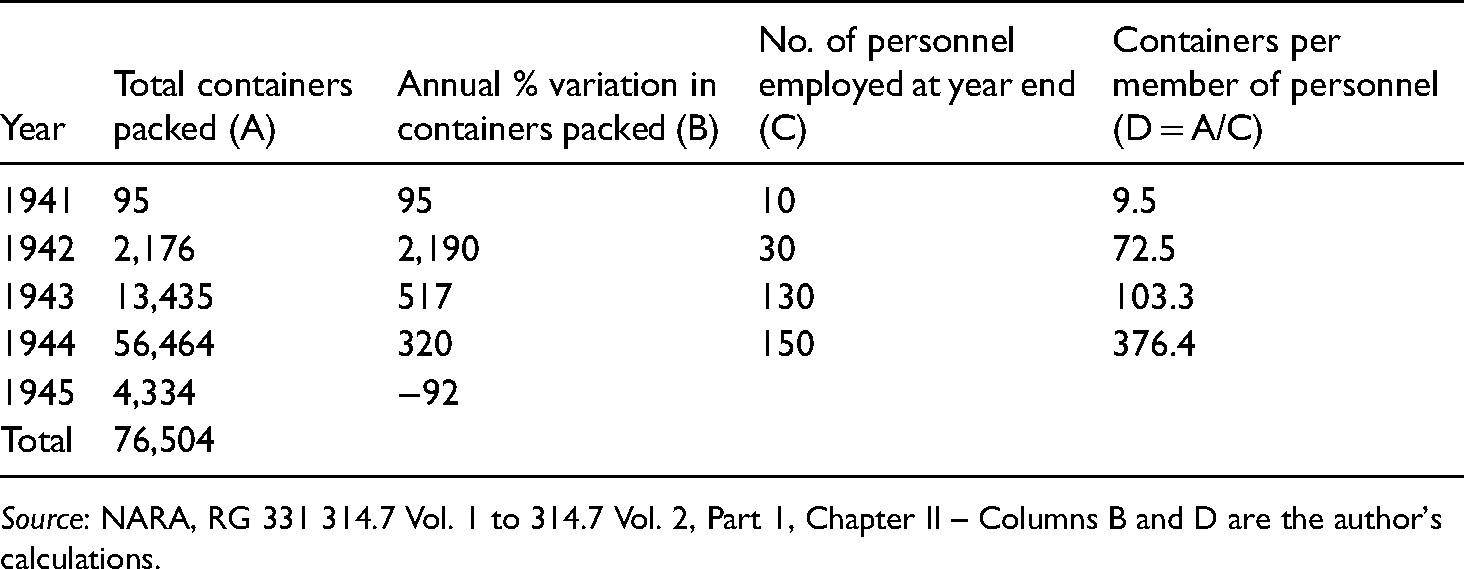
When considering special operations in France during the Second World War, there were two reasons for the use of Lockheed Hudsons and Westmoreland Lysanders. The first was to transport agents and their luggage into the country; and the second was to deposit containers and packages. The packing for these sorties was centrally organised, with the first dedicated station for containers being opened on 2 October 1941 in Holmewood House, a requisitioned country home, near Holme in Cambridgeshire. 12 Space for the staff was incredibly limited, as they were initially housed in a nine-foot by eight-foot office. Their production was undoubtedly hampered by this lack of room, as shown by the fact that only one package per month was being dispatched in 1940. Outhouses were used for storage and served as office space for the commanding officers – a major and captain – and the nine staff members who manned the facility. However, by April 1942, they had outgrown their initial property and required a much larger base. This new facility became known as ‘Station 61’, in the village of St. Neots, Cambridgeshire. 13 By hiring specialised employees from Carpet Trades Ltd., in Kidderminster, the growth in container production was extraordinary as shown in Table 1. 14
However, it must be stressed that these containers, in column (A), totalling over 10,000 tons in stores weight, were not all destined for France. Nonetheless, it shows the development of the canister packing industry that grew over the course of the war. As shown by the annual percentage variation in containers packed, (B), there was an exponential growth in containers packed between 1941 and 1942. This was the result of the move to ‘Station 61’ and the larger facilities at the personnel's disposal. It also reflects a change in the value being accorded to clandestine warfare measures in British policymaking. The final column, (D), shows an increase in the efficiency of the personnel working at ‘Station 61’. While (C) includes all the personnel working on the base – notably packers; container assemblers; loaders; store personnel; clerks; armourers; ammunition examiners; sheet metal workers; carpenters and tractor drivers – it demonstrates that the packing of equipment did greatly increase in speed as the years passed. In order to manage the additional demand for containers being requested in 1943, largely caused by the growth in numbers of resistance forces in France, additional buildings were added to the camp. It grew to comprise six large packing sheds, two magazines and an unheated storehouse. The reason for the sizeable increase in containers packed, in 1944, was due to the entry of the U.S. armed forces into the packing process. Having been aware of the earlier problems that the British faced, they were able to benefit from their ally's experience. At its height, the American operation employed between 250 and 300 personnel, meaning more containers could be packaged. 15 In order to maximise the amounts of equipment sent with each despatch, clothes would often be sent alongside pieces of ordnance.
As Albertelli indicated, two types of container were used: the type ‘C’ and the type ‘H’. Type ‘C’ were used at the beginning of the war and the type ‘H’ containers were introduced by June 1942.
16
The type ‘C’ containers (Figure 1) were of a more primitive design, being separated by three inner cells, inside an outer case that measured 5′8″ (172 cm) with a diameter of 15″ (38 cm). Daniel Cordier, the secretary of Jean Moulin, who was de Gaulle's clandestine envoy to France in the years 1942 and 1943, confirmed that these containers were not easy for the reception committees to manipulate:
17
‘We had to be two or three to lift them, transport them and put them in a truck. When there was a large parachuting mission, there needed to be many people on the ground.’
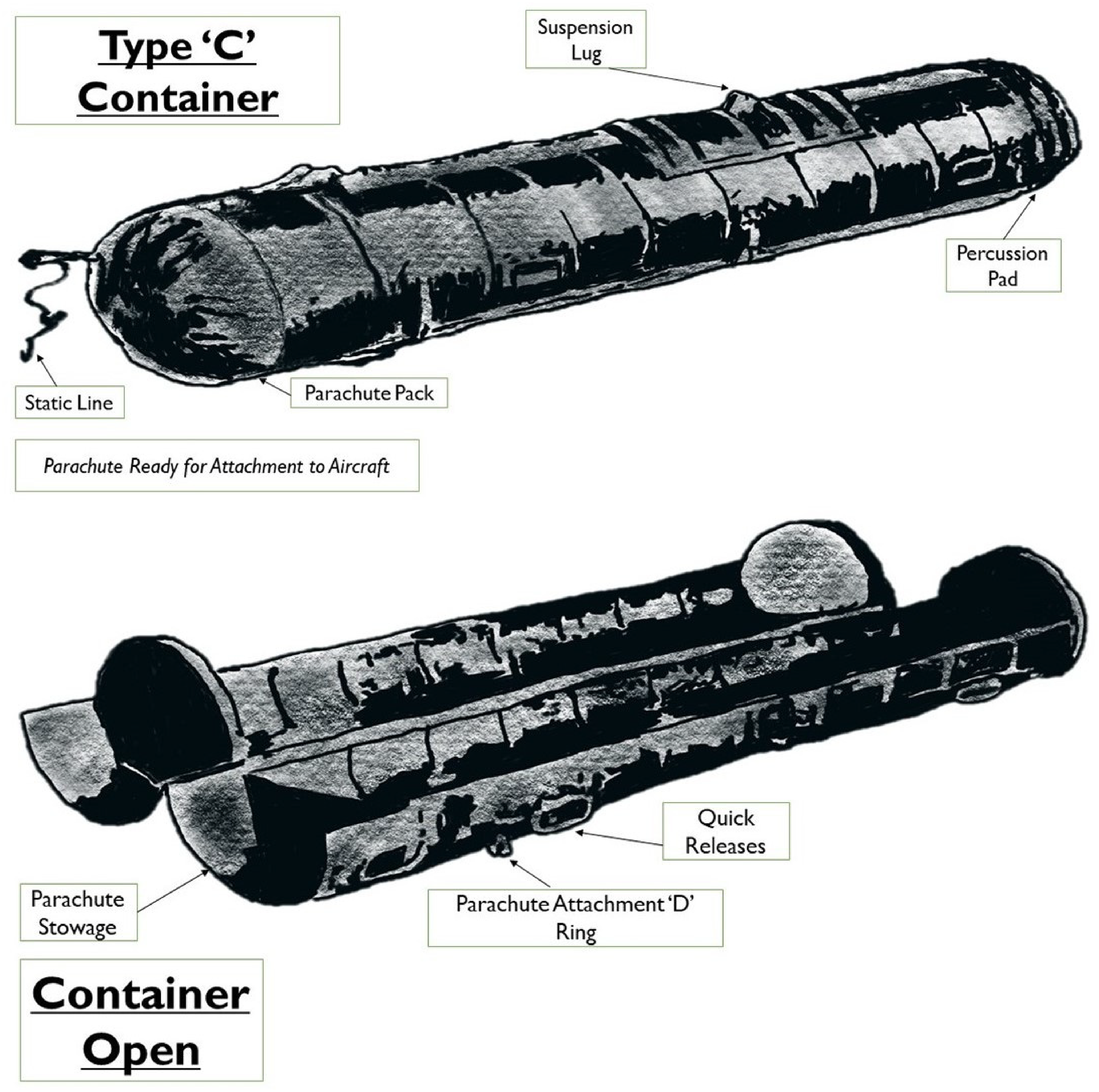
Type ‘C’ Container. Source: NARA, RG 331 314.7 Vol. 1 to 314.7 Vol. 2, French Forces of the Interior, Part 1, Chapter II, Sub-section II, p.375b, Illustration by the author
In case the shipment required more space, these inner cells were removed to allow for the transportation of Bren guns, rifles or even petrol and oil in jerrycans. The flammable liquids were separated from each other using plywood and padded with materials including hessian or hairlock. The change from the basic type ‘C’ to the type ‘H’ seems to have been precipitated by feedback from the field, in an example of military innovation based upon operational experience. When seeking to dispose of the illicit contents as speedily as possible, the reception committees found that the ‘C’ type containers were very difficult to open quietly. However, it was found that the ‘H’ type broke apart on landing. Instead, it was recommended that ‘C’ types should contain smaller cells, similar to the ‘H’ type, but housed within a more easily dismantled outer case. 18 As a testament to the packers’ skill, a consignment containing 200 glass bottles of printing ink was sent into France for the use of one of the country's underground newspapers. Upon landing, not a single bottle was broken. 19 However, this was not always the case. British documents show that ‘packing was generally satisfactory. Some cases of bad packing are reported…Six cases of containers exploding and five of catching fire are reported’. 20 Nonetheless, with the number of consignments that have been seen above, it would be extremely surprising if there had not occasionally been problems experienced during missions that essentially involved throwing highly unstable equipment from a great height.
Figure 2, shows the arms that were delivered to French resistance forces by air, up to April 1944, both from the U.K. and North Africa. It demonstrates those areas that received the greatest levels of support from both British- and Free French-run networks. The British-run networks on the map referred to S.O.E. Section ‘F’, which were also known as ‘Buckmaster Networks’, and the Free French-run networks were S.O.E. Section ‘RF’, which were conjoint British and Bureau central de renseignement et d’action (B.C.R.A.) operations. The B.C.R.A. were the Gaullist military intelligence agency, created in 1940 and led by Colonel Passy, which was the nom-de-guerre of André Dewavrin. It can be seen that the British circuits were provided with fewer arms than their Franco-British counterparts, who received 42,954 as opposed to the 66,268 arms that were sent to the ‘RF’ Section networks. The total number of arms delivered was 109,222. Section ‘F’ received 39.3% of the total arms sent and Section ‘RF’ received 60.7%, meaning that the Franco-British operations were more heavily armed. In large part, these were small arms. Sten guns made up the majority of the consignments, at 64.8% of the total weapons shipped. This is due to them being easier to package and parachute in the containers, even if, in the case of the Sten, their operational reliability left much to be desired. The second most shipped arms were pistols, at 21.2%. According to the evaluation of the Section ‘F’ operations, it was ‘generally agreed that the best personal arm for clandestine operators (was) the Colt.32 automatic’. 21 Operatives also remarked that they were sent far too many Stens. Preferentially, they would rather have received heavier weapons, notably Brens, rifles, bazookas and mortars. It can be seen that Savoie and Haute-Savoie received the lion's share of weapons for the Section ‘RF’ networks, whereas the Section ‘F’ networks concentrated their armaments provision in the South-West, around Lot-et-Garonne, Gers, Tarn-et-Garonne, Haute-Garonne and in Dordogne. It is also clear that the majority of munitions were sent into the southern half of the country and were destined for areas that had previously been under the control of the Vichy regime, until German troops occupied the previously ‘Free’ Zone in November 1942.
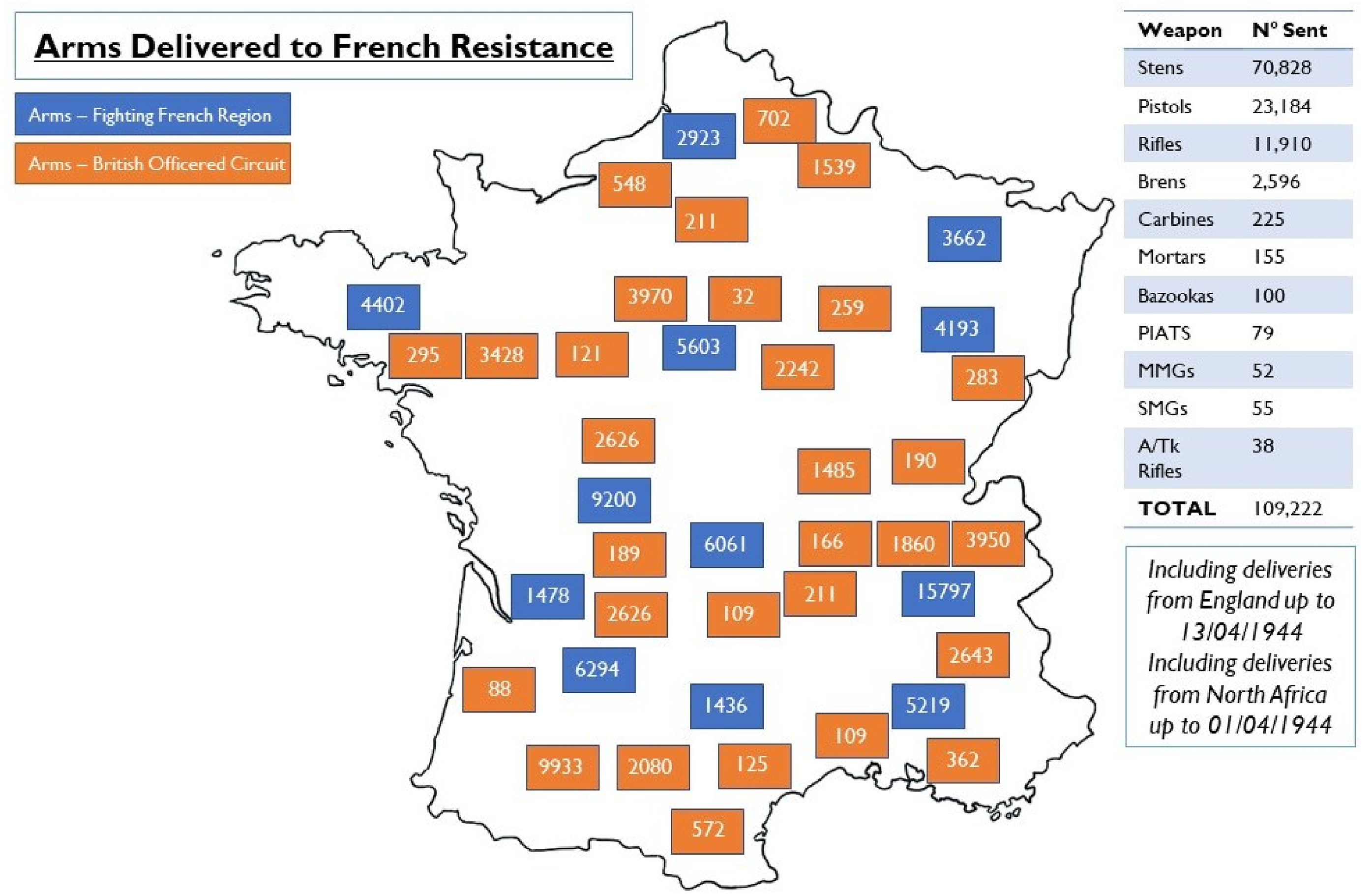
Arms Delivered to French Resistance to April 1944. Source: TNA, CAB 122/780. p.138, Illustration by the author
Figure 3 shows that these were also the areas around which the majority of Maquis forces began to congregate. The Maquis were composed of those who refused to participate in the forced labour scheme, or Service du travail obligatoire, which was run by Vichy, under the encouragement of the occupying forces. Labour requisition initially entered French legislation through the law of 4 September 1942 and was reinforced on 16 February 1943. 22 This programme incited a number of those who would otherwise have been conscripted to perform war-work in Germany to retreat into remote parts of the French countryside and enter the clandestine war. The following map shows the areas of France which housed these camps of réfractaires, or those who refused to participate in the scheme. The relationship between the amounts of weapons sent into France by S.O.E. ‘RF’ Section and the areas used by the Maquis forces seems to closely correspond. The largest concentration of Maquis seems to have been, once again, around the Savoie département, Haute-Savoie and towards the centre of the country. However, the same correlation is not noted for those arms supplied by the exclusively British-run ‘F’ Section. Instead, they appear to have distributed arms more widely and across the entirety of the country, albeit in smaller quantities.
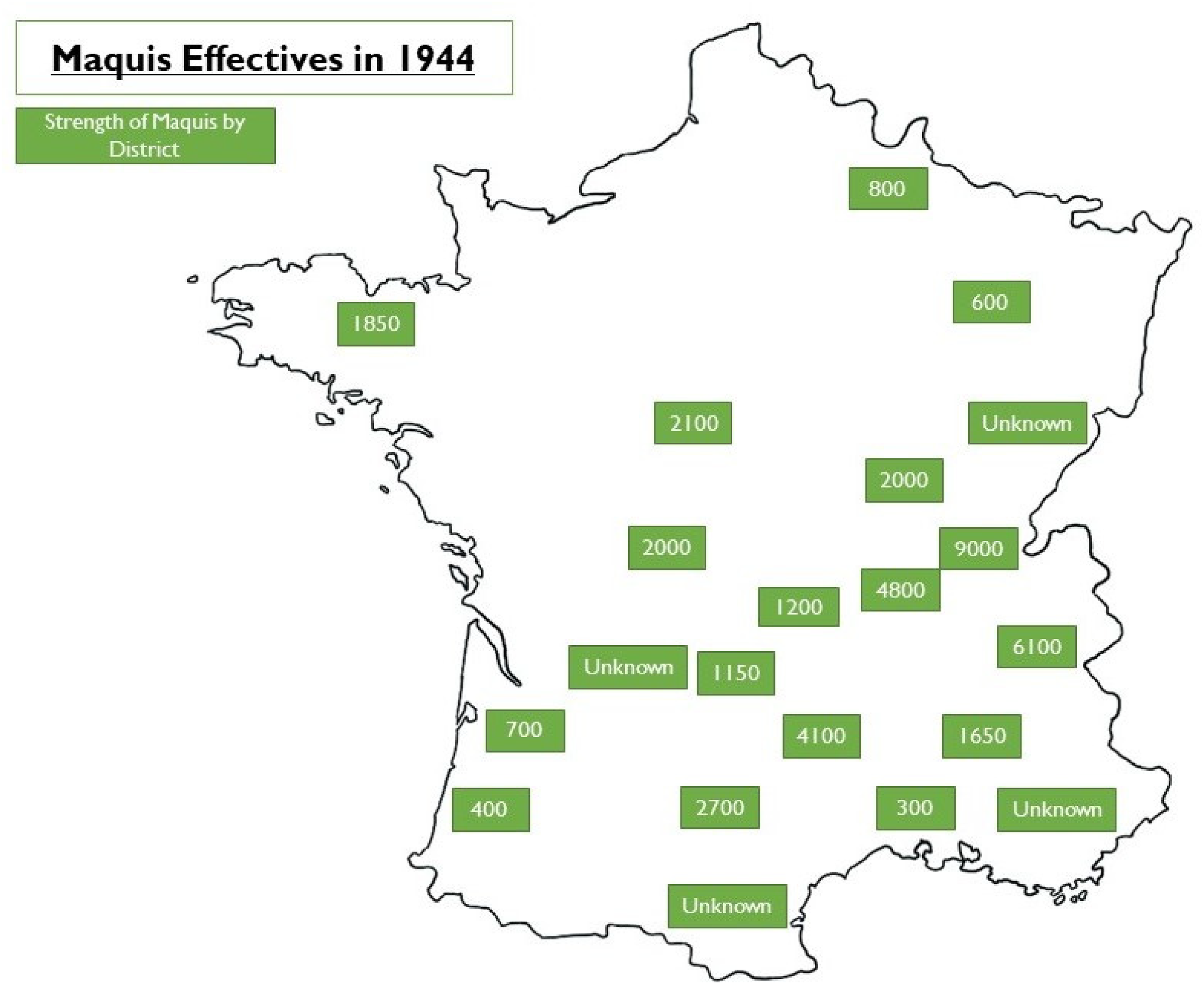
Maquis Effectives in 1944. Source: TNA, CAB 122/780, p.202, Illustration by the author
Having discussed the munitions that were provided to resistance forces and the relationship between the numbers of réfractaires and arms received in France, further investigation into the transportation of the despatched agents and the manner in which they arrived and left the occupied country will now be undertaken.
Pilots & Passengers
1419 Squadron was established at North Weald, with an initial contingent of three Lysanders, two Armstrong Whitworth Whitleys and two Douglas DC-3, but these were not yet exclusively for the use of the Special Operations Executive (S.O.E.).
23
The squadron soon moved to Stadishall and carried out their first special despatch operation during the winter of 1940 and 1941. The weather was a constant problem, hence sorties were minimal. Moreover, clandestine warfare was not viewed as being a high priority among those in Whitehall, as was made clear by Arthur Greenwood's report to the War Cabinet in June of that year:
24
On the assumption of guerrilla warfare, the chief and perhaps the only military need, would be to supply small arms and ammunition, the amount of which cannot be estimated.
American records show that the number of operations in 1941 was derisory, but the squadron needed somewhere to begin.
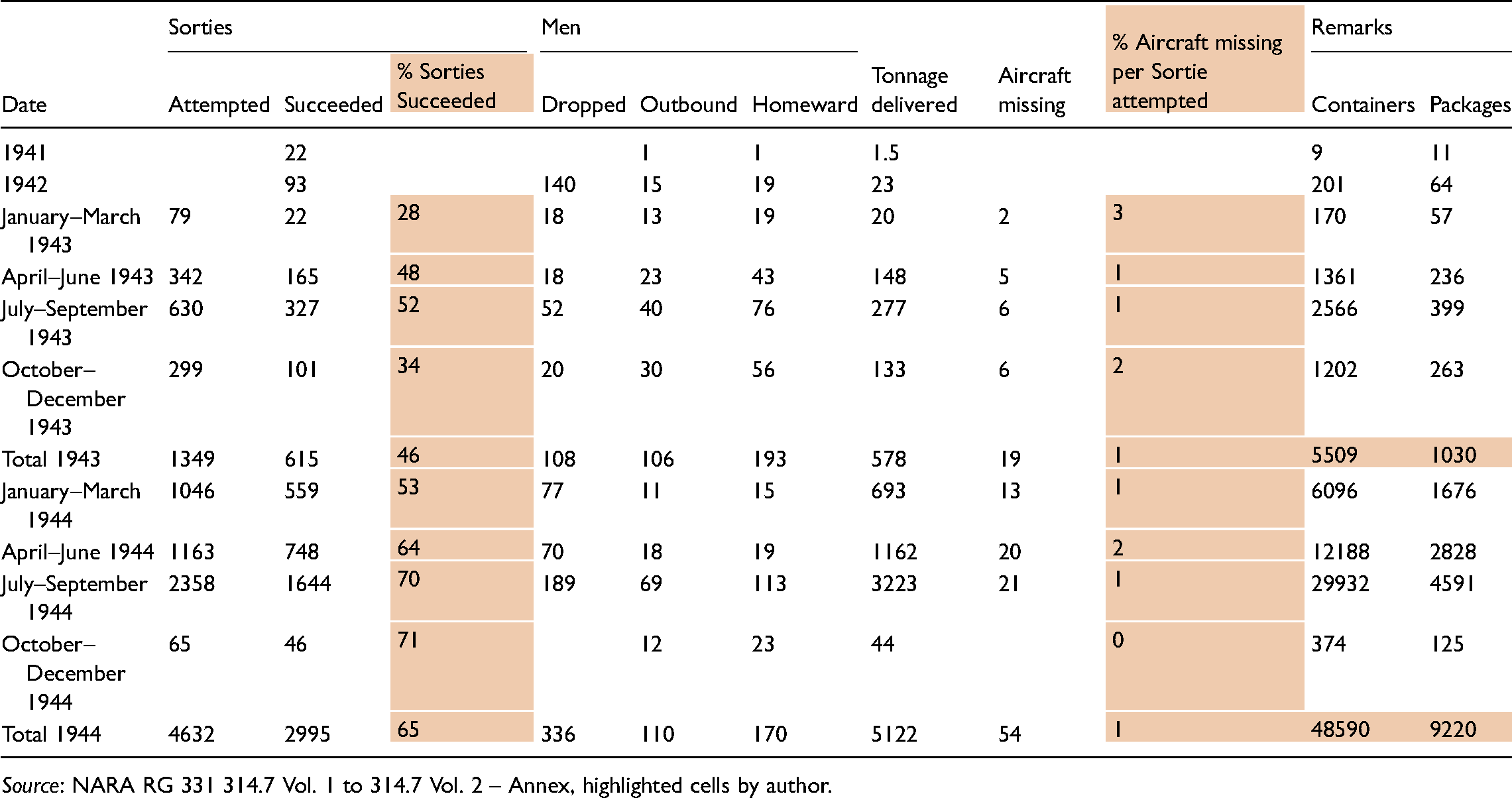
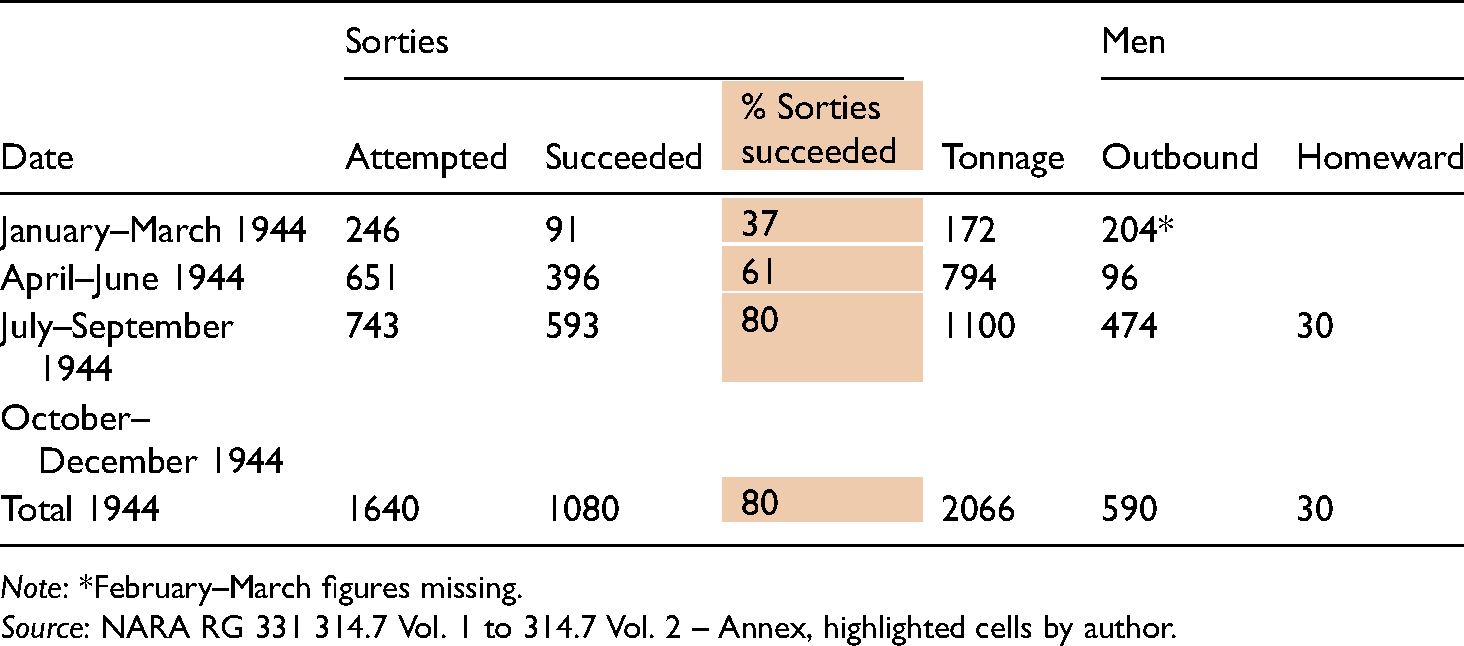
Effectively, Tables 2 and 3 show a multitude of different elements that are of interest to the understanding of clandestine warfare during the Second World War. Firstly, the differing rate of success for sorties undertaken by the R.A.F. into occupied France, from both Britain and the Middle East, can be seen. Data is not available for the number of sorties attempted and succeeded in 1941 or 1942. Nevertheless, from 1943, an increase in the efficacy of airborne missions that transported both agents and containers can be identified. There is a slight anomaly in the period ‘October to December 1943’, but this can be explained by the poor weather conditions, to which Group Captain Hugh Verity alluded, including fog and heavy cloud. 25 Overall, the trend steadily increased; from the totals of 1943 and 1944, a 41% increase in successful missions, over the course of two years, is shown. 26
Special Duty Operations to France undertaken by Aircraft Based in the U.K. – R.A.F. (From U.K., Including Pick-Up)
Source: NARA RG 331 314.7 Vol. 1 to 314.7 Vol. 2 – Annex, highlighted cells by author.
Special Delivery Operations to France undertaken by Aircraft Based in the Middle East – R.A.F.
Note: *February–March figures missing.
Source: NARA RG 331 314.7 Vol. 1 to 314.7 Vol. 2 – Annex, highlighted cells by author.
Due to the increasing demands for deliveries from France, the squadron given the responsibility for running missions from the Middle East, 624 Squadron, was increased in size. Subsequently, in February 1944, it was transferred to Blida in Algeria, in order to offer greater support to the resistance organisations in southern France. 27 These were reinforced by three American heavy bombers in March. The sorties effectuated by these aircraft are shown in Table 3 and demonstrate a similar pattern to those operating from England, albeit to a more limited degree. The total number of missions attempted were 1,640 with an 80% success rate. However, the number of agents taken into France were considerably greater, with 590 travelling into the country, as opposed to the 336 agents transported from the U.K. This shows that more supplies transited through the U.K. on their way to France, whereas more agents passed through Algeria.
Moreover, through increasing attempts to deliver supplies and to transport agents, this had significant negative consequences on the number of aircraft lost. In itself, this is unsurprising. However, it should also be underlined that the efficiency of R.A.F. flights from Britain increased over the course of the war. This is shown by the difference in losses experienced in two periods; for the period ‘October–December 1943’, wherein six aircraft went missing, a 2% loss of aircraft to the number of sorties attempted can be seen. By the period ‘July–September 1944’, despite increasing the number of flights nearly eight-fold, the rate of losses was held at only 0.8%. Clearly, this was contingent upon the course of the war. By July 1944, any air superiority on the part of the Luftwaffe over Western Europe had been comprehensively broken and the Allied invasions of Normandy and, from the south, Operation Dragoon (formerly known as Anvil), which was soon to begin, heralded the long-feared war on two fronts for the occupier. 28
Table 2 shows that the number of containers and packages sent into France was increasing greatly throughout the course of the war. This is a direct correlation to the augmented number of sorties that were being undertaken by the squadrons leaving from R.A.F. Tangmere and Tempsford. However, another consultation of Table 1 reveals that many of the containers packed by ‘Station 61’, in 1944, did not need to be used, in the end.
Containers Packed (A) and N° of Personnel Employed at ‘Station 61’ (B)
Source: NARA, RG 331 314.7 Vol. 1 to 314.7 Vol. 2, Part 1, Chapter II – Columns B and D are the author's calculations.
Furthermore, the original flight logs of the Lysander sorties flown by 161 Squadron, from February 1942 until the end of August 1944, have been studied 29 . During that period, a total of 235 sorties were undertaken, with 35 occurring in 1942, 139 in 1943 and 61 in 1944. The missions that were successful, and in which the pilots returned to their forward operating base, at R.A.F. Tangmere, numbered 158, or 67% of the total. Missions that were not completed, either due to the pilots not finding their target, in which crashes occurred, or which were cancelled owing to mechanical difficulties, numbered 73, or 31% of the total. Four flights, totalling two percent of the overall total, were unable to be classified as they were not able to be attributed as being either successful or incomplete. In some ways, these were the most surprising of all the Lysander missions for they were, in fact, Lysander bombing raids undertaken on sites in France. While the Lysander is generally seen as having been underpowered, slow and somewhat awkward to handle, it was also capable of carrying two 250 lb bombs and thus accompanied the squadron's Whitleys on raids over the week from Wednesday 24 June to the following Tuesday, 30 June 1942 30 . However, as these fell outside of the Flight's remit of ‘special operations’, the log keeper did not deem them successes or failures. The possible reason for the use of the Lysanders in such raids was the aeroplane's ability to slip through the cracks in the Atlantic Wall's anti-aircraft defences. However, as they were only used over the course of one week, it suggests that such missions were seen to be an inefficient use of highly specialised pilots and aircraft. During the 158 successful sorties, the pilots spent an average of 300 min in the air, equating to five hours of flying time. As the incomplete missions were often of far longer duration and the detail recorded in the logbook is often sparse concerning unsuccessful operations, these have been discounted. Furthermore, where it has been possible to calculate the time spent on the ground in France, the average turnaround time was just under seven minutes. Due to inconsistencies in the manner of writing the flight logs, the squadron's administrator only noted the turnaround timings on 29 occasions. For the remaining 129 successful missions, they neglected to do so.
Table 2 also shows the number of agents who were transported by pilots like Flying Officer McCairns and Squadron Leader Verity, which was Verity's rank at the time of flying. It is here that this work, once again, interacts with the articles of Smith and Kedward. Firstly, it must be reiterated that the totals are for the years 1943 and 1944. They do not, therefore, include 1941 or 1942. The three categories – ‘dropped’, ‘outbound’ and ‘homeward’ – respectively represent those who were sent in by parachute and those who were ‘outbound’ and ‘homeward’ represent those who were taken by Lysander or Hudsons either to or from the country. Interestingly, one of the largest periods for transfers occurred in 1942, with the despatch of 140 agents, by parachute, into France. It is unclear as to why the parachute jumps of 1942 should have been so numerous. One hypothesis is that it was the year in which much of the preliminary work for preparing future resistance actions needed to take place. By the end of the year, Marshal Pétain acquiesced to the Nazi policy of the Relève, wherein workers were taken from France in exchange for the release of a limited number of prisoners of war. 31 These actions encouraged numbers of predisposed youths to abscond and attempt to take up arms in isolated parts of the French countryside. The meteorological reasoning behind the low numbers of sorties in the final quarter of 1943 has already been mentioned. The change in the numbers of people being transported to and from France, in 1944, is mostly reflected in the increasing numbers of parachute drops, particularly in the period from July to September 1944, wherein 189 personnel were dropped into the country. This same trend was replicated in the number of people travelling both to and from France via landed aircraft.
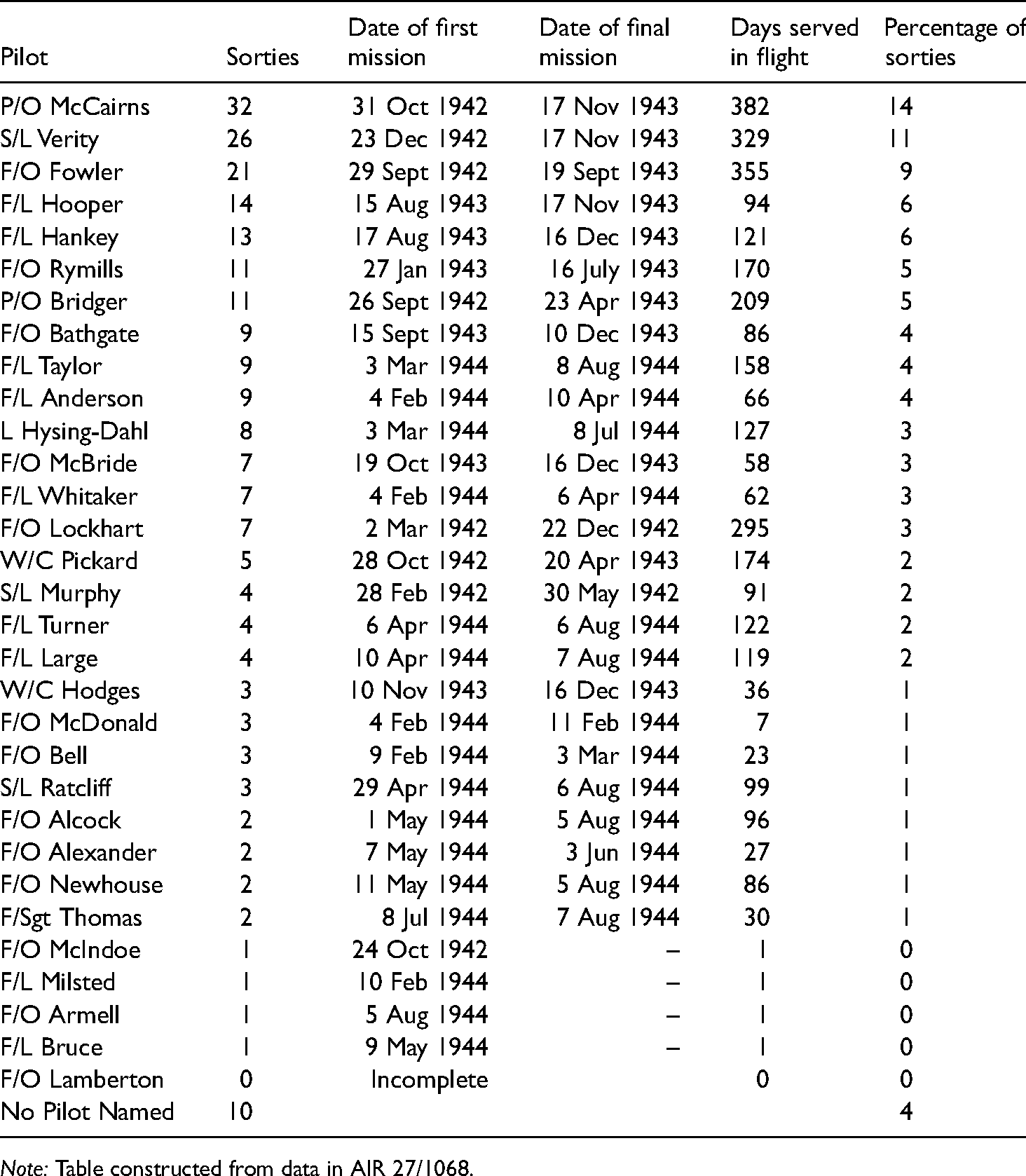
However, what about the men who flew the flights, and their passengers? Entry into the Lysander flight was fraught with difficulties. As they were involved in special operations, little was done to announce their existence to potential recruits. Due to the danger involved in their missions, they only wanted to welcome the keenest and most experienced pilots into their midst. In order to not risk generating negative morale among the pilots, they allowed those who did volunteer to drop out as soon as they felt it necessary to do so. Table 4 shows the 31 pilots who participated in the Lysander operations from February 1942 until the end of August 1944, the dates of their first and final missions, the number of days that they served and the percentage of sorties in which they participated. Pilot Officer McCairns was the most frequently deployed, followed by Squadron Leader Verity, hence their memoirs should be considered as being authoritative on the subject of 161 Squadron.
Table of Pilots in 161 Squadron (Lysander) between 28 February 1942 and 31 August 1944
Note: Table constructed from data in AIR 27/1068.
161 Squadron's Lysander training involved learning to fly an aeroplane that handled very differently to many others, notably with far stiffer controls to those to which they were normally habituated. 32 The landings necessitated great precision from the pilots, having to land in fields of about 250 m (270 yards) in length. Three lamps would be set up, signifying ‘A’, ‘B’ and ‘C’ points, in an inverted ‘L’ shape. The pilot would aim to the right of ‘A’ and slow down between points ‘B’ and ‘C’ before taxiing back to ‘A’. 33 As they had already flown for many hours, by this time, and were facing a return trip of a similar length, expecting German flak over the Normandy coast and Luftwaffe fighters, the routine had to become as close to flying-by-rote as was possible. 34
Inside the cockpit of the aircraft, there was barely room for three passengers, and entailed the third spending the entire flight on the floor.
35
The historian, Benjamin Jones, stated that four passengers were able to be carried.
36
While true, this was not a usual occurrence and only happened twice. Moreover, one of these four-passenger sorties involved the transportation of two children, during the mission ‘FLORIDE’ on 21/22 July 1944
37
. When required to pick up more than three passengers, it was generally the case that the squadron sent two aircraft, or one with a larger holding capacity. Nonetheless, while this ‘taxi’ journey did not resemble, in any way, the comfort of a Hackney carriage, it provided a lifeline for the clandestine passengers and for those who remained in France. In a form of poetic humour, the pilots wrote ditties in the ‘line book’, housed in the Tangmere Cottage, where the pilots and their passengers would rest and wait for their flight time. While these were undoubtedly written in jest, they offer an insightful view of clandestine life. One particular example, written by Flight Lieutenant (later Sir) Robin Hooper and entitled ‘As Others See Us’, explains about the international trading lines that were established by the pilots and the reception committees:
38
‘I’m the skipper of a Lizzie,
And I’m feeling pretty swell,
For the bottom tank's full of Chanel Cinq,
And the back, of best Martell.
I’m the skipper of a Lizzie,
My Joes roll up in cars,
And with glee they shout, as I hand them out,
Their coffee and cigars.
So Vive la France and Up Free Trade,
And long may it last, I hope!
For watches (Swiss) are a piece of cake (?)
For a chap who knows the ropes’.
(Sgd.) Chastity Weeke
The French reception committees provided perfume for the pilots’ wives, and alcohol was given for the airmen and their crews, back in Britain. In exchange, some pilots provided items that were difficult to acquire in France, scrubbed clean of any marks that may have given away their British provenance. 39 Otherwise, the pilots carried little on them. Standard escape kits that held ‘French money, a map of France printed on silk, a compass, fishing hook and line and some concentrated food tablets,’ were all that was permitted. 40 To carry more would have been virtually impossible, due to the limited space within the cockpit. The adverb ‘virtually’ has been employed as McCairns lists a slightly different carry-on, including a pistol and thermos, but the principle remains the same – space was incredibly precious in such a small aircraft. 41 Having covered the experience of the Lysander pilots, it would also be judicious to speak of the sentiments expressed by some of the French people who undertook these flights. However, far from suggesting that these flights were an exclusively masculine undertaking, women, including Cecily Lefort, Noor Inayat Khan and Diana Rowden, took the airborne ‘taxi’ service, too. ‘The only trace of nerves' that Vera Atkins, of Colonel Maurice Buckmaster's Section ‘F’, showed before her flight ‘was in a slightly trembling cigarette’. 42
Unsurprisingly, memories that the former resistance members held of their airborne experiences revolved around the cramped conditions of the cockpit. This was remarked upon by both Christian Pineau, the head of Libération Nord, and Henri Frenay, the leader of Combat. 43 Moreover, others, such as Colonel Remy, the nom-de-guerre for Gilbert Renault, remarked about their feelings of utter elation upon seeing the arrival of the pilots. Nonetheless, even he made the comment that he had the impression of ‘having a leg around his neck’, making reference to the cramped conditions. 44 This seems to have been a fairly universal sentiment when embarking. It is also what helped the aircraft and their pilots make as many individual flights as they did. It must be remembered that, whenever they had been able to get through the flak and anti-aircraft defences to arrive in France, the pilots would need to repeat the process again a few hours later. Had they been spotted on the outbound flight, the return journey would have been under heightened tension as the anti-aircraft forces on Hitler's Atlantic Wall would have been alerted to their presence. Richard Heslop, nom-de-guerre Xavier, was a member of Buckmaster's Section ‘F’. He gave a more detailed explanation of the aircraft's cockpit, describing how the passengers sat back-to-back with the pilot, conversing via the onboard intercom. 45 This activity seems to have been more of an English preoccupation, as the French passengers do not talk of conversations taking place with the pilot, presumably due to linguistic difficulties. This is with the notable exception of the ill-fated flight of de Gaulle's representative in occupied France, Jean Moulin. On 24 February 1943, when the Lysander carrying Moulin crash-landed, Verity offered his best attempts at excusing himself in the language of Molière. 46
In the next section, the places to where the Lysanders and Hudsons flew will be seen, in order to ascertain exactly where these pick-up missions occurred. The role that reception committees played in these missions will also be investigated.
Places & Porters
Thus far, only passing mention has been made of the Lockheed Hudson. The aeroplane was a ‘low-wing monoplane with two Wright Cyclone radial engines’. 47 Originally designed and built by Lockheed-Vega, it was intended to be a small passenger airliner but was quickly adapted by the military as a form of dual-purpose bomber and reconnaissance aircraft. 161 Squadron's Hudsons were further adapted by the removal of the rear-gun turret, so as to improve the aircraft's handling when performing manoeuvres at low speed. 48 Provision was made to allow the aircraft to despatch parachutists through the addition of a small floor hatch. The Hudson, as of its fifth iteration, began to use Pratt and Whitney motors. 49
Many of the flights left England via Beachy Head, near Eastbourne. McCairns explained that the channel crossing often used to take place near Cabourg, in Calvados. 50 From the flight logs, it is shown that the Cabourg route was used 41 times. The Lysanders, therefore, crossed 110 miles of Channel before hitting the French coastline. 51 It is likely that the Hudsons would have followed a similar flightpath, due to the pilots’ shared knowledge of the terrain, intelligence reports and the lower probability of meeting Axis resistance than were they to have attempted to cross at the Straits of Dover.
The following G.I.S. maps (Figures 4–6) were created using the software QGIS and data taken from Hugh Verity's book. By examining details about the geographical location of the fields, identifying their locations on Google Maps, harvesting their G.P.S. coordinates and putting them into a CSV file, the programme is able to create maps that depict both the location and frequency of landings that took place in both the Lysanders and the Hudsons. However, the maps do not show parachute drops as it would be impossible to plot the drop zones because the logbooks do not usually show their exact coordinates.
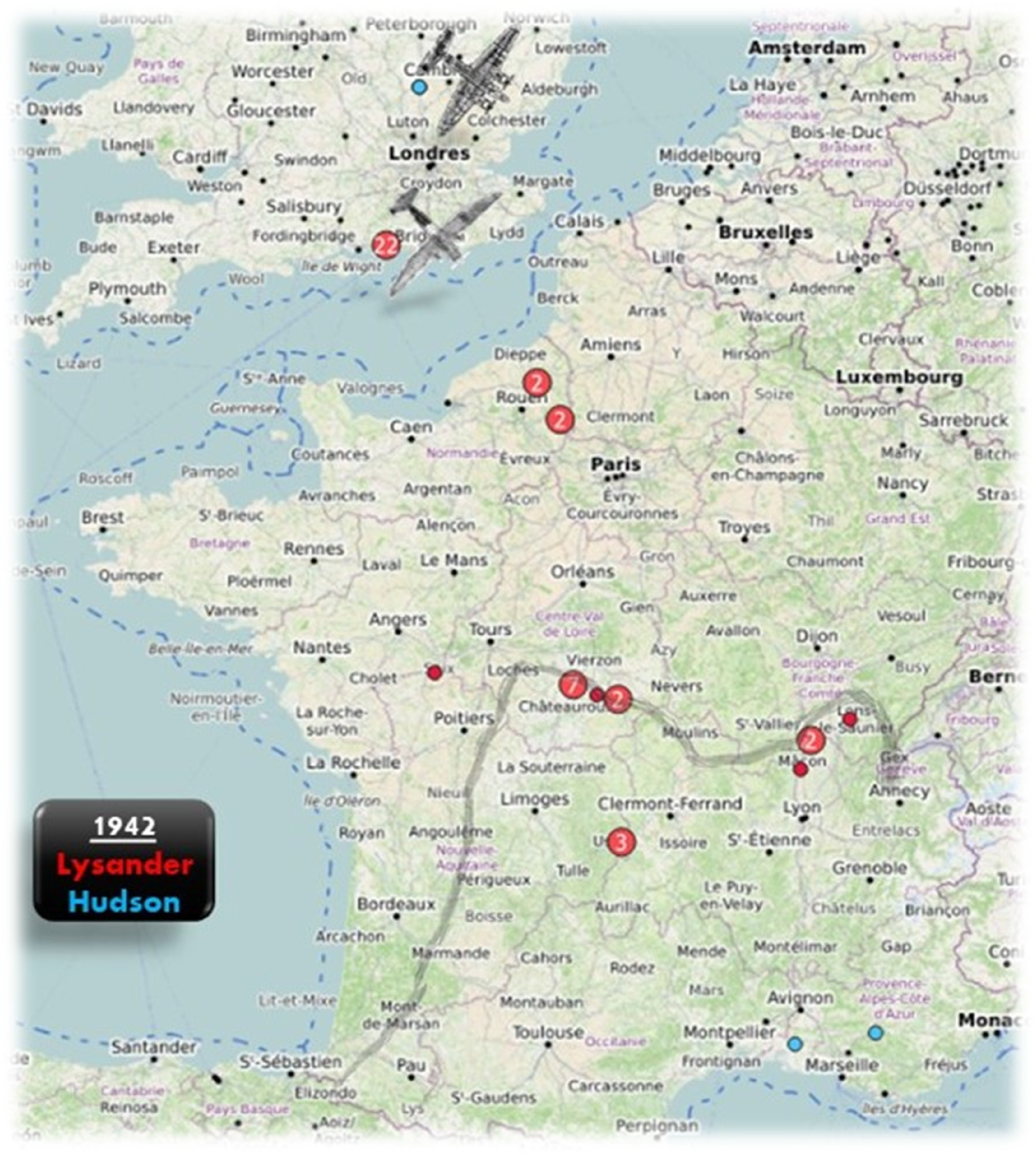
Lysander & Hudson Flights to France (1942) – Maps by the author based on data from Verity (2013)
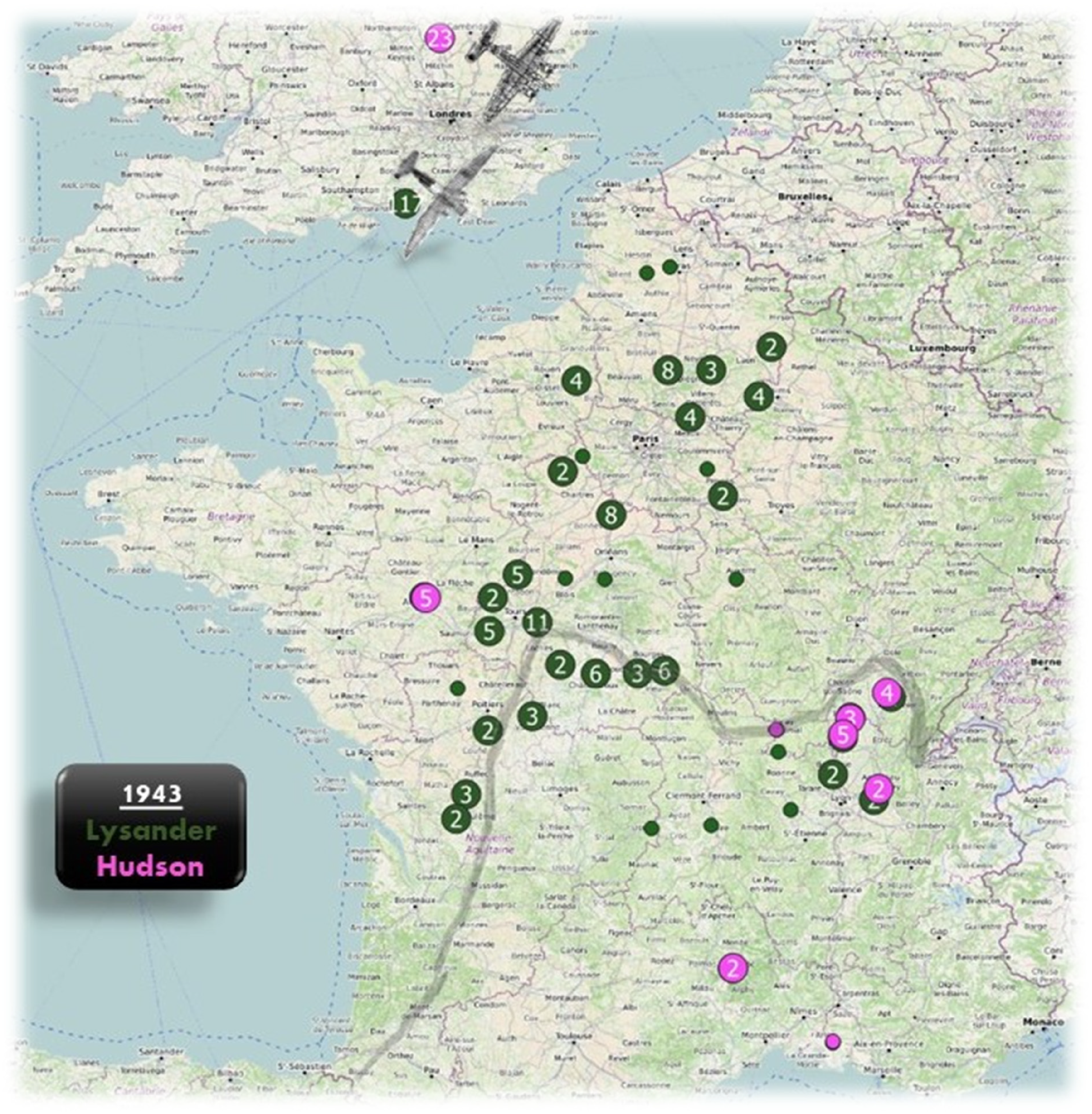
Lysander & Hudson Flights to France (1943) – Maps by the author based on data from Verity (2013)
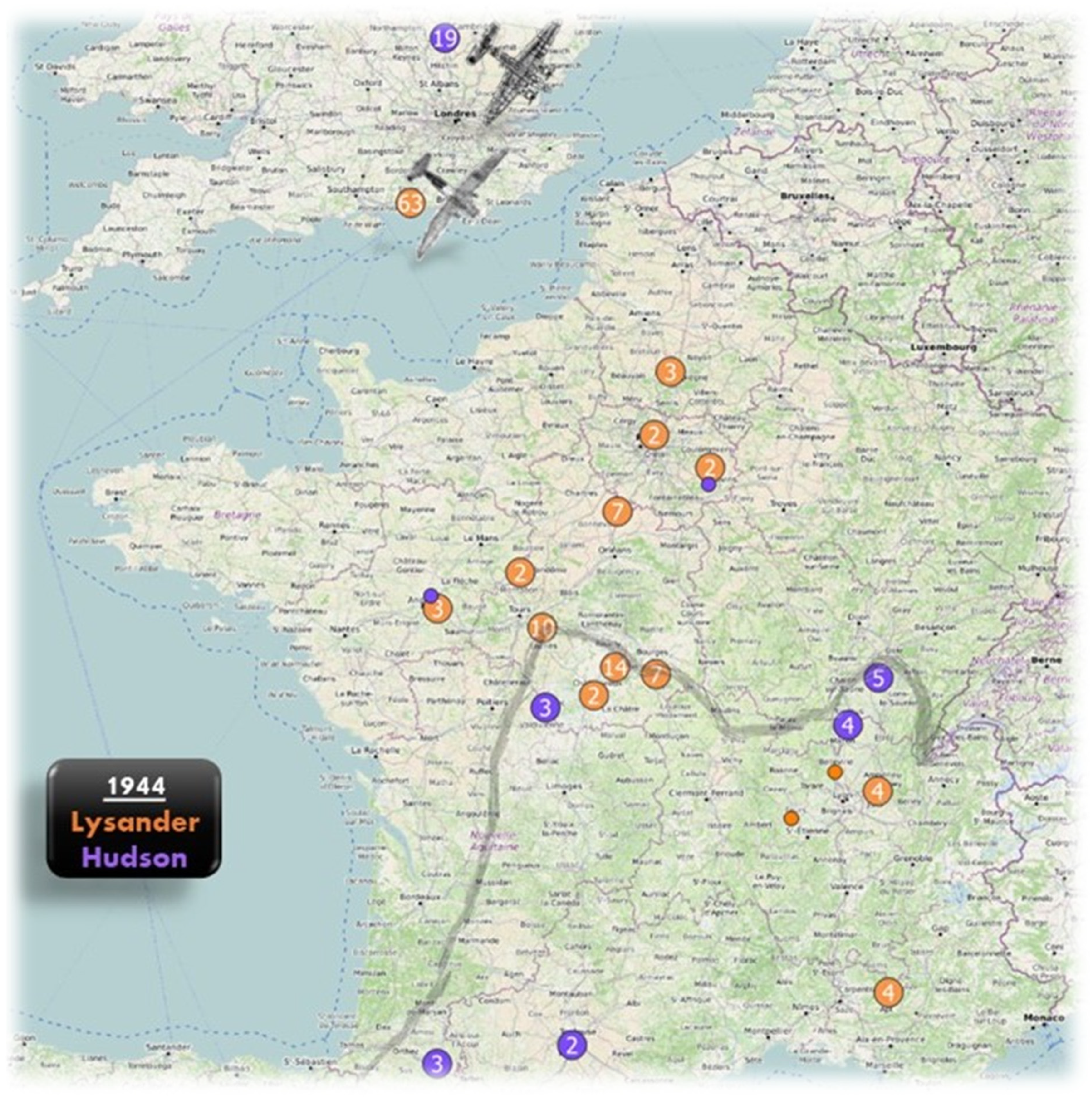
Lysander & Hudson Flights to France (1944) – Maps by the author based on data from Verity (2013)
Nonetheless, it must also be admitted that the maps have their own failings. For instance, in Verity's table, relatively little information is given. Instead, references that use relatively oblique markers are given, such as that of the ‘HALIBUT’ sortie, on the night of 13 April 1943, which explains that ‘Marguerite’ field was ‘NNE of Mâcon, 2.5 km NW of Feillens (01)’. 52 This is relatively imprecise. However, at the scale presented, this will make little difference to the overall effect of the map. Nonetheless, it would be amiss not to mention this unavoidable methodological issue.
The maps show the totality of metropolitan France, with the exception of Corsica, and the southern half of Great Britain. The two aircraft that can be seen represent the Lysander, in the south, and the Hudson, in Bedfordshire. The Lysanders were operating from their forward operational base at R.A.F. Tangmere, near Chichester. This allowed the aircraft greater access to larger areas of French territory than if the squadron had been operating from a base further to the north. This was due to the smaller fuel capacity available in the lighter of the two aircraft. The Hudson, being an airliner and military transport plane, had much greater fuel capacity, allowing the pilots to continue flying from their home base at R.A.F. Tempsford, near to Cambridge.
Figures 4–6 show a cartographical representation of the demarcation line. This was replicated from the maps available through the Bibliothèque national de France, using the software ‘ProCreate’ for the iPad. 53 It is, therefore, an accurate representation of the line as it was prior to November 1942. To the north and west, the territory was under the control of the ‘Militärverwaltung in Frankreich’ or Military Administration in France. To the south and east was Vichy territory and, for a very limited part around the border, the area that was under Italian control. With the aircraft landing maps being transposed with this demarcation line, it can be seen that many of the landings were, in fact, taking place in the occupied zone. Even as recently as 2019, French historians, including Douzou, Albertelli and Blanc, have posited that ‘…significantly, most S.O.E. agents sent to France arrived in the unoccupied zone, even when they had to operate in the occupied zone.’ 54 While they acknowledge that a certain number of agents did land in the occupied zone, a consultation of the above maps shows that this majority only existed during the year 1942, with nineteen landings taking place in the non-occupied zone, and five in the occupied zone. Following the successful Allied landings in French North Africa, codenamed Operation Torch, the German and Italian armies occupied the southern zone, thus rendering the entirety of the country under Axis military occupation. It can be seen that agents arrived, and left, from both sides of the line of demarcation. In fact, in 1943, there is a weak majority in the former northern zone, with 73 landings taking place, of the 140 landings effectuated. In all likelihood, this is due to the organisation of the Provisional Consultative Assembly, which began meeting at the behest of the French Committee of National Liberation (C.F.L.N.). The C.F.L.N. was the body that replaced the French National Committee, which had been the governing body for the rallied territories and the Free French between 1941 and 1943. The Provisional Consultative Assembly was constituted of representatives of the internal and external resistance movements, the French political parties and the rallied territories. 55 They met in Algiers during the period from November 1943 and July 1944. 56 In order to reach Algiers, where the Assembly was being held, the representatives for the internal resistance movement and political parties needed to be extracted from France in significant numbers and the Hudsons of 161 Squadron will have played a part in these operations. By 1944, the landings reverted back to the pattern initially shown in 1942 with more flights being landed in the former southern, Vichy-controlled, zone.
Hence, by using the map for 1942, patterns are already beginning to emerge. Firstly, the Hudsons were able to travel to sites in the south-east of the country, near to the French Riviera, close to Montpellier, Marseille and Avignon. Moreover, judging by the Lysander landings, it would appear there were three clusters of activity in 1942; around the centre of France, near to Vierzon and Bourges; around Lyon and, lastly, in the north-west, near to Rouen. This would become more pronounced as the years passed. The concentration of activity in central France is simple to understand; it is a heavily agricultural region, with relatively low population density, yet it allows easy access to urban centres, including Paris, as well as to Vichy. Fields are plentiful and, at the same time, there is much woodland, which would have served as cover for the special operations activities that were taking place. It can also be seen that the most heavily used landing site was at Ménétréols-sous-Vatin, near Châteauroux, in Indres.
The pattern continued into 1943 and, during this period, the greatest number of landings by Lysander and Hudson occurred. In the flight logs, 105 individual Lysander missions were undertaken. Verity records 112 Lysander operations being flown from Tangmere and 21 Hudson flights from Tempsford. The difference is due to Verity counting sorties by each individual pilot, whereas some missions included multiple pilots and planes participating. The 117 represented on the map is due to return trips being included for pilots who were killed or went missing in action. The reasons behind this increase in activity from 1942 was due to the growing imperative to provide a military framework to the burgeoning resistance activity in France and, secondly, because the special operations capabilities of the Allies were increasing. This was also reflected earlier, through the improvements seen in ‘Station 61’ packing facilities, in Table 1, and flight statistics from Table 2.
The majority of Lysander landings took place in a band that stretched from the Aisne area, near Laon, down to Charente, at Angoulême. The outlier areas were around Lens, closer to the Channel, and a small number of landings around Lyon and Clermont-Ferrand. A surprising element of the flights is that fields close to one another were used as landing grounds by both Hudsons and Lysanders. This can be seen in the Hudson landings at Soucelles and those by the Lysanders at Rives-du-Loir-en-Anjou. The two grounds are less than a kilometre apart. Moreover, this did not occur once, but on multiple occasions. Operational security concerns notwithstanding, this demonstrates that the landing grounds were ideal for the amount of traffic that was being transported to them. Moreover, it also suggests that there was a highly active resistance group operating in this area.
By 1944, while the number of flights had reduced, it is increasingly clear that the main landing grounds were in the central region of France, and specifically around the Lyon area. This is understandable as Lyon was a major centre of resistance activity. Equally, a ‘golden line’ has clearly emerged, in the area between Bourges and Châteauroux. Furthermore, it can be seen that the distance travelled by the Lysanders was generally shorter than those flown by the Hudsons. This remained the case for each of the three years that have been charted.
It is also important to discuss those areas which were not serviced by the Lysanders and Hudsons of 161 Squadron. Firstly, little activity was seen in the south-west of France. This was because of the heavy presence of German forces in and around the Bordeaux area. Resistance activity did occur in Aquitaine and was mostly under the aegis of the ‘Buckmaster’ networks, or those supported by Section ‘F’ of the S.O.E. 57 However, following the ‘Affaire Grandclément’, the networks in the region were effectively neutralised. 58 André Grandclément was a leader in the resistance movement Organisation Civile et Militaire (O.C.M.). 59 By 1942, Grandclément had risen through the ranks to become the head of the O.C.M. in region B, around Bordeaux. However, imprudently, he actively partook in the local nightlife and became known to be leading a resistance group in the area, thus becoming a target for the local head of police, Poinsot, and the region's S.D. or the S.S. Intelligence and Security branch, headed by Friedrich Dohse. Grandclément's network was discovered in July 1943 and 250 people were subsequently arrested. During his interrogation, Dohse played on Grandclément's fears of Bolshevism by underlining the risks of arming the local left-wing members of the Maquis. 60 In exchange for securing the release of some of the members, including his own wife, Grandclément agreed to hand over the arms caches hidden throughout the Gironde to Dohse. The confiscated weapons totalled around 945 containers, or nearly 2,000 Stens. 61 Using the figures from Table 1, this hoard represented 6% of all the containers that had been packed and shipped between 1940 and 1943! This effectively put an end to most organised resistance efforts in the area.
Furthermore, Brittany was too heavily protected, as a major constituent of the Atlantic Wall and any equipment that was needed would have been supplied by maritime routes, as was earlier suggested by Arthur Greenwood's report. The North-East had already been annexed into the Greater German Reich and so was not as easily accessible as other parts of France.
Conclusions
This article contributes to the comprehensive negation of the doggedly persistent discourse about the Second World War, at least on the British side of the Channel; that Britain and her imperial allies fought to liberate the world of Nazism ‘alone’. 62 Allied cooperation was extremely important to the continued execution of paramilitary and clandestine action in important theatres of operations.
The cartographic representations show the spread of such missions and are easily visualised. Despite the obvious caveats – namely that people travelled from far and wide to the landing sites in order to meet the incoming Lysanders and Hudsons – it is now possible to visualise the areas that were most propitious for welcoming the Allied airmen. Previously, this was not able to be done. This article has demonstrated the logistical operations of S.O.E. and the R.A.F. which helped to support resistance activity in France. In contradiction to aprioris, the most important year for clandestine transportation was 1943. This was encouraged by the necessity to prepare the ground, prior to the invasion. Furthermore, future work can be undertaken, specifically as to the American contribution towards these flights.
Ultimately, this work clarifies the findings and sentiments expressed by both Smith and Kedward, by demonstrating the work of 161 Squadron's Lysanders and Hudsons in a more cartographical manner.
Footnotes
Acknowledgements
The author warmly thanks Prof. Robert Gildea, Emeritus Professor of Modern History at Worcester College, University of Oxford, for his suggestions and insights during the conception of the present paper. The author accepts full responsibility for any oversights, and this should not reflect upon those mentioned above.
Declaration of Conflicting Interests
The author declared no potential conflicts of interest with respect to the research, authorship, and/or publication of this article.
Funding
The author received no financial support for the research, authorship and/or publication of this article.
