




Abstract
When Wuhan became the centre of Chinese resistance, the Kuomintang formulated a defensive strategy for the geography of the Central Yangtze. Without a coherent riverine defence doctrine, they were over-confident about the benefits of the terrain, causing a series of catastrophic blunders including the neglect of the intricate connections between ground and waterborne forces, the deployment of subpar troops for the defence of key fortifications, and the mistaken utilization of ‘drowned earth’ tactics. This article challenges existing narratives of the Second Sino-Japanese War and fills a gap in the current understanding of the defensive aspect of riverine warfare.
Keywords
I. Introduction
After the fall of Nanjing in 1937, Wuhan became the new centre for the war of resistance. Being the most industrialized and populous commercial city on the Central Yangtze, the defence of Wuhan persisted until October 1938 when Chinese troops were forced to abandon the city to the invading Imperial Japanese Army. After the fall of Wuhan, the Second Sino-Japanese War entered a stage of strategic stalemate where both sides were able neither to occupy nor reclaim any large area. Unlike the Battle of Nanjing where the riverine defence was ancillary, riverine operations were the principal aspect of the Battle of Wuhan. To resist the Japanese advance, the Kuomintang (KMT) formulated and deployed a defensive strategy based on the rugged riverine environment of Central China. As this article intends to show, despite the apparent soundness of this strategy, the Chinese defenders were over-confident about the degree to which the geography was favourable to them, and this led to a series of catastrophic blunders in riverine defence that cost them the campaign.
Riverine warfare is a special form of amphibious warfare defined by topographical features which encompass both land and water elements in a given area of operation. 1 The literature on amphibious and riverine warfare focuses predominantly on the offensive side and emphasizes the importance of the navy, neglecting the defending side and the role of land- and shore-based operations. 2 On the one hand, the study of riverine warfare in China shares many similarities with the historiography of amphibious operations in the Second World War. Historians have discussed how the development of Japanese amphibious capabilities was a significant part of the global ‘military innovation’ of the 1930s and 1940s. On the other hand, these analyses have generally focused on the battles in the Pacific, ignoring the place where the Japanese armed forces first tested their amphibious capabilities, the Yangtze, as well as how the Chinese forces dealt with this. 3 The important case of the riverine operations on the Yangtze during the Battle of Wuhan remains hitherto one of the largest riverine operations in history. The example of the Chinese riverine defence of the Central Yangtze is an illustrative example of how the riverine defence was conducted by a semi-industrial state facing an industrialized aggressor in a situation of total war, enhancing our understanding of the riverine aspect of amphibious operations in modern warfare.
The Battle of Wuhan, being one of the largest and most devastating campaigns of the Second Sino-Japanese War, has naturally attracted the attention of historians. Historians have written about Japanese atrocities there; the socio-economic, cultural, and political lives of Wuhan residents during this period; as well as international co-operation before and after the fall of Wuhan. 4 However, unlike the historiography of the Second World War in other theatres, the study of the Second Sino-Japanese War is characterized by a lack of developed operational analyses of the particular campaigns and battles of the war. 5 General accounts of the process of the Battle of Wuhan are insufficient for historians to reach a more accurate idea either of how KMT forces attempted to defend China or of the effectiveness of the Japanese military in terms of their invasion and occupation of China proper. Furthermore, general accounts tend to either underestimate the importance of the riverine environment or exaggerate the efficiency of the Japanese navy and therefore cannot be used as a bedrock for deeper theoretical analyses. 6 For instance, Hans van de Ven claimed that ‘the Japanese navy functioned in some way like a German Panzer force. It repeatedly broke through China’s defences along the Yangtze River and advanced beyond their infantry divisions . . .’. 7 This article contends that what happened was the exact opposite of what van de Ven describes. The Japanese navy was unable to penetrate the Central Yangtze without the support of Japanese ground forces. Finally, the existing literature relies overwhelmingly on published Chinese sources. While it is essential to build on Chinese sources, it is also important to balance and crosscheck these one-sided accounts with materials in other languages.
By examining materials in Chinese, English, and Japanese, the majority of which are untapped by previous authors, this article argues that the KMT’s defence of the key fortifications on the Central Yangtze including Madang and Tianjiazhen, in the absence of coherent riverine defence doctrine, relied too much on the terrain of the Central Yangtze valley and that this led to serious operational failures which compromised the defence of Wuhan. The article begins with an exploration of how the KMT organized its defences on the Central Yangtze and shows that the Chinese riverine defence was initially focused primarily against the Japanese navy. Then, the second part deals with how the KMT’s reflections on its failure in the Battle of Madang led to improvements in its riverine defence and yet failed. The third deals with a discussion of the KMT’s unconventional tactic of deliberately flooding the land by breaching the dykes along the Yangtze. The KMT repeatedly used ‘drowned earth’ tactic as a result of the lack of a coherent riverine defence doctrine and the idea of using ‘water as a substitute for soldiers’. 8 Finally, the article explains how the ‘drowned earth’ tactics compromised the Chinese defences in the battle for Tianjiazhen, the most important riverine defence fort on the Yangtze.
II. The Yangtze and Chinese riverine defence strategy
Chiang Kai-shek and the KMT leadership believed that Central China, the valleys of the Yangtze, and the river itself were crucial to the resistance. The Yangtze is the longest river in Asia. The Yangtze and its tributaries formed a network of riverine communications connecting the major political, industrial, and commercial centres of Shanghai, Nanjing, Wuhan, Changsha, Chongqing, and others. The Yangtze valleys were perhaps the most important agricultural areas in China and were also rich in strategic raw materials such as iron, wolfram, and oil. 9 Besides these factors, home to more than 100 million people, it was also the most populous region in China. 10 Although the Japanese had occupied the major cities of the lower Yangtze in late 1937, the rest of the region remained within the control of the KMT, meaning even after 1937 the Yangtze remained critically important. After the fall of Nanjing in December 1937, Wuhan became the de facto capital of China. As a major transport hub, it sheltered hundreds of thousands of refugees and countless factories that had been migrated from the coasts inland in the course of the war. From the perspective of Imperial Japan, conquering Wuhan was the ‘best chance’ to end ‘the China Incident’. 11
As China was faced with the Goliathan superiority of the Japanese military, the KMT formed the strategy of a ‘protracted war of attrition’. China needed time to relocate its coastal industry and retrain its troops. Therefore, the strategy of a protracted war of attrition aimed at exhausting Japanese forces and delaying or even halting their advance for as long as possible. 12 The KMT military leaders such as Chiang and Chen Cheng believed that the Yangtze would be the best place to fulfil this strategic aim. Hence, they formulated a defence strategy based on the geographical features of this region.
Instead of regarding riverine operations as integrated, KMT military officials treated riverine defences as composed of three separate elements: the army, the navy, and amphibious landing crafts. There was little discussion regarding the nature of riverine warfare among the Chinese military intellectuals before the Battle of Wuhan. 13 This is why they lacked a coherent riverine defence doctrine. The advice from German, Italian, and Soviet naval advisors formed the basis of Chinese riverine defence in countering the Japanese naval threat on the Yangtze. 14 Senior KMT military leaders such as Chiang, Chen, and Gu Zhutong did not understand that riverine warfare was an interoperable combined arms operation of both land- and waterborne forces. 15 They failed to appreciate that amphibious warfare in a riverine environment blurred the distinction between ground and naval operations. Ground troops were no longer bound to the land and could assault from and get supplied from the river, for instance by amphibious crafts. A breakthrough on one front could facilitate the other and ultimately neutralize the entire defence. Consequently, the KMT compartmentalized riverine defence so that it relied on the riverine environment of the Central Yangtze to deal with the Japanese army by conventional armies and the unconventional tactic of man-made flooding. The KMT defence strategy focused more on countering the Japanese navy because the Yangtze enabled Japanese naval movements, but disparaged the threat posed by landing crafts commonly associated with amphibious assaults.
The Chinese had long been convinced that the terrain of Central China would prove an advantage to them in their defence against Japanese ground forces. Central China’s terrain was defined by the Yangtze, a river which, enclosed by mountains, flows into the East China Sea through aggraded valley plains, lakes, creeks, and swamps. The riverine environment between the Dabie Mountains and the mountains south of the Yangtze formed a corridor with rough terrain. Forces passing this way to Wuhan faced an arduous march. The uneven terrain rendered Japanese mechanized divisions useless, forcing the Japanese troops to fight on foot. It was hoped that this fact would give the Chinese forces bunkered down in the mountains and behind city walls more time to prepare and would enable them to be in a better position to fire on the approaching Japanese ground forces. 16 The topography was expected to hamper Japanese large-scale ground manoeuvres and scatter them, reducing their fighting power. Unlike the North Plains where there was more space for the Japanese mechanized forces to manoeuvre, the mountains on both sides of the Yangtze constrained the battlefield, protecting the Chinese flanks. 17 Chen, perhaps the closest confident to Chiang, was the Commander of the Ninth War Zone and summarized the defence strategy thus: ‘to prolong the war by using the favourable terrain to exhaust and impose attrition on the enemy while annihilating small groups of enemies in some local areas’. 18 The belief in the utility of the terrain of the Central Yangtze heavily influenced Chiang’s decision to engage the Japanese in Shanghai in August 1937 and the decision to breach the dyke of the Yellow River in June 1938. 19
In the minds of the KMT military leadership, however, the main problem posed by the riverine environment was that it facilitated the movement of the Japanese navy. The Yangtze was a strategic problem since opened to foreign navigation, allowing seapowers to project influence into the Chinese hinterland from the Yangtze. 20 In the summer when the water level was at its highest, warships of up to 2,000 tons could reach Wuhan. Furthermore, the Japanese navy in the Yangtze had been a strategic threat for the Chinese since the Shanghai Incident of 1932 and had inflicted huge casualties on Chinese troops during the Battle of Shanghai in 1937. 21 To stop or delay the Japanese advance further into China, the KMT had to find ways to prevent the Japanese navy from moving upriver. 22 This did not mean that the Japanese ground forces were not considered a threat. The utility of the geography was central to the KMT’s calculations. If the terrain favoured defence against the Japanese army but was unfavourable for defence against the navy, the KMT would place greater emphasis on the effort against the navy accordingly. The focus on the Japanese navy was also because of the weakness of the Chinese navy. One tends to focus more on the threats against which one does not have the corresponding capacity to defend. The Chinese navy could not begin to compare with that of the Japanese. What was worse, the Chinese navy was plagued by cut-throat rivalries among different factions and was held in deep suspicion by the Chinese government. 23 Furthermore, in September 1937, the Japanese naval aviation force wiped out the bulk of Chinese surface vessels. Chen explained that ‘we have no navy. As a result, the Yangtze which should have been our natural barrier against Japanese invasion turned to benefit the enemy and forced us to deploy too many forces for defending the river front . . . which was ridiculous’. 24
Consequently, the KMT focused on destroying Japanese naval vessels on the Yangtze by deploying fixed riverine defence installations, namely, artillery batteries on the shores and barriers in the river. China built a series of fortifications along the Yangtze River in the mountains and established water barriers at Madang, Tianjiazhen, and Gedian.
Madang and Tianjiazhen were the most important ‘chokepoints’ of the Yangtze where the waterway suddenly narrows and is overlooked by hills and cliffs on the riverbanks. Madang was expected to withhold against Japanese onslaught for months, while Tianjiazhen was renowned for having never been captured by assailants for over a thousand years. 25 The KMT mobilized tens of thousands of labourers. For the materials of the barriers, the bricks of streets and houses were dumped into the river. The Chinese government and merchant marine sank 79 vessels of various tonnage, accounting for 33 per cent of Chinese shipping capacity. 26 On top of these obstacles sunk into the river, the navy laid thousands of naval mines in the waterways to damage any vessel which dared to sail in the Central Yangtze. 27 The Japanese navy described the countless mines like so many grains of ‘salt spilt’ across a table. 28 During battles, the barriers halted the advance of Japanese vessels. The batteries ashore, equipped with guns removed from sunken warships or imported from the Soviet Union, shelled the area to protect the barriers from attacks by Japanese gunboats and prevent minesweepers from disarming the naval mines.
In order to halt the Japanese advance, none of the barriers or batteries could be neutralized. If the barriers failed to block the waterways, the batteries would be in a tactically disadvantageous position. If the batteries were conquered, the barriers could be easily dealt with by explosives and minesweepers. Yet, believing that the hills and cliffs were advantageous to the Chinese defender, the KMT deployed incompetent armies to defend the forts from the Japanese ground forces.
In 1938, the Military Affairs Commission (MAC), the supreme governing body of wartime China, formed a specialized force for defending the Yangtze, the Riverine Defence Force (RDF, jiangfang jun). 29 The primary goal of the RDF was to stop the Japanese navy and deny the enemy the utility of the Yangtze. The RDF was commanded by General Liu Xing with Commodore Zeng Yiding serving as his deputy. It was a combined arms force consisting of infantry divisions, a few small vessels, artillery regiments, and fortress garrisons. Although China mobilized over 800,000 troops nationwide, the Central army was stationed in major cities such as Jiujiang and Nanchang or kept in reserves at locations too remote for timely counterattacks or reinforcement for the riverine defence operations. Instead, the constituent armies of the RDF were drawn from provincial armies of Hunan, Sichuan, and Guizhou. Their missions were to protect the batteries on the mountains along the Yangtze River and, as Chen emphasized, to guarantee the loyalty of the naval personnel operating the guns. 30 Because of supply and ammunition shortages, the armies of Chiang and his confidants naturally received the best and the most available supplies and ammunitions, whereas others like the RDF were woefully ill-equipped. 31 A German advisor commented that ‘the mortars and machine guns . . .were piles of scrap, and the usable rifles were less than half of the reported number’. 32 The RDF also had received little training on modern defence tactics. 33 However, they believed the mountainous terrain would serve to shore up their defensive capabilities against the far better-trained and equipped Japanese ground forces.
III. The fall of Madang and the re-evaluation of the riverine defence strategy
In late June 1938, the Japanese began to advance on Madang. In terms of the failure to defend Madang, historians tend to blame Li Wenhang for attending the graduation ceremony of a military training camp instead of mobilizing to defend against the Japanese landing. 34 However, this alone is not a sufficient explanation. Rather, the most important reason for the failure was the defending forces’ over-estimation of the advantages presented by the surrounding terrain.
The MAC could have deployed at least some of the troops from the Central army, but it left Fort Madang to the RDF believing that the terrain would compensate for their inferior fighting power. 35 Undoubtedly, the RDF at Madang was far from capable of halting the Japanese army on its own. Moreover, the defence against the landward front was deliberately neglected in favour of naval defences, as mentioned above. Nearly all of the artillery pieces were pointed towards the river front to defend the barriers. 36
Initially, the Chinese defence was effective. The Soviet air volunteers and Chinese riverine fortresses were able to suppress Japanese naval gunfire and prevent minesweepers and warships from sailing near the barrier at Madang, forcing the Japanese to change plans. Originally, the Japanese had envisaged that the navy would rapidly break through the Chinese barriers and that then the Hada Detachment specialized in amphibious warfare would occupy Jiujiang, cutting off communications between the two before occupying the weakened forts of Madang. 37 Because the fortifications and barriers were stronger than expected, the Japanese army had to take Madang first so that the minesweeper could operate more safely. With the batteries taken, it took about 20 days for the Japanese to make the waterway safe for Japanese water transport through Madang and cost five minesweepers and several other vessels including two Japanese warships and a landing craft full of marines. 38 Although the mines and batteries did not halt the Japanese navy, this was the battle where the most Japanese vessels were sunk, and delaying them and forcing them to change their plans to land their troops on a site further downstream. 39
However, the Japanese army exploited the weaknesses in the Chinese defences on the land fronts. On 24 June, the Japanese launched a stealth landing of 800 troops beyond the reach of the batteries in Madang. As there were very few artillery pieces prepared for ground attacks, the RDF was quickly overwhelmed by the superior firepower of the better-trained and equipped Japanese ground troops. 40 In less than three days, the Hada Detachment of the Japanese 11th Army occupied Fort Madang, and in 10 days the Japanese had occupied the other fortifications from Madang to Hukou. 41
More importantly, the riverine terrain became a nightmare for Chinese counterattacks, causing the strategy of relying on the terrain to compensate for their inferior military power to backfire. After the batteries were taken, the Japanese minesweeper cleared enough of the mines in the region to allow other Japanese ships to support further army operations on the shore. The Yangtze became a convenient path for Japanese logistics and manoeuvres, allowing Japanese troops to enjoy superior mobility and reduced fatigue. 42 Meanwhile, the Japanese-occupied hilltops were used to frustrate counterattacking Chinese troops. By contrast, without a comparable naval force, the Chinese troops could only move arduously on foot, trekking strenuously up mountains and around lakes and swamps. Even when the Chinese retook part of their territory and pushed the Japanese back to the riverbanks, Japanese troops could still be reinforced from the river while their warships inflicted heavy casualties on Chinese troops. 43
The fall of Madang within mere days was a shock to the Chinese government. The KMT military leadership had believed they could hold the Japanese army at Madang for months. The fall of Madang made them reflect on the utility of the terrain in their defensive strategy. Chiang reflected in 1938 that
Regarding the failure at Madang, I had to admit that it was mainly due to the problem of deployment . . . the terrain is very favourable to us, so we believed that some marines, fortress garrisons and a few infantry divisions were enough. We believed that they were enough to defend Madang for two or three months if they could fight heroically as the troops did in Shanghai in 1937. However, because of our overreliance on topography and fortifications, we overlooked the importance of deploying the appropriate troops, deploying government armies to strengthen the defence of the fortifications. Consequently, the enemy discovered and attacked the weak point.
44
After the fall of Fort Madang, the MAC began to address their neglect of the landward front. In July 1938, the MAC noted, ‘the enemy always used its army to achieve a breakthrough on the landward front and then took the fortifications from the rear or flanks. After that, the navy moved slowly to clear the obstacles in the river’. 45 The MAC believed that the Japanese would most likely repeat this tactic to conquer the rest of the riverine forts.
The reflection was monumental but limited. First, it emphasized the importance of the landward front in the defence of the forts. The MAC began to replace the RDF with the better-trained and equipped divisions drawn from the Central army, including three of Chen’s best divisions commanded by Whampoa Military Academy alumni. 46 From then on, the defence of the Yangtze was entrusted to the Central army, which succeeded in putting an end to Japanese movement westward in 1943. This adaptation drastically improved the riverine defence operation prior to the Battle of Tianjiazhen. Yet, not all forts completed the adaptation in time.
On the contrary, the KMT’s obsession over the benefit of the riverine environment persisted. The MAC believed that China could defeat Japan as the Turkish had defeated the British landing in Gallipoli, meaning through the strategic use of terrain by capable commanders and brave troops.
47
Chiang wrote in his diary,
I’ve read the chapter on terrain in Sun Tzu’s ‘The Art of War’. The enemy had now entered a treacherous terrain, a trap we had set. The enemy knows they could defeat our troops, but they do not know that the terrain does not allow them to achieve that. Therefore, the enemy will definitely lose.
48
Worse still, it did not alter the underestimation of the threat posed by Japanese amphibious capabilities. The MAC concluded that ‘in lake and swamp warfare, the enemy had no advantage’. 49 It ignored that the advanced amphibious capability of the Japanese army could compensate for or even take advantage of the riverine environment. This mindset contributed to Chiang’s reckless decision to breach dykes for the defence of Tianjiazhen, ignoring objections from subordinate commanders. Before the Battle of Tianjiazhen began, Chiang told his senior generals that Madang was his ‘utter humiliation’ and his ‘great regret’. 50 Yet, more was soon to come.
IV. More ‘drowned earth’
When Chiang said to use ‘every inch of territory including hills and creeks for military purposes’ as ‘the greatest weapon’, he meant literally to use the terrain to compensate for the military inferiority of the Chinese defenders. 51 The KMT used an unconventional tactic of breaching the dykes of the river to stop the advance of Japanese troops. 52 The KMT’s ‘drowned earth’ tactics at the Huayuankou dyke on the Yellow River in June 1938 has been well studied. 53 The immense sacrifice in North China was effective militarily, as it did halt the Japanese advance and forced them to fight upriver along the Yangtze River where the Chinese forces believed that they would have a better chance of winning.
However, Huayuankou was not the only place where the Chinese defenders harnessed the power of the river for military purposes. In fact, during the Battle of Wuhan, the Chinese forces broke multiple dykes along the Yangtze for tactical purposes, such as the dykes near Jiujiang, Wuxue, and Xiaochi. Unlike the flood of the Yellow River, using the Yangtze to undermine the Japanese advance was counterproductive. The Yangtze flood briefly neutralized facilities that might be used against the Chinese troops by the Japanese and slightly reduced the mobility of the Japanese infantry (Map 1). However, the reduced mobility of the Japanese infantry was compensated for by their amphibious supply and reinforcement operations. Furthermore, it compromised the Chinese encirclement effort because the Chinese could not envelop the Japanese by water due to the inferiority of their naval forces. Worse still, it undermined the ability of the Chinese to defend positions by exposing their flanks and rear to amphibious assaults by Japanese forces.
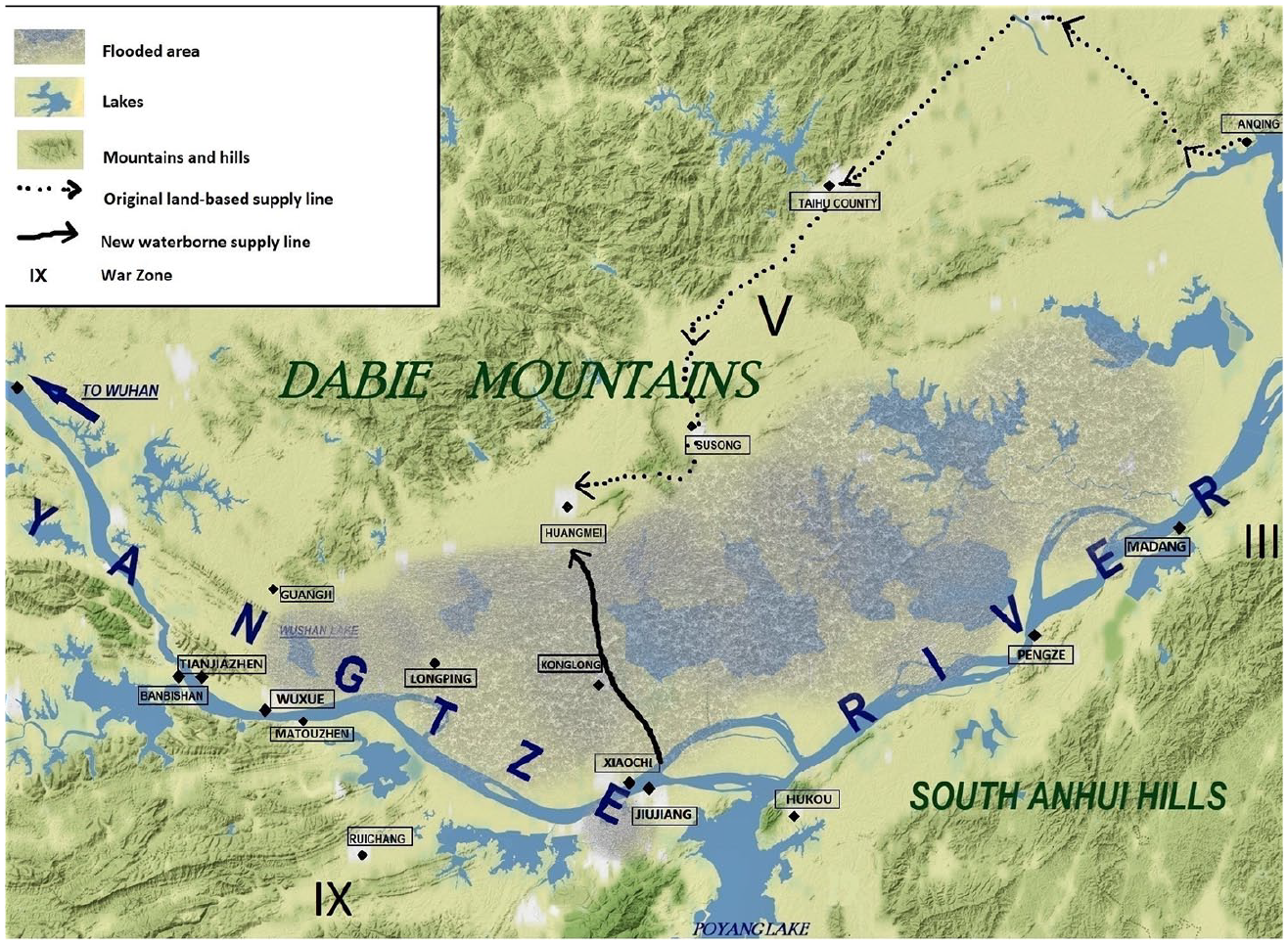
Map of the Yangtze flood.
Chiang’s enthusiasm for using ‘drowned earth’ tactics to stop the Japanese advance was based on the idea of utilizing the riverine environment to compensate for the military inferiority of the Chinese army. The terrain of the Central Yangtze was believed to nullify the Japanese advantage in weaponry to a large degree. However, terrain alone was not enough to completely stop the Japanese army unless the region became completely inaccessible. Causing an artificial flood rather than using conventional military forces to stop the advance of enemy armies was not alien to the Chinese military tradition. 54 Chiang repeatedly emphasized that ‘the battlefield is either mountainous or covered in water, negating the advantages of the enemy’s weaponry. So, we should pay attention to utilise flooding when it is favourable to our military operations’. 55 Meanwhile, the strategic impacts of breaching the dykes of the Yellow River were encouraging. 56 In summer 1938, the heavy rain led to the rise of Yangtze’s water level, making artificial flooding possible. Despite the fact that the flood could facilitate the operations of Japanese landing crafts, Chiang and many high-level commanders were convinced that the crafts were ‘easier to deal with’. 57
The decision to breach the dykes was also the result of the government’s mentality towards the lives of individuals as expendable. 58 The KMT was more than willing to inflict great suffering on the local population, neglecting that they were then less likely to contribute to the war of resistance after coming under Japanese occupation. 59 Once the decision regarding the Yellow River had been made, dyke-breaking became a characteristic technique of the KMT for the duration of the war.
The first attempt was made in Anqing. On 10 June, a day after the order to breach the Yellow River, Yang Sen, the commander of the garrison stationed in Anqing, received instructions from Chiang to ‘sabotage the Anqing airfield as quickly as possible, and make it a lake inaccessible to Japanese troops and “aircrafts.” Breach the dykes in the east and west to stop the enemy advance’. 60 But Yang refused, arguing that it would be devastating to the livelihood of a densely populated region of approximately 80,000 households. He noted the attempt would be rejected by the local population. 61 Chiang replied furiously that ‘now is the critical moment for the survival of our nation, you should do whatever it takes’ and stressed that if there were resistance from the civilian population, ‘do not be confused by the locals . . .’ 62 But the Japanese did not allow enough time and occupied the Anqing airfield the next day. The occupation of the Anqing airfield increased the ability of the Japanese air force to operate farther inland. After the occupation, shorter range Japanese bombers were able to reach Chongqing. 63
The absence of a coherent riverine defence doctrine resulted in an equally incoherent attitude towards ‘drowned earth’ tactics among KMT military leaders. Low-level commanders, especially those who were in charge of the defence on the ground, had detailed awareness of the terrain, how it might be used by the Japanese, and sometimes hands-on experience with defending against amphibious assaults. They were, therefore, reluctant to implement ‘drowned earth’ tactics. Conversely, high-level commanders’ battlefield awareness was based on reports, many of which stated that Japanese landing crafts moved unescorted and could be easily opposed. 64 Therefore, high-level commanders were more enthusiastic about the use of ‘drowned earth’ tactics. For instance, Liu Xing and Zeng Yiding, both of whom had combat experience against Japanese riverine assaults in the Battle of Nanjing, raised their concerns to Chiang that the breach of the dykes of the Yangtze would in effect facilitate the movement of smaller Japanese vessels. 65 However, encouraged by the effectiveness of the ‘drowned earth’ tactics at the Yellow River, Chiang looked favourably on using similar tactics on the Yangtze. In addition, Chiang was also encouraged by the riverine defence forts’ ability to sink smaller vessels a few days before the Battle of Madang. On 24 June, Chiang replied, ‘We must flood all areas where it might be beneficial to our army operations. Do not worry too much about enemy motorboats, because they are easier to destroy . . . .’ 66
Chiang was not alone in supporting the ‘drowned earth’ tactics without due regard for Japanese amphibious capabilities. Gu Zhutong, the commander of the Third War Zone, also instructed his subordinates to breach the dykes opposite Anqing to form an obstruction of 20 km2. He did this ‘to reduce the number of troops needed’ for defence and even argued that, if the enemies landed, ‘they could not advance quickly’. Ironically, he suggested spreading the propaganda that ‘the Japanese breached the dyke to facilitate rubber landing crafts’. 67 Luo Zhuoying, a close friend of Chen and commander of the 19th Army Group (Central army), believed that using small landing crafts was ‘precarious adventure’ for the Japanese and could be dealt with ‘calmly’. 68
In July 1938, Zhang Fakui conducted the first successful breach of a Yangtze dyke in Jiujiang. Just before the fall of Jiujiang in late July 1938, Zhang ordered the breach of the nearby dyke to cover the retreat route of the Chinese army and to inundate the Jiujiang Airfield and the Jiujiang-Ruichang highway. 69 The water of the Yangtze submerged the airfield and the highway, denying the Japanese forces’ use of the infrastructure and granting more time for the Chinese troops to retreat to safety. However, the same flood blocked the residents of Jiujiang city from fleeing westward. Consequently, approximately 90,000 fell victim to Japanese atrocities. Worse, although the Japanese could not use the airfield for supplies and communications, within three weeks Japanese engineers had built a new airfield in Fuxingzhen on the other side of the Yangtze River, north to Jiujiang. 70
Perhaps the most damaging effort of the breaching of the dykes was just before the Battle of Tianjiazhen. After the fall of Xiaochi on 25 July, Li Pinxian, the Deputy Commander of the Fifth War Zone, ordered his forces to breach the Yangtze dykes at Longping to block the Japanese advance. Li Pinxian did this because he feared that the Japanese troops south of the Yangtze River would move from Xiaochi to support the Japanese troops at Susong or would attack Tianjiazhen. 71 The Commander of Fort Tianjiazhen raised the concern that the Japanese boats might use the flood to attack Chinese defenders’ flanks and rear. He argued that the swampy rice fields in the region could achieve the same effect without facilitating Japanese amphibious crafts. 72 Yet, his report did not change the determined minds of his superiors whose eyes were fixed on the Japanese army. 73
On 27 July, the Chinese troops stationed in the north side of the Yangtze started breaching the dykes at Longping and Wuxue. By late August, after continuous efforts, the water level was between 3 and 5 m deep from the east of Tianjiazhen to Susong. Almost all land between the Dabie Mountains and the Yangtze River became a flood zone, including the town of Konglong, leaving only some hilltops and rooftops above water level. The flood displaced over 500,000 people. An area of approximately 3,000 km2, including 660,000 mu of farms, became utterly waterlogged. No land transport was possible between Xiaochi and Huangmei. 74
Zhang Zhili, a survivor of the flood, recalled,
On 31 July, I had a quarrel with my wife over when to harvest rice and ran to the dyke. I heard the sounds of an explosion. The shock was so strong it knocked over some houses . . . I saw the water of the Yangtze rushing to my village. Everyone was scared and ran to higher ground . . . Houses, furniture, bedding, clothes and food were all submerged in the water. The ground became a lake and the villages became a part of the river . . . The ‘Shibapeng’ flood emergency react team saw the water rise and thought there was a breach of the Yangtze River dyke. So, they gathered a hundred men, lanterns and torches to fix the dyke. However, they were stopped by the soldiers and were forced to dig another breach at the dyke. Villagers in the region closer to the Dabie Mountains were harvesting rice against the speed of the flood. Only those rice fields on relatively higher ground survived the flood.
75
The Chinese had breached the dykes of the Yellow River and the Yangtze. However, the floods had different results. First, the terrain was different. The Yellow River generally flows above the land from Zhengzhou; therefore, the breaking of the dyke practically unleashed the full volume of the water onto the central plain spread across a vast area. On the contrary, the Yangtze flowed between mountainous terrain, valleys, and lakes. With each dyke breached along the Yangtze, the flood was confined to only a limited area. Second, the water itself was different. The Yellow river loess, silt, and sediment concentration is much higher and is mixed with central plain farm soil creating a sticky mud. This made it difficult for motorboats to operate and too shallow for large vessels. The water of the Yangtze is much clearer and far more navigable. 76 Moreover, the Japanese military forces were familiar with the operational environment of the Yangtze, since they had surveyed the region and planned for operations before the outbreak of the War. 77
The breaching of Yangtze dykes had no significant impact on Japanese operations. Japan did not postpone its plans as expected by the Chinese leaders and military observers. 78 The difficulties which resulted from the flood were quickly overcome by the Japanese forces. Ironically, the flood, on many important occasions such as the fall of Tianjiazhen, became a natural aid to the Japanese.
V. The fall of Tianjiazhen
After the fall of Madang, Tianjiazhen became the most important barrier to the Japanese advance. Tianjiazhen was the last chokepoint between the Japanese forces and Wuhan. The narrowest distance between the two banks was about 600 m. There were mountains on both sides. The steep slopes and cliffs formed a natural barrier against invading forces from the east. These mountains were less than 10 km from the southern tip of the Dabie Mountains. There was no better terrain for defence further west. Based on the topography, the Chinese built positions and fortifications to stop the advance of the Japanese. 79 Ultimately, the fall of the Tianjiazhen was primarily due to the flood unleashed by the Chinese (Map 2).
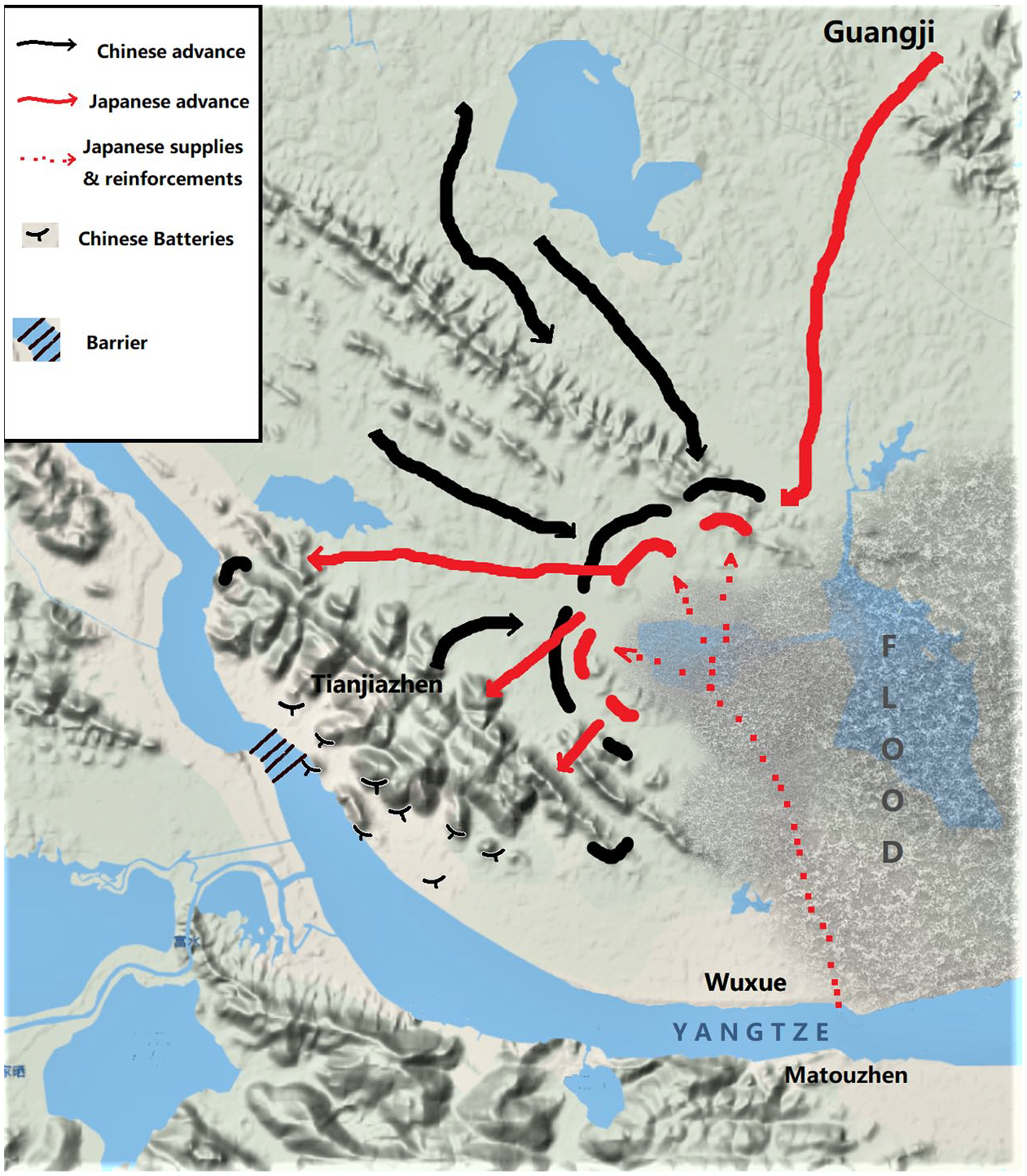
The Battle of Tianjiazhen.
The MAC reinforced the defending forces with better-trained and equipped armies from the Central army including three of Chen’s best divisions. 80 Both the commanders of the armies and all of the division commanders were graduates from the Whampoa Military Academy. These forces had combat experience against the Japanese landing in Shanghai. As a result, the defence of the landward front was drastically enhanced without reducing the efficacy of defences on the river front.
The Japanese navy fully appreciated the difficulties they would face in attempting to conquer Fort Tianjiazhen directly. As previous experiences in Jiangyin and Madang had shown, overcoming the batteries on the mountains and clearing the mines in the river were perilous and painstaking operations. Therefore, the Japanese Imperial General Headquarters decided to attack Tianjiazhen by land instead. 81
Before the flooding of the area, the Japanese troops relied on land transport which was costly, inefficient, and constantly subject to harassment by Chinese guerrillas. Having fought in a harsh environment for more than a year, the Japanese were experiencing supply problems. Japanese operations usually had to halt to wait for further supplies. There were two major supply routes. From a supply depot in Anqing, a portion of the supplies would be shipped along the Yangtze River to the front. This waterborne supply route was not completely secure, but it was more efficient and economical. Chinese troops used mobile artillery to fire at the vessels and lay mines in the Yangtze, but the Japanese escort gunboats suppressed Chinese fire with ease. The other from the depot was travelled by horses and a small number of lorries from Anqing to Susong. The approximately 200-km-long route was close to the south side of the Dabie Mountains where Chinese troops repeatedly launched counterattacks to retake the counties and conducted guerrilla operations against the supply line. To protect this route, the 6th Division of the Japanese Army deployed half of its troops to the occupied region. The forces that the Chinese tied down left the Japanese without enough forces to conduct offensives against Tianjiazhen. 82
Ironically, the flooding caused by the breaching of the dykes facilitated Japanese logistics and freed these troops tied down along this southern, land-borne route. After the Japanese occupied Jiujiang, the city replaced the original supply depot in Anqing. By 2 August, the Japanese north of the Yangtze took the counties south of the Dabie Mountains along the highway connecting these counties. When Huangmei was occupied, it became a forward base. With the help of the ‘drowned earth’ tactic, it became easier for the Japanese navy and army waterborne supply troops to carry supply from the sea to the Jiujiang depot and then to supply Huangmei, where the flood had reached the city wall. 83 The distance between Jiujiang and Huangmei was about 40 km, cutting the distance of the supply route from the nearest depot by nearly 75 per cent. Moreover, this change of the supply route freed Japanese forces formerly tied down for its defence to push further west. On 6 September, the Japanese took Guangji. The flood did not block the road completely from Huangmei to Guangji, but the Japanese swung further north near the foot of the mountains and hence bypassed the flooded area entirely. 84
Because of the flooding, the Chinese defenders were unable to encircle the Japanese troops. In late August, the Japanese began advancing towards Tianjiazhen. Soon, the Japanese broke the Chinese defence lines defended by the Guangxi army. Following previous successes in taking Chinese riverine fortresses from the land, the Japanese Sixth Division complacently assumed that they could take Tianjiazhen within a week and prepared supplies accordingly. The operations started smoothly, but two days later weather conditions worsened and disrupted infantry-artillery-air coordination. Chinese fortifications, including barbed wire, pillboxes, and trenches, slowed the Japanese advance. More importantly, the Chinese defenders replacing the RDF from the Central army were better trained and supplied than their predecessors and were able to conduct small-scale but successful offensive operations against the Japanese, such as in an attack against the enemy flank and rear. On 18 September, the Japanese forces were surrounded by the Chinese troops on three sides. 85 However, the Japanese east flank was protected by the flood zone as the Chinese lacked the capacity to conduct amphibious operations, thwarting the encirclement effort.
The ‘drowned earth’ tactics, intended to halt the Japanese advance, in effect accelerated it by providing safe passage for Japanese supplies and reinforcements. While the Japanese army was trapped, the Japanese navy slowly moved further up the river but was stopped by Chinese batteries at Matouzhen. Batteries equipped with old Russian guns produced in the 1910s were able to suppress Japanese naval gunfire, but after Japanese ground troops captured Matouzhen, the Japanese navy was able to pass through. 86 When Matouzhen fell, Japan enjoyed an undisrupted riverine line of communication from Shanghai to Wuxue and the flooded land enabled a water transport route to the entrapped Japanese forces. On 23 September, Okamura Yasuji, the Commander of the Japanese Eleventh Army who would later become the Commander-in-Chief of the China Expeditionary Army, sent a fleet of iron boats with the help of the Japanese Third Fleet carrying food, medicine, and ammunition to the trapped troops who had barely eaten for four days. 87 The Japanese troops, resupplied and revitalized, resumed their attack on the Chinese positions. Meanwhile, the Chinese reinforcements moving on foot failed to reach the front because the terrain encumbered their mobility. The Chinese side crumbled in front of Japanese night attacks and surprise attacks, while the mountains and lakes blocked the routes for Chinese flanking manoeuvres. 88
The fall of Tianjiazhen was devastating to the Chinese resistance. Tianjiazhen alone had withstood and delayed the Japanese advance for almost a month. Before the fall of Tianjiazhen, the Japanese were only able to advance a few hundred metres a day. 89 After the fall of Tianjiazhen, the speed of the Japanese movement surged to almost 10 km a day towards Wuhan, during which the Japanese army bypassed Gedian. Wuhan was occupied by the Japanese Sixth Division within four weeks of the fall of Tianjiazhen. 90 This was a sign that the crumbling defence of the Chinese was no longer capable of holding out against the Japanese onslaught until the Chinese troops retreated to Yichang, a city on the Yangtze about 400 km upstream of Wuhan. 91
The well-trained and better-equipped troops of the Central army performed much better than the warlords’ armies had in Madang. The fall of Tianjiazhen was the result of the underestimation of Japanese amphibious capabilities. The troops of the Central army almost encircled the Japanese forces and were able to hold the fort longer than all previous riverine defence forts, and they were able to do so even after the arrival of Japanese reinforcements. However, the improvements made after the failure in Madang were negated by the use of ‘drowned earth’ tactics. Because of the flooding, the Japanese forces were freed from the harassment of Chinese guerrillas and were able to concentrate on the operation to take Tianjiazhen. The flood also prevented the Japanese forces from being encircled and annihilated. The ‘drowned earth’ tactics not only hindered Chinese military operations but also facilitated Japanese supply operations. Consequently, the fall of Tianjiazhen was added to Chiang’s list of ‘great regrets’. 92
VI. Conclusion
As Carl von Clausewitz authoritatively wrote, ‘defense is the stronger form of war’ and ‘the benefit of terrain’ produces ‘decisive advantages’. 93 Yet, KMT’s over-reliance on terrain had cost them the defence of Wuhan. Convinced that the terrain would greatly hamper the Japanese army but benefit the navy, the KMT military leadership initially focused more on defence against the Japanese navy and hence deployed subpar troops to defend the landward front. After the fall of Madang, Chinese forces enhanced their defensive capabilities against Japanese ground assaults, but the improvements were ultimately nullified by the unforeseen consequences of the ‘drowned earth’ tactics.
As a kind of warfare defined by the topography of a battlespace, riverine warfare necessitates the exploitation of the setting of operations. Belligerents with inferior conventional military capabilities intuitively try to utilize geographical features of a region to compensate. However, theoretically sound strategies could backfire. Exploiting the potential benefits of a battle space’s terrain depends on the methods of belligerents and their capacity for using it. The Chinese defenders correctly believed that the riverine environment would pose difficulties for the movement of the advancing Japanese army and reduce the efficiency of the mechanized force but failed to realize the same terrain could be a strategic and logistical nightmare for Chinese reinforcements and counterattacks as well. Because Japan possessed advanced amphibious capabilities, the Japanese forces took advantage of the Yangtze and the artificial flooding unleashed by the Chinese ‘drowned earth’ tactics. Without such capabilities, the Chinese forces were victimized by their own home turf.
Riverine warfare may not be one of the types of operations which favour the defender. Riverine operations are combined arms operations that require systematic coordination and cooperation among different arms and services. This applies not only to the attacker but also the defender. The defender must excel at not only riverine but also landward defence. For the attacker, a breakthrough on one front could be easily exploited and hence the entire defence can be overcome. Furthermore, the hybridization of conventional defensive tactics and the unconventional ‘drowned earth’ tactics was not a cohesive and automatically optimized system of defence where different elements of the operation work together to enhance the others and enhancing the system as a whole. The employment of unconventional tactics, if not coordinated well enough with other aspects of the operation, could undermine the overall military effectiveness of a riverine defence strategy. Therefore, as evidenced by the KMT’s inability to defend the Central Yangtze, riverine defence should treat the landward front and the river front as a whole and avoid the compartmentalized approach that divided amphibious assault into army, navy, and small riverine crafts without considering the connection and interoperability among them.
Finally, the Battle of Wuhan shows the importance of a coherent riverine defence doctrine to the adaptation of military strategy during wartime. Without common intellectual foundations, preparing for the next battle by addressing the mistakes of the previous operations relied on ‘learning on the job’. Yet the experience gained and lessons learned under the extreme pressure of active combat varied at different levels of command. Frontline commanders learned from actual combat, whereas high-level commanders usually contemplated on telegrams and reports. In wartime, there is little time for internal debates to form a coherent approach to a particular threat. Adaptation under the KMT military culture was top-down and heavily was dependent on the will of the high-level commanders. 94 Consequently, while the KMT was able to address the problem of underestimating the landward front after Madang by reinforcing it with troops from the Central army, it failed to halt the ‘drowned earth’ tactics because Chiang and other senior commanders mistakenly believed in its efficacy.
Footnotes
Acknowledgements
The author would like to thank Mr Wang Jia-shian for his help with materials and Mr Thomas Burnham at the University of Oxford for his comments and suggestions on earlier drafts.
Funding
The author(s) received no financial support for the research, authorship, and/or publication of this article.

1
Richard Meyer, ‘Riverine Warfare in the Indochina Conflict’ in Bartlett Merrill, ed., Assault from the Sea: Essays on the History of Amphibious Warfare (Annapolis: Naval Institute Press, 1983), pp. 360–5.
2
Kevin Rowlands, ‘Riverine Warfare: Exploiting a Vital Maneuver Space’, Naval War College Review 71(2018), pp. 53–69; Blake Dunnavent, Brown Water Warfare: The US Navy in Riverine Warfare and the Emergence of a Tactical Doctrine, 1775-1970 (Gainesville: University Press of Florida, 2003); General accounts on defence against amphibious attack see, Theodore Gatchel, At the Water’s Edge: Defending against the Modern Amphibious Assault (Annapolis: Naval Institute Press, 2013). Gallipoli was the most well-studied case for amphibious defence, Jenny Macleod, Gallipoli (Oxford: Oxford University Press, 2015); Tim Travers, ‘The Ottoman Crisis of May 1915 at Gallipoli’, War in History, 8(2001), pp. 72–86.
3
Allan Millett, ‘Assault from the Sea: the Development of Amphibious Warfare between the Wars, the American, British, and Japanese Experiences’ in Military Innovation in the Interwar Period, eds. Williamson Murray and Allan Millett (Cambridge: Cambridge University Press, 1996), pp. 50–95; Edward Drea, In the Service of the Emperor: Essays on the Imperial Japanese Army (Lincoln: University of Nebraska Press, 1998), pp. 15–40; Douglas Ford, ‘Brute Force or Combat Finesse? The Evolving Role of Firepower in US Amphibious Operations against the Imperial Japanese Forces, 1941–1945’, War in History 23(2016), pp. 341–61.
4
Stephen MacKinnon, Wuhan, 1938: War, Refugees, and the Making of Modern China (Oakland: University of California Press, 2008); Guo Daijun, ed., Chongtan Kangzhan Shi: Cong Kangri Dazhanlue de Xingcheng dao Wuhanhuizhan [Revisiting the War of Resistance: from the Formation of the Grand Strategy of the War of Resistance to the Battle of Wuhan], 1931-1938 (Taipei: Jinglian Chuban Gongsi, 2015); Ao Weiwen, Hubei Kangrizhanzheng Shi [The History of the War of Resistance against Japanese Aggression in Hubei] (Wuhan: Wuhan University Press, 2006); John Garver, Chinese-Soviet Relations, 1937-1945: The Diplomacy of Chinese Nationalism(Oxford: Oxford University Press, 1988), pp. 30–73.
5
Yang Kuisong, ‘Kangrizhanzheng Yanjiu Liying Zhongshi Zhanzhengshi Yanjiu’ Kangrizhanzheng Yanjiu, 25(2016), pp. 22–5.
6
Hans van de Ven, War and Nationalism in China: 1925-1945 (London: Routledge, 2003), pp. 226–9; Stephen MacKinnon, ‘the Defense of the Central Yangtze’ in The Battle for China: Essays on the Military History of the Sino-Japanese War of 1937-1945, eds. Mark Peattie and Edward Drea (Stanford: Stanford University Press, 2011), pp. 181–206
7
van de Ven, War and Nationalism in China, p. 226.
8
This article borrows the term ‘drowned earth’ from Diana Lary, ‘Drowned Earth: The Strategic Breaching of the Yellow River Dyke, 1938’ War in History, 8(2001), pp. 191–207.
9
Yang Zihui ed, Zhongguo Lidai Renkou Tongji Ziliao Yanjiu [China Historical Population Data and Relevant Studies] (Beijing: Gaige Chubanshe, 1995), pp. 1318–20.
10
Wang Chengzu, Benguo Dili [Chinese Geography] (Shanghai: Guangming Chubanshe, 1939), pp. 90–8; Shiyebu [the Ministry of Basic Industries], Zhongguo Jingji Nianjian [Statistical yearbook of Chinese Economy], (Shanghai: Shangwu Yinshuguan, 1934), pp. 429–50.
11
Xu Yong, ‘Jindai Riben zhi Yangzijiang Kuozhang jiqi Zhanzhengguihua Zaiyanjiu’ [Revisiting the Japanese Militarist Expansion in the Yangtze Valley and its War Planning]’, Junshilishi Yanjiu 29(2015), pp. 1–15.
12
Guo Daijun, Chongtan, pp. 458–60.
13
Kwong Chi Man, ‘Intellectual officers, professional journals, and military change in the Northeast and National Revolutionary Armies, 1928–1937’, Journal of Modern Chinese History, 11(2017), pp. 180–208.
14
Ortwin Rave, Changjiang Yaosai Jianyue Baogao ji Gailiang de Jianyi [Reports on the Inspection of the Fortifications on the Yangtze and Recommendations on the Improvement], February 1934, 787–2182, the Second Historical Archives of China, Nanjing (SHAC); Fabio De Ninno, ‘The Italian Navy and Japan, the Indian Ocean, Failed Cooperation, and Tripartite Relations (1935–1943)’, War in History, 27(2020), pp. 224–248.
15
Chen Cheng, Chen Cheng Huiyilu: Kangrizhanzheng [Memoirs of Chen Cheng: The War of Resistance] (Shanghai: Dongfang Chubanshe, 2009), pp. 57–61.
16
Canmoubenbu [the General Staff], Zhongguo Zhongbu Guojun Zuozhan Jihua [the Central China National Revolutionary Army Operational War Plan], 1934, 787–2124, SHAC.
17
Guofangbu Shizheng Bianyiju [History Bureau of the Ministry of Defence], Kangri Zhanshi: Wuhanhuizhan [History of the Sino-Japanese War: the Battle of Wuhan], (Taipei, 1962), pp. 11–3.
18
Cheng, Chen Cheng Huiyilu, p. 58.
19
Mackinnon, Wuhan, 1938, pp. 35–6.
20
Alfred Mahan, The Problem of Asia and its Effect upon International Policies (Boston: Little, Brown and Company, 1900), pp. 99–100.
21
Georg Wetzell, Zhongguo Zhongbu Fangyu Jihua [Central China Defence Plan], 1932, 787-1973, SHAC; van de Ven, War and Nationalism in China, p. 214.
22
MAC, Jiangfang Jun Fangyu Jihua [The Defence War Plan of the Riverine Defence Force], 1938, 787-3482, SHAC.
23
HT Baillie-Grohman, Report on the Naval Mission in Nanking, ADM1/8765/133, the National Archives, Kew.
24
Cheng, Chen Cheng Huiyilu, p. 60.
25
Henri de Fremery, ‘Report. 13’ in Ger Teitler, Bernd Radtke eds., A Dutch Spy in China: Reports on the First Phase of the Sino-Japanese War, 1937-1939(Leiden: Brill, 1999), p. 220.
26
Huang Zhenya, ‘Jianzao Shuinichuan: Zuse Tianjiazhen Hangdao Shimo’ [Building Cement Ships: Stories of Blocking the Waterway at Tianjiazhen], Wuhan Wenshi Ziliao, 26(2006), pp. 36–8.
27
Haijunzongbu [Naval Command Headquarters], Tianjiazhen Bulei Zuse An [Naval Mines blockade at Tianjiazhen], 1938, B5018230601/0027/935/6040, the National Archives Administration, Taipei.
28
Bōei Kenkyushō [Institute of Defence Studies], Chūgoku Hōmen Kaigun Sakusen (2) [The Naval Operations in China] (Tokyo: Asagumo Shinbunsha, 1975), p. 21.
29
MAC, Jiangfang, 1938, 787-3482, SHAC.
30
Chen Cheng to Chiang Kai-shek, 13 March 1938, Chiang Kai-shek papers, 002-080200-00495-150, Academia Historica, Taipei (AH-JZZ).
31
Wuhan Weisu Geshi Renma ji Zhuyao Wuqi Qicai Shuliang Dianchabiao [the Table of the Personnel and Weapons of the Wuhan Garrison Command], May 1938, Chen Cheng’s papers, 008-010701-00026-002, Academia Historica.
32
Gu Zhutong to Chiang Kai-shek, 17 July 1938, 002-020300-00011-035, AH-JZZ.
33
Du Longji, ‘Madang Yaosai Changshan Zhendi Baoweizhan [The Defence of the Changshan Positions in Madang]’, Wuhan Wenshi Ziliao, 28(2008), pp. 30-4.
34
Ke Yufang, ‘Wuhan Huizhan Madang Hukou Zhanyi Lunshu [On the Battles of Madang and Hukou]’, Minguo Dang’an, 32(2017), pp. 93–102.
35
de Fremery, ‘Report. 12’ in Teitler, A Dutch Spy, p. 214.
36
Bai Chongxi to Chiang Kai-shek, 25 June 1938, 002-080200-00497-194, AH-JZZ.
37
Hada Detachment and the 6th Division later became the core of the 48th Division that participated in the landing operations in the west Pacific, including the Philippines and the Dutch East Indies. See, Fujii Hisanshi, Teikoku Rikugun Shidan Hensen-shi [History of the Imperial Army Divisions] (Tokyo: Kokushokankōkai, 2018), pp. 115–213.
38
Kenkyushō, Chūgoku Hōmen Kaigun Sakusen (2), pp. 25–7.
39
Shina Jihen Sakusen-Chō B2 Yōsukō Hōmen Sakusen [China Incident, Operations on the Yangtze Front], s13.1.1~s13.11.30, Senshi-Shinan Jihen-113, the National Institute for Defense Studies, Ministry of Defense, Tokyo (NIDS).
40
Hada Shitai Yōsukō Sojō Sakusen Bukan Kōryakusen Sentōkeika no Gaiyō [General Operation Report of Hada Detachment Operation Moving-up Yangtze of the Battle of Wuhan] S13.5.22~13.11.11, Shina-Shinajihen Bukan-386, NIDS.
41
Bōei Kenkyushō, Shina Jihen Rikugun Sakusen Shōwa: Jūshinen Kyōgatsu made [Army Operations during the China Incident: until September 1939] (Tokyo: Asagumo Shinbunsha, 1976), pp. 112–4.
42
Bianyiju, Kangri Zhanshi, p. 113.
43
Gu Zhutong to Chiang Kai-shek, 1 July 1938, 002-020300-00011-035, AH-JZZ.
44
Chiang Kai-shek speech, 9 July 1938, in Xian Zongtong Jianggong Sixiang Yanlun Zongji [The Collection of Chiang Kai-shek’s Speeches] (YLZJ), vol. 15 (Taipei: Zhongyang Dangshi Weiyuanhui, 1984), p. 345; similar conclusion but in harsher words in Chiang Kai-shek speech, 28 August 1938, YLZJ, pp. 452–4.
45
MAC, Baowei Wuhan zhi Jiangfang yu Lufang [The Riverine and Land Defence for Wuhan] July 1938, National Library of China, Beijing (NLC); MAC, Jiangfang Jiantao [Riverine Defence Review], May 1939, 777-117, SHAC.
46
Guo Rugui, Zhongguo Kangtizhanzheng Zhengmian Zhanchang Zuozhan [The History of the Regular Operations during the Second Sino-Japanese War] (Nanjing: Jiangsu Renmin Chubashe, 2005), p. 829.
47
MAC, Baowei Wuhan, NLC.
48
Chiang Kai-Shek’s Diaries, 31 August 1938, Hoover Institute Archives, Stanford, CA (CKSD).
49
MAC, Baowei Wuhan, NLC.
50
Chiang Kai-shek speech, YLZJ, vol. 15, pp. 454–5.
51
Chiang Kai-shek speech, 2 July 1938, in YLZJ, vol. 15, pp. 119–22.
52
Lary, ‘Drowned Earth’, pp. 196–9.
53
Micah Muscolino, The Ecology of War in China: Henan Province, the Yellow River, and Beyond, 1938–1950 (Cambridge: Cambridge University Press, 2014), p. 60.
54
Historical examples in Ralph Sawyer, Fire and Water: The Art of Incendiary and Aquatic Warfare in China (Oxford: Westview, 2004).
55
Chiang Kai-shek instructions, 19 July 1938, 787-3038, SHAC.
56
Muscolino, The Ecology of War in China, pp. 23–4.
57
Chiang Kai-shek to Chen Cheng, 24 June 1938 in SHAC, ed., ‘Wuhanhuizhan Changjiang Juekou Shiliao [Historical Materials Relating to the Breaching of the Dykes of the Yangtze River during the Battle of Wuhan]’(JKSL), Minguo Dang’an, 19(1994), p. 20
58
Rana Mitter, China’s War with Japan, 1937-1945: The Struggle for Survival (London: Penguin: 2013), p. 157.
59
Cheng, Chen Cheng Huiyilu, p. 50.
60
Chiang Kai-shek to Yang Sen, 10 June 1938, 002-020300-00011-018, AH-JZZ.
61
Yang Sen to Chiang Kai-shek, 11 June 1938, 002-090106-00013-197, AH-JZZ.
62
Chiang Kai-shek to Yang Sen, 11 June 1938, 002-090106-00013-197, AH-JZZ.
63
Kenkyushō, Chūgoku Hōmen Kaigun Sakusen (2), pp. 20–1.
64
For instance, Xue Yue to Chiang Kai-shek, 9 April 1938, 002-090200-00036-242, AH-JZZ.
65
Liu Xing to Chiang Kai-shek, 19 June 1938, ‘JKSL’, p. 20.
66
Chiang Kai-shek to Chen Cheng, 24 June 1938, in ‘JKSL’, p. 20.
67
Gu Zhutong to Chiang Kai-shek, 25 June 1938, 002-080200-00283-052, AH-JZZ.
68
Luo Zhuoying to Chiang, 2 July 1938, 002-080200-00284-003, AH-JZZ.
69
MAC to Chen Cheng, 15 July 1938, ‘JKSL’, p. 21.
70
Kenkyushō, Shina Jihen Rikugun Sakusen Shōwa, pp. 151–2.
71
Li Pinxian to Chiang Kai-shek, 26 July 1938, in SHAC, ed., Kangrizhanzheng Zhengmian Zhanchang [The Second Sino-Japanese War: Regular Warfare at the Front] (Nanjing: Fenhuang Chubanshe, 2005), p. 752
72
Li Yannian to Xu Yongchang, 30 July 1938, ‘JKSL’, p. 22.
73
Chiang Kai-shek to Li Yannian, 3 August 1938, ‘JKSL’, p. 26.
74
Bi Chunfu, Kangzhan Jianghe Juekou Mishi [Secret History of River-Breaching in the War of Resistance] (Taipei: Wenhai Jijinhui Chubanshe, 1995), pp. 83–4.
75
Chunfu, Kangzhan Jianghe Juekou Mishi, pp. 86–7.
76
Mitter, China’s War with Japan, p. 157.
77
Yong, ‘Jindai Riben zhi Yangzijiang Kuozhang jiqi Zhanzhengguihua Zaiyanjiu’, pp. 1–15.
78
The North-China Daily News, 6 August 1938, p. 6.
79
Bianyiju, Kangri Zhanshi, pp. 443–50.
80
Rugui, Zhongguo Kangtizhanzheng Zhengmian Zhanchang Zuozhan, p. 829.
81
Kaisen Junbi Yōryō no Sakutei [The War Planning for the Campaign], 13 August 1938 in Daijūich Gun Kimitsu Sakusen Nisshi Shiryō [Confidential Operation Diaries of the Eleventh Army] Shina- Shinajihen Bukan-2, S13.7.12~13.9.29, NIDS.
82
Kenkyushō, Shina Jihen Rikugun Sakusen Shōwa, pp. 125–31.
83
Kenkyushō, Shina Jihen Rikugun Sakusen Shōwa, pp. 126–30; Tobe Ryōichi, ‘The Japanese Eleventh Army in Central China, 1938-1941’, in The Battle for China, p. 212.
84
Bukan Kōryakusen Daijūichi Gun Sakusen Shidō Gaiyō [The Conduct of the Battle of Wuhan by the Eleventh Army], s13.9~s13.11.9, Shina-Shinajihen Bukan-21, NIDS.
85
Ryo Shūdan Bukan Kōryakusen Sentō Shōhō [Detailed Reports of the Battle of Wuhan] s13.7.15~s13.11.11, Shina-Shinajihen Bukan-29, NDIS; Tianjiazhen zhi Zhandou Jinguo ji Suode Jingyan Jiaoxun [Reports on the Battle of Tianjiazhen and Lessons-Learned], September 1938, 787-8198, SHAC.
86
Guo Rugui, Guo Rugui Huiyilu [The Memoirs of Guo Rugui] (Beijing: Zhonggong Dangshi Chubanshe, 2009), p. 135.
87
Kashiwagi Jitarō, ‘Mita mama Aita mama [I Saw and I Opened]’, Dai Roku Shidan Tensen Jitsuwa Kan kuchi [True Stories of the Operations of the Sixth Division] Shina-Shina Jihen Bukan-73, November 1939, NIDS.
88
Kenkyushō, Shina Jihen Rikugun Sakusen Shōwa, pp. 157–60.
89
Kenkyushō, Chūgoku Hōmen Kaigun Sakusen (2), pp. 489–92.
90
Ryōichi, ‘The Japanese Eleventh Army in Central China’, p. 214.
91
Rugui, Guo Rugui Huiyilu, pp. 136–9.
92
Chiang Kai-shek speech, 28 November 1938, YLZJ, vol. 15, pp. 546–7.
93
Carl von Clausewitz, Michael Howard and Peter Paret, trans. and eds, On War (Princeton: Princeton University Press), pp. 358–61.
94
Li Chen, ‘From Burma Road to 38th Parallel: the Chinese Forces’ Adaptation in War, 1942-1953’ (PhD Dissertation, The University of Cambridge, Cambridge, 2013), pp. 234–8.