




Abstract
The papers from George Blair's war service as a prisoner of the Japanese in the Second World War are unusually complete. It is a valuable record because it is representative of those young doctors who provided most of the medical care in the camps, and also because the Taiwan camps are not well documented in the literature.
Introduction
George Blair's (1916–79) name may be familiar to readers because his brother, John Blair (1928–2023), wrote the centenary history of the Royal Army Medical Corps (RAMC) and used George's experience as a prisoner of war (PoW) of the Japanese in the Second World War (WW2) to illustrate the text. 1 George's war service is representative of that of many young doctors who qualified during WW2 and soon afterwards found themselves PoWs. Biographers have focussed on senior doctors, such as Sir Edward ‘Weary’ Dunlop (1907–1993) and Jacob Markowitz (1901–1969)2,3 but most medical care was delivered by less experienced generalists. Hearder, in her survey of the work of the captive Australian doctors, makes a similar point. 4
George spent most of his captivity in one camp in Taiwan (Formosa). He donated his papers to the RAMC and his wartime work can be reconstructed.5–8 The record is particularly valuable because, as Gill and other commentators have observed, the camps in Japan's wartime possessions of Taiwan, Korea and Manchuria are less well-documented than those on the Thai-Burma Railway. 9
Family and education
George grew up in Tayport, Fife, the oldest of three children, his birth in 1916 followed by Lydia's (1922–97) and John's in 1928. His background was similar to that of other medical students of the period; his father was a civil servant and his paternal grandfather a clergyman. He went to Dundee High School and St Andrews University, with clinical years at Dundee Royal Infirmary. He became a fine golfer, gained a Blue, and graduated in 1940. He registered with the General Medical Council on 28 June 1940 and remained in Dundee as a house officer. After the war he became a general practitioner in Middlesbrough, North Yorkshire.
Regimental medical officer, 1941–42
The war began on 3 September 1939 as George started his final year as a student. Japan had not yet joined the war but in 1940 signed agreements with Germany and Italy, the Vichy regime in French Indochina (Vietnam) and neutral Thailand. In its concept of the ‘Greater East Asia Co-Prosperity Sphere’, Japan would lead other nations from European or American control. Britain had invested heavily in the naval base in Singapore during the 1920s and 1930s but did only the minimum necessary to reinforce its dependencies in South East Asia while the war against Germany absorbed most of the available resources.10,11
The Official History of the War describes a medical manpower crisis with over 13,500, about 40%, of the UK's active doctors, in the forces. 12 George entered the RAMC as a Lieutenant on 7 March 1941, eight months after qualifying. 13 (Figure 1). He had a short induction course covering military law, administration, man management, and the organisation of medical services. 12 His only previous medical employment was as a house officer in Ear, Nose and Throat diseases and, like most of his cohort, he had no tropical medicine training because courses sponsored by the War Office began only after the fall of Singapore. 14
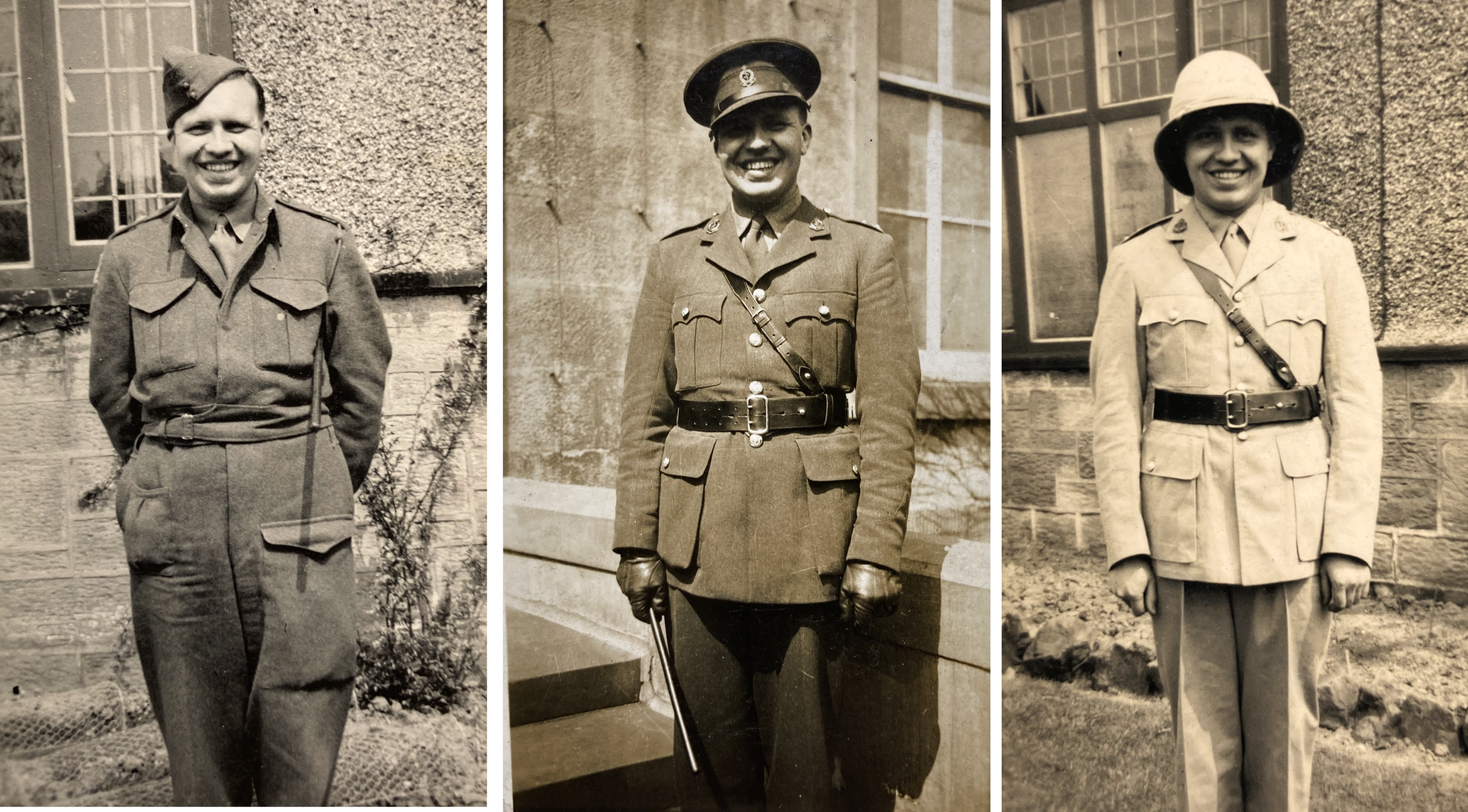
His first attachment was to 183 Field Ambulance in Norfolk. Family photographs show George in a variety of military uniforms, the tropical uniform hinting at India.
6
By October 1941 he had joined the 5th Field Regiment, Royal Artillery, and was living in ‘Polo Villas’ in Nowshera on the old North-West Frontier.
6
At some point he took Urdu lessons.
8
He stayed only a few weeks in India and next wrote home from a ‘hutted camp in a rubber plantation’ near Ipoh in Malaya Command.
6
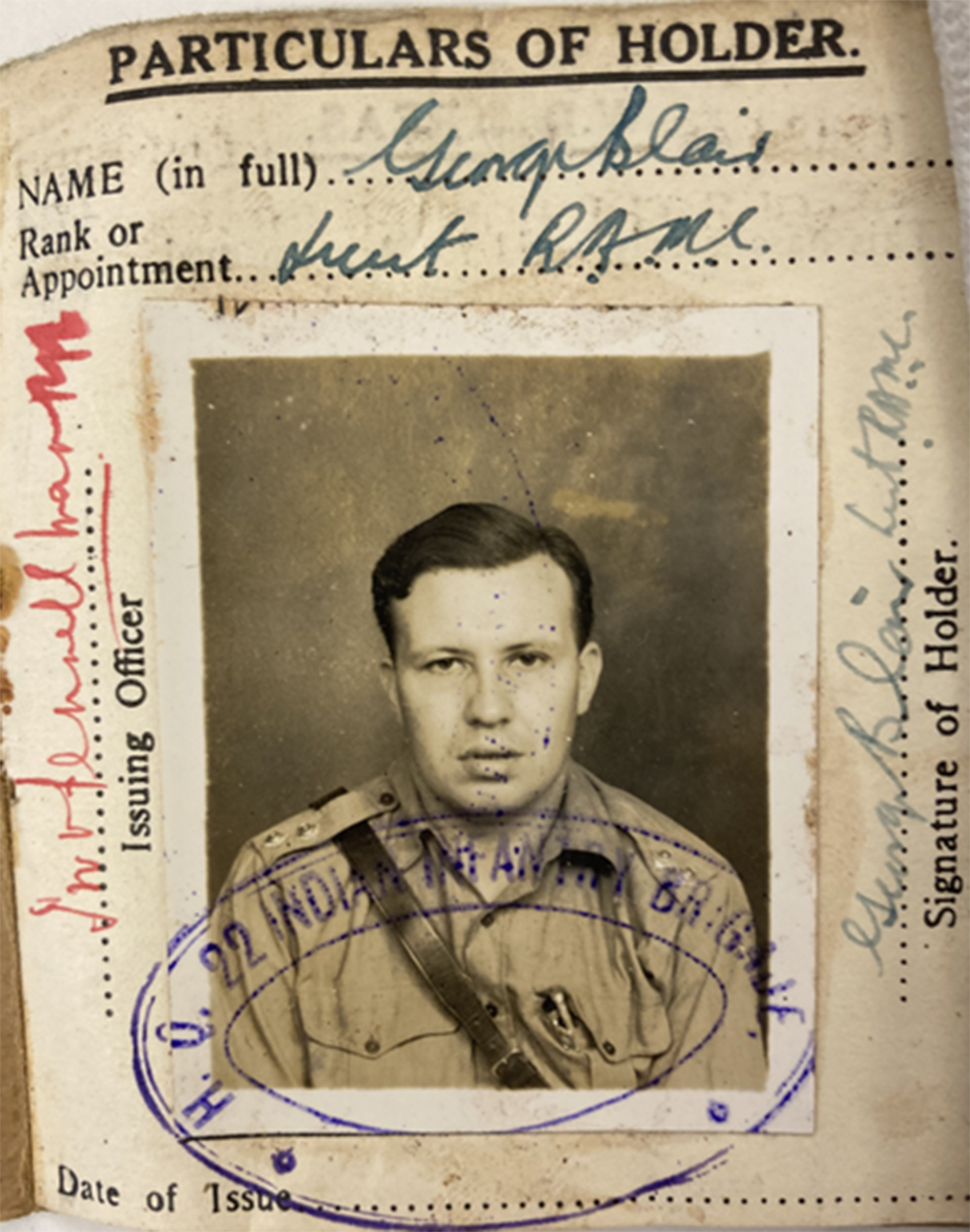
On the same day as the Japanese attacked the American naval base at Pearl Harbor in Hawaii on 8 December 1981, George's Division faced an amphibious assault on their position close to the Thai border, one of a series of stunning co-ordinated moves across South-East Asia. Although individual units fought bravely, the Allied defence was characterised by repeated retreats down the Malayan peninsula.10,11 Even the understated account written in captivity by Major Geoffrey Fennell (1899–1977) refers to ‘confusion’ and ‘disorderly flight’ in the hot, humid darkness beneath the rubber trees. 16 (Figure 3). The decimated Division was amalgamated with the 11th Indian Division. A quarter of George's regiment would eventually be killed in action or die as PoWs.
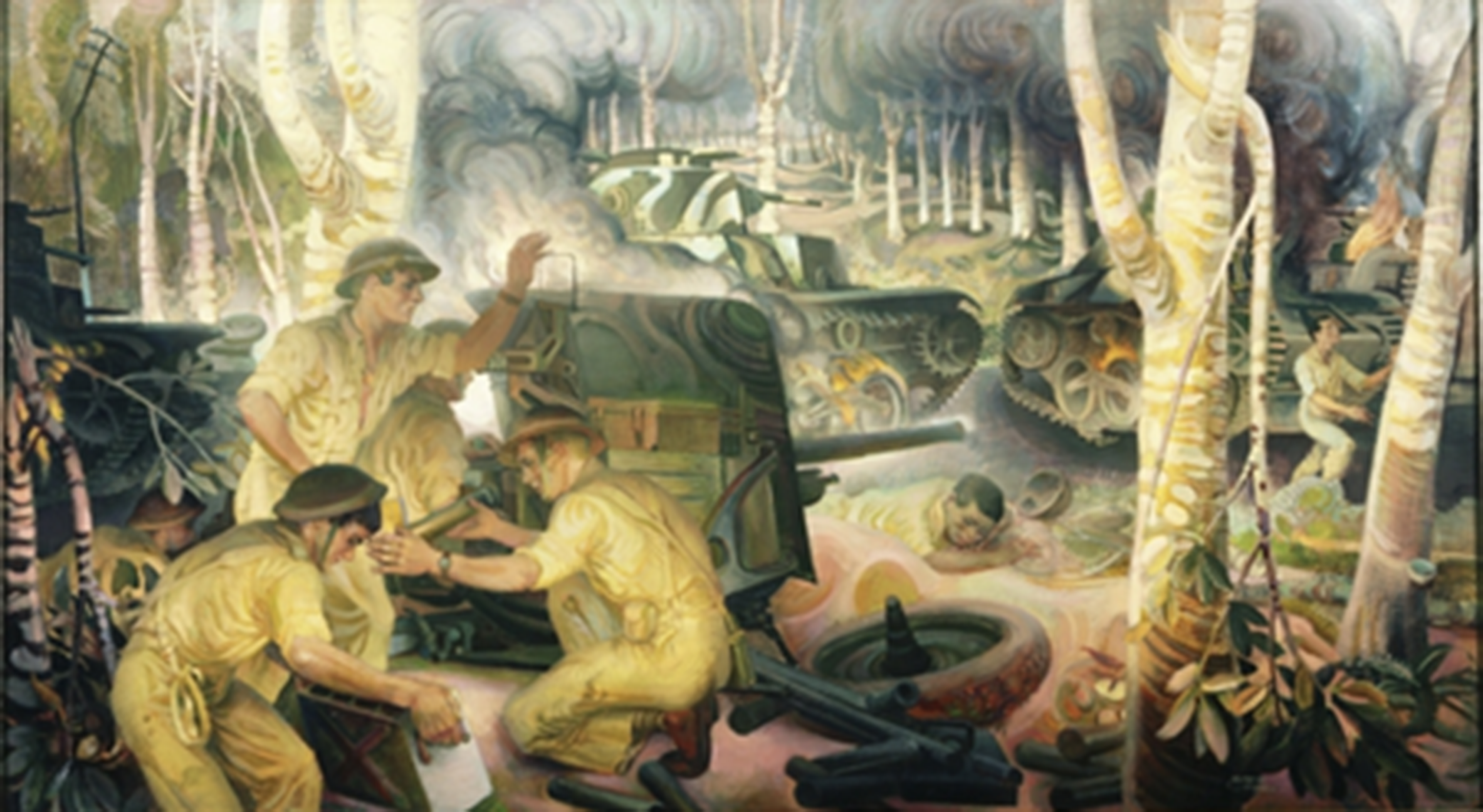
Artillery during the retreat in Malaya. Murray Griffin. Australian War Memorial: ART/27570.
George teamed up with regimental chaplain, Captain Tom Pugh (1903–80). Like doctors, chaplains were non-combatants, and were expected to work with the medical team in battle. 17 Tom, a veteran of the British Expeditionary Force's retreat to Dunkirk, was ‘a decided asset’ and ‘the Padre and the Doctor proved a very formidable team’, scouting ahead of the regiment to find sites for camps. 16 George's principal role was triage, overseeing the medical orderlies as they provided immediate care and sending the sick and wounded down the line to mobile hospitals, which repeatedly retreated with the fighting. 18
Military mail was still functioning and George admitted to his parents that ‘things are a bit difficult just now’ but ‘I am fine and perfectly fit.’ 6 He was able to send Christmas greetings home by cable on 17 January 1942 but the retreat continued, with ‘wounded left in a rubber estate’ when the causeway to Singapore Island was blown up on 31 January. 16 George sent a reassuring telegram home on 5 February, but the Japanese crossed the Johore Straits and advanced on Singapore city. After they gained control of the water supply, surrender became inevitable and took place on 15 February 1942.
Captivity and Changi
Less than a year after joining the RAMC, George was a PoW. The Japanese captured about 300,000 Allied prisoners, with four large surrenders: c 14,000 in Hong Kong in December 1941 (British, Canadian, Indian); c 130,000 in Singapore in February 1942 (British, Australian, Indian); c 32,000 in Java in March 1942 (Dutch, British, Australian, American); c 75,000 in the Philippines in April and May 1942 (American, Filipino). 19 The nuances of captivity in the Far East have been explored in recent years to ‘challenge the monolithic image’ conveyed by post-war popular films such as The Bridge on the River Kwai and emphasise the ‘diverse experience’ of PoWs.20–24
PoWs were marched to Changi, a military area on a peninsula at the east of Singapore island. The decapitated heads of Chinese prisoners were impaled on poles in Singapore City streets and failure to obey a Japanese instruction was punished by slapping or a worse beating but diarists sometimes describe Changi as a ‘holiday camp’. Many Allied PoWs never met a Japanese soldier in this open parkland surrounded by palm-fringed beaches and dotted with modern barracks and other military buildings. Photographs taken using secret cameras survive. 25 (Figure 4). Changi PoWs, essentially self-governed, repaired buildings, dug latrines and made chapels. 26 They constructed vegetable gardens, kept chickens and other animals, and found inventive ways to repair or build equipment. There were sports, games, crafts, plays, and concerts. The prisoners assembled libraries of books and devised lecture programmes: the ‘Changi university’. 27
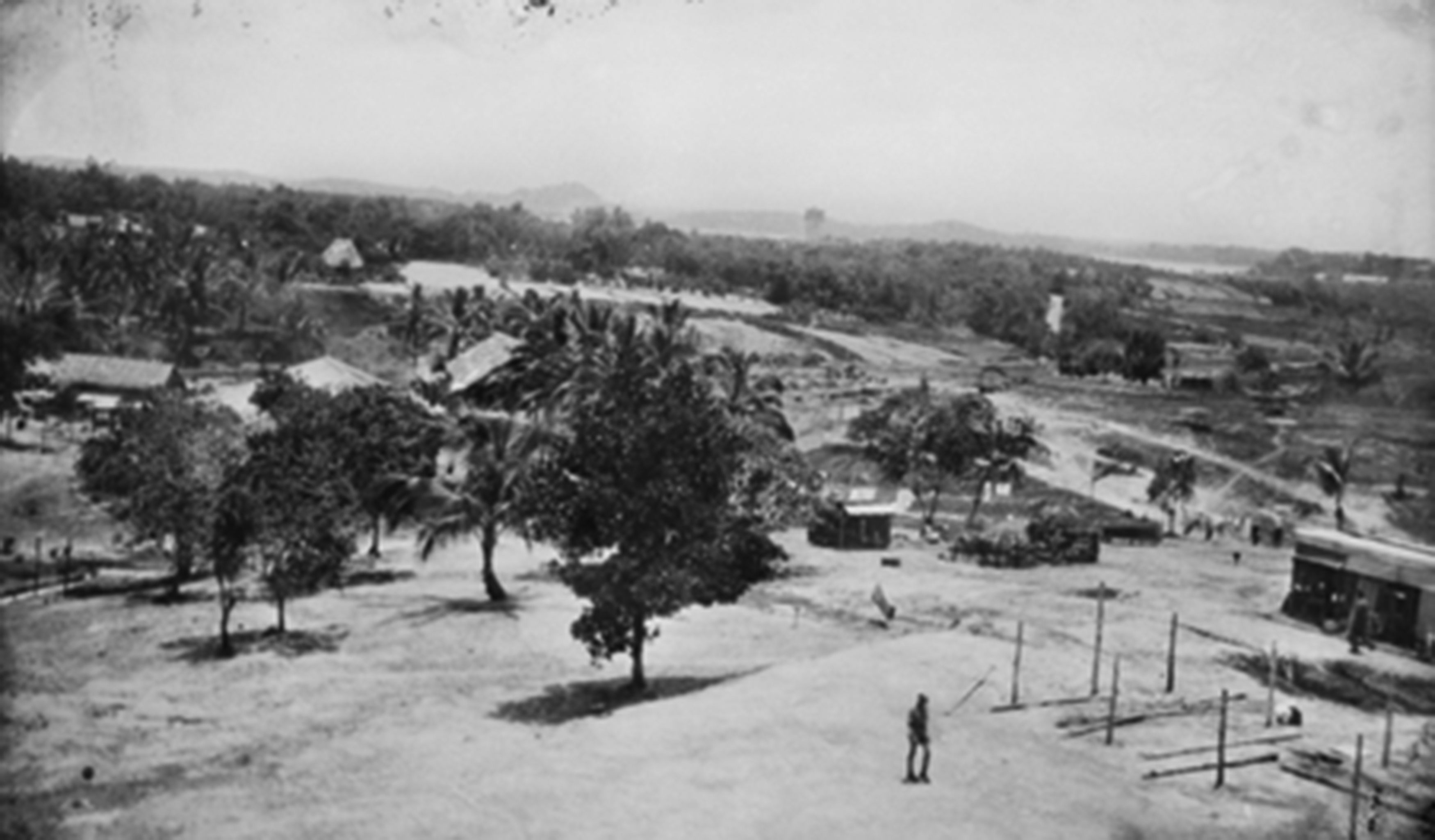
The Changi peninsula. George Aspinall. Australian War Memorial: AWM/P02569.126.
George's regiment was based at Birdwood Camp in the 11th Division area. He could refer patients to a central hospital with up to 2500 beds in Roberts Barracks, which had radiology and pathology services, and whose annual reports survive. 28 In his papers there is a collection of what appear to be lecture notes made in talks given by senior officers about medical aspects of the war, suggesting there may have been a professional development programme. 8
Working parties
Over the next several months the Japanese dispersed prisoners to about 300 camps across their possessions, to facilitate control and as forced labour. 19 They travelled in ‘Overland Parties’ northwards by rail, or to other destinations by sea. George was listed as one of ‘Overseas Party Z’, which comprised 1100 men, 89 officers and 1011 other ranks, from the 11th Indian Division, including men from three artillery regiments, 5th Field, 155th Field and 80th Anti-Tank, as well as Divisional headquarters, provost and signals staff. 29 (Figure 5). Listed with him is padre Tom Pugh and two doctors, Major Ben Wheeler (1910–63) and Captain Peter Seed (1913–77). Ben, George and Peter would become the doctors in the two northern camps in Taiwan, Taihoku (Taipei) and the copper mining camp at Kinkaseki (Jinguashi). (Figure 6). Ben Wheeler noted that he received orders on 24 October 1942 to accompany the party as Senior Medical Officer. 30 It left the following day.
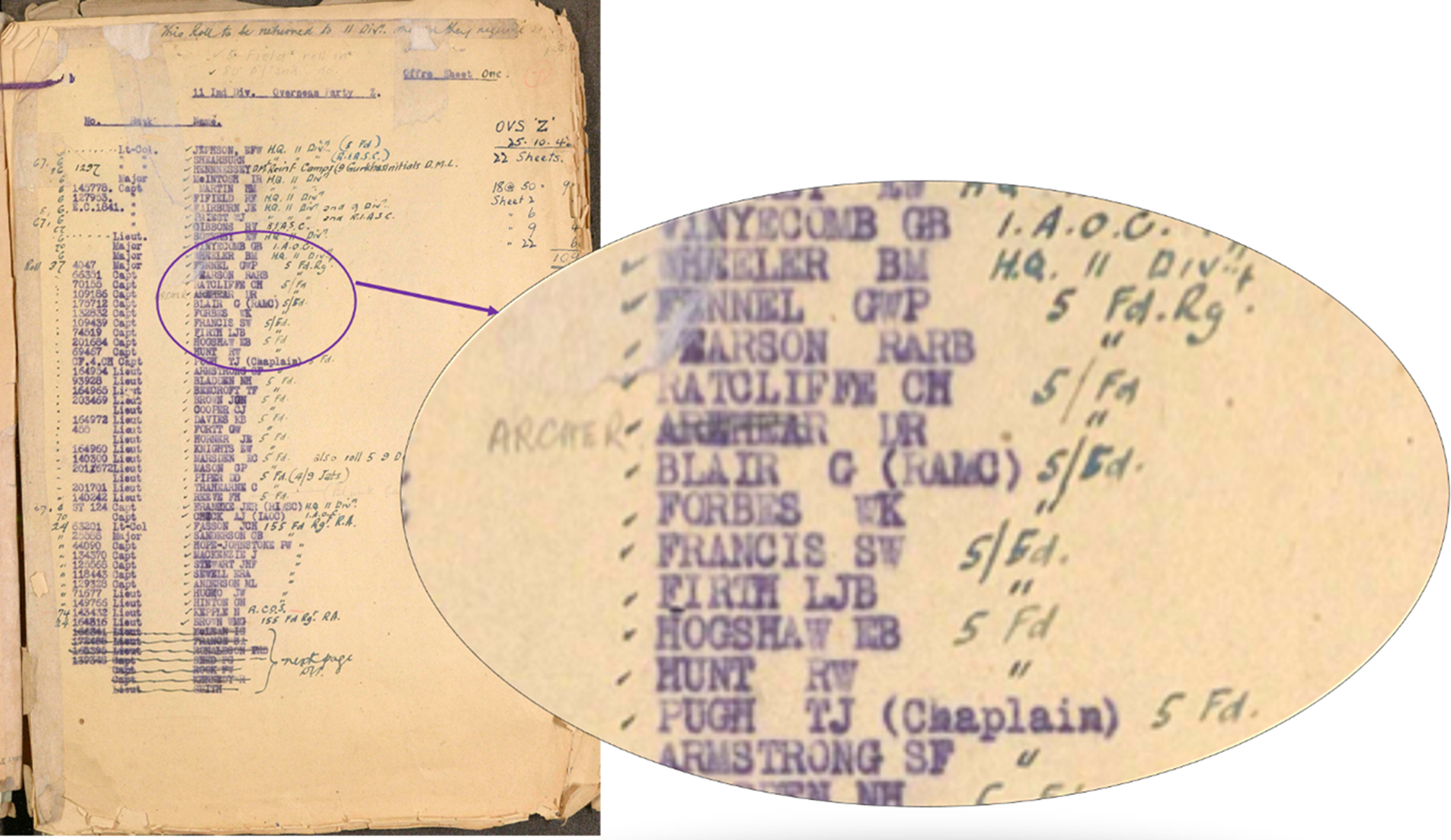
Overseas Party ‘Z’. 29
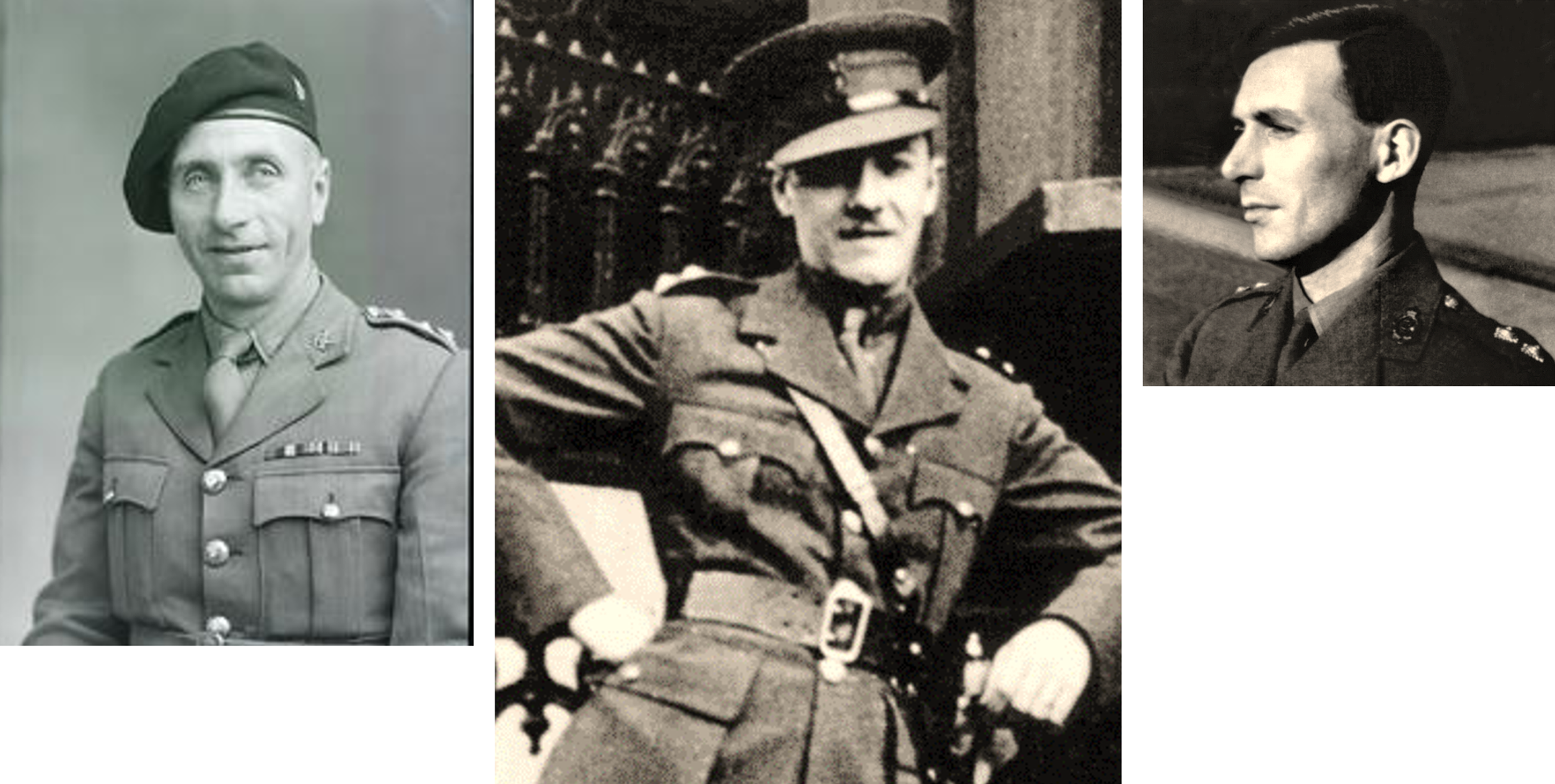
Companions in captivity: Captain Tom Pugh RAChD (left), Major Ben Wheeler IMS (centre) and Captain Peter Seed RAMC (right). Pugh family collection (left) and The Taiwan Camps Memorial Society: www.powtaiwan.org.
Ben Wheeler
George and Peter were fortunate to have Ben Wheeler as their senior doctor. He qualified from the University of Alberta in 1935 and joined the Indian Medical Service, which gave him formal teaching in tropical medicine in London and clinical experience in Karachi. He was an exceptional PoW doctor, mentioned with respect in many memoirs. George described Ben as ‘one of the finest men I have ever met’ 6 and Peter stated that he was ‘the best doctor I’ve ever known … and I’ve known a few very good doctors.’ 31 When George was hospitalised in their early weeks in Taiwan, Ben worked single-handed through epidemics of dysentery and diphtheria and initial harsh treatment by camp guards. Later, Peter became ill and Ben moved to Kinkaseki. Peter described himself as near death, but saved by Ben's medical care and by the nursing of the RAMC medical orderlies. Ben's care of Peter also included personally donating blood. 31
Ben kept a secret diary and his papers are held in a closed file in the University of Alberta archive. After his death in 1963 his daughter, Anne Wheeler, a film director, used the diary and her interviews with survivors to make a drama-documentary, A War Story (1983). 32 The Readers Digest published an article about Ben, 33 and memoirists such as Jack Edwards used the diaries before they were deposited. 34
England Maru, 1942
Overseas Party ‘Z’ sailed in the ‘hellship’ England Maru, one of the requisitioned cargo vessels which transported prisoners, soldiers and supplies. 35 She was built in Kobe in 1919 and sunk near the Admiralty Islands on 17 May 1943 by the US submarine Grayback. 36 Conditions were over-crowded and insanitary, the men kept in four holds. Peter looked after holds 1 and 2, George hold number 3, and Ben number 4. 30
There were outbreaks of dysentery and diphtheria and three men died, a relatively low mortality compared to some of the 156 hellship voyages in which c 1540 deaths are attributed to transport conditions alone. Furthermore, because the ships carried troops and war supplies, c 19,000 PoWs died in Allied air attacks. 35
For many, these voyages provided their first direct interactions with Japanese soldiers and Ben Wheeler's diary is not alone in expressing a sense of shock. Major Fennell was disciplined for protesting. At disembarkation at Kiirung (Keelung) harbour they stood for hours in ‘tattered tropical uniforms’ before being ‘packed onto a train’, and were then ‘herded off at the camp at bayonet point’ for inspection.16,30 Ben and George, with three medical orderlies, accompanied c 500 men to Taihoku. Peter Seed accompanied the rest to Kinkaseki. George later wrote that ‘Conditions in Formosa were quite different from those in Singapore.’ 7
Taiwan
Taiwan had been a Japanese colony since 1895 when China ceded the island after the First Sino-Japanese War. Only older Taiwanese could remember life before Japanese rule. It is a mountainous sub-tropical island with a mild winter from December to February and a humid summer from June to September, in which 250–350 mm rain falls per month. Its deposits of coal and copper were vital war materials, it housed important air bases and, with three ports, was a stop-off point for naval and merchant shipping. 37 (Figure 7) The camps were not well documented until Hurst's work identified six camp groups. 38
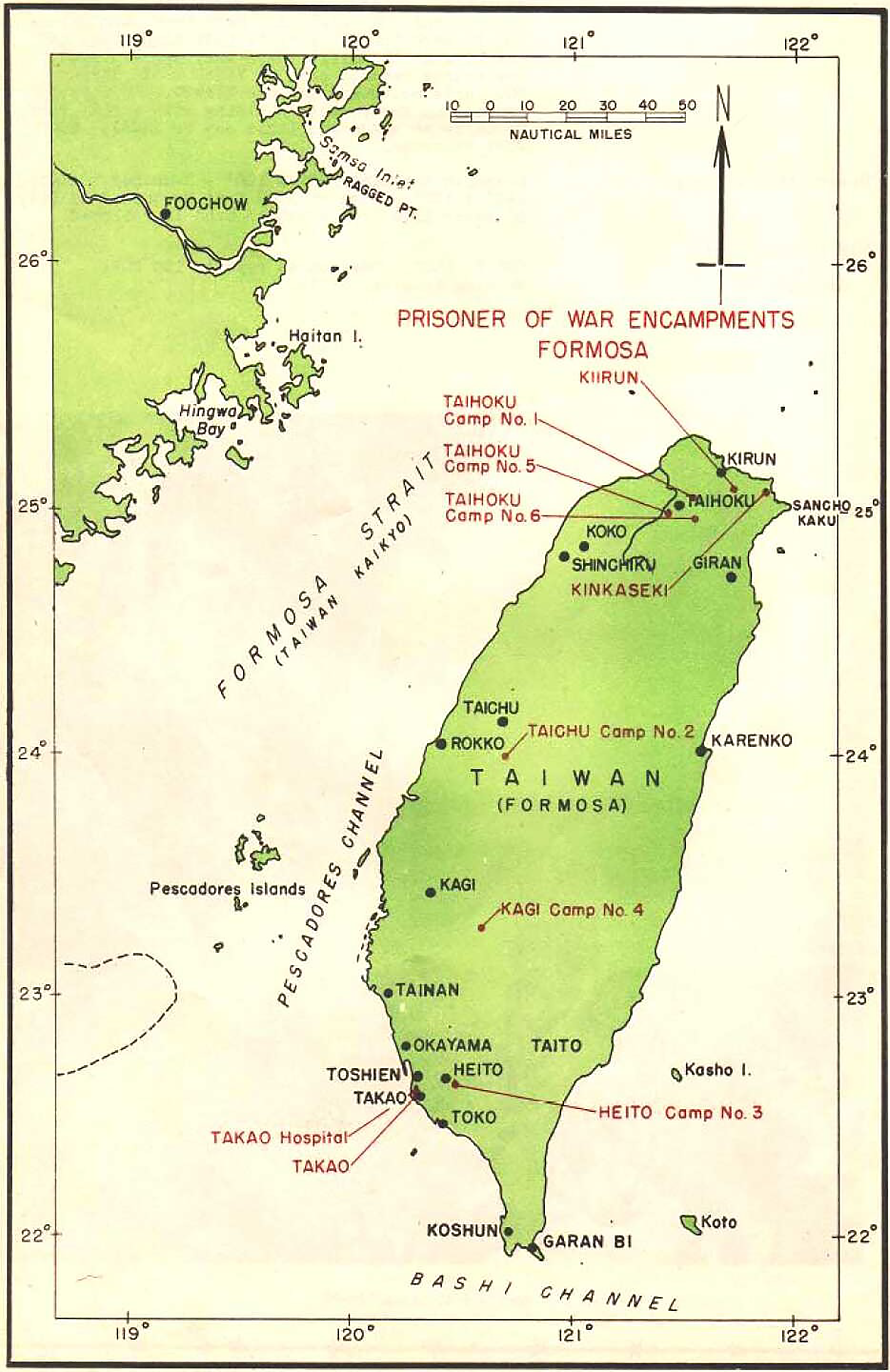
PoW camps in Taiwan, as understood during the Allied Pacific bombing campaign. 37
Taihoku, 1942–45
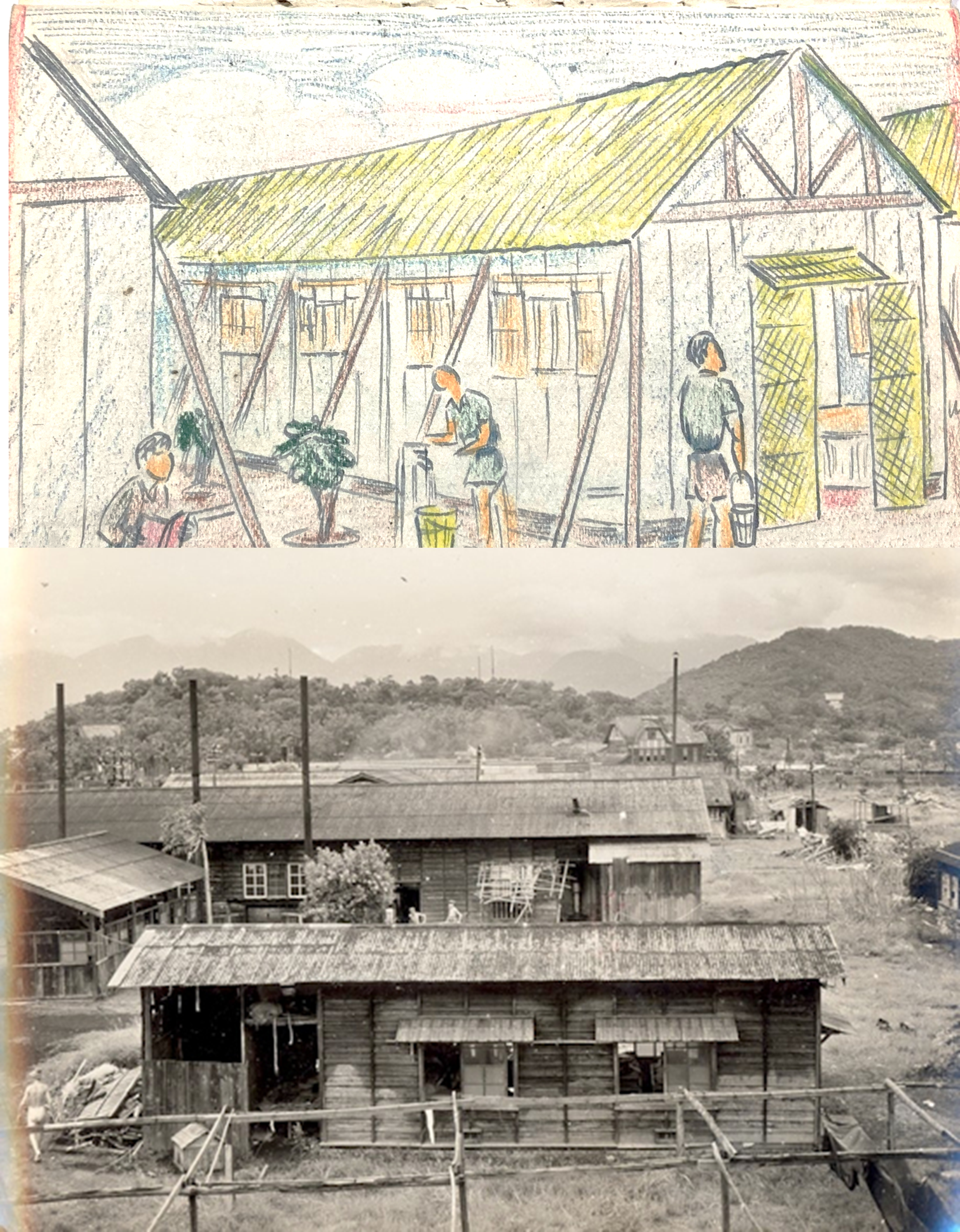
Taihoku (‘Number 6’, ‘Bamboo’, ‘Paradise’) camp was a collection of bamboo huts surrounded by a bamboo fence, newly built in 1942. Gunner John Clement, a commercial artist before the war, made crayon sketches,
39
American planes took aerial photographs,
37
photographs were taken at liberation,
40
and a British war artist accompanied the liberation force.
41
There is also testimony from the War Crimes Trials.42,43
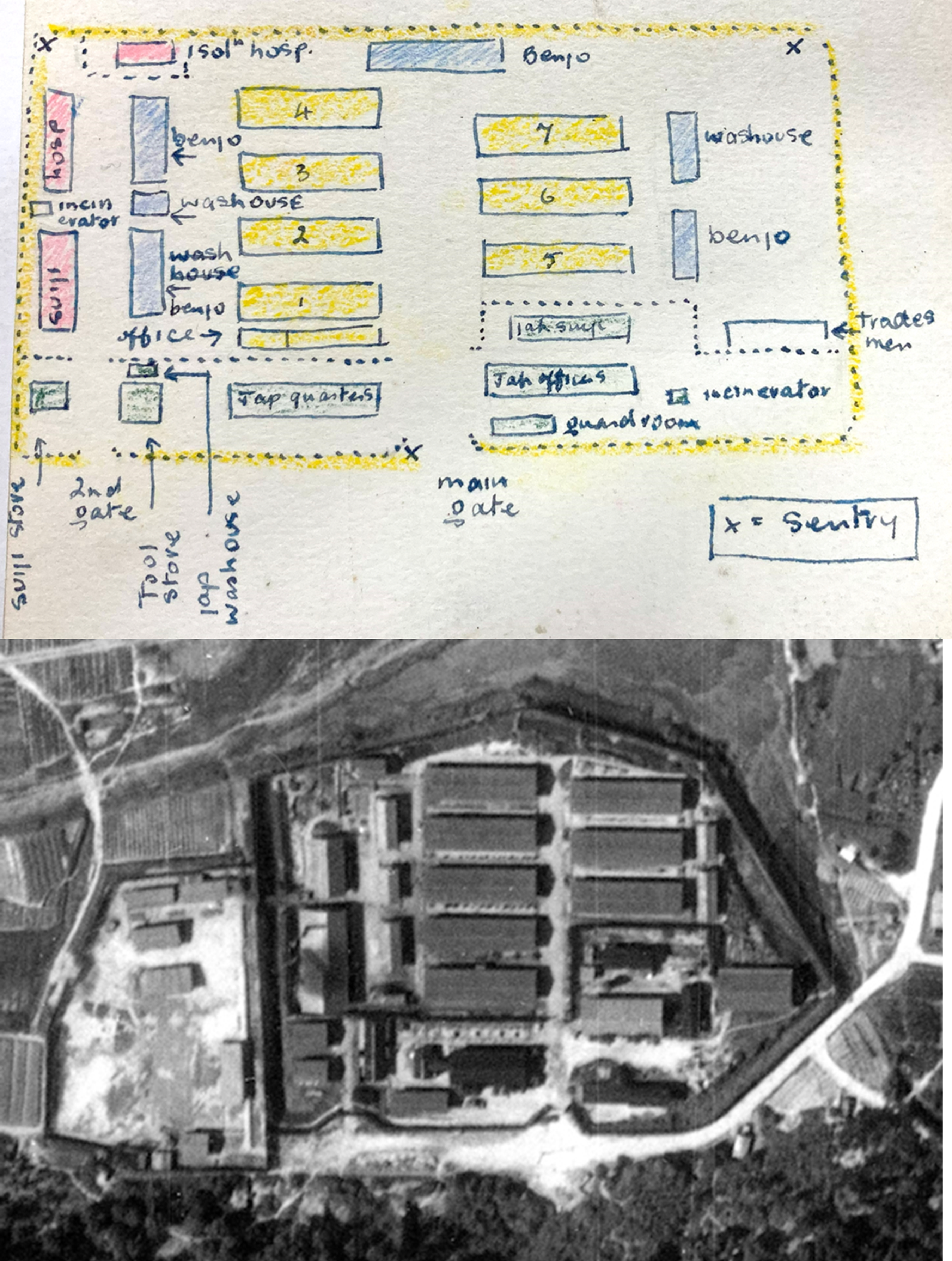
Taihoku camp. Plan drawn by PoW John Clement (above). 39 Photograph USAAF www.taiwanairpower.org (below).
Ben and George worked together until August 1943 when Ben went to Kinkaseki and, for over a year, George was the only doctor. Tom Pugh wrote to the Archbishop of Canterbury in August 1944 that ‘The Camp Hospital is in the charge of a young Scottish doctor, and he is both conscientious as regards his duties and sympathetic in his attitude towards my work.’ 44
Patient population
The camp population stayed at about 400 to 500 but its composition varied. Officers were transferred to other camps in 1943, leaving only ten, including George and Tom. The original homogenous population became diversified as drafts of PoWs were moved in and out and George recalled that ‘relatively few men’ remained throughout his captivity. 7 A greetings card given to George at the end of the war listed 53 British units as well as men from Australia, Malaya and the USA. 8 There were Dutch soldiers at Taihoku at other times, and airmen and naval and merchant seamen were also imprisoned on the island.
Medical conditions
There are many instances in War Crimes Trials testimony of harsh treatment of both the sick and the PoW doctors by the Japanese, including beatings. But the principal challenge was to stay alive in the face of starvation, malnutrition, overcrowding, poor hygiene, tropical diseases and forced labour. Every PoW, to a greater or lesser extent, suffered from beri beri, dysentery, intestinal worms, and skin conditions. Gill and Parkes give a detailed account and clinical presentations and treatments are not elaborated in this article. 14
The Japanese recognised four categories of PoW: sick in hospital, sick in camp, fit for light duties, and fit. As a snapshot, War Crimes trial records noted that on 21 September 1943 105 men (over 20% of the Taihoku camp strength) were sick: 18 in hospital, 34 were allowed to lie down in their huts, 46 carrying out light duties in camp, and seven who had reported sick but were not yet categorised. Of the sick, 35 had beri beri, 28 had disorders such as fevers, jaundice and diarrhoea and 42 had skin conditions including ulcers and boils. 42
The sickest patients were nursed in the small camp hospital and within a few days of arrival George was admitted himself with dysentery and beri beri. He remained for two months but even on 1 February 1943 Ben recorded that he ‘won’t be fit for some time’. Once he started work again ‘We [Ben and George] share a lot of the work and are trying to start some kind of record of our Beri Beri cases. He has rather a bad go himself with edema. […] Blair is a good chap – about 26 […] I like him – he is genuine I am sure and a good temperament.’ 30
Work
Health status was intimately connected with work and food. PoWs were weighed regularly and all lost weight. The mean weight of the camp population ‘at the end of 1944’ was 55 kg. 7 The Japanese based transfer decisions on weight, deeming heavier men capable of heavier work. They provided reduced rations for the sick on the grounds that they were not working. Because PoWs shared their food, and tried to provide extra nutrition to the sick, the higher the proportion of sick in the camp, the greater the reduction in rations for all. This vicious circle of sickness and under-nutrition created ethical dilemmas for the camp doctors.
At Taihoku, the fittest PoWs worked on creating a ‘Victory Park’. Later, PoWs travelled from the camp daily to work in railway and bus works and George's notes record eye injuries from pieces of brass. 7 PoWs were ‘compelled to continue working during air raids’. 43 Sick PoWs able to undertake light duties worked in the camp, including making ropes and bamboo artefacts. (Figure 10). Officers worked and Tom Pugh, for example, looked after a buffalo. 44
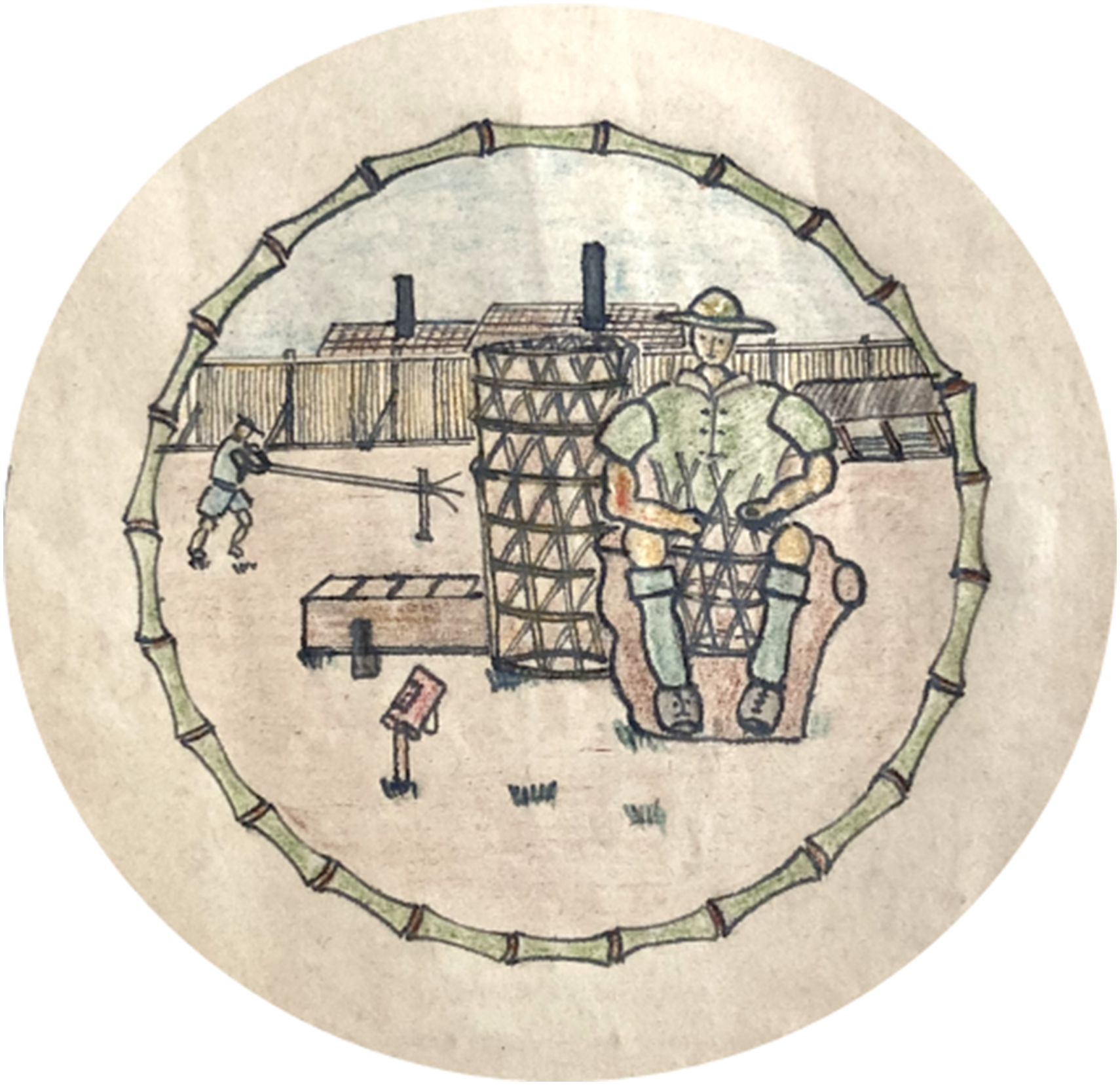
PoW working on bamboo in camp. Detail from a Christmas card given to George. 8
Medical routine
Equipment and medicines were scarce. As an example, ‘as a substitute for gauze dressings I [George] used cellophane squares from the inside of Japanese cigarette packets. … When the Japanese no longer packed their cigarettes in cellophane … I had to use ordinary newspaper.’ 7 The Japanese withheld food and medical supplies from Red Cross parcels for their own use. Despite these challenges, doctors followed a routine and kept meticulous clinical records. The day was punctuated by reveille at 6.00 am, strictly timed meals, and the morning and afternoon work sessions. George's day was:
‘06.45 sick parade
08.00 ward round
09.00 Japanese sick parade
10.15 abscesses, dressings etc
13.15 sick parade & weekly review of beri-beri cases
14.00 hospital dressings etc
19.00 ward round
19.15 sick parade for town workers [railway and bus works]’ 5
War Crimes Trials evidence shows that in these parades the PoW doctor's examination was observed by a PoW clerk, with a Japanese medical orderly separately recording data.42,43 The Japanese orderly regularly over-ruled the PoW doctor and sent sick men to work. Although Japanese doctors made periodic visits, they delegated decisions to orderlies. A PoW needed to have a visible condition in order to be accepted as sick. George stated that ‘on frequent occasions’ patients with an invisible illness, such as malaria, would be beaten if they reported sick. 7
After initial protests, George and the other officers decided to adopt a ‘conciliatory’ approach and in 1943 George noted regrets that two Japanese orderlies were to be transferred because ‘both had been good to me’. 7 The Japanese doctor, however, was ‘singularly unco-operative’. 7 There was a Japanese military hospital in Taihoku city and PoWs were, on rare occasions, transferred there for X-rays or surgery.
Hospital admissions
George recorded 341 admissions to Taihoku hospital and 85 deaths.5,7 There was a peak of admissions in the first month, November 1942, related to the outbreaks of dysentery and diphtheria that started on the England Maru. Various manifestations of malnutrition become more prominent over time and, in the final month, there were admissions, and deaths, with diagnoses of ‘debility’ and ‘anorexia’.
The end of the war, 1945
Prisoners heard rumours about Allied successes in 1944 and Taiwan came within reach of Allied bombers. At Heito camp, 28 PoWs were killed in a raid on 7 February 1945 and a further 80 were injured (numbers vary slightly according to the source). The camp was closed and survivors transferred, including to Taihoku. 38 After the war, Tom Pugh described considerable tension while the men cheered the American bombers but simultaneously feared air raids and rumours that the Japanese would ‘annihilate’ PoWs in the event of an Allied landing. 45 Rations were reduced still further. Doctors arrived with transfer parties and George shared duties with American Captain ‘Herb’ Coone USAMC (1911–2001),7,46 Captain ‘Russ’ Grant RAMC (1910–97) and Australian Captain Patrick O’Donnell AAMC (1916–73). Drs Grant and O’Donnell had survived the Heito bombing. 7
In July 1945, America called for Japan's surrender, and dropped atomic bombs on Hiroshima and Nagasaki on 6 and 9 August 1945. The USSR invaded Manchuria on 9 August. Emperor Hirohito gave a radio address on 15 August announcing the surrender. On 20 August, the Taihoku camp commandant announced an ‘armistice’. Heavier work ceased and PoWs from across the island were concentrated on Taihoku ready for evacuation. The doctors started to move the sickest patients into the Japanese military hospital in the city. On 28 August, three American B29 bombers circled the camp and dropped drums of relief supplies, killing three PoWs, one British, one American, and one Dutch, and injuring 21 others. Supply drops then continued almost daily.
Liberation and repatriation, 1945–46
American naval officers landed on 2 September and the Japanese were disarmed. 38 Over the next week prisoners who were fit to travel were evacuated to the American aircraft carriers Santee and Block Island where they showered, were deloused, and were fed and given clean clothes (Figure 11). Photographs of these emotional events survive. 40 Ben and George remained behind with c 120 very sick patients. British cruisers Bermuda and Argonaut arrived, with a war artist. 41 A Royal Navy chaplain felt ‘privileged’ to meet Tom and George on 7 September. ‘When the British ships came into view the padre and the doctor were hardly able to express their delight.’ 6 The next day, Tom conducted his last funeral at Taihoku. The Taiwan burials would later be removed to the Sai Wan Commonwealth War Graves Commission Cemetery in Hong Kong.
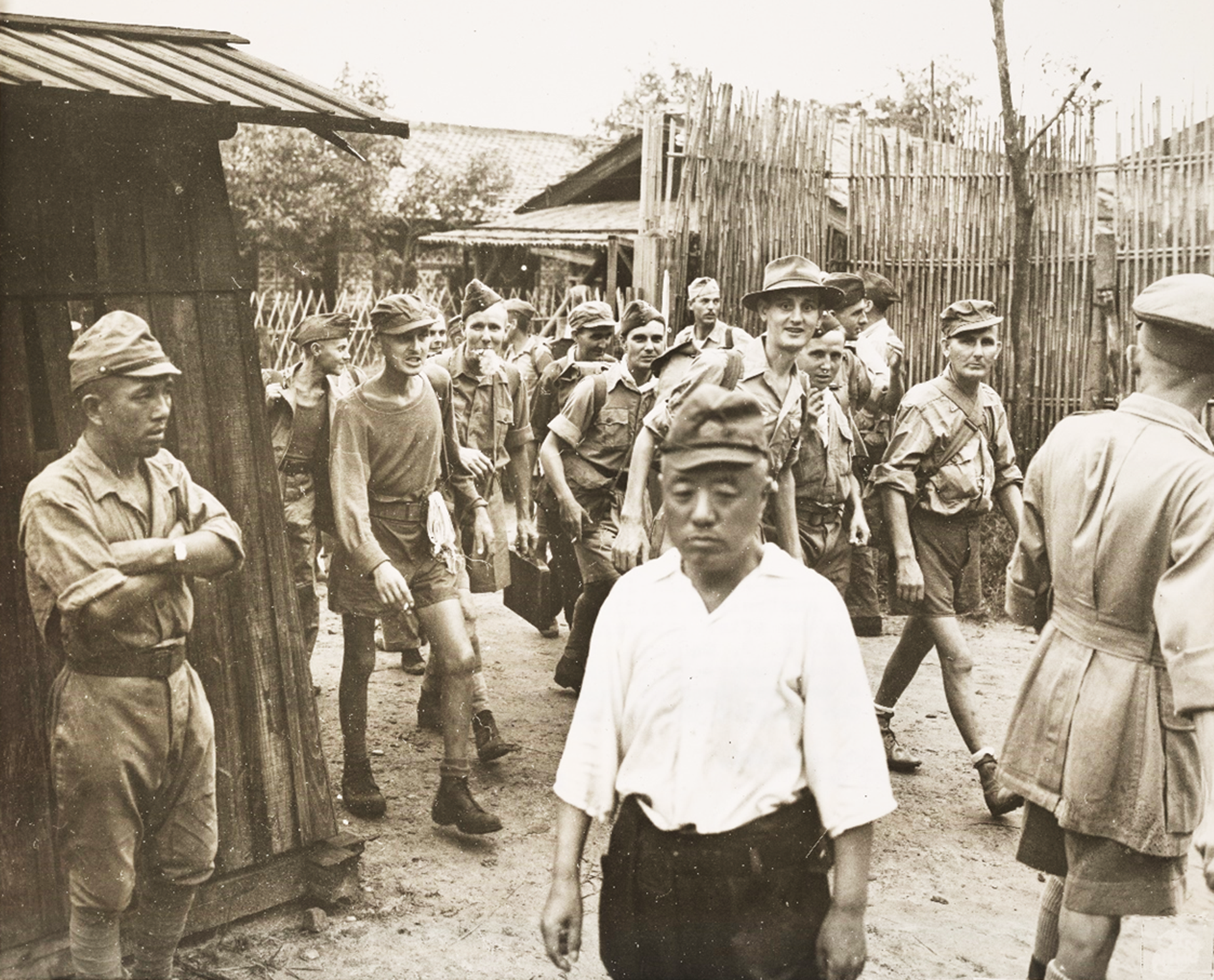
Leaving Taihoku camp. US NARA: 80-G-495663.
The remaining patients were transferred to the New Zealand hospital ship Maunganui. She was a former luxury liner, built on the Clyde in 1911, which became a troopship in the First World War. As a hospital ship in WW2 she could carry 365 patients and 100 medical and nursing staff. 47 She sailed on 12 September for Manila in the Philippines and then on to Wellington, New Zealand, where she arrived on 9 October. Four patients died on board.
George wrote with relief that ‘We are all patients now’. 8 But he also worked alongside the ship's medical team. 6 The voyage and subsequent stay in New Zealand provided a decompressive hiatus in which men were fed and cared for, regained strength, and could start to behave normally again. The ship produced a regular newsletter, What Knots, and encouraged the former PoWs to contribute; George and Ben limited themselves to short factual accounts. As the voyage continued, debates and concerts were organised and patients wrote poems and humorous pieces. 48
George's recovery continued after his arrival in New Zealand, while he completed a long course of dental treatment and recorded his increasing weight. 6 He wrote home with news of the kindness of local people, of outings and dances. A Middlesbrough general practitioner had offered a partnership and correspondence looked to the post-war future and to details of the new position.
Post-war life, 1946–79
George arrived in the UK in January 1946 and was admitted, like many PoWs and probably only briefly, to the military hospital in Chester. 6 In Scotland in March 1946 he started to write a MD thesis on Malnutrition among Prisoners of War in the Far East.7,8 This work had started in February 1943 and, in November 1944, ‘I have been working on an essay on beriberi but as soon as one argument is advanced, another, diametrically opposed, presents itself.’ 7 He submitted it to St Andrews in December 1947 but chose not to make revisions and it remains unpublished.
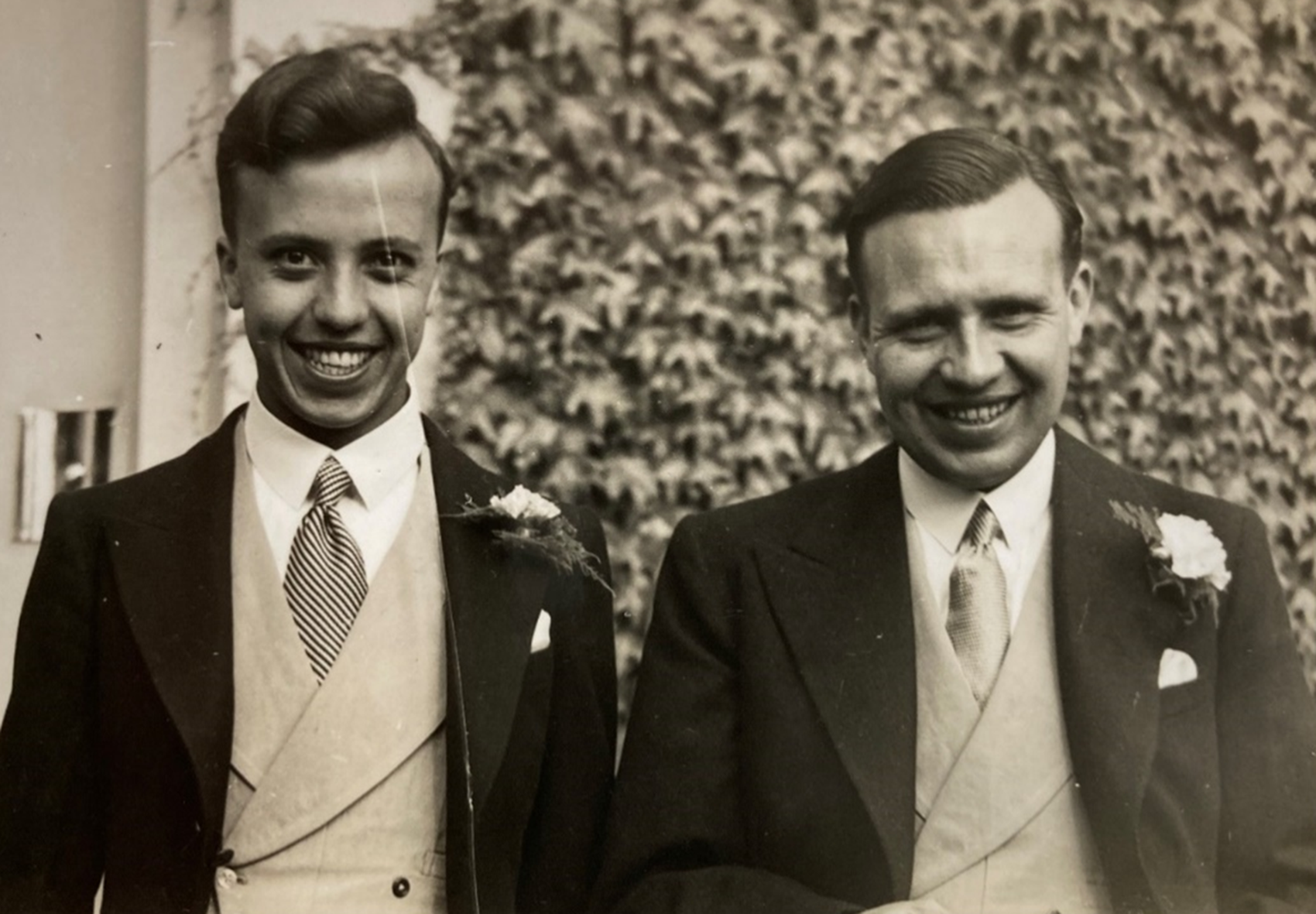
By June 1946, he was seconded to the North Riding Infirmary in Middlesbrough in a government scheme to ease the return of military doctors to civilian practice. The War Office wrote about his award of the MBE and wrote again in August 1946 that he would be on leave until his release from military service in 25 November 1946. 6 (Figure 12). He spent time at the family home, 49 but set up house in Middlesbrough with his sister Lydia. There would be rationing for several more years and their ration cards survive. 8 The new National Health Service started in 1948.
The British War Crimes trials of 123 defendants were held in Hong Kong in 1947 and 1948. George and Ben Wheeler sent factual statements and Tom Pugh attended in person. There were 95 charges, 25 related to Taiwan and five to Taihoku.42,43,50 The defence was, essentially, that: PoWs were treated the same as Japanese soldiers, deaths were due to illness rather than mis-treatment, illness was in turn related to poor weather and Allied air raids and, in any event, responsibility was borne by those of higher or lower rank to the accused. 50
George maintained contact with fellow PoWs and with his artillery regiment. At Christmas 1949 the final handmade PoW cards arrived, in 1951 he attended an exhibition in Edinburgh, run by the Sottish Returned Far East P.O.W. Association. 6
George's papers are silent about his life in the 1950s and 1960s, when he was a respected GP in Middlesbrough. His niece and nephews recall that he suffered from nightmares. a In 1975, he attended Liverpool School of Tropical Medicine and was awarded a 20% war disability pension on account of ‘duodenal ulcer, bacillary dysentery, beri beri, and helminthiasis’. 6 He became part of the Liverpool cohort of Far East Prisoners of War. 51 This extensive research programme has published many papers about the longterm effects of Japanese captivity on physical and mental health, and also three books, covering medicine, oral history and prisoner art.14,52,53
George died in 1979, shortly after retiring. The Gunner magazine printed an appreciation which referred to his high reputation amongst gunners and which included the comment that ‘Dr Blair nearly died but I am sure God kept him alive to look after us.’ 54 George's friendship with padre (now Canon) Tom Pugh continued and led to George leaving Presbyterianism to become an Anglican; a brief death notice recorded George's active role in his local church as treasurer of the parochial council. Tom officiated at George's funeral in Tayport. b There was no obituary in the medical press.
Conclusions
George Blair was respected and liked, and was awarded the MBE for his work as a PoW doctor, but otherwise was an unsung hero, understated and unassuming. In important ways, the PoW experience defined George's life, filling his twenties with sights and smells that few nowadays can imagine and affecting his health until his death, which was premature when compared to his siblings’ and parents’ longevity. His war service resembled that of other young PoW doctors, many, as he wrote, working in ‘much worse’ conditions than his. 7 His peer, Peter Seed, later said that ‘it was a very character forming experience … more valuable to me than my university. Far more valuable. I received an education as a Japanese prisoner of war, quite different from my other experience. And that's my considered opinion.’ 31
Footnotes
Acknowledgments
I thank David Wiggins (Museum of Military Medicine), Marie Ellis (Royal Army Medical Corps Headquarters), Barbara McLean and Irene O’Brien (Glasgow City Archives), Siân Mogford (Royal Artillery Archive), David Blake (Royal Army Chaplains Museum Archive), and the staff of the Bodleian Library, The National Archives, Imperial War Museum, Wellcome Collection and Lambeth Palace Library. Michael Hurst, the historian of the Taiwan camps, answered questions and Anne Wheeler extracted excerpts from her father, Ben Wheeler's, diaries. I thank the Blair and Pugh families for support, advice, information and access to family documents and photographs. For support on the larger project over several years, I thank my tutors and fellow students at Goldsmiths, University of London, Rob Lyman and the Burma crew, and colleagues at the University of Oxford.
I declare a personal interest in that George Blair was a family friend. Research for this article contributed to the 2024 George Blair Lecture (friendsofmillbank.org).
Declaration of conflicting interests
The author declared no potential conflicts of interest with respect to the research, authorship, and/or publication of this article.
Funding
The author received no financial support for the research, authorship, and/or publication of this article.
