




Abstract
William Butler (1535–1618) was a man without a medical degree who was styled as the ‘greatest physician of his age’. He was famous in his lifetime, and in the latter stages of his career was involved with the royal court, attending to King James I and his son, Prince Henry. Butler was an empiricist who practiced confidently and compassionately in a time of limited medical understanding. He was also a man of contradictions: he was loved and respected by his contemporaries but could be cantankerous and obtuse; he was anti-establishment, complaining bitterly about the restrictive monopolisation of medicine sustained by the Royal College of Physicians, but advanced his career via connections within the aristocracy; he sometimes practiced orthodox Galenic medicine, but was at times highly unconventional in his treatments. Posthumously, despite some compelling historical studies of Butler, there has been a great deal of embellishment of his behaviour and practice. This biography draws from Butler's own letters, contemporary writers and modern scholarly literature. It aims to arrange these sources into a verifiable narrative of this singular physician's life.
Background
Early years
William Butler was born in Ipswich in 1535. Little is known about his early life. According to an account of Cambridge apothecary John Crane (1571–1652), his friend and partner, Butler had three sisters and two brothers – one a doctor of physick and one a goldsmith – all of whom died without children, as Butler himself would. 1 One of his brothers may have sailed overseas and converted to Catholicism. 2
Butler probably matriculated from Peterhouse, Cambridge, in 1558, becoming BA in 1561 and MA in 1564. 3 He was often referred to as ‘doctor’, though he never actually took a medical degree. In October 1572, at the age of 37 years, the University of Cambridge granted him a licence to practice physic and he became a fellow of Clare College. 3 He practiced in Cambridge for around 20 years, and only received a licence to practice in London from the Royal College of Physicians in 1592. 4
Religion
It is obvious from many of his writings that Butler was a committed Christian. 5 Nevertheless, in February 1574, aged 39 years, Butler fell afoul of the ecclesiastical Court of High Commission, which had been set up under Queen Elizabeth to enforce Anglican conformity. Members of the commission sent a letter to the vice chancellor of the University of Cambridge with charges related towards Butler's ‘misdemeanour’ towards a minister in Suffolk. Unfortunately, the specifics and outcome of this case seem to have been lost.6,7 Writers would later exonerate Butler, describing him as being â causelessly suspected of Papist inclinations’ (p. 28). 8
The only very tenuous suggestion we have that would give us any clue to Butler's distaste of the ecclesiastical orthodoxy is in his obvious dislike of King Henry VIII, founder of the Anglican church, whom he described as ‘that rude bruit and monster of crueltie’ (p. 73), 7 and ‘that vaste and Rumbleduste Gyaunte, that had better skill of a Butcher's axe, then of a secretaries penne’ (p. 443). 2
Sexuality
Butler never married and remained childless. It seems probable that Butler was gay, and he may have had a sexual relationship with John Crane. 3 In his Brief Lives, the gossipy John Aubrey (1626–1697) writes that Butler ‘tooke a fancy to a chamberlayn or tapster in his inne, and tooke him with him, and made him his favourite’ (p. 140) and that he ‘would many times sitt among the boyes at St Maries church in Cambridge’ (p. 139). 9 Homosexuality was not accepted by society in Butler's lifetime, despite King James I likely having had sexual relationships with men. 10
Living arrangements
Although Butler seems to have made frequent trips to London, he was probably based for the entirety of his life in Cambridge. For at least the last 18 years of his life, Butler lived in a property in Regent Walk which likely doubled as an apothecary's shop. Near-contemporary James Primrose (died 1659) explained that ‘as for men hee never kept any, our Apprentices serving for that busines; nor any maide but a foole’. 1 1 The latter was probably an old lady called Nell. 9
In 1599, the house was recorded as occupied by Butler and a Walter Betson, and in 1617, it was recorded as being in the tenure of ‘the famous and learned Gentleman Mr William Butler, Practitioner in Phyzicke, (p. 435). Although it has been suggested that Crane and Butler lived together, this is unlikely save for the final few months of Butler's life. 11 An inventory of goods from April 1618 details that Butler owned two bedsteads (one for him and Nell), 52 pictures (one specifically of Saint Mary), one great crucifix, one small crucifix, a telescope, 2 a snakeskin, an ostrich egg and diverse jewels (total value of inventory £637). 12
Appearance
The only likenesses we have of Butler are from his memorial in St Mary's church in Cambridge (line drawing of this in Figure 1), and a posthumous engraving of Butler by Simon de Passe in 1620 which is likely derived from the same (Figure 3). In these, Butler is portrayed as a scholarly man dressed in a hat and ruff with a neatly trimmed long black beard. This challenges later assertions that he was ‘slovenly in his apparel’ (p. 34) 13 and had not ‘made himself ready for some seven years together’ (p. 28). 8
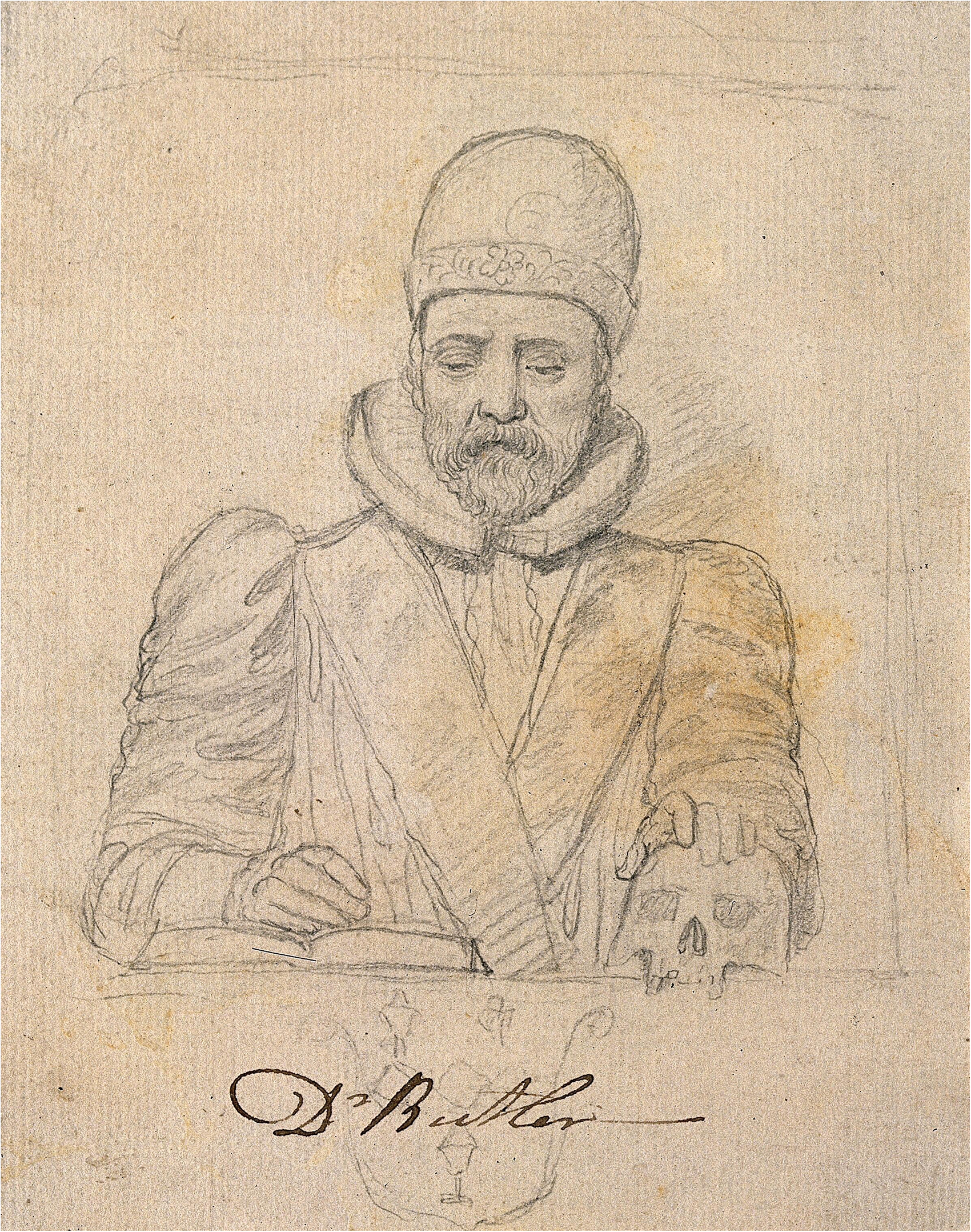
William Butler: His memorial bust in Great St Mary's church, Cambridge. Pencil drawing. Wellcome Collection. Public Domain.
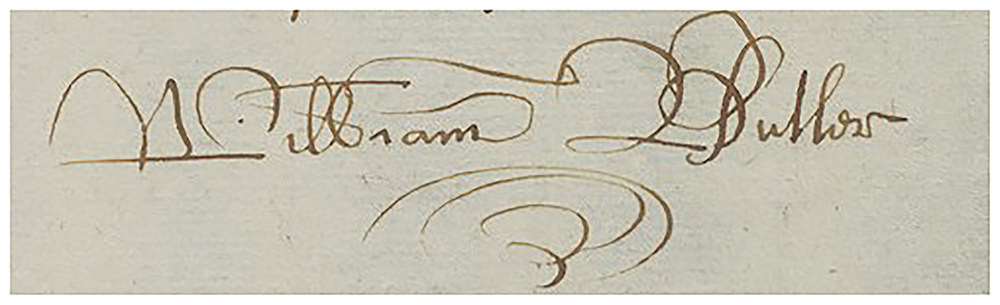
William Butler's signature from MS 5. Clare College, University of Cambridge (CCPP/BTLR). Creative Commons.
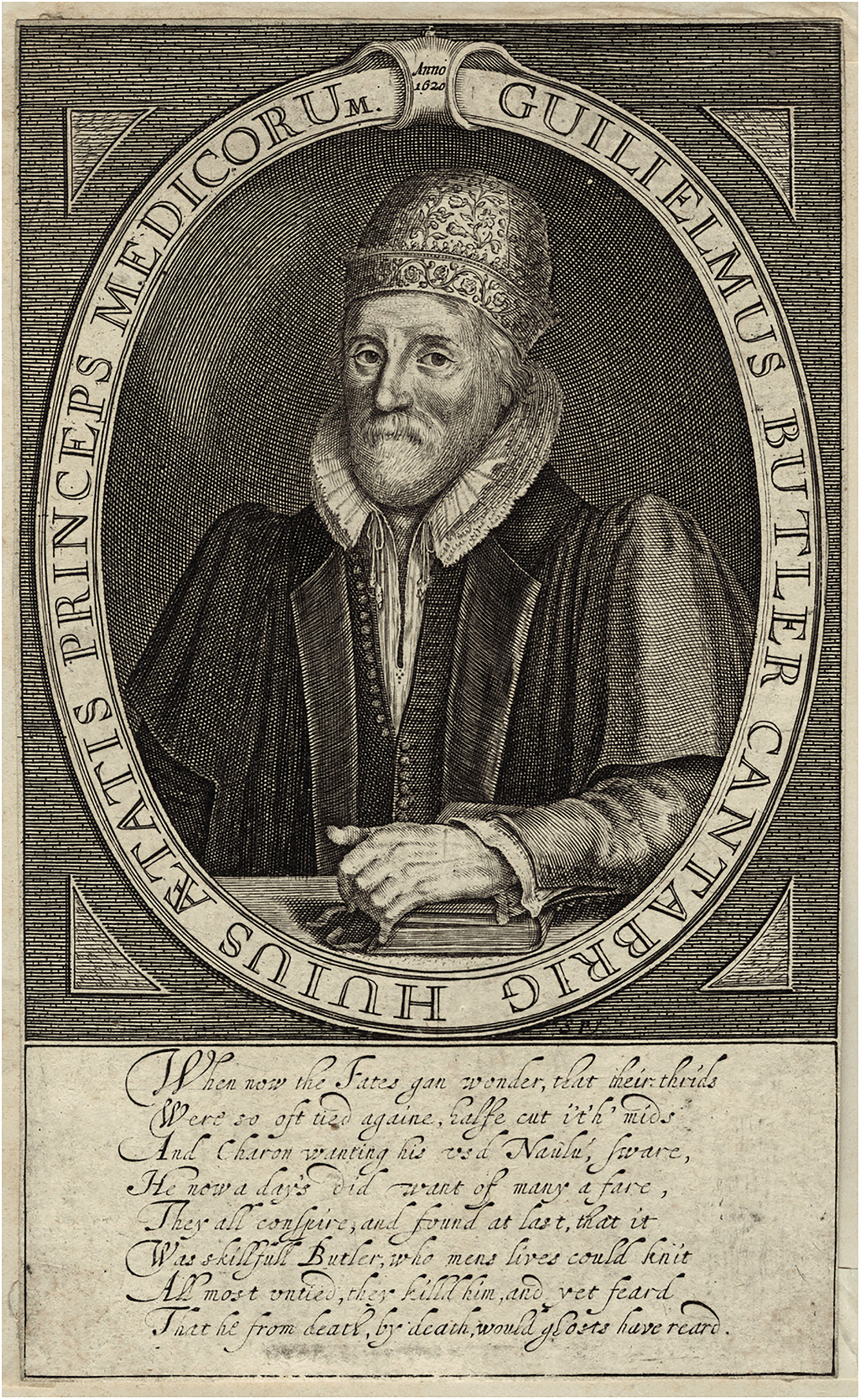
Engraving of William Butler by Simon de Passe. Academic licence was obtained from National Portrait Gallery (NPG D27929). 11
Alcohol
Posthumously, Butler has been recognised as someone who liked a drink. Years after his death, Aubrey wrote that ‘Dr Butler would many times goe to the taverne, but drinke by himselfe’. About 9 or 10 at night, old Nell comes for him with a candle and lanthorne, and says ‘Come you home, you drunken beast.’ By and by Nell would stumble; then her master calls her ‘drunken beast’; and so they did drunken beast one another all the way till they came home’ (p. 140). 9
This account can be partially verified by more contemporary sources. In a letter dated November 12 1612, the letter writer John Chamberlain (1553–1628) describes Butler as ‘but a drunken sot’ (vol. 1, issue 2, p. 389). 14 Butler himself makes reference to the effects of alcohol in a characteristically humorous letter to an anonymous interlocutor who has asked for medical advice about his vertigo: ‘My Lord, potton & Reelingworthe towne 3 are not farre a sondere The nearest way … will brynge yowe … so to downfall in the vale’ (p. 440). 2 In another, he continues in the same vein: ‘Surely yowe devysed that Gifte at Tippelstall or Staggerington towne when yowre head was lined with tinkers freese, & the drunken Truncke of yowre Bodie drowned with nappye 4 and dagger ale 5 ’ (p. 425). 15
Character
Butler was as famous for his personality as he was for his medical practice. He was warmly respected by many who knew of him. John Hawkins (active 1641), 6 described him as ‘a marvellous great scholler, and of long practise, and singular judgment, but withall very humerous’ (p. 42). 16 A poetic eulogy of Butler describes him as ‘a noble despiser of wealth and a Croesus by not taking it from others’ (p. 420). 15 7
Butler's own manuscripts are another window into his personality. Written in a mixture of English, Latin and Greek, the letters espouse a sometimes sarcastic but often playfully learned wit. His letters are sharp and entertaining and abound with classical and biblical references. He maintains his sense of humour even when making earnest entreaties, for example for increased university funding or for compassion towards an unwell bishop from the ecclesiastical hierarchy. 5
His manuscripts also show that Butler could be a tender, humane man: ‘Righte worshippefull & my very singular Goodde ladie, I am exceedinge sorie for yowre heavynesse. the losse of friendes myghte be redeemed by inwarde griefe or Anguyshe of mynde, The loosers myghte eate Ashes as breade & mingle theire dryncke wyth weepinge as the psalme saieth. deathe ys the ende of all fleshe: wee come weepinge into the world & are brne mortall & in Corruption, but wee shall aryse agayne wyth Joye, and wyth a Resurrection of Immortalitie’ (MS 6). 5
Despite being an austere and philosophical scholar, Butler also appears to have been wonderfully free with his insults; in one case he brands an unnamed target an ‘Asse’ and ‘Brasen faced lyer.’ 5 He could also be unrelenting in his ethical high-mindedness. He became involved in a gold-clipping affair after Paul Tompson (active 1614), a Senior of Trinity College confined to Cambridge Castle on a death penalty, appealed for clemency to the establishment. To Tompson, he wrote that ‘your giddie-headed phantastique fidlinge fingers and scribblinge pen, directed by the quicke motion of your quicksilver brayne, without penetancy, pretending piete, practizinge policie, will bringe you to a violent end. As you have alwayes lived a conceited wizard, so now you will dye a nynnyhammer foole’ (vol. 3, p. 73). 7
Medical practice
Style of practice
Butler was designated as the ‘Aesculapius of his age,’ 8 and his practice has been described as progressive 15 and pragmatic. 2 Since his death, he has acquired a reputation as an early English pioneer of chemical treatments. 4 Nevertheless, a review of his extant writing indicates only limited recommendation of such treatments (but the small literature we have does not fully settle the issue). It is most likely that Butler combined chemical medicine with Galenic practices in his empirical and singular style of practice that brought him his fame.2,15
Whatever Butler's medical framework, writings about his practice from cotemporaries indicates he had a broad approach to his patients, often with a stoic philosophical foundation. 15 He was quoted as telling a patient ‘his disease was not to be found in Galen or Hippocrates, but in Cicero's Epistles’ (p. 139). 9 In a letter to another unknown recipient, Butler gives advice to study only until lunchtime (but not too strenuously), to avoid full-blooded wines, to try a head-cap made of nutmeg, sage, and cloves, or simply salt of euphrasy, to ‘strenghten a cold brain’ (p. 419). He then sums to summarises that his patient ‘should have recourse to Cicero, whose precept should be followed: Health is preserved by a knowledge of one's body’ (ibid). 15
In another letter addressing ‘a malignaunte Reume’ Butler suggests that ‘sweate & diet must be the methode of the Cure’. In the same letter, this time addressing unspecified complaints of the father of the above patient, Butler recommends ‘another standynge course of cotinewaunce shall be prescribed more agreeable to the partes & humours 8 ’ (MS 10). 5 In another, Butler offers treatment for vertigo caused by ‘melancholique vapoures from the spleen’, by explaining ‘yowr panges & passions of unquietnes and suddeyne anger rayseth many tempestes and show an unquiete shippemaister & unskillfull Governoure can neither Rule the sterne nor Caste the anchor. Pacifie yor affections’ (p. 440). 2
Butler developed a reputation for withholding treatments he thought would be futile. He is recorded as telling his patient Sir Thomas Bodley's (1545−1613) retinue that ‘he can do nothing els to him: for upon sight of his water he sent him word what case he was in’ (vol. 1, p. 413). 14
In 1612, to Nicholas Ferrar, another of his patients, Butler asked ‘Why should I give you any more prescriptions? all I can do will not conquer this distemper. You must through a spare diet, and great temperance even all your life long, seek to be quit of this unhappy companion: he must be starved away’ (vol. 3, p. 123). 7 Ferrar improved, but then relapsed. Butler then suggested a change of air, ‘he must go in the spring to travel. The course I propose may prolong his life till he is thirty-five years of age; but longer, in my judgment it will not last’ (ibid.) 7
Butler seems to have had a non-dualistic understanding of mental disorders. Another of his letters is addressed to the ‘righte honorable the poore, sicke,weake & afflicted Earle, whom Justice hathe condemned; the sicke prisoner dyd feed as heartily upon one dyshe of Griefe & melancholy as I dyd upon a loyne of mutton’ (p. 441). 2 This may be Robert Devereux (1565−1601), Earl of Essex, put under house arrest and later executed for treason. Butler diagnosed him with ‘lnwarde anguyshe & deaddely heavynesse of mynd whyche by sympathie hath Inflicted & Imprinted a malignant fever upon a distressed, comfortless, & forlorne Creature’ (ibid.) 2 His treatment advice was simple, ‘For my parte, for the furthering of the Cure I thincke it moste necessaire that he myghte take the free ayre of the Gardine & growndes about it’ (pp. 441–442). 2
Chemical cures
There is some intriguing suggestion of Butler's use of chemical cures from a casebook of the French royal physician Theodore Turquet de Mayerne (1573–1655). Neatly written and dated to 1602, mostly in Latin but also sometimes in French, the casebook includes a list of treatments for a wide range of indications. The casebook has been added to until at least 1644, and it is possible that the section on Butler may have been copied from another source at a time after his death. We also have evidence that Mayerne met directly with Butler's apothecary Mr Garret when he visited London in 1606 and may have instead copied the recipes from him. 17 Whether or not the chemical cures he copied from this time were Butler's own, or Garret's, or only those sold to the public with little use in medical practice, is unknown.
Nevertheless, there are some contemporary accounts of Butler recommending chemical cures. In 1589, Butler appears to have had a minor role in the ‘Witches of Warboys’ affair after a young girl became sick with a number of neurological symptoms. Butler was asked as a second opinion, and ‘considering of the urine, and hearing the maner of the childs trouble said, that he thought it might be the wormes … and appointed medicine and phisicke (for the remedie)’ (p. 5, italics mine). 18 The child never took the medicine, because in the meantime her other doctor had assured the family that there was probably ‘some kind of sorcerie & witchcraft wrought towards his childe’ (ibid.) 18 Three people involved in this case were eventually hanged for witchcraft. 18
One of the most detailed first-hand accounts of Butler's practice is in a letter of his in response to a question posed to him by King James I of whether bloodletting is recommended after the appearance of smallpox or measles. Butler vehemently disagrees with this practice in this particular situation: ‘To lett Bloodde is wilifull murder, and it is monstrouse, Grosse, Ridiculouse, and Absurde, and springeth out of the Idle Brayne of Ignoraunce’ (p. 439). He instead recommends: ‘alexipharmics, because they deflect and keep away poison from the heart … diaphoretics: because through transpiration and sweating they expel noxious vapours and malign juice … and cardiacs, because they nourish and increase that wine-forming nectar of the blood and the whole vinosity of original moisture and flow of spirits’ (p. 438). 2
Galenic methods
However, other contemporary accounts of Butler's practice also suggest he was a sometime advocate for mainstream Galenic ideas such as bleeding and purging (i.e. by vomiting or evacuating the bowels). For example, Chamberlain wrote of Butler's treatment of Lady Mary Vere (1581–1671) in February 1617: ‘If she recover (next unto God) she is beholding to Butler of Cambridge, who in her greatest weaknes and when the case was desperat, by letting bloud and a vomit wrought a straunge cure’ (vol. 2, p. 54). 14 As we shall see later, Butler also recommended bloodletting to King James I when he was injured in a hunting accident.
Unorthodox cures
Even though Butler’s eccentricity is likely to have been somewhat inflated posthumously, there is evidence from contemporary sources that he could indeed practice in an unorthodox manner. In one of his casebooks, Mayerne records an account of a patient with severe catarrh. Butler had told him that ‘a hard knot must be split by a hard wedge’ and directed him to smoke tobacco without intermission till he had puffed through an ounce. The man took 25 pipes to get through this ordeal. The disorder was entirely cured and did not return for 17 years.4,20
Reputation
Butler was well renowned and respected as a practitioner by his contemporaries. In his will of 1600, Baron Roger North, (1530–1600), gave to ‘Mr Butler my physition, my wrought velvet cassocke which I last wore and my plaine blacke satten dublet’ (p. 101). 19 Stephen Perse (1548–1615) left Butler £3 6 s 8d in his will ‘to make him a ringe in a token of my especial love to him’ (vol. 3, p. 94). 7 John Chamberlain (1553–1628) wrote in January 1613 that Sir Thomas Bodley (1545–1613) was ‘somewhat discouraged that he cannot get Butler of Cambridge to come at him’ (vol. 3, p. 122). 7
In February 1613, the Bishop of Chichester called on Butler to medically excuse him from ecclesiastical duties after he noted some haematuria. He wanted Butler to write a letter of excuse to the Lord Chamberlain who had summoned him, ‘but it must bee in Mr Buttler's Style: commanding [the Lord Chamberlain] to spare mee’ (p. 442). 15 Butler wrote to the Lord Chamberlain, explaining that the ‘sickly man, soare and grievouslye vexed and tormented with stone stranguire and pissing of bloodde is a sheep of my flocke now under my handes for cure, at this time mutche grieved, unfitte, and impotente for that service. Make not my poore sheepe a sacrifice to his Majestye.’ (p. 443). 2
Relationship with the establishment
Butler had an ambivalent relationship with the establishment. There is evidence that he corresponded with the royal court and the nobility, including the earls of Northampton, Suffolk and Salisbury. Conversely, he seems to have despised other aspects of the establishment. In one letter, thought to be intended for an intermediary of King James I, Butler took aim at the ‘hypercritical pride’ of Oxford University scholastics, their ‘bragging and boasting is nothing else but a shadow and ostentation, ambition, and vain pomp most like a puffed and swollen bladder’ (p. 436). 2 He also seems to have fallen out with the medical establishment at the end of his career, and was ‘finding [him] selfe mutche wronged by the englysh mine own countremen (whose policie is to raise there owne credittes and gayness by depraving and discrediting other men)’ (MS 20921, fo. 61). 21
In 1592, Butler sought help from William Cecil, Baron Burghley (1520–1598), the Lord High Treasurer, to lobby the Royal College of Physicians to grant him a licence to practice physic in the capital when he visited.4,15 Burghley duly wrote to the college: ‘Whose request for the good opinion I have of his learning and honesty, I cannot but recommend [Butler] to your good furtherance, that at some one of your Assemblies you will propound his request and procure allowance thereof’ (p. 335–336). 22 The college acquiesced and granted Butler licence to temporarily practice on his visits. They put further conditions on his practice should he ever move to London, but it appears that he never did. 4
Nevertheless, Butler appears to have borne a grudge against the college throughout his life. In some of his writings, he took aim at their monopolisation of practice: ‘Even as Rome would Bynd as to a stake all other Churches to peters Chayre, so the wysdome of … professoures, would Bynd all new practise to theire Colledge onely, & reiecte bothe universities, the nurses of Their Education & fowndresses of learninge. That Colledge or Holy House of Inquisition, is the Castle of knoweledge, tower muste be strongelie keapte agaynste all foreyners & stranngers’ (p. 444). 2
In 1600, Butler appears to have been suspended by the University of Cambridge for breach of statute, although it is unclear as to why this case was brought forward. In retaliation, Butler appealed to the Archbishop of Canterbury. The latter duly sent the university heads letters and ‘entered into some argument with them of too much rigour in their proceedings in the execution of the statutes’ (p. 436). 23 The university eventually relented, and after asking Butler to apologise, the vice chancellor cancelled the charges against Butler, which were never entered into the University records. 23
In one of Butler's manuscripts written in his old age, he fumes at the ‘masters and leaders of medicine’ who ‘spew forth the venom of their bitterness so unworthily and maliciously, and … smear such muck on my name, or brand me with infamy’ (p. 418). 15 Because of this, Butler says he is withdrawing from the ‘delicate, uncertain, treacherous, slippery, and deceitful … practice of medicine’ (ibid.) He continues, ‘I am not the sort of man to find the be-all and end-all of my studies in medicine, which is the servant of pride, the bringer-forth of lasciviousness, the nurse of delusions, the mistress of dyes and bodily beauty, the handmaid of wealth and fortune, the daughter of toil, the child of grief, an offspring in captivity, a mercenary virtue trailing after servitude, and envious of the bronze-smith's art’ (ibid). 15
Butler's relationship with Mayerne and Prince Henry's illness
Butler may have first met the famous French physician Théodore Turquet de Mayerne when the latter came to England in 1602 and collected medicinal recipes from Butler's apothecary Mr Garret. 24 There is good evidence that when Mayerne came to England in earnest in 1610, he sought to establish professional and personal links with Butler, using his patron Lord Hay (1580–1636) as an intermediary. Butler's response to these entreaties was non-committal, explaining to Hay that he did not agree with Mayerne's hermetical doctrines, ‘preferring a sceptical suspension of judgement’ (p. 174). 25 Hay suggested that the two physicians become friends, but Butler's reply was characteristically forthright: ‘After humble comendiscons, henceforth I will no more be drawen by proscription to choose my friends, but I will be free in making mine owne election. Yf youe persist in your purpose to bringe us bothe aquianted for your selfe, your lads, my lord denny & all must & shall finally loose me’ (MS 20921, fo. 59). 21
Nevertheless, the two were amongst the most famous doctors of their time, and they were bound to meet again. In early 1612, the Lord High Treasurer Sir Robert Cecil (1563−1612) became unwell, and Chamberlain recorded Butler gave a stern prognosis, but was ignored ‘for that and other odde and rude behaviour’ (vol. 1, p. 336). 14 In April 1612, when Cecil moved to Bath in the last stages of his illness, Chamberlain wrote that Butler recognised Cecil was dying, and ‘with rudenes sought to winde himself out of the busines, and withall had a great tooth to [Mayerne] who hath since sought his good will divers wayes and by kinde letters, which he will not accept but aunswers doggedly’ (vol. 1, p. 346). 14
In October 1612, Prince Henry (1594–1612), James I's son and heir, became unwell with vomiting, faintness and shaking. 26 John Hammond (active 1573–1608), the royal physician, called in help from five others as the prince's condition worsened. These included Butler and Mayerne. 26 Butler's time caring for the prince was characterised by disagreements with the other physicians on the case, principally Mayerne.
On the morning of Wednesday 28 October 1612, Butler attended Prince Henry and reportedly was light-hearted with the prince, comforting him with good hopes that he would recover. Yet to the professionals around him, he divulged that he was unsure what illness Henry was faced with, but that he ‘did not well like [it]’, and that if he were to recover it was likely to be a long and difficult convalescence. Nevertheless, Butler agreed with the light-touch approach already recommended by the other doctors, including a gentle purge of senna and rhubarb. 24
On 31 October, the king asked Butler for his prognosis, and Chamberlain reports ‘he aunswered after his dudgen 9 manner with a verse of Virgil, [ending] et plurima mortis imago’ (And many are the faces of death) (vol. 1, p. 389). 14 Butler was noted to limit his morning visits to the prince to only 1-hour sessions, with another hour to talk and advise others on the case. These curtailed visits confused his contemporaries. Hawkins, writing in his account of the prince's illness, speculated Butler’s behaviour could have been due to his dislike of Mayerne, jealousy at the fact that he was not lead physician on the case, or fatalism about the prince's prognosis. 16
Much of the ensuing arguments between Butler and Mayerne centred around a decision to venesect the prince. Mayerne was keen to do so on day seven of the prince's illness, after witnessing a nosebleed which was thought to be the boy's desire to be rid of harmful blood. 24 Nevertheless, Butler and the other doctors argued that it should wait. ‘After much adoe pro & contra’, the doctors agreed to venesect, on the next day (1 November). When it came, Butler initially resisted before relenting, and the prince was eventually bled. 16 The prince rallied, but then declined again. The doctors tried further bloodletting (again particularly advocated by Mayerne), but the patient deteriorated. 16 He continued to worsen, developing diarrhoea and convulsions, and died of ‘fever’ on 6 November. 10
Rumour abounded that the prince may have been poisoned, and so an autopsy was performed, one of the first high-profile ever recorded in England. The ensuing report was signed by all the doctors, including Butler, and was widely circulated in order to dispel the rumours. 26 Butler and Mayerne had continued their arguments about the cause of the prince's death, with Chamberlain writing on the 12 November that Butler ‘[maintained] that his head wold be found full of water, and Turquet that his braines wold be found overflowenne as as it were drowned in blood.’ The autopsy vindicated Butler, finding ‘his head full of cleere water’ (vol. 1, p. 389). 14
After the prince died, Mayerne came under attack. As Chamberlain puts it, ‘the phisicians are much blamed, though no doubt they did theyre best, but the greatest fault is layde on Turquet, who was so forward to give him a purge the next day after he sickned, and so dispersed the disease as Butler sayes into all parts’ (vol. 1, p. 388) 14 Here, Butler seems to have suggested that Mayerne faltered by purging the prince too early, which is in opposition to his recorded stance at the time. Some authors have therefore suggested that Butler helped stoked public chagrin towards Mayerne,24,25 but direct evidence for this is lacking.
In 1613, the relationship between Mayerne and Butler was tested again. James I had become ill, and Mayerne suggested a course of treatment with the ascent of all the royal doctors, save a Dr John Craig (d. 1655). Craig sent Mayerne a copy of Petrach's Invectiva contra medicum – ‘an attack on a doctor’ – with the unwritten implication that it applied to him.21,25 Mayerne suspected Butler was responsible for instigating this attack, and wrote to both Butler and the King to complain. Butler was in a compromised situation, having recently overseen a printing run of the Invectiva in Cambridge. Nevertheless, he patiently replied and admitted having printed Petrarch's letter, but in the year prior to Mayerne's arrival in England. Butler wrote that ‘this honest and learned doctor Mayerne must be made an instrument of there malice serpentine nature of conceyted and hidden poilcie must kindle a fire between us bothe. And invisible villain must laughe in a corner’ (MS 20921, fo. 61). 21
Overall, the relationship between the two unorthodox doctors seems to have been mostly civil, with Mayerne referring to their disputes as amantium irae – lovers quarrels. 25 Butler wrote of Mayerne as a ‘honest and learned doctor’ who was undeserving of the malice showed towards him by other members of the medical establishment, including Dr Craig. 21
Relationship with the king
William corresponded with King James I, and although not an official court physician he attended him and his family. He evidently had a close relationship, and described King James as a ‘gratious and mercifull prince, defender and patron of religion and learninge’ (p. 73). 7 As early as 1611, as Butler was entering the peak of his fame, the king gifted him 24 ounces of gilded plate. 27
In November 1614, Butler attended the king at Newmarket after he had fallen from his horse whilst hunting. In his advanced age, Butler travelled to see the king in a coach bed of his own with large black cushions. 12 The king had bruised his side and his arm and had suffered after the horse had laid upon him for a while. Butler suggested bloodletting and a purge the day after he consulted with him. Nevertheless, the king declined and recovered regardless. 14
The final recorded meeting with the king took place on 13 May 1615. At 4 o’clock, the King went to Butler's office whilst he was visiting Cambridge. The king was ‘closeted with the doctor for nearly an hour’. What exactly passed between them is speculation, but may have been related to his will, particularly the king's desire to take hold of the pictures Butler had in his possession. 7
Death
Butler must have felt his health declining in 1615, and he wrote his will in May of this year at the age of 80. 28 He died at Cambridge on 29 January 1618, ‘very religiously of meere age and weakness’ after receiving the sacrament. 14 We can imagine Butler passing peacefully, following his own advice he given to a bereaved friend: ‘deathe ys a sleepe & haven of Reaste, an Anchor of securitie to all affliction. It ys a qwiete harboure to laboure & doloure, after the pilgrymage of This transitorie & troublesome lyfe’ (MS 6). 5
He was buried in St Mary's church in Cambridge, his lifelong friend and partner John Crane later buried by his side. He bequeathed most of his books to Clare Hall, and the rest of his books and all his household objects to Crane. He also directed his executor to spend £260 in making a gold communion cup for Clare College. 21 He also left £30 to the poor. King James I asked for all the pictures which hung in Butler's house to be kept aside for his own keeping. 14
Posthumous reputation
Butler was famous when he died, and his reputation lived on. In the decades following his death, Primrose wrote that ‘there are so many that pretend to have served him, that he had need had a Noblemans estate to have maintained them all’. 1 These pretenders, Primrose claimed, made use of his reputation to sell medicinal recipes which they falsely claimed were Butler's own. Although there are numerous manuscripts from the seventeenth century containing dozens of medical recipes attributed to Butler, 17 we cannot know for sure how true these attributions are. Similarly, the farfetched tales relayed in Aubrey's Brief Lives, whilst representing Butler's character to a degree, are possibly no more than exaggerated gossip.
One of the most famous recipes posthumously attributed to Butler, from as early as 1656 onwards, 29 is his purging ale. There is no evidence that Butler ever wrote or prescribed this recipe, nevertheless in the decades after his death a number of pubs around London were making a roaring trade selling Dr Butler's Ale. 9 Some pubs hung his portrait on their signs as an indication that ‘his’ ale was sold there. There is still a pub in London, the Old Doctor Butler's Head in Moorgate, which claims direct association with Butler and hangs his likeness on their sign. Like much of his posthumous reputation, there is flimsy evidence to substantiate these claims. But it does seem fitting that, 400 years after his death, drinks are still raised in the name of this singular physician.
Footnotes
Declaration of conflicting interests
The author declared no potential conflicts of interest with respect to the research, authorship, and/or publication of this article.
Funding
The author received no financial support for the research, authorship, and/or publication of this article
