




Abstract
Elizabeth Blackwell's younger sister, Emily (1826–1910), was the third woman to graduate from a regular U.S. medical college in 1854. Unlike the experience of the two women who preceded her, the Chicago medical school that accepted Emily refused to allow her to complete her studies and graduate, forcing her to hastily find an alternative. There was no explanation at the time and the Chicago Tribune, which investigated the incident, could only speculate about the source of such a dishonorable act: “It is very evident there is duplicity and double dealing somewhere. Who is guilty?” Generations of historians have attributed it to Illinois Medical Society pressure against Rush Medical College, but there was no contemporary evidence of such pressure. A closer examination of Blackwell's journal and historical records suggests that Rush founder, president, and professor of surgery, Daniel Brainard engineered her dismissal. One possible motive was a misplaced romantic approach by Brainard. Rush's actions had the paradoxical result of temporarily opening the doors of the Cleveland Medical College (now Case Western Reserve) to four more women medical students.
Elizabeth Blackwell's younger sister, Emily (1826–1910), was the third woman to graduate from a U.S. regular (allopathic) medical college in 1854, following Elizabeth in 1849 and Nancy Talbot Clark in 1852.1,2 Elizabeth became a woman's rights icon, with Emily in her shadow, but Emily also deserves recognition. Emily nurtured and developed Elizabeth's New York City infirmary/hospital and medical college after Elizabeth left medical practice and returned to England in 1869. Emily treated patients and trained 368 women physicians over the next thirty years. 3 She was the first woman physician admitted to a regular county medical society, the nation's largest, New York County, on June 5, 1871. 4 And, unlike the two women before her, who faced their own adversities but were well-treated in medical school, Emily overcame an act of academic duplicity that has never been adequately explained: Rush Medical College refused to allow her to continue her studies and obtain her diploma after she had successfully completed her first year of medical school in 1852–53.
Current biographies of Emily and her sister decry the Rush episode but vaguely attribute it to organized male hostility without delving further. The Encyclopedia Britannica states, “Emily attended Rush Medical College in Chicago until outside pressures forced the school to dismiss her,” and Lisa Crayton wrote in 2017 that Rush, “locked her out after her first year because of pressure from male doctors in the state,” with neither account providing supporting evidence.5,6 Julia Boyd explained in her 2005 biography of Elizabeth that Emily was not surprised when she was refused re-enrollment because her champion, Daniel Brainard, was travelling in Europe in November 1853, without providing further thoughts on how the matter might have developed. 7 Janice Nimura, who wrote a biography of both Blackwell sisters in 2021, offered no reason beyond moral cowardice by Rush's trustees. 1
This outside pressure explanation can be traced to a contemporary history of the period that supports Blackwell biographers’ male hostility thesis, even if they do not reference it. Charles Warrington Earle, co-founder of the Woman's Medical College in Chicago, described the event in 1879 and wrote, “the reasons for the change [Emily's departure from Rush in 1853] I am unable to state.” He had written to Emily, but she did not reply, so he claimed, “This much, however, is known: The Illinois State Medical Society, saturated with the then prevailing prejudices against female medical education, censured the college for admitting women to its instruction.” 8 Earle's account naming the State Medical Society as the instigator found its way into local histories,9,10 a 1985 study of women in medicine, 11 a 1987 biography of Rush founder Daniel Brainard, 12 and another 1992 study of women in medicine. 13
This argument has face validity but suffers on closer examination. Earle had no knowledge of the situation and never mentioned anyone who might have. He was eight-years-old and living in Vermont when Emily was a medical student. 14 The existing organizational and newspaper records do not provide any evidence that medical society pressure forced Rush to sabotage Emily Blackwell's academic career, nor do they demonstrate such a prevailing misogynistic climate in 1853 that one could safely conclude Rush would have had no choice but to refuse her. Emily Blackwell's unfortunate medical student experience is worth a another look because it allows us to re-examine the choices of several well-known actors and consider how their actions were affected by and then influenced larger social currents. 15
Much of Emily Blackwell's medical student story comes from her personal journal, with colorful Victorian Era insights, sometimes obtuse references to external events, and a sense that she, like her sister, was writing for history. Assessing her accounts 170 years later is precarious business; however, other sources, which have not been adequately explored, also touched on her experience. The picture that emerges is supposition, but it fits a familiar pattern and is better supported than other interpretations.
Twenty-six-year-old Emily faced stiff resistance when she applied to regular medical colleges in 1852; even Geneva, where Elizabeth graduated at the top of her class, no longer accepted women. Rush Medical College in Chicago finally allowed Emily to enroll in October 1852.1,7 Emily was shy, but less standoffish than Elizabeth, and according to her journal, she called on forty-year-old Daniel Brainard, Rush's founder, president, and professor of surgery shortly after she arrived. Brainard welcomed her and encouraged her to make the rounds of the other professors before classes began on October 30, which she did. 16
Blackwell was an uncomfortable celebrity when she entered her first medical school class. She described how Rush's young professor of medicine and American Medical Association founder, Nathan Smith Davis, was aware of the tensions a female presence might prompt, and put the male students on notice to behave themselves: “I have introduced into the Lecture Room, with the cheerful consent of all the Faculty, a lady who proposes to spend the winter with us. To save all inquiry, I will inform you that it is Miss Blackwell, sister of Miss Eliz. Blackwell who studied some years ago at Geneva and subsequently in Europe. The Americans have the reputation of being a very gallant nation. I need not tell you; you will be expected by your conduct to maintain the national character.”
16
Daniel Brainard was a strikingly handsome man, six feet tall, with an erect carriage and steel blue eyes who had studied in Paris in 1839–40 and achieved his dream of starting a Chicago medical college with the opening of Rush in 1844. He had a young wife, twenty-seven-year-old Evelyn, a seven-year-old daughter and a three-year-old son when Emily met him. 12 Brainard often had students living in the quarters behind his house, and he quickly adopted the role of Emily's protector. He invited her to tea at his home on November 12 and by November 14 she was more comfortable in her student life: “Another week has passed and proves my fears too easily excited. I still visit the College without difficulty.” 16
She followed Brainard to his office after class on December 1 to ask a delicate question: “I asked him some questions about the Lecture – he appeared ready to talk, and after he had finished – I had seated myself near him – there was a pause. At last, and I rather wondered as I listened to the sound of my voice, I said, ‘Dr you don’t want a student in your office, do you?’ There was a silence – then he said, ‘I don’t know but I should like a good one.’ I could hardly believe my good fortune, for I saw he understood me, so used I have been to meet difficulties and refusals. We had an hour’s pleasant friendly conversation – on surgery – his plans for a college in N.Y. – E’s [Elizabeth Blackwell’s] practice, etc. I walked to his office, so he showed me where he kept everything. I went home how happy – I wrote to E but could not sleep – the clock struck 12 and after three hours restless sleep I rose and went to the office and commenced my duties by putting the books in order. I believe I have secured a valuable position.”
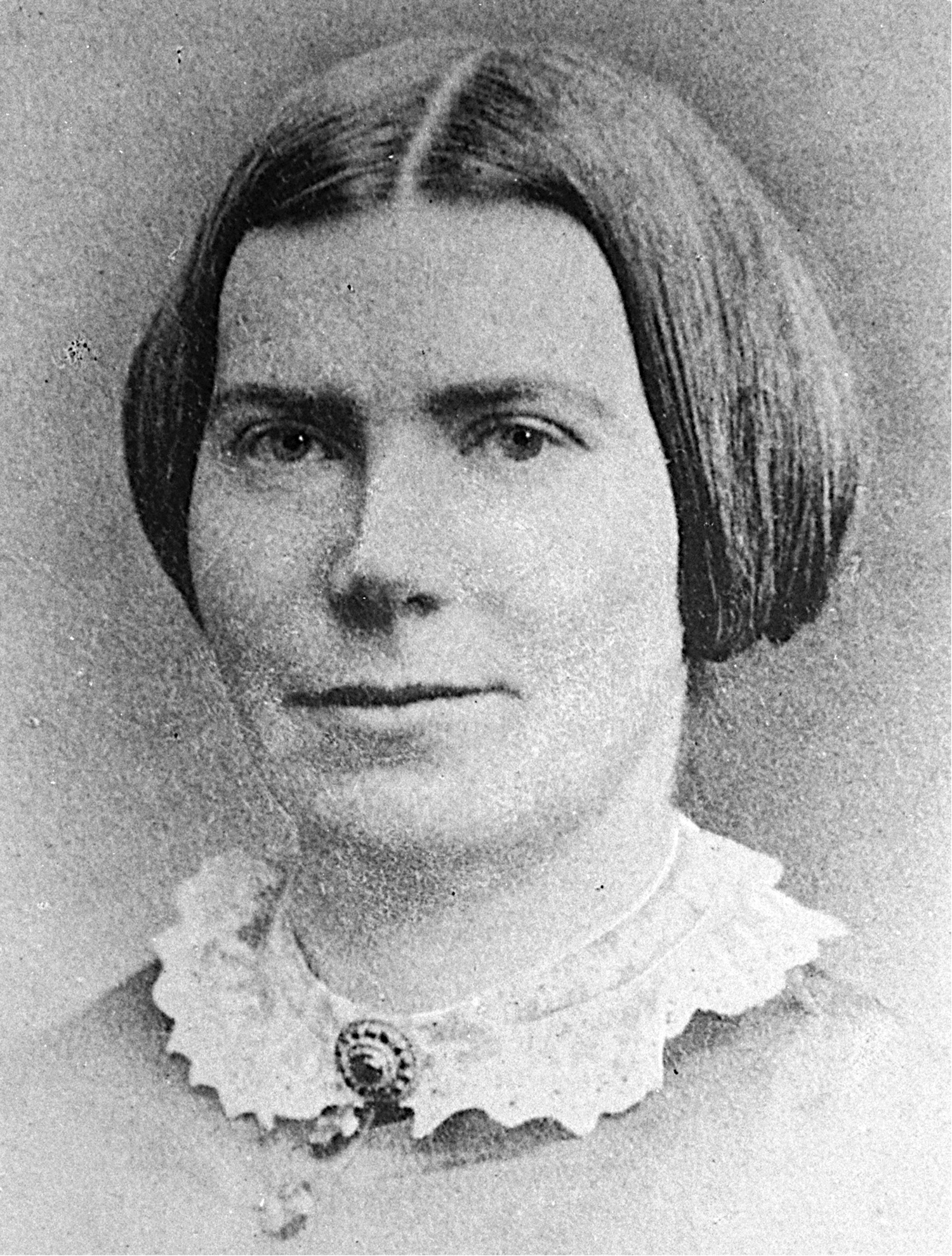
Emily Blackwell about age 27. Courtesy of Schlesinger Library, Radcliffe Institute, Harvard University.
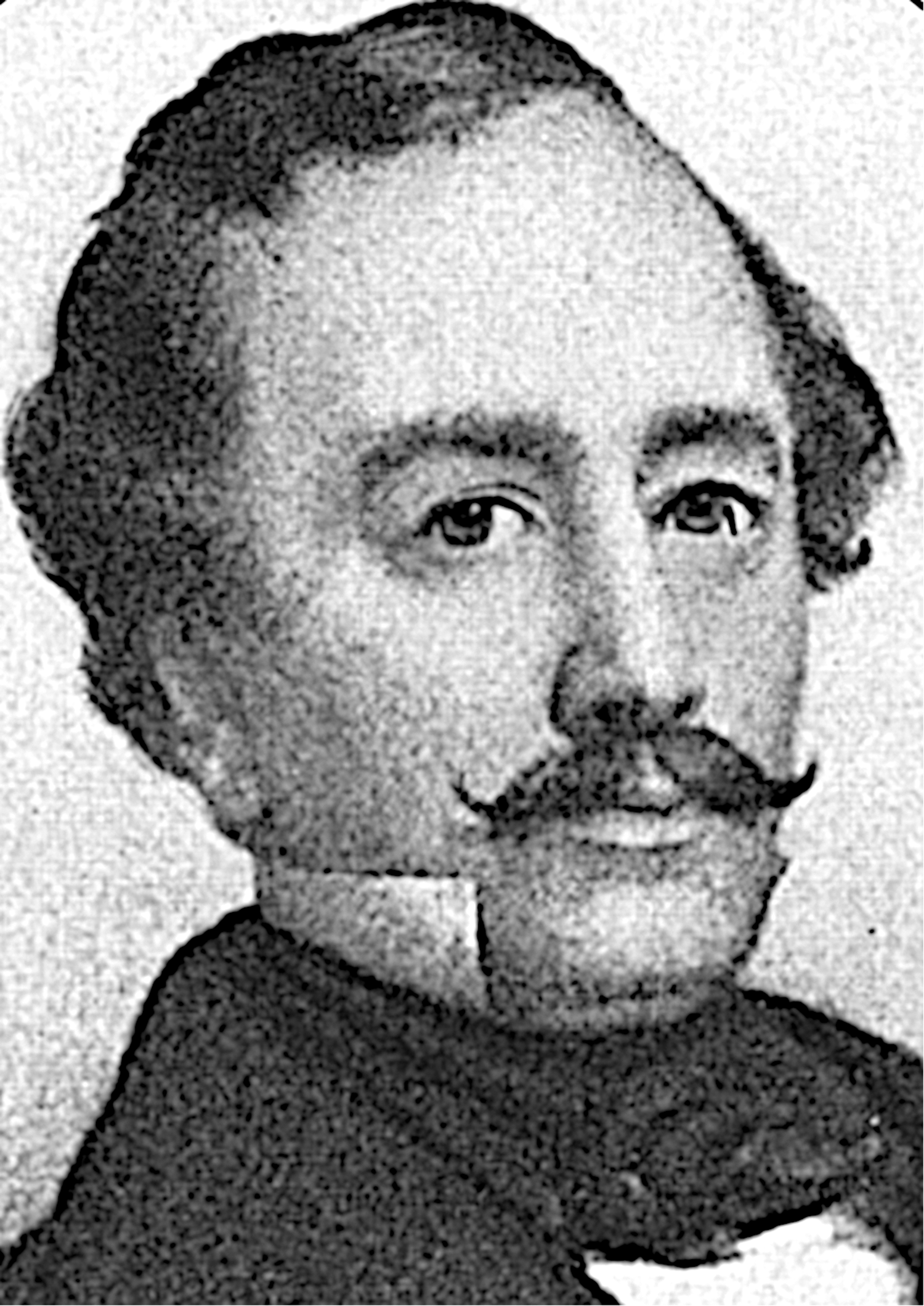
Rush medical college founder Daniel brainard about age 40. From Surgery Gynecology & Obstetrics 1933 January; 56(1):122. Copy courtesy of Rush University Medical Center Archives.
Daniel Brainard became a big part of Emily's life. She had Christmas dinner with the Brainard family. She chatted with him two days later about setting up a medical facility in New York and he shared ideas on how to do it that she passed to Elizabeth. She joined him on hospital visits and helped with an operation on January 8. A week later he asked her to assist him with an operation in front of her classmates. Blackwell wrote that she was thrilled: “I perceived he called me because he thought I should do better than another.” She attended a party on January 20, 1853, where she spent most of the time with Brainard's wife, Evelyn: “Mrs. Brainard pleased me – she is a very sweet pretty character I imagined and we got better acquainted in the corner of the supper room than in any former interview.” 16
But an undefined classroom event the next day made her realize that Brainard had misinterpreted her attention and admiration. The morning started well enough. She accompanied him as he removed a lower jaw exostosis; however: “His afternoon lecture however was a very painful one to me – for the first time I felt as though I ought not to be there, and as though he must have misunderstood my motives – my feelings. Indeed, I think sometimes my frank friendliness – my quiet way of taking things is misunderstood – that I must learn a graver, colder, more reserved demeanor.”
16
The Brainards travelled to New York City in May, where Emily was living in Elizabeth's cramped apartment. Daniel Brainard looked Emily up and, when they talked about medicine on May 7, he reassured her that her academic prospects were solid: “He told me the [Rush] trustees would make no difficulty about my graduation, so my way is clear.” Emily spent time with the couple over the next few days, but always in the company of others. 16
It was a tough summer after this visit. Blackwell wrote: “My opportunities are small, and my position, without retirement, and occupied in providing for every day wants is exceedingly unfavourable for study.” Then things got worse. Brainard wrote on August 21 that he would not be in Chicago the coming winter because of a hastily scheduled European trip. Moreover, it now seemed that Rush might not welcome Blackwell back. She was devastated. His letter removed, “the quiet comfortable sense of my way being open that I have felt since the Dr's last visit. I have begun to write my Thesis, uncertain whether I shall have an opportunity to present it.” 16
Brainard still had an interest in Blackwell and she in him. According to a later article in the Chicago Tribune, Brainard personally told her in late September or early October that the school had decided not to admit any more women but would allow her to graduate. She recorded that he may have been in town on October 7th and came by to see her while she was out. She made a note in her journal that the Brainards sailed to Europe on October 15.16,17
The Tribune article also noted that Blackwell had written confirmation from William Ogden, president of Rush's board of trustees, that she would be allowed to graduate. Julia Boyd's assertion that Blackwell was not surprised when Rush refused her re-enrollment was not correct. Blackwell may have been anxious, but her journal showed that she had Ogden's reassuring letter in hand when she arrived in Chicago on November 27, 1853, to begin the fall session at Rush. She was surprised to learn on November 29th that the trustees had held a closed meeting the day before and refused her enrollment. Nathan Smith Davis had the unpleasant duty of explaining to her on November 30th that “letters had been sent,” which settled the matter. Two days later, she took the morning train for Cleveland, hoping for better luck, writing: “It was best to leave Chicago and its annoyances.”16,17
Emily travelled to Cleveland Medical College (now Case Western Reserve), where she had a different experience. Cleveland decided after Nancy Talbot Clark graduated that, like Geneva, it would no longer accept women medical students, and it was one of the schools that denied Emily in 1852. However, two of the school's founders, sixty-six-year-old John Delamater, who had mentored Brainard when he was a student in New York, and sixty-year-old Jared Potter Kirtland, relented for Emily Blackwell in December 1853. Emily successfully graduated in 1854.
Blackwell's journal suggested that there were personal issues between her and Brainard that might have led to Rush's dismissal. This is hardly irrefutable evidence, but the competing explanation that her treatment was due to outside pressure, particularly Illinois State Medical Society censure, as Charles Earle reported in 1879 and numerous historians have repeated, has no evidence at all. There was considerable prejudice against women physicians by 1879, but in 1853, they were more a curious novelty than a threat. 11 Daniel Brainard was Medical Society president that year and the issue never arose at the group's annual meeting nor in 1854.18,19
There was no hint of outside pressure on Rush in the in the newspapers either; instead, the episode was a well-publicized mystery. The Chicago Tribune reported on November 30, 1853, the same day Emily met with Davis to learn her fate, that Miss B had recently arrived at Rush, with assurances from the faculty of her good standing, to find, “the Medical College closed against her.” The Tribune's sources could find no explanation, particularly an exculpatory suggestion of outside pressure. The editor speculated that the professors or students were not able to handle the stress of a lady among them, but could not come up with a logical justification for such a dishonorable act, demanding: “Whatever the reasons are, we should like to have them.” 20 When Rush did not respond to the Tribune's call, the paper published a letter from a Rush student on December 3, 1853, who wanted it understood that whatever motives the trustees and faculty had for refusing Miss Blackwell, it was not the students’ doing. The editor's conclusion was: “It is very evident there is duplicity and double dealing somewhere. Who is guilty?” 17
The signals point to either an inside maneuver by Daniel Brainard or an inside maneuver against Daniel Brainard. There is no irrefutable evidence in either direction, but Brainard was Blackwell's closest contact at Rush and the common thread in every scenario that might have prevented or caused her dismissal. He was Illinois Medical Society president when the Rush trustees did their deed. He was Rush Medical College's president and a member of the board of trustees. He was conveniently out of the country when things happened.
Elizabeth Blackwell never trusted Brainard again. Emily travelled to England in March 1854, after graduating from Cleveland, and her ship literally passed Brainard's returning voyage during the night. Dr and Mrs. Brainard looked up Elizabeth in New York in April 1854, and Elizabeth's long letter to Emily on April 20 recounting their visit framed the complicated relationship: “But it is too bad that you have missed Dr B. [in Europe], for friendly companionship, as I think he will always give you, is very welcome in a strange country. But “He [Brainard] is just the same queer mixture (he has a yellowish moustache) – told me had never approved of ladies taking up medicine, though saw no reason for opposing it if it did not hurt him – and that he would help if it were for his own interests. He did not think you would have been finally rejected at Chicago, though he says if he had known of Cleveland he would have advised you going there, considering its reputation rather better than his – believes it was a feeling of spite to him that made them [Rush] exclude you, thinking that he had left them & that shows him they could act independently… So you see, dear Emily that all reliance on active aid from him is futile, either here or abroad – and it was fortunate that you have learned somewhat to distrust the Dr”
21
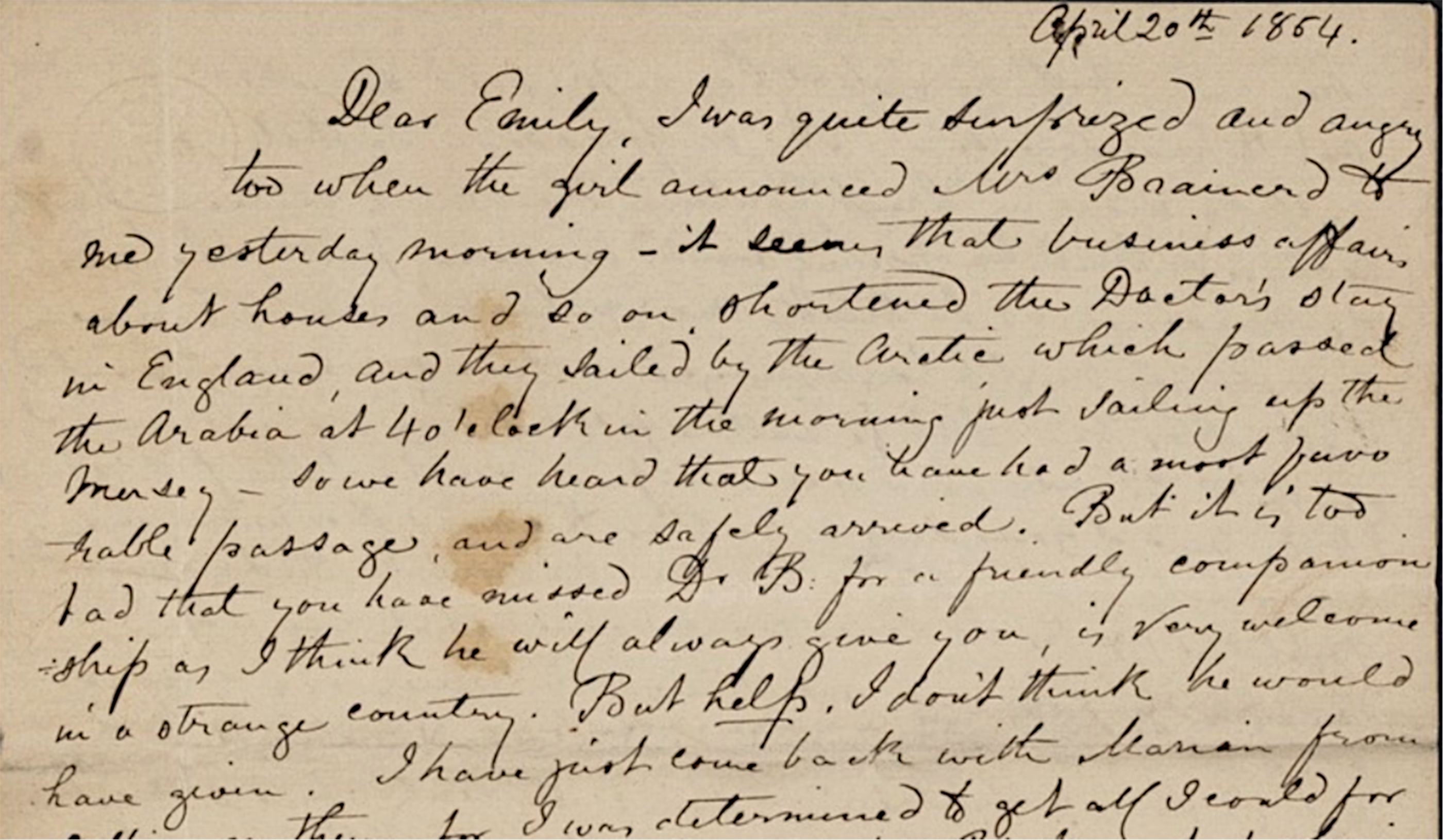
Beginning of Elizabeth Blackwell's letter to Emily on April 20, 1854. She describes her visit with Daniel Brainard and notes her distrust; “But help, I don’t think he would have given.” Courtesy of Schlesinger Library, Radcliffe Institute, Harvard University.
Looking at the evidence from a twenty-first century perspective, Blackwell's classroom discomfort on January 21, 1853 would be enough for a charge of sexual harassment because today's law allows the notion of claimant discomfort to suffice. 22 Emily Blackwell never suggested that Daniel Brainard sexually harassed her, a non-existent legal concept in 1853, but if she were to make such a complaint today, what Rush subsequently did would meet the current standard of illegal retaliation.23,24 However, judging past mistakes by contemporary moral and legal standards dehumanizes the historical actors and facilitates a Whiggish interpretation that the bad old days are behind us. 25 We should want to know more about Brainard and how this episode might have affected medical co-education in America (Figure 3).
Daniel Brainard was a restless and innovative physician, born in New York, who was inspired by Fairfield (New York) Medical College's John Delamater. In 1836, at age twenty-four and with his medical degree in hand, he headed to Chicago, a bustling town of 3500 inhabitants. He sold his pony, started practice in a friend's law office, and pursued his dream of founding a medical college named after Benjamin Rush. Brainard's dream and practice were derailed by the depression that followed the Panic of 1837 and in 1839 he joined a wave of young Americans for two years of study in Paris. 12
After returning from Paris, Brainard re-opened his practice, which proved a success. He was widely recognized as an excellent surgeon and was one of the earliest adopters of ether anesthesia. He re-launched his plans for a medical college, with Rush opening its doors in 1844. Brainard had a keen eye for academic quality and Rush prospered. He enticed Austin Flint to be the new school's first professor of medicine and recruited Nathan Smith Davis in 1849. He died in the cholera epidemic of 1866 at age fifty-four. Rush University honors Brainard today with a named conference room and the Daniel Brainard Award for faculty excellence in the basic and behavioral sciences.12,26
Brainard deserves recognition for starting and maintaining Rush, but during the Blackwell period he was locked in battle with Nathan Smith Davis over Rush's direction. Davis was a student favorite, often called the “Prophet” because of his fixation on educational reform and his sermons against alcohol. Brainard was more flexible personally and professionally, willing to do whatever it took to keep Rush going. There was a bitter sundering of the relationship when Davis left to start a new medical school in 1859, which appeared on the surface to be due to different educational philosophies, with Davis favoring a more rigorous approach. However, the schism had deeper personal roots. Davis did not trust Brainard any more than the Blackwells did. Davis offered his assessment of Brainard's character in an 1866 obituary. He began with appropriate respect: “With feelings of deep sadness we record the death of one of the most prominent surgeons in our country.” But, sandwiched between Brainard's professional and personal accomplishments, Davis gave his true thoughts: “In his unofficial capacity, as a member of the profession, Dr Brainard was not noted for genial affability, scrupulous regard for ethical rules, or cordial cooperation in the support of medical organizations.”12,27
It seems reasonable to make Brainard, rather than unnamed faculty members, the prime suspect in Emily Blackwell's dismissal from Rush, but there is no way to discern a motive from Emily's cryptic journal entry of January 21, 1853 and apparent change in their relationship. Blackwell could have spurned Brainard's romantic advances, and he took revenge. Brainard could have made an awkward remark and felt too uncomfortable around Blackwell to continue with her close presence in Chicago. His wife could have seen his young protégé as a threat and told him to get rid of her, or any other conceivable possibility. But what counted historically was that having hastily dismissed Emily Blackwell in 1853, Rush fixed its path for the rest of the century. There were forty-six regular medical colleges that admitted women students in 1899, including Johns Hopkins, Tulane, the University of Texas, and five schools in Chicago, but Rush was not one of them. 28 Rush did not graduate its first woman doctor until 1903. 29
Rush's visible mistreatment of Emily Blackwell had the paradoxical effect of briefly opening a crucial door in the history of medical co-education. After Emily successfully graduated from Cleveland in 1854, Delamater and Kirtland pushed their school to admit and graduate four other women by 1856. One of these was Marie Zakrzewska, who helped Elizabeth and Emily Blackwell establish the New York Infirmary for Women and Children and later founded The New England Hospital for Women and Children. Another was Cordelia Green, successful physician and even more successful proprietor of the Castile Sanitarium in Western New York for forty years. The next generation of Cleveland Medical College leaders closed the door to women after 1856 and it would not reopen until 1919, but the small burst of Cleveland's women graduates between 1852 and 1856 helped cement Elizabeth Blackwell's 1849 accomplishment.30,31
Footnotes
Declaration of conflicting interests
The author(s) declared no potential conflicts of interest with respect to the research, authorship, and/or publication of this article.
Funding
The author(s) received no financial support for the research, authorship, and/or publication of this article.
