




Abstract
Here we present newspaper accounts from the Sussex Advertiser to consider hitherto largely unknown Brighton doctors active between 1800 and 1809. This body of physicians, surgeons and apothecaries comprised Brighton's ‘Gentlemen of the [medical] Faculty’, whom the newspaper also dubbed the ‘Disciples of Aesclepius’. Members are considered under three broad categories. First, are Brighton-based clinicians (Mr Barratt, Mr Bond, Charles Bankhead, Thomas Guy, John Hall, John Newton, Benjamin Scutt and Sir Matthew Tierney). Second are London clinicians, probably in attendance to the Prince of Wales (John Hunter and Thomas Keate), More widely, two dentists (Dr Durlacher and Mr Bew) and two Royal Navy surgeons (Robert Chambers and Thomas Thong) also recorded at Brighton are considered. Other aspects of medical life are described: recruiting an apprentice, anatomy training at Joshua Brooke's London museum, midwifery, a description of a surgeon's bag and the last reference to the Royal Sussex Jennerian Society (which disappears from the newspaper record in 1807). Clinical cases described include: resuscitation from near-drowning, post-mortem examinations, death from the ‘gravel and stone’ and accounts of suicide. The primary sources presented in this paper offer rare glimpses into medical life in Brighton at the very start of the nineteenth century.
Introduction
Until the mid-eighteenth century, Brighton (then known as Brighthelmston or Brighthelmstone), on the south coast of England, was a remote fishing village. Its low status stood in stark contrast with the more fashionable and nearby county town of Lewes, an observation captured in the following eighteenth century proverb: “Proud Lewes and poor Brighthelmston”. 1 The development of this impoverished village into a burgeoning seaside resort was in part due to the promotion of sea bathing therapy there by Dr Richard Russell (1687–1759). 2 It is of note that Brighton was of fame around this time for its air as much as its water:
“The air of this place [Brighthelmston], being strongly impregnated with sea-vapour, is exceedingly healthy. In the hottest weather, the refreshing breeze is always found here. The inhabitants are remarkably robust, and strangers to coughs, and all disorders of the lungs. Asthmatic and consumptive patients, and valetudinarians, in general, find the greatest relief from this air: physicians esteem it to be excelled by that of few places in the kingdom” 3
Much has been written about (or by) key medical figures in Brighton's early days. These individuals are largely remembered for their promotion of sea/mineral water therapy or their association with the military and royalty: Richard Russell, 2 Anthony Relhan (c.1715–1776), John Awsiter (1732–1801), Sir Lucas Pepys (1742–1830), Robert Henderson (d1808), 4 Sir Matthew Tierney (1776–1845), 5 William Chambers, 6 William Taylor 7 and Sake Dean Mahomed (1759–1851). This article, instead, exploits previously untapped primary sources to consider hitherto largely unknown Brighton doctors. Indeed, for a few individuals considered below even their first name remains unknown. Through such ‘glimpses’, this article seeks to start the process of developing a broader historical picture of the practice of medicine in Brighton at the beginning of the nineteenth century.
Primary sources
Local news sections of the Sussex Advertiser focused on the following themes: royalty and high society, military news (regimental movements and parades), crime and rule breaking (e.g., prosecutions, smuggling and suicide), coincidences and accidents (e.g., fires, falls, drowning, vehicular injuries), farming and fishing, sport and rural pursuits (e.g., horse racing, fox hunting, cricket, bellringing) and marriages and deaths. The unnamed author(s) of this section – probably editors Arthur (1759–1824) and William Lee (1747–1830) - reveal a penchant for pleasing anecdotes, close shaves with disaster, longevity, rural life, record-breaking accounts (especially livestock and plants exceptional in their size or hyper-fecundity) and, unusually, the activity of local medical practitioners. The writer(s) sometimes bestow grand titles upon bodies of distinguished local people: in this vein, Brighton doctors are dubbed “Gentlemen of the Faculty” and “Disciples of Aesclepius”.
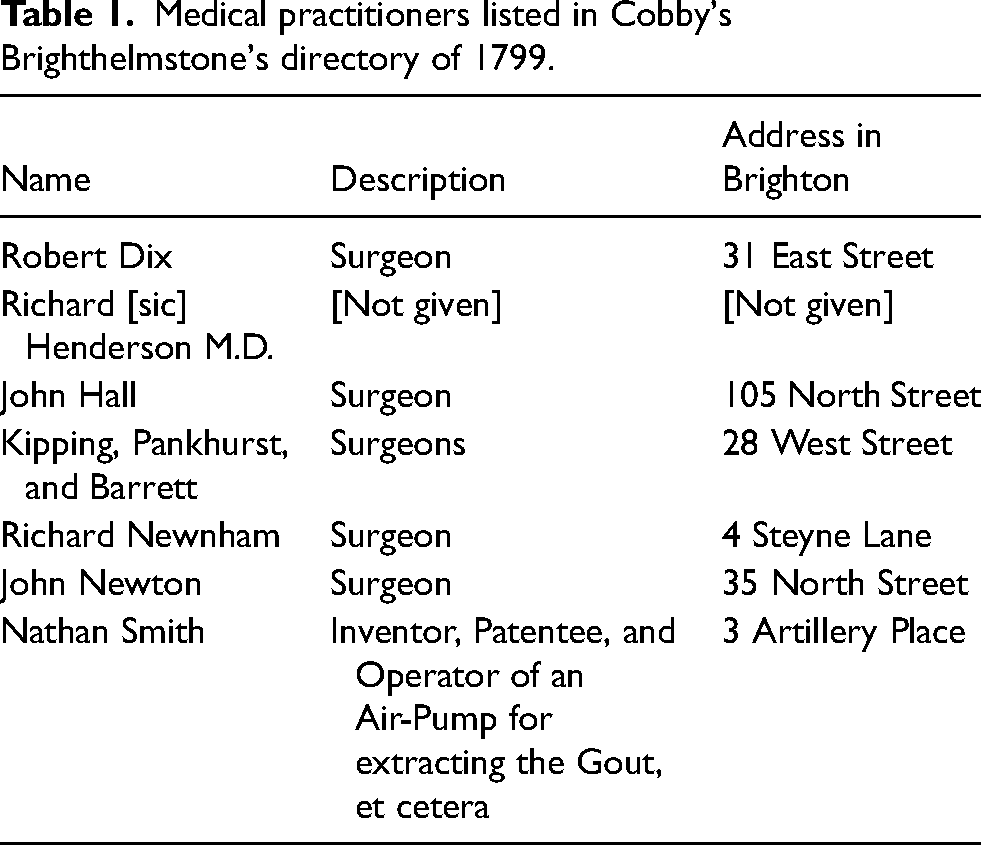
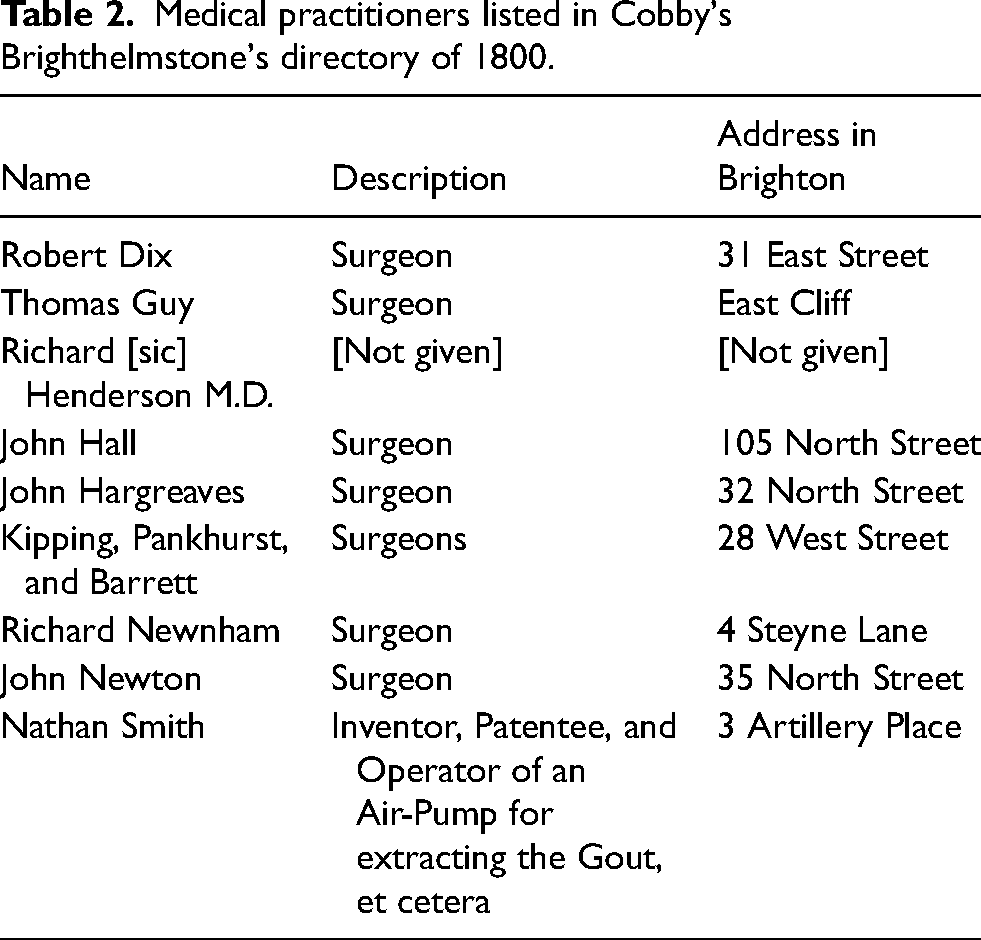
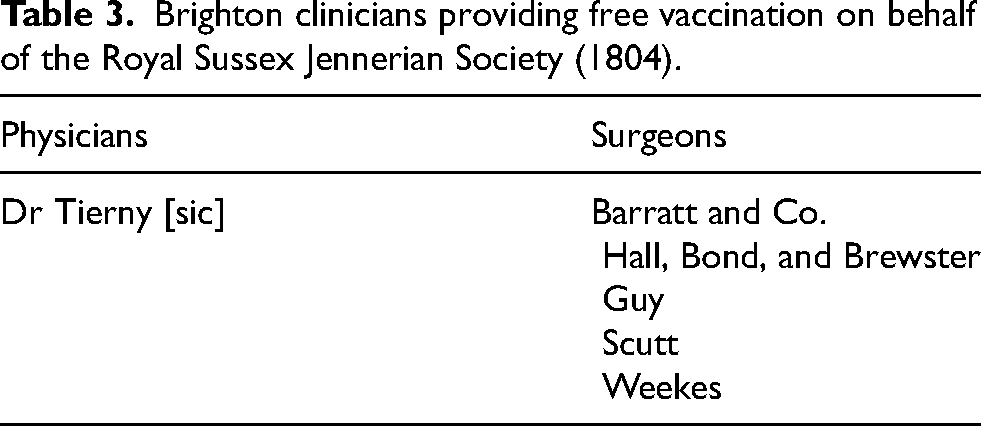
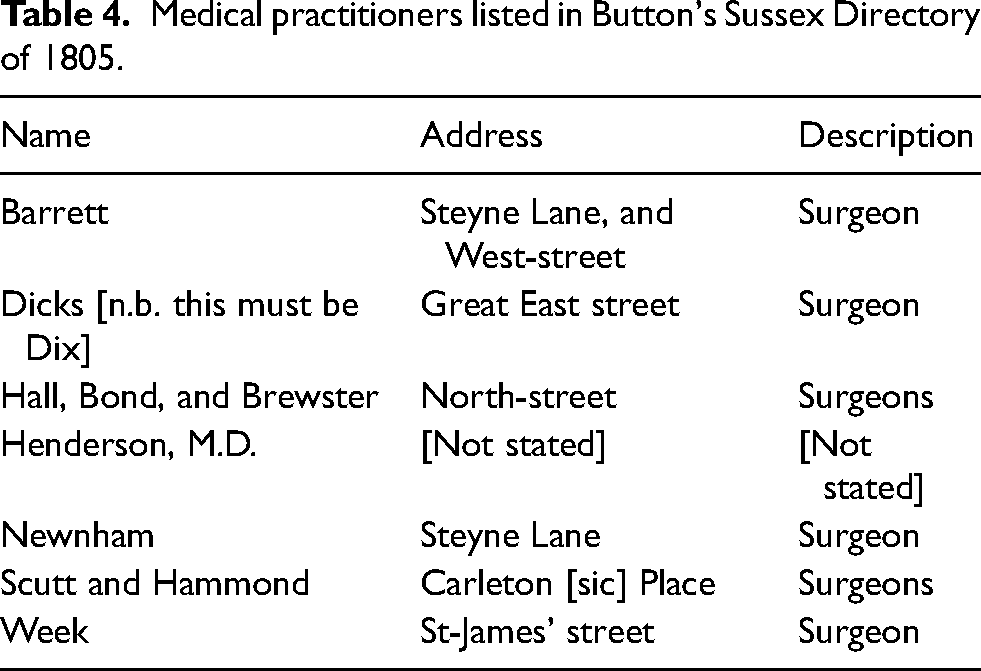
Members of the Brighton medical faculty appear to fall into three overlapping categories. First, are Brighton-based clinicians (Mr Barratt, Mr Bond, Charles Bankhead, Thomas Guy, John Hall, Mr Newton, Benjamin Scutt and Sir Matthew Tierney). Second, are two London clinicians both probably in attendance to the Prince of Wales (John Hunter and Thomas Keate). A third category comprises practitioners whose presence in Brighton appears to be transitory: two dentists (Dr Durlacher and Mr Bew) and two Royal Navy surgeons (Robert Chambers and Thomas Thong). Wider aspects of medical life are then presented. A summary of Brighton doctors listed in contemporary directories is included in Tables 1 to 4.
Medical practitioners listed in Cobby's Brighthelmstone's directory of 1799.
Medical practitioners listed in Cobby's Brighthelmstone's directory of 1800.
Brighton clinicians providing free vaccination on behalf of the Royal Sussex Jennerian Society (1804).
Medical practitioners listed in Button's Sussex Directory of 1805.
Brighton-based clinicians
Mr Barratt
Mr Barratt is documented as practising at 28 West street, Brighton, in the firm of Kipping, Pankhurst, and Barrett (see Tables 1 to 4). His surname is spelled in various forms across sources. Mr Barratt's first newspaper reference relates to a near drowning and shows his awareness of contemporary resuscitation methods:
“On Wednesday last a man, servant to Mr Otto, of the Royal Crescent, Brighton, was seized with the cramp and sunk, whilst bathing in the sea, under the East Cliff at that place. Being an expert swimmer and diver, his disappearance for a while was disregarded by a number of other men bathing near him; some of them, however, at length approached the spot where he went down, and took him out of the water under a total suspension of animation; but the means recommended by the Humane Society, being perseveringly used by Mr Barret [sic], the man was happily restored to life, and to his friends” 8
The second reveals that Mr Barratt held a royal appointment. This highlights that the Prince of Wales appointed local clinicians alongside those he brought from London:
“The PRINCE happening to ride up North-street, at the time of the above last mentioned accident [a boy falling from a building], his Royal Highness with that kind-ness of heart, for which he is as distinguish-able as for his elevated situation in life, made himself acquainted with the circumstance, and immediately went in person to Mr Barratt, his Royal Highness's surgeon at Brighton, whom he ordered to attend the unfortunate lad, and administer to him every relief and comfort which laid [sic] in his power. - We understand his Royal Highness also made the young man's mother a present in money to enable her the better to provide for her son during his illness. 9
An advertisement also reveals Mr Barratt as a referee for a house maid in 1808:
“WANTED
BY a Young Person, a Situation in a genteel Family, either as Lady's Maid, or as an Attendant on an elderly Lady.
Reference, which she hopes will prove in every respect satisfactory, may be made to Mr Barratt, Surgeon, Brighthelmston” 10
Dr Charles Bankhead (1767–1859)
Bankhead was an Irish physician who was appointed physician extraordinary to King George III in 1816. 11 Munk's roll states that Bankhead moved to Brighton in about 1807, however, the evidence shows that he was associated with the town as early as 1804:
“We have great satisfaction in communicating to the numerous friends of Sir Edward Winnington, and to those of the noble family of FOLEY, that the eldest son of Sir Edward, who has been confined, during the last fortnight, in a dangerous fever, is now pronounced out-of-danger, by Dr Bankhead, the physician from Brighton, who attend him” 12
His ongoing association with Brighton is indeed emphasized in 1807:
“At a meeting of the Royal College of Physicians, in London, on Thursday last, Dr Bankhead, of this town, was admitted a Licentiate of that learned body” 13
Mr Bond
Mr Bond practised in North street in the firm of Hall, Bond, and Brewster (see Tables 3 and 4). In 1807 Mr Bond is noted as operating on a surgical colleague Mr William Attree (1780 −1846), an event which we present in detail within a separate article under submission to this journal. The following year an account of death by drowning mentions Mr Bond's surgery and highlights risks associated with the much-vaunted benefits of Brighton sea water. It also underlines widespread faith in the practice of bloodletting, presumably here in the belief that it served to extract fluid from the lungs:
“The dangerous, but too prevalent custom of inexperienced bathers venturing beyond their depth, had on Saturday nearly deprived two servants of their existence; one who belongs to Mr. Dolman, being below the rocks opposite the Marine Library, endeavoured to touch ground and immediately sunk; his companion, however, succeeded, at the hazard of his own Iife, by timely plunging to his aid, in saving him; when brought on shore he was in so exhausted a state, that it was found, requisite to convey him to the surgery of Messrs. Hall, Bond, and Brewster, when after losing some blood, he returned home in a considerable state of recovery, to ruminate on the dangerous effects of his imprudence” 14
In the following accounts it is clear that Mr Bond's clientele included nobility:
“The blooming children of Lord and Lady Ellenborough, under the skilful management of Mr Bond, have now nearly recovered from the enervating[?] effects of the meazles; a malady, which we are concerned to observe, has proved fatal, during the last week, in many parts of this town” 15
Mr Bond is noted in 1803 operating (under Dr Bankhead's watchful eye) upon the Duke of Bedford. It is noteworthy how freely the newspaper authors reveal causes of death of local people, including the nobility:
“We have great pleasure in being enabled to state, for the sake of humanity, that, within the last fortnight, a remarkable instance has occurred at Rottingdean, of the happy effects resulting from a timely and judicious operation, in an aggravated case of Hernia. This disorder, (at all times formidable), has, in these days, attracted more general attention from having caused the melancholy death of the late worthy and benevolent Duke of Bedford. The case to which we allude, was under the management of Mr Bond, Surgeon, in Brighton, who performed the operation in the most skilful and circumspect manner, in presence of Dr Bankhead, and several of the faculty; and has been attended with the most fortunate issue, the patient, (who is the father of a small family) being now completely re-covered” 16
Mr Thomas guy
Thomas Guy is recorded as practising at East Cliff (see Image 1 and Tables 2 and 3). Mr Guy is revealed in two instances assisting and observing an operation undertaken by William Chambers, regimental surgeon to the 10th Royal Dragoons. Both descriptions below highlight how often surgical procedures were undertaken in the presence of another doctor, presumably for educational purposes:
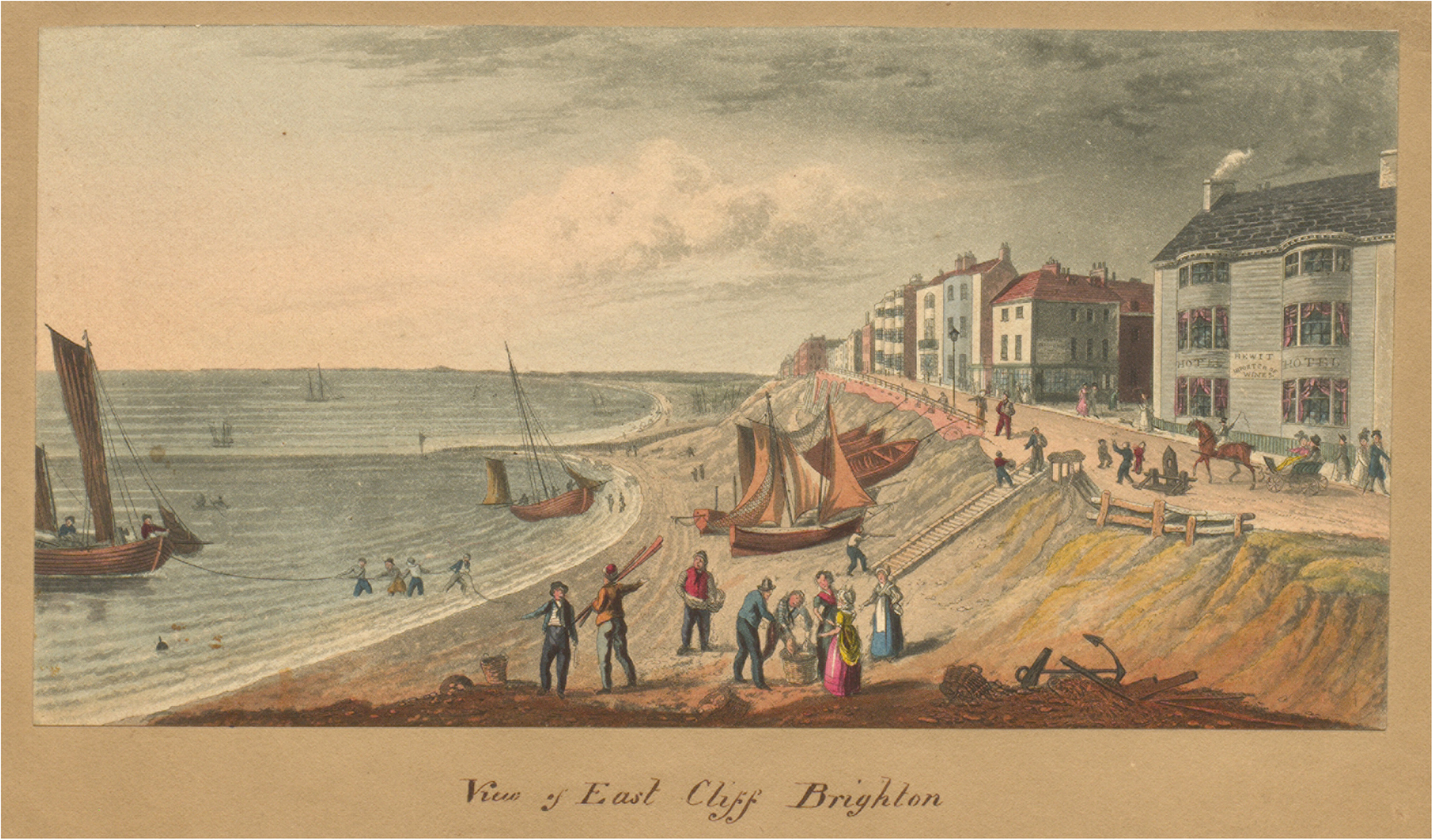
View of East Cliff Brighton, 1825. Near here was the surgery of Thomas Guy. It was at East Cliff that Mr Otto nearly drowned, leading to his resuscitation by the surgeon Mr Barratt. Courtesy of the Royal Pavilion & Museums, Brighton & Hove.
“A private of the Prince's regiment of Light Dragoons, had, on Saturday last, one of his arms amputated, in Brighton Barracks, in consequence of hurt he some time since received from the bite of a monkey. The operation was performed by Mr Chambers, surgeon extraordinary to the PRINCE of WALES, and principal surgeon to his Royal Highness's regiment, assisted by Dr Guy. Most of the surgical gentlemen of Brighton, attended the operation” 17
“A young woman of Sompting, near Worthing, last week suffered amputation of one of her legs, in consequence of a white swelling on her knee, of upwards of seven years standing. The operation was performed by Mr Chambers, surgeon, attended by Mr Taylor, his assistant, in the presence of Dr Bankhead, an eminent physician, Mr Guy, of Brighton, and several other professional gentlemen 18
Mr John Hall
Mr Hall practised from 105 North street (see Tables 1 to 4) and is mentioned in just one reference, again relating to resuscitation after near drowning. This suggests that drowning was not an uncommon event in Brighton and one that local surgeons prepared themselves to address through contemporary ideas. Unfortunately, these techniques are not described:
RESUSCITATION - Last Wednesday as Mr Ireland, linen draper, in North street, was bathing in the sea, at this place, he imperceptibly got out of his depth, and being but an indifferent swimmer, was stricken with fear, and sunk. The circumstance being observed by a soldier of the South Gloucester Militia, who was also bathing, he hastened to his assistance, and in his humane attempts to save him, had nearly lost his own life, from the difficulty he experienced in disengaging himself from the drowning man, whom he had brought up by diving, and whom self-preservation compelled him to abandon until he was aided in his exertions, by two other men, who together succeeded in recovering the body, after it had lain about five minutes under water, when it was taken to shore, but without any apparent signs of life. No time was lost in conveying the body to Mr Smith's, in North-street where Mr Hall, surgeon, assisted by Mr John Smith, and others, exerted themselves in the application of the means recommended by the Humane Society, and with the happiest effect as in about half an hour symptoms of returning animation appeared, and increased, until at length Mr Ireland was perfectly restored to his friends, and to society, of which he is a deserving member. As the circulation quickened, Mr Ireland suffered great pain, and in consequence expressed a wish to die; but he has not the smallest recollection of any painful sensation at the time he was sinking” 19
Mr John Newton
Mr Newton is recorded in one local directory as practising from 35 North Street, Brighton (see Tables 2 and 3). Nothing more is known about his life. His death in London is reported in 1804. This points to Newton having served in the war between Sweden and Russia during the period 1788 and 1790:
“On the 30th ult. died, in a private asylum on Bethnal Green, Mr Newton, formerly and eminent and skilful [sic] Surgeon, in Brighton - He was chosen (in the late war between Russia and Sweden) by the Duke of Sudermania, as an Assistant Surgeon on board his ship, and was in the heat of the engagement in the Gulf of Finland, and at the time the late King of Sweden was nearly taken prisoner by the Russians” 20
Dr Benjamin Scutt
Mr Scutt was associated with Carlton Hill (see Tables 3 and 4), an area of Brighton described thus:
“Carlton Hill is a steeply rising road that once ran through one of the poorest areas of Brighton. Most of the land was owned by Dr Benjamin Scutt and between 1804 and 1808 he sold it for housing and concentrated on building nearby Carlton Terrace.” 21
One advert offers insight into the Scutt household there:
“WANTED,
A Good Plain COOK, and two sturdy HOUSE MAIDS.
Apply to Mrs. B. Scutt, No. 8, Carlton Place, Brighton.” 22
Sir Matthew Tierney and the Royal Sussex Jennerian Institution
Sir Matthew John Tierney (1776 − 1845) was an Irish physician who learnt vaccination directly from Edward Jenner. His name is recorded in Table 3 and later in the legacies of British slavery database:
“Royal physician, of Brighton and Bruton St, claimed with his wife Dame Harriet Mary nee Jones (q.v.) and brother Edward Tierney (q.v.) and his wife Anna Maria Jones as creditors of the Douglas estate on St Kitts. 23
Despite his legacy above, Tierney appears to have been held in affection by the Sussex Advertiser, the people of Brighton and his own regiment. The first illustrates how doctor fees are only mentioned in these accounts where they have been waived:
“During the recent maladies of the meazles [sic], &c, which raged in this town, and in many parts fatally, we conceive it a duty incumbent on us to notice, the successful, as well as humanely, benevolent practice of Doctor Tierney. His success, however, has been but the natural concomitant of his skill - but his systematic refusal of his well-merited fees, where an acceptance of them he has considerately supposed would subject such as proffered them to temporary difficulties, does honor to his heart for genuine worth and feeling, and enhances his character as a Man” 24
Unfortunately, the account above offers no description of the services provided by Tierney for patients with measles, in particular if these comprised medication or included any public health measures. The following quotation highlights the overlap in contemporary between medical practitioners, the military and high society:
“On Saturday last, after the dismissal of the evening's parade, which, from the fineness of the weather, was numerously attended; the band of the South Gloucester Militia enlivened the enclosed part of the Steine, and having taken their station opposite Dr Tierney's house, continued playing the most popular airs and pieces of music, till considerably after nine o’clock, while the promenade, without the enclosure of Donaldson's Library, was completely filled with groups [sic] of elegant females, officers, and the sprinkling of other fashionables” 25
Tierney's marriage in 1808 is also noted:
“MARRIED. On Saturday, the 8th instant, at Chiswick Church, by the Rev. Inigo Wm. Jones, Dr Tierney, of Brighton, to Miss Jones, of Turnham Green” 26
Tierney is also noted for founding in 1804 the Royal Sussex Jennerian Society for the Extermination of the Small-pox. 5 This was the first countywide (rather than urban) vaccine centre. Its function probably ceased after the inception of the Brighton dispensary (and other regional hospital services) that took over the function of providing free vaccination. The evidence shows that the institution was still in operation on 1 August 1807 27
London clinicians in attendance at Brighton
John Hunter
This appears to be the Scottish physician John Hunter (died 1809) by dint of his appointment as physician extraordinary to the Prince of Wales 28 Dr Hunter is noted at one of the post-mortem examinations described later. He was also present at a road traffic injury at the Old Steine (see image 2) accompanied by Dr Thomas Blair, physician of Lewes:
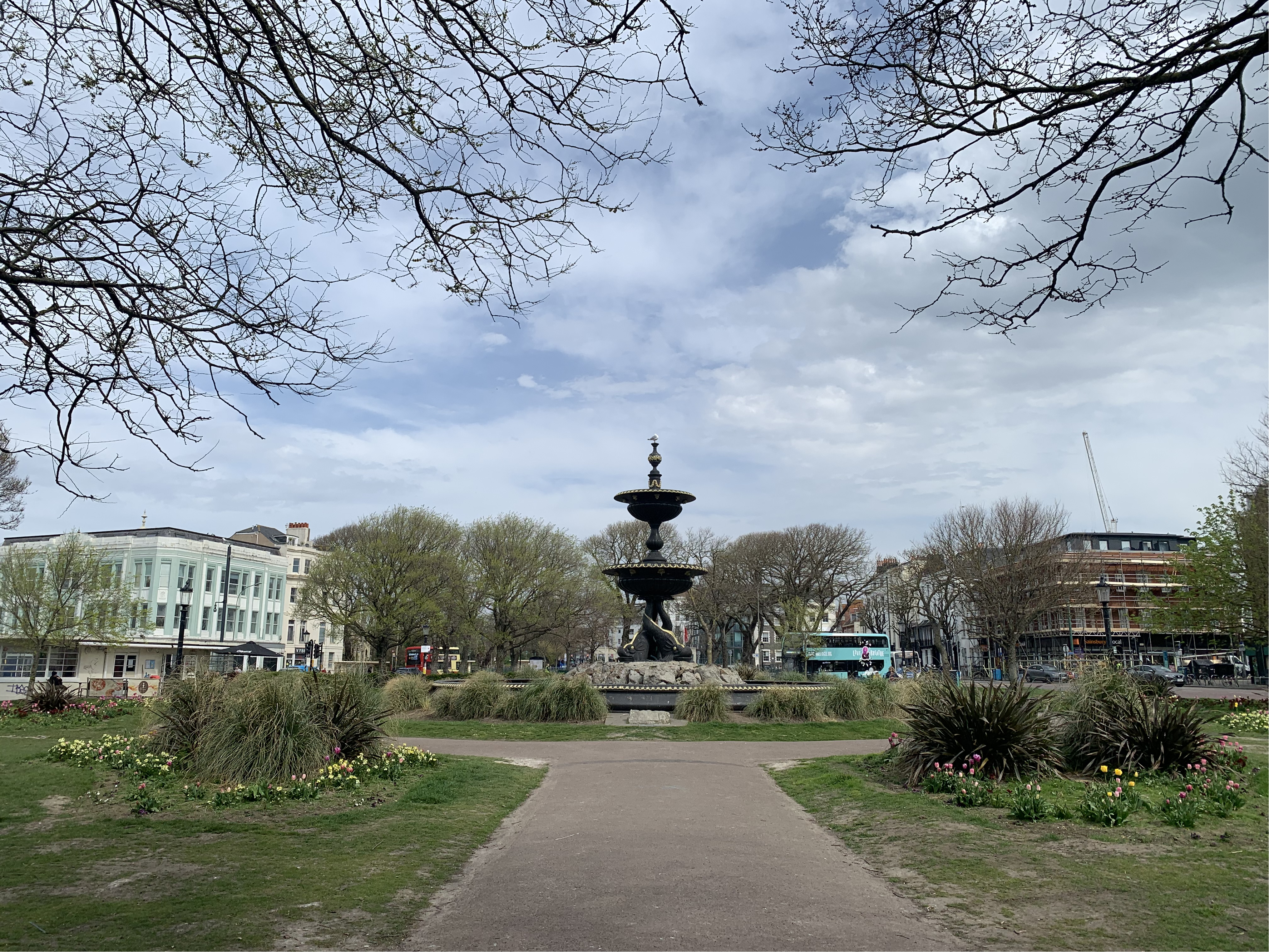
The Old Steine, Brighton – an area beside the Royal Pavillion and associated with the medical faculty of Brighton (image by Carl Fernandes, April 2022).
“On Thursday last, about four o’clock in the afternoon, as a barouche drawn by four fine horses, was turning the angle of the Steine near the North Parade, the leaders beat down a woman with a young child in her arms, and went completely over them. The coachman, who had all four in hand, with a deal of presence of mind and skill, stopped the horses before the wheel ones had trod upon either woman or child; and they were both, almost miraculously dragged from under the feet of the animals, without material injury. Drs Hunter, and Blair, who were both casually present, humanely examined the mother and child, and reported to the ladies in the barouche (who were greatly affected by the accident) that they received no serious hurt” 29
A further reference shows Hunter working in conjunction with Drs Blair and Hunter and Mr Hall:
“It is with sincere regret, that we have now to add another great name to the mournful list of eminent men, whom England has lost, within the compass of a few months. The Right Rev. Dr Samuel Horsely, LORD BISHOP OF ST ASAPH, having expired here, on Saturday last… Though he was upwards of 70, yet, the activity and strength both of his body and mind, gave reasonable grounds for hoping he might still have been spared to his country and friends, for some years longer. His disease, we believe, was of a bilious nature, and of very short duration, as his Lordship was seen walking on the Steine, on Wednesday last; but all that medical skill could administer for his relief was, beyond doubt, afforded him, under the care of three such men as Doctors Hunter and Blair, and Mr Hall, who were his attendants” 30
Thomas Keate
Keate (1745−1821) studied at St George's Hospital and succeeded John Hunter (1728–1793) as surgeon-general to the Army. 31 Keate became surgeon to the Prince of Wales and it is likely that he accompanied the Prince on Brighton sojourns:
“One of the poor men who lately fell from a scaffold, at Brighton, and thereby had his skull much fractured, was a few days since trepanned by Mr Keate, surgeon to the PRINCE of WALES; and we understand is likely to do well” 32
Royal Navy surgeons
Two references to Royal Navy surgeons are noted as below. Again, one is a case of suicide:
“Robert chambers, Esq. assistant Surgeon in His Majesty's gun-brig Strenuous, lately off Brighton, is appointed full Surgeon to the Nautilus sloop of war, now fitting for service, at Chatham” 33
“On Wednesday Mr Thomas Thong, surgeon of his Majesty's ship Port Mahon, in a fit of insanity, cut his throat with a razor in such a dreadful manner, that he expired immediately afterwards. His remains were brought on shore, and interred in our church yard” 34
Wider aspects of medical life
Services for teeth and feet
These advertisements point to gaps in the services provided by the Brighton medical faculty, namely dentistry and podiatry. It is likely that both surgeon dentists were in attendance from London, hence the need in the first advertisement to mention approval from Brighton's medical faculty. The first reference describes a Mr Bew practising at Ship Street Garden (see image 3): “UNDER THE PATRONAGE OF THE FACULTY
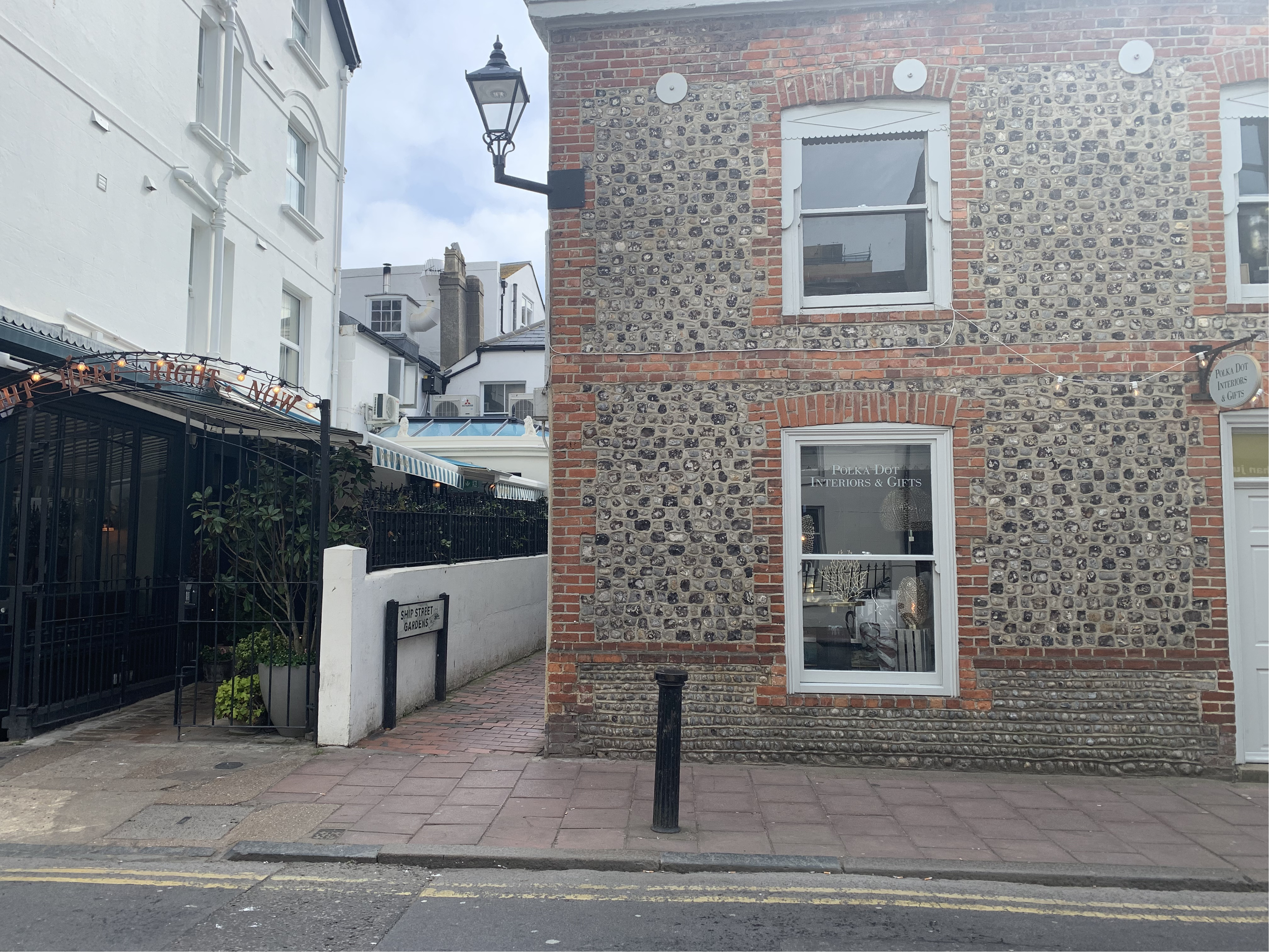
Ship Street Gardens, a twitten (i.e. alley way) in central Brighton; its name hints at proximity to the ‘3 Ship Street Garden’ of Surgeon Dentist Mr Bew. His prostheses were advertised as being so good that ‘where losses by accident or time are supplied with substitutions in which Nature and Art are so happily blended as to baffle discovery in the keenest observer’. Photograph by Carl Fernandes April 12th 2022.
PERSONS labouring under TOOTH ACHE, or diseases in the TEETH and GUMS, may find a speedy and safe relief by application to Mr Bew, Surgeon Dentist, No. 3 Ship-Street Garden, where losses by accident or time are supplied with substitutions in which Nature and Art are so happily blended as to baffle discovery in the keenest observer…” 25
The second is a Dr Durlacher of London: “CORNS ERADICATED!
“DR DURLACHER
CORN OPERATOR, AND SURGEON-DENTIST
NO 2, Orange-Street, Leicester Square (late Long Acre) London
TAKES the liberty to inform the Nobility, Gentry, and Public, that he has arrived at No. 5, Cumberland Street, Brighton, where he attends to eradicate CORNS of every species, in a few minutes, without the least pain. Also, ease immediately given to NAILS that are grown into the Flesh, without pain.
Real, or Artificial TEETH made, and securely set without inconvenience – Teeth cleaned in a superior style, and when necessary extracted with ease – Instantaneous relief given to the TOOTH ACHE.
Ladies and Gentlemen attended at their own houses. Letters, or messages punctually attended to” 35
Midwifery
Two mentions of midwifery were noted. The first was part of an advertisement for a parish doctor in 1807:
“It is intended that the said Tender shall include Surgery and Midwifery, and also the dispensing such prescriptions as may be ordered by any Physician, at the request of the said Parish Officers.” 36
The second hints at the significant increase in Brighton's population at this time. Rather than pointing to arrivals for reasons of health, high society and military secondment, the author blames the attire of Brighton women:
“The Gentlemen of the Faculty, to whom the practice of MIDWIFERY is, WITHOUT A BLUSH, confined here, have within the last twenty years, experienced a considerable increase of BIRTHS; and this they, with good reason, attribute to the females judicious abandonment of STIFF STAYS and TIGHT LACINGS!!” 16
Advertising for an apprentice and anatomy training in London
That the apprenticeship approach to training was widely practised in Brighton can be deduced from numerous advertisements seeking apprentices to apothecary-surgeons. These highlight the necessary financial imperatives of working in medicine at this time, i.e., the close link between medical education in the apprenticeship model and remuneration.
No sum for this service is mentioned but is likely to have been significant given that the 1808 advertisement below describes a ‘handsome premium’. This advertisement is also of note as it highlights the close relationship between master and apprentice, presumably to increase revenue and to protect professional secrets within medical families:
“WANTED IMMEDIATEY, AN APPRENTICE to a Surgeon and Apothecary, in a respectable situation on the Coast of Sussex. As he will be treated like one of the family, a handsome premium is expected. Enquire of the Printers [of the newspaper]” 37
Apprenticeship advertisements tended not to reveal the name of the surgery or even the relevant town, for instance stating “in the country”. There is also evidence of networks between doctors across counties: “WANTED
AN APPRENTICE to a Surgeon and Apothecary in a Market Town, on the Brighton road, distant 21 miles from London; a youth of respectable connections, from 14 to 16 years of age. A premium will be expected.
For further particulars enquire of Mr Steel, Reigate; Dr Bankhead, Brighton; or Messrs. Chamberlin and Rugg, Fleet street” 38
It is of note that the only references to formal medical education identified were two advertisements for Joshua Brooke's (1761−1833) FRS anatomy school on Great Marlborough Street, London. In the nineteenth century, medical education in Brighton was closely linked to London. 39 This relationship is evident in these two advertisements for Brooke'smuseum and lectures in anatomy, physiology, surgery as well as dissection. One describes teaching through weekly “Anatomical Converzationes…. when the different subjects treated of will be discussed familiarly, and the Students’ views forwarded”, 40 a method which hints at a modern interactional approach. They also convey a notion of a new kind of trainee: “pupils” (in contrast with more traditional “apprentices”).
“THEATRE OF ANATOMY, BLENHEIM-STREET, GREAT MALBOROUGH-STREET, MR BROOKES will commence his Autumnal Course of LECTURES on ANATOMY, physiology, and Surgery, on Monday, the 3d [sic] of Octo-ber, at two o’clock in the afternoon. An Apprentice, or a Pupil, may be accommodated in the house. Spacious and commodious apartments [sic] thoroughly ventilated, and fitted to the purposes of dissecting, and injecting, are open early in the morning, where Mr Brookes attends" 41
The practice of post-mortem examination
Newspaper entries indicate that post-mortem examination was not uncommon in Brighton at this time:
“Two females who lately died here, of complaints not well understood by the faculty, were afterwards opened, when it appeared that the death of one of them was caused by an inflammation of the kidneys; and of the other, by an ossification of the valves of the heart” 42
The second includes reference to Henry, 3rd Viscount (1761–1808) MP of Firle place, Sussex. The entry suggests that he too had undergone post-mortem examination:
“DIED. Suddenly, at his house on the West Cliffe, after taking a ride to the Devil's Dyke, about four o’clock on last Wednesday afternoon, Sir George Pauncefort, Bart. of Russell-Square, London, aged 56. The body of the deceased was opened by Mr Barrett, in the presence of Dr Hunter, when the cause of dissolution became apparent in a cancer which had destroyed a part of his stomach. The late Lord Gage died of the same complaint. The Baronet's title and estate, we understand, devolve to Captain Bloomfield, of the Royal Navy.” 43
A surgeon's bag
A glimpse into the accoutrements of a contemporary surgeon can be gleaned from the advertisement below. This brief description and the bag's location hint at a ‘shoe leather' role of contemporary surgeons, i.e., portable equipment for operating in patients’ homes:
A MOROCCO CASE of SURGEON'S INSTRUMENTS
WAS picked up a short time since on the road between Lewes and Brighton. The owner, by applying to Mr Arthur Lee, giving a description of the contents of the case, and paying for advertising, may have it again” 44
A case of suicide at sea
A sad case of suicide in 1802 reveals insight into life in Brighton as a seaport:
“On Monday last, about ten o’clock in the forenoon, Mr Ford, a free merchant of Calcutta, and (with his four children) a passenger in the homeward bound East Indiaman the Anna, from Bengal, in a fit of desperation, cut his throat in a shocking manner, with a razor, as he was about to leave the ship to go on shore at Brighthelmston, and to which place he was, nevertheless, with dispatch conveyed in a lugger, where on being landed, a surgeon was immediately called to his assistance, but it proved of no avail, as he languished till the afternoon of the following day, and then expired under suffocation, the consequence of an internal haemorrhage. This unhappy gentleman, had at intervals, during the whole of his passage, been in a deranged state, occasioned it is said, by the recent death of his wife; but after the infliction of the wound, he became perfectly collected. He expressed astonishment at his weakness in committing the rash act, added a codicil to his will, in favour of his eldest daughter Marian, a charming girl of about 11 years of age, declared his children were all legitimate, and manifested a strong desire to see them, but they were only within sight of the shore when their unhappy father breathed his last On Wednesday the Coroner's Jury sat on the body, and delivered in their verdict lunacy. His remains were interred in Brighton church-yard on Friday. The children, on Wednesday passed through this town, under the care of a gentleman, who was also a passenger in the above ship, and two black servants for London 45
A further contemporary account of this sad death confirms the passenger's name as William Ford and that about a fortnight prior to the voyage, William had ‘lost his wife’. 46 Aboard he ‘appeared in a most melancholy and dejected state’ and ‘during the last two or three days of his voyage, he frequently interrogated his servant if England could yet be descried [sic] from the vessel, and on being answered in the negative, appeared much hurt and disappointed’. The account reveals that William died in the Ship in Distress inn (see image 4), a small tavern which used to stand at 1 middle street at the original cliff edge. 47 We note in passing that the Fairlawn hotel in Kolkata was founded in 1789 by a merchant named William Ford. 48
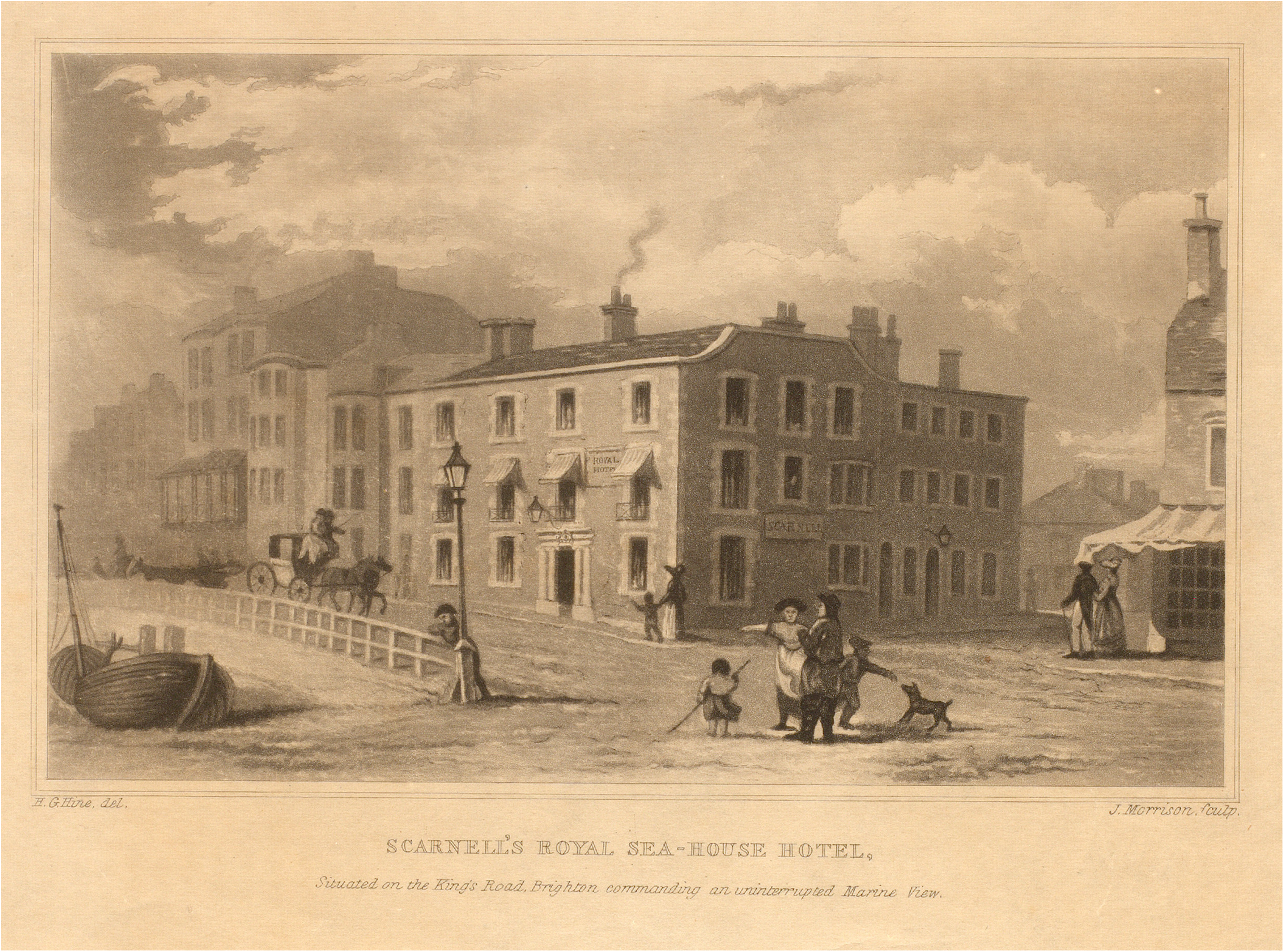
Brighton's Ship in Distress Inn (later called Scarnell's Royal Sea-House Hotel). Here William Ford of Calcutta died in 1802. The title Royal was added in 1830 when King William IV visited Lord Nelson's widow who was in residence. Image and information courtesy of the Royal Pavilion & Museums, Brighton & Hove.
Death from the ‘stone and gravel’
Urological stones appear to have been a commonly described cause of morbidity. The following account from 1808 suggests that it could also be terminal:
“DIED. On Wednesday last, at his seat, Tewksbury - lodge, in Gloucestershire, Lieutenant Colonel Wall, of the Royal South Gloucester, Militia, now and for several years back, stationed in this town. Colonel Wall attended in his military capacity, the [l?] ate grand review in honour of the Prince's birthday, when he appeared in perfect health and spirits; but a few days after the review, he left this place for his seat as above, where he was so terribly afflicted with the stone and gravel, that, notwithstanding every medical aid, it painfully terminated his mortal existence. The deceased was justly beloved and respected by his brother Officers, and by every individual in the regiment, in which he had been an Officer upwards of 50 years; and his death will be a long subject of regret to all who had the happiness of his acquaintance” 49
Discussion and conclusion
The excerpts presented here reveal glimpses into the lives and clinical practice of Brighton doctors at the very beginning of the nineteenth century. These findings also offer hints of the wider spirit of revolution and innovation that started to permeate medical practice in this period, for example vaccination. Allusions are also made to new techniques (for example, surgery and resuscitation) and technological advances (for example, inventor Nathan Smith's ‘Air pump for extracting the Gout’ in Tables 2 and 3).
Surprisingly Brighton's much vaunted sea water therapy is not mentioned. While accounts of drowning and near drowning were frequent, the reasons for entering the water were rarely recorded. Where this may have been for medical reasons, it seems likely not to have been disclosed for reasons of protecting details of the treating doctor's regime. Likewise, there is scant evidence of medical attempts at public health by promoting ‘hygiene’. It is of note, however, that the London anatomy school described above publicized measures to prevent infection, for example ventilation. 41
These vignettes must be viewed in light of the town's growing status and rapid expansion at this time. In the late eighteenth century, Brighton's royal connections and fame as a seaside resort and spa led to an influx of medical practitioners, including some high profile clinicians from London, Scotland and Ireland. A further driver was Brighton's status as a key garrison town on England's south coast during the struggle against Napoleon. Many of the regiments stationed near the town brought with them army surgeons and physicians. Although divided in this article into Brighton-based, London-based and transitory clinicians, it is clear that with time these groups became increasingly mixed. This is most evident in royal appointments made by the Prince of Wales to local clinicians. Aside from the quotidian tasks undertaken by these doctors and surgeons these findings offer glimpses into the more exotic and challenging tasks that life in cosmopolitan Brighton could present.
It seems fair to conclude that a key driver in the expansion of doctors practising in Brighton was financial profit from an affluent clientele, especially during the summer months. These findings point to close links between Brighton and London, even at a time before the advent of the steam train. This relationship is evident in medical education, where attending a London anatomy school offered the only formal example of training beyond apprenticeship. It is also of note that clinicians can be seen observing each others’ clinical practice. This undoubtedly constituted a key way of learning (and, presumably, mutual protection against complaints) that rarely happens today. It is hoped that the primary sources presented here will contribute to knowledge of the medical world of Brighton's lesser known doctors two centuries ago.
Footnotes
Declaration of conflicting interests
The author(s) declared no potential conflicts of interest with respect to the research, authorship, and/or publication of this article.
Funding
The author(s) received no financial support for the research, authorship, and/or publication of this article
