



Abstract
Knitted fabrics exhibiting a Negative Poisson’s Ratio (NPR) show significant potential for advanced engineering applications, including personal protective equipment and industrial sectors such as aerospace, automotive, marine engineering, and biomedical devices. In this study, auxetic weft knitted fabric structures were designed by systematically varying loop length using polypropylene filament yarn. The knitted fabrics were subsequently incorporated into an epoxy matrix using the Resin Transfer Molding (RTM) process to form fabric-reinforced composite laminates. Tensile tests were conducted to investigate the load–extension behavior and auxetic response of the knitted fabric architecture in both wale and course directions. The results demonstrate that loop length has a pronounced effect on the auxetic behavior of the knitted structure, with increased loop length leading to higher extension and displacement, while shorter loop lengths exhibited greater load bearing capacity. The composite fabrication process was found to preserve the structural integrity of the auxetic fabric architecture. Failure analysis revealed matrix cracking, surface buckling, delamination, and fiber fracture as the dominant damage mechanisms. The findings highlight the effectiveness of structural design in controlling auxetic behavior in knitted fabric–based reinforcements for composite applications.
1. Introduction
Poisson’s Ratio (PR) is the ratio of transverse strain to axial strain in a material subjected to uniaxial loading. In this context, tensile deformation is regarded as positive, whereas compressive deformation is considered negative.1,2 Most traditional fabrics demonstrate a positive Poisson’s ratio (PR), meaning they shrink in width under tensile stress and broaden when compressed. Auxetic fabrics, however, behave oppositely, expanding laterally when stretched and narrowing when compressed due to their negative PR.3–5 Poisson’s Ratio (PR) of textile materials has become the viewpoint of many researchers in the past recent years.6,7 Materials with a Negative Poisson’s Ratio (NPR) behave in a fundamentally distinct manner compared to conventional materials. Whereas most materials tend to shrink laterally when stretched and expand laterally when compressed, NPR materials exhibit the opposite response they widen when pulled and narrow when compressed. This unconventional deformation behavior leads to unique mechanical characteristics, making NPR materials highly advantageous for a range of advanced engineering and technological applications. 8 It is suggested by 9 that efficient Poisson’s ratio can be corelated to the surface tension and surface roughness properties of their auxetic textiles.
Knitting structures is broadly divided into two categories based on yarn orientation and processing methods: weft knitting and warp knitting. In recent years, auxetic textile materials have garnered considerable attention from researchers. Advancements in this area have enabled the development of auxetic fibers, yarns, and fabrics, along with textile reinforcements suitable for use in composite materials.10–15 The properties of textile reinforcements can be tailored by choosing from various configurations, such as long or short fibers, conventional yarns, single or multifilament structures, and different fabric forms including woven, nonwoven, weft-knitted, or braided fabrics of varying widths. The selection is primarily influenced by the type of raw materials, cost considerations, target performance characteristics, manufacturing techniques, and the intended end-use application.16–19
Several studies have focused on developing innovative weft-knitted fabric composites with negative Poisson’s ratio (NPR) characteristics, produced using flat-knitting machines. The NPR behavior of these fabrics was then evaluated and compared with theoretical or mathematical predictions. Findings revealed that many of the knitted structures exhibited the expected NPR effect.20–22 However, in different fields of engineering auxetic materials have gained enough attention, especially with their special and unique mechanical behavior, utilizing plastic or elastic deformation parameters of polymers, both in the linear and in the nonlinear regimes.23–26
Textile researchers have examined a wide range of current and prospective uses of knitted fabrics in the development of engineering composite materials. 27 For example, weft-knitted reinforced matrix composites offer high flexibility, making them well-suited for the production of intricately shaped or specialized components. In contrast, composites fabricated from warp-knitted structures combined with a rigid resin matrix are more appropriate for applications requiring enhanced stiffness and long-term durability. 5 The development of specialized and innovative textile architectures offers new opportunities to enhance the performance benefits of composites reinforced with weft-knitted fabrics. The introduction of auxetic fibrous structures, in particular, contributes significantly to the improvement of key mechanical properties such as increased fracture toughness, shear modulus, and resistance to indentation. Additionally, these architectures enable tunable porosity and permeability under mechanical loading, expanding their functionality for advanced engineering applications.28,29
Plain, rib, interlock, and purl represent the four fundamental weft-knitted structures, serving as the foundation for the development of all other weft-knitted designs. Innovative design methodologies have been employed to engineer auxetic weft-knitted textiles based on these core structures. 30 The auxetic fabrics produced exhibit expansion in the X- or Y-axis (aligning axes to direction of knitting). 31 Recently, a range of auxetic knitted fabric has been produced by using weft flat knitting technology.32–34 The design was guided by a geometrical analysis of a novel three-dimensional structure capable of exhibiting a negative Poisson’s ratio, also known as the auxetic effect. 35 Blaga, M et al. 36 investigated how material composition, loop density, and structural factors including the repeat size and the ratio of rib width to repeat size affect the folding behavior of selected links-links weft-knitted fabrics.
Ugbolue et al. 37 in the pedant article, knitted structures were fabricated using conventional yarns through the incorporation of chain-shaped configurations and filling yarn inlays. By combining geometric principles, structural characteristics of the fabric, and traditional elastic yarns, the researchers successfully engineered hexagonal knitted architectures exhibiting a negative Poisson’s ratio. 38
Hu, H., Z, and S. Liu,. 39 The study examined three types of geometrical structures: foldable structures, rotating rectangles, and re-entrant hexagons. The results indicated that, among these, the folded fabric constructed using face and back loops arranged in the pattern demonstrated a unique auxetic behavior. Specifically, the auxetic effect initially increased with axial strain and subsequently decreased as the strain continued to increase. Andrews Boakye et al. 40 A knitted tubular fabric demonstrating a negative Poisson’s ratio was developed and produced using a flat-bed knitting machine. Three structural pattern variations based on an arrowhead configuration namely 4 × 4, 6 × 6, and 8 × 8 were implemented. Among these, the 6 × 6 pattern exhibited the most pronounced auxetic behavior. And in the other study Boakye et al. 41 used the weft-knitted process to develop an auxetic-knitted tubular samples using Kevlar yarn for reinforcing materials. Yaxin Sun 42 designed, a novel auxetic weft-knitted fabric based on the rhombus-shaped grid re-entrant structure. The structure was manufactured using Kevlar yarn on a computerized flat knitting machine. The results showed that the negative Poisson’s ratio affected all three directions.
Flexural properties tear resistance and puncture impact properties is analyzed by Schwaiger et al. 43 Overall, the influence of the knitted structures on the mechanical properties was found to be independent of the manufacturing process. This suggests that the auxetic behavior and performance characteristics are primarily governed by the structural design rather than the specific production method employed. Aktas et al. 44 The study evaluated and compared the impact and post-impact performance of plain, Milano, and rib-knitted fabric structures. Among the three, plain-knitted fabrics showed the lowest values in tensile strength, penetration impact energy, and compression-after-impact resistance. In contrast, rib-knitted fabrics achieved the highest performance across these metrics. Furthermore, the tensile and forming behaviors of auxetic warp-knitted spacer fabrics were investigated and benchmarked against conventional warp-knitted spacer fabrics. Results indicated that the auxetic spacer fabrics exhibited a prolonged low-stress response phase and markedly enhanced formability relative to traditional spacer fabrics. 45
Steffens et al. 12 was the first who studied the use of high performance fiber yarns such as high tenacity polyamide to manufacturing auxetic textile structures by knitted technology to improve the mechanical properties. Dong et al. 46 Fabricated weft-knitted fabrics by using high performance fiber (Carbon/aramid) to improve the impact toughness.
In a previous study, the authors identified NPR weft-knitted PP fabric/epoxy resin composites with different loop lengths under varying impact loadings.2,47,48 In this study, the influence of loop length on the auxetic behavior of polypropylene (PP) weft knitted fabrics and the resulting mechanical performance after epoxy composite fabrication is investigated. The findings provide insights into the design and processing of auxetic knitted reinforcements for composite applications. Owing to their unique deformation mechanisms and mechanical characteristics, auxetic knitted architectures hold potential for advanced applications such as vibration isolation, impact mitigation, and other functional structures in high performance sectors.
2. Materials and Methods
2.1. Material
Main properties of the polypropylene (PP) yarn used in fabrication.

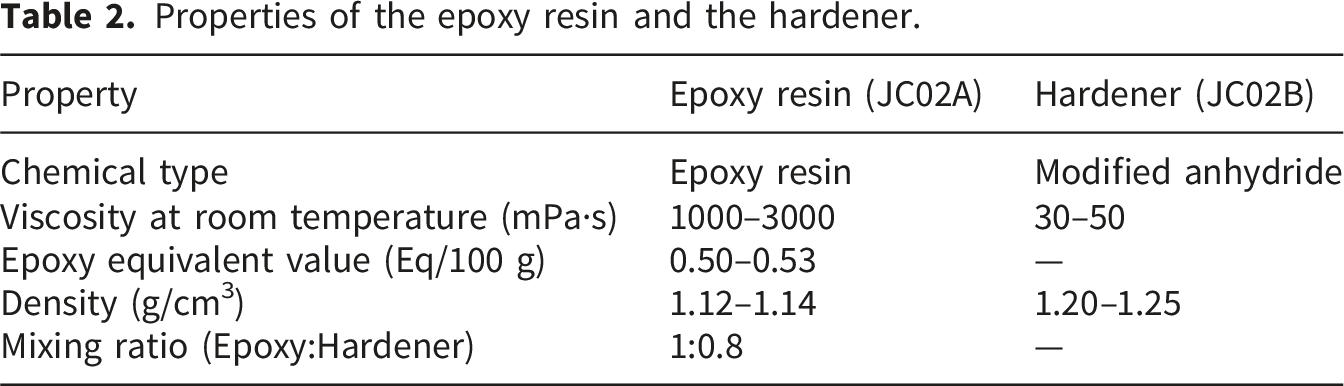
Properties of the epoxy resin and the hardener.
2.2. Knitted textile structure
Weft-knitted fabrics demonstrating auxetic characteristics were produced using a flatbed knitting machine (Passap Duomatic 80), configured with a two-cam system. The design employed a rib knitting structure, incorporating loops on both the front and back needle beds. The knitting process utilized a total of 120 needles 60 on the front bed and 60 on the back with a gauge of 5 needles per inch. This setup allowed for precise control of needle selection and cam settings, thereby facilitating the fabrication of customized fabric specimens. The explanation now states that this configuration was chosen to ensure structural symmetry between the two needle beds, provide a sufficient fabric width for reliable mechanical testing, and allow stable formation of the rib-based auxetic loop architecture. Additionally, the selected number of needles ensured consistent loop geometry and minimized edge effects during fabrication and testing.
To induce auxetic behavior, the fabric geometry was designed based on a negative Poisson’s ratio configuration. The study focused on varying loop lengths as the principal structural parameter while maintaining all other variables constant. This ensured that any observed differences in fabric performance could be attributed solely to loop length variations in both the face and back loops.
The fundamental stitch structure selected for this investigation was the Fisherman’s rib double-bed configuration, as illustrated in Figure 1. Three different loop length, were produced as shown in Figure 2. Structural characteristics, including loop length and stitch density, are detailed in Table 3. The knitted fabric with different loop lengths (LL). Structural parameters of knitted fabric.


This design approach was selected due to its capacity to store a greater volume of yarn within the fabric structure, thereby contributing to the auxetic (negative Poisson’s ratio) effect.
2.3. NPR testing
Various methods have been reported for evaluating the NPR behavior of auxetic structures derived from knitted fabrics. In this study a laboratory developed testing protocol was employed to characterize the auxetic behavior of the specimens. Tensile testing was conducted, as illustrated in Figure 3, to evaluate the negative Poisson’s ratio (NPR). The specimens were cut to dimensions suitable for gripping in the testing machine jaws (80 mm × 120 mm), with an effective gauge area of 80 mm × 80 mm. During testing, in our experimental setup, all axial measurements were obtained directly from the testing device; however, the device did not provide transverse strain data. The transverse deformation was obtained using an image-based measurement method. During tensile testing, the specimen was recorded with a fixed camera, and a calibrated scale placed in the specimen plane was used for reference. Transverse dimensions were measured from the recorded images at selected strain levels. Measurements were taken within the effective gauge region and averaged to reduce local variability. Although this method is less accurate than full-field optical techniques (e.g., digital image correlation), it is commonly used when transverse instrumentation is unavailable. A graduated scale was placed in front of the specimen, which was clamped securely in the jaws, and images were captured using a digital camera mounted on a fixed stand to ensure consistent positioning. The crosshead displacement was applied in increments of 10 mm, and the test was paused at each increment to record deformation. Images were captured at five successive displacement levels, allowing accurate determination of strain and Poisson’s ratio. The same setup and procedure were applied consistently for all samples, ensuring comparative validity. The repeatability of the results and the consistent auxetic response observed across tests support the reliability of the measurements within the scope of this study. Evaluating the NPR in course and wale direction for three different loop lengths.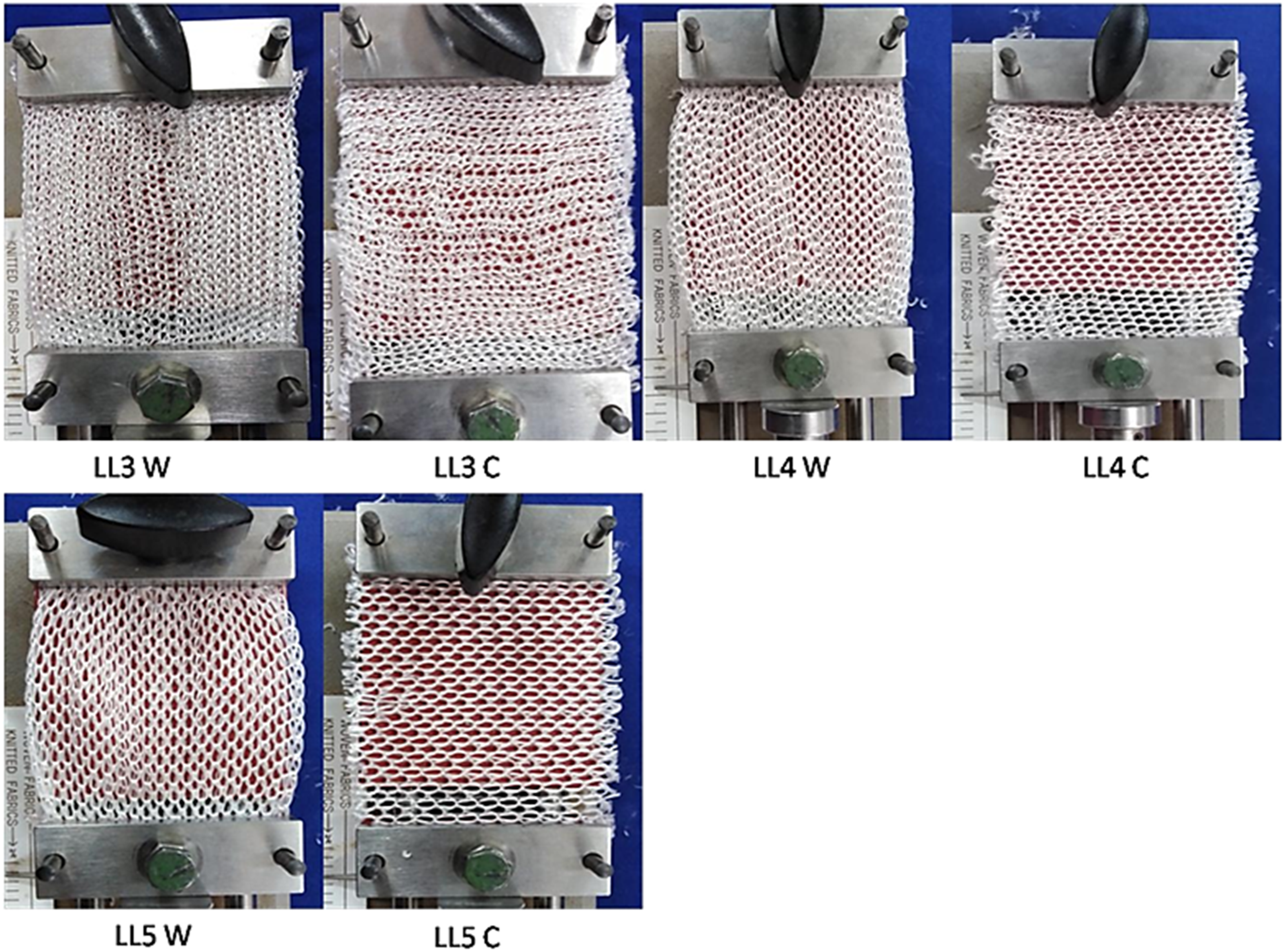
2.4. Composites fabrication
The resin transfer molding (RTM) technique was employed to fabricate (NPR) knitted fabric composites with varying loop lengths. This method utilizes vacuum assistance to promote the infiltration of epoxy resin and hardener into knitted fabric layup consisting of eight layers oriented in the same direction. The layup was enclosed within a mold and sealed with a vacuum bag, as illustrated in Figure 4. Following resin impregnation, the composite panels were cured under vacuum in an oven. Knitted composites fabrication using (RTM).
The curing schedule consisted of heating the sample for two hours at 90°C, then raising the temperature to 110°C for one hour, followed by 130°C for four hours, before allowing it to cool to room temperature over an eight-hour period, as illustrated in Figure 5. Temperature curing cycle for specimen fabrication.
2.5. Tensile Test
Tensile tests were conducted using the MTS 810 Material Test System equipped with Hydraulic Wedge Grip, as illustrated in Figure 6. A constant loading speed of 2 mm/min was applied during the tests. Load–displacement curves were recorded for each specimen; three samples were prepared and tested to ensure result consistency and reliability. The tensile testing of composite specimens was conducted in accordance with the ASTM D3039 standard. MTS 810 Material Test System for tensile tests.
3. Results and discussions
3.1. Evaluation of Poisson’s ratio of knitted fabric
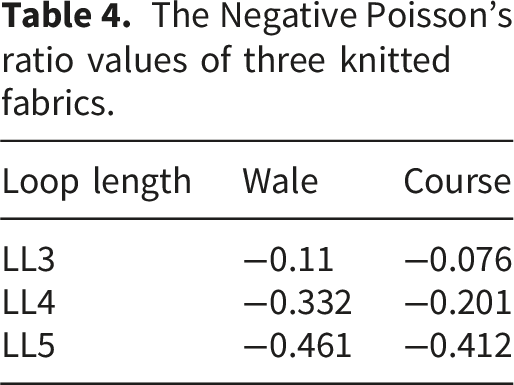
In this study, to assess the Negative Poisson’s Ratio of the knitted fabric structures. Longitudinal and transverse deformations of the specimens were obtained during tensile loading in the wale and course directions. The corresponding longitudinal strain was determined from the measured extension relative to the initial gauge length, while transverse strain was calculated based on the change in specimen width during loading. The Poisson’s ratio was then evaluated as the negative ratio of transverse strain to longitudinal strain. This approach enables assessment of the auxetic response of the knitted fabric architecture and its behavior after incorporation into the composite laminate. 51
When stretched along either the wale or course direction, each loop adjusts its inclined angle relative to the fabric’s surface. This movement causes the overall structure to expand, increasing its dimensions both horizontally and vertically. Consequently, the auxetic effect emerges, despite the individual loops maintaining their original shape and length. This phenomenon is due to the geometric opening of the loop formations in both directions, as shown in Figure 3.
The Negative Poisson’s ratio values of three knitted fabrics.

Variation of negative Poisson’s ratio (NPR) with strain for different loop length configurations: (A) course direction and (B) wale direction.
3.2. Load extension behavior
The tensile test results for the weft knitted polypropylene (PP) fabric reinforced epoxy composites with varying loop lengths (LL3, LL4, and LL5) are presented in Figures 8 and 9. These load-extension curves were analyzed to the auxetic (NPR) knitted fabric composites and failure modes associated with each loop length. Load-extension curves in the course direction for auxetic knitted fabric composites with different loop lengths. Load-extension curves in the wale direction for auxetic knitted fabric composites with different loop lengths.

All the three loop lengths structures exhibited similar curve profiles which could be categorized into three distinct regions. The initial region exhibited linear, indicating the elastic deformation phase. In this stage, the composite samples effectively carried the applied load, reflecting strong interfacial bonding between the knitted fabric and the epoxy matrix. The second region demonstrated an oscillating behavior, characteristic of plastic deformation, where the matrix began to yield under continued stress. The third region showed the load being sustained without exceeding the previous peak values. This phase indicates that, at this stage, only the reinforcing fibers were carrying the load until eventual structural failure.
An exception to this general trend was observed in the LL3 samples, which exhibited sudden failure following the plastic deformation stage. This brittle failure is attributed to the higher density and lower NPR values of LL3, which limited its ability to deform under stress. These observations are supported by the data shown in Table 3.
Furthermore, the results clearly indicate that loop length plays a critical role in influencing the extensibility of the knitted composites. As the loop length increased, the extension under tensile load also increased. This increase in extensibility resulted in a lower stress concentration at higher strains, reflecting an enhancement in the NPR effect. In the course direction, the extension increased by approximately 91% from LL3 to LL4, and by about 150% from LL3 to LL5, as illustrated in Figure 8. These results confirm that longer loop lengths enhance the deformation capacity in auxetic weft knitted composite structures.
The results presented in Figures 8 and 9 clearly demonstrate that Poisson’s ratio exhibits a nonlinear dependence on strain for all tested configurations (LL5C, LL4C, and LL3C). At low strain levels, Poisson’s ratio changes rapidly, which can be attributed to the initial reorientation and bending of the structural elements within the fabric architecture. In this region, deformation is dominated by geometric rearrangement rather than material stretching, resulting in a pronounced nonlinear response.
As the strain increases, the rate of change of Poisson’s ratio gradually decreases, indicating a transition from geometry driven deformation to yarn stretching and load transfer between structural components. This behavior is particularly evident in LL4C and LL3C, where higher loads are sustained over shorter extension ranges, leading to stronger nonlinear effects at early strain stages.
At higher strain levels, the Poisson’s ratio tends to stabilize or fluctuate slightly before failure, reflecting structural locking, frictional interactions between yarns, and progressive damage mechanisms. The differences observed among the three configurations highlight the influence of structural parameters on strain-dependent Poisson’s ratio behavior.
Figure 10 presents a comparison of the peak load values of the auxetic weft knitted fabric composites with different loop lengths in two directions (course and wale). The results indicate that the peak load gradually decreases as the loop length (LL) increases. The shortest loop length (L3) exhibits the highest peak load in both directions, while the longest loop length (LL5) shows the lowest values. This trend reflects the influence of loop length on the mechanical structure of the knitted composite. Shorter loops lead to a denser and more compact structure with increased interlocking between yarns, which enhances the material’s load-bearing capacity. In contrast, longer loops result in a looser structure, reducing the material’s mechanical strength. The effect of varying loop lengths on the peak load of NPR knitted composites.
Additionally, the peak load in the wale direction consistently exceeds that in the course direction across all loop lengths. This may be attributed to the wale direction being the primary knitting orientation or possessing inherently better structural support, resulting in superior mechanical performance.
Figure 11 illustrates the extension behavior of auxetic weft knitted fabric composites with different loop lengths. The composite with loop length LL5 exhibited the highest extension, measuring 45 mm in the course direction and 43 mm in the wale direction. In contrast, LL3 showed the lowest extension values, with 4 mm in the course direction and 22 mm in the wale direction. The effect of varying loop lengths on the extension of NPR knitted composites.
The data indicate that the maximum extension occurred in the wale direction for all samples, except LL3. This can be attributed to the enhanced auxetic response (higher NPR) associated with the increased loop length, which allows for greater deformation under tensile load.
When comparing the extension of the course and wale directions across the three loop lengths, it was observed that the difference in extension became more pronounced as loop length decreased. However, in the case of LL5, the extension in both directions was nearly equal, suggesting a more uniform deformation behavior, likely due to increased fabric relaxation and better load distribution enabled by the longer loops.
3.3. Failure modes
In accordance with ASTM D3039 stander, the failure modes of the tested composite specimens were classified using the standard three-part failure mode classification system. The failure behavior was analyzed across varying loop lengths (LL3, LL4, and LL5 as shown in Figure 12. Failure mode under tensile load for auxetic knitting composite for different loop lengths.
LL3 exhibited a failure mode consistent with Lateral Gage Middle (LGM), characterized by a sudden, brittle fracture concentrated at the center of the gage section. This failure suggests a high-stiffness, low-deformation response, typical of materials with high fiber density and limited auxetic behavior. LL4 demonstrated a failure pattern aligning with Angle Gage Middle (AGM – Type 2), marked by diagonal stress paths and pronounced fiber/matrix interaction. The failure propagated at an angle, indicative of shearing mechanisms and partial interfacial de-bonding. LL5 presented a failure mode comparable to Angle Gage Middle (AGM – Type 1), but exhibited greater deformation and ductility prior to fracture. This mode was characterized by distributed damage and energy absorption, consistent with an enhanced auxetic effect.52–54
Photographic evidence of the fractured specimens supports these classifications. The quality of interfacial bonding between the knitted reinforcement and epoxy matrix previously established as improved had a significant effect on failure mechanisms. The LL3 specimen, which recorded the highest tensile strength, failed in a brittle manner with minimal plastic deformation. The abrupt fracture correlates with the high structural density and low negative Poisson’s ratio (NPR), confirming a failure dominated by matrix cracking and clean fiber rupture. The LL4 specimen exhibited signs of fiber pull-out along the specimen’s length. While matrix cracking was evident, full fiber fracture did not occur, suggesting a semi-ductile failure with limited energy dissipation via fiber bridging and interfacial sliding. The LL5 specimen underwent considerable displacement prior to failure, which was localized at the gage midpoint. This mode involved localized micro-fibrillation, complete fiber rupture, and matrix fragmentation. The resulting necked profile illustrated in Figure 12, highlighted the material’s enhanced ductility and energy-absorbing capacity.
These failure characteristics confirm the dual role of loop length in both tuning auxetic response and governing failure mechanisms. As loop length increases, a transition is observed from brittle to more ductile and distributed failure modes, offering insight into the design optimization of auxetic fiber reinforced composites for energy dissipating applications.
4. Conclusion
This study examined the effect of loop length on the auxetic response and mechanical performance of weft-knitted fabric structures incorporated into composite laminates produced via the Resin Transfer Molding (RTM) process. The auxetic behavior observed in the laminates was governed primarily by the deformation mechanism of the knitted fabric architecture, which was preserved after epoxy impregnation, although with a reduced magnitude compared to the bare fabric.
Among the investigated configurations, the LL5 structure exhibited the strongest auxetic response, confirming that loop length plays a critical role in controlling lateral expansion under tensile loading. A clear relationship was identified between increasing loop length and enhanced auxetic deformation, while shorter loop lengths favored higher stiffness and load-bearing capability. Mechanical testing revealed a trade-off between strength and ductility: LL3 specimens demonstrated superior tensile strength, particularly in the wale direction, whereas LL5 specimens showed increased elongation and energy-absorbing capacity.
Failure mode analysis further supported these trends, with brittle fracture observed in shorter loop structures, transitioning to semi-ductile and ductile failure mechanisms as loop length increased. These results indicate that while the epoxy matrix constrains the auxetic deformation to some extent, the fundamental auxetic mechanism remains active within the knitted reinforcement and significantly influences the composite’s mechanical response.
Overall, the findings demonstrate that tailoring loop length in weft-knitted fabrics provides an effective strategy for controlling both auxetic behavior and mechanical performance in fabric-reinforced composite systems. This structural design approach offers potential for engineering applications requiring customizable combinations of strength, flexibility, and energy absorption, without overstating auxetic behavior at the composite scale.
Footnotes
Acknowledgment
The authors would like to thank the support from the 2216B - TÜBİTAK-BİDEB - UNESCO-TWAS Postgraduate and Postdoctoral Fellowship Programmes.

Funding
The authors received no financial support for the research, authorship, and/or publication of this article.
Declaration of conflicting interests
The authors declared no potential conflicts of interest with respect to the research, authorship, and/or publication of this article.