



Abstract
The variability of microstructures in the SMC composite induced by the manufacturing process is very important. The volumetric fraction and reinforcement orientation distribution significantly affect the material’s mechanical properties in both the elastic and nonlinear phases, associated with the development of damage phenomena. The distribution of local stresses between the reinforcements and the matrix is conditioned by the privileged orientation of the reinforcements. This, in turn, influences both the elastic mechanical properties and the degradation mechanisms, resulting in a degree of anisotropy. Additionally, SMC composites typically exhibit viscoelastic-damageable behavior. Therefore, it is necessary to characterize the microstructure accurately and comprehensively to effectively manage the mechanical behavior and damage of SMC structures. The research process involved investigating the viscoelastic behavior of randomly oriented Sheet Molding Compound (SMC) composites using Dynamic Mechanical Analysis (DMA) in the glass transition zone. By conducting a thorough analysis of the frequency and temperature-dependent behavior of the viscoelastic material, the experimental results obtained from the DMA test have been modeled. To demonstrate the effect of the matrix, two types of SMSs were utilized: standard SMC and Advanced SMC (A-SMC). The Cole-Cole experimental results fit well with the Perez model showing deformed semi-circles denoting the heterogeneity of the material system used in this study. The aim of this study is to link the WLF Law to the Perez model near the transition zone. The results demonstrated that dynamic properties can be plotted against temperature due to the strong correlation between the experimental and numerical data. Additionally, an increase in the strain rate results in a shift in the damage threshold and a reduction in damage kinetics. These effects are directly related to the damage thresholds and kinetics at the fiber-matrix interface.
Keywords
Introduction
Unsaturated polyesters, synthesized through the condensation of diols and unsaturated acids, with or without diacids, are renowned thermoset resins. Their inherent unsaturation provides pivotal sites for subsequent cross-linking reactions.1,2 Since their inception in 1930, these resins have found extensive utility across a spectrum of applications, from water tanks to trays, boats, shower stalls, and swimming pools. Their widespread use underscores their significant mechanical prowess, establishing them as indispensable components of thermosetting systems.3,4
Understanding the mechanical properties of polymers necessitates grappling with the influence of loading frequency,5–9 prompting a thorough exploration of their viscoelastic behavior. Dynamic Mechanical Analysis (DMA) emerges as a prominent technique10–13 for scrutinizing the viscoelastic properties of polymeric materials. Such analysis is critical for delineating their dynamic attributes across multifarious applications.14–19
The dynamic mechanical behavior of polypropylene composites reinforced with flax and hemp fibers has been studied by Wielage et al. 20 They discovered that the fibers enhance the mobility of the molecules, leading to an increase in storage modulus as fiber content rises, and a decrease in the loss factor. A study 21 investigated the dynamic mechanical analysis (DMA) properties of composites combining soy protein with styrene–butadiene rubber, revealing a significant enhancement in strength attributed to the inclusion of soy protein. Sreekala et al. 22 explored the viscoelastic behavior of phenol formaldehyde composites reinforced with oil palm fiber, both individually and in combination with glass fibers, noting a decrease in the glass transition temperature with the addition of oil palm fiber. Additionally, Mandal et Alam 14 analyzed the dynamic mechanical response of polyester composites reinforced with short glass and bamboo fibers, finding a reduction in loss modulus peak values as the proportion of bamboo fibers increased, which they linked to the stiffness of bamboo fibers. This study aimed to conduct DMA tests to establish a correlation between two distinct models characterizing viscoelastic behavior.
Certain authors have assumed that the Arrhenius Law in the transition region can correctly represent the network behavior
5
; however, the majority5,14,21,22 admit that the WLF (Williams-Landel-Ferry) equation, associated to the time-temperature superposition, effectively represents the temperature variation of the viscosity in the region of the glass transition.
23
The equation was obtained on the supposition that, over the temperature of the glass transition, as the free volume fraction raises linearly with temperature,
24
the viscosity of the material decreases rapidly.
25

While aT is the shift factor, C1 and C2 are empirical constants near to the pseudo universal values for the majority of linear polymers: C1 = 17, C2 = 54. 24 But for dense networks, C1 and C2 can vary greatly from these values, which show the dependence of these constants to the cross linking, T is the temperature, Tα is the reference temperature taken as the glass transition temperature, f is the frequency, fr is the frequency of the reference generally taken as 1 Hz, η is the viscosity of the material and ηr is the viscosity of the reference.
In mechanical response, the frequency effect on polymer material is well studied. An increase in the frequency will displace the curve tangent (delta)’s peak to an elevated value of temperature.26–30 Such a phenomenon is based on the accord between the frequency of the molecular change in the polymers and the temperature. 31 In fact, the molecules are firmly bound together by an attractive intermolecular force. These attractive forces are responsible for the viscosity since it is difficult for one molecule to oscillate because they are bound to their neighboring chains. So, the increase in temperature or frequency reduces the cohesive forces and increases the molecular interchange.
Various investigations32,33 have indicated a correlation between the reduction in Tα and a consequent decrease in Young’s modulus, attributed to the presence of free volume fraction within the material under specific load conditions. This phenomenon is elucidated by the high density of cross-linking, which leads to entanglements and subsequently diminishes the free volume fraction, thereby impeding molecular mobility, as evidenced in prior research. 34
In the polymers field, it is important to study the viscoelasticity because many properties depend on this behavior. 35 The way to investigate it is by modeling, to evaluate the effect, the evolution of the polymer on its period of application and to compare it to other materials. One of the methods that study the viscoelasticity and give information about viscous and elastic properties separately is founded on the Cole-Cole diagram. Among divers models in the literature, the Perez model24,36,37 was found to be the appropriate one for the amorphous polymers.
The mechanical behavior of SMC composites is significantly influenced by the rate of loading,38–42 highlighting the importance of understanding and managing their response under varying rates of deformation for optimal utilization. During high-speed testing,38–42 these composites undergo significant accelerations, introducing transient phenomena such as inertia and wave propagation within the materials and structures. These transient effects, characterized by non-uniform changes in stress and strain fields over space and time, pose a challenge to analysis. Minimizing the amplitude and duration of this transient phase is essential to facilitate accurate assessment and interpretation of the mechanical performance of the composite.
In contrast to metallic materials, which rely on plastic deformation for energy absorption, SMC composite structures depend on various diffuse and progressive damage mechanisms that occur at the local scale. These mechanisms include microcracks in the matrix, fiber breakage, fiber-matrix interface debonding, and delamination or pseudo-delamination.38–42
The novelty of this study lies in its comprehensive investigation of the viscoelastic-damageable behavior exhibited by various Sheet Molding Compounds (SMCs) with a focus on analyzing the impact of matrix content. By utilizing dynamic mechanical analysis (DMA) and applying the Perez model, the research examines the effect of frequency on viscoelasticity within these SMCs. The primary objective is to formulate a predictive model that elucidates the temperature-dependent variation of storage and loss modulus, subsequently validating this model through alignment with experimental data. Notably, the study highlights the significant influence of strain rate on the macroscopic mechanical properties of SMC composites, underscoring a crucial aspect often overlooked in prior research.
Material and methods
Materials
The glass fiber reinforced unsaturated polyester (GFRUP) used in this study was provided by Forvia from France. The diameters of glass fibers were about 15 µm and their fraction was 28%. The resin was based on the polycondensation of diacide with glycols. The reinforcement by Talk particles CaCO3 were about 37%.
Advanced Sheet Molding Compound (A-SMC) composite is a high mechanical performance SMCs consisting of a vinyl-ester resin reinforced by a high content of chopped bundles of glass fibers (50% in mass corresponding to 38.5% in volume). A-SMC composite was provided by Plastic Omnium Auto Exterior. The fibers are presented as bundles of constant length (L = 25 mm). and each bundle contains approximately 250 fibers of 15 µm diameter.
Analytical methods
Scanning electron microscopy
To investigate how fiber distribution influences the viscosity of SMC composites, surface specimens were extracted from various zones of the plate and subsequently analyzed using a HITACHI 4800 Scanning Electron Microscope (SEM). For this analysis, samples with dimensions of 10 mm in length, 10 mm in width, and 2 mm in thickness were prepared.
Dynamic mechanical analysis (DMA)
The viscoelastic properties of SMCs were analyzed using a DMA Q800 instrument (TA Instruments). For these measurements, samples measuring 60 mm in length, 12 mm in width, and 2 mm in thickness were prepared. DMA testing was conducted in three-point flexion mode with a static force of 1 N and an amplitude of 25 µm, at frequencies ranging from 0.5 to 25 Hz. The temperature range for testing was from 25 to 150°C, with a heating rate of 0.5°C/min.
Methodology: viscoelastic behavior analysis
The WLF equation is one of the most used equations in polymer systems to describe the relaxation times and the temperature effect on viscosities. It is principally utilized to predict the mechanical properties of material out of the time range of the experimental test. The Cole-Cole equation is a relaxation model used to describe the dielectric relaxation of a material which refers to the relaxation of a polymer when applying an external load. The frequencies changes affect the viscoelastic properties because it has a direct effect on molecular architecture. In fact, when applying an oscillatory load, the macromolecules movements in the free volume present in the material system cause new overlaps with neighboring chains. This transformation carries out a significant role in the time relaxation phenomenon which increases with the frequency. The diagram below illustrates the different steps of this work.
In order to link the two viscoelastic models: the Cole-Cole and the WLF, it is necessary to show that a bi-parabolic model (Perez model) can represent the viscoelastic behavior of the SMC composite material by superimposing the theoretical curve to experimental ones to plot E″ = f (E′) at different frequencies. If there is a good correlation between the two results then a model describing the E′ and E″ variations are obtained as a function of frequencies. Finally, using the WLF equation, the E′ and E″ plots versus temperature can be represented with the Perez model Figure 1. Flowchart diagram indicating the different steps of modeling.
High strain rate tests
The testing device was used on a servo-hydraulic machine manufactured by Schenk Hydropuls VHS 5020. The test could vary the crosshead speed from quasi-static (10−4 m/s) to 20 m/s. Additionally, a piezoelectric crystal load cell with a capacity of 50 kN was used. The investigation involved measuring the load level of A-SMC composite at different strain rates until failure occurred. It is worth noting that the strain was followed by a contactless technique that utilized a high-speed camera. 42
Results and discussion
Microstructure observations
Figure 2 presents the SEM micrograph of the two studied SMCs composites: Standard SMC and A-SMC. It can be seen that these materials present a remarkable heterogeneity. SEM imagery of (a) standard SMC and (b) A-SMC morphology.
In general, SMC composite material can contain several undesired types of heterogeneities in its microstructure that can be obtained during the manufacturing process. In most cases, it is about porosities or chalk loads whose dimensions may sometimes exceed reinforcement size in terms of diameter. The micrographs illustrate the presence of fibers depletion and chalks particle in some places, thus favoring zones rich in resin only. These SEM pictures obtained on polished surfaces show clearly the higher glass fibers content in A-SMC compared to standard SMC.
Effect of glass fiber distribution on viscoelasticity
In order to study the influence of fibers distribution on the viscoelastic behavior, two specimens of Standard SMC were tested by DMA at a frequency of 1 Hz. Figure 3 shows a plot of tan (δ), defined as the ratio between the loss modulus E″, referring to the dissipated energy under the applied deformation; and the storage one E′ related to the gain in energy under the same condition. Tan delta of the standard SMC at a frequency of 1 Hz.
The sensitivity of material modulus to molecular motions is a fundamental aspect governed by rubber elastic theory.4,24 This theory posits that the alignment of polymer chains between cross-linking nodes plays a crucial role in determining mechanical properties, irrespective of changes in molar mass. In the context of composite materials, the alignment and distribution of reinforcing fibers are often presumed to influence material behavior. However, the observation of well-superposed curves suggests that the distribution of glass fibers does not directly impact material viscosity. Rather, it implies a stronger correlation with the matrix composition of the composite under examination.6,7
This finding highlights the intricate interplay between matrix properties and mechanical behavior, emphasizing the need for a deeper understanding of the role of matrix constituents in dictating material performance. Further investigation into the specific interactions between matrix components and reinforcement fibers is warranted to elucidate the underlying mechanisms driving material behavior in composite systems.
Viscoelasticity modeling by Cole-Cole principle
The magnitude of polarization in a material is determined by its dielectric constant, as described by Debye and Onsager’s equations. 4 However, relying solely on a single relaxation peak is insufficient for adequately characterizing the viscoelastic properties of polymers. A more appropriate method is provided by the Cole-Cole model, which effectively analyzes dielectric relaxation data by plotting the imaginary (E″) against the real (E′) parts of the dielectric permittivity. 37 Each data point on this plot corresponds to a specific frequency, offering a more comprehensive insight into the material’s behavior across various frequencies. Additionally, the Cole-Cole principle can be utilized to investigate structural changes occurring in cross-linked polymer materials, providing valuable understanding of their dynamic properties.
Effect of frequency: standard SMC
Figure 4 shows a Cole-Cole plot where the loss modulus data (E″) was plotted against storage modulus (E′) for Standard SMC. The plots’ form is an indicative parameter of the polymeric system homogeneity.
29
Semicircle diagram shows the homogeneity of the material system. Imperfect semicircular shape reveals the presence of heterogeneity among the composite material. It is clear that fibers and the additives particles affect the shape of the Cole-Cole plot by influencing the dynamic mechanical properties of the composites. Cole-Cole plot of standard SMC composites (a) 1 Hz, (b) 15 Hz, and (c) 25 Hz (the points correspond to the experimental results and the line corresponds to the modeling).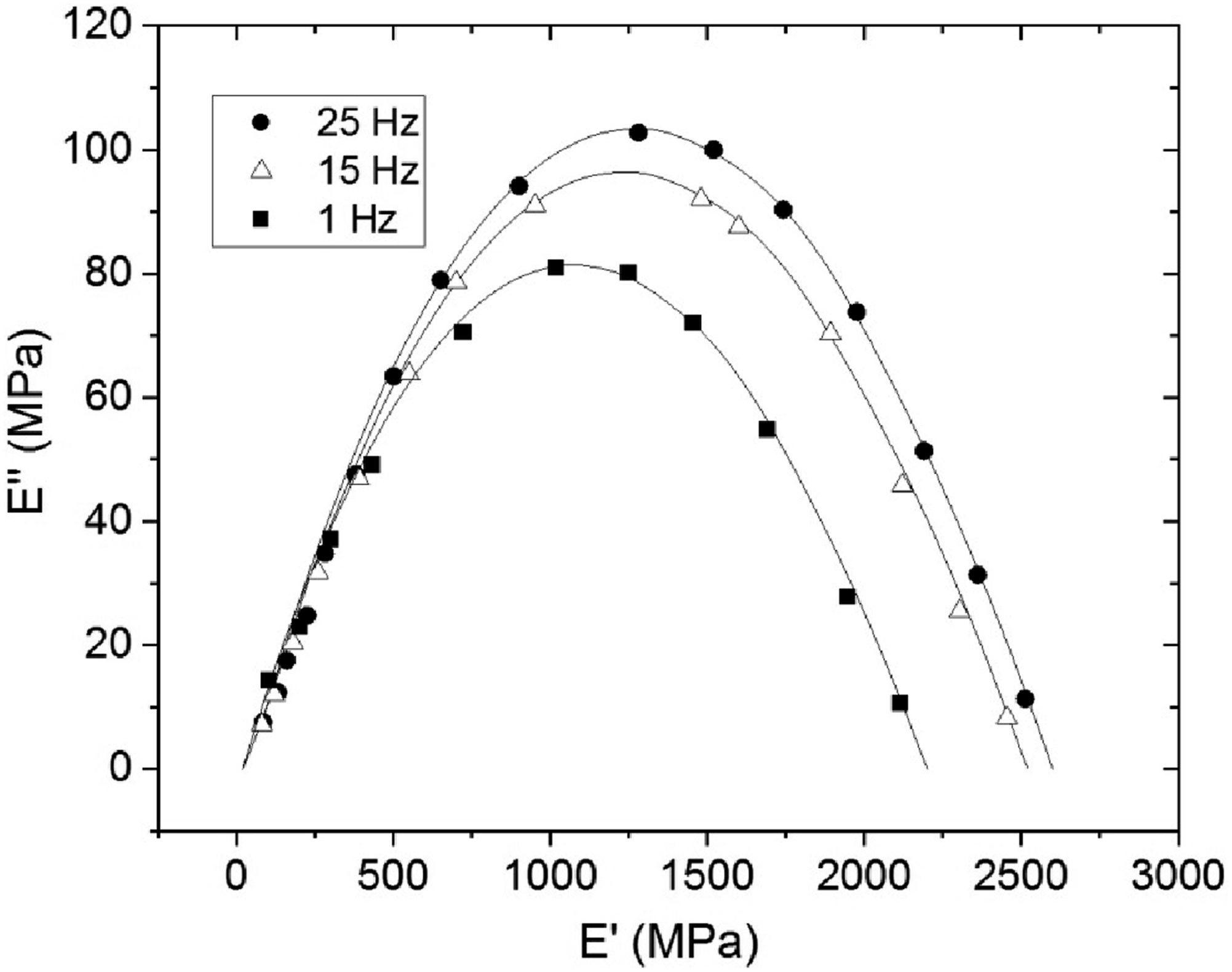

Perez model parameters of standard SMC at different frequencies.

Effect of matrix content: standard SMC and A-SMC
Figure 5 and Table 2 present the results of viscoelastic modeling for A-SMC. The analysis of Figure 5 and Table 2 reveals that A-SMC exhibits significantly higher loss modulus (E″) and storage modulus (E′) values compared to Standard SMC, reflecting the influence of its increased fiber content, which enhances the material’s stiffness and resistance to deformation. This increase in modulus is indicative of A-SMC’s improved structural rigidity and load-bearing capacity. Despite these changes, the values of Cole-Cole plot of A-SMC at f = 1 Hz. Perez model parameters of A-SMC at f = 1 Hz (the points correspond to the experimental results and the line corresponds to the modeling).

The adherence of both SMC composites to the Perez model confirms its effectiveness in describing their viscoelastic behavior, underscoring the pivotal role of the matrix material in shaping these properties. This indicates that while higher fiber content impacts stiffness and damping, the fundamental viscoelastic characteristics are governed by the matrix material, reinforcing the importance of matrix properties in optimizing composite performance.
Viscoelastic properties
The dynamic mechanical analysis (DMA) response of materials is significantly influenced by both time (frequency) and temperature, reflecting the complex interplay between viscoelastic properties and external conditions. Previous research, as documented in references,7,28,29 has extensively investigated the frequency effect on DMA response, highlighting its importance in understanding material behavior under different loading conditions.
Furthermore, when a material is subjected to a constant load, its Young’s modulus (E′) undergoes a significant decrease over time with increasing temperature. This phenomenon highlights the time-temperature dependence of material properties, where elevated temperatures lead to increased molecular mobility, resulting in reduced stiffness and elasticity. Such insights into the dynamic behavior of materials under varying stress and temperature conditions are crucial for optimizing material performance and designing structures that are resilient to environmental changes.7,28,29
This can be explained by the undergoing of molecular rearrangement to reduce the localized stress. Figure 6 represents the variation of The storage modulus of elastic properties of SMC GFRP at different frequencies.
It is clear from the Figure 6 that the two behaviors regimes of the polymer result in the variation of the molecular mobility (change in the degree of freedom) with the temperature. For T <
Tan (δ) is the damping term that may be associated to the material impact resistance. The damping peak appear in the glass transition region where the polymeric material turns from a rigid state to a more elastic one, this is explained by the movement of chains and small groups of molecules in its structure.
15
Damping is related to the incorporation of fibers in a composite system. This returns to the concentration of the shear stress at the ends of glass fibers mixed with dissipation of the viscoelastic energy in the matrix material. Figure 7 describes the effect of temperature and frequency on the tan (δ). Tan (δ) of Standard SMC composite at different frequencies.
It is noticed that the
Determination of the WLF constants
Glass transition temperature versus frequency for standard SMC.

The WLF equation is given as follow:
With Plot of 
For linear polymers,
Generally, the expressions of 

WLF constants for standard SMC.

Cole-Cole principle and WLF law superposition
The necessary coordination of the motions of different parts of a polymer molecule is made by the basis of a theory of the linear viscoelastic properties. The action of the frequency disturbs the distribution of configurations of the polymer molecules away from its equilibrium form, storing free energy in the system. The coordinated thermal motions of the segments cause the configurations to drift toward their equilibrium distribution. The preceding paragraphs have shown molecular mobility analyzes in the case of an amorphous polymer by the Perez and WLF principles. Therefore, it should be in question the adequacy of the two expressions and verify the correspondence between them. This section shows the validation of the proposed model by means of numerical curve fitting to experimental data obtained by DMA tests in a temperature range from 25°C to 150°C. Referring to equation (6), frequency can be expressed as a function of the temperature:
Then it is replaced in the imaginary and real parts, 

With:


The quality of fitting is illustrated in Figure 9. The model shows a good description of the viscoelastic behavior by predicting the storage modulus and tan (δ) shapes against temperature. The model was fitted on the frequency of 1 Hz. Then in order to validate it, it was applied for other frequencies (15 Hz and 25 Hz). Validation of the model to the viscoelastic behavior at different frequency, (a) 1 Hz, (b) 15 Hz, and (c) 25 Hz.
The methodology adopted to fit the curves obtained by the model to experimental ones is as follow. As the Cole-Cole principle depends on 6 parameters (
Viscoelastic-damageable behavior
The mechanical behavior of Sheet Molding Compound (SMC) composites undergoes a complex evolution, typically characterized by three distinct phases. Initially, the behavior is linear, reflecting reversible elastic deformation within the material. This phase is followed by a nonlinear stage, marking the onset of damage mechanisms. During this phase, microcracks initiate at the interfaces between fibers and the matrix, gradually propagating and causing a reduction in composite stiffness. Subsequently, the material enters an anelastic and linear phase, where microcracks multiply and extend into macrocracks. This progressive degradation process ultimately leads to a phenomenon known as pseudo-delamination, wherein layers of the material separate just prior to failure. Notably, previous studies have identified various damage mechanisms, with matrix cracking being highlighted as a significant driver of damage under tension conditions. This multifaceted analysis provides valuable insights into the intricate mechanisms governing the mechanical behavior of SMC composites, emphasizing the importance of understanding the progression of damage for optimizing material performance and durability.38–42 For instance, Figure 10 displays stress-strain (σ − ε) curves for SMC and A-SMC composites, respectively, at different strain rates. It is evident that the tensile stress-strain curves’ overall behaviors are significantly influenced by the strain rate. High strain rates significantly affect the mechanical properties. The elastic modulus remains consistent regardless of the strain rate. Tensile stress-strain curves at different strain rates: (a) SMC, (b) A-SMC.
The results demonstrate that the mechanical properties of the various SMCs are significantly influenced by the strain rate. Like standard SMCs, A-SMC exhibits a delay in the initiation of damage. In standard SMCs, the damage is characterized by a viscous nature, which is indicated by a delay in initiation and a decrease in damage kinetics during propagation. This behavior can be described as visco-damageable, a concept introduced by Shirinbayan et al. 42
Conclusion
Dynamic mechanical analysis of two types of SMCs was used to study the thermo-mechanical and viscoelastic properties of this material. Referring to the effect of frequency and temperature on the dynamic properties,
The mechanical behavior of SMC composites undergoes three phases: a linear elastic phase, followed by a nonlinear phase associated with damage initiation. During the first phase, microcracks form at the interfaces between the fibers and matrix, which reduces stiffness. Subsequently, anelasticity ensues with microcrack multiplication leading to pseudo-delamination. Moreover, high rates have an effect on properties. A-SMC, similar to standard SMCs, exhibits delayed damage initiation, which is characteristic of a visco-damageable behavior.
Footnotes
Author contributions
Mohammadali Shirinbayan, Joseph Fitoussi: construct the idea. Mohammadali Shirinbayan, Abir Abdessalem, Achraf Kallel, Samia Nouira, Amine Mohamed Laribi, Joseph Fitoussi: analyzed results, draft manuscript preparation, and wrote the paper. Mohammadali Shirinbayan, Abir Abdessalem, Achraf Kallel, Samia Nouira, Amine Mohamed Laribi, Joseph Fitoussi: corrected the English and the paper format.
Declaration of conflicting interests
The author(s) declared no potential conflicts of interest with respect to the research, authorship, and/or publication of this article.
Funding
The author(s) received no financial support for the research, authorship, and/or publication of this article.

Data availability statement
All data generated or analysed during this study are included in this article.