




Abstract
Bitumen is a petroleum residue that is extensively used as a pavement material. Rutting at high temperatures is one of the limitations of bitumen in warmer regions. The aim of this study is to improve the performance and increase the temperature susceptibility of neat bitumen. In this study, polyethylene glycol (PEG) and nano ZnO have been used to modify the properties of neat bitumen. Four samples were prepared by incorporating PEG and nano-ZnO with a standard laboratory mixer. Polyethylene glycol with 2%, 4%, 6%, and 8% by weight were mixed initially with neat bitumen along with nano ZnO (1.5% and 3%). To check its applicability in the road construction industry, the blends were subjected to mechanical properties tests such as ductility, flash point, fire point, softening point, and penetration test. It was investigated that decrease in ductility ranges from a maximum of 143 (neat bitumen) to a minimum of 83 (8 wt%). Softening point increased from 54°C to a maximum of 59°C (8 wt%). Flash and fire point increase first and then decrease; the optimum content was found to be 6%. The structural properties of blends were investigated using X-ray diffraction. The spectra show there is a shift of peaks in polymer-modified bitumen (PMB) as compared to neat bitumen, which leads to homogeneous mixing. The shift of peaks is because of an increase in interlayer spacing of neat bitumen and a decrease in Bragg’s angle. FT-IR analysis shows the presence of peaks in the range of 3000–2800 cm−1 which confirms the presence of additives in modified bitumen. SEM analysis was conducted to check the quality of dispersion and to investigate the microstructure. ZnO nano particles affect the mechanical properties of samples. The physical properties of polymer-modified bitumen (PMB), PEG, and nano ZnO blends enhance the stiffness of samples at high temperatures.
Introduction
Bitumen is a petroleum scum, a byproduct of crude oil yields after the catalytic cracking process. It is used as high-grade pavement worldwide. It is a semisolid composed of four components: (i) saturates; (ii) resins; (iii) aromatics; and asphaltenes. These four components are acronyms for SARAs. Herein, aromatic saturates and resins are called maltenes. Among maltenes and asphaltene, asphaltene is heavier than maltenes. 1 It is usually fenced by resins and reflected as a colloidal suspension of asphaltene particles. 2 Bitumen has excellent mechanical and chemical properties and can be used as a binder in road paving. Properties of bitumen vary from one oil source to another, as does the method by which they are extracted. 3 Bitumen is a temperature-sensitive material; it is unstable at high temperatures and cracks at low temperatures. 4 It also exhibits high viscosity and a large cohesive force. 5 This increase in its viscosity is due to asphaltenes, which contain a high percentage of (N, O, and S) and some metals. 6 Bitumen’s viscosity increases with an increase in temperature, and its stiffness increases with a decrease in temperature. At room temperature, bitumen becomes viscoelastic. This property is best for pavement. Due to the growing traffic load and changing environmental conditions, the performance of bitumen has been reduced. 7 In order to improve the performance of bitumen, various techniques are used. New materials are mixed with bitumen to enhance its properties.
One of the conventional ways to modify the properties of asphalt binder is to add polymers to it. The process of adding polymers to bitumen is being used all over the world. Conventionally, three different modification styles are used: polymer modification, additive modification, and chemical modification.8,9 It had been investigated that the surface study and properties of polymer-modified bitumen were largely dependent upon the nature of the polymer and the proportion of polymer. The mechanical properties of bitumen may be enhanced by the proper addition of the polymers. Polymer modified bitumen has been fabricated by many researchers. These researchers investigated the effect of polymers on the structural, electrical, and mechanical properties of bitumen. 10 Commonly used polymers are styrene butadiene styrene (SBS), ethylene vinyl acetate (EVA), crumb rubber, waste plastic, and polyethylene glycol (PEG), which are used as bitumen modifiers.11–13
The incorporation of nano materials in bitumen has become a field of study for many researchers. It is observed that nano materials enhance compatibility between polymers and bitumen. 14 Additive modification requires some nano particles to be incorporated with binder, such as nano oxides, nano clays (montmorillonite, kaolite), and carbon nanotubes. The mechanical and structural properties of such materials have also been investigated.15,16
Literature review
The prime objective of research is to study the effect of polymer composites on bitumen and investigate structural and mechanical changes in the base material (bitumen). Base bitumen is an insulator and can be used as road construction material worldwide, but its mechanical properties can be improved by mixing it with polymer composites. Jiqing Zhu et al. investigated how bitumen can be polymer modified by different plastomers and elastomers. Some properties of bitumen can be enhanced, but some limitations do exist. These gaps can be improved by adding antioxidants. Improved properties of polymer-modified bitumen (PMB) could also be observed by using hydrophobic clay minerals.
17
Mahabir et al. reported that EVA-based polymers are delegated plastomers that adjust bitumen by shaping an intense and inflexible organization to oppose distortion. Their qualities lie between those of low-thickness polyethylene, semi-inflexible, clear items and those of straight-forward Furthermore, rubbery materials like plasticized PVC and specific sorts of rubber.
18
Gonzales et al. showed that this kind of polymer has been uncovered as a great modifier that works on long-lasting deformities.
19
Du Pont et al. reported that EBA-based polymers can be utilized in an assortment of street applications. This sort of polymer does not have a low temperature influence on strength.
20
Becker et al. showed SBS is a block copolymer that also expanded the flexibility of bitumen. It is presumably the most suitable polymer for bitumen alteration. Despite the low temperature, adaptability is expanded. Some creators guarantee that a decline in strength and protection from entrance is seen at higher temperatures.
21
Henglong Zhan et al. investigated UV aging properties. Three inorganic nanoparticles, nano SiO2, TiO2, and ZnO, were surface modified by using a saline coupling agent. Results show compatibility between bitumen and nano particles as penetration and ductility decrease, and values of softening point and viscosity can be improved.
7
Zhang Hong-lian et al. reported that the high and low temperature properties of pure bitumen can be improved by mixing nano ZnO, CaCO3, and SBS. The morphology of modified asphalt has been investigated using SEM and the reaction of a nanoparticle with asphalt by infrared microscopy. High and low temperature properties of bitumen can be improved due to chemical and physical reactions with polymers and nano particles.22 Yun Feng Liu et al. reported a micro-mechanism to reduce the viscosity of bitumen by adding quaternary ammonium salt of heptadecenyl (QASHI) along with nano particles of TiO2, CuO, and ethylene cellulose. The result shows a decrease in the viscosity of bitumen.
23
Behnam Golestani et al. incorporated SBS polymer and MMT with pure bitumen, which was separately prepared. Then physical and mechanical properties were studied. There is a change in the physical, mechanical, and rheological properties of modified asphalt. The result shows an increase in tensile strength and rutting resistance.
24
Zeng Qing et al. incorporated nano ZnO and polymerized butadiene styrene with asphalt. Here, asphalt consists of four components: saturates, aromatics, asphalts, and resin. Using density functional theory, it was observed that ZnO acts as a bond between four components and PSB. ZnO increases the binding energy between asphalt and PSB. There is chemical and physical interaction between ZnO and asphalt; here, physical interaction between asphalt and PSB was observed.
25
Meng Jia et al. used polyethylene glycol to be incorporated with virgin bitumen as a heat storage material. PEG with different molecular weights is available. The properties of PEG vary with its molecular weight. PEG contains latent heat in the range of 184400 to 211900 J/kg. It has been observed that adding PEG to bitumen can reduce the rutting and swelling of bitumen.
26
Burak Sengos et al. incorporated ethylene vinyl acetate and styrene butadiene styrene in pure bitumen. Bitumen is mixed with EVA and SBS in a shear mixer at a definite temperature with different proportions. Different mechanical and conventional tests were done, which showed that adding the above-mentioned polymers could enhance their properties.
27
Gholam ali et al. investigated the viscosity and storage stability of bitumen composites. Bitumen is mixed with acrylonitrile, ASA, and Al2O3. It is observed that the rheological properties of composites are enhanced at high temperatures. Here it is also seen that nano particle Al2O3 also improves compatibility between bitumen and acrylate styrene acrylonite (ASA).
28
Andreas et al. reported that pyrolytic carbon black acts as a latent modifier for the bitumen industry. Numerous samples were used with different proportions of pyrolytic carbon black to check the effects of pyrolytic carbon black mixed with bitumen. It is concluded that electrochemical and physical properties were improved.
29
In order to investigate the mechanical and structural properties of pure bitumen, polymer-modified (PMB), and nano particle (ZnO)-modified bitumen, the following laboratory tests were conducted. (1) Penetration (ASTM 5-86). (2) Softening point (AASHTO.T 49-89) (3) Fire and flash point (ASTM-D-92-05). (4) Ductility (ASTM-D-113) (5) XRD (Bruker-D8).
Problem statement
The properties of neat bitumen are usually affected by changing environmental conditions. Neat bitumen melts at high temperatures and is unable to hold aggregate, especially in warmer regions. One of the prime objectives of the study is to modify the properties to increase the temperature-bearing capability of neat bitumen through the incorporation of polymers and nano materials.
Experimental
Materials
Physical properties of bitumen.

Physical properties of polyethylene glycol (PEG).

Sample preparation
To prepare bitumen/PEG, a bitumen/PEG/nano ZnO composite shear mixer of three thousand revolutions per minute (RPM) is used at a temperature of 150°C. In this study, PEG and nano ZnO with different proportions were blended with neat bitumen. To produce homogeneous blends, the mixture is blended for 2 hours at the same speed and temperature. Firstly, bitumen of grade 60/70 is heated in a steel bowl at a temperature of 150°C. A mechanical shear mixer is dipped into the neat bitumen, which is placed on the heating plate, as shown in Figure 1. Stirring of bitumen with polymer (PEG) and ZnO.
After 5 minutes of pre heating and blending, polyethylene glycol with 2%, 4%, 6%, and 8% was incorporated into the bitumen, and the mixture was blended with constant speed along with nano ZnO with percentages of 1.5% and 3% by weight of the bitumen, as shown in Figure 2. Flow chart of samples preparations.
Results and discussion
Physical properties of bitumen binder of grade 60/70 can be modified with polymer and nano particle. Various conventional tests including penetration (25°C), softening point, ductility tests, fire and flash point have been performed.
The penetration test is one of the conventional tests piloted on bitumen and polymer-modified bitumen (PMB). It implies the stability and flow-like properties of bitumen. Penetration basically defines the hardness and softness of bitumen. The results of the penetration of bitumen and polyethylene glycol-modified bitumen (PMB) are shown in Figure 3. It is observed that the penetration value of PMB as compared to neat bitumen decreases with an increase in polymer content in the bitumen. The penetration value of neat bitumen was 69 mm and was reduced to 67.3 mm, 61 mm, 49.6 mm, and 44.6 mm with polymer (polyethylene glycol) content of 2%, 4%, 6%, and 8%, respectively. This reduction in penetration for polymer-modified bitumen is responsible for hardening the blend. This decrease in penetration overcomes the high-temperature rutting of neat bitumen. The decrease in penetration is because PEG has the ability to show intermolecular hydrogen bonding, which leads to an increase in the viscosity of bitumen.
30
It shows that PEG has a good effect on reducing penetration value, increasing the stiffness of the PEG bitumen binder, and making it less susceptible. It also increases the resistance of the binder to rutting. Effect of polymer content on Penetration values of bitumen.
A ductility test is used to evaluate the anti-cracking performance of asphalt at low temperatures. Ductility is the ability of a material to stretch before breaking. It is clear from Figure 4 that the ductility of pure bitumen was 143, and the ductility decreased from 109 to 83 as we increased the percentage of polyethylene glycol from 2% to 8%.
31
Ductility decreases with an increase in the content of polymer (PEG). This decrease in ductility enhances intermolecular forces between PEG and bitumen, which further results in an escalation of the stiffness of the sample. The stretching ability of neat bitumen decreases. Figure 8 of the XRD spectra shows some increase in interlayer spacing of polymer-modified bitumen, which results in an increase in cohesivity and a decrease in ductility as compared to pure bitumen. As the polyethylene glycol-modified binder gets harder and stiffer, the reduction in ductility values is predictable. The addition of polyethylene glycol to viscous bitumen tends to reduce the ductile characteristic of the material. Thus, the addition of <8 wt% of polyethylene glycol to bitumen composite binder fulfills the requirement and can be applied for pavement usage. The lowest temperature at which vapors of the material will catch fire and continue burning even after the ignition source is removed is called fire point. The lowest temperature at which vapors above the bituminous material will flash when exposed to a flame under certain condition. It is obvious from Figure 5 that the value of fire and flash points increases from 235°C to 245°C as we increase the concentration of polyethylene glycol in neat bitumen from 2% to 8%.32,33 Moreover, the value of fire and flash point decreased to 238°C as we further increased the content of PEG from 6% to 8%, while 6% of PEG was found to be the optimum condition for fire and flash point Figure 6. Effect of polymer content on Ductility of bitumen. Effect of polymer content on (a) Fire point. Effect of polymer content on (b) Flash point.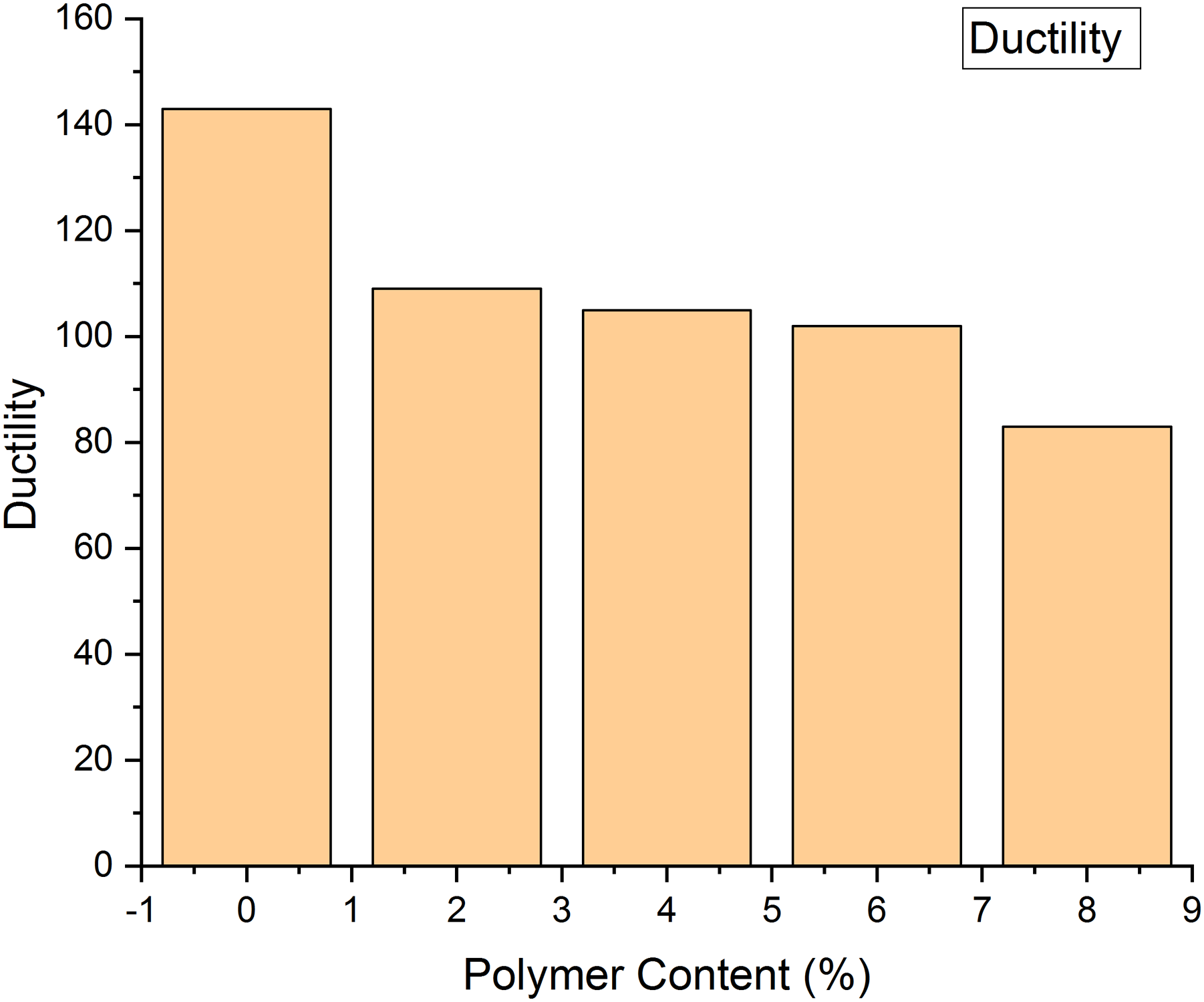


Bitumen has no sharp melting point because it is a viscoelastic material. With an increase in its temperature, its viscosity decreases. The softening point of bitumen can be calculated experimentally using a ring and ball apparatus submerged in distilled water from 30°C to 80°C. The softening point is the temperature at which the sample gains some viscosity. It is evident from Figure 7 that the softening point temperature of bitumen/PEG blends increases. The softening point of neat bitumen was 54°C; when PEG content is 5% of the weight of bitumen, the softening point temperature reaches 55°C, which is noticeably greater than when there is no PEG added to the pure bitumen, i.e. 54°C. The increase in softening point indicates the increasing temperature-bearing capacity of composites. This rise in softening point makes the blends suitable for warmer areas. Based on the bar graph of the softening point above, it can be said that when the softening point is increasing, there is a reduction in susceptibility at high temperatures. This phenomenon indicates that the resistance of binder to the effect of heat is increased. Thus, it will exhibit a reduced tendency to soften in hot weather. Hence, with the addition of PEG, the modified binder will be less susceptible to temperature changes. Therefore, it is expected that by using PEG in the pure bitumen, the rate of rutting will decrease due to the increase in softening point. Effect of polymer content on Softening point of bitumen.
Effect of nano zinc oxide on polymer modified bitumen
Effect of nano ZnO on PMB6.

XRD analysis
XRD (X-ray diffraction) analysis of neat bitumen, PEG and polymer modified bitumen (PMB) with 1.5% and 3% of nano zinc oxide is done by using Bruker D8 having a wavelength of 0.154 nm. XRD spectra of bitumen, PEG, NPMB1.5 and NPMB3 are shown in Figure 8. XRD pattern of (a) bitumen (b)PEG (c)PMB6% (d)NPMB1.5% (e) NPMB3%.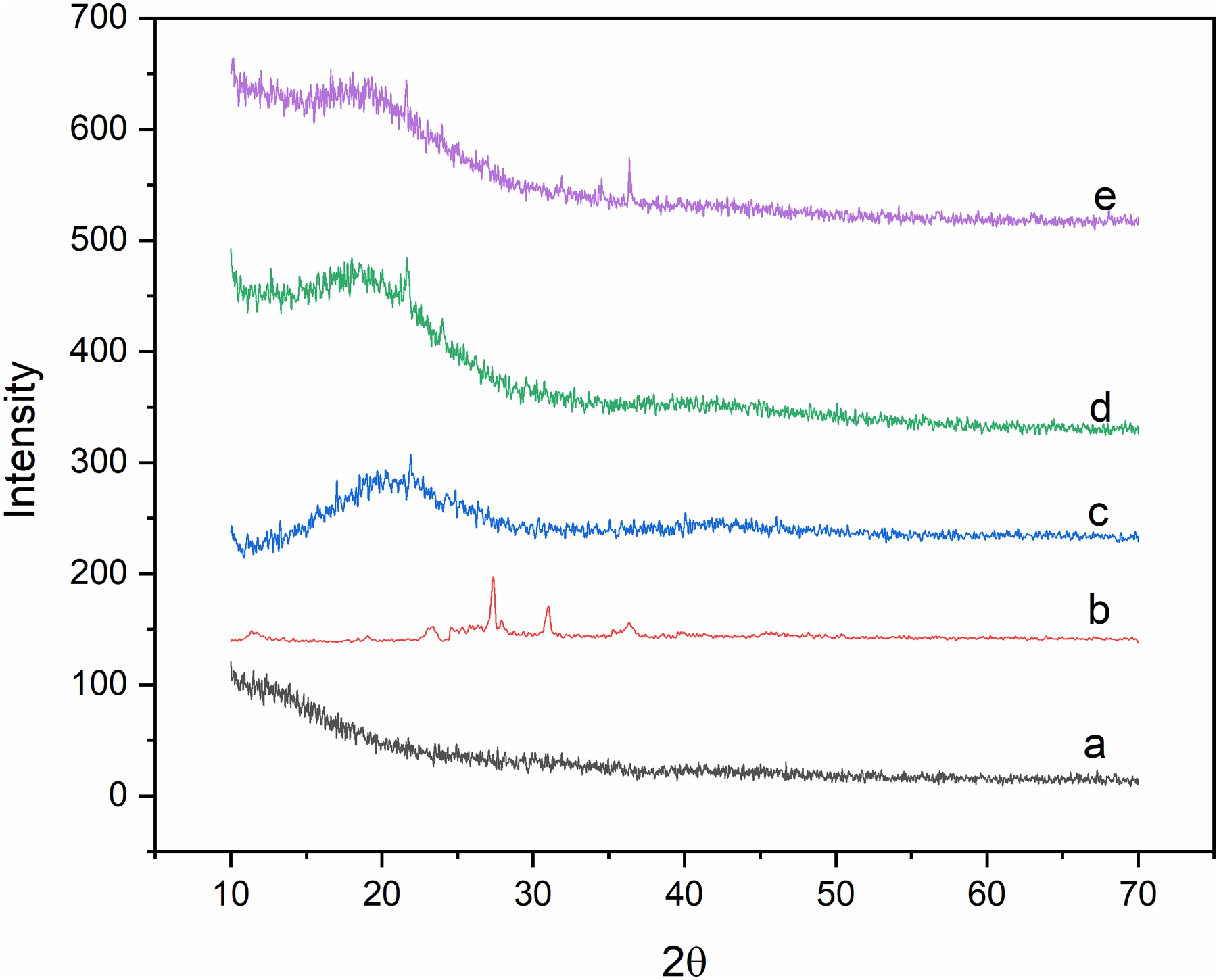
The X-ray diffraction machine uses high-energy x-rays to explore the crystalline phase in solid and semisolid materials. The structural and crystalline parameters of the modified bitumen were inspected with XRD in the form of intensity peaks with arbitrary units. Bitumen shows amorphous nature as indicated in Figure 8(a). Two sharp peaks of PEG are observed at 2θ = 27.3° and at 2θ = 30.9°. The interlayer spacing is calculated using Bragg’s law. The interlayer spacing for these two peaks is 0.32 nm and 0.28 nm, respectively. However these two peaks shifted towards lower angles i.e. 2θ = 21.9° and 2θ = 25.4° in polymer modified bitumen after mixing. Correspondingly, their interlayer spacing values increased from 0.32 nm to 0.40 nm and 0.28 nm to 0.35 nm, respectively. The shifting of peaks towards smaller angles confirms that PEG has uniformly covered the denser bitumen and increased the interlayer spacing. This is also visible in the physical properties of PEG-modified bitumen. The increase in interlayer spacing increases the intermolecular force of modified bitumen, which results in a decrease in the ductility of the sample. The XRD pattern of PMB-ZnO obtained by adding in ratios of 1.5% and 3% of synthesized nano particles of ZnO in PMB exhibits no significant effect on PMB6 structure.
FT-IR analysis
In this research project, FT-IR analysis of polymer-modified bitumen along with ZnO was carried out on a Bruker FT-IR instrument. From the FT-IR spectra, it has been clearly seen that no peak has been observed in the range of 3000–2800 cm−1 in pure bitumen, but by modification with polymer (PEG), a small peak in the range of 300–2800 cm−1 has been observed (see Figures 9 and 10). Moreover, peaks of polymer-modified bitumen appear more prominent, along with 1.5% ZnO nano particles. Furthermore, by increasing the percentage of ZnO nano particles (3%) with polymer-modified bitumen, a clear peak in the range of 3000–2800 cm−1 has been found that indicates C-H stretching vibrations of aromatic compounds present in bitumen as well as bending vibrations in the CH2 group of ethylene glycol 1450 cm−1 as shown in Figures 9 and 10. From this discussion, it has been concluded that PMB successfully binds with the surface of ZnO nano particles. FT-IR analysis of polymer modified Bitumen with ZnO (a) Absorbance. FT-IR analysis of polymer modified Bitumen with ZnO (b) Transmittance.

Morphology
To investigate the quality of the dispersion of additives and microstructure, SEM was conducted. Figures 11-14 shows the typical morphology of base bitumen, along with polymer and nano modified bitumen. Figure 9(a) shows the morphology of base bitumen with a magnification of ×3314 and a bar scale of 3.0 µm. Relatively, smooth and irregular surfaces can be observed after bitumen modification by additives in Figures 11-14. However, particles are observed to be clumped together with bitumen as nano ZnO percentages increase up to 3%, as shown in Figures 11-14. Morphology of (a) Base Bitumen. Morphology of (b) PMB6. Morphology of (c) NPMB1.5. Morphology of (d) NPMB3.


Conclusion
In this paper, the effect of the polyethylene glycol (PEG) nano particle ZnO on the structural and mechanical properties of pure bitumen has been investigated. PEG and nano ZnO are used as additives to modify the properties of neat bitumen. It has been found that the physical properties of bitumen depend on the polymer and nano content. A decrease in penetration and ductility values with the increasing content of PEG indicates higher resistance to rutting. An increase in softening point shows an increase in the temperature-bearing capacity of modified samples. This increase in softening point makes samples less susceptible to temperature and can be utilized in hotter regions. An increase in fire and flash values makes samples safe from fire hazards. The XRD spectra result shows some shift of peaks toward a smaller angle and an increase in interlayer spacing of pure bitumen, which confirms the successful intercalation of PEG. Furthermore, FTIR and SEM analysis confirm the effective blending of additives in neat bitumen.
Footnotes
Declaration of conflicting interests
The author(s) declared no potential conflicts of interest with respect to the research, authorship, and/or publication of this article.
Funding
The author(s) received no financial support for the research, authorship, and/or publication of this article.
