



Abstract
In this study, PEG and TiO2 were used to modify the properties of neat bitumen of grade 60/70. The physical and structural properties of the modified bitumen samples were investigated using penetration by grade, softening point, fire and flash point, ductility, and x-ray diffraction. Results showed that the physical properties of base bitumen were dependent on the polymer content. In the first phase bitumen was blended with PEG at different proportions (2%, 4%, 6%, and 8%). It was observed that stiffness in samples increases as we increase the polymer content which leads to a decrease in penetration and ductility values. The softening point increased with increasing polymer concentration. However, fire and flash point attained maximum value of 250°C and 240°C at 6% and decreased to 242°C and 238°C at 8% respectively. The optimal polymer content was found to be 6%. In a second phase, the effects of incorporation of various percentages of TiO2 (1.5% and 3%) in PEG modified bitumen have been investigated. XRD analysis has also been performed for nano and polymer modified bitumen. An increase in the interlayer spacing value (d) was observed which confirms the successful intercalation of PEG in neat bitumen. Incorporation of TiO2 in PEG modified bitumen affects the physical properties of polymer modified bitumen.
Introduction
Bitumen holds huge importance in construction industry mainly for roads, streets, and highways, as it acts as a binder and binds other pavement components. 1 Bitumen is basically a thermoplastic and is widely used in road pavements because of its good viscoelastic properties. 2 It is highly viscous, black and sticky by nature and is produced by the refining of crude oil. It is mainly composed of heavy and complex hydrocarbons. 3 In spite of its huge usage in road pavement, the material has some limitations also. 4 Rutting at high temperatures and cracking at low temperatures are generally recognized as the limitations of the asphalt binder. 5 Increased traffic volume and temperature affects the performance of roads. 6 To improve the properties of asphalt binder, various techniques are being employed worldwide. One of the traditional ways is to add polymers in bitumen to modify its properties. 7 Polymer modified bitumen shows greater resistance to thermal cracking and rutting. 8 Owing to increased usage of PMB (polymer modified bitumen) in the pavement industry, Pakistan made its first ever plastic road in Islamabad with the incorporation of waste plastic in bitumen. 9
Various polymers, including polyethylene (PE), ethyl vinyl acetate (EVA), polypropylene (PP), and styrene-butadiene-styrene (SBS) were found to be promising in improving the engineering properties of bitumen. These reported polymers improve bitumen properties such as fatigue strength, higher thermal cracking, and rutting resistance. 10 Incorporation of polymers in bitumen can be done by chemical reaction or mechanical mixing. 11 The rise of nano-technology has urged many researchers to utilize nano materials for this purpose. Nano clays (montmorillonite, kaolinite), nano oxides (CaO, ZnO, TiO2), and carbon nano tubes (CNTs) can be used for modification of bitumen. 12
Literature review
There has been a long history of polymers use in bitumen modification. Various modifiers, including sulfur and carbon black were used to modify the properties of bitumen. However, these modifiers have limited potential. Polymer incorporation in bitumen has been thoroughly investigated in the last decade. Various polymers have been used to control pavement defects. 13
Previous literature has revealed that incorporation of waste high density polyethylene (HDPE) in bitumen has improved storage stability and rheological properties of bitumen. The Marshall Stability value was found to be increased with the addition waste HDPE in bitumen. 14 A similar study has been conducted by O. Gonzalez et al. Extensively higher stability results are achieved by using metallocene catalysed linear low density polyethylene (m-LLDPE) instead of traditional polyethylene. 15 The Viscoelastic properties and relaxation time of bitumen have been improved by the addition of ethylene vinyl acetate. This enhancement provides fine resistance to rutting. 16 Wen-qian luo et al. reported the preparation of EVA and EVA grafted maleic anhydride copolymers. Various samples have been prepared with varying concentrations of EVA and EVA-g-MAH. Significant changes have been observed in softening point, storage stability, penetration by grade and ductility as the polymer concentration changes. Moreover, polymer modified bitumen samples show greater resistance to thermal cracking and rutting. 17 Mazlina et al. reported the modification of bitumen by natural rubber. Along with conventional physical tests, samples were also investigated by Fourier transform infrared (FTIR) spectroscopy and thermogravimetric (TGA) analysis. Incorporation of natural rubber into base bitumen improved the softening point, penetration, and temperature susceptibility of samples. Infrared (IR) and thermogravimetric (TGA) analysis confirmed the presence of natural rubber in base bitumen. 18 Kashif et al. utilized waste plastic including plastic bottles (PET) and gas pipes (PE) to modify bitumen properties. Five samples with different plastic percentages (0%, 5%, 10%, 15%, and 20%) were prepared and subjected to various physical tests. Ductility and penetration values decreased and the softening point was found to increase with the increasing plastic content. Incorporation of waste plastic can enhance the service life of roads. 19
The addition of nano materials in polymer modified bitumen enhances the compatibility between bitumen and polymer. Various nano particles and clays are being used worldwide by many researchers. Polythiophene doped with Fe3O4 nano particles which later blended with bitumen were investigated by Seyyed et al. 20 Good interaction and compatibility had been observed between the molten phase of bitumen and prepared nano particles. Incorporation of polythiophene doped Fe3O4 in bitumen improved its physical properties. Samir et al. synthesized carbon nano tubes (CNTs) based samples to modify the properties of asphalt cement of grade 60/70. The performance of modified samples was evaluated by multiple tests, including penetration by grade, softening point, kinematic viscosity, and dynamic shear rheometer. The values of softening point, kinematic viscosity, and marshall stability improved as the content of CNT increased. Where the values of penetration and marshall flow decreased with the increasing content of CNT. 21 The modification of bitumen by using acrylate styrene acrylonitrile (ASA) and aluminium oxide nano particles (Al2O3) has also been discussed. Viscosity, frequency sweep, and storage stability measurements were taken for the evaluation of modified bitumen. Significant improvements have been observed in the rheological properties of asphalt binder at high temperatures. Good compatibility has been observed due to the addition of acrylate styrene acrylonitrile and nano particles of aluminum oxide. 22
Problem Statement
The average temperature in Pakistan is above 25°C and is increasing due to global warming. Temperature in some cities even crosses 50°C. Due to hot climate conditions, rutting is a predominant issue in Pakistan. It is the need of the hour to improve the rutting resistance of existing pavements. Bitumen is an important component of the pavement industry as it acts as a binder and holds aggregates. Therefore, improving bitumen properties to increase rutting resistance will ultimately enhance the condition of roads in warmer regions.
In this present study, polyethylene glycol (PEG) and titanium dioxide (TiO2) are used to improve properties of bitumen.
Materials and experimental procedure
Materials
Physical properties of bitumen of grade 60/70.

Properties of PEG.

Experimental procedure
Polymer modified samples were prepared with different PEG concentrations in neat bitumen, as shown in Figure 1. These samples were prepared using a high shear mixer with a shearing speed of 3000 rpm for almost 2 h. The Temperature was maintained at 180°C with the help of a hot plate. At first, base bitumen was heated until it converted into fluid form. Samples were stirred, and various percentages of polyethylene glycol (2%, 4%, 6%, and 8% by weight) were added slowly into the neat bitumen with continuous stirring for 2 h. These polymer modified bitumen (PMB) samples were named PMB2, PMB4, PMB6, and PMB8 respectively. Modified bitumen samples preparation.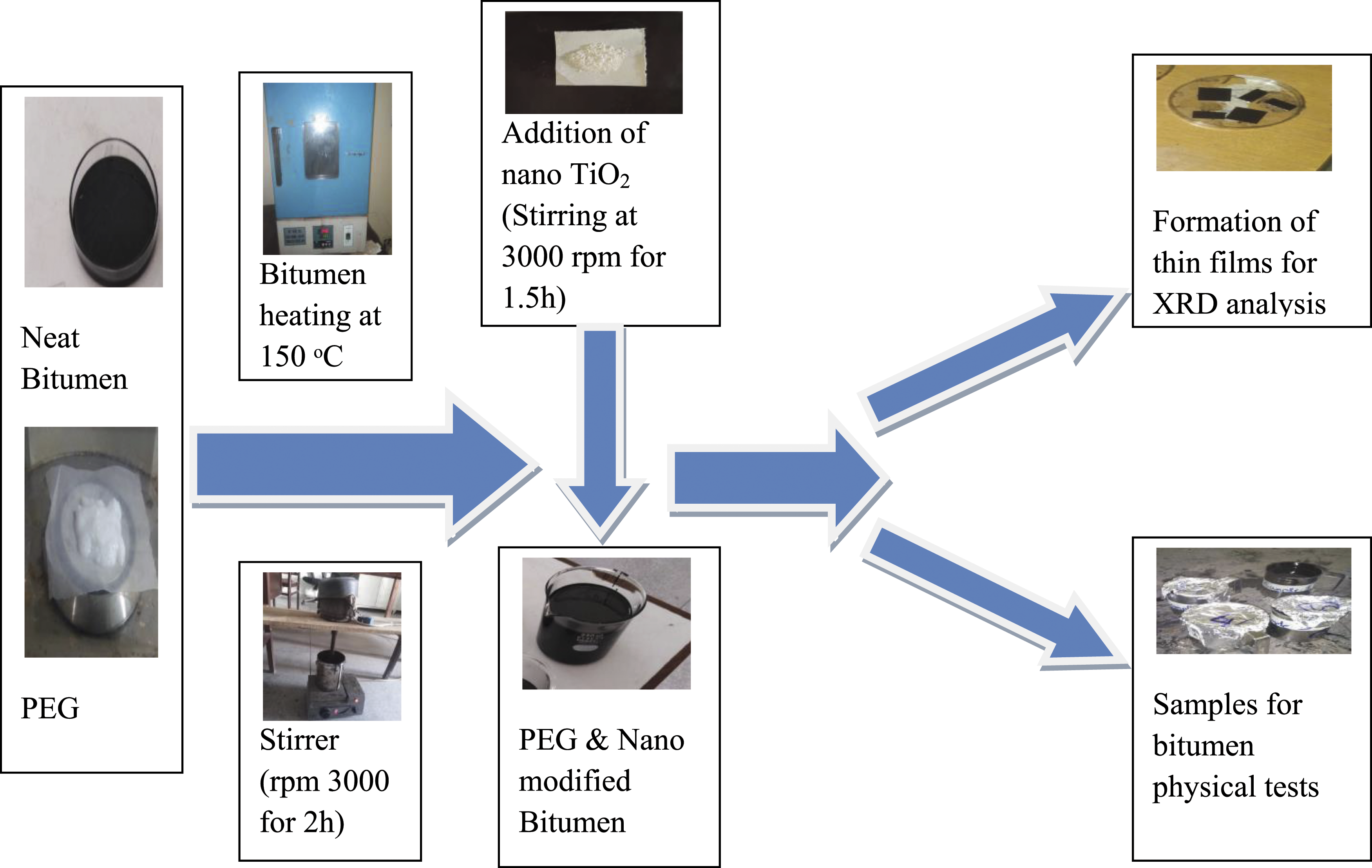
The Melt blending method was chosen to prepare a triple composite of bitumen, polymer, and nano particles. Initially, bitumen was heated at 180°C and an amount of polyethylene glycol (6% by weight) was added into it. Finally, particles of nano TiO2 of various percentages (1.5%, 3%) were added slowly into bitumen. The mixture was stirred at a fixed speed of 3000 rpm for almost 1.5 h. These nano-polymer modified bitumen samples were named NPMB1.5 and NPMB3.
Results and discussion
Various conventional tests including penetration, fire and flash point, softening point, and ductility tests were performed on samples. XRD is performed for structural analysis.
Penetration by grade
Penetration values determine the hardness and softness of bitumen. It is usually measured with the help of a penetrometer. The change in penetration values depends upon the type and percentage of particular polymer that is being incorporated in bitumen. Figure 2 shows the decrease in penetration value from 69 mm to 44.6 mm as the PEG concentration increases from 2% to 8% respectively. It is evident from the results that the hardness of bitumen increases with the addition of PEG. The lower penetration values indicate harder bitumen. The increase in hardness could contribute to the higher resistance towards rutting.23-24 A Decrease in penetration could be attributed to the nature of PEG. PEG can readily associate itself with polar or non polar components due to its amphiphilic nature.
25
This association between PEG and bitumen could lead to an increase in intermolecular forces, which ultimately enhances the viscosity of samples. Effect of polymer content on penetration by grade values.
Softening point
The softening point gives us information about the temperature at which bitumen attains specific fluidity. Higher values of softening point make bitumen less temperature susceptible. Such samples are considered to be more heat resistant and would melt at higher temperatures. Figure 3 shows the increase in softening point from 54°C to 59°C with the increase in polymer content. The values of the softening point of polymer modified bitumen are large as compared to neat bitumen. As the addition of PEG has made bitumen more viscous, modified samples will need higher temperature to attain a specific fluidity. Improved values of the softening point indicate samples would be less prone to rutting and thus could be used in warmer areas.
26
Effect of polymer content on softening point.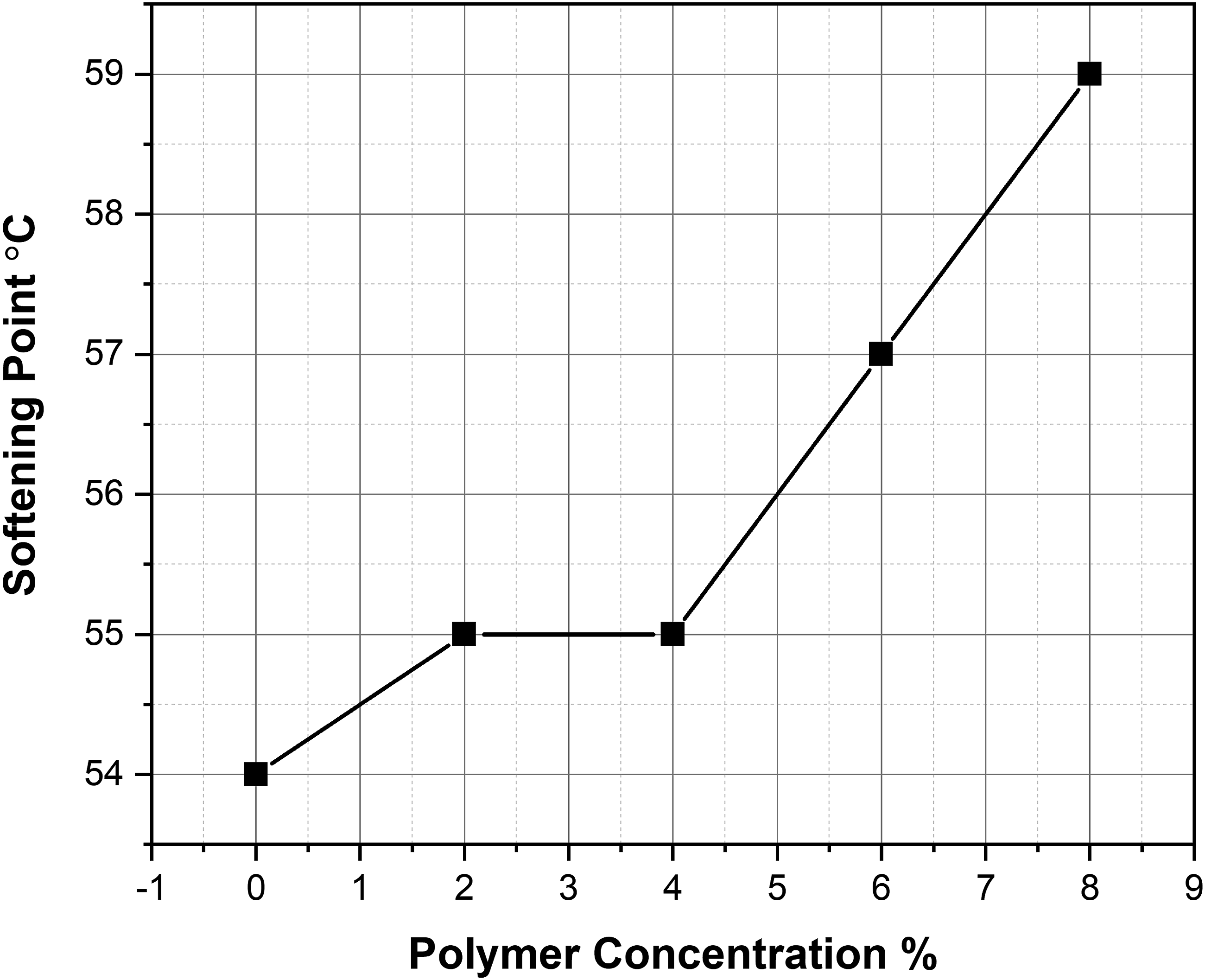
Fire and flash point
The Fire and flash point test is a safety test for bitumen. It measures the safe temperature at which samples of bitumen can be exposed. Flammable liquids possess vapour pressure. The concentration of vapour pressure increases as the temperature increases. At high temperatures this volatile concentration reaches a point when exposed to an external flame, it ignites (flash point). The temperature at which flammable liquids sustain burning after ignition is known as the fire point. A higher value of fire and flash points indicates higher safety for bitumen during heating.
27
It is evident from Figure 4 that the values of fire and flash points increase with the increasing content of polymer up to 6% and then decrease at 8%. 6% is found to be optimum level of polymer content for fire and flash point. Effect of PEG on (a) Fire Point (b) Flash Point.
Ductility
Ductility is the property of bitumen that allows it to go through elongation or deformation. It shows the elasticity of the bitumen sample. It is measured by the distance in centimeters to which bitumen elongates before breaking out the thread. Bituminous materials should be capable of tolerating traffic loads or temperatures without being cracked. Stiffness is usually increased with a controlled amount of polymer in bitumen. An Increase in stiffness makes bitumen less flexible, which causes a reduction in ductility.
28
Reduction in ductility could be because of the interlocking of PEG molecules with bitumen.
29
Figure 5 shows the decrease in ductility from 143 cm to 83 cm as percentage of PEG increases from 2% to 8% respectively. A ductility value less than 50 cm may make bitumen unfit for its use in road construction.
30
Effect of PEG concentration on ductility.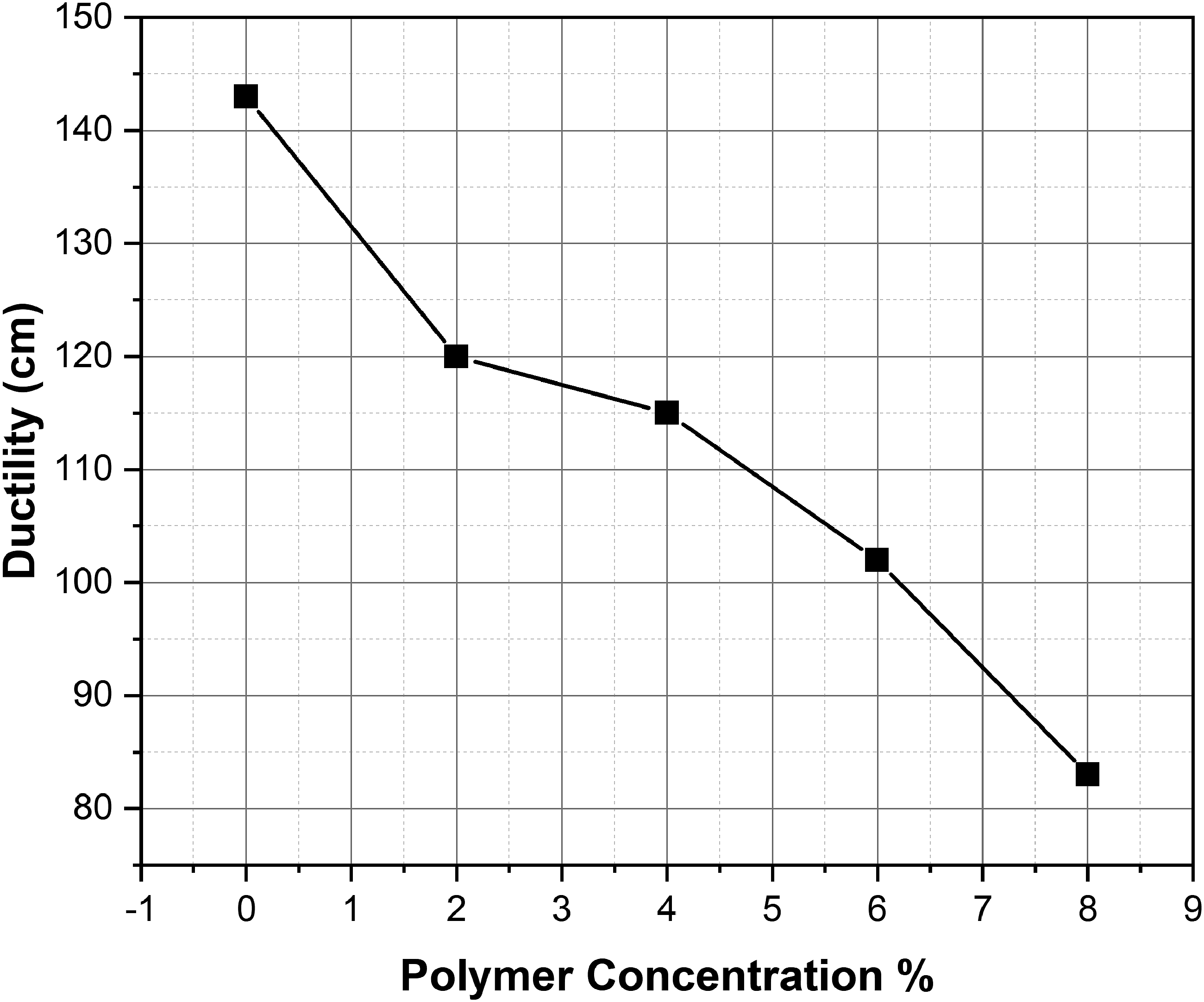
As fire and flash point values are observed to be maximum at 6% of polymer content and the ductility value is also greater than 100 cm, 6% of polymer content has been decided as the optimum value and chosen for investigating the effect of nano particle TiO2 on PMB6.
XRD Analysis
X-ray diffraction is a non destructive technique used to determine the crystallinity and structure of materials. It uses high energy x-rays to identify the phase of crystalline materials. The XRD spectra of Bitumen, PEG, PMB6, TiO2, NPMB1.5, and NPMB3 are shown in Figure 6. XRD patterns of (a) Bitumen (b) PEG (c) PMB6 (d) TiO2 (e) NPMB1.5 (f) NPMB3.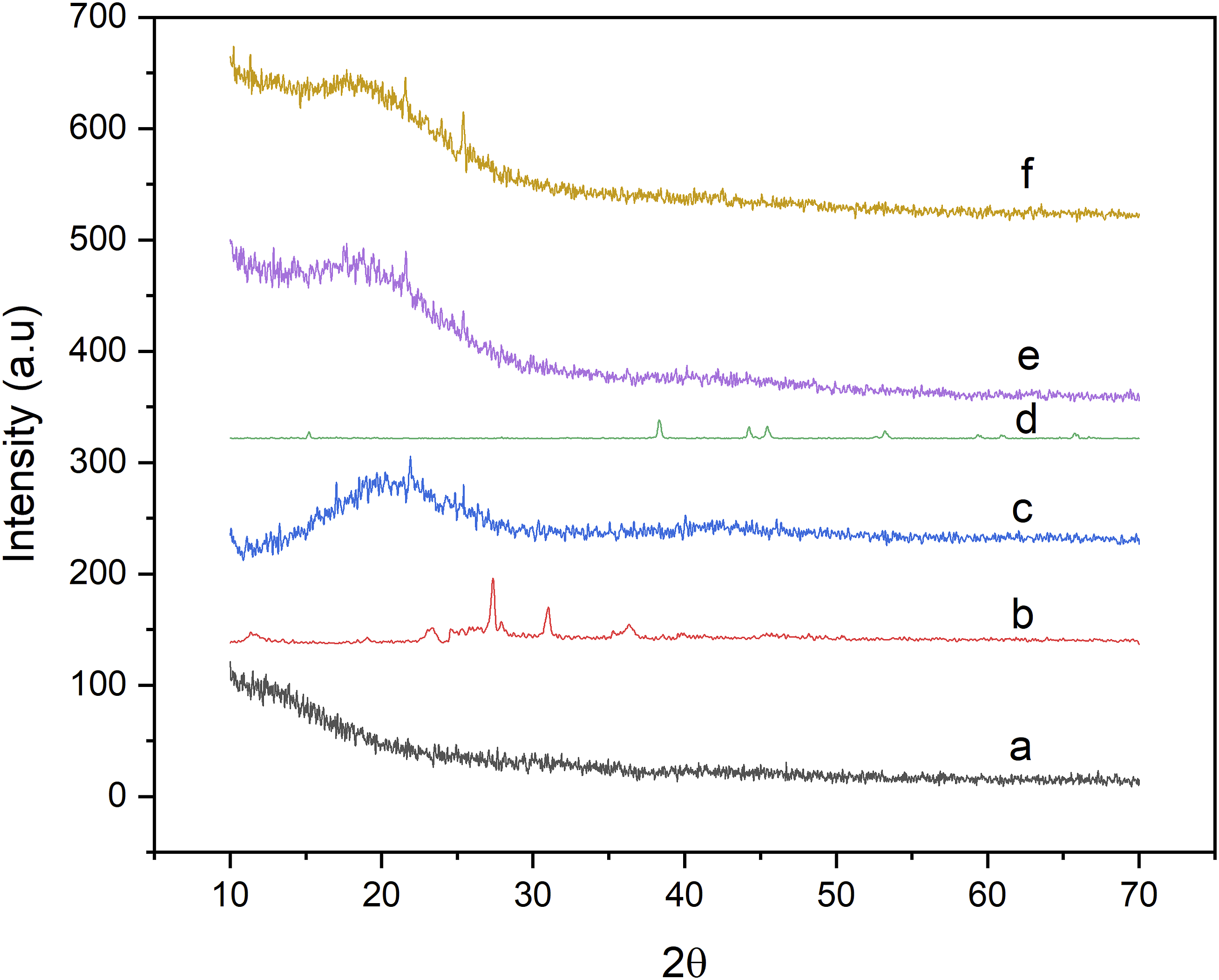
Structural analysis of samples was carried out using a Bruker D8 Advance diffractometer with Cukα radiation having a wavelength of 1.54Ǻ. XRD spectra of neat bitumen confirm its amorphous nature, as shown in Figure 6(a). Two major diffraction peaks of PEG appear at 2θ = 27.3° and 2θ = 30.9° as indicated in Figure 6(b). The inter layer spacing of peaks is calculated using the Bragg formula, which is nλ = 2dsinθ where θ is the diffraction angle, d is the interlayer spacing, n = 1 and λ = 0.154 nm. The calculated inter layer spacing of the two major peaks of PEG is 0.32 nm and 0.28 nm respectively. However, these two diffraction peaks of PEG disappear and appear at lower angles (2θ = 21.9° and 2θ = 25.4°) in polymer modified bitumen (PMB6) as shown in Figure 6(c). Their calculated interlayer spacing is found to be 0.40 nm and 0.35 nm. Shifting of peaks towards lower angles indicates an increase in interlayer spacing. 31 The increase in interlayer spacing value Figure 6(d) confirms the successful intercalation of PEG in pure bitumen which is also evident from the results of the physical properties of polymer modified bitumen. However, we could not observe any distinct nano TiO2 peak in nano-polymer modified bitumen as shown in Figure 6(e) and Figure 6(f).
Effect of TiO2 content on PEG modified bitumen
Effect of TiO2 on PEG modified bitumen.

Conclusion
In this study, polyethylene glycol and TiO2 have been used as modifying agents for neat bitumen. Effect of PEG concentrations (2%, 4%, 6%, and 8%) and TiO2 content (1.5%, 3%) on neat bitumen has been studied. It has been observed that the physical properties of bitumen depend on polymer and nano content. A current study suggests that the properties of bitumen of grade 60/70 can be modified by the incorporation of PEG. The XRD result shows an increase in d-value, which confirms the successful intercalation of PEG in neat bitumen. A decrease in penetration by grade and ductility with the increasing content of PEG shows higher resistance towards rutting. The increase of PEG content has resulted in an increase in the values of softening point. An increase in softening point suggests that samples would attain specific softness at higher temperatures, which would make these samples less temperature susceptible and thus can be utilized in warmer regions of the country. Fire and flash points attain their maximum value at 6% of PEG content. Incorporation of TiO2 in PMB6 further decreases penetration and ductility values which indicate stiffness in samples and thus can be utilized in tropical regions of Pakistan.
Footnotes
Declaration of conflicting interests
The author(s) declared no potential conflicts of interest with respect to the research, authorship, and/or publication of this article.
Funding
The author(s) received no financial support for the research, authorship, and/or publication of this article.
