




Abstract
Today, advanced materials like fibrous composites are widely used in the industry due to their favorable strength-to-weight ratio, corrosion resistance and many other suitable properties. Buckling phenomenon may occur in a thin composite structure subjected to high compressive loads. Moreover, the buckling strength of polymer based composites such as glass/epoxy decreases due to sunlight radiation. In this research, the effect of adding zinc oxide (ZnO) nanoparticles as a reinforcement to the matrix material of glass/epoxy composite on the critical buckling load of the beam specimens is investigated experimentally. In addition, samples are exposed to simulated sunlight irradiation and the effect of adding nanoparticles is investigated. Rectangular composite beams are made and reinforced with 1 wt. % of ZnO nanoparticles. Beams are clamped under tensile testing machine for buckling test. Compressive load is applied to the beams in the longitudinal direction and force-displacement graphs are plotted. Results indicate that the addition of ZnO nanoparticles into the epoxy resin increases the critical buckling load of these beams. As the results show, the critical buckling load of ZnO reinforced glass/epoxy specimens increases by %39.4 with respect to that of glass/epoxy samples. Moreover, to investigate the effect of adding nanoparticles after sunlight irradiation, some samples were placed in the accelerated weathering system for 24 h. Buckling test results represent a remarkable increase in the amount of critical buckling load for ZnO/glass/epoxy specimens even after the irradiation. SEM images of the break section of ZnO reinforced glass/epoxy specimens illustrate homogeneous dispersion of ZnO nanoparticles in the epoxy resin.
Introduction
Composite plates and beams are one of the most important and widely used structures used in various industries. These structures are constructive in different applications such as aerospace, marine, automotive, etc. One of the important topics regarding composite plates and beams is the strength-to-weight ratio of these structures. Also, the use of composites instead of metals is expanding rapidly. Polymer-based composites, including glass, carbon and aramid fibers, are widely used in the industry. These composites are used in the construction of aircraft bodies, drones, flying robots, marine vessels, electric vehicles, oil and gas transmission pipes, wind turbine blades and many similar cases.1–3 Another important issue in the design of thin composite structures is the stability of these structures against the compressive loads. The buckling phenomenon in such structures can cause instability of the structure before the material reaches the yield stress. SudhirSastry et al. 4 investigated pre- and post-buckling analysis of stiffened composite panels based on finite element models. They concluded that out of all the combinations considered in their work, the carbon epoxy panel with I shaped stiffeners possess the maximum bucking load capacity. Heidari et al. 5 studied the critical buckling load and failure modes of thin multilayer composites in a finite element analytical study. Sayer 6 has investigated the effects of different ceramic particles on the elastic properties and critical buckling load and load-bearing capabilities of filled glass/epoxy composite plates experimentally and numerically. Aslan et al. 7 investigated the effects of multiple delaminations on the compressive, tensile, flexural, and buckling behaviour of E-glass/epoxy composites.
In recent years, the study of various properties of nanostructured reinforcements in the structure of composite materials has become an attractive topic for researchers. 8 Bozkurt et al. 9 investigated the lateral and axial buckling characteristics of glass/epoxy composites reinforced with nanoclay (NC) particles. They concluded that incorporation of NC particles by 1 wt. % (weight percentage) in the composites resulted in 8.6% improvement axial buckling load, and further increasing NC content did not significantly effects on axial and lateral buckling values implying poor interfacial stress between NC particles and epoxy resin. Sabermanesh et al. 10 experimentally investigated the effect of adding carbon nanotubes as a reinforcement to the polymer base material with glass fibers on the critical buckling load of composite sheets under compressive loading. Goyat et al. 11 summarized some most recent findings on the mechanical properties, and toughening mechanisms of epoxy nanocomposites reinforced with nanoparticles. Karimi et al. 12 investigated buckling and post-buckling of graphene-reinforced laminated composite plates subjected to uniaxial and biaxial loadings. It is shown that plates reinforced by defective graphene sheets with 5% vacancy provide lower buckling and post-buckling resistance with respect to those reinforced by pristine graphene. Wang et al. 13 investigated the buckling behavior of graphene platelets reinforced composite cylindrical shells with cutouts. It is found that larger sized graphene platelets with fewer single graphene layers are favorable reinforcing fillers in enhancing the buckling performances of the structures.
In addition, in some applications, the composite structure is exposed to intense sunlight irradiation, which also reduces the resistance of the structure against buckling. It is widely known that wide-bandgap zinc oxide (ZnO) is a promising material for ultraviolet (UV) detection due to its high absorption coefficient in the UV spectrum. 14 High thermal and electrical conductivity, high exciton binding energy, biocompatibility, piezo- and pyroelectricity are few important properties of ZnO. 15 Samad et al. 16 added 0.5 and 1 wt. % of ZnO nanoparticles into the epoxy/polyaniline. Their results showed that ZnO nanoparticles were well dispersed and distributed into the matrix material and increased the hardness value of epoxy/polyaniline by 15% when 1 wt. % of ZnO nanoparticles are utilized. Ma et al. 17 grafted ZnO nanoparticles on the surface of aramid fibers of fiber-reinforced composite and investigated the improvement of UV-resistances and mechanical properties of composites. Nikafshar et al. 18 studied the improvement of the stability of epoxy coatings against the effect of sunlight. Their results showed that epoxy samples containing 1 wt. % halloysite nanotubes encapsulated with lignin had high UV stability. Jena et al. 19 developed Polyacrylonitrile templated CuO-ZnO nanofibrous nanocrystals using simple electrospinning technique followed by heat treatment methods that is hydrothermal and calcination. Alvarez et al. 20 mixed epoxy powder coatings with nanosilica through ball milling to study their effect on the wear performance after UV exposure. They stated that small amounts of nanosilica (0.75%–1% by weight) increased the wear resistance of epoxy coating after UV exposure. Huang et al. 21 fabricated an environment-friendly poly vinyl alcohol (PVA)/lignin nanocomposite films with excellent UV-shielding and visible-transparent performance. Li et al. 22 synthesized ZnO/polyurethane composite membranes using a simple solution casting method. They achieved a stable UV-shield composite in high temperature environments. Li et al. 23 successfully synthesized UV-responsive single microcapsule self-healing material with enhanced UV-shielding SiO2/ZnO hybrid shell. Pulikkalparambil et al. 24 developed polymer coatings that could protect the underlying metal substrates from corrosion. Their results indicated that the composites containing of encapsulated halloysite nanotubes were able to heal the scratches completely and recover the structural functions in the presence of sunlight. Xu et al. 25 improved durability of glass fiber reinforced polymer composites by incorporation of nano ZnO and organo-montmorillonite subjected to UV radiation and hygrothermal aging. They could increase the flexural strength and interlaminar shear strength by 26.5% and 27.2%, respectively in hygrothermal condition.
To the best knowledge of the authors, few literature has been focused on the effects of sunlight irradiation on the buckling behavior of polymer matrix composites including micro fibers and nanoparticles as reinforcements. In this study, the critical buckling load of fibrous composite beams, effects of adding nanostructured fillers and effects of sunlight irradiation have been experimentally investigated. ZnO nanoparticles were added to the matrix material of glass/epoxy composites. Accelerated weathering system is used to simulate sunlight irradiation. Glass/epoxy, ZnO/glass/epoxy with 1 wt. % of ZnOs are fabricated. Specimens were subjected to the longitudinal in-plane pressure load under fix ended boundary conditions before and after sunlight irradiation. Force-displacement diagrams of all samples are obtained and the critical buckling loads are extracted and compared. Scanning electron microscopy (SEM) images are provided to discuss the results.
Experiment
Materials
ZnO nanoparticles manufactured by US Research Nanomaterials, Inc. with a purity of over 95% is prepared from Pishgaman company, Iran. LR 620 epoxy resin, H 620 hardener and T300 unidirectional glass fibers were purchased from Iran composite kavian company, Iran.
Manufacturing method
Manufacturing of ZnO reinforced matrix material
Epoxy resin containing 1 wt. % ZnO nanoparticles is used to manufacture ZnO included specimens. Nanoparticles were added directly into the epoxy resin and completely mixed with mechanical stirrer for 10 min. Then, the mixture was put in the ultrasonic bath (90 W) at room temperature for 45 min. To achieve homogenous ZnO reinforced matrix material, these processes (mechanical steering and ultrasonic bath) were repeated three times. Next, the hardener was added and completely mixed with the ZnO/epoxy mixture. The weight ratio of resin to hardener in mixture is 100 to 20.
Manufacturing of composite specimens
ZnO reinforced epoxy resin and glass fibers are used to make unidirectional (
Characterization
In order to confirm the microscopic structure of ZnOs, the SEM and TEM (tramsmission electron microscopy) images are taken, which are shown in Figure 1. As the figure shows, the diameters of nanoparticles are less than 100 nm. Microscopic images of ZnO nanoparticles, (a) SEM image, (b) TEM image.
26

Further, the Raman spectrum of the ZnO nanoparticles excited by laser lines 532 nm is illustrated in Figure 2. Some spectroscopic peaks are observed in this figure. Among these Raman peaks, the E2 mode centred at 437 cm−1 has a stronger intensity and narrower line-width, which indicates that this nanostructure material is composed of ZnO with a hexagonal wurtzite structure and good crystal quality.
27
Raman spectrum of the ZnO nanoparticles.
Moreover, mechanical properties of fabricated glass/epoxy samples along with fiber volume fraction of this specimens are obtained. To acquire the mechanical properties of glass/epoxy composite, a glass/epoxy plate was manufactured and some beam-shaped specimens, according to ASTM D 3039,
28
were extracted using laser cutting method. (a) 
Tensile specimens were subjected to axial tensile force in the longitudinal direction of the specimen (Figure 3(b)), and stress-strain graphs where extracted. Using the graphs, Young’s modulus of the specimens were determined and named

Further, to specify fiber volume fraction of glass/epoxy composite, epoxy matrix was removed from glass/epoxy specimen by heating at 600 Finding fiber weight fraction of glass/epoxy, (a) weighting glass/epoxy sample, (b) placing the sample in the furnace at a temperature of 600 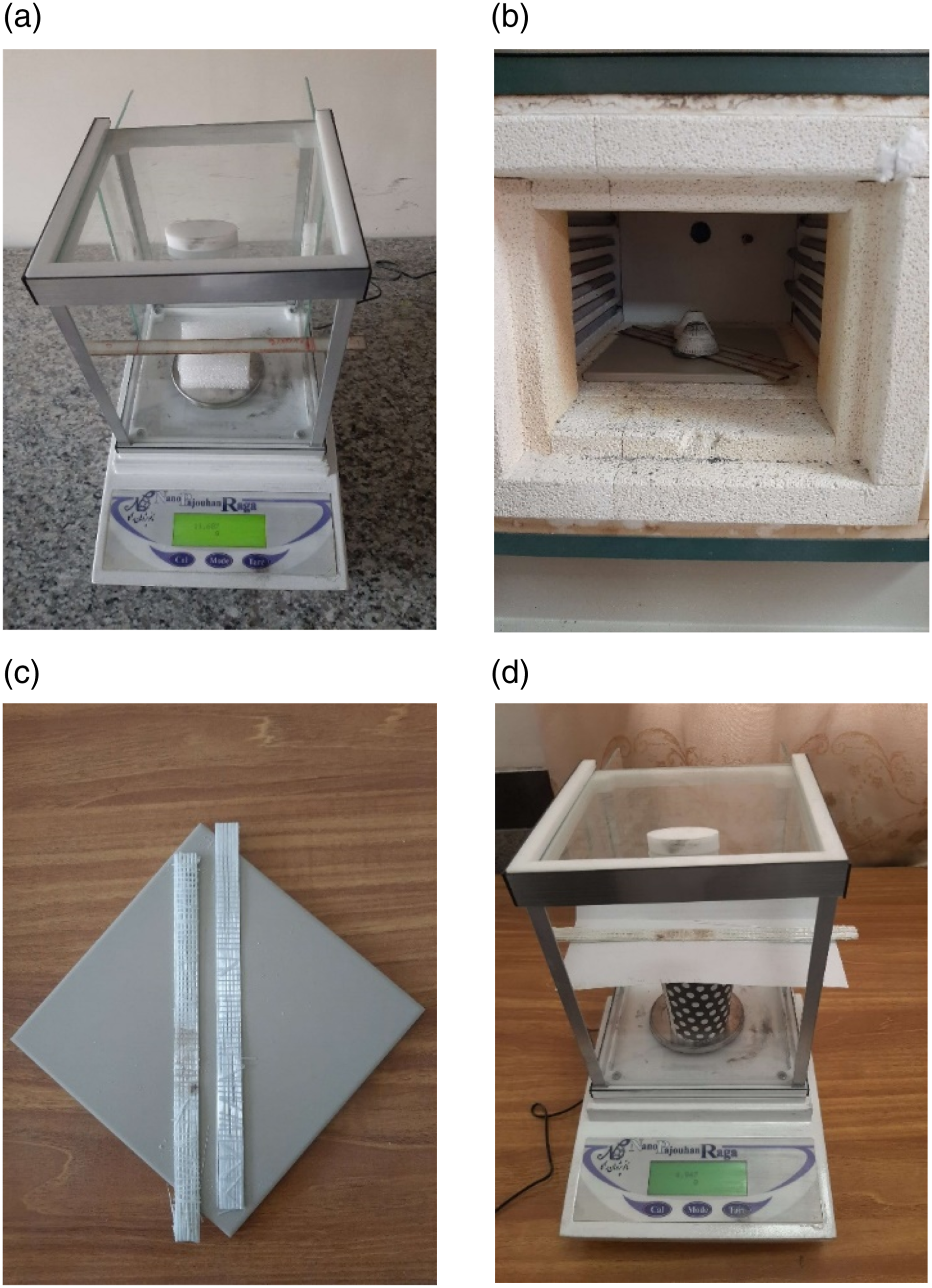

Measured properties of glass/epoxy composite (mean values).

Sunlight simulation test
Three beam shaped samples of glass/epoxy and three beam shaped samples of ZnO/glass/epoxy are exposed to simulated sunlight irradiation using an accelerated weathering system (AWS). AWS-300 Nanoshot company, Iran (Figure 5), is employed to shine on all specimens for 24 h. At a temperature of more than 55 (a) Accelerated weathering system, (b) Specimens under simulate sunlight irradiation.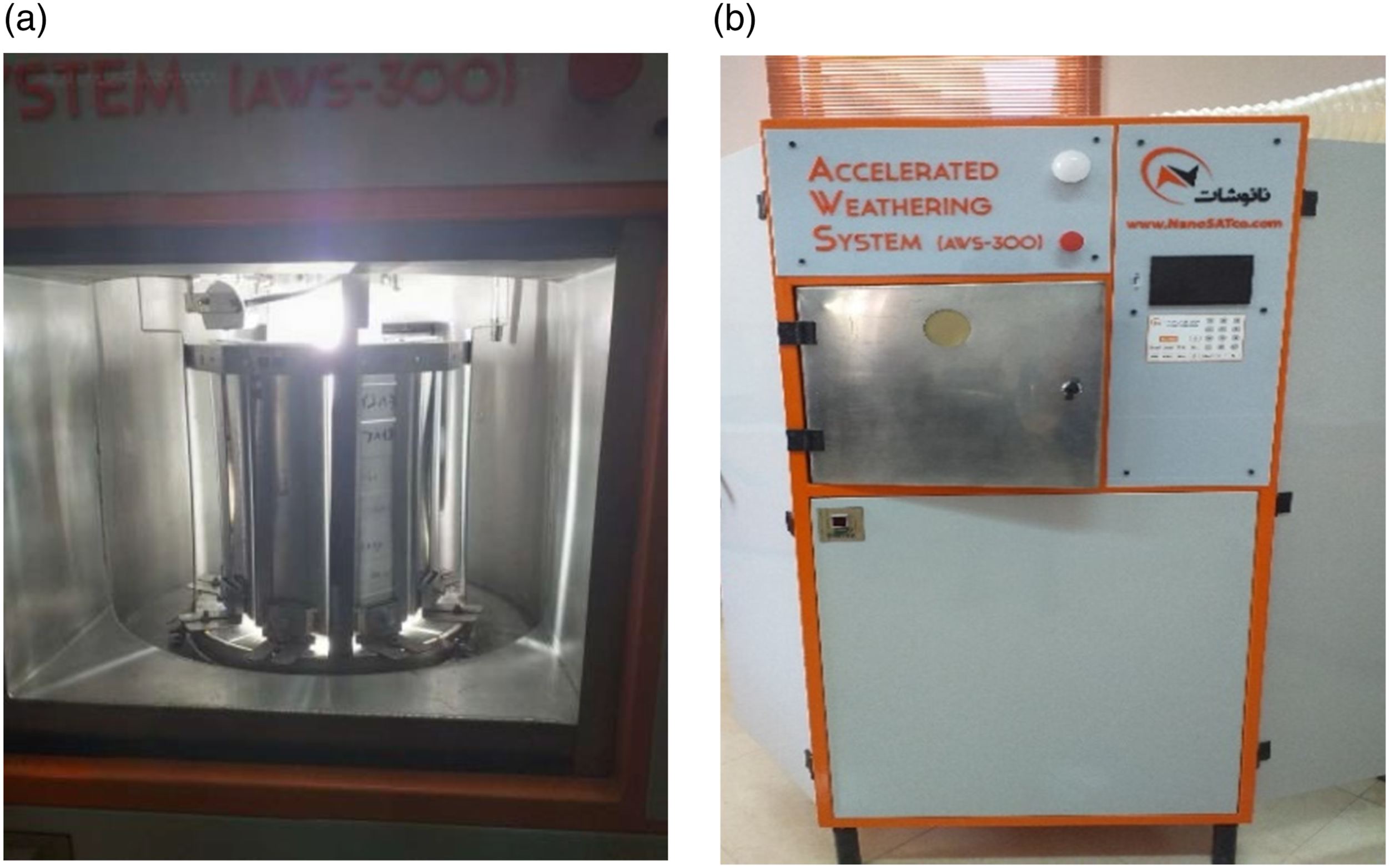
Buckling test
To investigate the effect of adding ZnO nanoparticles into the matrix material of glass/epoxy and the effect of sunlight irradiation on the critical buckling load, the experimental buckling test are performed. Three samples of each material are subjected to inplane unidirectional axial loading. Buckling test specimens are demonstrated in Figure 6. For convenience, glass/epoxy and ZnO/glass/epoxy specimens, after exposure to simulated sunlight irradiation, are named glass/epoxy-S and ZnO/glass/epoxy-S. Buckling test are performed on the samples by Santam universal testing machine STD-600 (600 kN capacity), Iran (Figure 7(a)). In order to apply loading on the samples, the composite beams are placed under the boundary condition of clamp-clamp. The other two edges are left free and without lateral bracing supports.9,34 Each beam sample is subjected to the inplane buckling load at its two fix edges, and the force-displacement diagrams are plotted. Figure 7(b) shows the sample of the composite beam during the test. The force-displacement diagrams obtained from the buckling tests. Buckling test composite samples, height=200 mm & width=20 mm, thickness=2 mm, (a) (a) Santam universal testing machine STD-600, 600 kN capacity, (b) Buckling of composite beams under compressive loading.

Results and discussion
SEM characterization results
In order to investigate the distribution of ZnO nanoparticles inside the matrix material, the fracture area of the sample was photographed by a scanning electron microscope (SEM).
The SEM image for ZnO/glass/epoxy specimen is illustrated in Figure 8. This image is taken with a 200 nm scale line to identify ZnO nanoparticles in the image. As the figure shows, nano-scale reinforcements are observed uniformly in the epoxy matrix. Homogeneous dispersion of ZnO nanoparticles into the matrix material for ZnO/glass/epoxy composite beam.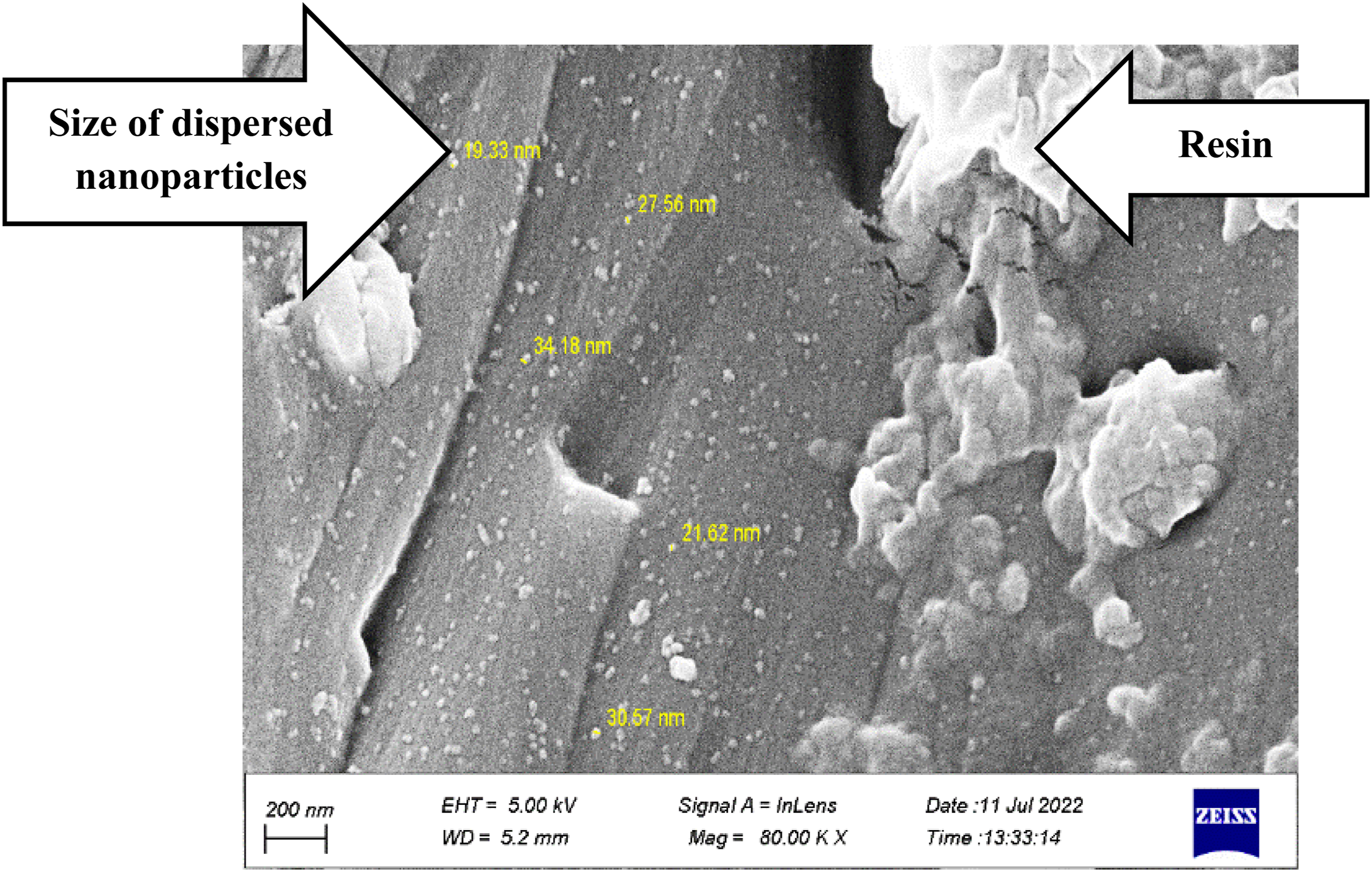
Moreover, the adhesion quality between glass fibers and ZnO reinforced matrix material of ZnO/glass/epoxy is demonstrated in Figure 9. A strong connection between the fibers and the substrate material causes good force transmission from the base material to the fibers and increases the amount of elastic modulus of the composite material. Furthermore, ZnO reinforced matrix material supports glass fibers when pressure loads are applied. It seems that this phenomenon has an effective role in the enhancement of critical buckling load of the material. Strong adhesion between glass fibers and matrix material for ZnO/glass/epoxy composite beam.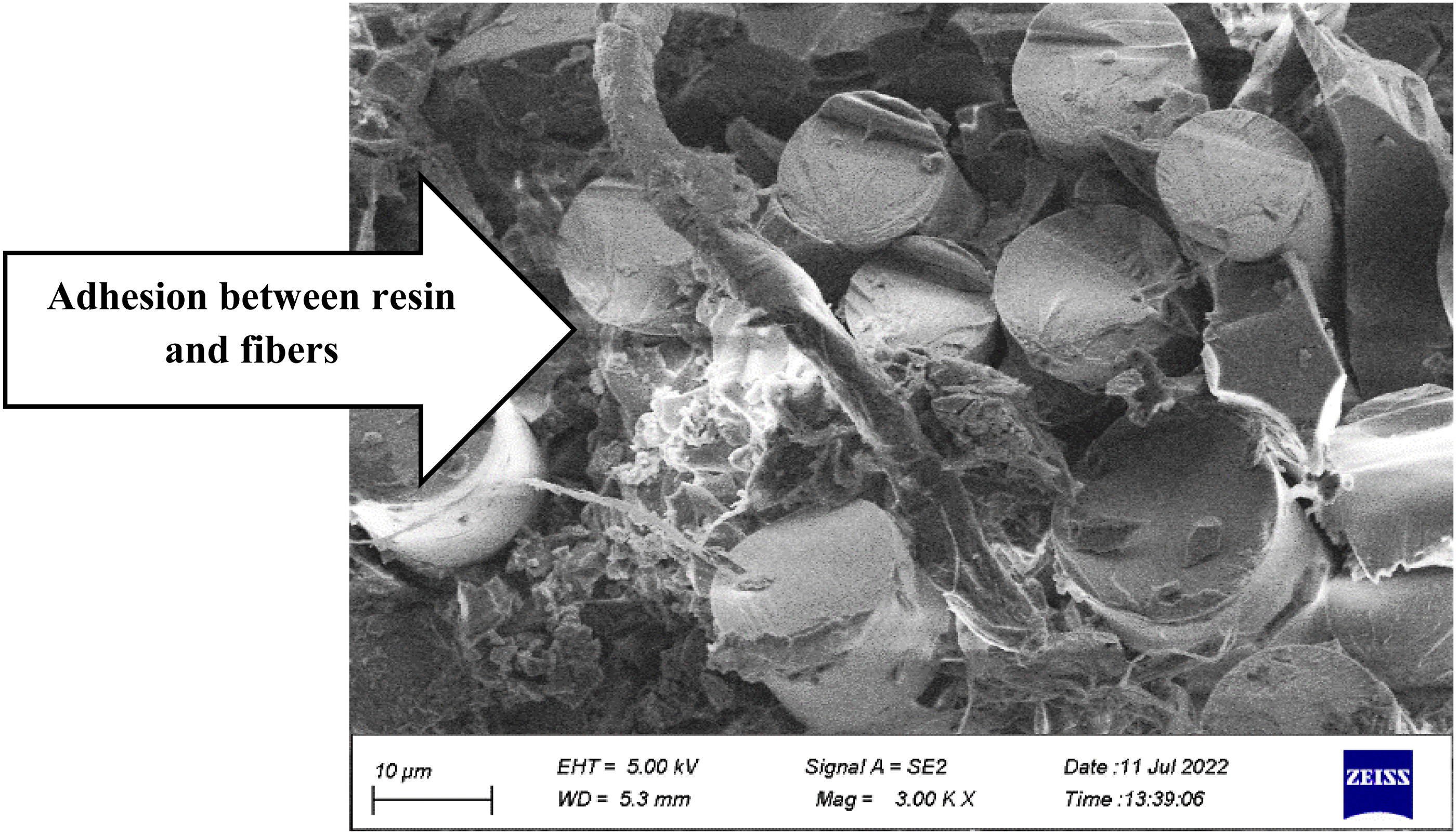
Buckling test results
To investigate the effect of adding ZnO nanoparticles into the matrix material of glass/epoxy, and the effect of sunlight irradiation on the buckling behavior of composite beam specimens, the experimental buckling test were utilized.
To compare critical buckling loads, three specimen of each material were subjected to unidirectional pressure load. Samples after buckling test are shown in Figure 10. Force-displacement diagrams of glass/epoxy, ZnO/glass/epoxy, glass/epoxy-S and ZnO/glass/epoxy-S are demonstrated in Figures 11–14. Since, in thin structures, buckling may occur when all fibers of the cross section are still elastic, an approximately linear behavior are observed after buckling in load-displacement graphs.6,9 Further, the amount of load in zero displacement is not zero. This preload is applied to the sample to compensate the clearances of the test device at the beginning of the test and does not affect the value of the critical buckling load. Samples after buckling test, Left to right: three samples of ZnO/glass/epoxy-S, three samples of glass/epoxy-S, three samples of ZnO/glass/epoxy and three samples of glass/epoxy. Force-displacement diagram of glass/epoxy composite beams. Force-displacement diagram of ZnO/glass/epoxy composite beams. Force-displacement diagram of glass/epoxy-S composite beams. Force-displacement diagram of ZnO/glass/epoxy-S composite beams.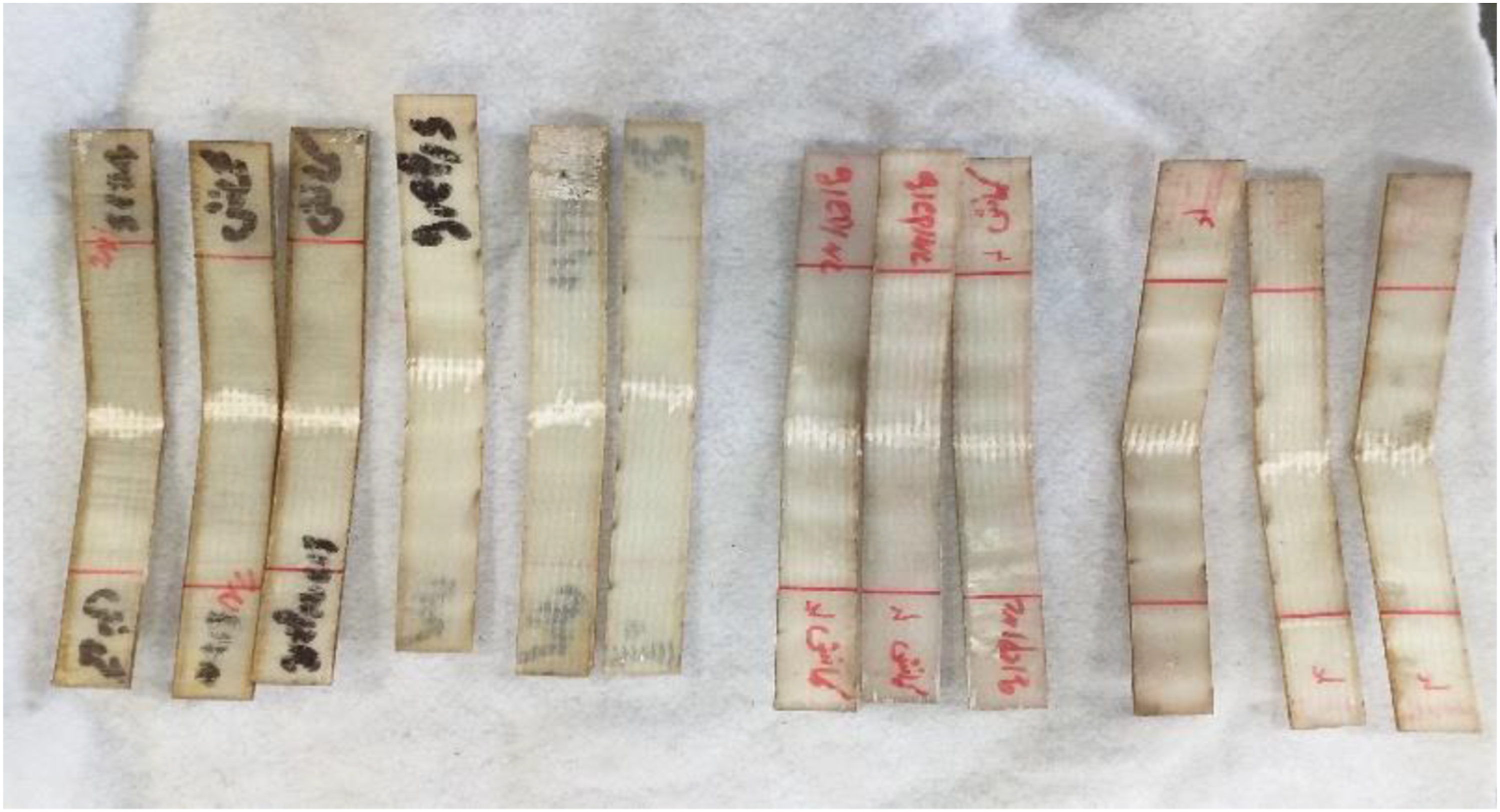


Critical buckling loads (N) of composite beam samples.

As Table 2 shows, the average critical buckling load for glass/epoxy beam specimens is 431.7 N. For ZnO/glass/epoxy specimens, which contains 1 wt. % of ZnO nanoparticles into the epoxy resin, the critical buckling load increases by %39.4 with respect to that of glass/epoxy beam and reaches 601.7 N. The increase of critical buckling load states that homogeneous dispersion of ZnOs into the matrix material can improve the composite beam stiffness. After exposing the samples to simulated sunlight irradiation, the average critical buckling load for glass/epoxy beam specimens (glass/epoxy-S) is decreased to 421.7 N. Moreover, according to the table, adding 1 wt. % of ZnO nanoparticles into the matrix material results in a noticeable improvement in the amount of critical buckling load even after irradiation. The value of critical buckling load was obtained to be 559.3 N for ZnO/glass/epoxy-S which indicates 29.5% increase with respect to that of glass/epoxy. For different specimens, the mean values of critical buckling loads along with standard deviation error bars are illustrated in Figure 15. The error bars show the reproducibility of the results for three tested samples of each type. Critical buckling load of different composite specimens.
Conclusion
In this study, the effect of adding ZnO nanoparticles into the matrix material of glass/epoxy composites on the buckling behavior of manufactured composite specimens is investigated. Critical buckling loads of glass/epoxy, Zno/glass/epoxy before and after sunlight irradiation are measured experimentally. It is concluded that utilizing of 1 wt. % of ZnO nanoscale constituent has a noticeable effect on the composite strength and improve the critical buckling load of the specimens. Moreover, the addition of ZnO nanoparticles to the composite structure prevented the reduction of the critical buckling load of the samples after sunlight irradiation.
Footnotes
Acknowledgements
The authors thank Dr. H. Haratizadeh from the Shahrood University of Technology for providing accelerated weathering system.
Declaration of conflicting interests
The author(s) declared no potential conflicts of interest with respect to the research, authorship, and/or publication of this article.
Funding
The author(s) disclosed receipt of the following financial support for the research, authorship, and/or publication of this article: This work was supported by the Shahrood University of Technology research grant.
