



Abstract
This present research aims to predict the mechanical behavior of the composite and hybrid composites based on a polypropylene matrix (PP) reinforced by organic/inorganic naturally occurring fillers using analytical and numerical models. It also aims to demonstrate the effect of hybridization on the global stiffness of the material. In this study, Voigt-Reuss models, Halpin-Tsai equations, the Hirsch model, and numerical simulation are applied to predict the effective elastic moduli of hybrid composites/composites with clay and other alfa fillers. The results obtained are compared with experimental data. Hirsch’s results match well with the experimental results for the alfa/PP composite. However, the values of the Halpin-Tsai model showed a good agreement with the experimental results for the alfa-clay/PP hybrid composite. The numerical results show good accordance with the experimental results with higher accuracy. The overall results provided a good indication of the effects of hybridization on the stiffness of the final hybrid composites.
Keywords
Introduction
The composite material is considered as a combination of at least two different immiscible components. These components have a high penetration capacity and their properties have a strong attitude to complement each other.1,2 The resulting composite is heterogeneous and has properties that the components alone do not possess. 3 However, hybrid composite materials contain both species of different nature or/and form. 4 In the same matrix, it is possible to find reinforcements as fibers and particles (different shapes), 5 the same type of reinforcement with a hybrid matrix. 6 Hybridization is used to improve the mechanical properties and sometimes to improve the moisture resistance of plant fiber composites such as flax, by decreasing water absorption and thickness swelling. 7 In a hybrid material, several types of reinforcements can be assembled, but most likely it is to have a more helpful combination only by two types of reinforcements.8,9 Lately, the need to adapt to economic constraints and the appearance of new terms such as sustainable development, green chemistry, and industrial ecology lead to the development of new composite materials and hybrid composites reinforced by natural elements. 10 These bio-fillers derived from plant origin such as flax, hemp, wood, alfa, coconut, henna, cotton hulls, pine cones, etc.,11–18 mineral origin including clay, brucite, basalt, talc, chalk...,5,19–21 or from the animal origin as horn, silk, etc.22,23 This new generation of materials has shown improved mechanical properties, reduced weight, and/or cost.5,6,8,9
The mechanical properties determination of composites/hybrid composites and the examination of the effect of the different reinforcements as a function of their volume fractions are based on experimental tests. These tests involve chemical surface treatment of the various components, followed by the fabrication of specimens for examination, which requires excessive time and cost. 24 To this purpose, modeling has been used to minimize the time and cost of experiments, to understand the mechanical behavior of the composite material from its constrictive elements, as well as to predict the reactions of structures based on this material to external stresses before their synthesis.25,26 The behavioral studies of the composite can be performed by Voigt-Reuss models, Hashin and Shtrikman model, Halpin- Tsai equations, Eshelby approach, Hirsch model, Mori-Tanaka model, etc.27,28 M. Racca and al. 29 used experimental tests and mathematical models like Halpin-Tsai, Kerner-Nielsen, and modified Guth model to determine the modulus of elasticity of the PP/talc composite. Hadi and al. 30 applied the ROM (rule of mixtures), IROM (inverse rule of mixtures), Halpin-Tsai and Hirsch models to determine the elastic modulus of the hybrid composite with jute and ramie fibers. K. Madu and al. 31 have employed micromechanical models such as the modified Kelly-Tyson equation and a modified rule of mixtures to predict the tensile strength of PP/Stipa composites. Y. Rafic and al. 32 have compared the results obtained from analytical and numerical models with the experimental results for artificial fiber composites.
This paper focuses on the stiffness prediction of PP/alfa and PP/alfa/clay hybrid composites by applying analytical models, namely Voigt, Reuss, Halpin-Tsai, and Hirsch, as well as the FE numerical analysis model. The elastic modulus results obtained from the different models are compared with experimental measurements. Finally, it is highlighted to explore the natural hybridization effect on the stiffness of the resulting hybrid composites.
Materials and methods
Materials
In this experiment, alfa fibers (Stipa tenacissima) and clay particles, which are presented in Figure 1, were used as reinforcements in the polypropylene (PP) matrix. These two resources are locally abundant in Morocco. The alfa fibers were exposed to an alkali chemical treatment to clean their surfaces. They were initially rinsed with water and then maintained for 48 h in a 1.6 mol/L aqueous soda solution. (a) Alfa plant; (b) clay.
5

Elastic constants of various constituents.

Composites preparation
The mixing of each material: the Alfa fiber reinforced PP matrix composite and the Alfa fiber reinforced PP hybrid composite with clay particles, is performed in a Leistritz ZSE-18 twin-screw extruder (LEISTRITZ EXTRUSIONSTECHNIK GMBH, Germany) operated at a screw speed of 125 r/min for polymer feed and 40 r/min for fibers feed (Figure 2). This operation is done in a random way. The temperature in seven cylindrical sections of the extruder, from the hopper to the die, was at 200, 200, 200, 180, 180, 180, 180, and 180°C, respectively.5,39

List of data of components of PP/Alfa composite. 39

List of data of each component of hybrid composite PP/alfa-clay. 5

Methods
Experimental method
Tensile testing
Tensile tests were performed on five PP/alfa-clay composite specimens with varying volume fractions according to ISO 527-1:2012.32. These tests were carried out on an Instron 8821S universal testing machine (Instron, Massachusetts, USA) with a 5 kN load cell at a cross-head speed of 3 mm/min. 5 Tensile tests on PP/alfa composites were done by ISO 527-03 using a universal testing machine INSTRON 8821S at an ambient temperature of 24°C and8,31,32,39–46% relative humidity.
FTIR analysis
A Fourier transform infrared spectrometer (FTIR) is used for the structural determination of compounds and functional groups. FTIR spectra are performed on an ABB Bomem FTLA2000-102 spectrometer with a resolution of 4 cm−1 and an accumulation of 16 scans.
SEM analysis
Scanning electron microscopy (SEM) was used to assess the dispersion of the fillers in the polymer matrix and to illustrate their morphology. All composite samples were fractured after immersion in liquid nitrogen to obtain clean and accurate fracture faces.
Mathematical models
Modelling has arrived to model the mechanical behavior of composite materials/hybrid composites from their constituents, based on the mechanical properties of different phases (matrix-reinforcement), their spatial distributions, their arrangements, and their volume fractions.
25
Using analytical or numerical models was not accidental, but to minimize the time and cost provided to experimental tests.8,9,24 In the present paper, the approaches used to predict the effective stiffness of PP/alfa composites and PP/alfa-clay hybrid composites are: - Boundary models: Voigt model, Reuss model - Semi-empirical models: Hirsch model, Halpin-Tsai equations.
1/ Voigt-Reuss models: is an approximation that provides a framework for the elastic properties of heterogeneous material, they can define the maximum (Voigt) and minimum (Reuss) limits of elastic properties.
The Voigt model is a deformation approach, which assumes that the deformation is constant in all phases. It is equal to the imposed macroscopic deformation. Furthermore, the Reuss model is the conjugate of “Voigt” based on a stress approach by stipulating that the stress at each point equals the imposed macroscopic stress. The calculation of Young’s modulus is done by the following equations.25,30
Voigt model
• PP/alfa composite: • PP/alfa-clay hybrid composite:


Reuss model
• PP/alfa composite: • PP/alfa-clay hybrid composite:


2/ Hirsch’s approach represents a combination of the two previous models (Reuss “the serial law” and Voigt “the parallel law”), introducing an adjustable parameter x, which varies from 0 to 1, which allows determining the transfer of stresses between the fibers and the matrix.12,25 In this study, this parameter equals 0.1 because the orientation of the reinforcements is random.
24
• PP/alfa composite: • PP/alfa-clay hybrid composite:


3/The Halpin-Tsai equations are used to calculate the longitudinal (EL) and transverse (ET) modulus of the composite. They predict the effective elastic modulus (Ec) of a composite reinforced with random or aligned short fibers.6,9,15,26,42,47 • PE/alfa composite: • PP/alfa-clay hybrid composite:


With
ζ is a reinforcement factor that depends on the geometry of the reinforcements:
?𝐿 = 2L/D, with L and D representing the length and diameter of the reinforcements respectively. 20
?𝑇 = 2
The elastic modulus of randomly reinforced composite and hybrid composite is determined by the following formula:
The MATLAB software does the calculation of the elastic constants represented by the above-mentioned models.
Numerical modelling
Finite element analysis (FEA) was used to verify the results obtained by the mathematical methods and compare them with the experimental results using the CAE ABAQUS software (Figures 3 and 4). It is consisted of specifying the problem modeling in 1D, 2D, or 3D, defining the virtual domain (VER size, fiber volume fraction, number of fibers), assigning the appropriate models, elements, meshes, and material properties, as well as applying boundary conditions and load. In this paper, the analysis is based on a 2D model with representative RVE elementary volumes with specified lengths and heights (LRVE, HRVE). A series of RVEs were created, in MATLAB code, with the consideration that the size of the RVE (SRVE) is large enough relative to the size of the heterogeneities (SH) and small enough relative to the size of the ensemble (Smacro) so that the stresses in the structure are macroscopically homogeneous (SH < SRVE < Smacro). These RVEs were generated with different fiber volume fractions according to the below equation: • The distribution of the fibers, which is random, is idealized as repeated and regularly spaced inclusions. Furthermore, the processing conditions can influence the orientation of the fibers, which can vary from random in-plane and partially aligned to approximately uniaxial.
8
• The alfa fibers remain unidirectional, without undulation, and there is no interaction between them, but the clay particles are random. • The reinforcements are considered isotropic and uniform, their properties being uniform. They do not exhibit porosity. • The adhesion between matrix/reinforcement is assumed to be perfect, with no voids, gaps, no air bubbles, or slippage. RVE for PP/alfa composite and meshing. RVE for PP/alfa-clay hybrid composite and meshing.
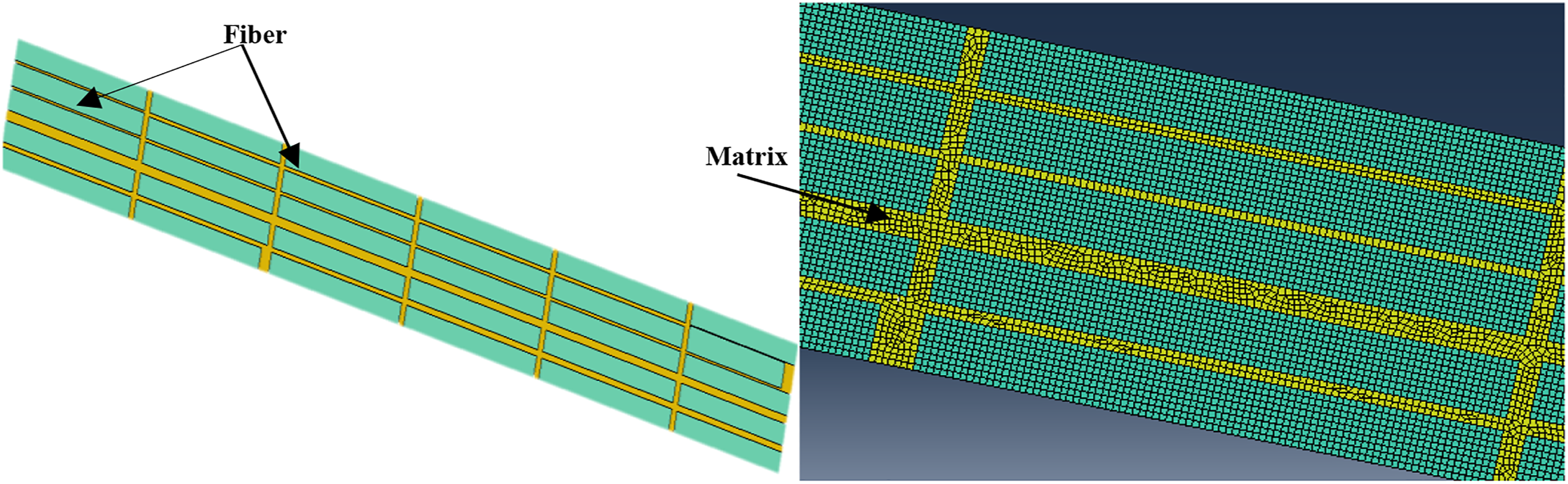

The mesh size was adjusted to determine the mesh that gives results close to the experimental results. The linear quadrilateral CPS4R and linear triangular CPS3 elements were used for composites and hybrid composites.
Periodic boundary conditions
The periodic boundary conditions of a 2D RVE are representable as follows:

These conditions are applied to the RVE by linear constraint equations via the EQUATION command in ABAQUS.
48
The N1 was thoroughly constrained along the studies to exclude any rigid body motion in the model.
48
Therefore, the constraint equations used were reduced:

Specific nodal constraints applied to the selected nodes.


A typical 2D RVE of a composite imposed with periodic boundary conditions.
Results and discussion
FTIR analysis
Figure 6 shows the FTIR results for the treated esparto fiber and the raw esparto fiber (Figure 4). In the 3400 cm−1 region, the FTIR spectrum of the raw alfa fiber (Figure 4) shows typical bands of OH groups. These absorptions may be due to carbohydrates (including stretched C-O-C and C-O and glucoside bonds) and possibly to lignins (that are composed of guaiacyl, syringyl, and hydroxyphenyl groups with aromatic OH groups).
49
The peaks at 2960 to 2900 cm−1 are characteristic bands of the C-H stretching vibration found in the cellulose and hemicellulose complex,
50
whereas the bands near 1730 cm−1 are assigned to carboxylic ester groups in lignin/hemicellulose.
49
Around 1250 cm1, the bands are characteristic of C-O stretch vibrations of primary and secondary aliphatic alcohols within hemicelluloses, cellulose, and lignin.
49
The beta-glycosidic bond of the glucose chain within the cellulose is observed at about 897 to 890 cm−1. In the alkaline alfa fiber, the intensity of the bands at 1500 cm−1 resulting from vibrations of the C = C aromatic backbone in the lignin was reduced. Similarly, the intensity of the bands around 1260 cm−1 was reduced, reflecting the elimination of hemicelluloses. FTIR analysis confirms the chemical effects of the alkaline modification on the alfa’s surface. Figure 6 also shows the FTIR spectrum of the clay particles. The vibrational bands at 3620 cm−1 correspond to the Al-O-H stretching vibration for bound water and Al2OH on illite.
51
The C-O stretching vibration in calcite is responsible for the peak of about 1407 cm−1.
52
The band at 1007 cm−1 is a typical Si-O-Si and Si-O-Al lattice vibration. Nonetheless, the existence of a Si-translation stretching vibration is affirmed at 778 cm−1.
52
FTIR analysis curves of the materials used.
SEM analysis
Figure 7 shows the typical scanning electron microscope analysis of the hybrid composite. The adhesion between the matrix and the reinforcements (alfa fibers and clay particles) seemed to be good since no voids are observed (Figure 7(b)) in sample H3, indicating that surface treatment was optimized. Furthermore, the strong adhesion resulted from the excellent wettability achieved by the treatment, which improves the strength and stress distribution in the material. SEM micrographs of the PP-alfa -clay hybrid composite: (a) dispersion of reinforcements, (b) absence of voids, (c) clay particles.
Figure 8 shows SEM images of the alfa/PP composite. (Figure 8(a)) shows the alfa fibers are well dispersed in the matrix. It can be seen that the matrix wets the fiber’s surface well, which is the result of the chemical surface treatment. (Figure 8(b)) shows the shape of the alfa fibers, appearing circular, and it can be observed that a single fiber is composed of micro-fibers. SEM micrographs of the PP-alfa composite (C6): (a) dispersion of fibers, (b) alfa morphology.
Mechanical properties
Figure 9(a) and (b) plot the tensile properties (elastic modulus and tensile strength) of a PP-based composite as a function of the volume fraction of alfa. It is observed that there is a linear increment of the elastic modulus with the increment of Vfalfa, indicating that the produced composite material has a higher Young’s modulus than PP due to the high tensile modulus of alfa fibers compared to pure PP. These results are in accordance with the findings of Kakou et al., reporting that natural cellulosic fillers possess a greater Young modulus than pure polymer.
52
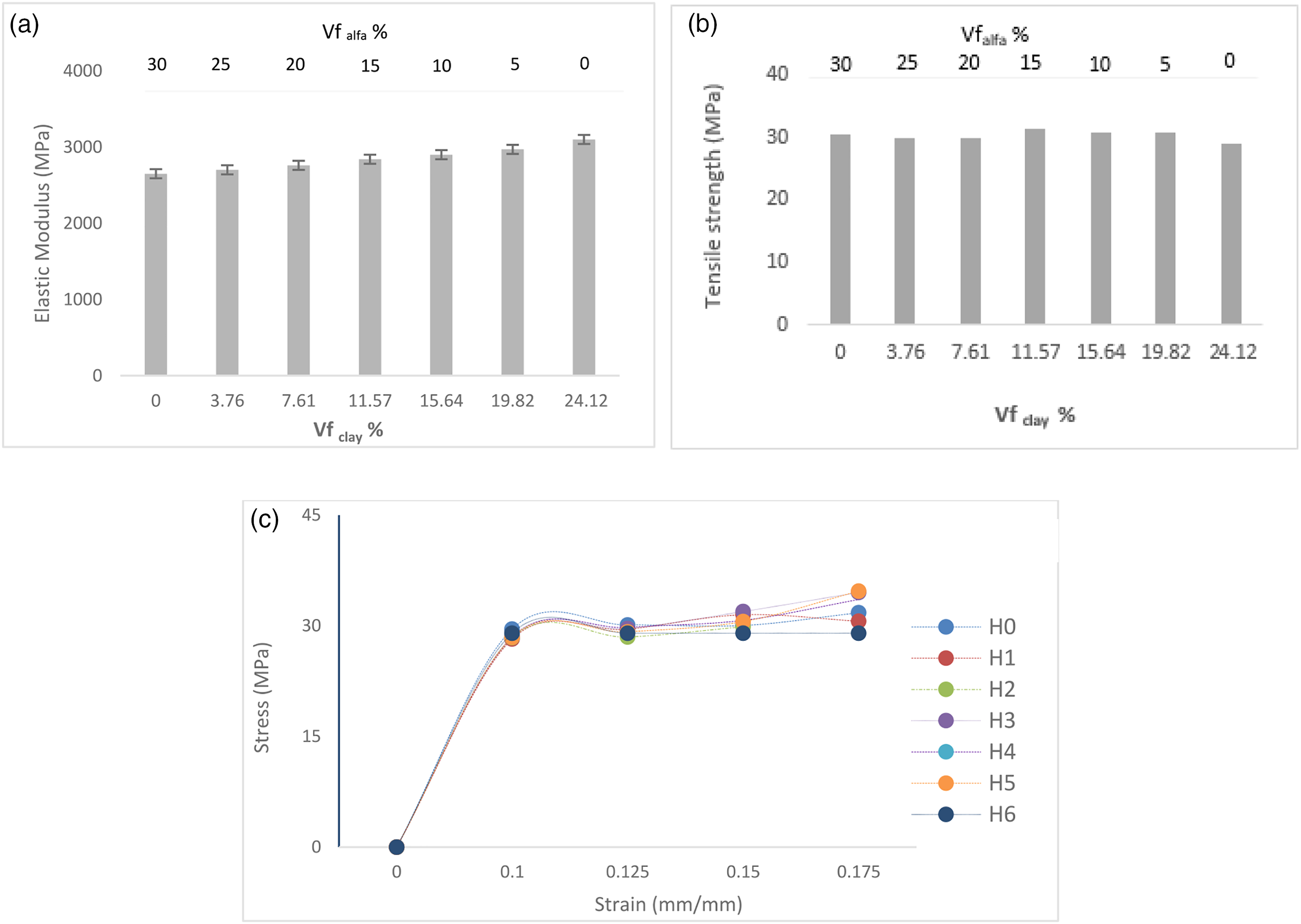
It is found that the tensile strength compared to pure PP decreases significantly with increasing Vfalfa. Figure 10(a) and (b) show the tensile properties (elastic modulus and tensile strength) of hybrid composite as a function of the volume fraction of alfa and clay. An increase in elastic modulus is observed with the increase in the volume fraction of clay, where the maximum Young’s modulus is 3.1 ± 0.02 GPa for H6. This can correspond to the stiffness of inorganic fillers being characteristically higher than that of cellulosic fillers. The increase in material stiffness may be due to the mobility reduction within the polymer chains under the presence of fillers. Figure 10(a) also shows the tensile strength, which did not decrease significantly and remained almost the same, probably due to the strong adhesion between the matrix and the fillers. Figures 9(c) and 10(c) show the typical stress-strain relationship obtained from tensile tests for composites and hybrid composites. It is clear that the curves fall roughly into two regions. The first region is characteristic of nearly linear behavior, which allows measurement of the elastic modulus. In the second region, the irregular curves show a non-linear behavior, which can be assigned to the plastic deformation of the matrix.
43
Tensile properties of the composites: (a) Elastic modulus, (b) tensile strength, and (c) stress-strain curves. Tensile properties of the hybrid composites: (a) Elastic modulus, (b) tensile strength, and (c) stress-strain curves.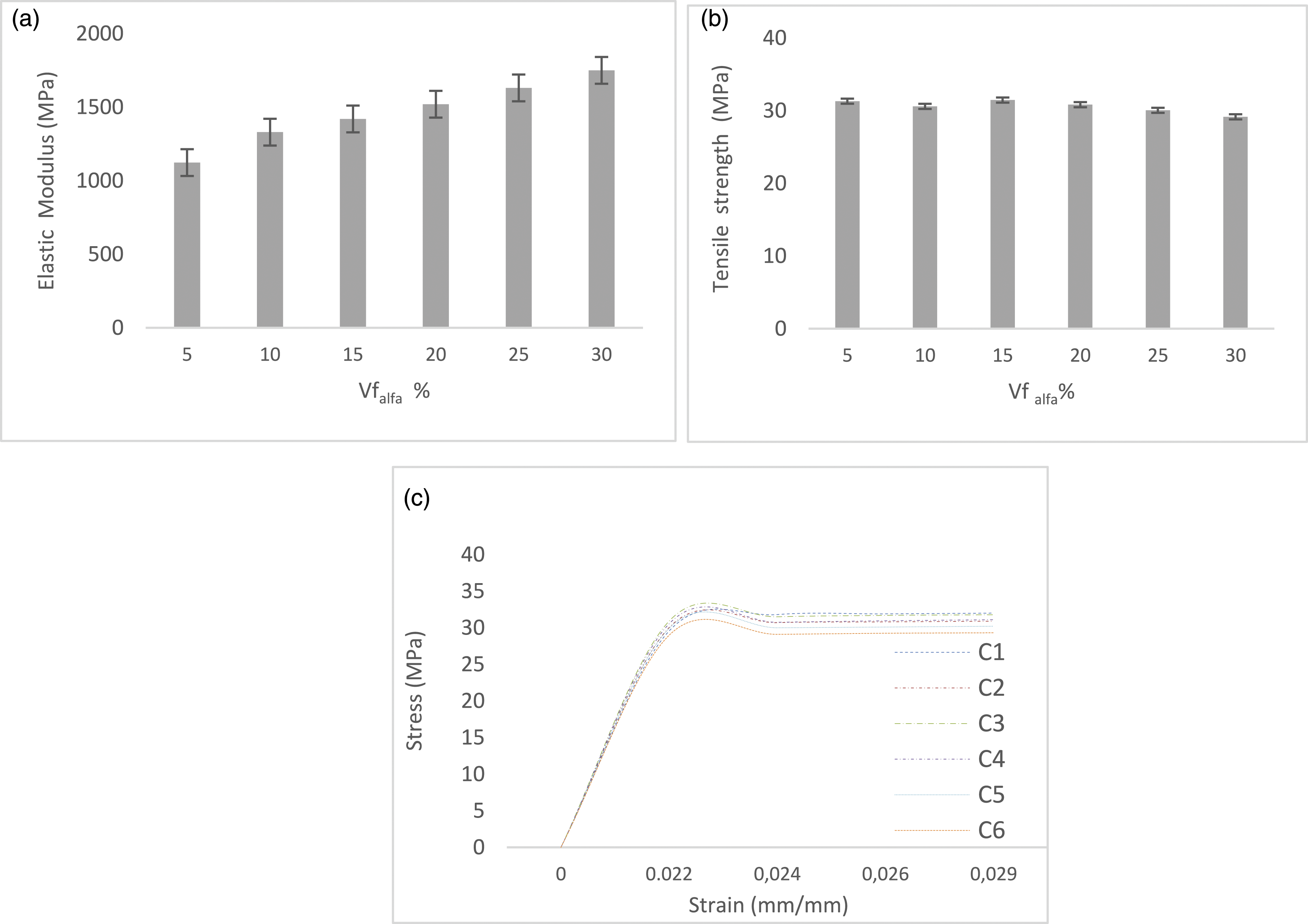
Mathematical and numerical analysis
This section presents the predicted Young’s Modulus (Ec) results. It was divided into two parts; the first for PP/alfa composites and the second for PP/alfa-clay hybrid composites. Ec was calculated for both materials by varying the volume fraction of the reinforcements (alfa, clay). Analytical and numerical results were compared with experimental data and showed the effect of hybridization between organic and inorganic fillers.
PP/alfa composites
The elastic modulus of alfa/PP composites using the different models proposed.


Variation of Young’s modulus of alfa/PP composites with Vfalfa.
The young modulus from the Halpin-Tsai model shows good agreement with the experimental results between (0–15) Vfalfa % with high accuracy error, but between (20–25) Vfalfa %, the predicted moduli deviate from the experimental results. Nevertheless, the results obtained from the Hirsch model show a significant agreement with the experimental results, with a higher accuracy error for all the studied samples. It may be due to strong interfacial adhesion between the phases (effective transmission of charges from the matrix to the reinforcement), which is provided by a higher wettability that ensures that there is no void between fiber/matrix and minimization of polar groups on the surface due to the chemical treatment of the fiber.44–46 The FEA results showed that the transverse Young’s modulus values (E22) are compared to the Reuss results. In contrast, the longitudinal Young’s moduli (very fine mesh,Figure 12) give significant results with the experimental results, validating the assumptions that the materials studied have a superior wettability (no interaction between the fibers, no air bubbles) and strong adhesion between the matrix and the reinforcements as observed in Figure 8. (a) Very fine mesh and (b) fine mesh of sample C3.
PP/alfa-clay hybrid composites
Figure 13 and Table 6 show the predicted Young’s moduli for PP/alfa/clay hybrid composites as a function of Vf alfa and Vf clay. The Voigt-Reuss values give a large framing of experimental results, as expected. The Hirsch model and the experimental results show the same evolution, although they are not convergent; this discrepancy may be due to dispersion and distribution factors that are not included in this model. Nevertheless, the experimental data of hybrid composites
5
are well described with excellent accuracy by the Halpin-Tsai model. It can be due to the effect of dispersion and distribution of reinforcements which were considered the most influential factors on the mechanical characteristics of the material.
44
Similarly, the FEA (E11 with very fine mesh) results describe the experimental results very accurately with a reasonable error. These confirm the previously mentioned hypotheses that the cohesion and compatibility between the matrix and the reinforcements are higher. Therefore, they confirmed by SEM morphological analysis (Figure 7) that shows a good dispersion of the reinforcements in the matrix (no agglomerate), and a good adhesion (no void), which indicates that a good wettability has been obtained. The FEA results (E22) showed that the transverse Young’s modulus was negligible compared to the experimental results and was comparable to Reuss values. Variation of Young’s modulus of PP/alfa/clay hybrid composites with Vfalfa and Vf clay. The elastic modulus of alfa/clay/PP hybrid composites using the different models proposed.

The analytical and numerical models showed interest in hybridization with two types of reinforcements over single-reinforcement composites. The results provided valuable insights into the positive effects of hybridization on the stiffness of the final hybrid composites. They showed that the overall stiffness of the hybrid composites increases with the increase in the content of clay particles. This is related to the effect of incorporating inorganic fillers (clay particles) into the PP polymer matrix that improves the stiffness of the composite, especially since the stiffness of these particles is generally higher than that of natural organic fillers (alfa). 5
Conclusion
The purpose of this study is to calculate the modulus of elasticity of PP/alfa and PP/alfa-clay hybrid composites using analytical models: Voigt-Reuss model, Hirsch, and Halpin-Tsai equations, as well as by FE numerical analysis model, and to compare it with experimental data. The obtained results show that this modulus Ec increases significantly with the increase of the volume fraction for both materials. For the PP/alfa composite, the Hirsch model showed a significant agreement with the experimental results, as well as with the results obtained by finite element analysis (FEA_E11), with a reasonable error. In contrast, the Halpin-Tsai equations provided satisfactory results for the PP/alfa-clay hybrid composites, and the FEA results described with excellent accuracy the performance of this material. The results for these two materials are in high agreement with the experimental data, showing the positive effect of hybridization on the stiffness of the material.
Footnotes
Declaration of conflicting interests
The author(s) declared no potential conflicts of interest with respect to the research, authorship, and/or publication of this article.
Funding
The author(s) received no financial support for the research, authorship, and/or publication of this article.
