




Abstract
Thermal fatigue is a serious distress in flexible pavement that reduces performance and durability. Many researchers have made efforts to understand the thermal fatigue phenomenology. Until now, there has not existed a standard test method for evaluating mixture and binder resistance to thermal fatigue. The bitumen binder is the first factor that participates in the degradation of asphalt concrete. The objective of this study was to contribute to characterizing the EVA polymer modified bitumen, which was subjected to thermal fatigue. The aim of this work is to determine the rheological components and their evolutions under thermal fatigue with heating–cooling cycles. The results suggest that thermal fatigue has more complicated effects on the rheological behavior of modified bitumen. It is concluded that thermal fatigue due to thermal cycling with aging is a major component in accelerating the degradation of pavement.
Introduction
Many pavements in the world experience large daily temperature fluctuations with extreme low temperature during the winter and high temperature and solar radiation that promote bitumen hardening during the summer. These conditions may cause transverse cracking problems in asphalt concrete pavements due to thermal fatigue. 1
Thermal fatigue cracking is one of the major failure modes in asphalt pavements and has been the subject of many studies. In the literature, thermal fatigue is described as a mechanism causing thermal cracking, a primary form of distress in asphalt concrete pavement.2–6
The repeated temperature fluctuations above the fracture temperature of asphalt concrete can result in tensile stresses, and aging of the mixture (rapid short-term and long-term aging) contributes to the level of stresses induced on cooling. Both these factors produce thermal fatigue distress. 1
Most research has been done on thermal fatigue of bituminous mixtures. The present study focuses only on thermal fatigue of polymer modified bitumen binder. In this research, the aim is to understand the evolution of rheological components (complex modulus and phase angle) of EVA polymer modified bitumen due to thermal loading with heating–cooling cycles and presence of the aging phenomenon.
Background
Bituminous concrete pavements are known to be susceptible to thermal distress when subjected to changes in ambient temperature. Several researchers have proposed that thermal cracking can be divided into two modes of distress: (a) low temperature cracking and (b) thermal fatigue cracking.3,7
Although previous research efforts have improved the understanding of the interaction between asphalt pavements and the environment, at the present there is not universal acceptance of thermal fatigue as a distress mechanism causing thermal cracking. 1 In examining the hypothesis of this mechanism of failure, thermal fatigue must be isolated from low temperature cracking. As a result, only those approaches that separate the effects of the two different forms of thermal cracking are recommended to explore the phenomenon of thermal fatigue. An advantage of direct measurement of mixture response to thermal cycling is the absence of the necessary assumption of material behavior required in mechanisms-based approaches. 1 Previous laboratory testing programs employing direct measurement of mixture response have produced mixed results. Jackson and Vinson indicated that thermal fatigue is not a viable distress mode in the absence of environmental aging, 8 but Sugawara and Moriyoshi suggested that mixtures do have a finite capacity for thermal fluctuations with low temperatures greater than but close to the mixture fracture temperature. 9 Janoo et al. also conducted a limited experiment with direct measurement of response to thermal cycling and were not able to validate failure by thermal fatigue. 10
Thermal fatigue failure is hypothesized to result from repeated tensile stresses induced by temperature fluctuations in the pavement as the temperature decreases and contraction is restrained. Aging of asphalt–aggregate mixture contributes to the level of stress induced. Both rapid short-term aging during plant mixing and construction and slower long-term aging in the field stiffen the mixture and increase the stress induced on cooling. When the effect of thermal cycling exceeds the mixture fatigue resistance, transverse cracks result from the maximum stress in the longitudinal direction of the pavement. 1
Materials used
The bitumen binder used in this study is a 40/50 penetration grade. Usually, it is used on aerodrome and road pavements in hot regions.
The polymer used in this study was thermoplastic and the type of polymer is ethylene vinyl acetate (EVA) with 18% vinyl acetate content.
The polymer modified bitumen was manufactured at the laboratory of LCPC (France) by mixing the base bitumen with 5% of polymer under moderate shear stirring (about 1000 rpm) for two hours at a temperature of 160°C.
Test program
This study focuses on the fundamental rheological properties of the unaged and the aged polymer modified bitumen: the unaged polymer modified bitumen is a 40/50 bitumen modified with 5% of EVA polymer; the aged polymer modified bitumen after thermal fatigue has the same origin as the unaged polymer modified bitumen binder.
The experimental method of the thermal fatigue phenomenon in this study was as follows. A controlled temperature oven with timer and ventilator was used to produce air pressure to accelerate the oxidation and aging of the polymer modified bitumen. The polymer modified bitumen was put inside the oven, under the stresses of thermal cycles and air pressure. The repeating of thermal cycles on the binder leads to the phenomenon of thermal fatigue.
The binder was spread in a flat metal mold, insulated by a sheet of aluminum with a thickness of about 1 to 2 mm. This thickness allows rapid oxidation of the sample surface.
The aged polymer modified binder was submitted to thermal fatigue with heating–cooling cycles. The temperatures used for the testing were 60°C for heating and 25°C for cooling. This thermal loading represents the temperatures in summer. The sample underwent 100 cycles of thermal loading. Figure 1 illustrates one cycle of temperatures in 24 hours. As shown in this figure, the duration of heating or cooling is the same: 12 hours. For each applied thermal solicitation, it is kept constant for 10 hours during the test.
One cycle of thermal loading.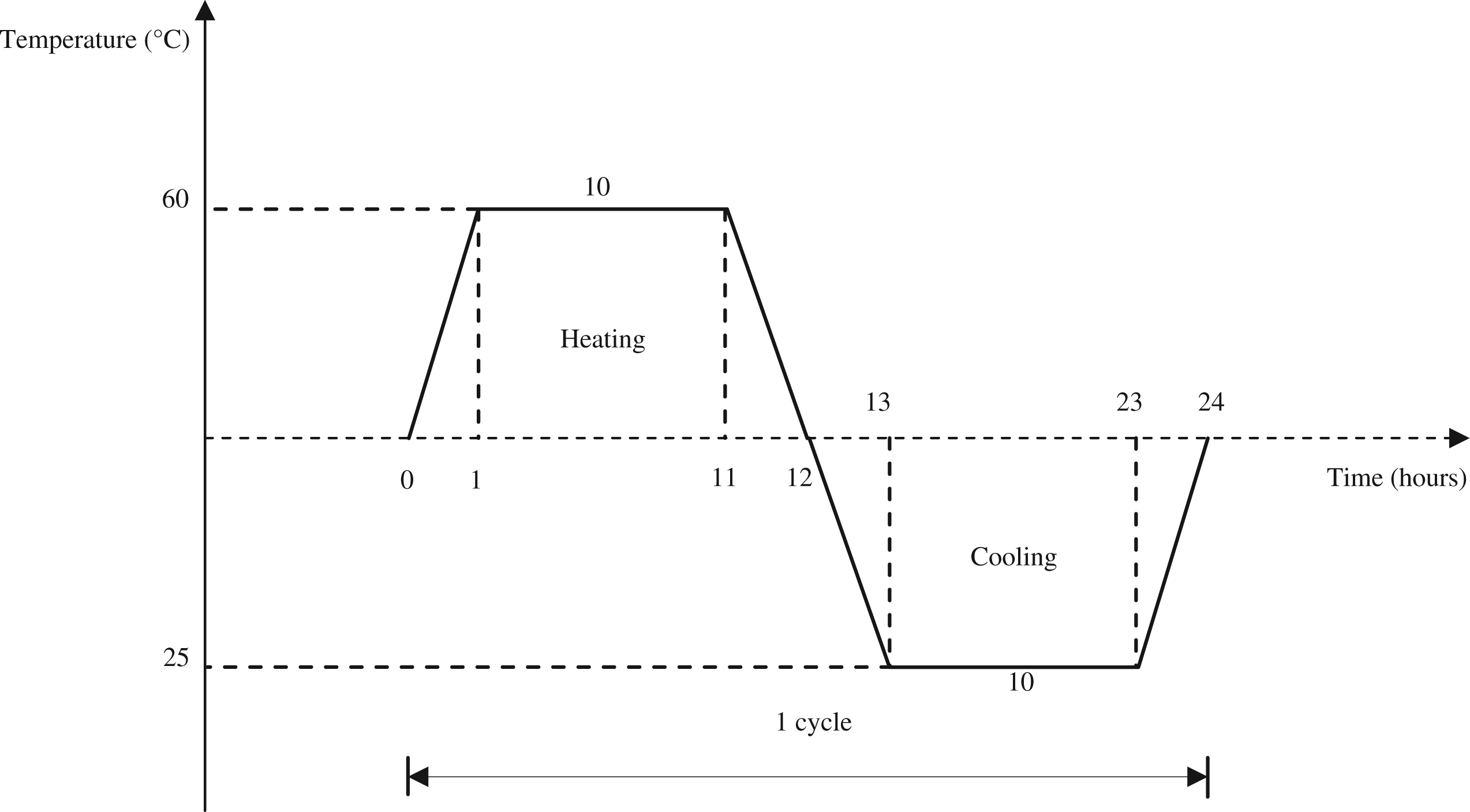
The rheological characterization was done with a Dynamic Shear Rheometer (DSR). The DSR was used to perform frequency sweeps on aged and unaged binders at different temperatures: -5, 0, 20, 30, 40, 50 and 60°C.
Measurements were taken at different temperatures. The 8- mm spindle was used for measurements at the temperatures -5, 0, 20 and 30°C, and the 25- mm spindle was used for temperatures 40, 50 and 60°C. A gap width of 2 mm and 1 mm was used for the small spindle (8 mm) and the large spindle (25 mm) respectively.
Results and discussion
Master Curves
Bitumen properties are thermally susceptible due to bitumen’s viscoelastic nature; this is true also for polymer modified bitumen. 11 In simple terms, asphalt will soften during periods of warm/hot weather and become harder or stiffer during cold winter months. So, bitumen ruts under traffic loading and climatic conditions during summer months and cracks during colder periods. Polymers help to reduce the temperature susceptibility of bitumen, thereby reinforcing the binder and reducing the risk of asphalt rutting and cracking.
Rheological behavior of polymer modified bitumen in dynamic oscillatory conditions in the linear domain is often qualitatively similar to that of unmodified asphalts. The main difference is in the magnitudes of moduli, especially at high temperatures. 12
The difference between modified and unmodified binder on the rheological plan is that, generally, the master curves change completely. This change reflects an increase in complex modulus and a decrease and sometimes fluctuations in phase angle depending on the polymer content. 13
Figure 2 presents the master curves of the complex modulus and phase angle of unaged polymer modified bitumen. At low temperatures or high frequencies, the polymer modified bitumen has a high complex modulus value and a small phase angle value. The high value of the complex modulus reflects the rigidity of modified binder. The small value of delta represents the elastic nature of the binder at these frequencies. The temperatures -5 and 0°C have the same behavior; when the frequency increases, the complex modulus increases and delta decreases.
Master curves of complex modulus and phase angle of unaged polymer modified bitumen at reference temperature 25°C.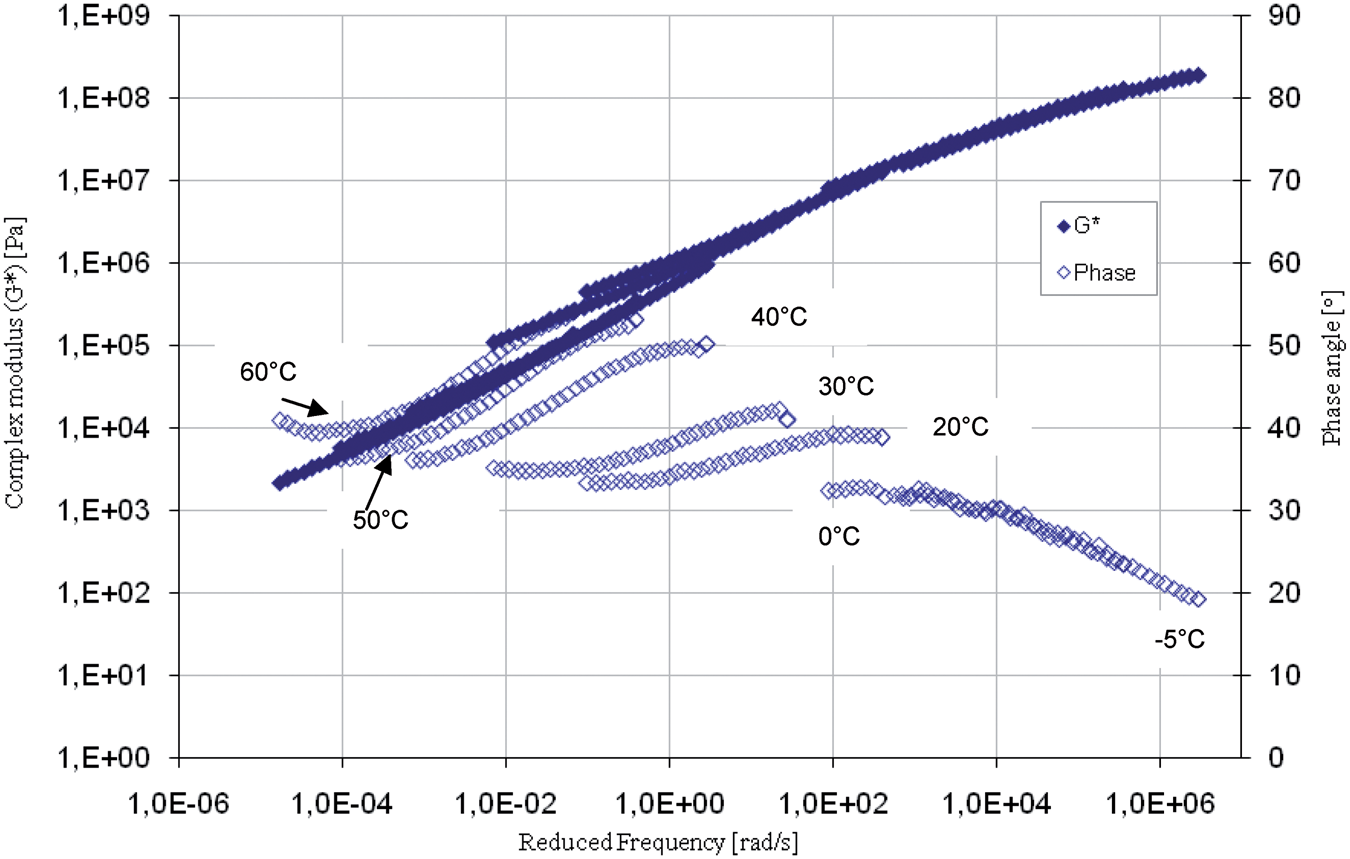
As the frequency decreases or as the temperature increases, the complex modulus decreases while delta increases continuously. The first reflects a decrease in resistance to deformation (softening) while the second reflects an increase in elasticity or ability to store energy. 14 The temperatures 20 and 30°C have the same behavior. The frequency increases, the complex modulus increases and also phase angle increases. In this case, the modified binder recovers elasticity.
Rutting can occur especially in regions where a hot climate can lead to a reduction in binder viscosity. 15 At high temperatures (40, 50 and 60°C), as temperature increases, the complex modulus decreases continuously, and the phase angle increases to approach a value of 55°, which reflects the elasticity behavior or ability to store energy. At high pavement temperatures, a low phase angle is desirable since this reduces permanent deformation. 16 The EVA polymer demonstrates a major role in reducing thermal susceptibility. 17 The polymer modified bitumen has more elasticity, which is good for rutting performance.
Figure 3 presents the master curves of the complex modulus and phase angle of the polymer modified bitumen submitted to heating–cooling cycles. At low temperatures or high frequencies the aged polymer modified bitumen has high stiffness and low phase angle. The temperatures -5 and 0°C have the same behavior. The frequency increases, the complex modulus increases and phase angle decreases.
Master curves of complex modulus and phase angle of aged polymer modified bitumen with heating–cooling at reference temperature 25°C.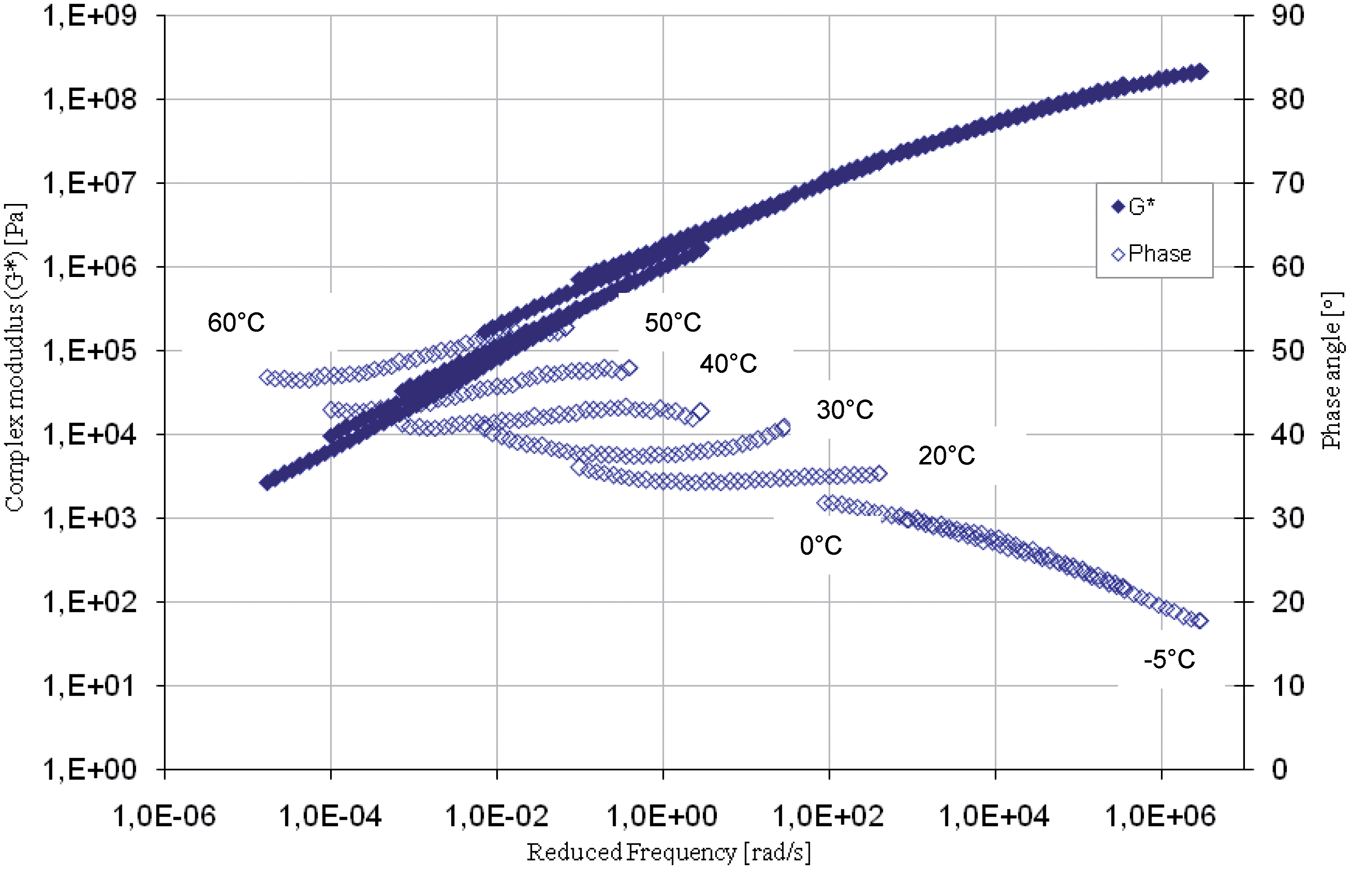
At intermediate temperatures, as the temperature increases, the complex modulus decreases continuously while the phase angle increases. For the temperature 20°C, the phase angle is approximately constant and complex modulus increases with increased frequency. The temperature of 30°C has a slightly different behavior. When the frequency is increased, the complex modulus increases and the phase angle initially decreases (loses elasticity) then increases (stores energy).
At high temperatures or low frequencies, the complex modulus decreases and delta increases to approach a maximum value of approximately 53°. For all temperatures 40, 50 and 60°C, both the complex modulus and phase angle increase with increasing of frequency.
Effects of Thermal Fatigue
The rheological characteristics of the binder are further complicated by the aging phenomenon. Bitumen binders are hydrocarbon materials that oxidize in the presence of oxygen from the environment. This oxidation process changes the rheological and failure properties of the bitumen. 14 Excessive aging leads to excessively large stresses that result in binder failure at intermediate and lower temperatures (cracking). 18 Thermal fatigue occurs in the presence of environmental aging that is hard on binder behavior and pavement performance.
Thermal fatigue results from the repetition of high thermal loading with heating–cooling cycles, which lead to a more viscous behavior in the first week. Also, in the presence of air pressure, the oxidation of the binder is accelerated, which produces the hardening. Therefore, greater accumulation of strain is expected under these thermal conditions. 6
Figure 4 presents the black curves of aged polymer modified bitumen submitted to heating–cooling cycles and unaged polymer modified bitumen. The environmental aging participates in the thermal fatigue. This factor changes the binder behavior by increasing the complex modulus and decreasing the phase angle.
14
The slope rate of aged polymer modified bitumen is decreased for each temperature, i.e. a little variation in the phase angle. The binder becomes hard; consequently viscoelastic behavior and flexibility begin to disappear. The effects of thermal fatigue on modified binder reduce the performance and durability of pavements.
Comparison between unaged and aged polymer modified bitumen binders.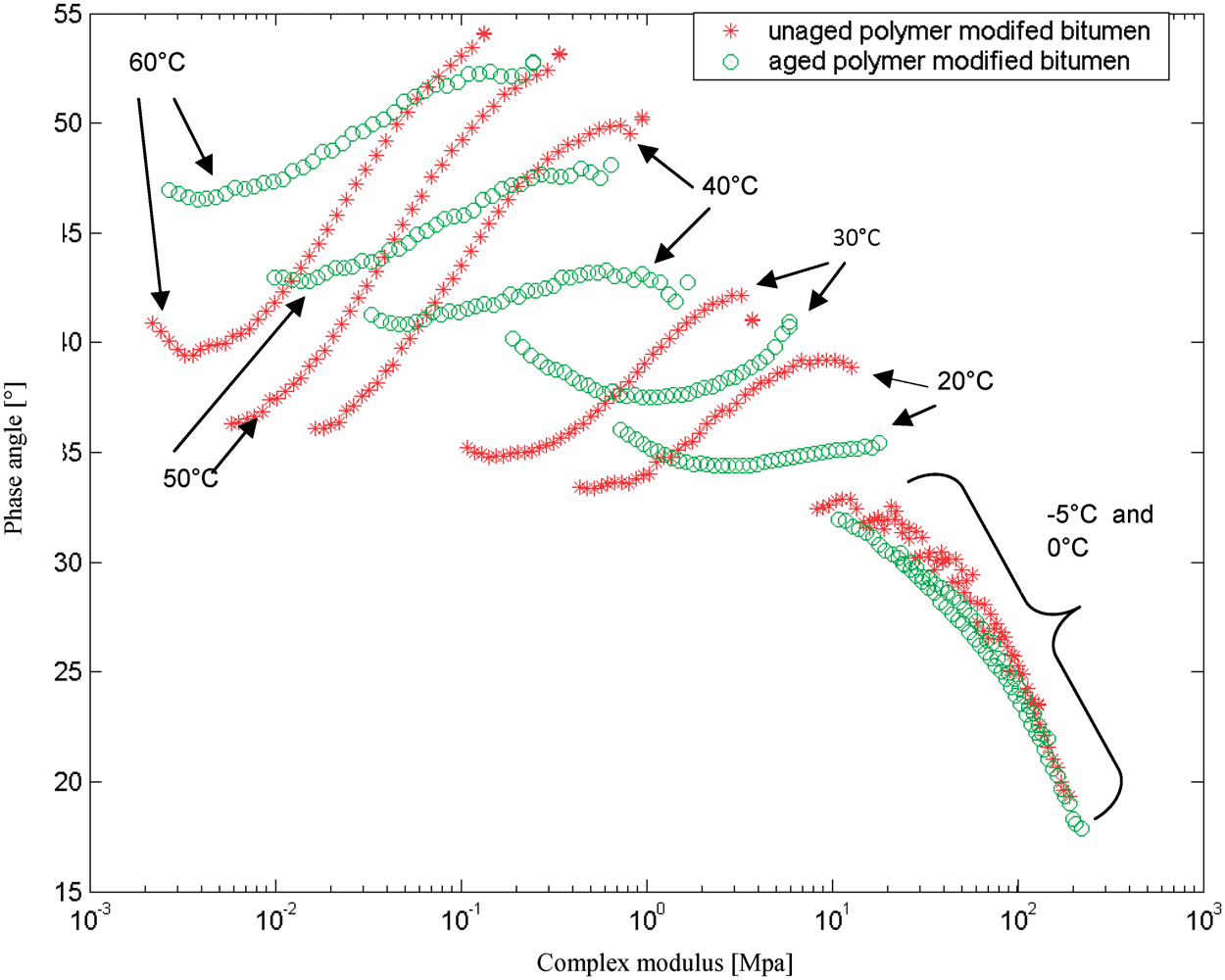
At the same frequency and the same temperature, the complex modulus of aged binder slightly increases.
At the same temperature and for low frequencies, the thermal fatigue increases the phase angle. This difference in phase angle decreases with increasing frequency.
At low temperatures (-5 and 0°C) there is a little change, which is observed in increasing complex modulus and decreasing phase angle. These changes are not favorable since they make the binder stiffer and more elastic. 14 In this temperature range, the phenomenon of oxidation by thermal fatigue increases the brittleness temperature where the risk of thermal cracking increases. 19 So, thermal fatigue induces in the modified binder an unfavorable behavior that precedes thermal cracking.
At intermediate temperatures (20 and 30°C), the rate of variation of the phase angle is smaller than in virgin binder. There is a fluctuation of phase angle, which tends to remain constant, and increase of complex modulus. In this case, the increasing in complex modulus is not favorable for fatigue cracking, where the stiffness and brittleness of bitumen increases, especially for thin pavements.14,19
At the high temperatures (40 and 50°C), the phase angle is the lower and complex modulus is the higher of aged polymer modified bitumen. This indicates an increase in rigidity and in elasticity, which results in better resistance to permanent deformation. 14 In this case, the EVA polymer reduces the thermal susceptibility, 17 which results in better resistance to permanent deformation resistance. However, at 60°C, approximately the phase angle of aged polymer modified bitumen is higher than of unaged modified bitumen. Thermal fatigue makes modified bitumen softer. This change is not favorable for permanent deformation resistance.
From the rheological behavior of aged polymer modified bitumen with thermal fatigue the complex modulus and phase angle results are more complicated. Thermal fatigue is harder on modified binder that manifests a bad behavior at different temperatures. Thermal fatigue influences the behaviors of thermal cracking, fatigue cracking and permanent deformation resistance. All these degradations reduce pavement life, requiring maintenance and rehabilitation to restore safe and efficient routes for moving people and goods.
Conclusion
The objective of this study was to determine the evolution of the complex modulus and phase angle of aged polymer modified bitumen submitted to thermal fatigue. Allowing that thermal fatigue was induced by laboratory experimental procedure, and the modified binder was exposed only to 100 cycles of thermal loading (heating–cooling), the results indicate that thermal fatigue changes the rheological behavior of modified bitumen. At low temperatures, complex modulus slightly increased and phase angle slightly decreased, which are not favorable for thermal cracking. At intermediate temperatures, the phase angle fluctuated, which tends to remain constant, and increasing complex modulus value. These changes are not good for fatigue cracking. At high temperatures of 40 and 50°C, a lower phase angle and the higher complex modulus were observed. In this case, thermal fatigue is not detrimental to binder behavior preceding permanent deformation resistance. But, at 60°C, the increasing of phase angle was not favorable for permanent deformation resistance.
The pavement performance is affected by thermal fatigue (influencing thermal cracking, fatigue cracking and permanent deformation resistance).
Further research is needed to increase the level of thermal loading (more than 100 cycles) and change the temperatures of cycles that represent the real seasonal temperatures. Also, it would be beneficial to study the evolution of thermal fatigue on different modified bitumen binders.
Footnotes
Acknowledgments
The writer wishes to express his gratitude to Mr Abdol Miradi, manager of the laboratories of Technology University of Delft (Netherlands), who allowed the experimental tests, and Professor Martin van de Ven of the Laboratory of Road and Railway Engineering (TU Delft) for his valuable comments and guidance. Also thanks are given to Milliyon Waldekidan for his assistance. The writer is also grateful to Professor Imad Al-Qadi (Illinois University, USA) for his comments and assistance.