




Abstract
This work investigates the dynamic mechanical properties (DMA) and ageing behavior of coir-sisal yarn reinforced polypropylene commingled composites. Moreover, the fibres were subjected to various chemical treatments and their effects on DMA and ageing studies were investigated. DMA reveals that the chemical treatment, especially MAPP treatment, enhances the storage and loss modulus values on the other hand it diminishes the mechanical damping coefficient (tan δ) of the composite. Diffusion studies indicates that treated composites shows a much lower apparent percentage weight gain compared to other treated ones. Solar ageing studies shows that accelerated solar ageing deteriorated tensile strength and modulus of PP/coir-sisal yarn composite.
Keywords
Introduction
Many research works, taken place in recent years, reveals that thermoplastic based composite exploit the advantage of combining the toughness of thermoplastic polymer with the stiffness and strength of reinforcing fibers. The characteristics of matrix and reinforcing fibers and their degree of compatibility play a major role in determining the ultimate property of the resulting composite. For the large scale production of composite materials, the matrices have to be readily available and economic. Among various thermoplastic polymers polypropylene proves to be the best matrix material especially due to economic reasons, ease of processing and recyclability. 1 Owing to its greater advantages such as low density, biodegradability, high stiffness, cost effectiveness and ease of recyclability natural fibers gained more attention as reinforcement in polymer composite during the last few decades. 2 Natural fiber reinforced polymer composites are becoming more popular in many application fields. However the incompatibility of natural fiber and polypropylene matrix limits their application to a certain extent. Many researches in this context unveil the possibility of using various coupling agents to improve the compatibility of the matrix and reinforcement to a greater extent.2–4
Composite fabrication is done by an environmentally benevolent technique called “commingling” in which the matrix fiber and the reinforcing fibers were intermingled together at the filament level itself. During compression molding the matrix will melt and fills the space between the reinforcing fibers and thereby form a uniform distribution of reinforcement in a non-molten state prior to the processing steps. In this technique the reinforcement fibers are not subjected to shear forces as in melt mixing and no solvents are required to mix the matrix into the reinforcement as in solution mixing. This technique uses only small amount of solvents for chemical modification which results in minimal evolution of gases and hence make it an environmentally benevolent technique. 5
The viscoelastic property of the composite is studied by dynamic mechanical analysis where a sinusoidal force is applied to a material and the resulting displacement is measured. DMA measures the modulus and damping properties of materials as the materials are deformed under periodic stress. Storage modulus is a measure of the maximum energy stored in the material during one cycle of oscillation. Loss modulus is proportional to the amount of energy dissipated as heat by the sample. The mechanical damping coefficient is the ratio of the loss modulus to the storage modulus. 6 The viscoelastic properties of polymeric materials are of practical significance when determined over a range of temperature and frequencies. Pothan et al. analyzed the dynamic mechanical properties of banana fiber reinforced polyester composites. They found that the glass transition temperature increased with higher fiber content. 7 Padal et al. investigated the dynamic mechanical and thermal properties of jute nano fiber reinforced polymer composite. DMA studies reveal that the storage modulus and loss modulus of jute nano composites was improved, whereas the mechanical loss factor decreased. 8
Natural fiber reinforced polymer composite undergoes property deterioration mainly due to their exposure to temperature, moisture, radiation and chemicals. Absorbed solvents cause swelling of the samples which results in residual stresses, break the bonds between the matrix and reinforcement and generate cracks and crazers. 9 The diffusion of different types of solvents into a composite weakens the fiber matrix interfacial adhesion and results in poor mechanical properties. Several studies have been reported concerning the effect of water uptake on the mechanical properties of natural fiber reinforced polymer composites.10–13 It was reported by Tsenoglou et al. that two parallel processes, i.e. diffusion through polymer matrix and through the imperfectly bonded polymer-fibre interface are the main causes for water penetration in polymer composites. 14
Composites of plastic materials are susceptible to solar radiation and this feature limits their outdoor service period. The wavelength region of sunlight is quite similar to the wavelength region of UV-A region i.e. 295–365 nm. The UV-B region causes photo damage to synthetic and naturally occurring materials. The property deterioration of these composites depends greatly on the chemical nature of material, the additives used and the extent of solar irradiation applied. Jose et al. reported that solar irradiation on cotton/PP commingled composites decreases their tensile properties considerably whereas chemical treatments stabilize the sample towards solar irradiation. 9 There are only a limited number of articles dealt with the solar ageing behaviors of natural fiber reinforced polymer composites.
The present paper is focused on the effect of various chemical treatments on the dynamic mechanical properties of PP/coir-sisal yarn commingled composites. Also studies the effect of solar irradiation on the mechanical properties and diffusion of different solvents through the PP/coir-sisal yarn composites.
Materials and methods
Materials
The matrix used for the study is polypropylene, which was supplied by Superfil Products Ltd., Chennai, India, in monofilament form and is having the following properties (average values are given); diameter-0.500 mm, denier–1609 and percentage of elongation-25%. Coir/sisal blended yarn was used as the reinforcement. The sample was collected from Central Coir Research Institute, Alleppey, India. The given sample which was a blend of coir and sisal comprises 80% coir (by weight) and 20% sisal and is having 968 m/kg and 10.40% runnage and elongation respectively. Potassium permanganate (KMnO4), toluene diisocyanate (TDI), maleic anhydride modified PP (MAPP), and vinyltrimethoxy silane (VTMO), of AR Grade, were used for the chemical treatments.
Fabrication of composites
Commingled composite fabrication was done by using a specially designed winding machine. The polypropylene and coir-sisal blended yarn was wounded on a metal plate in a particular pattern and the plate was then compression moulded. There are certain processing parameters that are to be considered while fabricating the laminate. Temperature is one such parameter. A temperature below 210°C was found to be insufficient for the proper wetting of the natural fiber by the molten matrix and above this temperature there is a possibility for the natural fibers to get decomposed. Holding time is another important parameter and we found that a low holding time is insufficient for the proper flow and wetting of the natural fiber. Long holding time can lead to degradation of fibers. Another important parameter is the pressure. At low pressures, air can be trapped inside the laminate creating voids and at a higher pressure, flow of matrix from the plates occurs and fiber orientation may get altered. In this study we found out that the optimum processing conditions required are 210°C, 0.5 MPa pressure and a holding time of 9 mins. The resulting material was cooled at room temperature and samples were taken for thermal and tensile studies. The size of the laminate is 15 cm × 15 cm with a thickness of approximately around 2–3 mm. 15
Fiber surface treatments
Various surface treatments have been done to improve the compatibility between the polymer matrix and the natural fibre reinforcement, as the matrix usually is hydrophobic while the cellulosic reinforcement is hydrophilic i.e. former is non-polar and the latter is polar. This incompatibility may lead to deterioration in the overall properties of the composite. In order to overcome this demerit, various chemical treatments such as with KMnO4, MAPP and VTMO were used. Chemical treatments improve the adhesion between the matrix and reinforcement.16,17 All the treatments were done during the winding process. KMnO4 treatment was done with 0.5% solution of KMnO4 in acetone. 2% solution of vinyltrimethoxy silane in water-ethanol (4:6 volume ratio) mixture was used for silane treatment, a 2% solution of MAPP in acetone was used for MAPP treatment. After each treatment the sample was placed in a hot air oven for 1–3 hours and then compression moulded.
Dynamic mechanical analysis
Dynamic mechanical analysis was performed using DMA 8000 (Perkin Elmer, USA) in a dual cantilever mode at a frequency of 1 Hz from room temperature to 160°C at a heating rate of 2°C/min.
Diffusion and solar ageing studies
Circular specimens having a diameter of 20 mm and thickness of 2 mm were used for diffusion studies. The specimens were dried in a vacuum oven for several days and then dipped in diffusion bottles containing solvents like distilled water, xylene and toluene. At particular time intervals, the specimens were taken out from the diffusion bottle and their surface was wiped. The wiped specimens were weighed using an electronic balance having accuracy of 0.0001 g.
If W0 and W
t
denote the initial weight and weight at a particular time t during the solvent uptake, then
9

The equilibrium solvent absorption of sample M ∞ was assumed to be reached when the weight gain of the sample was less than 0.01%. Mt values were then plotted against the square root of time in minutes.
The diffusion coefficient (D) can be calculated using the formula


The coefficient of diffusion can also be determined from the plot of mass uptake against square root of time.

The sorption coefficient S, is the ratio of the mass of solvent taken at equilibrium swelling sample (M).

The permeability coefficient p is the product of sorption and diffusion coeffecients

Result and discussion
Dynamic mechanical behavior
The dynamic mechanical properties of neat PP, coir-sisal yarn reinforced PP composite with and without chemical modification were done. Here the composite samples were subjected to a controlled sinusoidal strain and the resultant displacement was measured. The effect of various chemical treatments on the storage modulus (E1) of PP/coir-sisal yarn composite at various temperatures is graphically represented in Figure 1. Effect of chemical treatment on the storage modulus of PP/coir-sisal yarn composite.
As a result of various chemical treatments the storage modulus increases considerably. The increase is more notable in the case of MAPP treatment in both cases. Chemical modifications improves the interfacial adhesion between the matrix and reinforcement which enable more effective stress transfer between the matrix and reinforcement thereby increases the stiffness of the entire composite. As can be noticed, addition of natural fibers engenders a considerable increase of PP stiffness that can be ascribed by an increase in the storage modulus of the composite samples.
As in the case of storage modulus, an increase in the loss modulus of the treated composite compared to untreated composite was observed. The effect of chemical treatment on the loss modulus of composite is graphically represented in Figure 2. Effect of chemical treatment on the loss modulus of PP/coir-sisal yarn composite.
The figure shows that similar to storage modulus the loss modulus also increases as a result of chemical treatments. It can be deduced form the figure that MAPP treatment showed a notable increase in loss modulus compared to other treated ones.
In contrast to storage and loss modulus, tan δ values are higher for untreated composites compared to chemically treated ones. The effect of chemical treatment on the tan δ values of the composite is graphically represented in Figure 3. The decrease in tan δ value is due to the restricted free movement of the molecular chains of PP by the reinforcing natural fibers. This restriction was further accelerated by various chemical treatments as chemical treatments improve the interfacial adhesion between the matrix and reinforcement more effectively. However the increased adhesion transfers the stress from matrix to the reinforcing fiber. The reduction in mechanical loss factor means that, at the same temperature, the storage modulus is greater than that of loss modulus.
18
MAPP treatment modifies the natural fiber surface as well as the PP matrix thereby increasing the interfacial adhesion between the two. Formation of maleic anhydride grafted polypropylene comprises the first step in the reaction between PP and maleic anhydride. This was again treated with PP composite, and then the PP segment of MAPP forms compatible blends with bulk PP in commingled composite through the process of co-crystallization. The last step of the reaction comprises the formation of covalent bonds between the natural fiber and the compatible blend across the interface of PP matrix and the reinforcement fiber. Effect of chemical treatment on the tan δ values of PP/coir-sisal yarn composite.
The treatment with KMnO4 and VTMO shows similar effect on the storage and loss modulus of the composite.
The storage and loss modulus values of commingled composite shows a decrease due to increased interfacial adhesion between the matrix and reinforcement. These results are in agreement with the SEM micrographs as shown in Figure 4. SEM micrographs of (a) untreated composite (b) MAPP treated PP/coir-sisal yarn composite.
Untreated composite are shown in Figure 4(a), and as can be shown, there is no adhesion between the fiber and matrix since the fibers are pulled out from the polymer matrix. However, it can be observed from Figure 4(b) that in the case of MAPP treated composite a noticeable increase in fiber matrix interface is observed. This observations derived from SEM micrographs seem to explain the results obtained by DMA of the composites. It is very clear that the composite composition as well as the adhesion between the fiber and matrix have a greater influence on the mechanical behavior of the composite.
Diffusion and solar ageing studies
Effect of chemical treatment on moisture absorption behaviour
Effect of chemical treatments on moisture absorption behavior of PP/coir-sisal yarn is shown in Figure 5. In pP/CS composite, the magnitude of water uptake decreased from 48% to 34%, 26% and 25% in KMnO4, MAPP and VTMO treated composite respectively. The chemical treatments improve the interfacial adhesion between the matrix and reinforcement which in turn decrease the number of voids so that the route for solvent passage is somewhat restricted.
9
Effect of chemical treatments on the moisture absorption behavior of PP/CS composite.
Effect of nature of solvent on the diffusion behavior
The variation of weight gain % against square root of time for three different solvents viz. Water, xylene and toluene of PP/coir-sisal yarn composite was shown in Figure 6. The apparent weight gain % varies in the order water > toluene > xylene. Diffusion is considered to be a matrix dominated phenomenon, however the hydrophilic nature of coir-sisal yarn facilitates moisture absorption to a very high extent. Also water absorption is considered to be a capillary phenomenon, although the hydroxyl group of cellulosic coir-sisal yarn forms hydrogen bonds and thus enhances the absorption process to a considerable extent.
19
The variation of apparent weight gain % against square root of time for three different solvents (untreated samples with 20.89 wt % fiber content) at room temperature.
The non-polar PP matrix enhances the flow of non-polar solvents like toluene and xylene through the matrix and hence the whole composite considerably. The movement of solvents below glass transition temperature is a three stage process. At first the moisture is entrapped in the free volume present, the second stag involves swelling and finally water enters the closely packed regions. 19
Values of Diffusion coefficient (D × 10−5 mm2/s), Sorption coefficient (S) and permeability coefficient (P) for different solvents.

It can be noticed from Figure 6 and Table 1 that, even though the apparent weight gain % follows the order water > xylene > toluene, their diffusion coefficients values follows a reverse trend. A similar trend is also observed in the case of permeation coefficient values of xylene and toluene. The reason for this observation is that the matrix PP and the solvents toluene and xylene are all non-polar in nature. So that they can diffuse through PP/coir-sisal yarn composites much faster rate as compared to that of water.
Even though diffusion is a matrix dominated phenomenon, the hydrophilic nature of coir-sisal yarn absorbs water molecules through the composite slowly. Hence the values of diffusion and permeability coefficient of water are low compared to that of toluene and xylene.
Effect of chemical treatments on the diffusion behavior
The incompatibility arises in PP/coir-sisal yarn composite is due to the poor interfacial adhesion between hydrophobic PP and hydrophilic coir-sisal yarn. In order to increase the interfacial adhesion between the two both were subjected to various chemical treatments. This increased interfacial adhesion leads to a decrease in voids and other irregularities present in the interface and this causes a decrease in the relative uptake of solvents. The variation of apparent weight gain % against square root of time for PP/coir-sisal yarn composites for the solvents toluene and xylene are shown in Figures 7 and 8. Effect of chemical treatments on the moisture absorption behavior of PP/coir-sisal yarn composite for the solvent toluene. Effect of chemical treatments on the moisture absorption behavior of PP/coir-sisal yarn composite for the solvent xylene.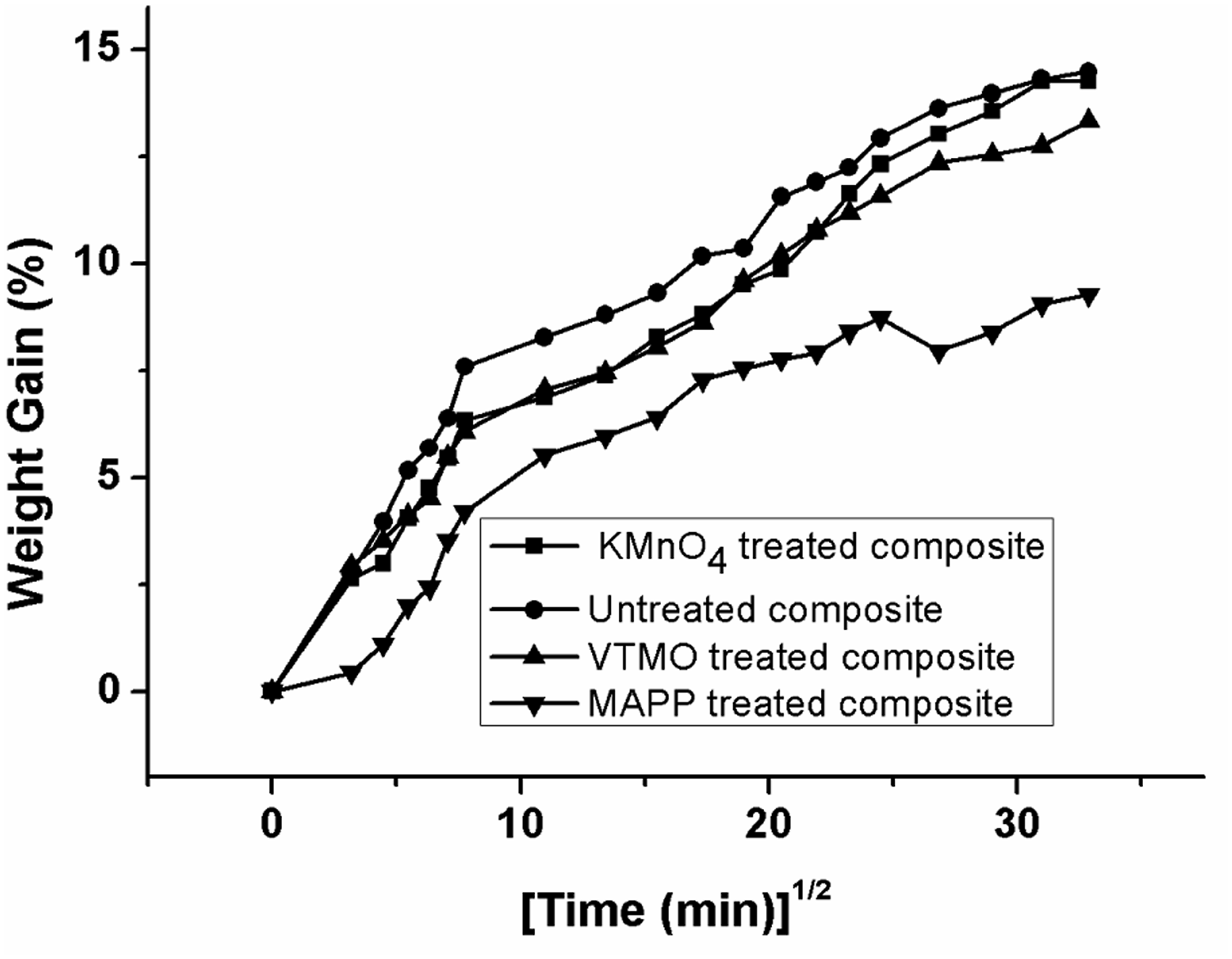
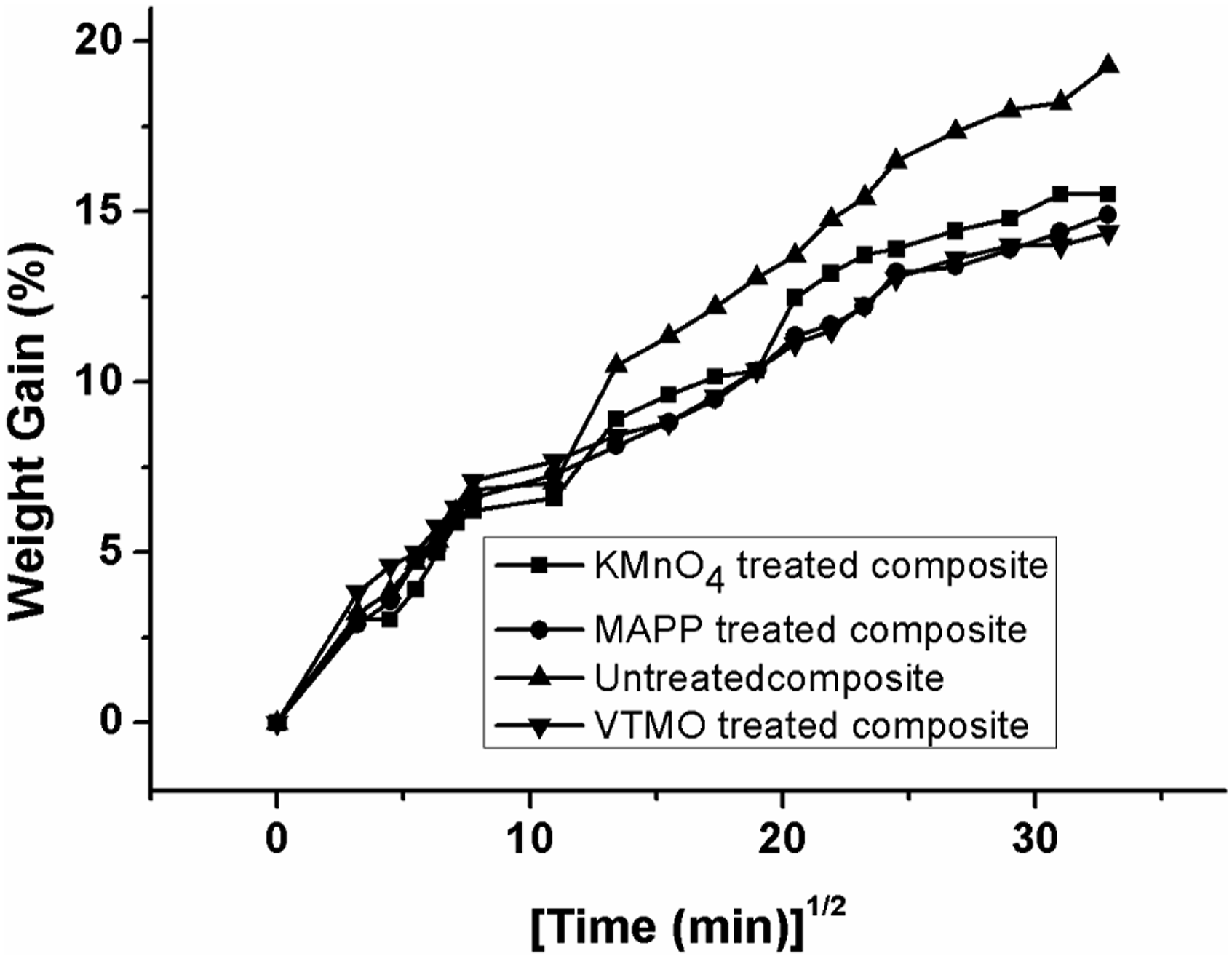
MAPP treated composite shows much lower apparent weight gain compared to other treated ones. This is an indication of the better interfacial adhesion brought about by MAPP treatment on PP and coir-sisal yarn. The compatible blend formed between the PP segment of MAPP and the bulk PP present in the composite reacts with coir-sisal yarn, thereby forming covalent bonds across the interface between the coir-sisal yarn and PP surface which in turn increases the interfacial adhesion between them. MAPP treatment is used for treating natural fiber surfaces as well as PP surface to improve the interfacial adhesion between the two considerably. This increased interfacial adhesion results in decreased free volume and number of voids thereby prevents the transport of solvents through the interface. The increased interfacial adhesion leads to close packing of PP and coir-sisal yarn within the entire composite. This may cause a decrease in the distance traveled by the solvent molecules and results in lower solvent uptake.
Effect of solar irradiation on tensile properties
Effect of solar irradiation on the tensile strength and tensile modulus of PP/coir-sisal yarn composite is given in Figures 9 and 10. PP is highly sensible to attack by UV radiation, which leads to chain scission, but the treated samples resist the UV radiation to a good extent. UV radiation enhances the photo-oxidation of PP, and the surface is more susceptible to the attack by oxygen. The mechanism of the photo-oxidation reaction is given as follows
9
Effect of solar irradiation on the tensile strength of PP/coir-sisal yarn composites. Effect of solar irradiation on the tensile modulus of PP/coir-sisal yarn composites.




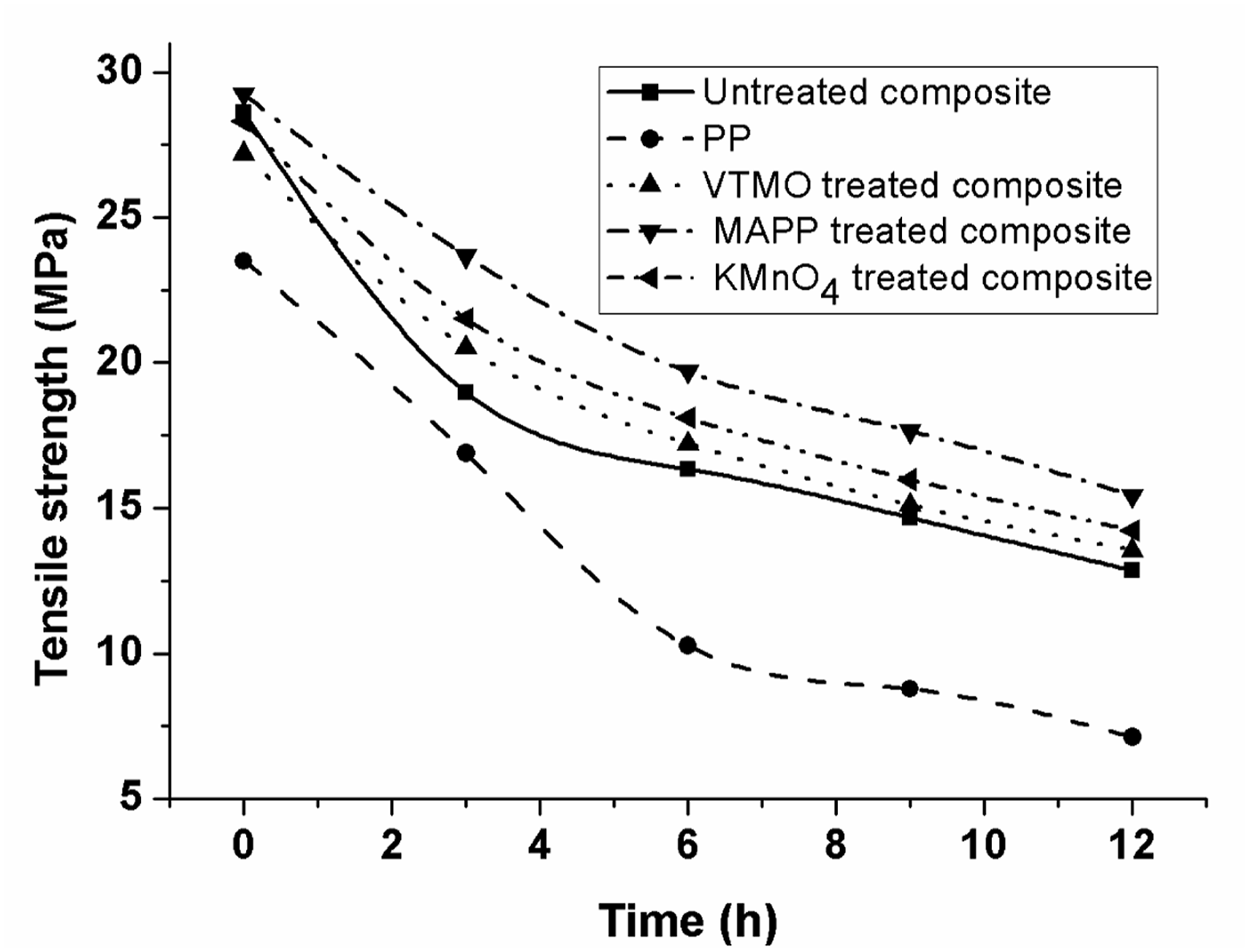

The composites when subjected to solar irradiation, their tensile properties decreases to a considerable extent.
From figure it is clear that treated composites show higher tensile strength because of the increased interfacial adhesion between the matrix and the reinforcement. The increased bonding will oppose the photo oxidation and crack propagation thereby reduces degradation of the tensile properties. 9
Conclusion
The present work dealt with the effect of various chemical treatments on the dynamic mechanical properties of PP/coir-sisal yarn composites fabricated by commingling technique. The storage modulus and loss modulus increased with MAPP treatment at all temperatures than the untreated ones. This is due to the increased interfacial adhesion between PP and coir-sisal yarn which is also supported by SEM micrographs. Diffusion studies with respect to different solvents reveals that treated composites especially MAPP treated composite shows a much lower apparent weight gain compared to other treated ones. Solar ageing studies reveal that accelerated solar ageing deteriorated tensile strength and modulus. However MAPP treated composite systems effectively resist the deterioration of tensile properties.
Footnotes
Acknowledgements
The Kerala State Council for Science, Technology and Environment (KSCSTE) is gratefully acknowledged by the authors for the financial support of this research.
Declaration of conflicting interests
The author(s) declared no potential conflicts of interest with respect to the research, authorship, and/or publication of this article.
Funding
The author(s) received no financial support for the research, authorship, and/or publication of this article.
