



Abstract
Axial compression performance is one of the main factors considered in the structural design of fiber-reinforced composites. However, the properties of the fibers in such composites are poor because of their orientation structures. Here, filament fibers were covered with reinforced fiber bundles to improve the axial compressive properties of the composites, and the effects of fiber covering on the axial compressive properties and failure modes of the composites were studied. The experimental results show that the covering can shorten the buckling wavelength of carbon fiber under compressive load, which can effectively improve the axial compression ability of the composite. A lower modulus of the covered filament reduced the potential to improve the compressive strength of the samples, and damage occurred primarily by splitting and shearing. With an increase in the covering density, the compressive strength and modulus gradually increased, and the damage mode changed from flexural instability to kinking damage.
Keywords
Introduction
Continuous fiber-reinforced polymer (FRP) composites have been widely used in automotive, aerospace, marine, and other industrial applications because of their high specific strength and stiffness, light weight, tunable performance, and other advantages. The fibers in FRP composites are the principal components in load bearing and stress transfer.1–4 Fiber properties have been developed significantly with changes in demand and technology. From initial glass fibers with a tensile strength of 1.0 GPa to carbon fiber (CF), with a tensile strength of 3.5 GPa or higher, the strength, modulus, and elongation of fibers in FRP composites have been greatly improved in the direction of the fiber.5,6 However, fibers in composites have specific orientations owing to their high aspect ratios; this leads to anisotropic mechanical properties. Specifically, the transverse tensile and compressive properties, as well as axial compressive properties, are poor, although FRP composites have high strength and moduli in the direction of the fiber.7,8 Transverse mechanical properties can be improved by the structural design of reinforced fiber tow using multidirectional lamination, plain fabric, and three-dimensional fabric. However, fibers in composites remain prone to compressive failure caused by fiber buckling instability under strong axial compressive loading, owing to the large difference in modulus between the reinforced fiber and the resin matrix. 9 The axial compressive strength of the unidirectional CF-reinforced epoxy is approximately half that of the tensile strength. The ratios of compressive to tensile strength for unidirectional Kevlar 49-and S-2 glass-reinforced plastic composites are about 0.15 and 0.49, respectively. 10 In addition, if FRP is used as a beam structure to carry bending moments, the compression side may fail before the tension side. 11 The weak axial compressive performance of high-performance fibers in composites restricts their full utilization as structural materials because it compromises the safety and reliability of these composites during operation.
As early as 1960, Dow observed that the compressive strengths of oriented fiber-reinforced composites were significantly lower than the tensile strengths. Rosen found that fiber buckling failure was the main damage mechanism of compressive failure in the axial compressive loading of unidirectional FRP. 12 Linear elastic fiber buckling follows two possible modes: the transverse instability mode, in which the matrix is subjected to a transverse tensile strain, and the shear buckling mode, in which the matrix is sheared parallel to the fiber. Fleck and Budiansky 13 noted that the buckling mode was determined by fiber content. When the fiber content is high, shear buckling failure is prone to occur. Argon et al. 14 believed that the compressive failure of unidirectional FRP was similar to the formation of a metal crystal twisted band: plastic microbuckling of fibers was the main failure mode, subsequent dislocation of fibers and defect areas induced local instability, and a resultant kinking band formed. The deformation and fracture of unidirectional FRP composites under compressive load are affected by factors such as the fiber modulus, initial arrangement of fibers, internal defects, and fiber–matrix interface, resulting in changes in the compressive behavior and failure mechanism.15–20 In general, the axial compressive failure modes of unidirectional FRP composites are debonding, resin fracture, fiber buckling instability, kinking, and fiber crushing. In the case of a good interface property and fewer defects, the fiber in the composite first reaches the critical instability state, followed by fiber buckling or microbuckling. Buckling occurs in the local fiber-bending area, and a ribbon fracture is formed at each end of the bend. When the applied pressure approaches the compressive strength, a through-folding band suddenly appears on a characteristic oblique section of the fiber composite, that is, the fiber kinking band.
The main approaches for enhancing the axial compressive properties of unidirectional FRP are improving the compressive resistance of the fibers and the structural design of the reinforced fiber preform. Chemical modification 21 and heat or radiation treatment 22 can be used to improve the transverse cohesion of polymer fibers. Three-dimensional weaving technology is commonly used to improve compressive performance, as it enhances resistance to interlayer delamination. 23 In addition, the properties of FRP can also be improved by modifying the resin matrix.24–26 We proposed a facile filament-covering method to enhance the axial compressive properties of unidirectional FRP; the compressive strength and modulus of covered ultra-high-molecular-weight polyethylene fiber FRP were improved by approximately 20% and 45%, respectively.27–29 This demonstrated that the covering structure was favorable for compressive performance.
The covered-fiber structure is similar to a vine structure in a plant, which has a high length-to-diameter ratio. The main stem of a climbing object cannot be easily buckled by the addition of a covering, with the exception of climbing materials with high bending rigidity (like branches). Thus, the whole is less prone to instability or bending. The vines work together in harmony to guarantee that the plants can spread to collect sunlight with the least amount of energy. Such covered structures can be used as references in the structural design of FRP composite materials to realize systematic weight reduction of materials.
The elastic modulus of the resin matrix is greater than 100 while the aspect ratio of CF is quite high (>105). Therefore, the compression of a single fiber can meet the critical instability stress of the fiber under the elastic support of the matrix. According to the classical Euler theorem of buckling instability for compression bars, the critical buckling compressive stress can be obtained as follows
30
:

In this study, we adopted a nature-inspired covering and studied the compressive properties of the covered carbon-fiber-reinforced epoxy resin composite. CF was chosen as the main stem, and organic fibers with different moduli and breaking strengths were used as the covering filaments. Axial compressive tests were used to examine the materials' axial compressive characteristics and failure processes.
Experimental
Materials specification
Physical properties of selected fibers and filaments.

Preparation of composite samples and experimental design
Simple wrapping equipment was used to prepare the filament-covered CFs. The cover density was adjusted by controlling the rotation speed of the sleeve. The preparation process and covered CF are shown in Figure 1. The covered densities of the CF bundles were 15 r/10 cm, 30 r/10 cm, and 45 r/10 cm, representing 15, 30, and 45 cycles on a 10 cm CF, respectively. A schematic of the cover density is shown in Figure 2. Preparation process for covering carbon bundles. Description of covered density of carbon fiber bundle.

The thermosetting epoxy compound system was purchased from Jiafa Chem Co., Ltd. (Changshu, China). The mixture ratio of epoxy resin (1.12–1.16 g/cm3 in density, 0.54–0.57 eq/100 g in epoxy value) and curing agent (0.92–0.96 g/cm3 in density, 450–510 mg KOH/g in amine value) was 100:27 at room temperature. Cylindrical composite samples were prepared via manual impregnation using a tubular mold.
Experiments
A hollow cylindrical end-loading fixture was adopted to avoid end collapse of the composite samples. The morphology, size, and test state of the loading fixture are shown in Figure 3. The inner diameter of the hollow cylindrical fixture was 3 mm. Axial compressive tests were performed on a micromechanical testing instrument (Mtest-1000K, Sino Test Equipment Co., Ltd.), referencing Chinese standards (GB/T5258-2008) and Japanese industrial standard (JISK-7076)31,32 the compressive speed was determined as 2 mm/min. It was ensured that compressive failure occurred in the middle of the samples, rather than crushing occurring at the end. Axial compressive specimen and compressive process.
The fracture surfaces of the specimens after the compressive test were examined and analyzed using an industrial electronic camera (Gaopin, gp-300c) and scanning electron microscopy (SEM, Hitachi, s-4800). The effects of filament type and covering density on the failure mode were analyzed.
Results and discussion
Effect of covered structure on axial compressive properties
Typical stress–strain (S–S) curves of the samples with different covering filaments are presented in Figure 4, where it can be observed that the unidirectional CF and covered CF-reinforced epoxy composites showed linear elasticity under compressive loading. Failure occurred owing to brittle fracture. The compressive strength and modulus of all the covered CF composites were improved, but the degree of improvement varied. Stress-strain curve of composite axial compression.
Compressive strength and modulus data of samples.


Axial compressive strength and modulus of covered samples at different filaments.
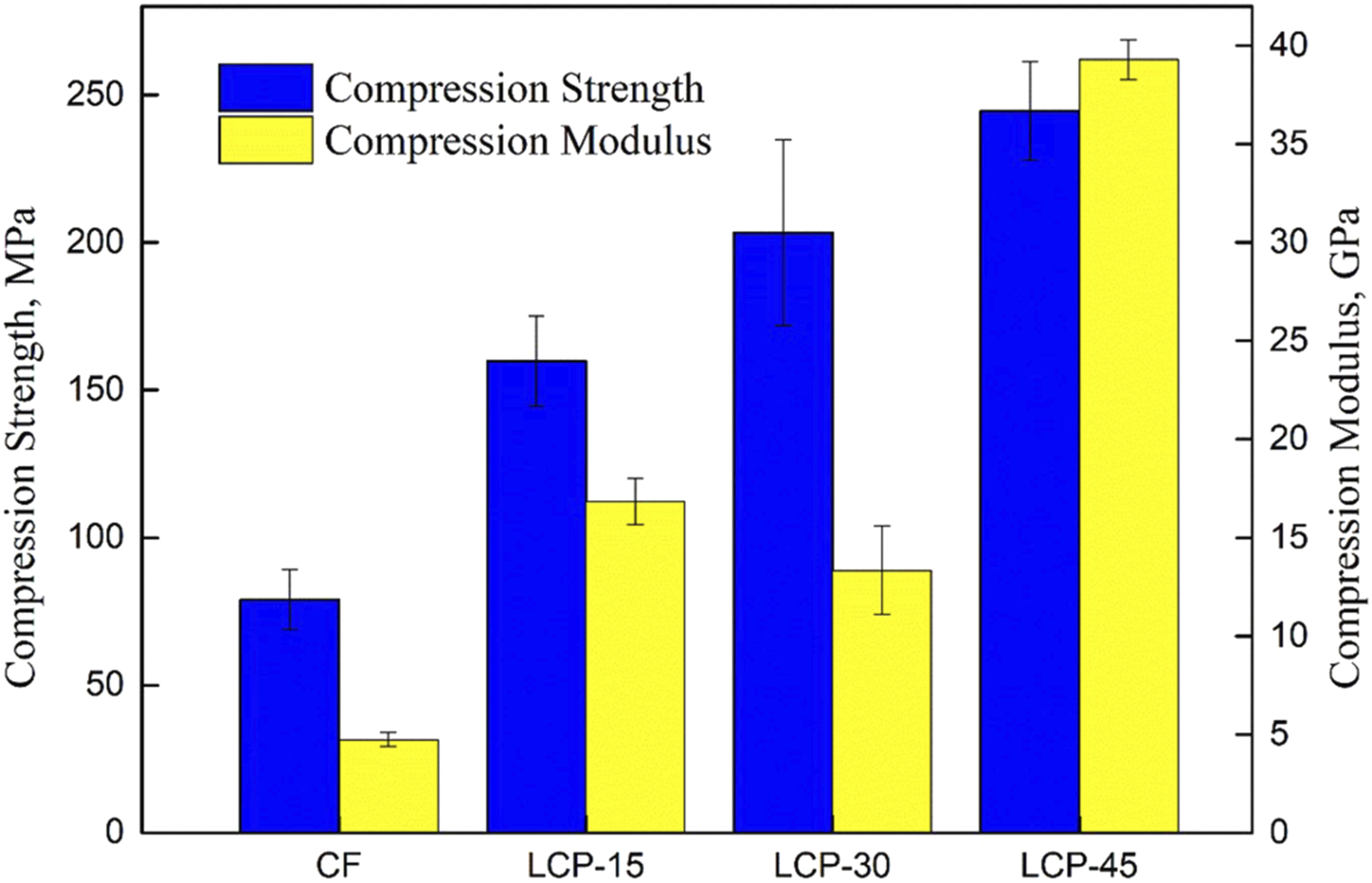
It can be seen in Figure 5 that the compressive modulus of the unidirectional CF composites was 4.74 GPa, similar to the that of the three-dimensional braided CF-reinforced composite. However, after filament covering, the modulus increased significantly. The compressive moduli of PBO-45, UHMWPE-45, and LCP-45 increased by 3.2, 3.4 and 7.28 times, respectively. Although the covered filaments increased the fiber volume content of the samples, the number of single filaments per covered fiber bundle was approximately 50–150. Compared with the 3000 CF bundles, the volume ratio of the covered filament bundles can be ignored. In addition, it was found that although the LCP filament had a lower modulus, it exhibited the greatest improvement in the axial compressive modulus of all the composites.
Figures 6, 7, and 8 compare the compressive strengths of samples with different covered densities. In general, compressive strength increased in proportion to the covering density. For the PBO filament-covered CF/epoxy composite, the axial compressive strength of the composite was maximized at 45 r/10 cm with a value of 236.46 MPa, which was 180% higher than that of the uncovered sample. According to the covering density, the distance ratio between the covered filaments was 2:3:6, and the ratio of the axial compressive strength was 1:8:9, which does not show regularity. This is because a single CF and CF bundle both buckle under a compressive load, and the change in buckling wavelength caused by these two types of buckling instability is inconsistent. For the compressive modulus, the PBO-covered sample reached a maximum value at a covering density of 45 r/10 cm, which was 321.7% higher than that of the uncovered sample. When the coating density was 35 r/10 cm and 15 r/10 cm, the compressive moduli increased by 35.7% and 70.3%, respectively. The data show that it is feasible to improve the compression properties of unidirectional composites by reducing the buckling wavelength of the reinforced fibers during compression. Moreover, increasing covering density leads to better compression performance. Axial compressive strength and modulus of PBO covered samples at different densities. Axial compressive strength and modulus of LCP covered samples at different densities. Axial compressive strength and modulus of UHMWPE covered samples at different densities.

Axial compressive damage mechanisms and covered structure
Figure 9(a) shows the axial compressive damage morphology of uncovered CF composites. An obvious shear deformation occurred, and cracks extended along the CFs until the matrix cracked. The resin aggregation area showed features of shear failure and interface cracking, with unusually long and wide cracks. Some CFs were damaged by shear stress until they experienced complete breakage and severe shear failure. Unidirectional carbon fiber compression after (a) breakage morphology and (b) SEM images.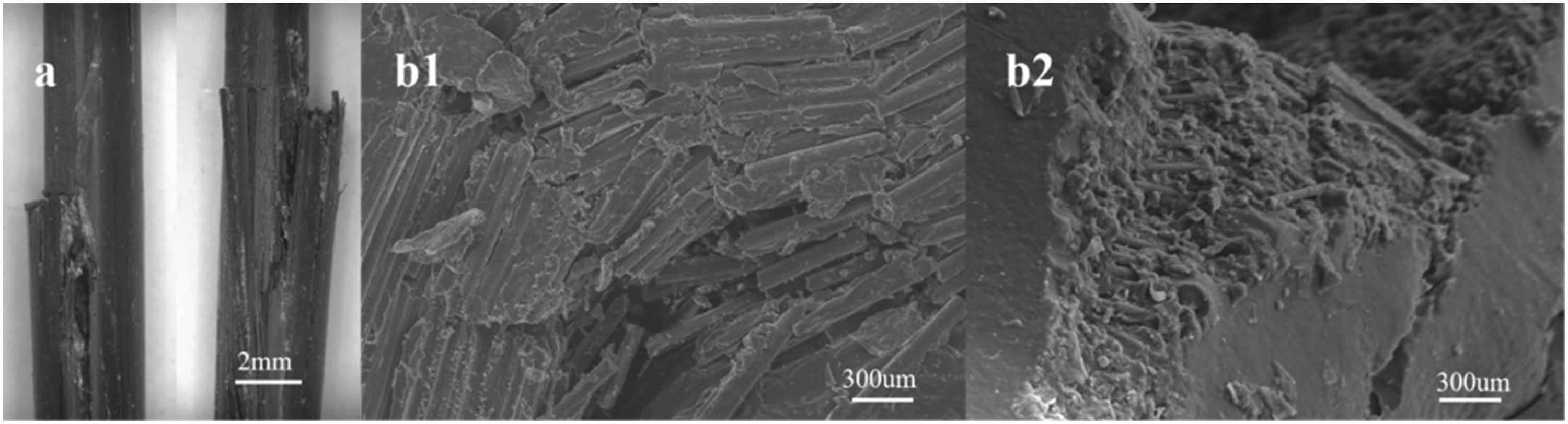
As can be seen from the SEM image in Figure 9(b), the interface between the resin and CFs is intact, and some CFs are buckled in the failure state. The CF failure mode changed to shear after buckling, resulting in cracks. Shear force led to fragmentation of some CFs.
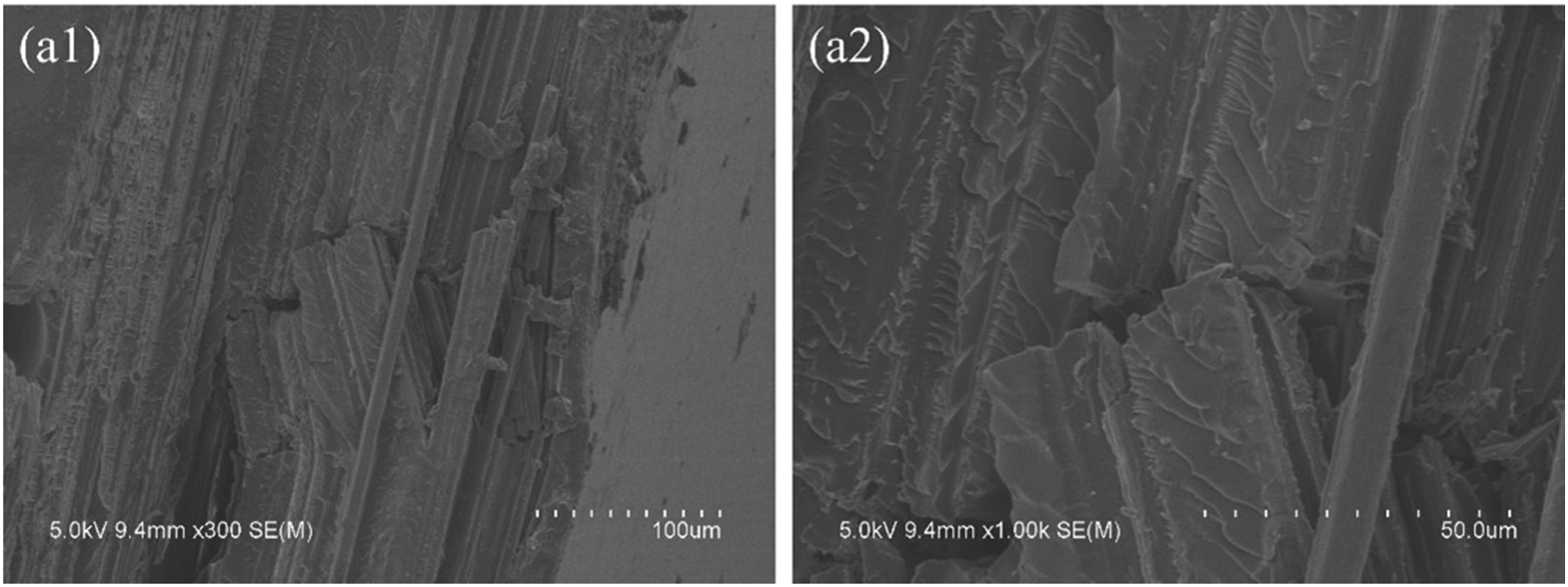
Figure 10(a1) shows the compressive damage morphology of PBO filament-covered CF composites with different covering densities. The failure of the PBO-15 sample demonstrates the main damage modes of the fracture of the carbon and PBO fibers: debonding and delamination. Figure 10(a2) shows that the PBO-30 sample had obvious kink failure, with only one kinking band and no other obvious damage. After the compression instability of the CF in the composite, owing to the coating effect of the PBO fiber, the failure mode of the CF changed from buckling failure to torsional failure. It can be inferred that the buckling instability of the CF changes to kinking failure owing to the covering effect of PBO filaments. The SEM image in Figure 12 also corroborates kinking failure in the CF. No obvious delamination or cracking was observed in the resin. With a further increase in the covering density, two kinking bands appeared for the PBO-45 sample. Moreover, the specimens exhibited shear failure. It can be inferred that the covering structure not only limits the buckling instability of the CF but also transfers the compressive force to the PBO fiber through the adjacent CF and resin. The PBO fiber is not damaged by compression, but by debonding with the resin through transverse shear and tension. The dominant failure factor gradually changes to longitudinal splitting and the CF kink band (Figure 11). Morphology of different samples after axial compression. SEM image of PBO-30 sample after compression.
Similarly, Figure 10(b) shows that debonding and delamination were the main failure modes of the UHMWPE-15 sample with a low covering density. This indicates that the covered structure is important in determining in the compression failure mode. As the covering density increased, a kinking band gradually formed. The UHMWPE-45 sample exhibited shear and delamination failure modes instead of overall shear failure. The failure modes of the LCP-30 sample include not only the kinking band, but also the fracture of the LCP and CF stemming from the lower modulus of the LCP filaments. With a further increase in covering density, the LCP-45 sample showed splitting shear failure, similar to that observed in the uncovered CF composites. This is because low-modulus covered filaments cannot limit buckling deformation and transfer strain when the CF is subjected to axial compressive loads, resulting in cracks between the resin and fiber, as shown in the schematic diagram in Figure 12. Cracks and shear between fibers or resins.
Conclusions
In this study, a nature-inspired coating was proposed to prepare a filament-covered unidirectional CF composite. The axial compressive moduli, strength data, and failure modes were obtained by compression testing and image observation with cylindrical samples. From the experimental results, the following conclusions can be drawn. (1) The covered structure can shorten the buckling wavelength of the CF in the composite under a compressive load. The compressive stress generated by buckling can be transferred to the covered filament, causing the pressure to become a tensile force. The axial compressive capacity of the composite can be effectively increased, owing to this compression–tensile transformation. (2) The modulus and strength of the covered filament affected the compressive performance and failure mode of the covered fiber-reinforced composite. Compared to the CF sample, the axial compressive strengths of PBO-30, PE-30, and LCP-30 increased by 149.5%, 73.6%, and 158.1%, respectively. The axial compressive module of PBO-45, UHMWPE-45, and LCP-45 were increased by 3.2, 3.4 and 7.28 times, respectively. The lower modulus of a covered filament, such as LCP, for example, decreases the margin of improvement for compressive strength, and the failure modes are mainly splitting and shear. (3) With an increase in covering density, unidirectional composites can bear larger critical compressive loads and exhibit better compressive performance. For the PBO filament-covered CF/epoxy composite, the axial compressive strength and modulus of the composite were 180% and 321.7% higher than that of the sample with uncovered fibers, respectively, at 45 r/10 cm. The samples were more inclined to kinking failure than buckling failure.
Footnotes
Declaration of conflicting interests
The author(s) declared no potential conflicts of interest with respect to the research, authorship, and/or publication of this article.
Funding
The author(s) disclosed receipt of the following financial support for the research, authorship, and/or publication of this article: This work was supported by the Natural Science Foundation of China (No. 51903001), Anhui Province University Excellent Talent Cultivation Project (No. gxgnfx2021133).
