



Abstract
In this research, the influence of carbon nanotubes agglomeration on the buckling behavior of multi-phase CNTs/fiber/polymer/metal composite laminates cylindrical shells under hydrostatic pressure was investigated. Governing equations were derived according to the Kirchhoff-Love’s first approximation shell theory and solved by a combination of the Galerkin and Fourier series expansion methods. Equivalent elastic properties of multi-phase CNTs/fiber/polymer/metal laminated (CNTFPML) cylindrical shell were obtained using the Eshelby-Mori-Tanaka approach, considering the dispersion and agglomeration effects. Primarily, CNTs were added to the polymer matrix and afterwards, this new matrix was reinforced by carbon or glass fiber materials. Finally, the composite layer was joined with metal layers and a hybrid shell prepared. The accuracy of the applied method was validated with the finite element method and experimental tests on carbon/epoxy and glass/epoxy composite cylinders under hydrostatic pressure. The results indicate that the CNTs agglomeration, weight and volume fraction of CNTs and type of fiber materials, have a key role on the critical buckling capacity of multi-phase composite shells.
Introduction
Due to the noteworthy mechanical properties of composites compared to metallic structures, composites have more industrial applications. Damage and failure in carbon/epoxy filament wound composite tubes have been evaluated through a damage model by Almeida et al. 1 Some deficiencies of composite structures can be modified in fiber metal laminates (FMLs), a structure manufactured by adding metal layers to composite layers. It is shown in some recent studies that using FMLs can reduce the weight of equipment up to %50. 2 The damping behavior of FMLs have been investigated according to the Voigt-Kelvin model by Botelho et al. 3 Also, fracture behavior of FMLs and fatigue life extension of riveted joints using FMLs employing numerical and experimental approaches have been presented. 4
The elasto-plastic buckling and post buckling of FMLs were investigated by Bi et al., 5 which followed the effects of the initial deflection, the loading state and the geometric parameters on the elasto-plastic buckling. Kolakowski and Mania 6 investigated the buckling of FML-FGM columns under axial load, concentrating the influence of the coupling matrix B on the interactive buckling. Ghasemi and Mohandes 7 used the beam modal function model to analyze the vibration of FML cylindrical shells. Bikakis et al. 8 studied buckling of rectangular GLARE subjected to shearing stresses. They used the finite element method and the eigenvalue buckling analysis to investigate the effect of volume fraction of the metal and fiber layers.
Adding carbon nanotubes (CNTs) to the matrix of composite laminates can improve the electrical, mechanical and thermal properties of the structures. Furthermore, multi functionality is one of the good properties of reinforced composites by CNTs. Despite pure composites that an improvement in one of the properties usually deteriorates some others, in multi-functional structures, several properties can be improved simultaneously. Using the perturbation method, Shen 9 analyzed buckling and post-buckling of cylindrical shells reinforced by CNTs and concluded that the volume fraction of CNTs has a significant effect on the buckling and post-buckling behavior of the cylindrical shells. Compressive high-strain rate behavior of thermoset epoxy resin dispersed with multi-walled carbon nanotubes was studied by Naik et al. 10 Prashantha et al. 11 reviewed significant challenges of CNTs reinforced and presented a discussion about the preparation, compounding, properties and applications of these nanocomposites. The effects of thermo-mechanical loading and elastic foundations on the buckling and post-buckling behavior of CNTs reinforced thick composite plates have been investigated by Trang and Tung. 12
Low bending stiffness, high aspect ratio and high adhesive interface between CNTs and polymer matrix are reasons for CNTs agglomerating in the polymer matrix. 13 Geometries and interfacial properties of nanofiller effects on the mechanical behavior of polymer nanocomposites using meso-scale finite element simulation were studied by Hu et al. . 14 Tuo et al. 15 investigated the dispersion states of carbon black (CB) and carbon nanotube (CNT)-reinforced composites. Also, the dispersion and distribution of CNTs in polymer matrix during manufacturing procedure of nanocomposites were investigated by Loux et al. 16 Shi et al. 17 presented a micromechanical model for studying the effect of CNTs agglomeration on the effective elastic modulus of CNTR composites. It is assumed that a large amount of CNTs are concentrated in some local regions of the matrix and the volume fraction of CNTs is much more than the average volume fraction of CNTs. Hedayati and Sobhani-Aragh 18 presented a 3D elasticity solution for free vibration analysis of CNTR plates resting on the Pasternak foundation.
A two-parameter micromechanical model of agglomeration was employed to determine the effect of CNTs agglomeration on the elastic properties of CNTR composites in their research. Sobhani-Aragh et al. 19 studied the vibration of continuously graded CNT reinforced (CGCNTR) cylindrical panels. Using the Mori-Tanaka (MT) approach, impacts of the volume fraction of oriented CNTs and different CNTs distribution were illustrated in their investigation. Based on three-dimensional elasticity theory, Pourasghar et al. 20 investigated free vibration of four-parameter CGCNTR cylindrical panels. They exploited Eshelby-Mori-Tanaka (EMT) approach to study the effect of CNTs local agglomeration on the dynamic behavior of cylindrical panels. Kleinschmidt et al. 21 studied the effect of different procedures of CNTs dispersion and functionalization in an epoxy matrix and its effects on the mechanical and dynamical properties. For studying the effect of CNTs agglomeration on the free vibration of CNTR doubly-curved laminated composite shells and panels, Tornabene et al. 22 used the general theoretical model based on the Carrera unified formulation [CUF]. They showed that when the two agglomeration parameters μ and η are set equal, the variation of natural frequencies is more evident increasing the percentage of CNTs in the reinforced layer. Furthermore, the effect of CNTs agglomeration on the dynamic behavior of functionally graded (FG) nano-composite sandwich beams was investigated by Kamarian et al 23 . . Results of their research represented that using FG nano-composite sandwich beams in the most agglomeration states improves the fundamental frequencies of the structures. On the other hand, in some cases it has a destructive effect on vibrational characteristics. Free vibration of CNTR conical composite shells was studied by Kamarian et al., 24 considering the agglomeration effects of CNTs. Employing the GDQM, they illustrated that agglomeration parameters μ and η have a significant effect on the natural frequencies, but can’t alter the wave number. Hosseinpour and Ghasemi 25 investigated the effects of CNTs agglomeration on long-term creep strain and stress in composite cylindrical shells and showed that CNTs agglomeration increases the creep strain. The influences of CNTs agglomeration on the vibration of multi-phase cylindrical shells have been studied by Ghasemi et al. 26 A method for investigating the effect of aggregation on CNTs composites developed using micromechanics model predicted the elastic properties of reinforced polymers with the agglomeration of fillers.27,28 In addition to the investigation of agglomeration, the slightly weakened CNTs-matrix interface on free vibration of nanocomposite cylinders was presented by Punera. 29 His results show a significant reduction in the material stiffness as well as the natural frequency with an increasing degree of agglomeration.
Multi-phase sandwich laminated cylindrical shells have wide applications in manufacturing ships, submarines, tanks and fluid transfer pipes. Since the introduced equipment are commonly used underwater, they usually are subjected to hydrostatic load and it leads to buckling, one of the most prevalent modes of damage in these structures. 30 As seen in previous researches, there are a few pieces of literature about the buckling behavior of CNTs/fiber/polymer/metal laminated (CNTFPML) cylindrical shells. In this research, the effects of CNTs agglomeration on the buckling behavior of reinforced composite cylinders are investigated. In the following sections, the theories, models and solution procedure are presented, and after verifying the reliability of the proposed method, the influences of “agglomeration parameters” on the “buckling behavior” are discussed in detail.
Analytical formulation
Problem description
As shown in Figure 1, a circular cylindrical shell consisting of a CNT/fiber/polymer core and two metal layers at the inner and outer surfaces is investigated in this research. In the following sections, the length and radius of the cylindrical shells are assumed 1 m and 0.10 m, respectively, but the thickness of the shells are different and mentioned in each section. Also, CNTs/fiber/polymer/metal laminated cylindrical shell (a), and local coordinate system and layups of FMLs (b).
Fundamental equations
The buckling equations [31] are considered for thin orthotropic cylindrical shells as.







Carbon nanotubes agglomeration
In this section, a micromechanical model is exploited for studying the effect of agglomeration on the mechanical properties of CNTR composites. Low bending stiffness, high aspect ratio and the interfacial bonding parameters between CNTs and the polymer matrix cause the CNTs to bundle and cluster together.
18
In the agglomerated CNTR composites, a number of CNTs aggregate in clusters and have different elastic properties compared to the uniformly distributed CNTs. Although agglomeration causes the non-uniformity in the properties of the materials, the layups and associated mechanical properties are symmetric, and the coupling matrix remained zero (
As shown in Figure 2, in some regions of representative volume element (RVE), CNTs are more concentrated than the average volume fraction. The total volume of CNTs in the RVE ( Reinforced polymer matrix by CNTs as a) agglomerated and b) well dispersed CNTs.








The



According to the MT method, the effective bulk modulus





Equations of buckling
The ends of the composite cylinder are closed by two rigid disks and it is assumed that disks can move only in the axial direction. Therefore, the boundary conditions of the cylinder

The pre-buckling stress resultants of cylinder are determined as follows.

By substituting equations (34) and (6) into equation (1)-(3), the buckling equations of composite cylinder basis of displacements



Analytical solution procedure
Using the Fourier series and the Galerkin method, an analytical method is employed to solve the buckling equations and calculate the critical buckling loads. In the present method, the kinematic variables




Knowing that the ends of cylinder are closed by rigid disks, the boundary condition can be assumed as fully clamped. Also, the maximum deflection will happen at the mid-span. So, by substituting equation (38) into equation (33) and using the Love’s relation between the strains and displacements and equation (6), the boundary conditions can be written as follows


As a result, first mode shape of the clamped-clamped beam can be an appropriate approximation function for lateral displacement.
32



As shown in graph of approximated function ( Approximated function (X).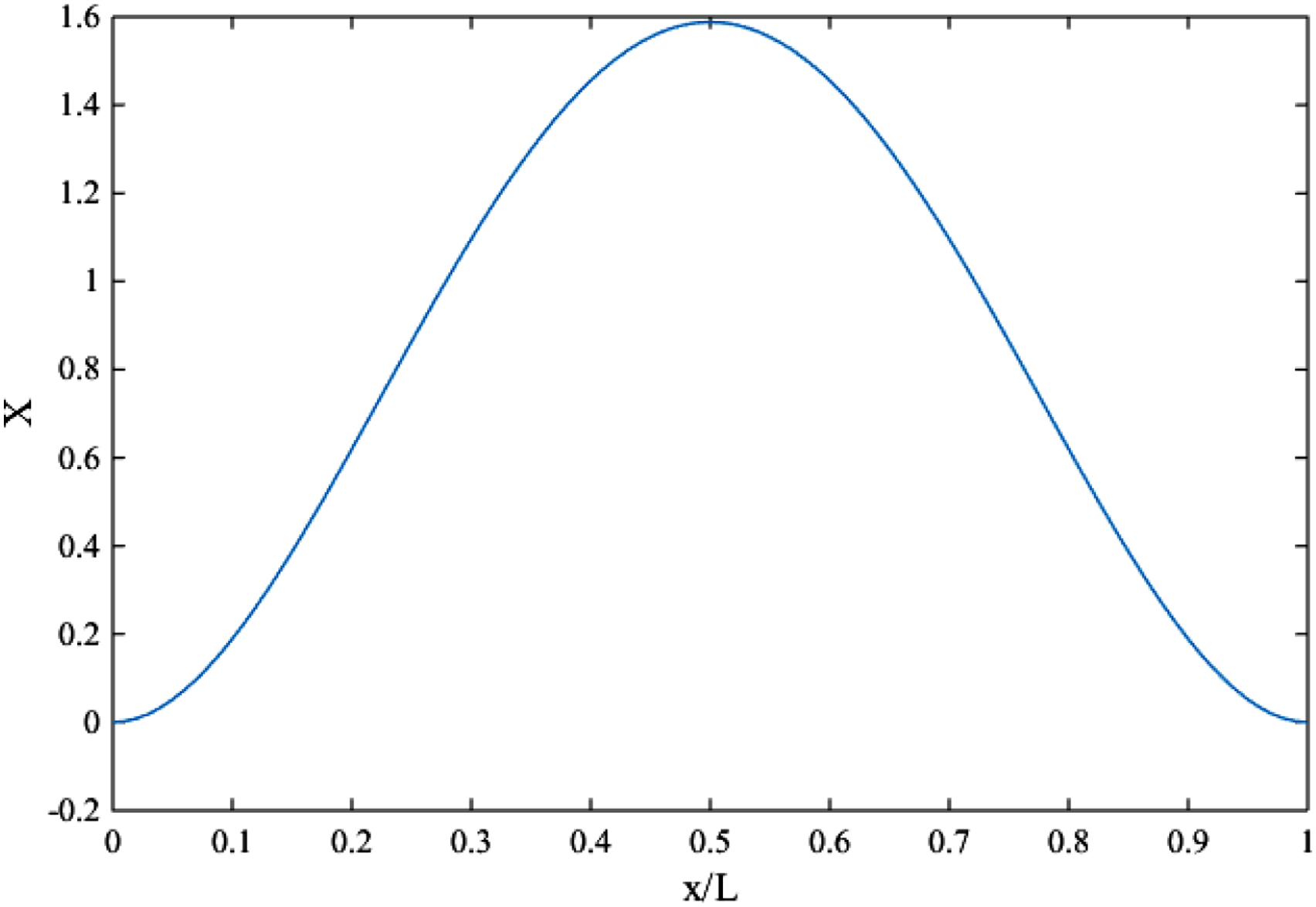

It should also be noted that the ends of the cylinder are free to move in the axial direction and because of the symmetrical loading, it is clear that axial displacement in the mid-span is zero. Therefore, the approximation function of axial displacement can be considered as follows


The diagram of approximated function response in this manner versus the length of the cylinder is shown in Figure 4. The Galerkin’s error equations will be derived by substituting the equations (44) and (48) into equation (39)-(40), as follows Approximated function (Y) vs. the length of the cylinder.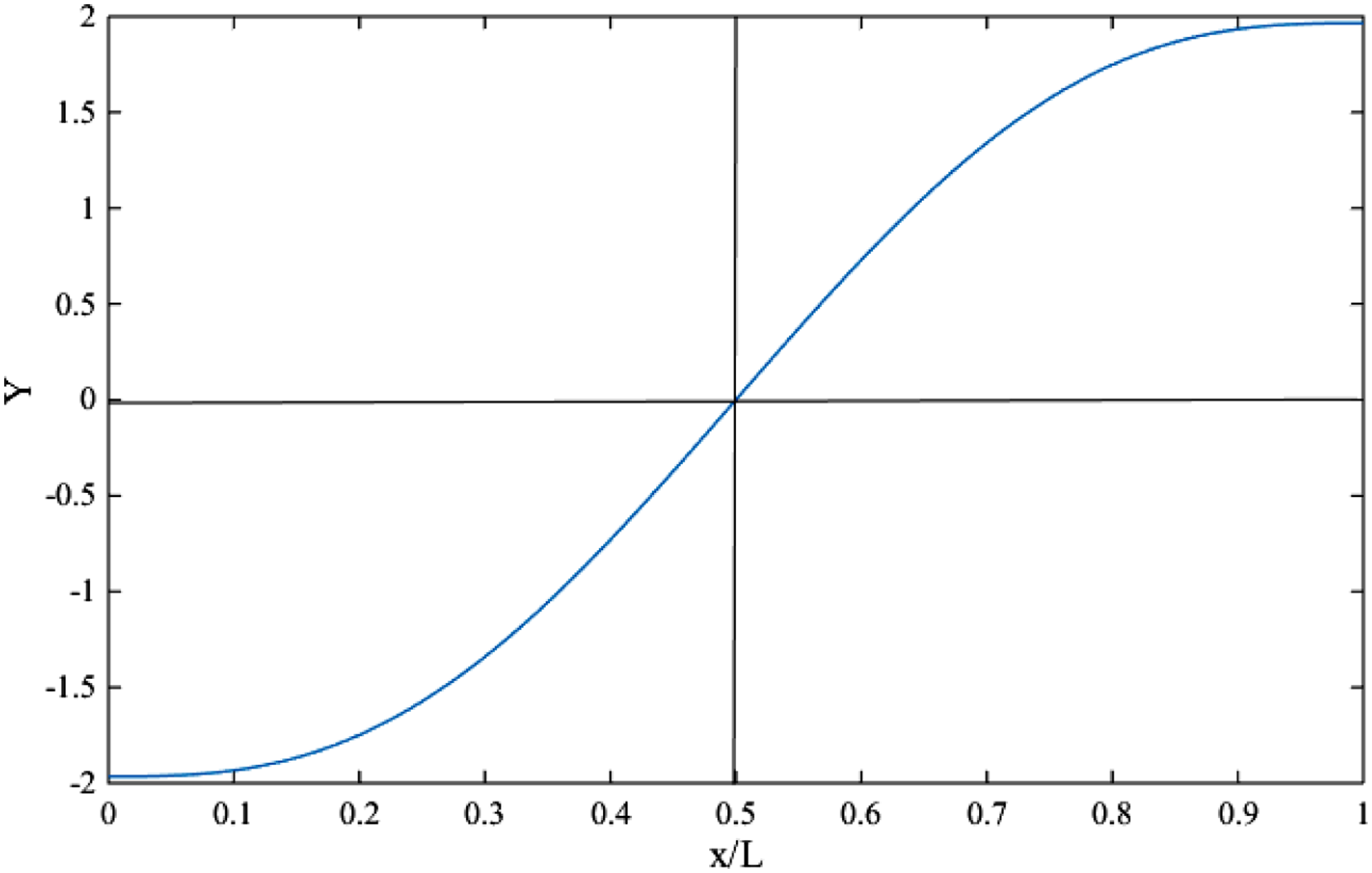



The conditions of orthogonality of these errors to the approximating functions are presented as follows

By substituting equation (50)-(52) into equation (53) the following equations can be derived


the integrals in these equations can be presented as follows

The system of equations (54)-(56) can be derived as follows


where

The system of equations (59)-(61), only have nontrivial solutions when the determinant of its coefficient be equal to zero. As, the buckling pressure for different buckling modes will be calculated as follows

the smallest pressure calculated by the relation above will be the critical buckling pressure.
Numerical results and discussion
In this section, the numerical results of buckling resistance for the CNTR cylindrical shells under hydrostatic pressure with different geometric and stiffness parameters, considering agglomeration effects are presented.
Validation
Geometrical properties of testing cases.

Critical buckling load obtained from experimental test and analytical method.

As shown in Table 2, there is a difference of approximately 12%–16% between the results obtained from the existing analytical method and the test results. 30 These differences may be due to defects of test samples, such as porosity or thickness uniformity.
Mechanical properties of composite layers. 33 .

Critical buckling load of composite cylinder obtained from FEM and analytical method.

Buckling analyzing of agglomerated CNTFPML
Mechanical properties of used material. 26 .

Mechanical properties of the equivalent fiber.

The effects of the agglomeration parameters Critical buckling load of CNTFPML cylindrical shell vs η for different μ . Critical buckling load of CNTFPML cylindrical shell vs μ values for different η .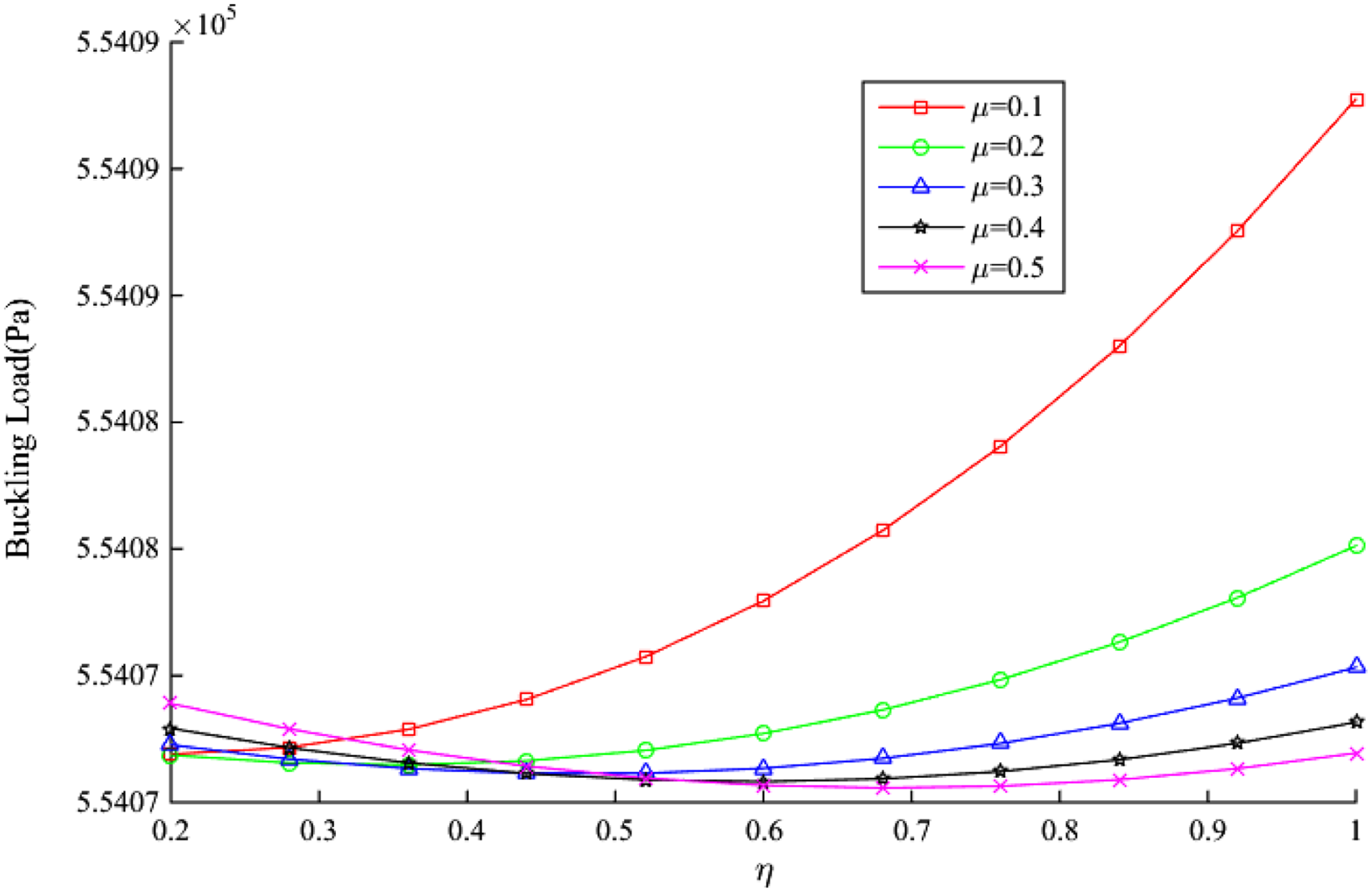

As observed in Figure 5, for small ratios between the volume of the cluster and the total volume REV (
In the above figures, it was seen that when clusters are formed in smaller regions, increasing the amount of CNTs inside the clusters improves the properties of the structure against buckling. On the other hand, when the clusters are in a large region of the material, increasing the amount of CNTs in the clusters causes strong anomalies and reducing the strength of the structure against buckling load. It means that when the clusters occupy a lot of space in the reinforced material, reducing the CNTs in the clusters contributes to the uniformity of the structures properties and reduces the destructive effects of agglomeration.
A further parametric investigation considers the sensitivity of the buckling resistance to Critical buckling load of CNTFPML cylindrical shell vs μ values for different 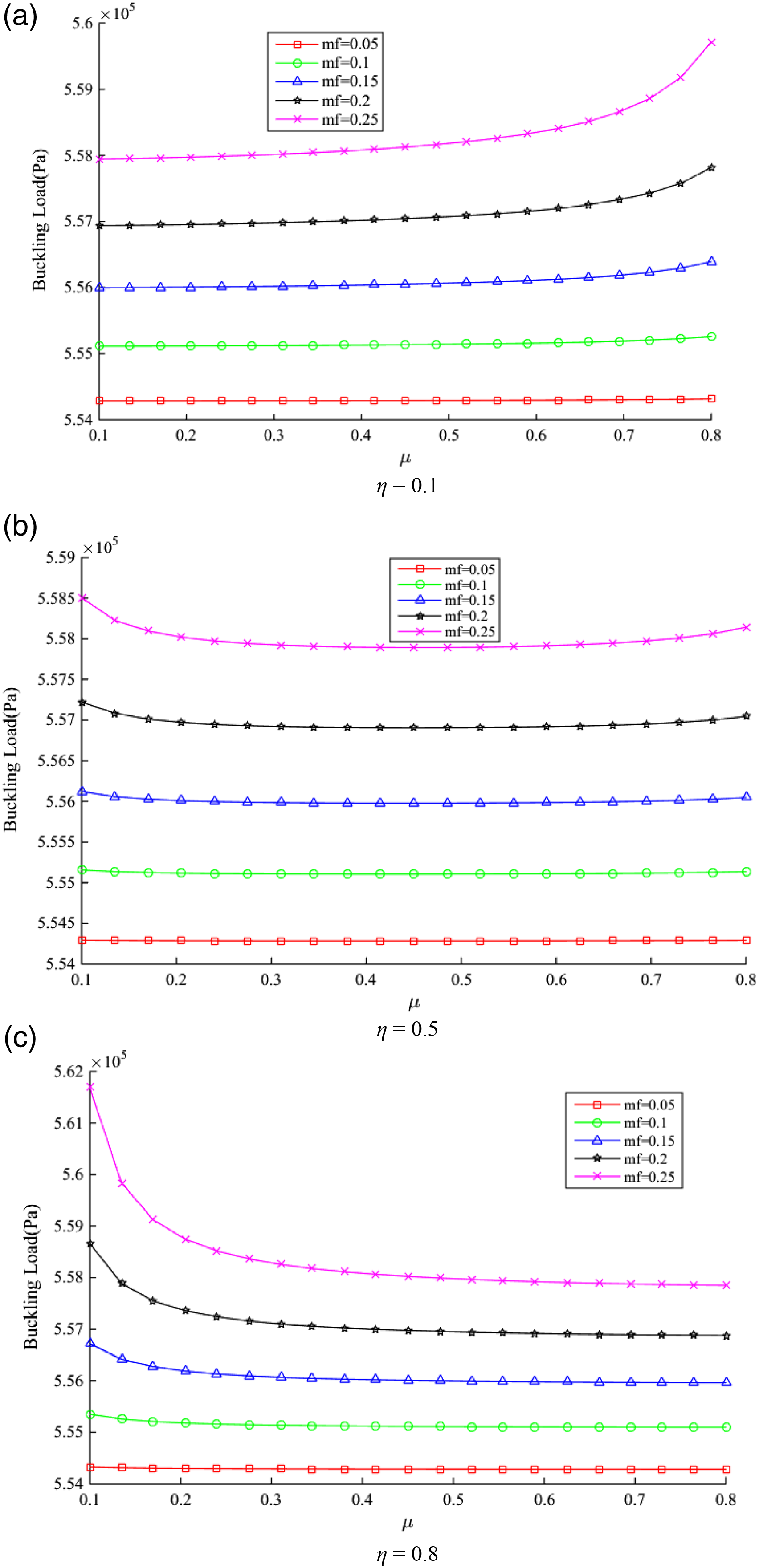
As clearly is visible in Figure 7, increasing mass fraction of fibers (
Figure 8 shows the effects of Critical buckling load of CNTFPML cylindrical shell vs η values for different 
Based on the plots of Figure 8, as shown in Figure 7, higher values of
Generally, it seems that very small and dense clusters act as reinforcing particles and help to improve the properties of the composite materials, but increasing the volume of these clusters and decreasing their density reduces the reinforcing properties of these regions until the lowest value. Consequently, the process of increasing the volume and decreasing the density of the clusters will tend to homogenize the material’s structure and consequently, the strength of the composite structure will be improved. Interestingly, at high
Figure 9 shows the variation of the buckling load of agglomerated CNTFPML cylindrical shell with the agglomeration parameter Critical buckling load of CNTFPML cylindrical shell vs μ values for different material types and 
As shown in Figure 10, the volume fraction of aluminum layers Critical buckling load of CNTFPML cylindrical shell vs μ values for different 
Conclusions
In this study, the buckling resistance of FMLs cylindrical shells reinforced by agglomerated CNTs have been investigated using an analytical solution method consisting of the Fourier series and the Galerkin method. The desired multi-phase cylinder consists of polymer matrix, fibers, CNTs and metal layers. To fabricate the desired cylinder, the polymer matrix is first reinforced by CNTs, then the reinforced matrix has been composed with fibers and finally, the composite layers have been joined with metal layers. The effects of CNTs agglomeration on the mechanical properties of composite structures are determined by the Eshelby-Mori-Tanaka approach. The effects of agglomeration parameters 1) In general, the effect of agglomeration coefficients on the mechanical properties of a reinforced material can’t be studied separately and the effect of changes in each agglomeration coefficient ( 2) The effect of changes in agglomeration coefficients on the behavior of reinforced composite structures by CNTs is not always the same. It means that in some cases increasing the coefficients increases the buckling resistance and in some cases deteriorates it. 3) At small values of 4) The formation of large clusters, if they contain a large percentage of CNTs, causes a decrease in the buckling strength of the structure and if they contain a small amount of particles, increases the resistance to buckling. 5) Although using several types of reinforcing materials in multi-phase composite structures improves the mechanical properties of the reinforced materials, it worth mentioning that the presence of reinforcing phases together can increase the impact of each phase changing on the behavior of the structure. It can make the manufacturing process difficult. 6) Very small and dense clusters act as reinforcing particles and help to improve the properties of the composite materials. 7) Decreasing the density and increasing the volume of the clusters cause the homogeneity of the composite structure and have a good effect on the buckling behavior of the material.
Footnotes
Declaration of conflicting interests
The author(s) declared no potential conflicts of interest with respect to the research, authorship, and/or publication of this article.
Funding
The author(s) received no financial support for the research, authorship, and/or publication of this article.
