



Abstract
The exploration of flexible, transparent, anti-corrosion and thermally stable electromagnetic interference (EMI) shielding materials is still a huge challenge and urgently demanded in the civil and military fields. Herein, two novel high-performance poly (amide-imide)s (PAIs) were designed and used to fabricate sandwich structure EMI shielding films through simple layer-by-layer casting method. Combining advantages of PAI and silver nanowires (Ag NWs), PAI/Ag NWs composite films showed a shielding effectiveness (SE) of 35 dB and simultaneously possessed an optical transmittance of beyond 80%. More encouragingly, the composite films remained more than 92% EMI SE with random deformations (>5000 times). Furthermore, benefitting from the excellent properties of PAI matrix and sandwich structure of EMI shielding films, the EMI SE was almost unchanged even when they were exposed to air for 30 min at 160°C. On the other hand, the PAI/Ag NWs composite films still exhibited EMI SE of more than 30 dB when they were dipped into aqueous solution for 1 h by varying pH values from 2 to 13. These results demonstrated that PAI and Ag NWs was a good combination to prepare EMI shielding materials with excellent comprehensive performances.
Introduction
In the past decades, the rapid widespread of various electronic devices have made the space full of electromagnetic (EM) waves, which is not only bringing about chaos among different communication channels, but also causing harm to human health. In order to clear the effect of this unwanted EM radiations, developing of electromagnetic interference (EMI) shielding materials is inevitable.1–5 Traditional EMI shielding materials, such as metal (copper,6–8 aluminum,9–11 and nickel12–14) or metal oxide (Fe3O4,15–17 ZnO,18–20 TiO221–23), possess good conductivity and high permeability. However, they are not the optimal choice owing to their high density, poor mechanical flexibility as well as prone to corrosion. Especially, modern display devices and visual windows require that the EMI shielding materials must be transparent and flexible. To meet such harsh requirements, one of the most important approaches is to develop conductive polymer composites (CPCs) with good optical transmittance, high EMI shielding effectiveness (EMI SE) and excellent shielding reliability.5,24–25 Indium tin oxide (ITO) exhibits both high visible transmittance and good conductivity, and thus has been widely used as EMI shielding materials. For example, Xu et al. fabricated ITO films with an EMI SE of 30 dB and transmittance of 80%. 26 However, ITO suffers from inherent brittleness, which restricts its application in flexible devices. Other transparent CPCs have also been proposed, such as graphene,27–29 conducting polymers30–32 and MXene.33–35 Unfortunately, these CPCs possess either unsatisfactory EMI SE or low optical transmittance.
Recently, silver nanowires (Ag NWs) have been considered as a promising candidate to fabricate transparent and reliable EMI shielding materials due to their full spectrum transparency, high inherent conductivity and good mechanical flexibility.36–39 For example, Jia prepared an EMI shielding film based on Ag NWs through a simple Mayer-rod coating approach. 37 The Ag NWs composite films exhibited a high EMI SE of 31.3 dB and a good transmittance of 81%. Furthermore, these transparent films still exhibited a highly reliable shielding ability in a complex service environment, with 98% and 96% EMI SE retentions even after 30 min of ultrasound treatment and 5000 bending cycles, respectively. But it should be reminded that these metal nanowire networks are susceptible to oxygen and tend to degrade rapidly in harsh ambient conditions, such as damp heat and high temperature, which limits the long-term practical application.
It is well known that in addition to conductive fillers, structural arrangement of CPCs is also very important for EMI shielding films. In particular, layer-by-layer sandwich structure has been proven to be one of the effective models in combining the individual advantages of polymer matrix and conductive filler.40–43 For example, Hu et al. fabricated flexible transparent poly (ethersulfone)/silver nanowires/poly (ethylene terephthalate) (PES/Ag NWs/PET) sandwich-structured film for EMI shielding. 40 The PES/Ag NWs/PET showed a EMI SE of more than 31.3 dB and a good transmittance of 81%. However, like some other traditional transparent polymer films, such as poly (methyl methacrylate),44–46 poly (carbonate), 47 Nylon,48,49 PET,40,50 also suffer from some inherent disadvantages of low glass transition temperatures (Tg) and high coefficient of thermal expansion (CTE) and sensitive to moisture, which is extremely detrimental to reliability of EMI shielding materials. Poly (amide-imide) (PAI) has been widely used as one kind of high-performance polymers containing amide and imide groups in the main chain.51–61 It is generally recognized that amide groups are useful for improving the solubility, and the aromatic imide groups are beneficial to offer good mechanical, anti-corrosion and thermal properties. In other words, PAI possess good mechanical and thermal properties of poly (imide) (PI) as well as ease of processability of poly (amides) (PA). Unfortunately, due to the intramolecular or intermolecular charge-transfer (CT) interaction between the electron donating diamine and electron accepting aromatic dianhydride, PAIs exhibit a dark color like traditional aromatic PI.62,63 Much efforts have been devoted to synthesized colorless and transparent PAIs through molecular structure design, such as the introduction of electronegative atoms, bulky side groups, alicyclic structures.64,65 For example, Kim et al. developed a novel PAI with a CTE value as low as 4 ppm/oC, which also retained high transparency, excellent thermal and mechanical properties by rationally designing and controlling the position of the trifluoromethyl on the polymer backbone. 61 Therefore, it is believed that PAI and Ag NWs would be a good combination to prepare EMI shielding materials with excellent comprehensive performances.
Herein, we report a very simple method to fabricate highly efficient and reliable transparent EMI shielding films. A series of PAIs were designed and selected as polymer matrix due to their preferable properties, such as excellent thermal resistance, anti-corrosion and high mechanical properties. As we know, this is the first time that PAI is used to manufacture EMI shielding devices. Ag NWs was selected as conductive filler. Combining the advantages of PAI and Ag NWs, PAI/Ag NWs composites gave a high EMI SE of 35 dB and a good transmittance of beyond 80%. This could satisfy the industry-accepted SE requirement, such as modern display devices and visual windows. Furthermore, the sandwich structure of PAI/Ag NWs EMI shielding materials enabled the film a highly reliable shielding ability in complex service environment, with more than 90% EMI SE retentions even after acid-base solution treatment, thermal anneal in air condition and random bending cycles. The sandwich structured, flexible and transparent PAI/Ag NWs composites with excellent EMI shielding performance and good anti-corrosion and thermal stable properties has a bright potential in electronic and communication applications in high-tech fields, such as flexible electronics, artificial intelligence, and optoelectronic devices.
Experimental section
Materials
4,4’-Diaminodiphenylmethane (DCP) and 2,2-bis(4-aminophenyl)hexafluoropropane (DFP) were purchased from Tokyo Chemical Industry (TCI) (Shanghai) Chemical Industry Co., Ltd. 1-Methyl-2-pyrrolidinone (NMP), pyridine (Py), triphenyl phosphite (TPP), isopropanol, γ-aminobutyric acid (GABA), silver nitrate (AgNO3), poly (vinyl pyrrolidone) (PVP), FeCl3·6H2O, anhydrous calcium chloride (CaCl2) and anhydrous calcium chloride (LiCl), acetone, ethanol, ethylene glycol and trifluoroacetic acid-d (isotopic) (TFA-d) were purchased from Aladdin Co., Ltd. 4,4'-Oxydiphthalic anhydride (ODPA) were purchased from Changzhou Sunlight Medical Co., Ltd. All chemicals were used without any purification.
Synthesis
Synthesis of polymer matrixes
Synthesis of diimide-diacid (DIDA) monomer. As shown in the Scheme 1, the DIDA monomer was synthesized by the condensation of ODPA with GABA through dehydration cyclization as our previous work.51–54 Firstly, ODPA (18.6 g, 0.06 mol), GABA (12.36 g, 0.12 mol) and acetic acid (150 mL) were added into a 250 mL three-mouth flask. The mixture was stirred vigorously at room temperature under nitrogen atmosphere for 12 h. And then the solution was heated to 120°C, the reaction carried out for another 6 h. The solution was cooled to room temperature, washed with acetic acid and deionized water by several times. The product was dried at 90°C for overnight (yield: 92%). Fourier transform infrared (FTIR) (KBr, v, cm−1): 3440 (carboxyl O-H), 1764/1703 (imide C=O), 1736 (carboxyl C=O), 1621/1610 (aromatic C=C), 1403 (C-N), 1234 (aromatic ether C-O-C). 1H NMR (TFA-d, 500 MHz, ppm): 11.57 (broad, COOH), 7.90 (dd, 2H), 7.50 (d, 2H), 7.42 (dd, 2H), 3.94 (s, 4H), 3.83 (t, 4H), 2.06 (t, 4H). Synthetic route of diimide-diacid monomer and poly (amide-imide)s.
Synthesis of PAIs. PAI-DCP and PAI-DFP were synthesized with varying aromatic diamine (ADA) monomers (DCP and DFP), respectively. All polymers were synthesized by the similar method. The synthetic detail is described as below taking PAI-DCP as an example. Diimide-diacid (2.40 g, 0.005 mol), CaCl2 (2 g, 0.018 mol), LiCl (1 g, 0.024 mol) and DCP (0.991 g, 0.005 mol) were added into 250 mL three-mouth flask. And then, TPP (5 mL), Py (5 mL), and NMP (14 mL) were successively added into the flask. The mixture was gradually heated to reflux and the reaction further continued for 8 h. The solution was poured into ethanol to obtain white filamentous solid. The crude product was washed ethanol and distilled water sequentially. Finally, the product was placed in a vacuum drying oven at 90°C for 12 h (yield: 87%).
PAI-DCP: FTIR (ATR, v, cm−1): 3327 (amide N-H), 1770/1707 (imide C=O), 1675 (amide C=O), 1394 (C-N), 1274/1232 (aromatic ether C-O-C). 1H NMR (TFA-d, 500 MHz, ppm): 7.87–7.89 (dd, 2H), 7.49 (t, 2H), 7.40 (d, 2H), 7.38 (d, 2H), 7.25 (s, 2H), 7.23–7.25 (d, 2H), 7.21 (s, 2H), 7.14–7.16 (d, 2H), 7.11 (s, 2H), 4.04 (s, 2H), 3.85 (t, 2H), 3.77–3.80 (t, 2H), 2.95–2.97 (m, 2H), 2.67 (t, 2H), 2.18 (t, 2H), 2.05–2.07 (t, 2H).
PAI-DFP: FTIR (ATR, v, cm−1): 3308 (amide N-H), 1770/1708 (imide C=O), 1674 (amide C=O), 1397 (C-N), 1256/1239 (aromatic ether C-O-C), 1202/1173 (C-F). 1H NMR (TFA-d, 500 MHz, ppm): 7.87 (d, 2H), 7.84 (dd, 2H), 7.52 (d, 2H), 7.45–7.50 (m, 2H), 7.42 (d, 2H), 7.38 (d, 2H), 7.34 (s, 2H), 7.25–7.32 (m, 2H), 3.94 (s, 2H), 3.8–3.86 (m, 2H), 3.0–3.05 (m, 2H), 2.62 (t, 2H), 2.17 (t, 2H), 2.08 (t, 2H).
Synthesis of silver nanowires
Ag NWs was prepared by a modified polyol method with some modifications. 40 PVP (0.2 g) was completely dissolved in ethylene glycol (25 mL). AgNO3 (0.25 g) and FeCl3 (3.5 g, 0.6 mmol/L in EG) were added into the PVP solution in sequence. The mixture was stirred for 5 min. And then, the solution was heated to 130°C for 5 h. The solution was centrifuged at 4000 r/min for 10 min, after flocculating three times with acetone, the crude product was washed by ethanol and water subsequently. Finally, the Ag NWs (0.015 g) and hydroxypropyl cellulose (0.002 g) were added into the isopropanol (10 mL).
Fabrication of PAI/Ag NWs composites
PAI (0.4 g) was completely dissolved in NMP (12 mL), and the solution was cast onto the glass plate, the PAI film was dried at 80°C until the solvent was evaporate completely. The Ag NWs solution was centrifuged at 2500 r/min for 5 min. The obtained Ag NWs was added into isopropanol: distilled water mixed sovlents with a volume ratio of 4:1. Subsequently, hydroxypropyl cellulose was added into the Ag NWs mixed solution. The fresh Ag NWs suspension was cast by Meyer rods, and then immediately put in an oven at 50°C for 5 min. Finally, the PAI wet film was used to cast onto the surface of the silver nanowire layer by drop-coating technique.
Materials characterization
Fourier transform infrared spectra were recorded by a Nicolt A vatar 370 FTIR spectrometer and measured by KBr pellet method for monomers and attenuated total reflection mode for PAI films. The solubility test was performed by dissolving the samples in different solvents at room temperature or 90°C for 3 h. The inherent viscosity was measured with an Ubbelohde viscometer at 30°C in NMP at a concentration of 0.01 g/mL. Differential scanning calorimetry (DSC) was carried out using a DSC8000 instrument from PE Instruments at a heating rate of 20 °C/min under nitrogen atmosphere from 30°C to 300°C. Thermogravimetric analysis (TGA) was carried out by TGA4000 instrument from PE Instruments at a heating rate of 10 °C/min under nitrogen atmosphere in the temperature range from 30°C to 750°C. Thermomechanical analysis (TMA) were carried out on a DMA8000 instrument adopting static stretching mode at a heating rate of 5°C/min with 0.005 N preload and 1 Hz frequency. The film size for TMA measurements was 5 mm wide and 20 mm long. The CTE values of samples were determined by calculating the results in a temperature range of 30–300°C. The tensile properties of films with a size of 20 mm long and 10 mm wide were measured by WDT-5 tensile apparatus at room temperature with a drawing rate of 5 mm/min. The UV-vis spectra were recorded on an UltraScan Pro spectrophotometer at room temperature in the absorption mode. The wide-angle X-ray diffraction (WAXRD) measurements in refraction mode were performed by a Smart Lab SE X-ray diffractometer with Cu/Kα radiation, operated at 40 kV. The 2θ of diffraction patterns were collected in the range of 0–50°. The EMI shielding performances were measured using a DR-S01 Coaxial Testing Device for SE at the frequency range of 0-8000 MHz. The bending tests were performed on a XD-9600 Multifunctional Alcohol Rubber Friction Testing Machine. The sample film was bent at a rate of 60 times per minute at an angle of 180 o.
Results and discussion
Design and synthesis of PAIs
In order to achieve such advanced EMI shielding materials, the polymer matrix should possess the following properties at the same time. First, the polymer matrix should be adequately soluble to form a uniform thin film by drop casting or other simple methods. Second, the polymer matrix film should be transparent. Third, the polymer matrix should have good thermal stability and high mechanical properties. Finally, the polymer matrix should be insensitive to acid-base solution and common organic solvents. Traditional transparent polymers such as PMMA, PET exhibit good solubility and processability, but their thermal stability and mechanical properties are poor. On the other hand, aromatic PI shows good thermal stability and mechanical properties, but its solubility and processability are not good. To avoid these drawbacks, PAI was selected as polymer matrix. The designed PAIs structure formed by ODPA, and ADA ((DCP), 2,2-bis(4-aminophenyl)hexa-fluoropropane (DFP)) can give good mechanical, thermal and anti-corrosion properties, the amide group and suitable aliphatic chain can produce good solubility and processability. As shown in the Figure 1, the non-coplanar structure of ODPA can increase the inter-chain distance, in addition, the flexible chain can increase the torsion angle between ODPA and ADA, which is be beneficial to reduce the crystallinity for achieving high optical transmittance. 3D structure of the repeating units of PAI-DCP (a) and PAI-DFP (b).
A diacid monomer bearing thermal stable aromatic benzene ring and good processability aliphatic alkyl chain was synthesized as shown in the Scheme 1. The dehydration cyclization of ODPA with GABA gave the corresponding DIDA monomer. The polymer matrixes (PAI-DCP, PAI-DFP) were respectively prepared by Yamazaki Higashi phosphorylation of DIDA with two different diamine monomers (DCP and DFP) in the presence of TPP and Py. In the FTIR spectra of ODPA and DIDA as shown in the Figure 2, the characteristic peak of dianhydride C=O at 1779 cm−1 disappeared, and in instead, the characteristic peaks of imide C-N at 1403 cm−1 and carboxyl O-H at 3440 cm−1 appeared, suggesting the successful formation of DIDA monomer. In the FTIR spectra of polymer matrixes, the characteristic peak of carboxyl O-H disappeared while the characteristic peak of amide N-H at 3310 cm−1 appeared as summarized in Table S1, furthermore, the trifluoromethyl C-F was observed in the FTIR spectrum of PAI-DFP, suggesting the successful synthesis of PAI-DCP and PAI-DFP. Moreover, these changes were also confirmed by nuclear magnetic resonance spectra as shown in the Figure S1. FTIR spectra of ODPA, DIDA, PAI-DCP and PAI-DFP.
Physical and chemical properties of PAIs
Unlike aromatic poly (imide), all PAIs exhibited good solubility in some common organic solvents, such as N-methyl-2-pyrrolidone (NMP), m-cresol. The inherent viscosities of PAIs were evaluated to be 0.94 dL/g for PAI-DCP and 0.64 dL/g for PAI-DFP, suggesting that these two polymers with high molecular weight were successfully prepared, although the two amine monomers possess different reactivity due to the electron-donating hydrogen atom and electron-withdrawing trifluoromethyl groups. This property allowed for processing polymer matrixes into films by casting the polymer solutions in NMP. A representative example of a PAI film is shown in Figure 3(a), indicating its high transparency. As shown in the Figure 3(b), the transmittances of all the PAI films at the 550 nm were higher than 88% measured by ultraviolet-visible (UV-vis) spectroscopy, and the cutoff wavelengths were estimated to be 360 nm for PAI-DCP and 350 nm for PAI-DFP as summarized in Table S2, suggesting that the PAI films only exhibited a subtle yellow hue. On the other hand, the higher optical transmittance PAI-DFP is ascribed to the presence of electron-withdrawing trifluoromethyl groups on the polymer backbone, which prevented the formation of CT complexes by sterically repelling adjacent chains, and weakening the electron density in the diamine unit.60,61 In addition, the hazes were investigated to be 1.8% for PAI-DCP and 0.6% for PAI-DFP, the better clarity of PAI-DFP is ascribed to its lower crystallinity as shown in the Figure S2. These results suggested that incorporation of fluorine containing functional groups into the polymer main chain was an effective strategy to improve the optical properties of polymer films. (a) Digital photograph of PAI film; (b) Optical transmittance of PAI pure films (black line: PAI-DCP; red line: PAI-DFP).
These two new polymers are quite thermal stable even at high temperatures as shown in the Figure 4(a), both of PAI-DCP and PAI-DFP showed a 5% weight loss at above 400°C. As shown in the Figure S3, the glass transition temperatures (Tg) of the polymers were estimated to be 186°C for PAI-DCP and 208°C for PAI-DFP determined by DSC analysis, which was far higher than those of organic solvent soluble transparent polymers, such as PMMA and PET. In addition, as shown in the Figure 4(b), the CTE values of the polymer films were calculated to be −3 ppm/oC for PAI-DCP and −6 ppm/oC for PAI-DFP measured by TMA, which were close to rigid PI films. Furthermore, as shown in the Figure S4, the Young’s modulus of the PAIs were as high as 1.3 GPa for PAI-DCP and 2.7 GPa for PAI-DFP. In other words, the two new PAIs of PAI-DCP and PAI-DFP not only possessed excellent thermal and mechanical properties like PI film, but also possessed good processability like traditional transparent polymers. Differential scanning calorimetry (a) and thermomechanical analysis (b) curves of poly (amide-imide)s (black line: PAI-DCP, red line: PAI-DFP).
Electromagnetic interference shielding performance of the sandwich structured PAI/Ag NWs films
To exploit the flexible, high transparency, excellent mechanical and thermal properties of the PAIs, as shown in the Figure 5(a), these two polymers were used as substrate to fabricate high-performance EMI shielding devices, in which silver nanowires (Ag NWs) was chosen as conductive filler. As shown in the Figure 5(b), the PAI/Ag NWs composites exhibited an EMI SE of above 35 dB in a wide range. More important, the optical transmittance was more than 80% at 500 nm as shown in the Figure S5. Schematic diagram (a) and EMI SE curve (b) of PAI/Ag NWs electromagnetic interference shielding films.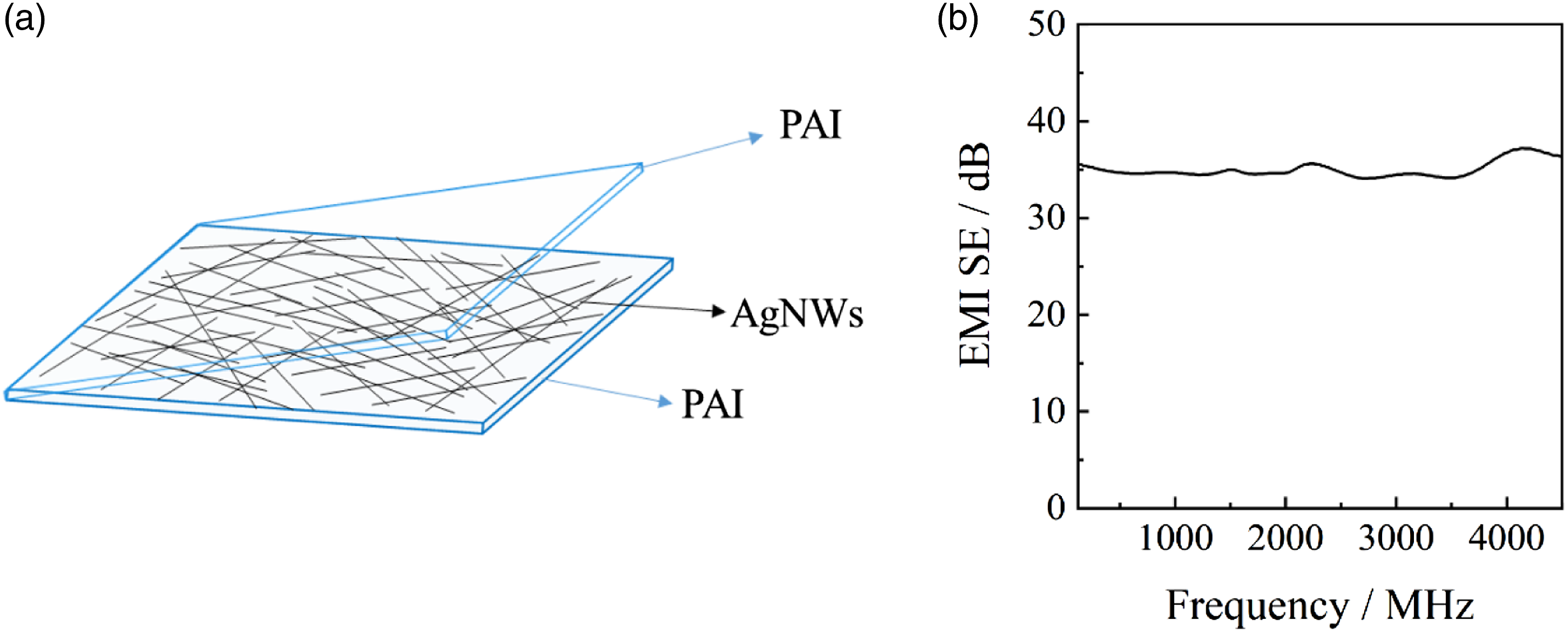
In terms of practical application, a reliable EMI SE is extremely important to EMI shielding devices. Firstly, the reliability of shielding performance under mechanical strain conditions was conducted, the PAI/Ag NWs sandwich films was folded by 5000 times with a bending angle of 180o. It is found that the EMI SE maintained a stable value close to the original value as shown in the Figure 6(a), suggesting the PAI/Ag NWs shielding films showed little sensitivity to mechanical deformation. In addition, there is no crease after this violent mechanical folding, suggesting the surface adhesion force is enough high to prevent the Ag NWs stripped from PAI substrate. Furthermore, it is worth emphasizing that the PAI/Ag NWs composite films still exhibited an EMI SE value of 32 dB, which exceeded the requirement of commercial applications. To describe the excellent flexibility of PAI/Ag NWs shielding films more precisely, a concept of EMI shielding durability (SD) was proposed, and the value can be calculated as the following equation. EMI SE variation of PAI/Ag NWs films with different treatments. (a) Bending cycles, (b) thermal annealing, (c) acid-base immersing, (d) organic solvents immersing. The variation is defined as the ratio of EMI SE after the treatments to the original EMI SE at 2.5 GHz.

Then the thermal reliability was investigated. As shown in the Figure 6(b), the PAI/Ag NWs shielding films with the new material still kept transparent even after in-air thermal annealing (160°C for 30 min), exhibiting 81% transmittance at 550 nm. This is a breakthrough compared to conventional PIs and PAIs, which typically exhibit significant yellowing ascribed from the formed CT complex, and further oxidation during the thermal annealing process. In addition, EMI SE only dropped slightly. The excellent thermal reliability of PAI/Ag NWs shielding films is mainly owing to the low CTE and high Tg of the new PAIs, which can limit the contraction or expansion of substrate. Figure 6(c) shows the relationship between pH and EMI SE variation of PAI/Ag NWs composite films. The acid-base treatments were conducted by immersing PAI/Ag NWs sandwich films into nitric acidic, sodium hydroxide solution for 30 min, respectively. Over a wide pH range from 2 to 13, there was no obvious fluctuation in EMI SE, and the EMI SE varied from 34 to 32.7 dB. These results indicated that the PAI/Ag NWs composite films possessed good resistance, not only in pure water, but also in corrosive acids and bases, which is very important for expanding its application. Also, the resistance of PAI/Ag NWs shielding films in acetone (CP), ethanol (EA), ethyl acetate (EAC), cyclohexane (CYH) and chloroform (CF) was also researched. As shown in the Figure 6(d), these common organic solvents also played a very limited influence on the EMI shielding performances. Therefore, the PAI/Ag NWs composite films not only showed a high EMI SE, but also exhibited a good reliability in complex EM environments.
Conclusion
Two novel PAIs with flexible, high transparency, excellent mechanical and thermal properties have been synthesized through careful molecular structure design. Combining the advantages of PAI and silver nanowires, the PAI/Ag NWs composite films showed EMI SE of 35 dB and possessed an optical transmittance of beyond 80% simultaneously. Furthermore, the PAI/Ag NWs composites films exhibited high reliability in acid-base, thermal, mechanical strain conditions. Even in these harsh environments, more than 90% EMI SE was kept due to the high-performance of PAI and sandwich structure of EMI shielding films. These results suggested that PAI materials can be used as versatile platform for organic devices that require multifunctional factors.
Supplemental Material
sj-pdf-1-ppc-10.1177_09673911221107292 – Supplemental Material for Design and synthesis of high-performance poly(amide-imide) for multifunctional electromagnetic interference shielding films
Supplemental Material, sj-pdf-1-ppc-10.1177_09673911221107292 for Design and synthesis of high-performance poly(amide-imide) for multifunctional electromagnetic interference shielding films by Changlong Zhuang, Yanbin Wang, Chengbi Chang, Zicheng Fan, Shuhan Hou, Chen Zhou, Hao Dong, Leier Xia, Zhonglin Luo and Biaobing Wang in Polymers and Polymer Composites
Footnotes
Declaration of conflicting interests
The author(s) declared no potential conflicts of interest with respect to the research, authorship, and/or publication of this article.
Funding
The author(s) disclosed receipt of the following financial support for the research, authorship, and/or publication of this article: This work was supported by the Natural Science Foundation of Jiangsu Province (BK20160280), Postgraduate Research & Practice Innovation Program of Jiangsu Province (SJCX20_0976).

References
Supplementary Material
Please find the following supplemental material available below.
For Open Access articles published under a Creative Commons License, all supplemental material carries the same license as the article it is associated with.
For non-Open Access articles published, all supplemental material carries a non-exclusive license, and permission requests for re-use of supplemental material or any part of supplemental material shall be sent directly to the copyright owner as specified in the copyright notice associated with the article.
