



Abstract
The study investigates four paper-based materials designed for short-time wrapping of meat products by determining morpho-structure, capillary-hydroscopic, barrier and antibacterial properties, wettability and migration into food simulants. The paper-based materials are coded as RO, SP, IT and SLO. RO and SLO samples exhibit the best barrier properties against water vapors. The low solubility and contact angles of RO, IT and SLO in A simulant (distilled water) make them suitable for aqueous food storage. The extremely high solubility of SP and SLO in simulant B (acetic acid) shows that wax and hydrophobized starch, respectively are carried by the acidic media, thus these agents are unlikely to coat the paper designed to package acidic food. SLO inhibits E. coli, Salmonella enterica, Lysteria monocytogenes, Pseudomonas aeruginosa and fluorescens. Polyethylene coated on RO and IT surface and wax impregnated on SP have a lower antimicrobial activity in comparison with hydrophobized starch coated on SLO.
Introduction
Paper-based materials, especially those intended for food packaging, must meet certain conditions of mechanical resistance and should provide protection against gases, water vapors and light. 1 Paper is a fibrous material which may require treatment with various auxiliary materials to render it suitable for service. The structure of the paper has the following particularities: the heterogeneous composition of the structural elements determined by the presence of fibers with different lengths and provenances and of the auxiliary materials; the anisotropic distribution of the structural elements on the three dimensions as a result of the different orientation and dimensions of the auxiliary fibers and materials; the capillary - porous character of the structure, which conditions certain characteristics of the paper, such as: absorption capacity, air permeability, hygroscopic, deformation due to the variation of ambient air humidity, irreversible modification of some properties as a result of drying, etc..; the presence of the connecting forces between the structural elements that determine the mechanical strengths of the paper. 2
Paper is mainly made from cellulose fibers consisting of alternative crystalline and amorphous cellulose phases. Cellulose macromolecules contain free hydroxyl groups which confer a hydrophilic character of the surface and reduces the barrier properties against water vapor and other polar substances. In this regard, the coating of paper surface with different materials in order to enhance the barrier properties and the antimicrobial activity is of great interest. 3 Currently, polyolefins,4,5,6 ethylene-vinyl alcohol copolymer (EVOH), polyesters and polyamides are used to reinforce the paper, in order to increase the hydrophobicity. 4 Zhang et al. 4 have prepared superhydrophobic paper with “Lotus” effect by coating a wax mixture of beeswax and carnauba wax onto paper surface. Tambe et al. 5 obtained kraft paper coated with silylated soybean oil with superior barrier against water vapor.
Currently, the modification of paper with biodegradable materials is intensely studied. There are such compounds that are deposited on the surface of the paper which gives them antimicrobial activity and barrier properties superior to the unmodified paper. Polysaccharides, proteins, and lipids are biopolymer-based materials that offer environmental-friendly, recycling, and renewal capabilities, compared to conventional petroleum-based polymers . 1 Chitosan and its derivatives are widely used for paper coating for improving the barrier against water vapors, gases and flavors and in order to achieve antimicrobial activity .1,7-1
The aim of this study was to evaluate the barrier properties, the migration into the food simulants and the antimicrobial activity of four types of functionalized papers and to establish their suitability for aqueous food packaging.
Materials and methods
Silica gel granules with moisture indicator, Escherichia coli (ATCC 25,922, Enterobacteriaceae), Pseudomonas fluorescens (ATCC 13,525), Pseudomonas aeruginosa (ATCC 10,145), Salmonella enterica (ATCC 13,076), as well as gram-pozitive bacteria Listeria monocytogenes (ATCC 19,114) and phosphate buffer 0.01
Experimental
Four types of functionalized papers were characterized. They are coded as RO, SP, IT and SLO and are commonly used in Romania, Spain, Italy and Slovenia for short-time packaging of meat and meta products from store to home. The samples were selected randomly. Prior to analysis, the samples did not undergo any pre-treatment. The dimensional, morpho-structural, mechanical and chemical characterization of the four paper-based materials currently in use in Romania (RO), Italy (IT), Spain (SP) and Slovenia (SLO) was performed in our previous study. 12
Capillary-hygroscopic characterization
Water vapor permeability (WVP) was gravimetrically determined according to the method described by Sobral et al. 13 adapted for this study and is detailed in the Supplementary material S1.
Wettability (contact angle) and migration into food simulants
The contact angle of food simulants on the package’s surface was determined. The distilled water (simulant A) mimics the aqueous foodstuffs, 3% acetic acid solution (Chemical Company, Romania) (stimulant B) mimics the acidic foodstuffs and 96% ethanol solution (Chemical Company, Romania) (simulant C) was used as fatty foodstuffs according to EU legislation 10/2011. Small portions of package were placed on a piece of glass by employing the sessile drop method. 14 The detailed procedure is described in Supplementary material S2.
Scanning electron microscopy
Small piece of paper-sample was prepared and top and food-facing surfaces were analyzed. A double-beam FIB (focused ion beam) instrument (FEI Helios Nanolab 650) was used.
Fourier-transform infrared spectroscopy - FTIR
A FTIR-BX Perkin Elmer spectrometer was used. The wavenumber ranged between 600 and 4000 cm−1. The resolution was 4 cm−1 and 8 scans were overlapped at each measurement. 15
Antimicrobial activity
The procedure was described by Zhang and Xiao 16 and by Liu et al., 17 with some changes abd is described in Supplementary material S3.
Results and discussion
SEM and FTIR results
SEM images of papers used in the present study.

Signals recorded in the FTIR spectra of the papers (ff - food-facing side, u-upper side).
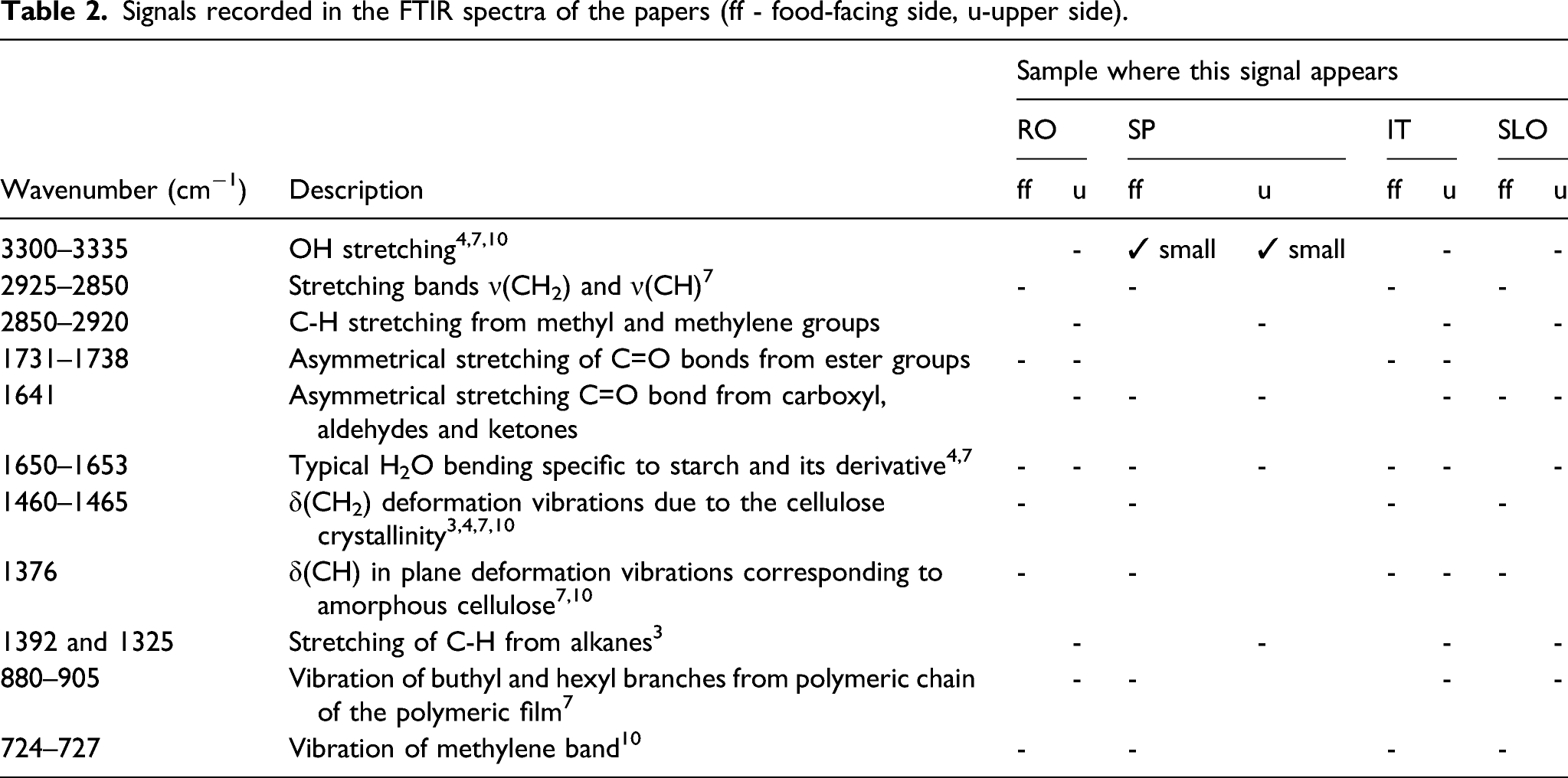
The FTIR signals recorded in the FTIR spectrum of RO show the presence of a homogeneous polymeric film coated on the paper surface. Similar polymeric structure is coated on both sides of the paper in the IT sample. Specific peaks at 1731-1738 cm−1 appear exclusively in the FTIR spectra of SP and SLO and show the presence of an organic material. Moreover, the peak 1650-1653 cm−1 from the FTIR spectrum of the SLO food-facing side corresponds to hydrophobized starch, result confirmed also by the SEM image.
Capillary-hygroscopic characterization
Capillary-hygroscopic characteristics of the papers. Each value is the average of three replicates. The standard deviation (RSD) was lower than 5%.

af - side in contact with the machine sieve/r - opposite side.
Wettability and migration in food simulants
Contact angle (o) of different simulants on paper based packages. Each value is the average of three replicates. The standard deviation (RSD) was lower than 5%.

The solubility of the papers in food simulants is shown in the Figure 1. The values significantly different in the statistical sense (p ≤ 0.05, Tukey’s test) and the correlation coefficients are in the range 0.9157–0.9835. The highest solubility at 20°C is exhibited in A simulant by SLO (3.70%), followed by SP (3.55%), RO (1.54%) and IT (1.45%). In comparison with the values for A simulant, the solubility in B simulant increases 4.43-fold for SP, 2.61-fold for SLO and 1.90-fold for RO and IT as compared with that in simulant A. The low-polar nature of C simulant (ethanol 96%) stimulates the solubility of the RO, IT and SLO packages by ∼2.52-fold and 1.34-fold, respectively and slightly decreases the solubility of SP by 1.03-fold, in comparison with those obtained for A simulant. At 4°C, the increase of the overall migration with increasing non-polar nature of the simulants is apparent (Figure 1). Higher values of the solubility are obtained for all packages in the case of C simulant (ethanol 96%), excepting SP. By reducing the temperature, an interesting aspect can be noticed in the evolution of solubility as compared with those obtained at 20°C. Although we expected a reduction of the paper components dissolution an increase in the solubility occurred. Thus, the solubility of RO and IT into A simulant at 4°C increased by 1.05 times and decreases by 1.27 times in the case of SP and by 1.04 times in the case of SLO, in comparison with the values in the same simulant at 20°C. In B simulant, the solubility of paper-based packages decreases under refrigerated conditions for RO, IT and SLO by 1.05, 1.05 and 1.14 times, respectively and for SP an increase by 2.07 times was noticed. Overall migration from the paper-based packages into the food simulants.
The highest Cobb60 water absorption index was measured for IT and SP samples, while the lowest values were obtained for RO amd SLO. A low water absorption value indicates the suitability of the paper for food packaging. In the case of SLO paper, however, it can be seen that the modified starch surface leads to low absorption values, due to its hydrophobic character, caused by mineral ions that crosslink sites in adjacent macromolecules forming interstitial spaces to trap water. 23 These values could be reached only when a highly advanced paper treatment is used. Normally, according to Romanian SR EN 535:2014, a Cobb60 around 20 g/m2 is the appropriate value for a good quality packaging paper. This value is reached by RO and SLO. In contrast, the Cobb index of IT and SP is ∼2-fold higher than that of RO sample. The values of Cobb60 index are in good agreement with those obtained for water vapor permeability (WVP). The lowest value of WVP at 4°C as well at 20°C was determined for SLO sample, for which a relatively low Cobb index was obtained, indicating that this type of paper is an efficient barrier against water vapor. A way to improve the characteristics is presented by Akter et al. 18 that applied a chitosan coating onto kraft paper and obtained a material with lower water vapor permeability. Moreover, they showed that the water vapor permeability increased as the chitosan concentration was raised from 1% to 3%. It was shown that the paper samples modified with chitosan derivatives and alkyldimerketene emulsion exhibit lower water absorption index, but this index increases by thermal treatment due to alkyldimerketene degradation . 7 Not all the chitosan derivatives have the ability to significantly reduce the Cobb index. For example, alkyl chitosan reduced the water absorption capacity of microfibrillated cellulose to a greater extent than quaternary chitosan and carboxymethyl chitosan, respectively.
A very important aspect is that none of the support paper was impregnated with greaseproof agent (by adding a specially designed additive for this barrier property). KIT values are below 3, indicating their resistance to grease and, in case of high-fat foods, the fact that the fat cannot penetrate the pack or become the suitable environment for the migration of the components from the package into the food. Good adhesion of the packaging to the food surface reduces the amount of oxygen from the inner space which decreases the intensity of the oxidation. On the other hand, tight food-packaging contact induces migration of the packaging components into the food.
The contact angle of all food simulants is lower than 90° and denotes a spontaneous partial or extended wetting of paper surface (Table 4). The composition and topography of papers significantly influences the values of the contact angle. High values of the contact angle were obtained when the A simulant (distilled water) is dropped on the coated surface of the papers, suggesting their different hydrophobic character. The most intense corresponds to SP, followed by SLO, RO and IT. This behaviour is confirmed by the Cobb60 index. IT sample also has the highest capacity for water absorption (Cobb60 index). The contact angle made by distilled water on the coated IT surface was the lowest, suggesting that this sample has the most reduced hydrophobic character. In contrast, SLO sample has reduced Cobb60 index and WVP value as well as high contact angle also suggesting the pronounced hydrophobic character. Sample SP forms a water drop with the highest contact angle as a result of its most pronounced hydrophobic character. This observation demonstrates that the wax coated on the both sides of cellulose (case of SP sample) has a pronounced hydrophobic character than the other coatings (polyethylene or modified starch). There is a contrast between the wettability and the WVP of the SP paper. Wettability is low, while water vapour permeability is high for this sample. Chevalier et al. 19 and Rauch 20 mentioned that, the water vapour permeability (WVP) is affected by various parameters. It was noticed that the materials present poor water barrier by wax addition, as a function of extruder configurations, screw speed, feed rate and operating conditions. 19 They have investigated different types of edible films made with various types of waxes, have obtained a high value of WVP for the edible film made with Candelilla wax as compared to that containing beeswax and carnauba wax, thus demonstrating that the waxes have different water vapor barriers as a result of the morphology and structure of the matrix. This affects the tortuous migration path length of water molecules diffusing through the composite material. Shih et al. 21 also showed that the WVP remained unchanged by modifying the edible film with 15.5 (wt)% rice wax. Based on these findings, we can establish that the amount of wax coated on the double side of SP paper is relatively low and didn’t assign an efficient barrier against water vapours. Literature data noticed that hydrophobized starch used for coating applications 22,23 and synthesized as anionic, 24 cationic 25 or non-ionic 26 derivative ensures a good protection against water.
By increasing the non-polar character of the simulant, the paper surface – simulant compatibility is enhanced and the dispersion of the simulant is improved. The highest reduction in the contact angles was obtained in the case of simulant C (ethanol 96%) due to its highly non-polar nature. Thus, the contact angle was reduced in the case of RO, SLO and SP. The packaging of fatty foodstuffs seems to have favorable effect due to tight adhesion of the package to the foodstuffs surface which reduces the amount of incorporated oxygen and decreases the rate of the oxidation processes. According to Oliver and Mason, 27 the spreading is enhanced by the rough surfaces for liquids that forms contact angle lower than 90°.
Overall migration (solubility) gives important information about the packages' integrity and the migration of packages components into the foodstuffs. 28 The highest solubility at 20°C in A simulant is exhibited by SLO, followed by SP, RO and IT. A detailed analysis shows that the increased solubility of SLO paper could be explained by the ionic character of the hydrophobic starch derivative deposited on the cellulosic paper surface, 22 resulting in the reduction of cohesive and adhesive strengths in the presence of A simulant (distilled water) that enhances the paper dissolution. The wax covering both sides of SP paper has also a certain hydrophilic nature and favors the solubility of the paper. The most resistant to A simulant seems to be RO and IT papers, due to the presence of polyethylene layer coated on one side of the paper which acts as a barrier against cellulose-simulant contact. The polarity of simulants significantly influences the solubility of papers. By adding acetic acid, the polarity of distilled water is reduced, the paper-simulant compatibility is enhanced and the solubility is facilitated. Thus, the SP solubility in B simulant increases in comparison with SLO, RO and IT. The low-polar nature of C simulant (ethanol 96%) stimulates the solubility of the RO, IT and SLO papers and slightly decreases the solubility of SP. At 4°C, the increasing of the overall migration with the non-polar nature of the simulants is also observed. Higher values of solubility were obtained for all papers in the case of B and C simulant (acetic acid 3% and ethanol 96%, respectively), while the lowest were noticed in the case of A simulant (distilled water). By analyzing the temperature influence, an interesting aspect can be noticed in the solubility evolution. The solubility of all four materials into A simulant (distilled water) at 20°C is similar with that determined at 4°C. The solubility of all four types of materials in B simulant (acetic acid 3%) is slightly higher at 20°C than at 4°C, excepting SLO sample. The chemical aggression of simulant C (ethanol 96%) over the materials was more intensive at 4°C that at 20°C in the case of SP and SLO samples. This behavior could be due to the more intensive shrinkage of the material as a result of the paper coating that allows a more advanced paper-simulant contact and favors the dissolution.
Antimicrobial activity
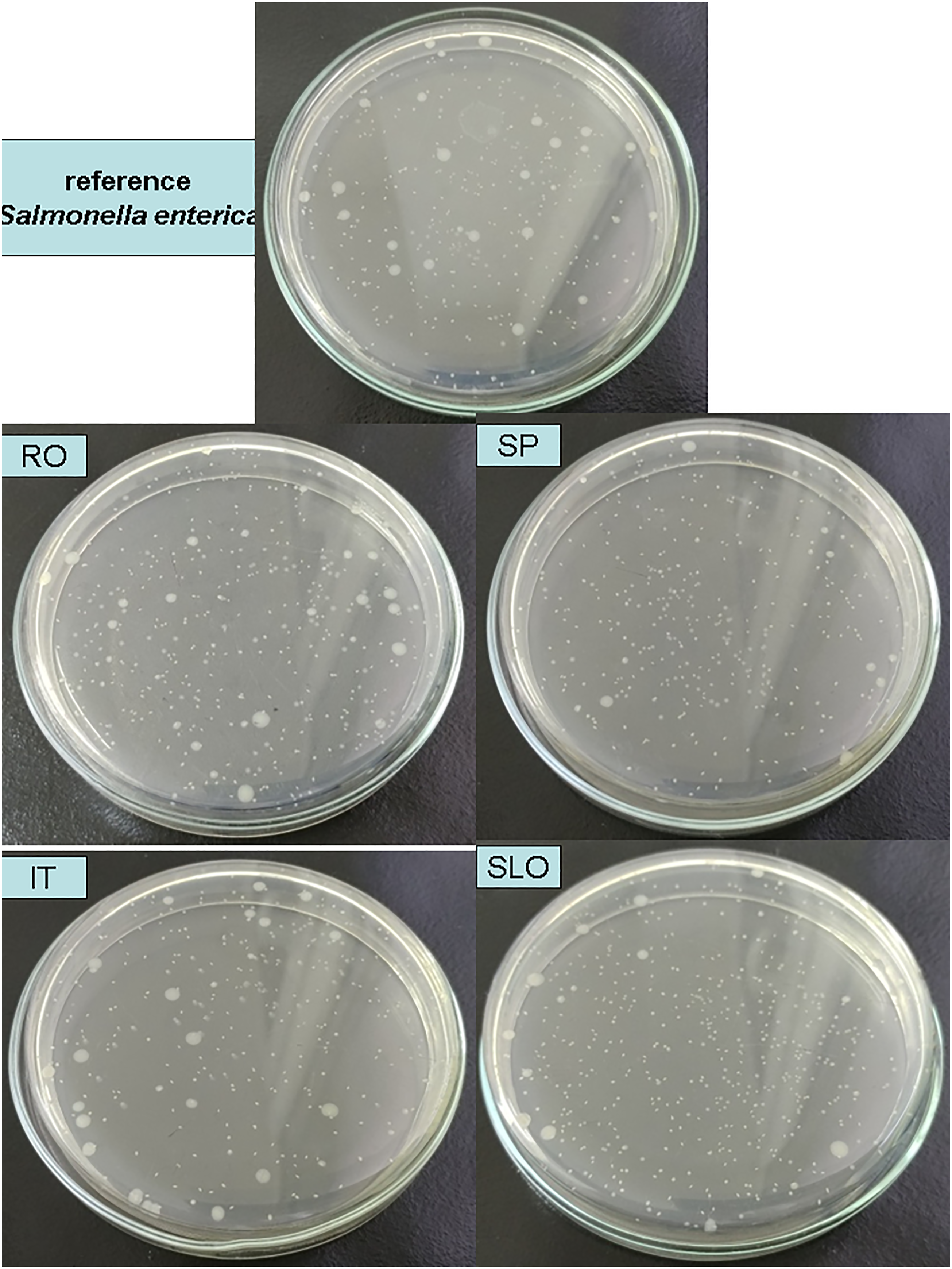
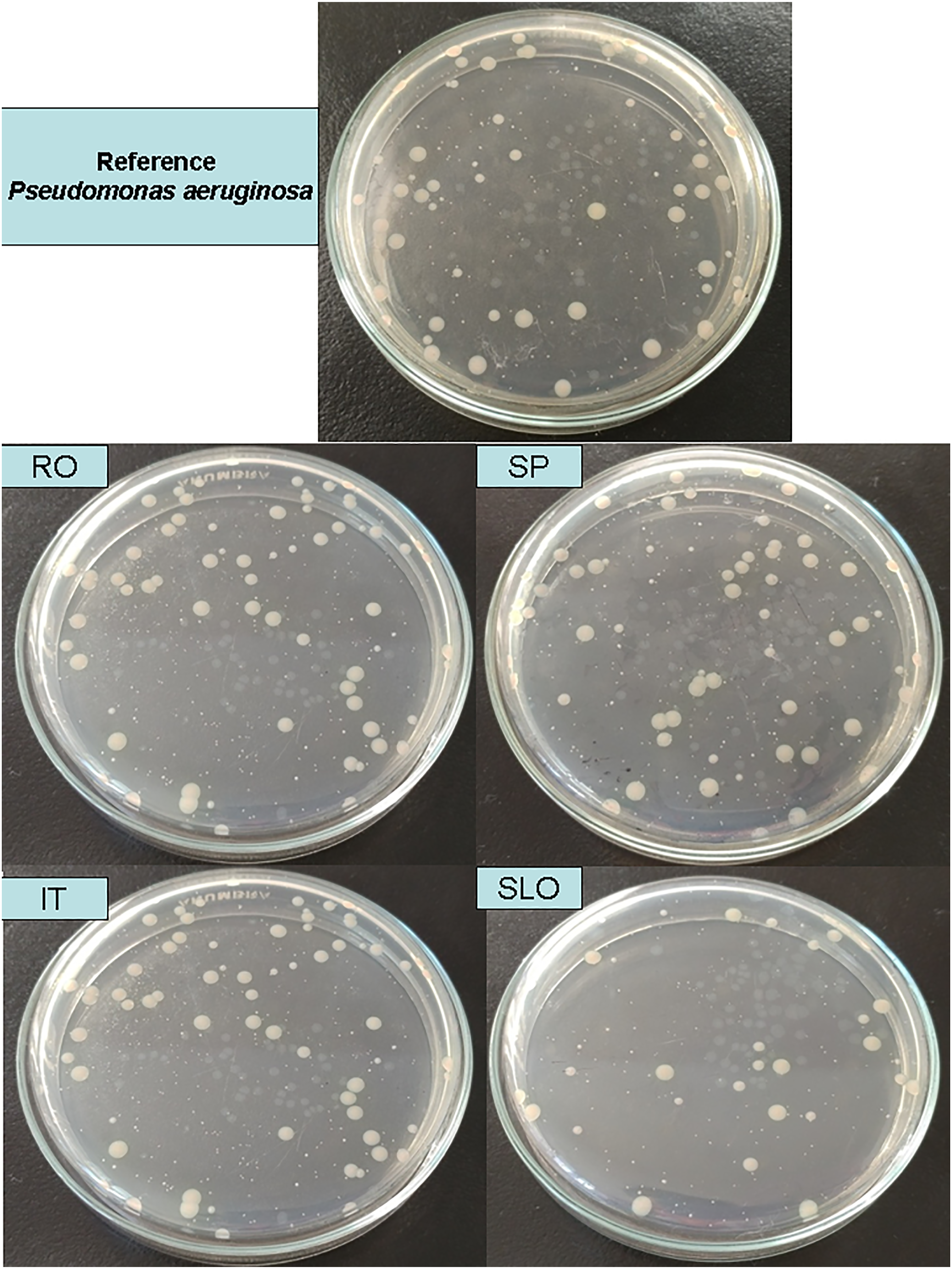
The images of the Petri dishes with the development of the used bacteria strains are illustrated in Figure 2 to 6. The growth of E. coli strains is displayed in Figure 2. It can be seen that the number of colonies developed in the presence of RO and SLO extracts is lower than that of the control plate. By analyzing the development of S. enterica (Figure 3), a higher number of colonies in Petri plate with RO, SP and SLO was observed. In contrast, the development was inhibited in the presence of IT sample. The growth of L. monocytogenes strains (Figure 4) was negatively affected by RO and SLO, while IT and SP samples showed a negative activity. All the papers have stimulated the development of P. aeruginosa bacteria (Figure 5), excepting SLO paper, that expressed an inhibitory activity. In the case of the P. fluorescens bacteria (Figure 6), RO and IT papers showed negative inhibitory activity, while SP and SLO exhibited moderate antibacterial activity. Development of E. coli in nutritional medium non-modified (reference) and modified with aqueous extract of papers. Development of Salmonella enterica in nutritional medium non-modified (reference) and modified with aqueous extract of papers. Development of Listeria monocytogenes in nutritional medium non-modified (reference) and modified with aqueous extract of papers. Development of Pseudomonas aeruginosa in nutritional medium non-modified (reference) and modified with aqueous extract of papers. Development of Pseudomonas fluorescens in nutritional medium non-modified (reference) and modified with aqueous extract of papers.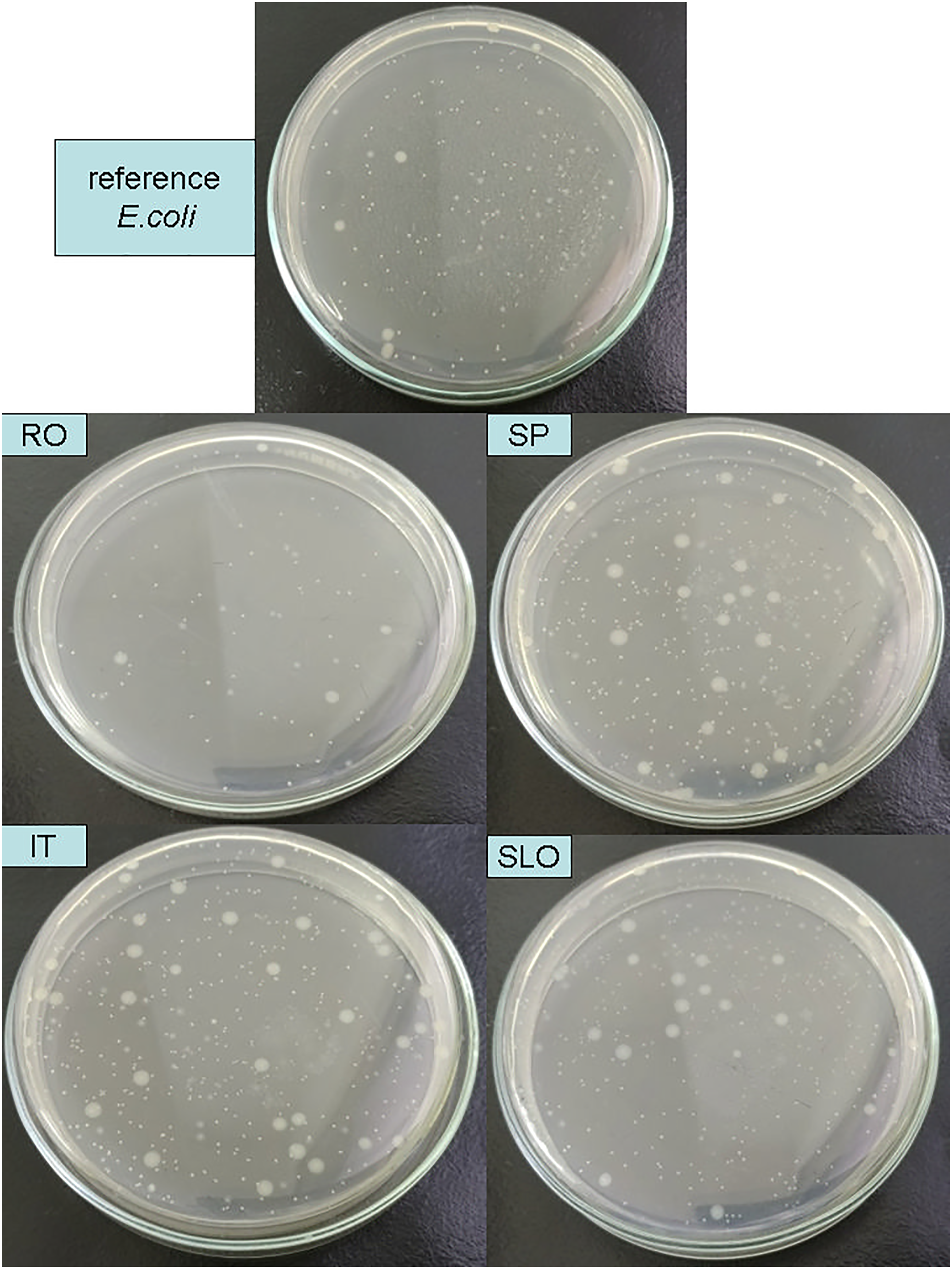


Values of inhibition index (GIB) of the papers against bacteria. Each value is the average of three replicates. The standard deviation (RSD) was lower than 5%.

All the papers were found to comply with the limit of the total number of germs. The Romanian legislation imposes a limit of 1 CFU/cm2 package. In all the papers, the CFU was <1/cm2, which proves that they can be used for food packaging. The positive values of GIB parameter showed that SLO paper is able to inactivate all types of tested bacterial strains, due to the modified starch coated on the surface. Probably, the starch treatment gave rise to compounds with a superior antimicrobial activity than PE and wax. The negative values of GIB observed for RO, SP and IT papers reveal that polyethylene coated on RO and IT surface and wax impregnated on SP paper have a lower antimicrobial activity in comparison with hydrophobized starch coated on SLO paper.
Conclusions
Four types of functionalized papers (RO, SP, IT and SLO) were investigated by determining capillary-hydroscopic, barrier and antibacterial properties, wettability and migration into food simulants. Morphological and structural investigations showed that RO and IT are polyethylene-paper structures, SP is waxed-paper and SLO is paper coated with hydrophobized starch. RO and SLO exhibit the best barrier properties against water vapors. The low solubility and higher contact angles of RO, IT and SLO in A simulant (distilled water) make them suitable for packaging food with high content of water. The extremely high solubility of SP and SLO in simulant B (acetic acid) is explained by dissolution of wax and modified starch, respectively supported on paper`s surface and shows that the coating the paper with these two agents is not recommended for the storage of the acidic foodstuffs. SLO paper is able to inactivate E. coli, S. enterica, Lysteria monocytogenes, P. aeruginosa and fluorescens. Polyethylene coated on RO and IT surface and wax impregnated on SP paper have a lower antimicrobial activity in comparison with hydrophobized starch coated on SLO paper.
Supplemental Material
Supplemental Material - Barrier properties, migration into the food simulants and antimicrobial activity of paper-based materials with functionalized surface
Supplemental Material for Barrier properties, migration into the food simulants and antimicrobial activity of paper-based materials with functionalized surface by Anca Peter, Leonard M Cozmuta, Camelia Nicula, Anca M Cozmuta, Robert Apjok, Catalina M Talasman, Goran Drazic, Antonio Peñas, Antonio J Calahorro, Franks Kamgang Nzekoue, Xiaohui Huang, Gianni Sagratini, Stefania Silvi in Polymers and Polymer Composites
Footnotes
Declaration of conflicting interests
The author(s) declared no potential conflicts of interest with respect to the research, authorship, and/or publication of this article.
Funding
The author(s) disclosed receipt of the following financial support for the research, authorship, and/or publication of this article: This work was supported by the Technical University of Cluj Napoca and Ceprohart Braila Romania (UEFISCDI contract no 72/2017), National Institute of Chemistry Ljubljana Slovenia (MIZS 4126), University of Camerino and Synbiotec Italy (MIUR) and Andaltec Spain (MINECO contract no PCIN-2017-037), in the frame of GRAFOOD project.
Author statement
Anca Peter: Conceptualization, writing-original draft preparation, Leonard Mihaly Cozmuta, Camelia Nicula, Anca Mihaly Cozmuta: methodology, data curation, Robert Apjok: methodology, Catalina Mihaela Talasman: visualization, reviewing, Goran Drazic: methodology, visualization, reviewing, Antonio Penas, Antonio Jesus Calahorro: methodology, visualization, reviewing, Franks Kamgang Nzekoue and Xiaohui Huang: methodology, software, Gianni Sagratini: visualisation, reviewing, Stefania Silvi: visualisation, reviewing.

Supplemental Material
Supplemental material for this article is available online.
References
Supplementary Material
Please find the following supplemental material available below.
For Open Access articles published under a Creative Commons License, all supplemental material carries the same license as the article it is associated with.
For non-Open Access articles published, all supplemental material carries a non-exclusive license, and permission requests for re-use of supplemental material or any part of supplemental material shall be sent directly to the copyright owner as specified in the copyright notice associated with the article.
