



Abstract
Material experts are striving to use natural resources as skin and core in composite sandwiches to achieve light weight, biodegradability, and cost benefits. This paper reports one such newly developed green composite sandwich and its biodegradable behavior. The skin and core of newly developed sandwich are flax fiber and agglomerated cork respectively. This composite sandwich is manufactured by vacuum bagging technique in order to get higher volume fraction of fiber. The biodegradability testing of the composite sandwich has been executed by soil burial test. The verification of the same has been done using Scanning Electron Microscope (SEM) images, Fourier Transform Infrared Spectroscopy (FTIR) analysis and Thermoanalytical test. The test results portray the percentage of weight loss in the specimens and that, it increases with burial time. It also depicts that the newly developed Green Composite Sandwich (GCS) has 82% higher degradation than the Synthetic Composite Sandwich (SCS) taken for the comparison. SEM images show that the green composite sandwiches have lost their fibrous structure and cell wall surface due to the degradation. FTIR and Thermoanalytical tests also confirm the biodegradability of the developed green composite sandwich.
Introduction
The expanding endeavours targeted to discover systems qualified by means of low density and higher mechanical properties has brought about the usage of sandwich technology in automobile and building applications. 1 Sandwich composite is a special type of composite, developed by inserting a high thickness, low density core in the middle of two skinny, stiff skin. The high thickness core provides better bending stiffness with minimum over all weight. 2
In recent days, the increased concern for environmental safety has a greater impact on the materials design and manufacturing of products. The vast majority of the composite sandwiches are made up of carbon or glass reinforced skin along with aluminium honeycomb or polyurethane foam core. These synthetic constituents require a greater quantity of electricity for production that produce higher amount of carbon dioxide. 3 Their non-biodegradable nature leads to very big issues in their end life disposal. With increasing ecological worry all through the world, and as an endeavor to diminish the effect brought about by synthetic materials, new alternatives are being suggested. 4 Other than the use of sandwich technology, the foremost necessity for the manufacturers nowadays are the use of natural resources for their applications. The persistent increase in pollution, carbon emission and the ozone depletion has led the material experts in all fields to experiment on utilizing the available natural green materials without compromising too much on their performance. Apart from the fact that they are eco-friendly, they have other advantages like fiber extraction with minimum energy, comparatively cheaper, degradable in nature, good sound and thermal insulation properties and acceptable specific mechanical properties. 5
In recent times, many material experts have engaged in research to study the usage of natural fibers in several applications.6–12 Flax fiber is a stem based natural fiber extracted from the flax plant and has good mechanical properties due to the crystalline structure and it has nearly equal mechanical properties as the E-glass fiber.13,14 Research to replace the synthetic core by natural core materials, along with skin reinforcement has paved the way to utilize. Cork as the core since it fulfils the requirements for properties of the core. It has an alveolar structure, with low density and remarkable mechanical and insulation properties. It is capable of taking up higher compressive loads than foam and can act as a better mechanical connector between skin and core than aluminium honeycomb structure.15,16 It is proposed that the natural flax fiber reinforcement and agglomerated cork core will help in improve the mechanical, thermal, sound absorption, vibration damping properties, and also provide environmental benefits.
Few investigations have already been conducted by using natural materials as constituents for composite sandwich. Dweib et al. developed natural fiber reinforced soy oil-based resin composite sandwich for housing applications. The outcomes revealed that the properties are in line with the preferred structural performance. 17 Hoto et al. assessed the bending strength and hydrophilic behaviour of natural composite sandwich made of flax and basalt as skin reinforcements with bio-based matrix and agglomerated cork as the core. The results portray that the green composite sandwich can be a viable alternative due to the good energy absorption during the flexural test, and minimum water absorption. 18 La Rosa et al. examined the composite sandwich made of naturally derived flax and cork material for their thermal conductivity. The test outcomes concluded that the sandwich has good insulation capacity than the conventional materials. 19 Zhang et al. inspected the sound absorption behaviour of eco-friendly sandwich made of flax and balsa wood using impedance tube tester. The result portrays that eco-friendly sandwich has good sound absorption capability due to the tortuous passage of fiber and natural honeycomb structure of the core. 1
The authors have developed a novel green composite sandwich made of flax fiber as skin reinforcement and agglomerated cork as core and tested for their mechanical properties and the results were published 20 The secondary performance criteria like vibration damping, sound absorption, thermal conductivity and flame retardant properties were also found to be good for green composite sandwich.21,22 In continuation with the work, the present study focuses on assessing the biodegradability of a green composite sandwich made of flax fiber as skin reinforcement and agglomerated cork as core material in a natural soil burial environment and verified with morphological, spectrum and thermoanalytical tests.
Experimental procedure
Constituents of composite sandwich
The materials used for preparing composite sandwich were skin reinforcement, matrix and core material. The natural skin reinforcement taken for the study is flax fiber in the bidirectional woven form (280 GSM) purchased from Lineo, France, whereas the synthetic reinforcement taken for comparison purposes is E-glass fiber and also woven in the bidirectional form (280 GSM). E-glass fiber is chosen because it is the most commonly used fiber in majority of the applications. The matrix used was LY 556 epoxy resin along with HY 951 hardener. The E-glass fiber and matrix were procured from Covai Seenu and Company, India. The core material used was agglomerated cork with a density of 340 kg/m3 from Anchor Cork Pvt. Ltd, India.
Composite sandwich preparation
Constituents and layer sequence of composite sandwiches.

aF: Flax; G: Glass; E: Epoxy; C: Agglomerated cork.
Soil burial test
Biodegradability was assessed by measuring the weight loss of the specimens buried in garden soil for a period of 100 days. Figure 1 shows the test specimens and the pot used for soil burial test. Specimen size for the test was 10 mm x 10 mm × 13 mm. Specimens were washed and vacuum dried at a temperature of 60oC for 48 h in a vacuum oven for exclusion of moisture and then their initial weights were measured. Each specimen was buried in the soil and incubated at the environmental temperature of 28 ± 3oC. Test specimens in pot for soil burial test.
Soil humidity was monitored every day using fist test and water was poured accordingly. Each specimen was exhumed from the soil after every 20 days interval up to 100 days, respectively. The specimens were then washed and vacuum dried at 60oC to remove the moistness before weight measurement. The percentage of weight loss of the specimens was calculated to recognize the biodegradable behaviour of specimens by using equation (1).
Wi = Weight of the specimen before soil burial test in grams and Wf = Weight of the specimen after soil burial test in grams
Scanning electron microscopy analysis
The morphology of composite sandwiches before and after biodegradability test were inspected by Scanning Electron Microscope (SEM, Zeiss) at room temperature, operated at 10 kV. The specimen surfaces were vacuum coated by evaporation with gold before examination and analysed at various magnification ranges between 500–2500 X.
Fourier transform infrared spectroscopy analysis
The Fourier Transform Infrared Spectroscopy (FTIR) analysis was performed in order to recognize the polymer bonds in each of the specimens before and after the biodegradability test. This helped to recognize the exact polymeric reaction experienced during the biodegradation time. The infrared spectra of the specimens before and after the degradation were found using Thermo ScientificTM NicoletTM iSTM 10 FT-IR spectrometer.
Thermoanalytical test
Thermoanalytical test of composite sandwiches was executed by thermogravimetric analysis (TGA) and Differential scanning calorimetry (DSC). TGA measures the mass degradation over time as the temperature changes whereas, DSC helps to identify the amount of heat required to increase the temperature of the specimen. Both the tests were conducted only for the GCS specimen in order to validate the soil burial test results. TGA and DSC were performed by a thermal analyzer (NETZSCH STA 449 F3 Jupiter). Specimens of 3–4 mg were tested within the temperature range of 30°C–600°C and the heating rate was 20°C/min.
Results and discussion
Measure of biodegradability using soil burial test
Figure 2 shows the percentage of weight loss over a duration of 100 days for different specimens. The degradation effect on the specimens due to soil burial test resulted in considerable weight loss except for SCS specimen and it is measured at an interval of 20 days. The test results portray that the highest percentage of weight loss has occurred in green composite sandwich (GCS) specimen and is about 11.46% at the end of 100 days. This is due to the presence of cellulose, hemicellulose and lignin in the flax fibre skin and agglomerated cork were material of the GCS specimen. These constituents are easily affected by the bacteria and fungi present in the soil environment, pertaining to the highest degradation of GCS specimen. In hybrid composite sandwich (HCS) specimen, the weight loss is 10.28% because of the presence of flax fibre, agglomerated cork along with synthetic based non-biodegradable glass fibre. In synthetic composite sandwich (SCS) specimen, the weight loss is only 6.31%, due to the existence of agglomerated cork as the only element that can be degraded. In SCS specimen, epoxy and glass fibre have greater resistance to degradation that results in the minimum percentage of weight loss. Percentage of weight loss during soil burial test.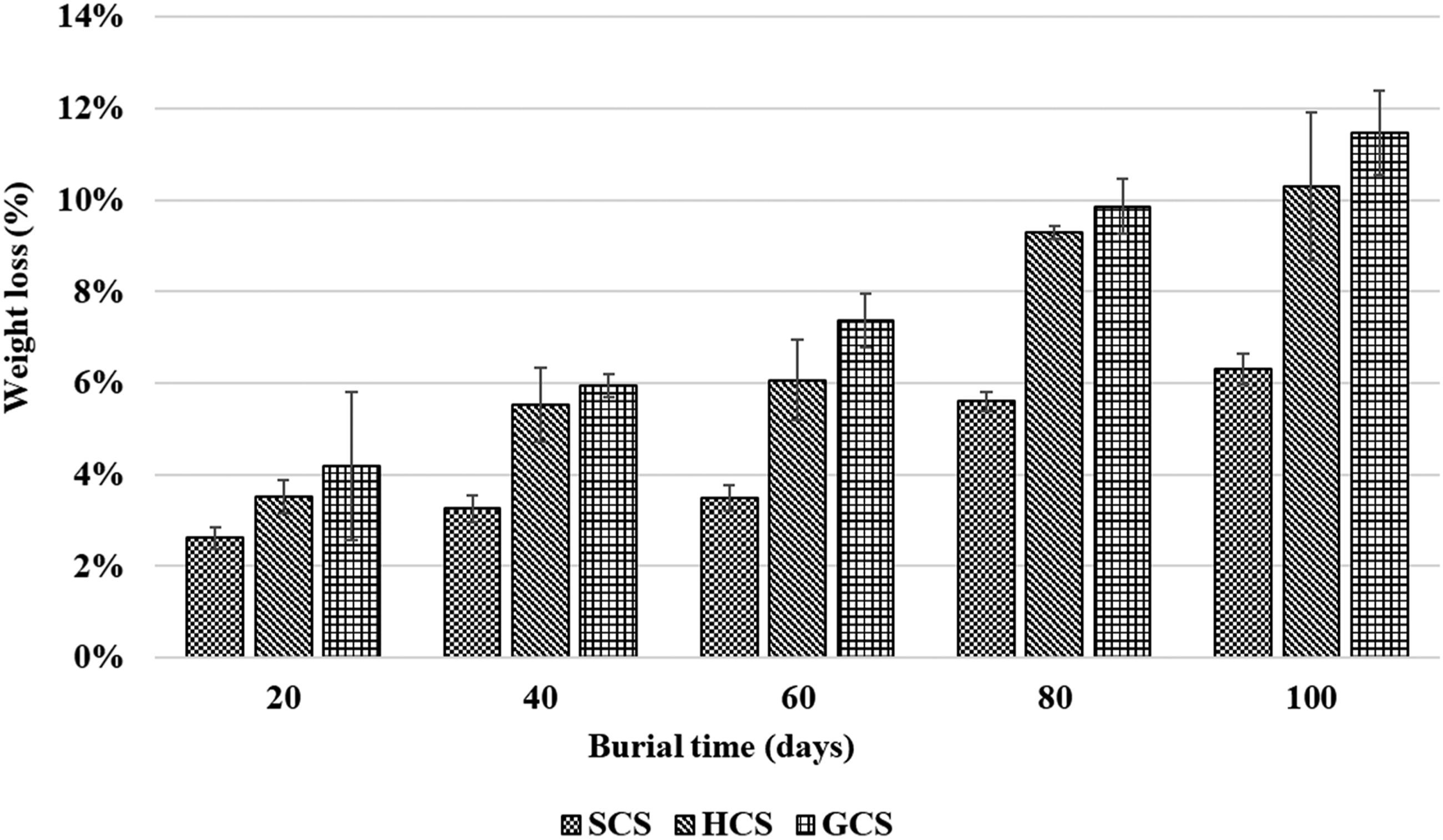
The test results undoubtedly show that GCS has 82% higher weight loss than SCS and is 11% higher than HCS. These results help to understand the biodegradable nature of green composite sandwich.
Morphological analysis
Surface morphology of the different composite sandwiches revealed a substantial degradation observed by the loss of fibrous nature in skin reinforcement, fibre debonding, and change in surface structure of cork core. Figure 3 illustrates the SEM images of different composite sandwich specimens before and after degradation. In all the specimens, before the biodegradation, the constitutents of the sandwich are clear and sharp fibrous and cell wall texture. Whereas after degradation, there are lot of holes and losses their surface sharpness in fiber and cork cell wall. SEM images of different specimens before and after degradation.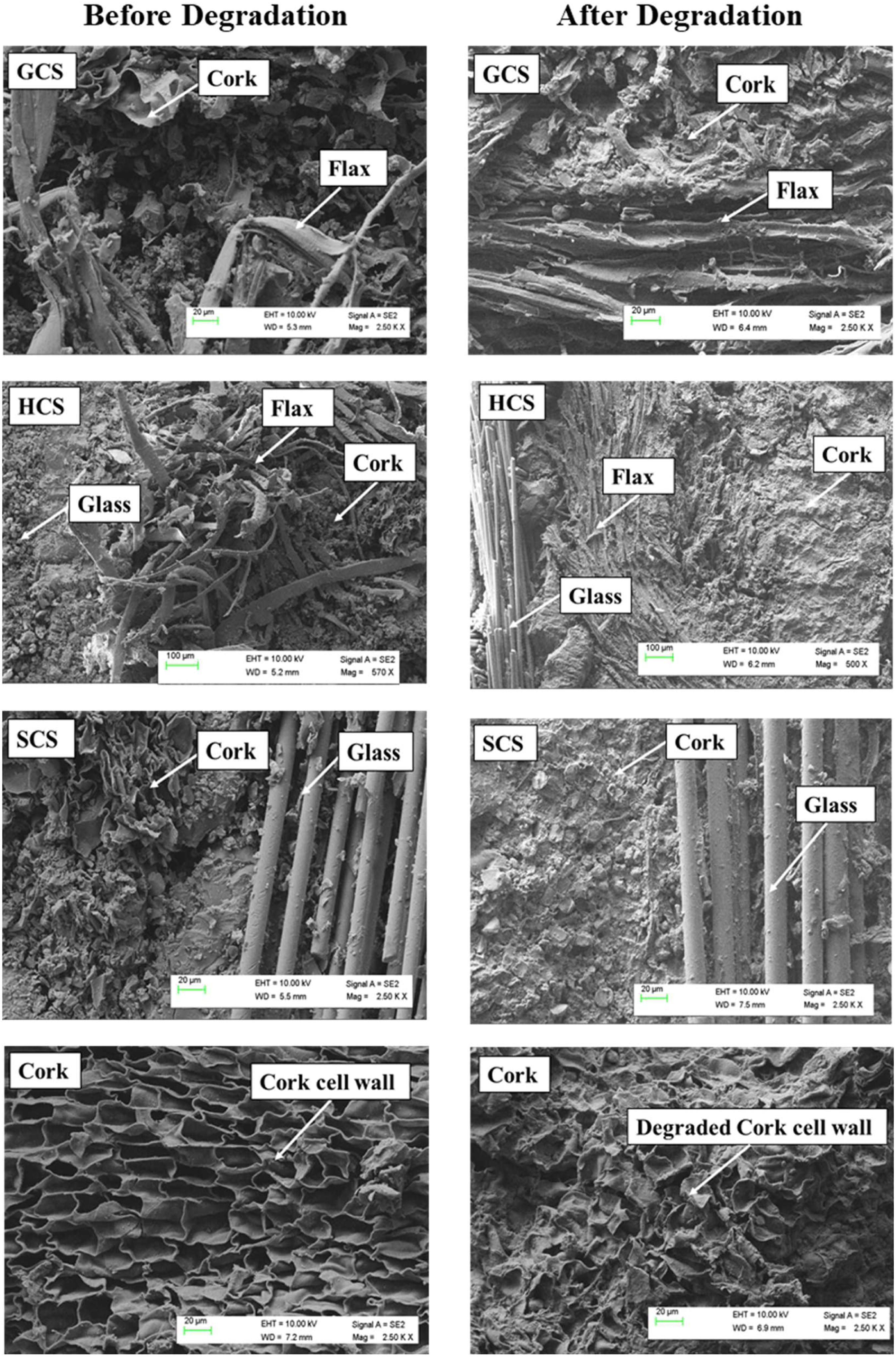
In GCS specimen, the flax fiber surfaces are eroded and the cork cell wall losses their sharphness due to the degradation by microorganisms. This made the GCS has highest degradation among the other specimens. Agglomerated cork core degrades faster than other constituents in composite sandwich due to the presence of liginin, suberin, and polysaccharides which are effortlessly degraded by living organisms and this owing to the loss of cell wall surface structure. In SCS specimen, only the cork core losses its cell wall texture due to the degradation, whereas the glass fiber is not affected by the microorganisms. Whereas in HCS specimen, both flax fibre and cork core are eroded by the bacteria and fungi present in the soil and the glass fibre seems to be intact and not affected by them. These morphological observations support and confirm the soil burial test results.
Fourier transform infrared spectroscopy Analysis
The biodegradability of composite sandwich can be confirmed using FTIR spectroscopy. The sign of degradation can be identified from the changes in the peak intensity, the corresponding presence and absence of peaks relative to bending and stretching of chemical groups. In this analysis, the infrared absorption spectra were recorded from 4000 cm-1 to 400 cm-1. Infrared spectra of GCS, SCS, and HCS composite sandwich specimens were examined before and after degradation. The sharp peaks 1507-1509 cm-1, 2340 cm-1, and 2361 cm-1 which are characteristics of epoxy resin were distinctly visible in spectra of all specimens with no substantial change observed in peak intensity after degradation. This shows the non-degradable nature of epoxy resin. Extensive peak in the range of 3200–3700 cm-1 corresponding to the stretching vibration of free and bonded hydrogen OH (Hydroxyl) groups, with a substantial increase in peak intensity after degradation was witnessed. The constituents of flax fibre contain cellulose, hemicelluloses and lignin which offers to the hydroxyl groups 14 The core of the composite sandwich made of agglomerated cork which is also composed of cellulose contributing to the hydroxyl groups.
Figure 4(a) shows the change in the peak intensity of GCS at 2800 cm -1 and 2950 cm -1 attributes to the alkane C-H stretching vibration that confirms degradation of the flax fibres. Presence of few peaks at 1300-1500 cm-1, 1238 cm-1, and 1100-1200 cm-1 corresponding to alkane (C-H) bending, amine (C-H) stretching and C-O stretching vibration indicate the degradation of the composite sandwich. A high intensity peak at 1750 cm-1 indicates the degradation of agglomerated cork due to the carbonyl (C=O) stretching vibration. Infrared spectra of a) green composite sandwich b) Synthetic composite sandwich c) Hybrid composite sandwich.
Figure 4(b) and (c) shows the infrared spectra of SCS and HCS, where the change in intensity of OH stretching vibrations is observed to be insignificant compared to GCS spectra. From the Figure 4(b), the absence of peaks (1630-1750 cm-1) and presence of peaks (1250 cm-1, 1102 cm-1) specify the degradation of agglomerated cork in SCS composite sandwich owing to the C-H bending and stretching vibrations. In SCS specimen, there is no noticeable changes in the spectra before and after degradation except from the cork, thus confirming the non-biodegradable nature of SCS. In Figure 4(C), similar peaks are observed for HCS specimen but noteworthy change in intensity was not observed. This may be due to compact manufacturing of the composite sandwich leading to unreachability for degradation by the living organisms in the soil.
Thermal Analysis
The thermal analysis is conducted for the GCS specimen for confirmation of biodegradability by measuring the residual mass of specimens which have undergone soil burial test and which have not. Figure 5 shows the combined TGA and DSC curve of GCS specimen before and after the biodegradability test. From the TGA curve, it is understood that the loss in mass is directly proportional to the temperature. Combined TGA and DSC curve of the green composite sandwich.
The TGA curve clearly depicts that the thermal degradation of flax fibre occurs in three stages, initial transition (25°C–240°C), quick decomposition (240°C–450°C) and final decomposition (above 450°C). In the initial stage, decomposition occurs due to the release of free water. Largest weight loss occurs in second stage, due to the decomposition of cellulose and hemi-cellulose. In the final stage, decomposition occurs at a slower rate owing to the weight loss. 23 The residual mass at 597°C of the GCS composite before and after degradation was 14.65% and 17.67% respectively. The GCS specimen which has undergone degradation has higher residual mass, as the cellulose has decomposed during the soil burial test itself. The GCS specimen which has not undergone the test has high cellulose and hemicellulose content and degrades more during the thermal analysis and only a minimum amount of residual mass is left behind after the test. The DSC curve for the GCS specimen which has undergone soil burial test indicates a higher heat requirement of 21.23 μv/mg to raise the temperature due to the absence of cellulose and hemicellulose rate, whereas the GCS before degradation specimen has only 15.03 μv/mg. Hence, the thermoanalytical test results also confirms the soil burial test results indicating that GCS specimen has biodegradable nature.
Conclusions
In this paper, the biodegradability of flax fibre reinforced green composite sandwich was assessed with that of glass fibre reinforced synthetic composite sandwich using soil burial test, and the degradability of the samples were also verified by using SEM, FTIR and Thermogravimetry test. A significant weight reduction was observed in green composite sandwich subjected to soil-burial test. The results revealed that GCS has 82% higher weight loss than SCS specimens. SEM analysis also adds evidence to the soil burial test that the flax fibre and cork core have lost their fibrous structure and cell wall texture in GCS due to the attack of microorganisms. But in the SCS, only cork core has lost its structure, whereas glass fibre is still intact and has not been affected by the microorganisms. FTIR analysis clearly indicates the changes in the peak intensity of GCS, which indicates the degradation. But for SCS, a change in intensity of OH stretching vibrations was observed, which is insignificant. In addition to that, TGA and DSC graphs also confirm the degradation of GCS specimen. These results suggest that the flax fibre reinforced, agglomerated cork core composite sandwich is a biodegradable composite sandwich, which can be considered as a viable alternative to reduce the environmental problems associated with waste accumulation.
Footnotes
Declaration of conflicting interests
The author(s) declared no potential conflicts of interest with respect to the research, authorship, and/or publication of this article.
Funding
The author(s) received no financial support for the research, authorship, and/or publication of this article.
