



Abstract
The effect of oil palm trunk (OPT) natural fibers used as reinforcement in High density polyethylene on the mechanical, biodegradation and water absorption properties of polyethylene films were investigated. The composites were formulated and prepared using twin-screw extruder while the hot compression molding machine was used to prepare the bio-films. The results showed that the incorporation of OPT fiber into the film enhanced the tensile modulus of the matrix while the tensile strength and elasticity reduced. The Young’s modulus of the composites reached 4450 MPa at 20% OPT fiber load while tensile strength and elongation at break reached its lowest at 7.11 MPa and 2.13% respectively at the same fiber load. Water absorption and biodegradability of the composites improved when OPT fibers were added. The composite film with 20% fiber load showed the highest fungal growth.
Introduction
Researches have shown that the incorporation of natural fibers into engineering polymers reduces their environmental effect by enhancing the overall biodegradation properties of the polymers. Degradable natural resources such as starch and natural fibers can be used to produce eco-friendly packaging materials.1–4 In addition, using these natural fibers reduces the total cost of products because of the low price of natural fibers in contrast to petroleum-based fibers. However, using natural fibers to produce polymer composites or to reinforce the polymer matrices might affect the processing temperatures and the hydrophilic nature of the final product.5–8
Palm oil processing produces a variety of natural waste such as empty fruit bunch, mesocarp and trunk fibers. These waste are available in large quantity and are considered as free sources of cellulosic based raw materials for the industry. The inherent biodegradation properties of these waste can be transferred to the plastic films of High-density polyethylene (HDPE) after compounding. Oil palm fibers can be derived from the oil palm empty fruit bunch (OPEFB) and the mesocarp. OPEFB is most commonly used for composite materials and other applications as indicated in the literature.9,10 In addition, there are other waste produced from the oil palm tree such as oil palm frond (OPF) and oil palm trunk (OPT). Researchers have tried to use OPF for papermaking and as animal feedstock; while the soft part of the inner trunk of OPT is currently used as layering coating for plywood and as cereal.11,12 The chemical composition of oil palm trunk is 41.2% cellulose, 31.4% hemicelluloses, 17.1% lignin, 3.4% ash, 0.5% extractives, and 2.3% soluble ethanol. The lignin content in OPT fiber makes it possible for it to be used as fillers in hydrophobic polymer matrices such as HDPE. 13
HDPE has been used in a number of industrial applications due to its low cost, good mechanical properties and ease of processing.14,15 The poor natural biodegradation of HDPE is considered a disadvantage when it is used as a packaging material due to the environmental concern.
The purpose of using OPT fiber to produce the bio-film is to reduce cost and enhance the natural biodegradation properties of the HDPE, and consequently producing eco-friendly materials for packaging applications. The addition of natural fibers such as OPT to petroleum-based polymer may be the solution to improve biodegradation and reduce the overall cost of final products.11,16,17
Experimental
Materials
High-density polyethylene (HDPE) resin was used as the matrix. It was supplied by Titan Petchem Malaysia. The density of HDPE was 0.96 g cm−3 and melting temperature (Tm) range from 130oC to 137oC. Oil palm trunk was supplied by Labu palm oil mill, Malaysia. Maleic anhydride (MA) was supplied by Shenzhen Jindaquan Technology Company. It was used as the compatibilizer. Glycerol was supplied by Hangsun Plastic Additives Company, Ltd. It was used as the plasticizer.
Preparation of bio-composite film
Formulation of HDPE/OPT bio-composite films.

Sample testing
Melt flow index
The melt flow index test was used to analyze the melt flow behavior of the composites. The test was conducted according to ASTM D1238 using an extrusion plastometer model of S. A. Associates. The mass of extruded material was determined and the results were expressed in g/10 min.
Mechanical properties
The tensile strength, elastic modulus and elongation at break of the samples were determined using Instron 4411 universal testing machine under ambient conditions. The test was conducted according to ASTM D882. The gauge length was set at an average of 100 mm at a crosshead speed of 50 mm/min. Five specimens were tested for each formulation and the average value was reported.
Biodegradation
Biodegradation of the films were determined according to ASTM G21. It was used to evaluate the resistance of polymeric materials to fungi. Samples of 40x20 mm dimensions were tested using petri dishes containing sterile nutrient salts agar. The petri dish cover was sealed with wax to avoid any kind of contamination. The samples were incubated at 27–37°C for 12 days after which they were examined for evidence of colony growth. The fungal species were tested with Aspergillus niger ATCC 9642. The degraded samples were reweighed to determine the weight loss.
Water absorption
The water absorption test was conducted to determine the water resistance of HDPE/OPT films. The test was conducted according to ASTM D570-98. Test specimens (with 5wt.% to 20wt.% OPT fibre loading) measuring 30 × 5 × 3 mm in dimensions were dried at 40oC in a vacuum oven until they attain a constant dry weight. The specimens were then immersed in distilled water at room temperature for 72 hours. After 72 hours, the samples were withdrawn from the water, wiped with tissue paper and then weighed. The weight gain after 72 h was recorded. The weight gain by each sample was recorded and the percentage weight gain, Mt was determined using equation (1).
Morphological studies
The morphology of HDPE and HDPE/OPT films was studied using the Scanning electron microscope (Hitachi Scanning Electron Microscope Flex SEM 1000 model) at 500X magnification.
Differential scanning calorimetry
The melting and crystallization behavior of the blends were studied using Perkin-Elmer differential scanning calorimetry after calibrating the temperature with Indium. 5–8 mg of each sample was sealed in aluminium pan and used for the DSC measurement. Temperature was raised from 25 to 200oC at a heating rate of 10oC/min.
Results and discussion
Melt flow index
Melt flow index of HDPE/OPT composite films.

Tensile properties
Tensile properties such as tensile modulus, tensile strength and elongation at break of the composites are shown in Figure 1. The Young’s Modulus (YM) of the HDPE matrix significantly increased after the incorporation of 20wt.% of OPT fibers. At 5 to 10wt.% of OPT fiber load, a small improvement in the YM was obtained. The tensile strength and percentage elongation were greatly reduced after the addition of OPT fibers (Figure 1(a) and (b)). There was a steady decline in tensile strength from 14 MPa at 5% of OPT load to 6 MPa at 20% OPT load. This steady decrease can be attributed to the poor interaction between HDPE and OPT as shown in section of morphological study. Also, the difference in their hydrophilicity is a factor that can influence the tensile strength negatively. OPT is a natural fiber with good affinity for moisture while HDPE is hydrophobic. For the OPT and HDPE to interact well, certain treatments has to be done on OPT. Other researchers have also made similar observations and suggested that to improve the interaction of natural fibers with polymer matrices, some surface treatment of the fibers has to be done.10,18,20 Tensile properties of bio-composite films at different percentage of OPT fibre.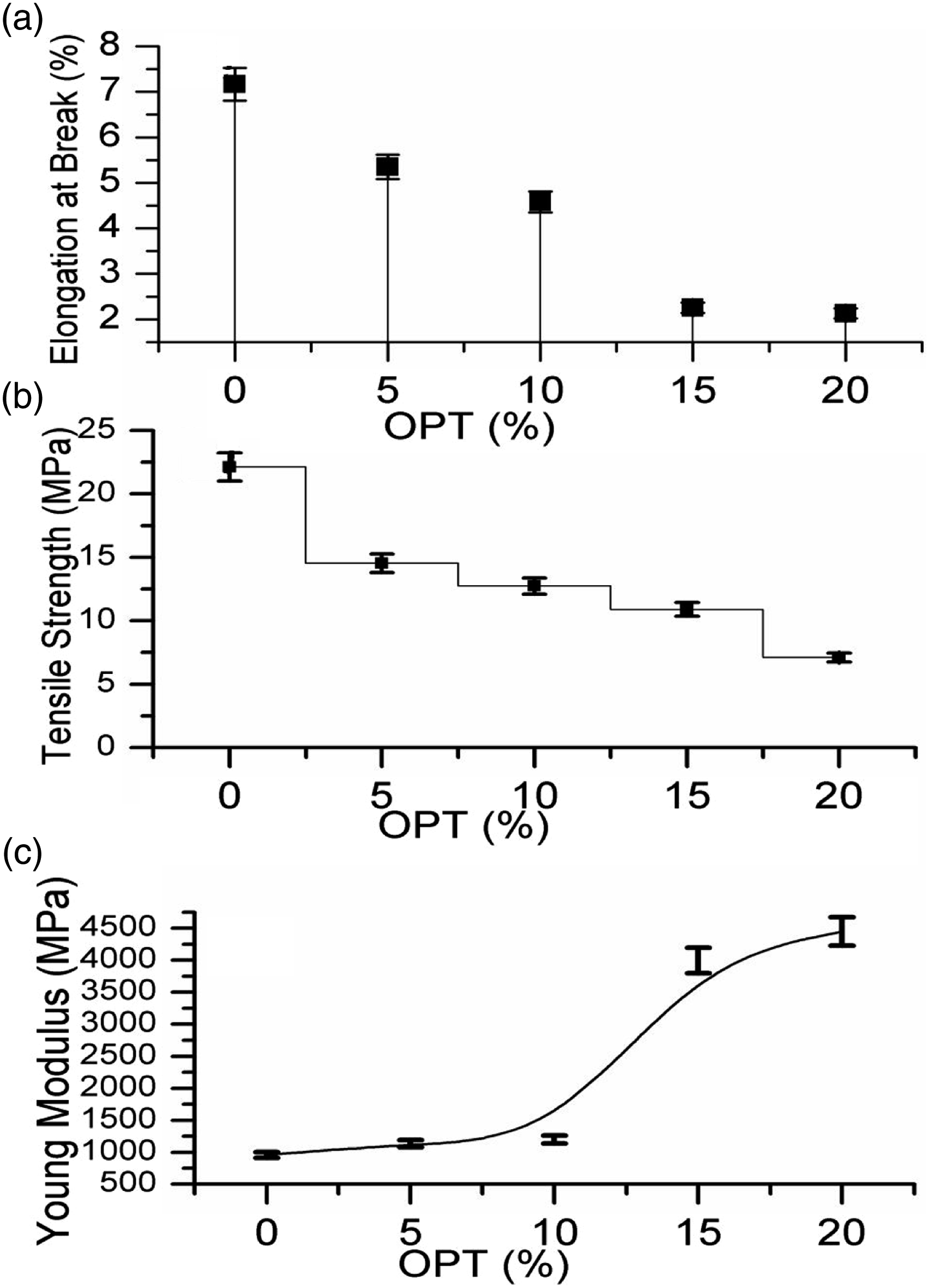
The highest percentage elongation at break of 7.16% was reported for the virgin HDPE. At 20% OPT fiber loading, the percentage elongation at break was 2.13%. The declined in elongation at break of the composite film is because of increase in brittleness of the composite film. As fibers are added, the viscoelastic behavior of the HDPE move towards elastic behavior. The findings of tensile strength seemed to be contradicted with most of reported literature as they indicated the stiffness and tensile strength are improved after the incorporation of reinforcement to the matrix.21–24 This can be interpreted that OPT fibers are not well integrated with the matrix of HDPE due to different hydrophilicity. OPT is a natural fiber with good affinity to moisture due to the nature of hydrophilic properties, while the matrix is hydrophobic synthetic based polymers. To enhance the surface adhesion between OPT fiber and HDPE matrix, the wettability OPT with HDPE matrix should be improved using surface treatment for OPT fiber or kind of additives need to be involved in the composite.
Biodegradation study
Percentage weight loss of the films at different OPT fiber loading.

After 12 days of incubation, the biodegraded composite films loss some weights. The percentage loss in weight as shown in Table 3 increased with increase in OPT fiber loading. The pure HDPE matrix film had the lowest weight loss while the film with 20% OPT fiber loading had the highest. This was attributed to the cellulosic nature of the OPT fibers. Figure 2 below shows the fungal growth on the various plates after 1 day and 12 days of incubation. The largest fungal colonies were obtained with the composite film loaded with 20% fibers. Other researchers have also submitted that the incorporation of natural fiber improved the biodegradation of polymer matrix composites.25–29 Fungi growth on the films after 1 day and 12 days of incubation, (a) film without OPT, (b) film with 5% OPT, (c) film with 10% OPT, (d) film with 15% OPT, and (e) film with 20% OPT.
Water absorption study
The percentage of water absorption of the films with different OPT fibre loading.

Morphological study
Scanning Electron Microscopy (SEM) was conducted on the composite films to investigate the interaction between OPT fiber and HDPE matrix. The SEM images in Figure 3 show the HDPE film without OPT fiber to be smooth in contrast to the composite films OPT fibers. The sample with 20% fiber loading has the highest surface texture roughness. This indicates low interaction between the matrix and the fibers as such reduction adhesion, interfacial tension and tensile strength of the composites. Scanning electron microscopy of the bio-composite films at magnification of 500 X, (a) film without OPT, (b) film with 5% OPT, (c) film with 10% OPT, (d) film with 15% OPT, and (e) film with 20% OPT.
Differential scanning calorimetry (DSC)
The DSC thermogram is used to analyze the melting temperature (Tm) of the composite film at different OPT fiber loading as illustrated in Figure 4. The onset Tm value for composite with 20% fiber load is 120.89°C while the peak Tm value for the same sample is 128.67°C. For the 15% OPT fiber load, the onset Tm was 120.65°C and reached its peak at 128.33°C. The film with 10% OPT fiber has onset Tm value of 120.79°C and Tm peak value of 128.00°C. The Tm values of all samples increased due to the infusion of OPT fiber into the matrix which lead to enhancement of percentage crystallinity of the composite. This has also been reported.
32
Differential scanning calorimetry curves for bio-composite films at 5, 10, 15, and 20% of OPT fiber.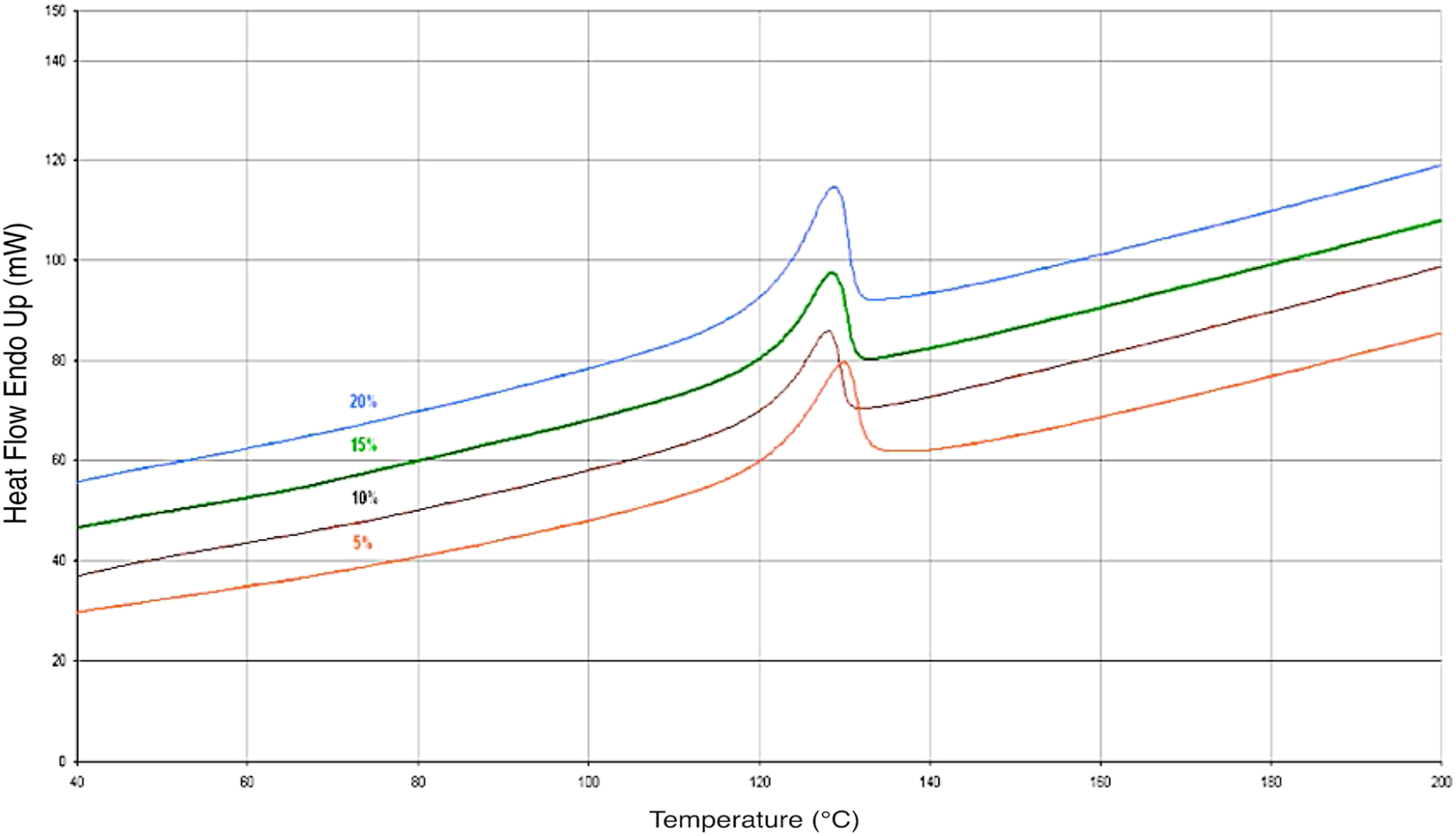
Conclusion
The addition of OPT fiber into HDPE films has significant effects on the polymer matrix properties. The fiber addition increased the melt viscosity of the matrix and consequently reduced the MFI and limits the fiber volume fraction for process able composites. The OPT fibers increased the tensile modulus while tensile strength and elongation at break of the composite films reduced. The incorporation of OPT fiber into the matrix enhanced the melting temperature of the composites. The water absorption of the composites was found to increase as OPT fibers load increased. This indicates that the composites will not good for use as packaging materials. The increase in biodegradability of the composite films is an indication that they will be Eco friendly.
Footnotes
Declaration of conflicting interests
The author(s) declared no potential conflicts of interest with respect to the research, authorship, and/or publication of this article.
Funding
The author(s) received no financial support for the research, authorship, and/or publication of this article.
