



Abstract
This systematic literature review aims to study the thermal properties (TP) of poly(acrylic acid)-based hydrogels (PAA) by differential scanning calorimetry. The data sources were obtained from Google Scholar via Publish or Perish software from 2018 to 2020. The synthesis results show that most of the analysis of TP in PAA-based hydrogel consists of glass transition temperature (
Keywords
Introduction
Wichterle and Lím introduced hydrogel in 1960. A network is formed from cross-linked hydrophilic polymers. They can take up water extensively without ripping their structure.1–3 The potential application of hydrogel materials is not only seen from their ability to absorb moisture. However, the hydrogel performance can be tested when absorbing aqueous solutions such as urea solution, metal salt solution, or metal ion solution to determine their potential application as diapers, 4 fertilizer medium, 5 water treatment, 6 wound dressing-healing, 7 contact lenses, 8 and drug delivery. 9
Over the years, hydrogels from synthetic polymers have become more interesting with their superior properties. They have an excellent water absorption capacity, long life duration, and enhanced mechanical properties functionalized with their structure.2,10 One of the synthetic polymers often used for hydrogel synthesis is poly(acrylic acid) (PAA).11–18 PAA is made from acrylic acid monomer (Figure 1.) and cross-linked to produce hydrogels. It is an interesting class because it can produce more water adsorption by swelling.19,20 Moreover, PAA-based hydrogels have good properties such as biodegradability, excellent mechanical and adhesion strength but have no good thermal properties (TPs). Thus, various materials need to build hydrogel composites that blend for better TP.
21
It can be applied in a wide range of application areas.22–27 Chemical structure of acrylic acid (source: https://pubchem.ncbi.nlm.nih.gov/compound/Acrylic-acid).
To date, TP is the main indicator widely used in the characterization of polymeric materials.
28
It is usually analyzed by differential scanning calorimetry (DSC) to determine the TP, namely,
SLR is a good recommendation for a specific review in a scientific investigation. It uses systematic and explicit methods to identify, select, extract, and synthesize the available scientific information from the studies.32–34 This method successfully leads to evidence-based conclusions that are more objective and organized in many fields, such as medical, business, and energy.35–39 In this work, the SLR is conducted to study the TP from several parameters such as
Methodology
Protocol
The present systematic review was conducted based on the Preferred Reporting Items for Systematic Reviews and Meta-Analyses (PRISMA) method. It consists of well-defined review stages, developed and described eligibility criteria of an information source, literature search strategy, literature selection process, and data synthesis based on selected literature.32,37 We used these steps as a review strategy in finding the significance of TP in PAA-based hydrogels. Therefore, this systematic approach includes identified and discussed TP from PAA-based hydrogels through their parameters referring to DSC results.
Eligibility criteria
The eligibility criteria consist of inclusion and exclusion criteria. In this present SLR, the inclusion criteria were: (1) articles that reported TP of PAA-based hydrogels; (2) published articles in 2018 until 2020; (3) articles that have comprehensive related information about TP. Besides, the exclusion criteria were: (1) articles without citation; (2) review articles types; (3) books and book chapters; (4) patents; (5) articles published in a language other than English; and (6) articles about PAA-based hydrogels without thermal analysis.
Search strategy and selection process
The database searches were carried out using PoP software with Google Scholar data sources to obtain information in articles published in 2018–2020. The search technique of PoP used the Boolean algorithm as keywords format to search the meta-data. The keywords format is “poly acrylic acid” AND “differential scanning calorimetry” AND “thermal properties” AND hydrogel. We obtained n = 719 meta-data and collected with the Mendeley Version 1.19.4 software to management and selection process as explained in Figure 2 based on eligibility criteria. Finally, 26 articles were selected and presented in Table 1. Flow diagram of study selection. Specific characteristics of articles selected by preferred reporting items for systematic reviews and meta-analyses method. PAA: poly(acrylic acid); PCL: poly(caprolactone).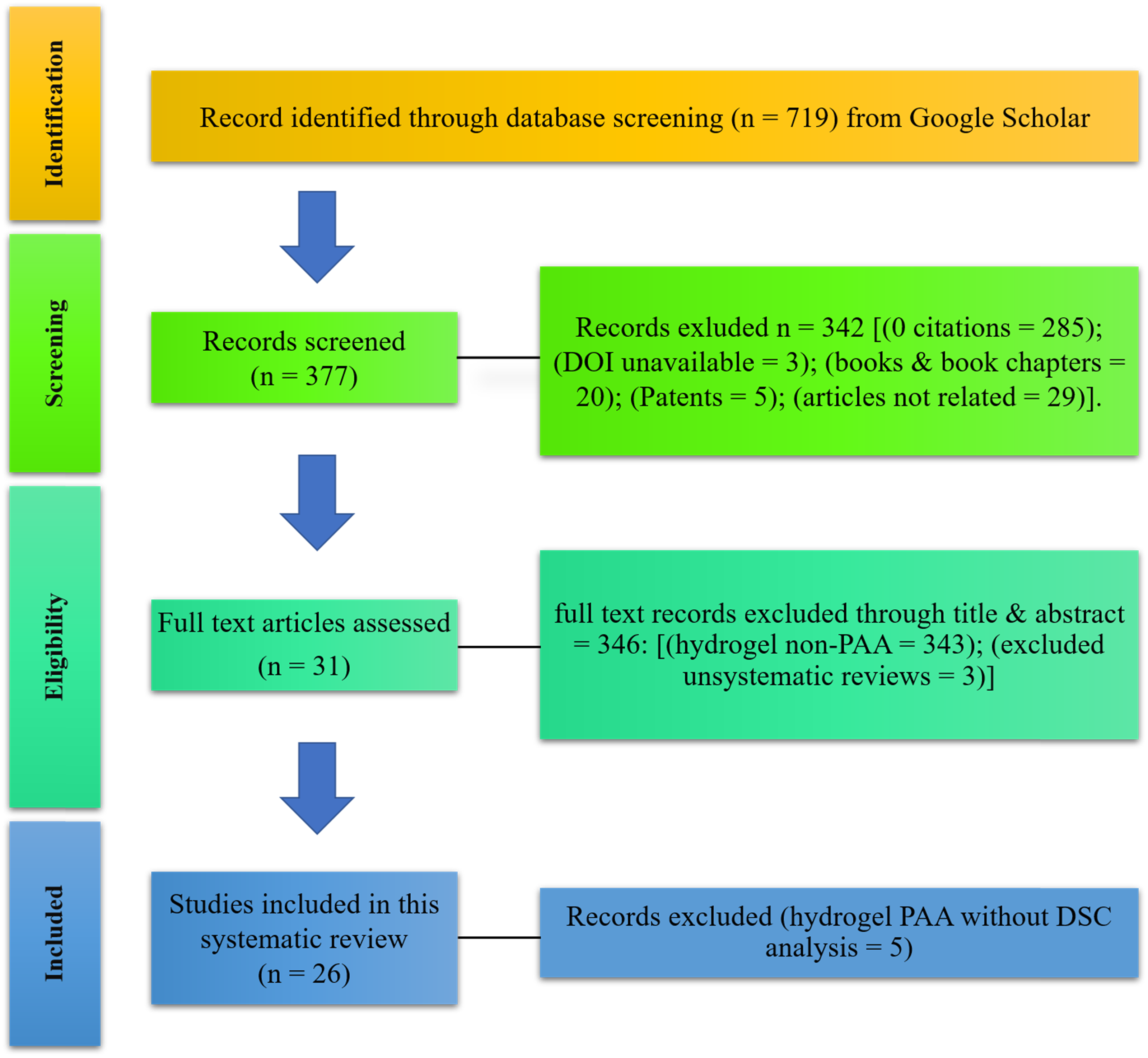

Synthesis of result
The synthesis of the results focused on discussing the empirical trends. The data is presented without meta-analysis because it lacks sufficient statistical information. In addition, the search process resulted in some variation data types such as patents, books, and websites. Therefore, it does not support to conducted meta-analysis.
Results and discussion
The 719 reports appropriated the objective or initial inquiry, as shown in Figure 2. This number reduces to the 377 reports after the elimination of the 0 citation works in PoP software. Furthermore, the article elimination via Mendeley software reduced the number of articles to the remaining 31 articles based on exclusion criteria. However, 5 of 31 selected articles are doubtful, and the review team excluded the six works in the author’s discussion. The doubtful works were conducted by Su et al., 64 Kertsomboon and chirachanchai, 65 Yang et al., 66 Kozyra et al., 67 and Wei et al. 68 Eventually, 26 articles were included in the present SLR.
analysis
Identification of 
T
g
, Correlation between w and 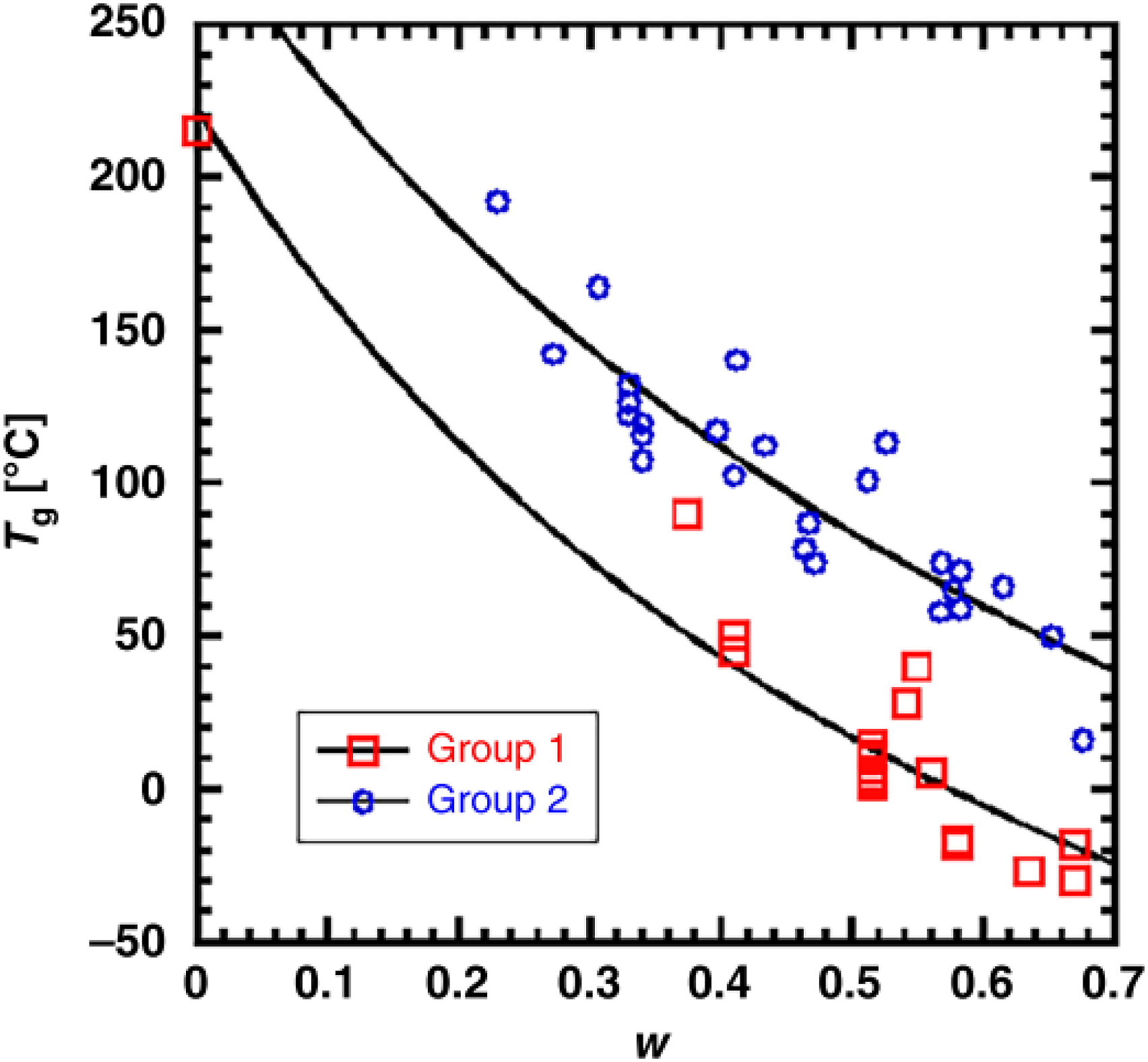
In addition, the increase or decrease of
Interestingly, we obtained another model to demonstrate the dynamics of Differential scanning calorimetryspectra of poly(acrylic acid) bulk at different heating rates.
44
Permission is granted subject to an appropriate acknowledgement given to David De la Garza, Francisco De Santiago, Luis Materon, et al., Fabrication and characterization of centrifugally spun poly(acrylic acid) nanofibers, Copyright 2011 John Wiley and Sons. The derivative of the DSC scan (
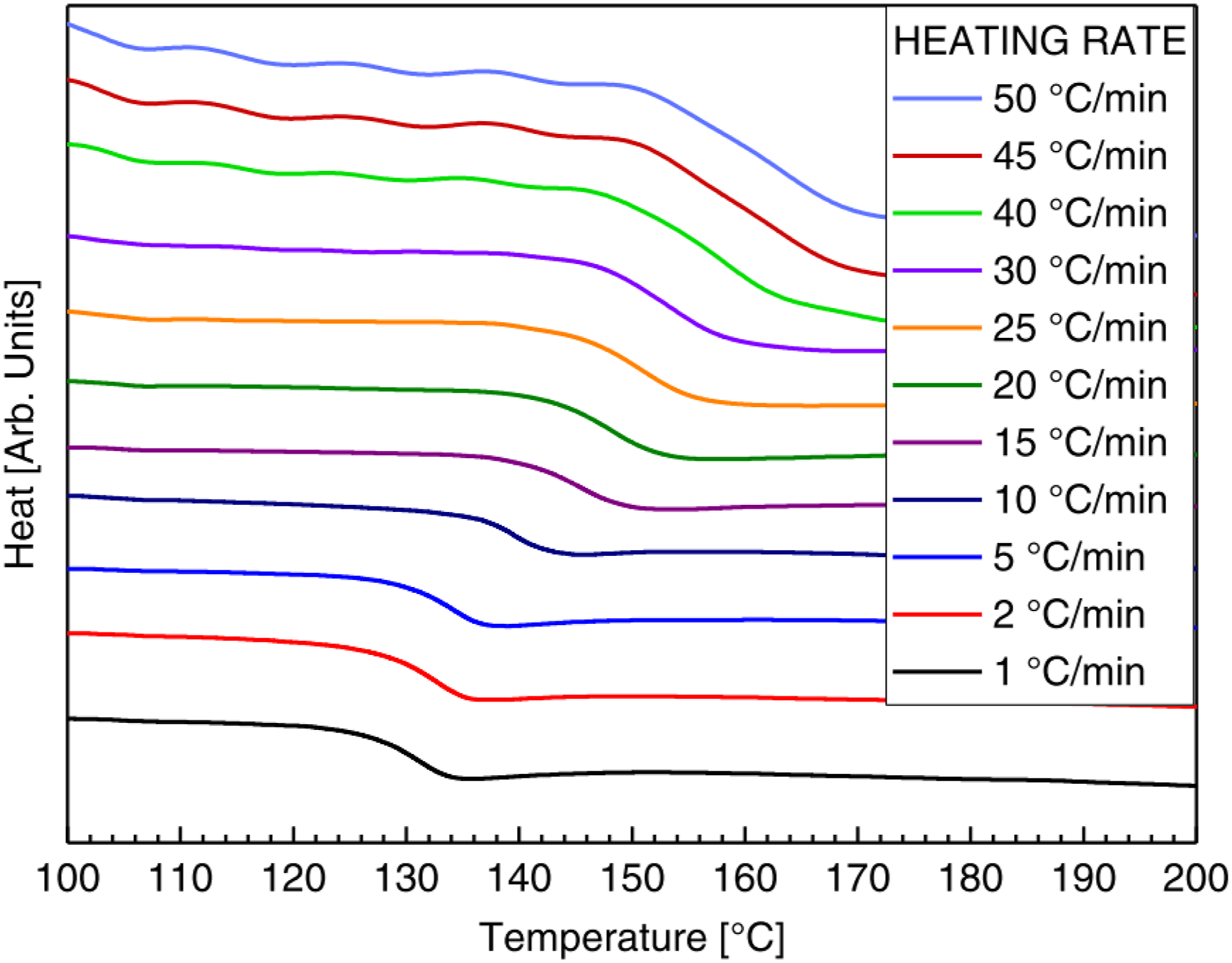
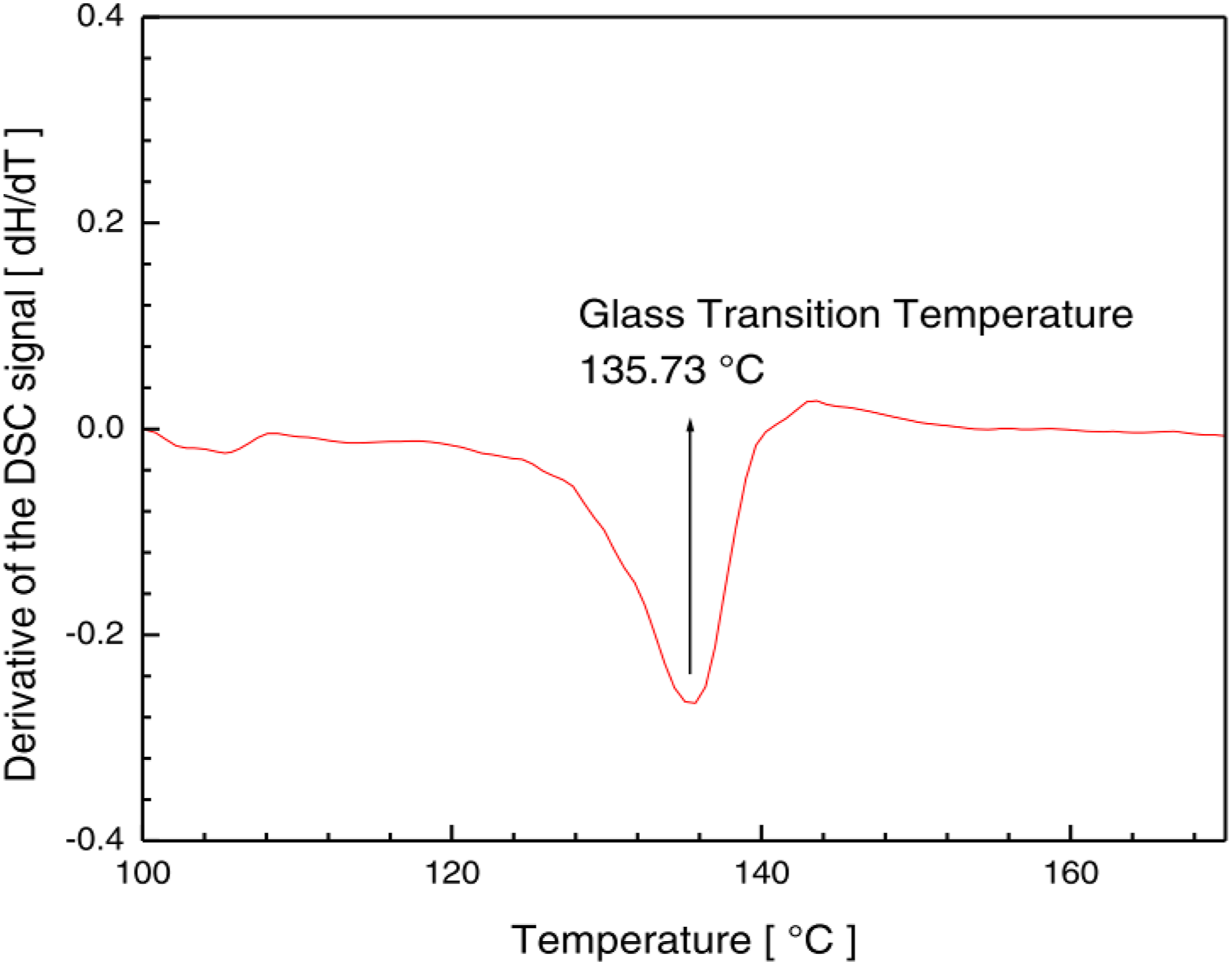
Furthermore, the analysis was continued with equation (2) to improve the accurate Heating rate versus 
Consequently, a conventional value for the
HR is the heating rate,
Tm analysis
T
m
is one of the key variables in polymer extrusion to determine thermal stability and hence melt quality.
74
We found some cases which explained T
m
values of polyelectrolyte-surfactant complexes.
Furthermore, a report from Vijayavenkataraman et al.
47
on poly(acrylic acid) PAA blend poly(caprolactone) (PCL) also performed the same pattern. In this case, a decision about
Enthalpy (
)
Differential scanning calorimetry thermogram of corn husk (a) and PAA-g-husk (b).
54
Reprinted from Carbohydrate Polymers, Vol 183, Jhimli Paul Guin, Y.K. Bhardwaj, Lalit Varshney, Radiation grafting: A voyage from bio-waste corn husk to an efficient thermostable adsorbent, Copyright (2018), with permission from Elsevier. PAA: poly(acrylic acid).
After that, a similar case has been found by Baştürk et al.
58
which observed the
Conclusion
PAA-based hydrogels and their copolymerization have some interesting TP parameters to study. Several TP parameters such as
Footnotes
Declaration of conflicting interests
The author(s) declared no potential conflicts of interest with respect to the research, authorship, and/or publication of this article.
Funding
The author(s) received no financial support for the research, authorship, and/or publication of this article.
