



Abstract
In this study, the co-polymer BF-g-LMA was successfully synthesized by grafting monomer lauryl methacrylate (LMA) onto bamboo fibers (BFs) using 2,2-azobisisobutyronitrile (AIBN) as an initiator. The grafting process was controlled by the monomer and AIBN concentrations, the reaction time and the temperature, and the optimal conditions were found to be [AIBN] = 0.04 mol/L, [LMA] = 1.0 mol/L, 180 min, and 75oC. Fourier transform infrared spectroscopy (FTIR), scanning electron microscopy (SEM) and X-ray diffraction (XRD) were used to investigate the characteristics of the BF-g-LMA product. The oil sorption capacity of the graft co-polymer was shown to be about 20.0 g oil/g sorbent.
Introduction
Lignocellulosic fibers such as jute, sisal, kenaf, and bamboo are inexpensive materials, and are easily obtained from renewable natural resources. They possess advantages for various uses due to their low density and high flexibility. Bamboo, a natural lignocellulose fiber, is abundant in Asia and Middle and South America. 1 In Vietnam, bamboo has been considered as an alternative resource to wood, in order to prevent a shortage of wood resources, due to its fast growth, short renewal period, and easy propagation. BFs are the last sustainable plant resource that has not been used on a massive scale. However, BFs should be modified to suit actual use. 2
Graft co-polymerization is commonly used to modify the physical and chemical properties of naturally polymeric fibers. During the grafting process, the side chains are covalently bonded to a main polymeric backbone/substrate to form a co-polymer via free radical polymeric reactions.3–6 Vinyl monomers and chemical initiators such as ceric ammonium nitrate (CAN), Fenton reagent (Fe(II)-H2O2), and particularly AIBN, are popular agents for lignocellulosic graft co-polymerization.7–11 In addition, the grafting of vinyl monomers with long-chain alkyl groups, such as LMA, butyl acrylate, and stearyl methacrylate, onto these fibers is an interesting approach for the production of low-cost, biodegradable materials with advantageous properties.
As natural products, BFs with high hydrophobicity are likely to be useful sorbent materials for oil spillages, and are also easily joined via graft polymeric reactions.12,13 The aim of this study is to synthesize the co-polymer BF-g-LMA for oil spill treatment, since the grafting of LMA onto BF with AIBN as an initiator has not previously been performed. To the best of our knowledge, the application of LMA in the synthesis of a lignocellulosic co-polymer for oil spill treatment is very rare. The co-polymer obtained in this way is characterized using FTIR, SEM, and XRD.
Materials and methods
Materials
BFs with an average size of 0.04 mm were supplied by the Polymer Center of Hanoi University of Science and Technology. BFs were treated with NaOH 0.1 mol/L at 30 oC for 72 h to remove hemicelluloses and pectins, and were then neutralized using water and dried. All other chemicals used in the experiments, including LMA, AIBN, N,N-dimethyl formamide (DMF), absolute ethanol, and acetone, were purchased from Sigma Aldrich.
IR spectra for BF and BF-g-LMA were recorded on a Nicolet (IMPACT 410, USA) FTIR spectrometer (4000–400 cm−1). SEM images of BF and BF-g-LMA were measured using a JEOL 6390 machine (Japan), and a Siemens diffractometer (model D5000) was used for the XRD study, in which scanning was carried out from 5o to 50o.
Graft polymerization
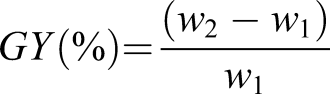
The method used here has been carefully described in previous publications.14–16 In summary, the graft polymeric reaction was carried out under a nitrogen atmosphere in a 150 mL three-neck flask equipped with a stirrer and condenser. BFs (0.5 g) were immersed in 10 mL of DMF for 4 h, and LMA (0.6–1.4 mol/L) was then added to the reaction mixture. The flask was placed into a thermostatic water bath at temperatures of 70–90oC. AIBN (0.02–0.1 mol/L) was slowly added, and the reaction mixture was stirred. After the desired reaction period, the graft product was poured into EtOH (100 mL) for precipitation. The product was then washed with EtOH (60 mL, three times), and extracted with acetone (60 mL, three times) to remove the homo-polymer of LMA. Finally, the graft co-polymer BF-g-LMA was dried in a vacuum at 60oC to a constant weight (Figure 1). The graft yield, GY (%), was determined by the following formula Plausible reaction of BF-g-LMA.
Oil sorption assay
The method used here has been described in detail in previous publications.17–19 Crude oil (5 mL) was poured into a 100 mL beaker containing 80 mL of distilled water (static system). Following this, the BF-g-LMA (0.5 g) was gently placed onto the surface of the oil. After a certain period of time (5–1440 min), the sample was removed from the beaker, which was then dried in a vacuum for 5 min before weighing. The oil sorption capacity was determined by weighing the sample before and after sorption, and was calculated using the following formula

Result and discussion
Effect of reaction time
As shown in Figure 2, the highest GY (%) was achieved for a reaction time of 180 min. However, the GY (%) was observed to be constant for a reaction time of above 180 min. The increase in GY (%) can be explained by the high number of grafting sites in the initial stages of the reaction.
20
During the long reaction time, the homo-polymeric reaction among monomeric LMAs may have priority over the co-polymeric reaction.
20
Thus, a reaction time of 180 min can be seen as the optimal condition for maximal GY (%). Effect of reaction time on the GY (%). [AIBN] = 0.04 mol/L, [LMA] = 1.0 mol/L, reaction temperature 75 oC.
Effect of temperature
The grafting reaction was also investigated at various temperatures (70–90 oC) while the other variables were kept constant. The effect of temperature on the GY (%) is shown in Figure 3. The maximal value of GY (31.28%) was obtained at 75oC, and this significantly decreased when the temperature was increased further. An increase in the temperature can promote the flexibility of the monomer and initiator, and can enhance the diffusion of the monomer and initiator from the environmental liquid to BF backbone.
21
However, with a further increase in temperature (75oC in this case), the poor selective graft polymerization and chain transfer reaction may have been accelerated, leading to a decrease in the GY (%).
21
Effect of temperature on the GY (%). [AIBN] = 0.04 mol/L, [LMA] = 1.0 mol/L, reaction time 180 min.
Effect of monomer concentration
Figure 4 shows the concentration of the monomer ranging from 0.6 to 1.4 mol/L, and the corresponding variation in GY (%). The highest percentage of GY is seen for a value of [LMA] = 1.0 mol/L. Above this value, the GY (%) decreases with an increase in LMA concentration. Khullar et al. suggested that the availability of grafting sites in the main cellulosic backbone is responsible for the increase in the GY (%) in the earlier stages of the reaction,22,23 whereas the reduction in the GY (%) beyond the optimal LMA concentration may be due to competition between the graft co-polymeric and homo-polymeric reactions.22,23 Effect of monomer concentration on the GY (%). [AIBN] = 0.04 mol/L, reaction time 180 min, reaction temperature 75 oC.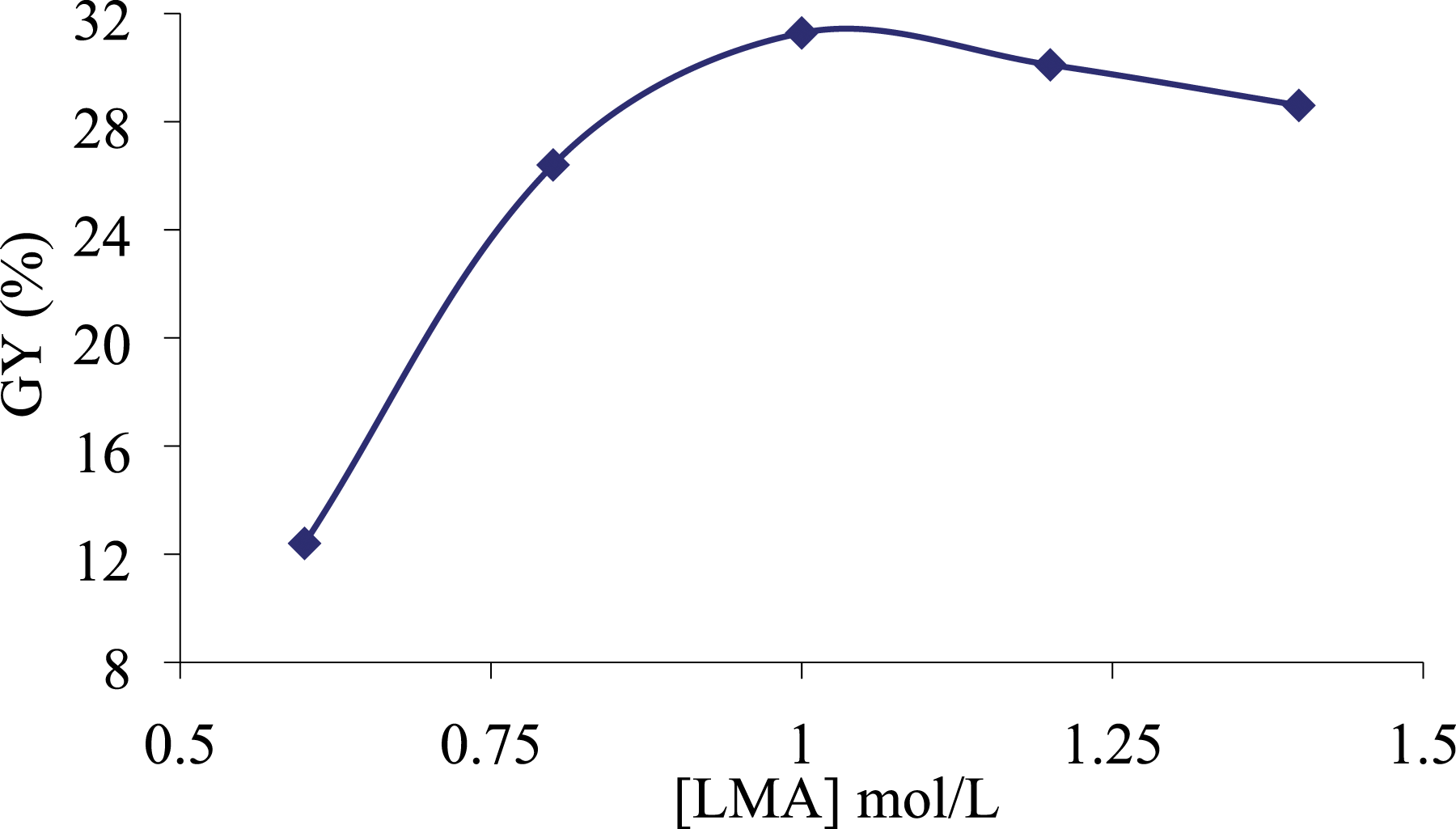
Effect of initiator concentration
The AIBN concentration was varied from 0.02 to 0.1 mol/L. The GY (%) increases with increasing AIBN initiator concentration, and reaches a maximum value of 31.28% at 0.04 mol/L (Figure 5). A further increase in AIBN concentration induces a decrease in the GY (%). This observed increase in the GY (%) with the AIBN concentration between 0.02 and 0.04 mol/L may be due to the fact that within this range, AIBN acts as an important agent to help CH2• formation in LMA and HO• formation in BFs. A relatively high concentration of AIBN might be responsible for a reduction in grafting, since the homo-polymer of LMA increases the viscosity of the reaction system. Effect of initiator concentration on the GY (%). [LMA] = 1.0 mol/L, reaction time 180 min, reaction temperature 75 oC.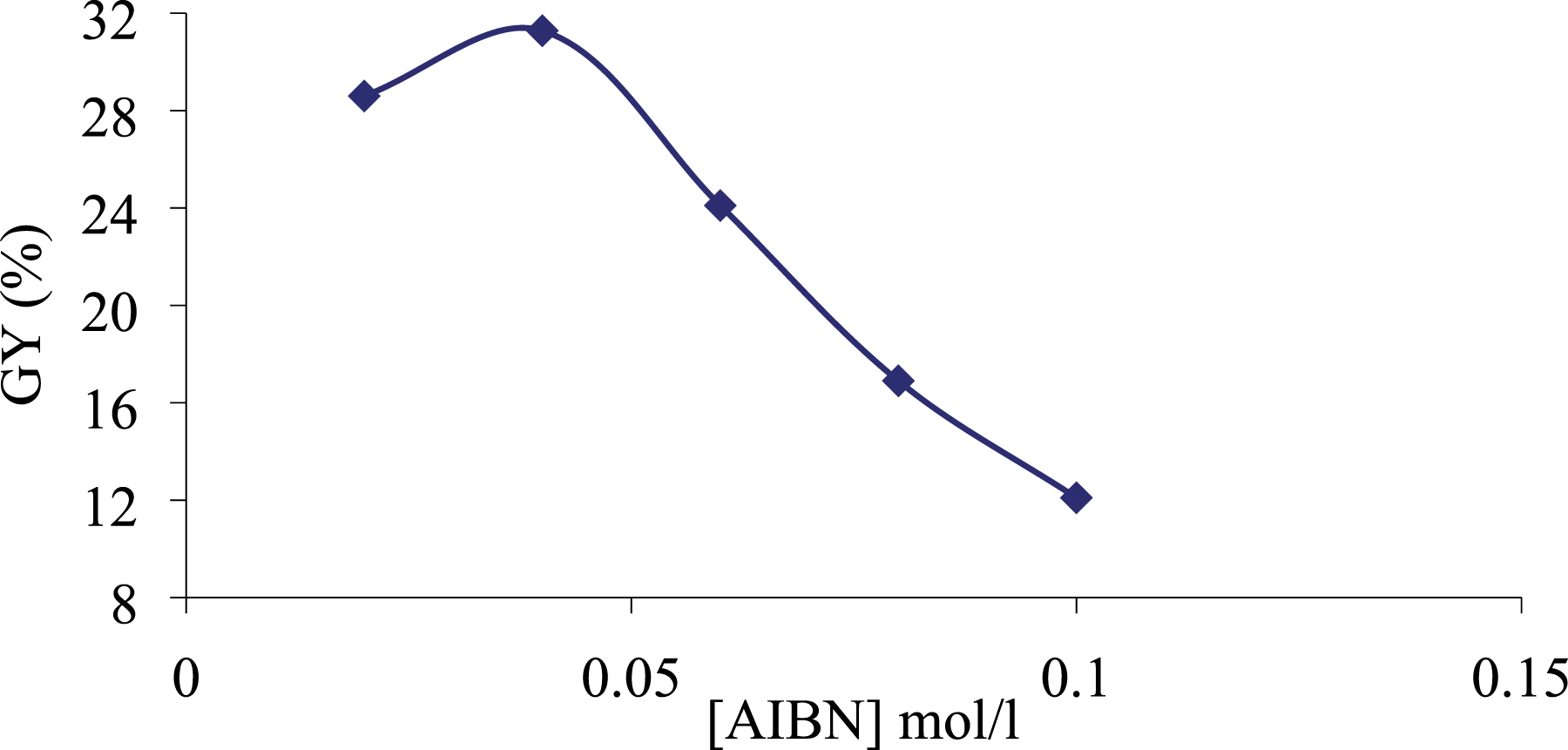
FTIR analysis
The FTIR results for BF and BF-g-LMA are illustrated in Figure 6. The peak due to O-H stretching vibration in BF-g-LMA is located at 3374.99 cm−1, whereas the same value for BF is 3423.28 cm−1. In both samples, the presence of peaks at around 2900 cm−1 may be due to C-H stretching. In particular, the new peak at 2856 cm−1 in the spectrum of BF-g-LMA indicates the presence of the aliphatic chain form poly (LMA), and provides strong evidence of grafting. Another new sharp peak at 1729.20 cm−1 represents C=O stretching for an ester, which may also indicate a success of the graft process. The IR spectra of BF (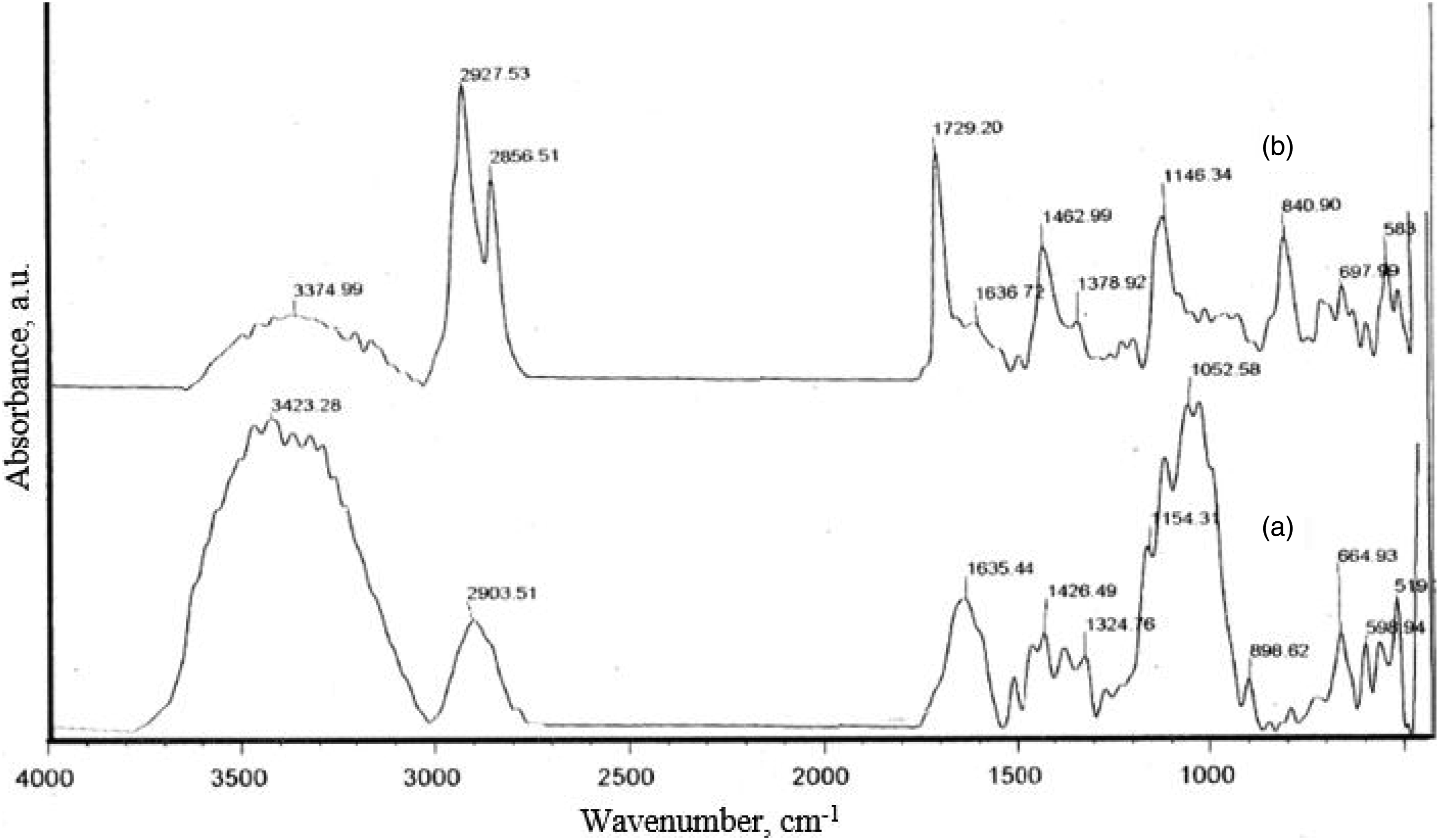
SEM analysis
The morphological surfaces of BF and BF-g-LMA (GY 31.28%) are shown in Figure 7. The untreated BF sample is composed of rough sticks and brittle textures with extensive fracturing. The SEM images of BF-g-LMA are completely different from those of the original BF. Poly (LMA) has been successfully grafted onto BF via covalent interactions between the double bonds of the monomers and hydroxy groups of the BFs, and deposition of the grafted LMA on the BF surface and several voids can be clearly observed. SEM micrograph of BF (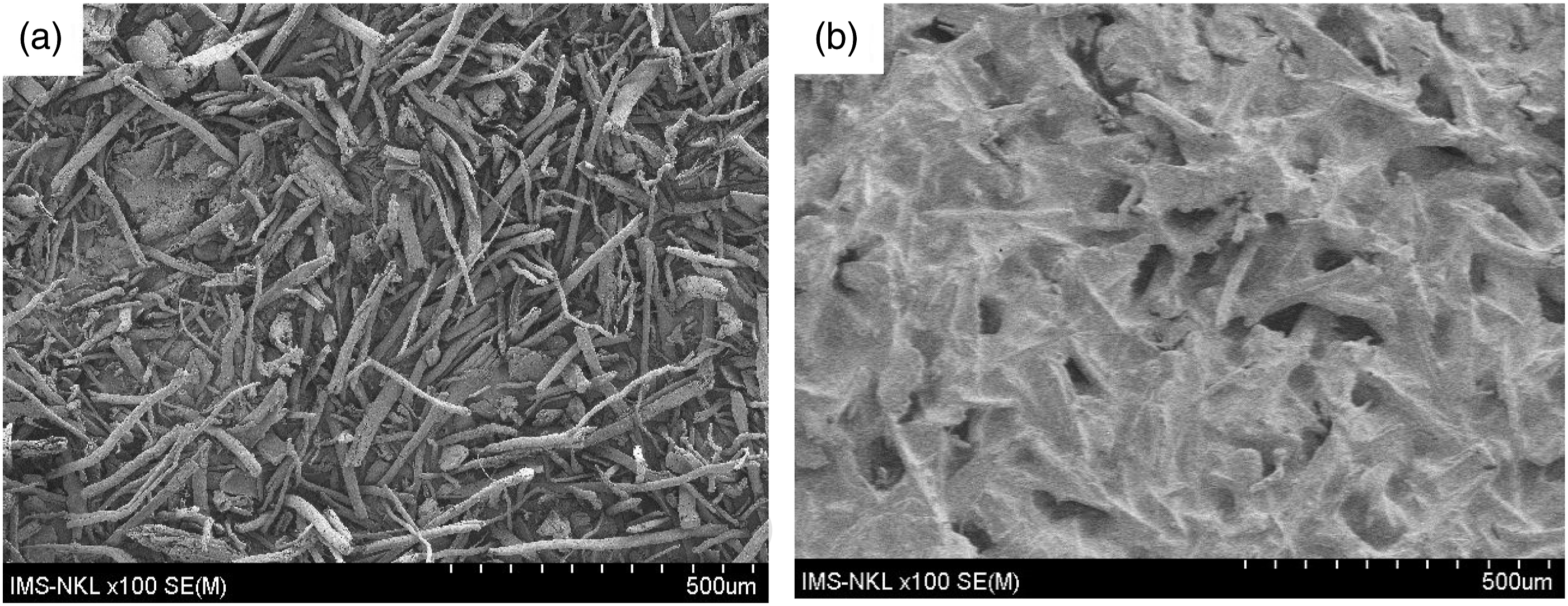
X-Ray diffraction analysis
As can be seen in Figure 8, the XRD pattern for the BF is accompanied by two strong intensive peaks. These two peaks are not shown for the co-polymer BF-g-LMA, and a broad peak is observed instead. This is caused by the introduction of additional poly (LMA) chains to the BF backbone, which disturb its crystalline lattice and cause a significant loss of crystallinity.24,25 XRD pattern of BF (
Oil absorbent capacity
Oil sorption of BF-graft co-polymer in the different systems.


Picture for the clean-up of crude oil from water. (a) Co-polymer BF-g-LMA, (b) the oil was absorbed by graft co-polymer, and (c) the oil-loaded co-polymer was picked up.
Conclusion
In this study, we determined the optimal reaction conditions for the graft polymerization of LMA onto BF as [LMA] = 1.0 mol/L, [AIBN] = 0.04 mol/L, a reaction temperature of 75oC, and a reaction time of 180 min. Under these conditions, the GY reached 31.28%. The successful connection between the poly (LMA) and the BF backbone was proved by FTIR, SEM, and XRD spectral analyses. The oil sorption capacity of BF-g-LMA reaches an average of 20 g oil/g sorbent for treatment over 24 h. In the water medium, with and without agitation, BF-g-LMA has shown to uptake water from 2.27 to 5.91%. It can therefore be concluded that graft polymerization onto cellulosic fibers is an effective method of preparing oil sorbent that can be applied to the large-scale removal of oil spilled on the surface of water. Further studies of the liquid-solid interface between oil and sorbent materials, including wettability, are necessary.
Footnotes
Declaration of Conflicting Interests
The author(s) declared no potential conflicts of interest with respect to the research, authorship, and/or publication of this article.
Funding
The author disclosed receipt of the following financial support for the Ministry of Industry and Trade (MOIT) via a project: ĐT.11.14/CNMT.
