



Abstract
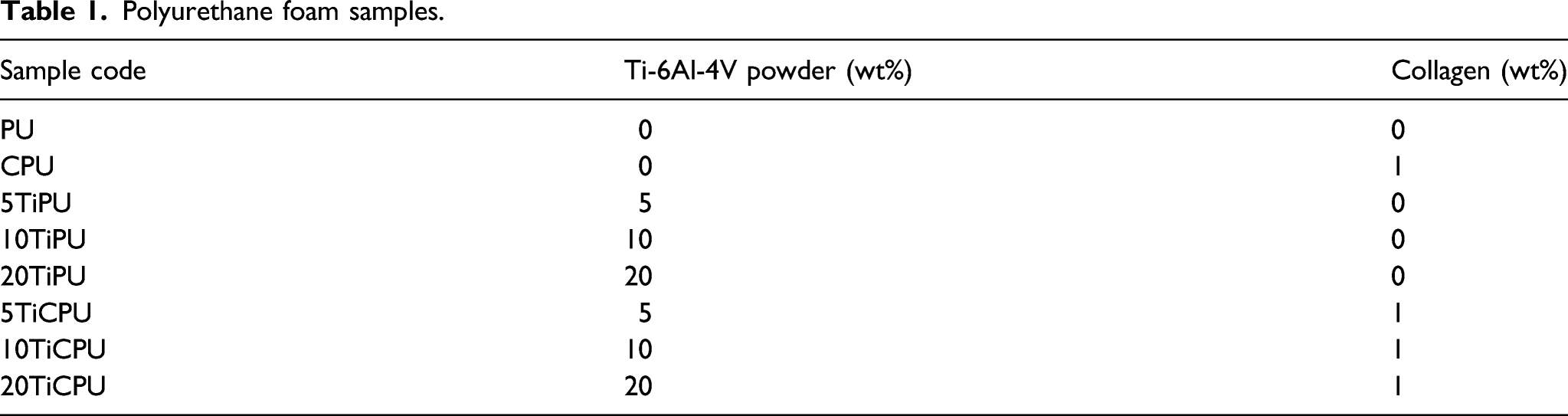
In this study, we aimed to develop a novel soy-based polyurethane (PU) foam material reinforced with titanium powder and collagen for use in bone tissue engineering. In this context, soy polyol-based PU foams having different (5, 10, 20 wt%) concentrations of recycled titanium powders and hydrolyzed collagen (1 wt%) were prepared and characterized by scanning electron microscopy, water contact angle measurement, and compression tests. Biocompatibility was determined by cytotoxicity analysis. It was observed that PU foams with different titanium and collagen concentrations can have optimized mechanical strength, biocompatibility, chemical composition, and morphology that resemble porous bone texture-like structure. The compressive strength of PU foam increased by 72.6% with the inclusion of 20 wt% titanium powder and slightly decreased by 9.4% with 1 wt% collagen. Cytotoxicity results revealed that PU foam with the synergistic combination of titanium powder and collagen had higher biocompatibility compared to control sample. To our knowledge, this novel biocomposite material, developed the first time in literature by incorporation of medical grade titanium powder and hydrolyzed collagen into soy-based PU matrix, has many advantages such as tunable mechanical strength, biocompatibility, low cost, and easy processability.
Keywords
Introduction
Bone tissue injuries are a major health problem involving deformations or losses in bone tissue damaged by various diseases, accidents, and trauma. Traditional methods such as autograft, allograft, and xenograft are used to repair bone damage in the clinic. In allograft applications, bone fragments taken from cadavers are applied to patients. In xenograft applications, bone fragments taken from animals are applied to patients. 1 In these applications, there are several disadvantages such as donor disability, tissue incompatibility, risk of immune response, and disease transmission. In autografting practices, bone is taken from the healthy area of the patient and implanted in the patient. In this application, there are negative effects such as the need for surgical intervention and a decrease in the life quality of patient.2,3
Nowadays, tissue engineering is the area of biomedicine studied intensively. The main objective in tissue engineering is to create organs or tissues at laboratory conditions that can be used in tissue and/or organ damage or loss. 4 This approach includes biocompatible tissue scaffold, which can integrate without damaging the human body and they are biological signal molecules that can stimulate various stem or primary cells and cellular behaviors to heal the damaged area.5,6 Bone tissue engineering, an alternative to existing treatment methods, is an important emerging field of study, designed to provide damaged bone tissue regeneration. 7 Within the scope of this field, polymers, metals, and ceramics are biomaterials used as matrix. Natural polymers are biocompatible, biodegradable, but mechanically weak. Synthetic polymers can be easily processed; however, their biocompatibility is low. An ideal bone tissue material is expected to have biocompatibility, good mechanical strength, and a porous structure.8,9 Pore shape and size have been found to be directly effective in cell adhesion and cell viability. The materials used in the literature have problems related to pore structure and size, insufficient mechanical strength, and cytotoxicity.5,10
Polyurethanes are versatile engineering materials with tunable mechanical properties and biocompatible properties 11 which can be tailored by the type and composition of their components, depending on the application. Novel polyurethane foams have been produced using diatomite and nanosized hydroxyapatite for medical uses. 12 Zhang and Hu investigated effects of hydroxyapatite nanofillers on PU composites. The results show that the surface wettability of PU composite is increased with the addition of hydroxyapatite nanofillers, and thus better biocompatibility is achieved. 13 Environmental problems with an increase in oil prices and oil dependency have led to the development and use of bio-based polyurethanes fabricated from polyols derived from renewable resources such as soybeans. Bio-based polyurethane foams with various functionalities and hydroxyl group contents can be produced. 14 Due to their poor mechanical properties compared to those of petroleum-based polyurethanes, soy-based polyurethane formulations could be improved with reinforcing agents. In the literature, there are studies on the optimization of polyurethane synthesis by using soy-based polyols with various hydroxyl numbers and different amounts of isocyanates to overcome the drawback of weak mechanical properties.15–20 Rui et al. studied the properties of waterborne polyurethane grafted collagen polypeptide/hydroxyapatite that a new nanocomposite with good mechanical property and biocompatibility. The results of the study showed that the PU composite has good homogeneity and mechanical flexibility. 21
In the search for the new biomaterials, collagen plays a critical role as it is naturally occurring during the life cycles of animals. Collagen is an animal protein-based biopolymer that has a broad spectrum of applications. Although collagen is widely used in different industries due to its biocompatibility, non-toxicity, and biodegradability; there have been very few studies on the use of collagen as a support material in conventional biomaterials. 22 Titanium alloys, due to their high strength and stiffness combined with very good corrosion resistance, are considered as advanced metallic materials in medical applications. 23 Moreover, various studies have been carried out about the biocompatibility of titanium alloys. 24 However, to our knowledge, there is no research on the use of titanium alloys in polymer matrix composites. The combination of the polymer matrix and titanium alloy powders would make the performance of the composite material much better in terms of elastic modulus optimization and biocompatibility. Li et al. investigated the biocompatibility of particulate reinforced Ti-NB2O5 composites that are fabricated via powder metallurgy showing excellent biocompatibility. 25 Bai et al. found that the Ti–Nb alloy with low Young’s modulus displayed any no adverse effect on new bone formation and had good bone tissue compatibility. 26
In the current study, soy polyol-based polyurethane foams with the addition of titanium and collagen were prepared, in order to fabricate low-cost, biocompatible, and eco-friendly bone tissue material in medical applications. Later, composite materials were characterized by SEM, contact angle measurements, and compression test to determine their physical and mechanical properties. Cytotoxicity tests were also performed to investigate the biocompatibility of the materials.
Materials and methods
Materials
Formulized soy-based polyol with a hydroxyl number of 325 mg KOH/g (trade name: Ravasol PD400) and polymeric diphenyl methane diisocyanate (PMDI; trade name: Voracor CD526) were supplied from Ravago Group, Turkey. The formulation of soy polyol comprising all the required ingredients (i.e., catalysts, surfactants, and water as a chemical blowing agent) was not disclosed by the company and used as received for PU foam production. The general characteristics of Voracor CD526 isocyanate are as follows: viscosity (25°C): 210 mPa·s, -NCO content: 31%, and density (25°C): 1.23 g/cm3. Hydrolyzed type I collagen was purchased from Eczacibasi, Turkey. Ti-6Al-4V alloy machining chip was obtained from Metrosan Company, Turkey.
Preparation
Ti-6Al-4V powder was added into the formulized polyol (PU) solution at 5, 10, 20 wt% concentrations and collagen was added at 1 wt% for the collagen formulations. The formulized soy polyol (component A) and polymeric diphenyl methane diisocyanate (PMDI, component B) solution was mixed in the ratio of A/B: 10/13 based on the suggestions of Ravago Group, without introducing yet another type of blowing agents or PU additives into the foam formulation. It is evident that one mole of water reacts with two -NCO groups, which is also very important in order to calculate the correct quantity of isocyanate needed for polyurethane formulations.
Ti6Al4V alloy was ground by mechanical disc milling method from chip to powder form. First, the Ti6Al4V powder was dispersed in the component A (formulized soy polyol) using a mechanical stirrer at 2000 rpm for 15 min to obtain a uniform distribution. Then, component A was mixed with component B (PMDI) and stirred together by using the mechanical stirrer at 5000 rpm for 15 s, at room temperature. The intermediate product of the reaction of an isocyanate group with water in polyol is a thermally unstable carbamic acid which decomposes spontaneously to an amine and carbon dioxide. The diffusion of carbon dioxide into bubbles previously nucleated in the reacting medium caused expansion of the medium to make a foam. The foams were later cut into dimensions of 50 x 50 x 50 mm and kept at room temperature, for 7 days before characterization.
Characterization
The major/minor elemental analysis and morphology of both neat and reinforced PU foams were investigated by using Zeiss Gemini 300 VP field emission scanning electron microscope (FESEM) with integrated energy dispersive spectrometer (EDS). Since PU foams are nonconductive, soy-based polyurethane foams were sputter-coated with gold by using QUORUM Q150 RES coating machine, at a sputtering rate of 8 nm/min, just before FESEM analysis. Compression tests were performed by using a universal testing machine (Shimadzu Ags-x5kn) with a cross-head speed of 5 mm/min for the sample dimension of 50 x 50 x 50 mm. Surface wettability of reinforced PU foams was determined via water contact angle measurement using The Attention Theta Lite Optical Tensiometer (Biolin Scientific AB, Vastra Frolunda, Sweden), with an average volume of 4 µL at static state. Image processing and analysis were done by OneAttention software. The measurements were performed under ambient condition (1 atm, 24 ± 2°C).
Cytotoxicity test
In the scope of cytotoxicity tests of synthesized soy-based polyurethane foam materials, Quantitative analysis, Cytotoxicity extraction method (ISO 10993-5: 2009) was used. The test details are as follows: Cell culture medium without serum (Dulbecco’s MEM F12, SD222-500, Serox, Germany, IS0 10993-12:1998 Prepared according to the Standard Preparation and Reference Material Selection) was used as a solvent. L-929, Mus musculus connective tissue (Monolayer, IS0 10993-5:2009 Tests for In Vitro Cytotoxicity were selected from cell lines found in the standard) was used. Culture medium includes Dulbecco’s MEM F12, 10% Fetal Bovine Serum (FBS, A0500-3010, Cegrogen Biotech, Germany), 1% Sodium Pyruvate (L0473, Merck, Germany), 1% Penicillin-Streptomycin (A2213, Biochrom, Germany). Ethylene oxide (ISO 10993-12:2007) was selected for sterilization method of test materials. Test materials were extracted for 24 h at 37°C ± 0.1 in a serum-free Dulbecco’s MEM F12 medium at a concentration of 0.2 g/mL. Cytotoxicity test was performed with L-929 cells. Cells were cultured at a concentration of 1 x 10⁵ cells/mL on 96-well microplates. Material extracts were applied on the cells at four different dilutions (1:1, 1:2, 1:4, and 1:8) and for 72 h at 37°C with 5% CO2 and 95% humidity atmosphere. The cytotoxic effect of the materials was evaluated by getting the absorbance of spectrophotometer (570 nm) by MTT test. 27
Results and discussion
Polyurethane foam samples.
SEM and EDS analysis of Ti-6Al-4V powder
The microstructure, morphology, and chemical composition of Ti-6Al-4V powder and titanium and collagen reinforced polyurethane foams were determined by SEM and EDS analysis. Figure 1 shows the SEM images of the powders at 100x and 500x magnifications. SEM micrographs of Ti-6Al-4V powder (a) 100x, (b) 500x magnification.
Elemental distribution of Ti-6Al-4V powder at 3 different selected areas.


EDS analysis shows that Oxygen (O) and Carbon (C) ratios are high. The effect of milling atmosphere and the particle size are considered as important reasons. The particle surface area and surface energy increase as the particle size decreases. Thus, the surface of impure atoms such as O and C accelerate. Another factor can be interpreted as the fact that the waste aluminum chips cannot be completely purified from the impurities as a result of the washing process.
SEM and EDS analysis of soy-based PU foam materials
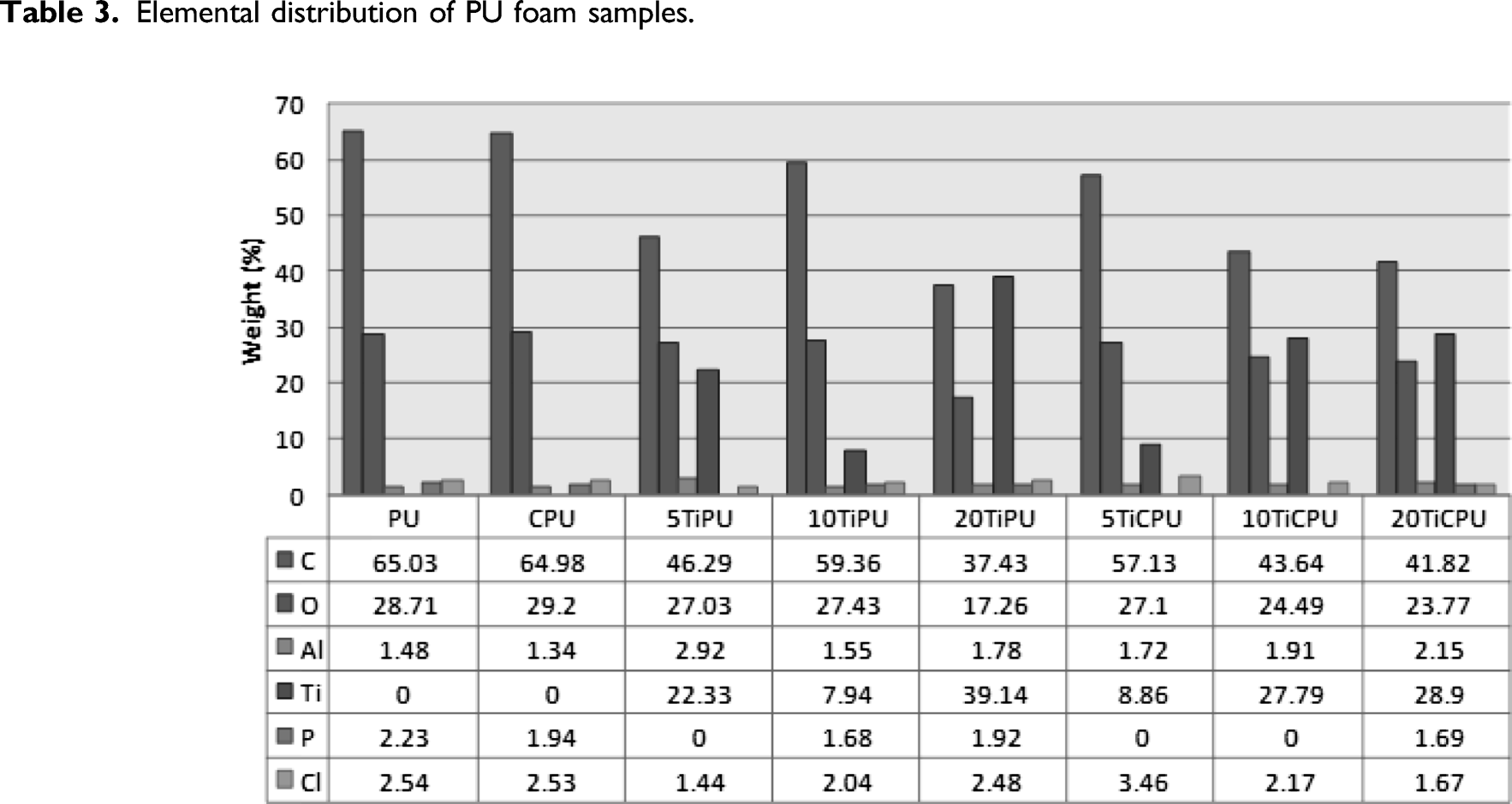
The chemical composition of the foams was determined by EDS analysis. In Figure 2, SEM micrographs show that PU foams are like spongy bone tissue. Ti-6Al-4V powders, which are used as reinforcing agent, were not homogeneously dispersed in structure and aggregation occurred. The mixing process is critical for the properties of the rigid PU foam obtained. Prevention of air bubbles and micro-pore formation, homogeneous distribution of additive material in the matrix, and low surface potential are the result of mixing process. Collagen molecules were not observed in SEM images. SEM micrographs of soy-based polyurethane foams.
Elemental distribution of PU foam samples.

Contact angle measurements of soy-based PU foam materials
The contact angle analysis was performed to determine the hydrophobic or hydrophilic properties of the soy-based polyurethane foams shown in Figure 3. The contact angle results are tabulated in Table 4. Contact angle analysis of PU foams. Water contact angle values of PU foams.

The hydrophobic property of a solid surface is determined by two factors: the surface chemical composition and microstructure. As the contact angle of the material was greater than 90°, their hydrophobic properties were determined. There were changes in the hydrophilicity of the materials by titanium and collagen additives.
According to contact angle analysis, there were changes in the hydrophilicity of the materials by titanium and collagen additives. Contact angle analysis depends on droplets of water on surfaces and may exhibit a wide range of contact angles. Materials exhibiting different water wettability with different water contact angles and water absorption are alternatively described as hydrophilic or hydrophobic. Hydrophilic materials which include polar chemical groups may become ionized and have interaction by way of ionic forces. Also, they form permanent dipoles and have interaction via H-bonding, orientation, and induction interactions. These interactions may also play an important role in biomaterial interactions with water, proteins, and different biologic species. A biomaterial/water interface with ionic groups or strong dipoles on the solid surface will have tendency to bind water molecules strongly and to orient or polarize them around the ionic or polar groups. This surface may have interaction strongly with ionic groups on proteins and cell surfaces and may adhere them tenaciously. Biomaterials need to provide a favorable hydrophilic, positively charged surface for cell adhesion and cell growth. Also, all organic and inorganic substances which are necessary for the human metabolism, may also interact with the hydrophilic biomaterials that have been introduced in the human body.28,29 Collagen consists of three polypeptides in spiral structure. They are functionally structural proteins. They contain hydroxyproline, the essential amino acid. While there are eighteen different amino acids in the collagen structure, eight of the nine essential amino acids (histidine, isoleucine, leucine, lysine, methionine, phenylalanine, threonine, tyrosine, and valine) are highly found in the structure of the collagen. Collagen contains high amounts of important amino acids such as glycine and proline compared to other proteins. It is seen that the apolar amino acids, which have a radical group in the side chains that show hydrophobic properties, are concentrated. 30
Although polyurethane foams are hydrophobic structures, the addition of titanium decreased the contact angle showing an increased biocompatibility. Titanium materials have been extensively used for their biocompatibility properties. This is one of the few studies using titanium powder as the reinforcing phase and especially for the polyurethane foam it is highly possible that it is the first time used.
Collagen has been known for its hydrophobic properties 31 and this was verified by water contact angle measurements. The neat polyurethane hydrophobicity was increased with collagen. Moreover, the collagen increased the water contact angle for the titanium powder reinforced PU foams as well.
Compression test of soy-based PU foam materials
The compression test was performed to determine the mechanical strength of the foam materials. PU foams were cut to size 50 x 50 x 50 mm. The compression speed was 5 mm/min and the compression span was 15 mm. The results are presented in Figure 4. When the test results were examined, it was observed that the strength of the foams reinforced with titanium powder increased. It was determined that the collagen additives caused a decrease in the mechanical strength of the foams. However, the density of PUs increased with increase of Ti-6Al-4V powder content too. Cell morphology is an important factor affecting the physico-mechanical properties of the rigid polyurethane foam. Compressive strength of PU foams.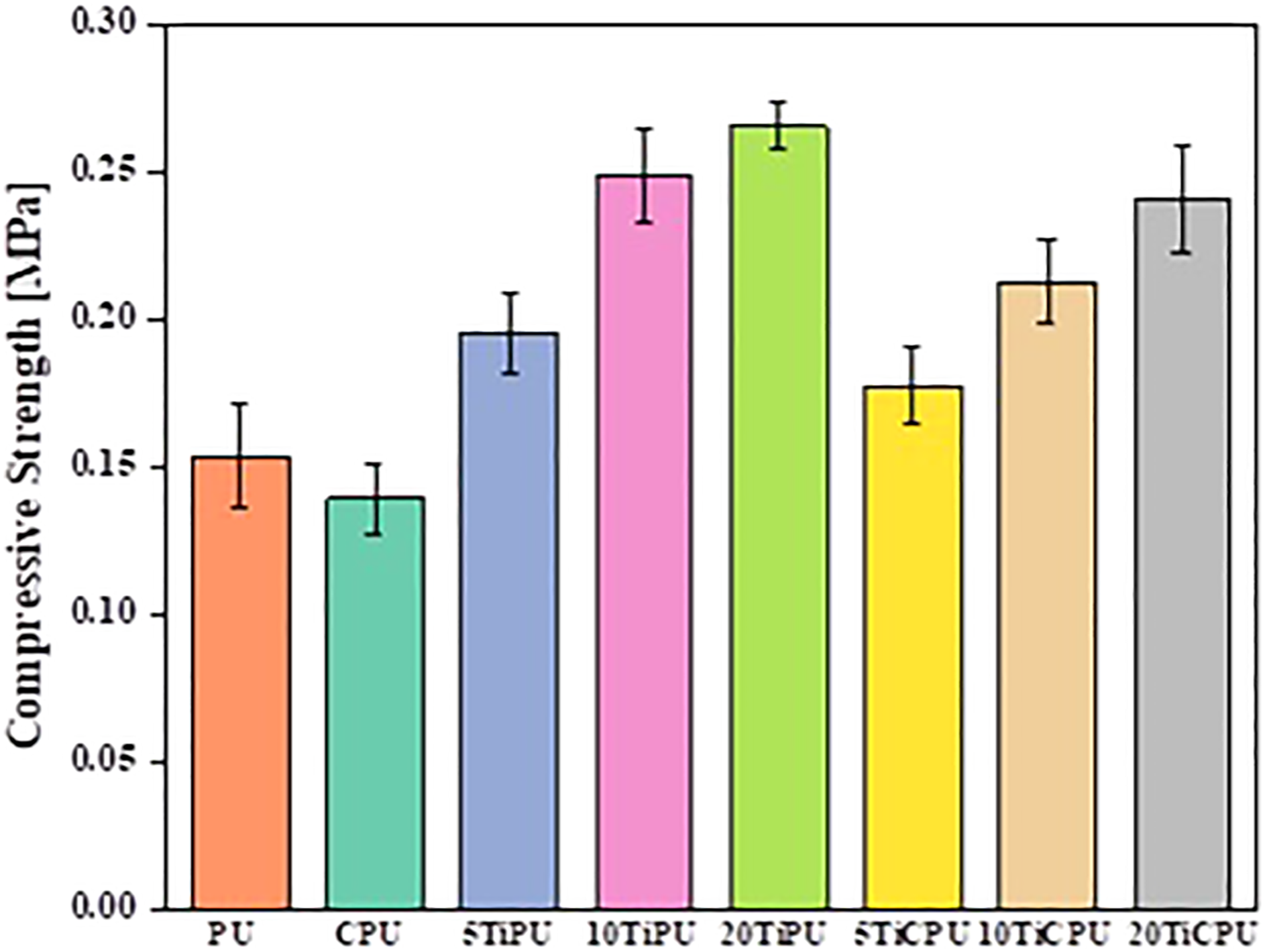
As seen in Figure 2, the shapes of the cells in 5TiPU, 10TiPU, and 20TiPU are regular and uniform and no collapse in the cell system. However, there was a significant collapse in the cell system with the effect of collagen in 5TiCPU, 10TiCPU, and 20TiCPU.
According to SEM and compression test results, morphological structure and mechanical strength of the foam materials are different because of titanium and collagen additives. Especially, collagen caused a changing porous structure and decrease in the compression strength of the foams compared to other samples. Collagen is a biodegradable molecule on account of its protein structure. Collagen is commonly used in tissue engineering materials due to its non-antigenic, non-toxic, biocompatible, biodegradable, and bioresorbable properties. But collagen has some imperfections like decreasing mechanical properties that can be eliminated by combining with other materials or by crosslinking. 32 Collagen provides a microenvironment for incorporated cells and governing the mechanical properties of the tissue. 33 The use of collagen decreased the compression strength but there are certain parts of the body where it can still be used. Furthermore, as discussed in the biocompatibility section, collagen provides excellent biocompatibility for the samples produced in this study.
In this study, we have developed novel materials with medical grade titanium powder, soy polyol-based polyurethane, and hydrolyzed collagen. Polyurethane foam materials with porous structure are highly important for medical and especially for bone substitute materials research as the bone has also a foamy structure called spongy part of the bone. By means of biomimicry, we have mimicked the bone structure with porous materials using plant-based materials. The important part of this research was to incorporate the collagen molecules in this bone graft material. Collagen improved the biocompatibility of the material as expected but the mechanical properties of the polyurethane foam decreased with collagen. To overcome this reduction, we have incorporated titanium powder in the polyurethane foam. Thus, we could adjust the mechanical properties of the polyurethane foam with titanium powder and adjust the biocompatibility with collagen molecules.
Cytotoxicity results of soy-based PU foam materials
Cytotoxicity tests of synthesized soy-based polyurethane foams were examined by using the cytotoxicity extraction method (ISO 10993-5: 2009). 34
When the MTT results of the test materials are taken as reference for the control, they are interpreted according to the ISO 10993-5: 2009 In Vitro Cytotoxicity Tests standard. In the MTT analysis performed at a concentration of 0.2 g/mL of PU, the cell viability was below 50%, which showed a cytotoxic effect in terms of cell death.35,36 It was determined that cytotoxic effect was not observed in other extraction concentrations in terms of cell death. Since the cell viability was higher than 70% at all concentrations of CPU, 10TiPU, 20TiPU, 5TiCPU, 10TiCPU, and 20TiCPU, it was determined that all of the samples had no cytotoxic effect in terms of cell death. In the MTT analysis performed at the concentrations of 0.2 g/mL and 0.1 g/mL in 5TiPU, the cell viability was below 70% and these concentrations were cytotoxic in terms of cell death. It was determined that cytotoxic effect was not observed in other extraction concentrations in terms of cell death.
All experiments were performed with three replications and the software IBM SPSS Statistics (Version 24) was used for statistical analysis. Results were analyzed by One-Way ANOVA test (p = 0.05) and Tukey was selected as post-hoc method. All results in Figure 5 were statistically analyzed; the cell viability of PU at concentrations of 0.2 g/mL, 0.1 g/mL, and 0.05 g/mL is statistically lower than the control group. The cell viability at a concentration of 0.025 g/mL was not statistically different from the control group. The cell viability of CPU at a concentration of 0.1 g/mL was statistically lower than the control group. Cell viability at a concentration of 0.2 g/mL, 0.05 g/mL, and 0.025 g/mL was not statistically different from the control group. The cell viability in all concentrations of 5TiPU was statistically lower than the control group. The cell viability in 0.2 g/mL concentrations of 10TiPU was statistically lower than the control group. Cell viability at a concentration of 0.1 g/mL, 0.05 g/mL, and 0.025 g/mL was not statistically different from the control group. The cell viability rate of 20TiPU at a concentration of 0.2 g/mL was statistically lower than the control group. Cell viability at a concentration of 0.1 g/mL, 0.05 g/mL, and 0.025 g/mL was not statistically different from the control group. The cell viability in all concentrations of 5TiCPU, 10TiCPU, and 20TiCPU was not statistically different from the control group. Cell viability (%) versus concentration (g/mL) graphs for cytotoxicity analysis of PU foams.
As a result of the morphological examination of the cells (Figure 6); at a concentration of 0.2 g/mL of PU, the cells are morphologically different from the control group. Cell morphologies were observed to change at a concentration of 0.1 g/mL. The cells are morphologically similar to the control group at all concentrations of CPU. At a concentration of 0.2 g/mL of 5TiPU, cells are morphologically different from the control group. Cell morphologies were observed to change at a concentration of 0.1 g/mL. The cells were morphologically different from the control group at concentrations of 0.2 g/mL and 0.1 g/mL of 10TiPU. Cell morphologies were observed to change at a concentration of 0.05 g/mL. At a concentration of 0.2 g/mL for 20TiPU, the cells are morphologically different from the control group. Cell morphologies were observed to change at a concentration of 0.1 g/mL for 20TiPU. The cells were morphologically similar to the control group at all concentrations of 5TiCPU. At a concentration of 0.025 g/mL for 10TiCPU, the cells are morphologically different from the control group. Cell morphologies were observed to change at concentrations of 0.1 g/mL and 0.05 g/mL for 10TiCPU. As for 20TiCPU, cell morphologies were observed to change at a concentration of 0.2 g/mL. Cell morphologies of PU foam samples at a concentration of 0.2 g/mL, in cytotoxicity analysis.
Cytotoxicity test results of PU foams.

*Std. Dev.: Standard Deviation.
Conclusions
Within the scope of the study, biocompatibility and mechanical strength of titanium and collagen included soy-based polyurethane foam material which has potential uses in bone tissue injuries have been developed. Soy polyol-based polyurethane, hydrolyzed collagen, and recycled Ti-6Al-4V powder were used in the preparation of these foam materials to prepare relatively a low-cost material. Thus, the preparation of titanium and collagen-doped soy-based polyurethane foam material is industrially applicable. At the same time, the fact that the polyol used in the synthesis is based on soybean oil has led to the production of an environmentally friendly material, and the use of waste titanium powders also contributes to the production of environmentally friendly materials and reduces the cost. SEM images show that collagen and titanium added soy-based polyurethane foam materials are like spongy bone tissue with soy polyol effect. The biocompatibility tests showed that the materials are biocompatible and can be used for medical purposes. The material to be developed in this sense will contribute to the literature and the health sector and will pave the way for new studies and will be promising for patients suffering from bone tissue damage.
Footnotes
Declaration of conflicting interests
The author(s) declared no potential conflicts of interest with respect to the research, authorship, and/or publication of this article.
Funding
The author(s) disclosed receipt of the following financial support for the research, authorship, and/or publication of this article: This research was financially supported by İzmir Katip Çelebi University Research Fund (grant number IKC-ÖNP-MÜM-0002).
