



Abstract
The main objective of this research was to study the influence of an enzymatic treatment process of date palm fibers on their chemical and morphological properties as well as the physical and mechanical characteristics of composites filled with raw and treated fibers. To this end, three extraction approaches were considered (a combination of xylanase and pectinase enzymes, xylanase enzymes followed by a pectinase one and pectinase enzyme followed by xylanase). Chemical and morphological analyses were performed on raw and treated fibers. The tensile test of the manufactured composites was achieved, using extrusion and injection molding process. These composites were also subjected to water absorption tests. The results showed that non-cellulosic components decreased after enzymatic treatments while the cellulose content increased significantly. The scanning electron microscope morphological analyses showed that the extraction with the combination of these enzymes is very effective as a fibrillation phenomenon. Composites with high rigidity were observed in the case of enzymatically treated fibers. These composites reveal a better moisture resistance compared to the untreated fibers.

Introduction
Fossil fuel resources depletion and pollution increase have prompted researchers to explore new alternatives to replace the synthetic fiber-reinforced composites. Natural fibers have shown a promising potential to be used as reinforcements in new applications where environmental concerns are stimulated. 1 Date palm fiber (DPF) is considered as one of the most interesting reinforcement elements in composites, thanks to their biodegradability, low cost, and availability. In fact, date palm trees count more than four million in Tunisia 2 and 120 million worldwide. 3 The DPF low density offers greater benefits compared to other natural fibers (coir, hemp, and sisal). The competitiveness of this fiber was observed even at a lower density and the displayed specific mechanical properties were the best. 4
DPFs were used as raw materials for different applications like bio-char production and 5 ropes and baskets fabrication. 6 Owing to their ecological and friendly character and especially their techno-economic advantages, DPFs are widely used in industrial sectors heading for sustainable development in automation and building sectors in order to improve thermal insulation.7,8 Nevertheless, PDF fibers are hydrophilic in nature which generated compatibility problems due to the hydrophobic character of their matrix. To overcome this problem, several physical and chemical treatment methods were considered by many researchers and scientists.9,10 One of the most known chemical treatments is the sodium hydroxide process. This treatment allows changes in the structure of the fibers manifested by the rupture of the hydrogen bonds. Consequently, the amounts of lignin, waxes, and oils are eliminated from the outer surface of the fiber.3,11 The principle of eliminating these amorphous polymers is to obtain fibers rich in cellulose that enhance the mechanical properties of the neat matrix when were used as reinforcement. 12 Previous works were essentially based on the study of the concentration of the necessary alkaline solution contributing to the best mechanical properties. A. Oushabi et al. 13 studied the effect of 0%, 2%, 5%, and 10% of NaOH on DPF-Polyurethane composite and found that 5% is the best percentage to achieve interfacial and adhesion properties. Khadija M. Zadeh et al. 14 used 1% of NaOH solution for the treatment of date palm leaves and maleic anhydride as a coupling agent in the preparation of Recycled Ternary Polyolefin Blend-Leaf palm fiber composites. A 2% and 5% NaOH concentration at different times (2 h, 4 h, 6 h, and 24 h) were used by I. TAHA et al. to treat date palm fibers. 15 The results of this study revealed the treatment with 2% of a sodium hydroxide solution over 2 h could be very promising among the other alkalization parameters. Different concentrations of NaOH (0.5%, 1%, 1.5%, 2.5%, and 5%) were also evaluated by Ahmad Alawar et al. 6 who found that 1% of NaOH allowed a maximum tensile strength while 1.5% caused the opening of the pores of the fibers but could not reach the bundle fibrillation. Recent studies have rather focused on the implementation of biological treatment than traditional ones. This can be explained by the fact that the extraction process had a substantial effect on the mechanical properties of the natural fibers and the resulting composites. 16 A soft treatment was therefore highly recommended. Enzymatic treatments using laccase, Pectin methylesterase, Polygalacturonase Xylanase, and Xylanase (10% cellulase) have been considered for flax and hemp fibers. 17 These enzymes were effective for reducing non-cellulosic components and exposing individual crystalline cellulose fibers. In addition, it was revealed that xylanase enzyme and pectinases (polygalacturonase and pectin methylesterase) are particularly the greatest contributors to the reduction of the hemicellulosic fractions. George et al. studied the treatment effect of flax fibers with xylanase, xylanase with cellulase, pectinase, and laccase. 18 These enzymes enhanced the water resistance of the resulting composite. However, the authors have found that the elimination of 25% of the fractions responsible for the absorption of humidity did not enhance the composite mechanical properties.
Currently, manufacturers and researchers are concentrating on new bio-based products able to be used in several applications. Owing to its bio-sourced character and its intrinsic characteristics, where density, elastic modulus, and yield strength are the most relevant criteria for experts, 19 the poly (butylene succinate) matrix (PBS) drew much interest and is therefore considered for biocomposite materials.
The main objective of our experimental work was to study the potential effect of using a low-concentrated sodium hydroxide solution and enzymatic treatment on improving the physico-mechanical characteristics of the manufactured bio composites. Various enzymatic treatment approaches (xylanase, pectinase, and the combination as well as the succession of these two enzymes) were used to treat the fibers. Chemical and morphological analyses were considered to investigate the best treatment that would lead to a greater elimination of hydrophilic components and a higher cellulose exposure. The biocomposites were then produced through an extrusion and injection process before being characterized by tensile and water absorption tests.
Materials and methods
Materials
The natural fibers used in our study were collected from a palm trunk waste harvested in the region of Kebili, situated in southern Tunisia. The used xylanase is an enzyme secreted by the AX4 fungus Talaromyces thermophilus and the pectinase is produced by the mutant strain CT1 of Penicillium occitanis. These two enzymes, together with sodium hydroxide and other chemical materials (xylan beechwood, poly-galacturonic acid, ethanol, toluene, glacial acetic acid, and sodium chlorite), were produced from the Laboratory of Molecular Biotechnology of Eucaryotes in Sfax Biotechnology Center. A commercial type of PBS matrix, the PBE 003 resin, was provided by Natureplast, France.
Fibers modification
Trunk fibers were extracted through chemical and enzymatic treatments. The chemical process is a primary step in the treatment of trunk fibers in an autoclave using a sodium hydroxide solution at low concentration (0.4 M corresponding to 1.6%) followed by an enzymatic treatment using pectinase and xylanase enzymes. A treatment with warm water was applied as a reference for other treatments. The fibers were washed after each process with distillate water and dried in an oven at 50°C. The treatment of the fibers with enzymes was carried out at 50° C with continuous stirring for 8 h. The xylanase and pectinase concentrations were 72 U/g and 5100 U/g, respectively. The Xylanase activity was determined using 1% xylan Bichwood and a phosphate buffer solution at 50 m
Chemical composition
The chemical composition of the treated and untreated fibers was also determined in order to identify the cellulose content of the raw fibers and its evolution corresponding to each treatment, on the one hand, and, to measure the reduction of the amorphous components (hemicellulose lignin and extractibles), on the other hand. The evolution of the cellulose content after the enzymatic treatments is explained by the lack of cellulase in the xylanase and pectinase enzymatic juices, which makes the cellulose intact for the treated fibers. This analysis was performed according to ASTM standard norm. 20 The quantification of the extractible content is acquired by treating the fibers with ethanol–toluene solution (1:2 v/v) using a reflux system. Lignin, holocellulose, and cellulose substances were quantified based on the dried free extractible fibers. The Klason lignin content was determined by the mass of the residue obtained after the treatment of 1 g of fiber with H2SO4 at 75%. The holocellulose protocol is based on the addition of 0.2 mL of glacial acetic acid and 1 g of sodium chlorite (NaClO2) every 1 h for 5 h in a flask containing 2 g of fibers and 150 mL of distillate water. The flask is placed in a water bath at 70−80°C and stirred continuously. This test was used to determine the cellulose content: for 3 g of fiber, the treatment with sodium hydroxide solution was used at 17.5%. The residue was then washed with a solution of 8.3% of sodium hydroxide and 10% of glacial acetic acid. Finally, the omission of the holocellulose contents from the cellulose allows the calculation of the remaining hemicellulose content. Three tests were performed for each component.
Particle size analysis
An image analysis to extract the characteristics of the fibers was performed by the UQAT laboratory biomaterials E214, using Kajaani FS300 equipment. A standard norm “TAPPI” of a single fiber mode has been adopted. The statistical analysis was carried out to finally get the population fraction as a function of diameter and aspect ratio (L/D). The tested fibers were previously sieved with a mesh ranging from 160 μm to 630 μm.
Morphological analysis
To study the influence of warm water, autoclaving in an alkaline solution and enzymatic treatment on trunk fibers, an examination of the fiber surface morphology was performed using a Jeol JSM-540 Scanning Electron Microscope (SEM). Sample gates were used experimentally to place the fibers. A thin layer of gold was also used to ensure the sticking, and the sample gates were placed in a conduction machine before analysis.
Composite preparation
The trunk fibers and the poly-butylene succinate resin were dried at 85°C for 4 h before being introduced into an extrusion machine of Clextral BC21 extruder (twin screw extruder type). A compounded composite was obtained, dried in an oven at 50°C for 48 h, and cut into pellets to produce standard dog bone shaped specimens by injection molding and then the tensile tests were performed. The used injection machine is a DK-Codim 50 multiprocessor system. The injection speed and temperature were, respectively, set at 25 mm/s and 180° C. Different lots (5%, 10%, and 20%) were considered for the crude fibers while a set mass of 20% was adopted for the enzymatically treated ones. The injected specimens were conditioned at 23°C for 1 week prior to the mechanical tests.
Differential scanning calorimetry characterization
The study of PBS matrix thermal stability was performed by a DSC analysis under nitrogen atmosphere (DSC 204 F1 NETSCH). About 8 g of the sample were weighed and put in a hermetic capsule. The program includes two heating–cooling cycles. The heating and cooling rate was 10 K/min, and the temperature was gradually increased from 20°C up to 200°C. The crystallinity rate (Xc (%)) of the matrix was calculated using the following equation

Water uptake
The water recovery test process, performed on the PBS polymer and the DPF-reinforced composites, consists in soaking samples in water at room temperature after dry weighing, then wiping and weighing them again, and finally putting them back in the water. Short time spans were considered in the beginning; 10 min, 30 min, 1 h, 2 h, 4 h, 7 h, 25 h, then, 2 days until reaching 7 days. Three specimens were tested for each case.
Tensile test
The measurement of mechanical properties (tensile strength, modulus of elasticity, and failure strain) was achieved using a universal testing machine Instron 33R4204 of 50 kN load cell. The cross head speed was 20 mm/min. Five samples were used to determine the averaged properties. The mass content of the raw fibers in the composite was set at 0%, 5%, 10%, and 20%. The fibers treated with the simultaneous action of the enzymes xylanase and pectinase are those adopted for loading the PBS matrix, at a rate of 20%.
Results and discussion
Particle size analysis
Fibers particle size analysis is of great importance if the biocomposites are intended to be manufactured. In fact, the fibers size is among the considered criteria for the determination of the final mechanical properties of the resulting composites to allow their final qualification as reinforcements or fillers depending on the case. The mass distribution of diameter and aspect ratio of raw trunk fibers are depicted in Figure 1. The results related to the diameter show that the trunk fibers had a diameter that did not exceed 80 μm. Moreover, these diameters are almost evenly distributed within 15% of the population fractions. With regard to the aspect ratio L/D, the major mass distribution for raw fibers was between 1 and 5 in 35.76% of the population fraction, but almost 25% of the distribution was between 10 and 20. Many researchers have claimed the importance of the aspect ratio in determining the final properties of the composites.
3
The reduction of the diameter and the increase in the aspect ratio (Length/Diameter) lead to the improvement of the mechanical characteristics.
22
Thus, enzymatic treatments, which act and remove the adhesive components that bond cellulose micro-fibrils, could be an effective method to produce fibers and, thus, composites with better mechanical properties. Mass distribution of diameter and aspect ratio (L/D) of raw trunk fibers.
Chemical analysis
Chemical composition of raw and treated trunk fibers.

Morphological analysis
The modifications of the raw and treated trunk fibers surface morphology were investigated and the corresponding images are illustrated in Figure 2. Like any other natural fiber, the untreated trunk fibers SEM micrograph (Figure 2(a)) shows a structure that consists of cellulose fibers which is the reinforcing element and non-cellulosic components (hemicellulose, lignin, pectin, and extractibles) gathering the microfibrils of cellulose together.
25
As a reference for the chemical and biological treatments, treatment with warm water was carried out (Figure 2(b)). Some impurities like waxes and oils were removed from the fiber surface. However, the structure remains rigid indicating that the amorphous components (hemicellulose, lignin, and pectin) were not eliminated. Autoclaving fibers with Sodium Hydroxide solution involved the elimination of impurities and contributed to the reduction of pectin and lignin (Figure 2(c)). Moreover, a porous surface was created to facilitate enzymes diffusion.
13
However, the extraction with xylanase and pectinase enzymes, (shown in Figure 2(d)), provided a clean and smooth surface and an exposure of cellulose micro-fibrils which reveal a significant reduction of cementing materials. Procuring such a rough surface could allow a better fiber–matrix interaction. For the successive treatments (given by Figure 2(e) and (f)), it is found that the treatment starting with pectinase is more effective in terms of ligno-cellulosic fibers fractionation and reduction of impurities and adhesive components. The decomposition of the ligno-cellulosic fibers into cellulose micro-fibrils causes a clear reduction in the diameter. This proves that the aspect ratio of these treated fibers could be improved, since the treatment with the simultaneous action of the two enzymes resulted in better fibrillation phenomenon and induced a cellulose content of the same order as that of the treatment with pectinase followed by xylanase enzyme. Consequently, treating the fibers with the mixture of enzymes seems to be more effective regarding the time and effort saved and the desired mechanical properties. Thereafter, these treated fibers were considered to fill the PBS matrix. Scanning electron microscope observation of (a) raw trunk fibers (b) treated with warm water, (c) treated with NaOH and (d) treated with xylanase + pectinase enzymes) treated with xylanase then pectinase (f) treated with pectinase then xylanase.
Differential scanning calorimetry
The curve of differential scanning calorimetry of the polymer matrix is illustrated in Figure 3. It was shown that there is no sign of polymer degradation when increasing the temperature up to 200°C. The PBS matrix has a melting temperature of about 118°C which makes it of great potential in case we need to incorporate ligno-cellulosic fibers. Indeed, the low temperature of the melting process leads to composites with good fiber properties. The crystallization temperature was almost 71°C and the calculated crystallinity rate was 61.9%. Differential scanning calorimetry curves of virgin poly (butylene succinate).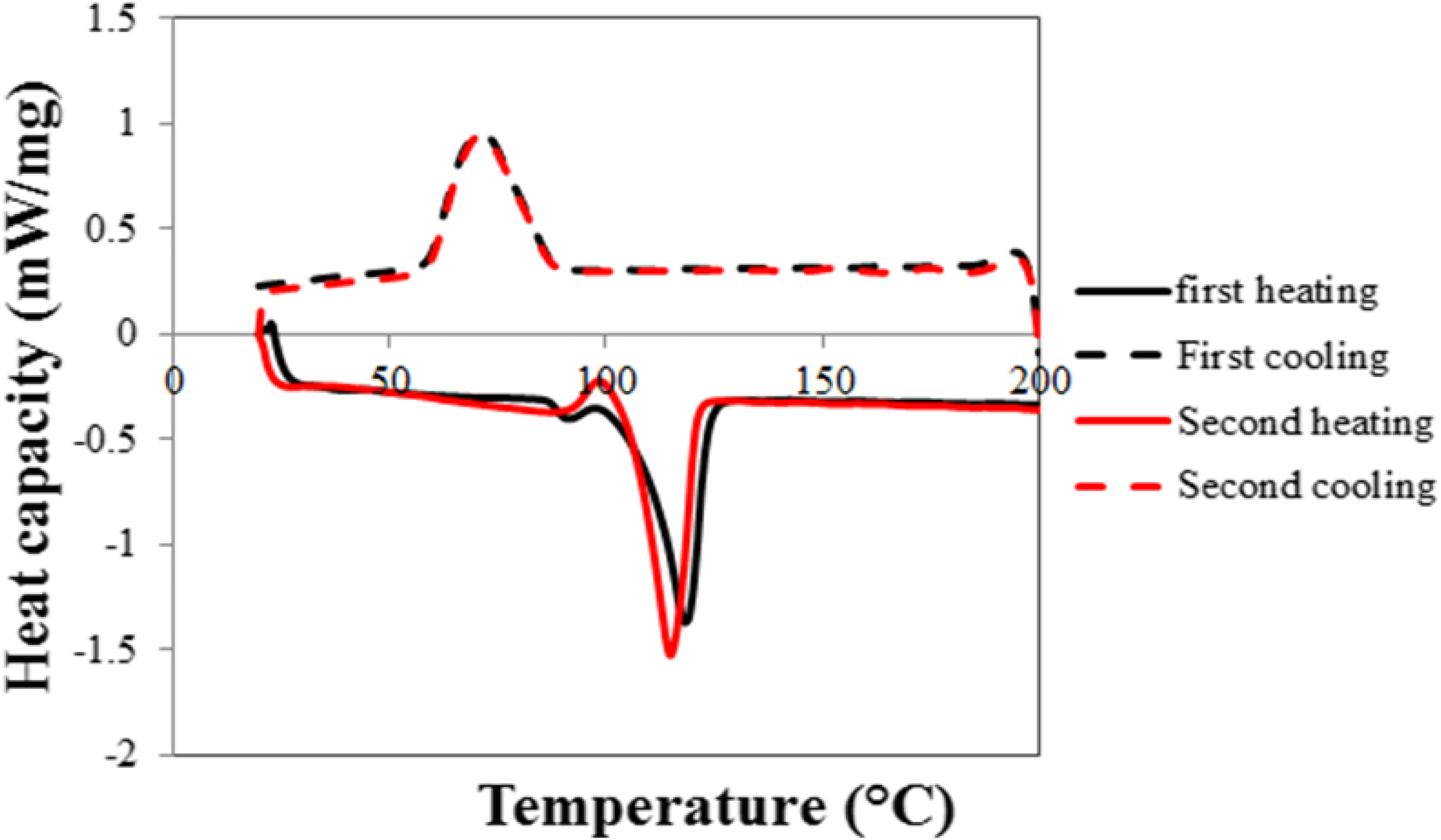
Tensile test
The mechanical properties of the virgin PBS and composites associated with the trunk fibers are illustrated in Figure 4. Unlike the virgin polymer which exhibits a ductile behavior, the composites associated with the trunk fibers have a brittle one. A significant improvement in the Young modulus was observed with further addition of the trunk fibers (Figure 5(a)). This is in agreement with the work of P. Noorunnisa Khanam and M.A. AlMaadeed
26
who found that reinforcing the ternary recycled polymer with DPFs increased the tensile modulus. Rigidity increased more and more with the enzymatically treated fibers up to 63% when compared to the Virgin PBS. The high cellulose content is thus a powerful parameter which could determine the mechanical properties of the resulting composite. Moreover, the modified fiber structure reduces the interfacial tension of composite components that allow a great interaction with the polymer.
27
Improving the fibers roughness with the synergy of the two enzymes, shown by Figure 2(d), is among the factors that could improve the interfacial adhesion which has a direct effect with the resulting mechanical properties. As for the tensile strength, the composite reinforced with raw fibers showed a drop of this property when fibers were added (Figure 5(b)). This drop reached almost 25% when applying 20% of raw fibers. At the same concentration of treated fibers, the tensile strength showed a slight increase. These results were further justified by the better water resistance obtained after enzymatic treatment. The failure strain (Figure 5(c)) decreased sharply with the addition of fibers compared to the virgin PBS. This was attributed to a lack of movement of the polymer chain when the fibers were added.
26
Composites including enzymatically treated fibers had a failure strain value which is lower than that of crude fibers at the same charge rate. Mechanical behavior of virgin poly (butylene succinate) and composites reinforced trunk fiber. Mechanical properties (a) tensile modulus, (b) tensile strength, and (c) failure elongation of virgin poly (butylene succinate) and composites filled with raw and enzymatically modified fibers.

Water recovery test
The water recovery test was performed in order to evaluate the influence of fibers enzyme treatment on the composites water absorption capacity. The water uptake test performed over a seven day-period showed that the water absorption rate increases with increase of the composite charge percentage (Figure 6). In fact, the more hydrophilic fibers introduced in the composite, the bigger the fiber–matrix or/and fiber–fiber formation contact area, leading to a high water percolation. According to Espert et al.,
28
the water absorption mechanisms are essentially limited to the introduction of water in the polymer micro-gap, the capillary water absorption favored by the existence of hydroxyl bonds in fibers, or the water circulation along the matrix–fiber interface. PBS reinforced with 20% of trunk fibers has an absorption rate of around 2.85% after 168 h. For a 20% reinforcement of treated trunk fibers, it is noted that the moisture absorption rate decreased when compared to composites containing 20% of untreated fibers. This was correlated to the elimination of the extractibles, lignin and hemicellulosic fractions, constituting the adhesive substances of the fibers. It can be assumed that the rough fibers obtained with the enzymatic treatment improved the interfacial bond with the PBS matrix, limiting the water molecules from percolating to the composite and ensuring moisture resistance. The improvement in the interfacial adhesion could generate a more efficient transfer of the stresses to which the composite is subjected. Water absorption of the reinforced composite with untreated trunk fibers and treated with mixed enzymes.
Conclusion
This work has shown that the PDF pre-treatment with NaOH at a concentration of 0.4 M improves enzymes penetration and action. Enzymatic treatment contributed to a significant removal of the amorphous components from the fiber surface, especially with pectinase succeeded by xylanase treatment and the combination of both xylanase and pectinase enzymes. This resulted in the cellulose bundles defibrillation and exposure. However, the treatment with the simultaneous action of both enzymes was shown to be more effective than that using each enzyme apart or successively taking into account time and effort saved. Moreover, better mechanical properties have been achieved with enzymatically treated fiber composites. The modification of trunk fibers with pectinase and xylanase enzymes can be an alternative to other traditional ones and an efficient method providing mild operating parameters, ecologically friendly materials, and high mechanical properties composites.
Footnotes
Declaration of conflicting interests
The author(s) declared no potential conflicts of interest with respect to the research, authorship, and/or publication of this article.
Funding
The author(s) received no financial support for the research, authorship, and/or publication of this article.
