



Abstract
Dielectric elastomer actuator (DEA) has broad application prospects because of their excellent properties. However, the need for high operating electric field limits their practical application. The natural rubber (NR) elastomer composite with excellent properties was obtained through the addition of high-dielectric-constant calcium titanate (CCTO) particles with modification by the deposition of poly(catechol/polyamine) (PCPA) and the graft of silane γ-(2,3-expoxypropoxy)-propytrimethoxysilane (KH560). The interaction and polarization were significantly enhanced at the interface of CCTO and NR matrix due to the participation for epoxy groups of KH560 in vulcanization reaction. In this paper, the 50 parts per hundred rubber (phr) CCTO-PCPA-KH560/NR composite revealed the largest actuated strain (11.38%), which was ∼4.48 times higher than that of pure NR composite (2.54%). And the CCTO-PCPA-KH560/NR composite revealed reinforced mechanical, dielectric, and electromechanical properties. In summary, this proposed approach is feasible, low cost, and helpful for the wide application of high-performance DEA.
Keywords
Introduction
Dielectric elastomer actuator (DEA) is able to convert electrical energy into mechanical energy. Due to its inherent nature, such as the large-strain actuation, high efficiency, excellent flexibility, and low density,1–4 DEA has been studied for applications in a wide range of emerging technology fields, including soft robotics,5,6 electromechanical transducers,7,8 tunable lens,9,10 and haptic devices. 11 However, DEA requires high operating voltage to drive, which could be harmful to humans and damage equipment. And it limits the practical utilization of DEA.12,13
Under the action of a high electric field, the DEA consisted of a thin film of dielectric elastomer (DE) sandwiched between two flexible electrodes which would deform under the Maxwell stress, resulting in a decrease in the thickness and an increase in width. Fundamentally, as compliant capacitors, the shapes of DEA were changed due to the difference in applied electric field.14,15 The actuated strain is closely related to dielectric constants and elastic modulus as expressed by the equation16–18

Therefore, increasing the dielectric constant is a crucial and efficient way of obtaining high actuated property with low electric field. Moreover, it has been found that the incorporation of high dielectric constant fillers can help increase the dielectric constant of DE.19–22 Although the dielectric constant of DE can be significantly increased when the concentration of conductive filler approaches the percolation threshold, it still results in high dielectric loss and low dielectric strength. So, ceramic particles have been widely concerned due to their high dielectric constant and low dielectric loss. As one of the typical ceramic fillers with supercapacitive performances, calcium copper titanate particle (CaCu3Ti4O12, CCTO) exhibits high thermal stability of dielectric response and giant dielectric constant (∼10,000) in the action of alternating current.23–25 The presence of transition metals (Cu and Ti) with variable oxidation states may promote pseudocapacitive behavior in CCTO. 26 Zhang et al. used CCTO particles and silicone rubber as fillers and matrix, respectively. The incorporation of modified CCTO particles enhanced the interfacial compatibility between fillers and polymer matrix. The obtained best composite had energy harvesting density of 0.69 mJ/cm3 and conversion efficiency of 3.36%, which were better than those of pure matrix. 27 Wang et al. also used CCTO particles as ceramic fillers but incorporated in poly (dimethyl siloxane) (PDMS) matrix. At a low electric field of 5 V/㎛, the greatest actuated strain of the best CCTO/PDMS composite (9.83%) was about 4.37 times than that of pure silicone elastomer (2.25%). 28
However, the absence of adhesion between the matrix and fillers could lead to inorganic filler aggregations and uneven distribution in the polymer matrix. 29 This is a major factor that affects the electromechanical properties of dielectric composite. Therefore, the key to the uniform distribution of fillers in matrix is to strengthen the interface compatibility between fillers and matrix. Many researches have shown that an effective method is used to solve the problem, which modifies the surface or graft chemical molecules onto the surface of particles. 30 Inspired by the outstanding adhering ability of mussel on almost all types of surfaces, dopamine can effectively improve the interfacial compatibility between the fillers and polymer matrix. 31 Nevertheless, due to the expensive price of natural dopamine, it could not be widely used. Thus, the development of a low-cost alternative is essential. Many studies have shown that catechol and polyamine may polymerize by undergoing Michael addition or Schiff base reaction under alkaline condition and exhibit outstanding adhering ability as natural dopamine.32–34 This is a feasible solution to overcome the defection, which have replaced natural dopamine with polydopamine (PDA) made from a low-cost CPA binary system (catechol/polyamine). Ning et al. used the PDA instead of natural dopamine to modify GO nanoparticles. Compared to the actuated strain of pure XNBR (0.2%), the actuated strain of GO-PDA/XNBR composite (2.3%) with the PDA thickness of 1.1 nm obviously enhanced at a low electric field (2 kV/mm). 35
In this work, we used low-cost catechol and polyamine to replace dopamine and obtained a PCPA layer. The CCTO particles with supercapacitor property were firstly co-deposited with poly(catechol/polyamine) (PCPA) and subsequent grafted silane γ-(2,3-expoxypropoxy)-propytrimethoxysilane (KH560) to form core-shell structure CCTO-PCPA-KH560 particles. Due to its inherent properties, including excellent mechanical, large breakage elongation, high elasticity, and low cost, natural rubber (NR) serves as a dielectric flexible matrix.31,36 The epoxy groups on CCTO-PCPA-KH560 particles participate in the vulcanization reaction of NR composite during crosslinking process and strengthen the molecular interfacial interaction, which can effectively avoid the aggregation of fillers and enable uniform distribution of fillers in the polymer matrix. Herein, the microstructure of particle and the effects of addition of modified CCTO particle on mechanical, dielectric, and electromechanical properties of NR composite were researched in detail. In summary, this proposed approach is feasible, low-cost, and helpful for the wide application of high-performance DEA.
Experimental
Materials
Calcium copper titanate (CCTO) particles were obtained from Kela Material Co., Ltd. Natural rubber was chosen as the main matrix. Catechol, polyamine (tetraethylenepentamine, TEPA), Tris, and KH560 were purchased from Shanghai Macklin Biochemical Technology Co., Ltd. Dicumyl peroxide (DCP) was supplied from Rhawn, China.
Preparation of CCTO-PCPA-KH560 particles
First, 0.36 g Tris was added into 300 mL deionized water to get an alkaline solution (PH = 8.5). Then, 0.81 g catechol and 0.45 mL TEPA were gradually added into alkaline solution, which formed a PCPA solution under constant stirring. Then, 60 g CCTO was added into the PCPA solution under constant stirring for 6 h at 40°C to yield CCTO-PCPA suspension. After that, 2 mL KH560 was gradually dropped into the above suspension and continually stirred for 5 h at 60°C. Last, the as-formed CCTO-PCPA-KH560 particles were washed with deionized water and dried in a vacuum oven at 60°C for 24 h.
Preparation of NR dielectric elastomer composites
First, the different amounts of dielectric particles (0, 10, 30, and 50 parts per hundred rubber) and 1.2 g of DCP were added slowly into 60 g of NR matrix, which was mixed by a two-roll mill to prepare NR composites. Next, the as-obtained NR composites were vulcanized at 160°C for 50 min.
Characterization
The surface chemical compositions of primordial CCTO and surface modified CCTO particles were determined by Fourier transform infrared spectrometer (FTIR, Therom Electron Corporation, USA) at room temperature. The phase composition of the particles was identified via X-ray diffractometer (XRD, Cu Ka radiation, Rigaku-D/max-2500). The weight loss of the particles was measured by thermogravimetric analysis (TGA) via the thermal gravimetric analyzer (TGA, USA) under N2 atmosphere. The microstructure of the particles was displayed on a transmission electron microscope (TEM, JEOL JEM-2100). The stress–strain curves were recorded by a CMT6104 material testing machine. The elasticity modulus was calculated by taking the slope at 10% strain. The dielectric constants were measured by a Novocontrol Alpha-A impedance analyzer. The actuated strain tests were performed by using a high voltage power supply and the processes were recorded with a camera. The area strain (Sa) was calculated according to the equation

Results and discussion
Characterization of shell-core CCTO-PCPA-KH560 particles
The schematic diagram of the reaction mechanism of CCTO-PCPA-KH560/NR composites is illustrated schematically in Figure 1. In an alkalescent Tris buffer solution, catechol is oxidized and generates the quinoid structure with four unsubstituted carbon and two quinones, which can react with TEPA by Michael addition or Schiff base reaction to form cross-linked networks.
32
Whereafter, the silanols are obtained due to the hydrolyzation of KH560, which react with the hydroxyl of the cross-linked network PCPA and further deposit on CCTO-PCPA particles surfaces to obtain CCTO-PCPA-KH560 particles. At last, the obtained CCTO-PCPA-KH560 particles would take part in the vulcanization reaction of NR composite to obtain CCTO-PCPA-KH560/NR composites. A schematic diagram of the reaction mechanism of CCTO-PCPA-KH560/NBR composites.
The TEM morphology images of bare CCTO, CCTO-PCPA, and CCTO-PCPA-KH560 particles are shown in Figure 2. As shown in Figure 2(a), the bare CCTO particles exhibit smooth surface. Under alkaline condition, the PCPA layer and KH560 are deposited on the surface of bare CCTO particle. Figure 2 (b) and (c) displays that the surface of the CCTO-PCPA and CCTO-PCPA-KH560 particles is fuzzy and has an amorphous layer, respectively. The thickness of the PCPA amorphous layer is about 2 nm. The thickness of the PCPA-KH560 amorphous layer increases to ∼4 nm, indicating that KH560 is successfully coated on the surface of CCTO-PCPA particles. TEM morphology images of (a) CCTO, (b) CCTO-PCPA, and (c) CCTO-PCPA-KH560 particles.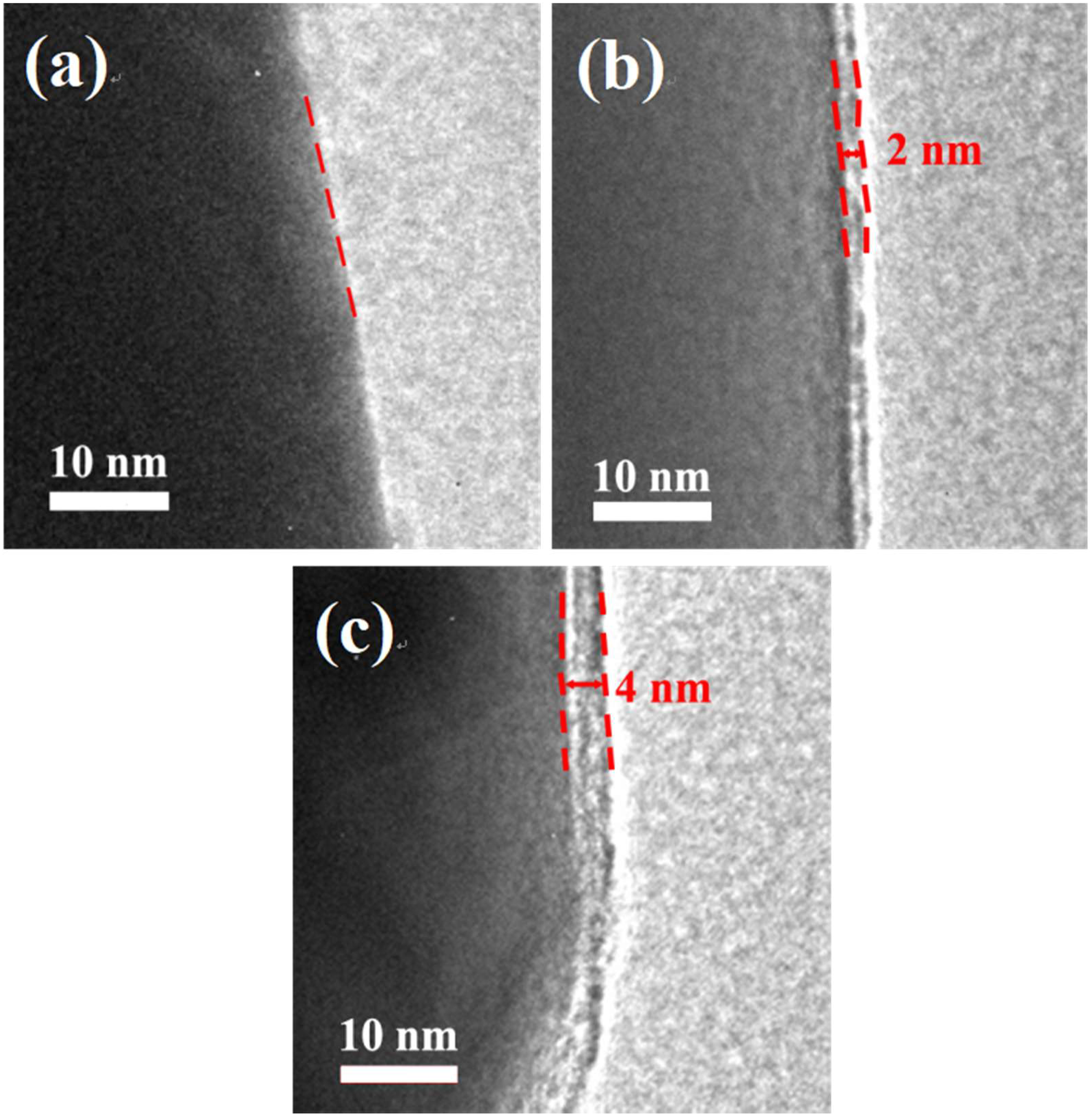
The XRD spectra obtained for the pristine CCTO, CCTO-PCPA, and CCTO-PCPA-KH560 powders are exhibited in Figure 3. The main diffraction peaks of pure CCTO powders correspond to the main planes of (110), (211), (220), (013), (222), (321), (400), (422), and (440), which is consistent with the cubic phase standard powder diffraction pattern (JCPDS card number: 75-2188). This indicates the presence of a cubic phase of CCTO powders. The XRD spectra of CCTO-PCPA and CCTO-PCPA-KH560 powders were the same as that of pure CCTO powders, confirming that the intact crystal structure was not destroyed when CCTO particles combined with PCPA and KH560. It can be seen that the precipitation of amorphous PCPA and KH560 has no effect on the crystal structure growth of CCTO powders. XRD patterns of CCTO, CCTO-PCPA, and CCTO-PCPA-KH560 particles.
The TGA curves of CCTO, CCTO-PCPA, and CCTO-PCPA-KH560 powders are shown in Figure 4. As shown in Figure 4, the weight of the particles was gradually decreasing when the temperature gradually rose to 800°C. The mass residues of CCTO, CCTO-PCPA, and CCTO-PCPA-KH560 particles were 99.79%, 98.88%, and 96.7%, respectively. And the weight loss of PCPA and KH560 was 0.91% and 2.18%. Combined with TEM morphology images and TG curve analysis, the results showed that PCPA layer and PCPA-KH560 layer were formed and successfully coated on the surface of CCTO particles. TGA curves of CCTO, CCTO-PCPA, and CCTO-PCPA-KH560 particles.
The FTIR spectra of CCTO, CCTO-PCPA, and CCTO-PCPA-KH560 particles are displayed in Figure 5. The FTIR spectra of all particles display strong peaks at around 3310 cm−1, which can be attributed to the O-H stretching. This phenomenon indicates the presence of -OH on the surface of CCTO particles and the possibility of functionalization and surface modification.
37
In the FTIR spectrum of modified CCTO particles, there are peaks at around 1650 cm−1, 1480 cm−1, and 1250 cm−1, respectively. The peak at 1650 cm−1 and 1480 cm−1 may be caused by the tensile vibration of benzene ring skeleton.
23
The absorption peak at 1250 cm−1 is contributed to the stretching vibration of C-O. This demonstrates that the catechol successfully reacted with TEPA to form PCPA layer and deposited on the surface of CCTO particles. Moreover, the absorption peaks at around 1540 cm−1 and 1099 cm−1 are characteristic absorption peaks of the C-N and Si-O-C, which is owing to the condensation reaction between the methoxy groups of KH560 and the PCPA layer hydroxyl groups.
38
Thus, it proves that KH560 was successfully grafted on the surface of PCPA layer. FTIR results of CCTO, CCTO-PCPA, and CCTO-PCPA-KH560 particles.
Mechanical properties of NR dielectric composites
The stress–strain curves of pure NR and NR composites are observed in Figure 6 (a) and (b). Compared with NR composite, the tensile strength of all the composites decreases after addition of dielectric fillers. The phenomenon may be contributed to some internal structural defects of the NR composites caused by the aggregations of ceramic fillers.
39
In addition, it is observed that the elongation at break of NR composites were higher than that of pure NR composite, which may be attributed to the decrease of crosslink density due to the interference of dielectric fillers on the crosslinking process.
40
However, it is found that the elongation at the break of the 10 phr CCTO-PCPA-KH560/NR composites displayed higher than that of 10 phr CCTO/NR composites. The elongation at break of the 30 phr CCTO-PCPA-KH560/NR composites was slightly higher than that of 30 phr CCTO/NR composites and the elongation at break of the 50 phr CCTO-PCPA-KH560/NR composites displayed even lower than that of 50 phr CCTO/NR composites. Generally, the elongation at break may be decided by the competitive effect of crosslink density and interfacial interaction. The lower crosslink density results in the smaller elongation at break, while the stronger interfacial interaction generates the larger elongation at break. The epoxy groups on KH560 take part in the vulcanization reaction of NR composite during crosslinking process, which enhanced the interaction compatibility between CCTO-PCPA-KH560 particles and NR matrix. However, this reduces the fluidity of NR chains, resulting in the reduction of elongation at break. Compared with the same amount of CCTO composites, the higher elongation at break of 10 phr CCTO-PCPA-KH560/NR composites is attributed to the lower crosslink density. When 30 phr CCTO-PCPA-KH560 particles were incorporated into the NR matrix, the strong interfacial interaction and crosslink density played a same role in the impact of elongation at break of NR composite. Nevertheless, when 50 phr CCTO-PCPA-KH560 particles were incorporated into the NR matrix, the strong interfacial interaction played a decisive effect which restricted the movement of NR molecular chains, resulting in the lower elongation at break of the composite. Hence, the tensile strength of 30 phr or 50 phr CCTO-PCPA-KH560/NR composites were lower than the same filler content of CCTO/NR composites because of their appropriate elongation at break. In summary, the elongation at break of NR composites was still higher than 600%, revealing excellent flexibility. The elastic modulus of pure NR and NR composites is graphed in Figure 6(c). When the content of dielectric fillers is less than 70%, the elastic modulus of NR composites decreased gradually with the increase of dielectric fillers, attributing to some internal structural defects of the NR composites caused by the aggregations of dielectric fillers. Furthermore, the CCTO/NR composites displayed the higher elastic modulus compared with CCTO-PCPA-KH560/NR composites under the same filler conditions. There are two possible explanations, as follows: (1) the relatively thick (∼4 nm) PCPA-KH560 layer leaded to the mechanical behavior of the part polymer so that the elastic modulus of CCTO-PCPA-KH560 particles was lower than that of original CCTO particles and (2) the crosslink density of NR composite was lower than that of pure NR composite at same filler content, as usually, the decrease of the crosslink density can cause a decrease in the elastic modulus. In addition, the elastic modulus of 70 phr NR composite increased sharply, which can be mainly attributed to the lots of filler networks formed by CCTO or CCTO-PCPA-KH560 particles. Stress–strain curves of (a) CCTO/NR and (b) CCTO-PCPA-KH560/NR composites and (c) the elastic modulus and dielectric constant at 1 kHz of CCTO/NR and CCTO-PCPA-KH570/NR composites.
Dielectric and electromechanical properties of NR dielectric composites
The curves of the dielectric constant ( Dielectric constants (a and b) and dielectric loss tangents (c and d) as a function of frequency for pure NR and NR composites.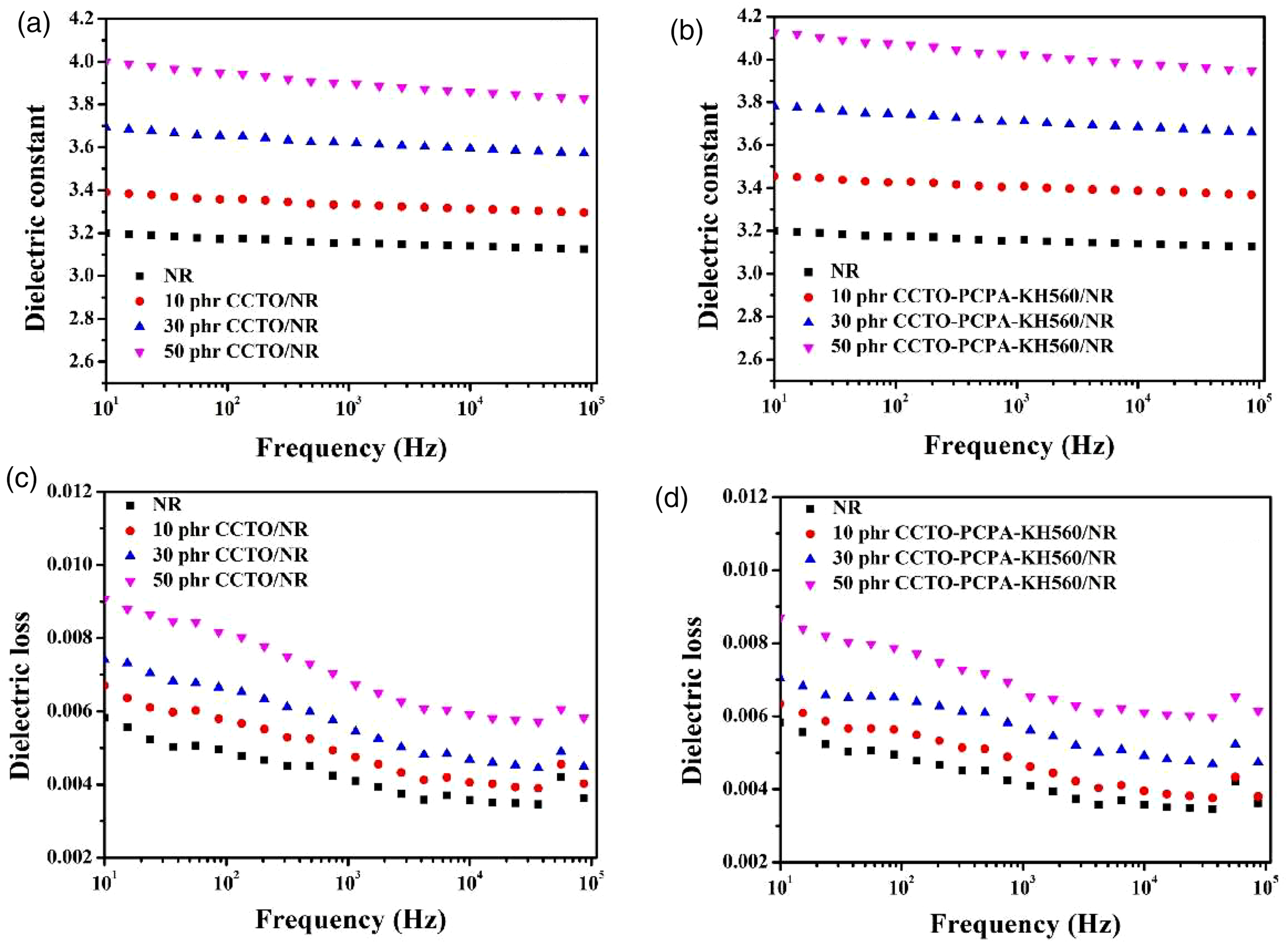
The actuated strains curves of pure NR and NR composites are shown in Figure 8(a) and (b). The electromechanical sensitivity β of pure NR and NR composites at different filler content is shown in Figure 8(c). By the addition of 50 phr dielectric fillers, the β values of NR composites were maximum, leading to the maximum actuated strain of 50 phr CCTO/NR or CCTO-PCPA-KH560/NR composites under the same electric field. The higher electromechanical sensitivity was also a reason why the actuated strains of CCTO-PCPA-KH560/NR composites were higher than that of CCTO/NR composites. Moreover, the breakdown field of the CCTO-PCPA-KH560/NR composites was higher than that of the CCTO/NR composites under the addition of 10 phr and 30 phr fillers. This is related to the insulative property of PCPA-KH560, which hindered the migration and accumulation of space charge and further prevents current leakage. But the breakdown field of 50 phr CCTO-PCPA-KH560/NR composites was lower than that of the CCTO/NR composites, owing to the polymer internal structural defects of the polymer caused by the aggregations of dielectric fillers. Although the electromechanical sensitivity β of 70 phr NR composite was lower, the actuated strain increased sharply at about 40 kV/mm. It can be interpreted as that the multiple filler networks were connected to form a larger conductive filler network at a large electric field. And the largest breakdown field of 10 phr CCTO-PCPA-KH560/NR composites (76.21 kV/mm) was obviously higher than that of pure NR composite (50.28 kV/mm). However, the 50 phr CCTO-PCPA-KH560/NR composites revealed the largest actuated strain (11.38%), which was ∼4.48 times higher than that of pure NR composites (2.54%) as shown in Figure 8(d). The higher actuated strain demonstrated the advantage of our work. Actuated strain of (a) CCTO/NR composites and (b) CCTO-PCPA-KH560/NR composites as a function of electric field, (c) electromechanical sensitivity of pure NR, CCTO/NR composites and CCTO-PCPA-KH560/NR composites, and (d) images of actuation of 10 phr CCTO-PCPA-KH560/NR composites at 0 kV/mm and 76.21 kV/mm.
Conclusion
Herein, the high-performance natural rubber (NR) composites were obtained through the addition of modified CCTO particles. We used low-cost catechol and polyamine to replace dopamine and obtained a PCPA layer. The CCTO particles with supercapacitor property were first co-deposited with PCPA and subsequent grafted silane γ-(2,3-expoxypropoxy)-propytrimethoxysilane (KH560) to form core-shell structure CCTO-PCPA-KH560 particles. Owing to strong interfacial interaction between CCTO-PCPA-KH560 particles and NR matrix, the mechanical properties of CCTO-PCPA-KH560/NR composites can significantly increase. The diversity of interfaces was the main factor to enhance the interfacial polarization, leading to the increase of dielectric constant. Due to the augment of εr and reduction of Y of NR composites, the 50 phr CCTO-PCPA-KH560/NR composites acquired the largest β value, resulting in the largest actuated strain (11.38%) which was ∼4.48 times higher than that of pure NR composite (2.54%). Moreover, the insulative property of PCPA-KH560 can reduce the leakage current to improve the breakdown field. In summary, this proposed approach is relatively efficient and low cost, which is helpful for the wide application of high-performance DEA.
Footnotes
Declaration of conflicting interests
The author(s) declared no potential conflicts of interest with respect to the research, authorship, and/or publication of this article.
Funding
The author(s) disclosed receipt of the following financial support for the research, authorship, and/or publication of this article: This work was supported by the Scientific Research Project of Tianjin Municipal Education Commission (2019KJ096)
