



Abstract
At present, puncture resistance and rheological performance of shear thickening fluid (STF) is an essential design requirement for a soft armour material (target sample). The target sample is prepared with a dip and dry process of STF impregnated woven polypropylene (PP) fabric. These samples were tested and compared with neat PP fabric. The penetration depth of target samples is highly sensitive to the coefficient of friction between the indenter’s nose shape geometry and the target sample. The STF is prepared by mechanical dispersion of synthesized microsphere silica microparticles at a volume fraction of 57% in polyethylene glycol (400 g/mol). The rheological response indicates that the prepared concentration of silica microparticles in the STF suspension is observed to have a better shear thickening effect. The viscosity of suspension is highly sensitive to silica aspect ratio, volume fraction and particle size distribution in this work. Tensile tests along with puncture resistance with different indenter nose shapes geometry (hemispherical, elliptical, flat and conical) have been performed in the present study. Results indicate that the energy absorption is more with the hemispherical indenter and less with that of the conical indenter, which is attributed to the minimum surface area of contact as compared to all other indenters. A total of 16 number of fabricated target samples with various coating thicknesses of STF impregnated fabrics achieved the desired tensile strength, modulus and puncture resistance.
Keywords
Introduction
Research is continuously growing every year in the personal protection system for military, police and forest industry sectors to improve the performance and to protect them from the risk of puncture attack.1,2 To tackle this problem, many researchers have chosen high-performance fabrics such as UHMWPE (ultra-high molecular weight polyethylene), Kevlar and carbon fabrics3–10 due to their high strength, and material stability, stacked multi-layered woven fabrics, which can provide ultimate protection, and functionally graded polymer materials11,12 that can provide desired properties in a specific direction. These are high-cost, complex manufacturing processes, and most suitable for high-risk ballistic applications. However, there are not many developments in low-risk soft armour materials to perform flexibility in the neck, arm and leg joints; also the protective effects become a challenge. 13
At present, there is an urgent need to develop soft armour which can support regular wear and as light weight to strength ratio as possible. The prepared target samples in this current article not only identify and develop the light weight material but also adopt a methodology for easy and quick manufacturing without compromising the performance of soft armour. To achieve this performance, 14 non-Newtonian shear thickening fluid (STF) has been developed by dispersing the 57% volume fraction 15 of silica microparticles in a polyethylene glycol (molecular weight 400 g/mol) career fluid 16 . The volume percentage of silica is selected with a better understanding of the shear thinning and thickening mechanisms. 17 The reinforced material woven PP fabric is considered most promising for low density, better weight-to-strength ratio, better fabric cover factor and best suitable for surface modification of fabrics in soft armour applications.18,19
The target samples are prepared using a dip and dry process (impregnation), and an STF impregnated woven PP fabric with various layer thicknesses is used to evaluate the penetration depth of various indenter nose shapes.20,21 Such as hemispherical, elliptical, flat and conical indenters were investigated systematically for the first time.
The puncture resistance result shows that the penetration ability of the target samples has a strong correlation with the indenter nose shape and surface area of contact friction between the fabric yarns.22–29 Tensile tests were also carried out with neat PP fabric and STF impregnated PP fabrics.
A prepared STF is analysed with various characterization techniques such as Fourier transform infrared spectroscopy (FTIR), X-ray diffraction (XRD), scanning electron microscopy (SEM), particle size analysis (PSA) and rheology. The obtained results have shown the improved behaviour of the prepared target samples under different testing conditions. Hence, the results of this analysis would be helpful in promoting the application of soft body armour.
Experimental
Materials
The chemicals and reagents used for preparation of STF are taken as purely analytical grade without any further purification. Polyethylene glycol (HO(C2H4O)nH) (molecular weight: 400 g/mol) and tetramethyl ortho silicate (TMOS) purchased from Sigma Aldrich,ammonia solution (NH4OH) purchased from Avantor Performance Materials India Limited and ethanol purchased from Chennai chemicals Co., Ltd. The woven PP fabric of 303 GSM, filament type: multifilament yarns, weave density: eight ends/cm, molecular weight: 80,000–90,000 g/mol and linear density: 80.4 tex were purchased from, Mudaliyar Enterprises, Hosur, Tamil Nadu.
Methodology
In this paper, the synthesis of STF is done using a facile and economic method. Also synthesized silica microparticles with uniform particle sizes, shape, better aspect ratio and higher volume fraction of particles can produce.
Synthesis of silica microparticles
An improved morphology, size and shape controlled silica microparticles were prepared by using water in oil, micro-emulsion method. 30 The reactant (tetramethyl orthosilicate) of 500 mL dissolving in organic solvents, 50 mL of absolute ethanol and 100 mL of deionized water mixture were stirred for 30 min and then ammonia (NH4OH) catalyst was added drop wise to increase the pH of 12 into the prepared mixture and stirred mechanically for 60 min at 80°C, and a white transparent homogeneous solution was obtained. Then the prepared samples were post cured at room temperature for 4 h. Finally, the settled suspension was collected through a filtration process followed by washing in ethanol to improve purity. Then the collected white powder was dried in a hot air oven for 6 h at 105°C. After cooling, the white powder was then kept in a clean silica crucible for calcination at 800oC for 3 h in a muffle furnace.
The obtained silica powder31,32 sample was characterized in FTIR which confirmed to the presence of the silica chemical compound, and XRD analysis confirmed the amorphous nature. In SEM analysis, irregular microsphere morphology was seen, and PSA determined the narrow distribution and average particle size.
Preparation of shear thickening fluid
The following steps are involved in the preparation of STF. The 57% volume fraction silica microparticles were dispersed in PEG 400 g/mol to obtain the basic solution in thick suspension form. It was diluted with an ethanol solution in a ratio of 1:3; to obtain a uniform distribution of silica microparticles within the suspension and also to ensure that particles were not agglomerated, the mixture was stirred for 12 h at a speed of 500 rpm at room temperature. Finally, a thick white coloured suspension fluid solution was obtained. The preparation process is shown in Figure 1. Schematic diagram showing the preparation method of shear thickening fluid and target sample.
The obtained fluid was characterized in a rotational rheometer where the rheological properties of the prepared fluid were showing the shear thickening behaviour under shear testing.
Preparation of target samples by impregnation process
The neat woven PP fabric was immersed in a prepared STF solution by using the dip and dry (impregnation) method. Figure 1 shows the target sample fabrication process, and the different STF layer thickness on PP fabrics was increased using the impregnation process. The STF impregnated samples were kept in a hot air oven at 80oC for 24 h in a vertical hanging position for curing. In order to increase the STF coating thickness, a layer-by-layer hot curing process was used in this work. The prepared STF and target samples are validated for their rheology, tensile and puncture resistance.
Results and discussion
Fourier transformed infrared spectroscopy analysis
The FTIR spectrum of synthesized silica microparticles was observed at room temperature in the range of 500–4000 cm−1. Figure 2(a) shows the FTIR spectra of the main silica peaks in the wave numbers of 805 cm−1 and stronger absorption peak of 1054 cm−1 are resulted from the symmetrical vibration and the bending vibration of Si-O. The wave number of 515 cm−1 is the bending vibration of Si-OH. The FT-IR spectrum of absorption peaks of the anti-symmetric H-O bond of the hydroxyl silicon groups shows that there is no trace of water observed in the wave number range of 4000–3500 cm−1. The single chemical compound present in this graph and also it indicates that the purity of silica was observed. Fourier transform infrared spectroscopy spectra of (a) synthesized silica microparticles and (b) shear thickening fluid impregnated polypropylene fabric.
Figure 2(b) shows the FTIR spectrum of prepared STF impregnated PP fabric, a hybrid chemical composition presented in this graph. The wave number of 3382 cm−1 is the stretching of hydrogen bonded O-H groups. The symmetric stretching vibration of CH2 groups of the main chain at 2873 cm−1, respectively, the CH3 bending vibration of 1452 cm−1 corresponding to the characteristic peak of PP. The spectrum of polyethylene glycol new absorption peaks at 1647 cm−1 bending vibration of C=O, the small bend of 1350 cm−1 is stretching vibration of CH2 and the characteristic peaks at 791 cm−1 stretching vibration of O-H, respectively. The silica particles present characteristic peaks at stronger absorption peaks of 1040 cm−1 resulting from the symmetrical vibration and 791 cm−1 the bending vibration of Si-O. The wave number of 950 cm−1 is the stretching vibration of Si-OH, respectively.
X-ray diffraction analysis
The XRD pattern of the prepared sample indicates only one broad peak at 21.3o and noisy diffraction peak is observed. Broadened XRD peak can be seen in Figure 3, which is for amorphous silica centred at 2θ close to our measured value.33,34 The broad angle XRD pattern of the synthesized silica exhibits a broad hump in the low 2θ region which shows the amorphous nature of the material because it does not exhibit any sharp diffraction peaks. This demonstrates that a high percentage of these particles are amorphous; no other impurity peak is present which represents purity of silica microparticles. Also, the broad peak indicates the smaller crystalline size of 4.479 Å, which was estimated using Debye Scherrer’s equation.
31
Powder X-ray diffraction patterns of synthesized silica microparticles.
Scanning electron microscope
Figure 4 shows the SEM image of the synthesized silica particles at 2.0 kX magnification. From the figure, it can be seen clearly that synthesized particles have irregular microsphere morphology. The regular microspheres of the microparticles are capable of improving viscosity at low critical shear rates for shear thickening effect because it creates closer contact surface areas of the frictional interaction between particles to particles. It influences the flow of particle size in STF suspension. The irregular shapes of microsphere particles having a better shear thickening effect than spherical shape silica particles.
35
Scanning electron microscopy micrograph of synthesized silica particles.
Particle size analysis
1gm of synthesized silica particles was mixed in 100 mL of distilled water. Each sample was sonicated in an ultrasonicator for 30 min before the measurement. The obtained average particle size was identified as 370 μm. Figure 5 shows the particle size distributions of silica microparticles are observed to be narrow in the graph. The narrow size silica particles present in the STF suspension it effect, causes in the shear viscosity improvements in rheological measurements. Particle size analysis of synthesized silica particles.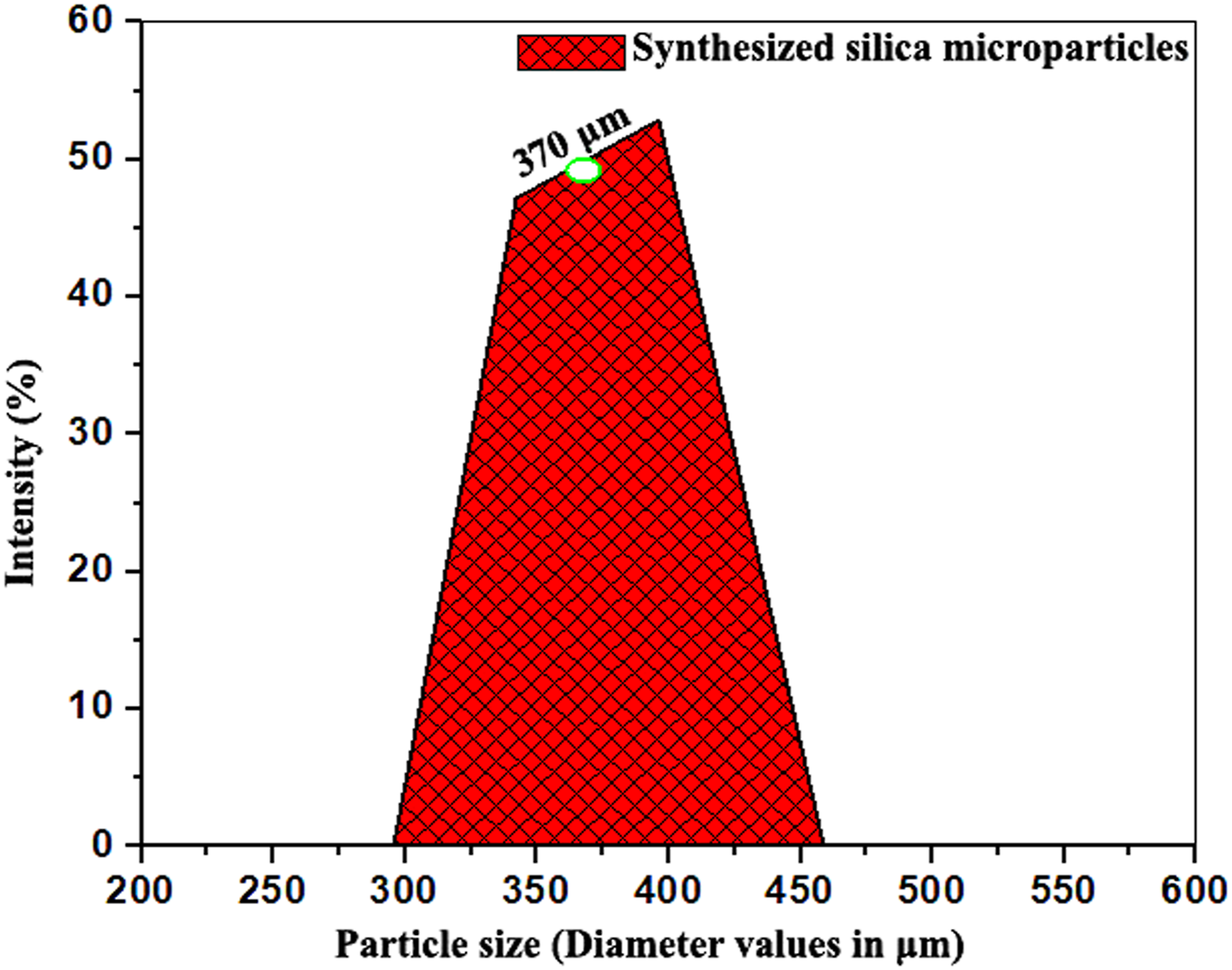
Rheological behaviour of prepared shear thickening fluid
The prepared STF suspension was measured with Anto paar – MCR 301 series, rotational rheometer instrument, the test performed in parallel plate geometry with a diameter of 25 mm was used and gap was set as 0.5 mm. The rheological property of the prepared fluid viscosity is highly sensitive to synthesized silica particle size, shape, volume percentage and career fluid molecular weight. The test result of the fluid suspension exhibits shear thinning and thickening behaviour as observed in Figure 6. Effects of viscosity with shear rate of shear thickening fluid for the suspension of silica microparticle in polyethylene glycol 400 career fluid.
The shear rate versus viscosity of the prepared fluid performs, and shear stress was observed as a function of rotational shear rate over several minutes (0–300·1/s). The fluid is in zero shear rate, and it is in equilibrium condition; if we gradually increase the shear rate, the fluid particles start to agglomerate, and the fluid viscosity get decreased in what is called the shear thinning zone in the range of 0–12.61·1/s. At the critical shear rate point (12.61·1/s), the fluid phase changes its nature from shears thinning to shear thickening, and there is a gradual increment in viscosity from 8.70 Pa s to 19.45 Pa as was observed in Figure 6.
Next, the transient stress exhibited a fluid maximum viscosity reaching period of induction (slow separation of particles in the suspension) during which the viscosity gradually reduced as reported in Figure 6. The phenomenon was explained by the supra-molecular structure formed during flow. 36 The understanding of the flow behaviour or rheology of prepared suspensions and how this flow behaviour can be manipulated is important to improve soft armour application.
Tensile test
The tensile test was performed on a universal testing machine (UTM) (load cell 100 kN, USA, made Instron model 3382). The maximum load, elongation at break, tensile strength and Young’s modulus were raw data taken from the machine. Target samples were prepared following ASTM D3039 and had a dimension as 300 mm × 50 mm. The gauge length was 200 mm, and the samples were loaded at a speed of 5 mm/min.
Tensile properties of neat and shear thickening fluid impregnated polypropylene fabrics.

STF: shear thickening fluid; PP: polypropylene.

Stress - strain curve of neat polypropylene and shear thickening fluid impregnated polypropylene.
The tensile strength and modulus values of the target samples are given in Table 1. The presented values are recorded with video extensometer; the tensile strength and modulus are calculated with the stress total area of cross sectional for each sample is determined. 36
The stress–strain graph of the fabricated samples undergoes elastic modulus or plastic deformation, ultimate tensile strength and elongation at break. The strain decreases while strength is increased by increasing the STF impregnated layer thickness due to the target samples have different elastic modulus. This can be observed in single and double STF impregnated fabric layers where strain percentage is higher than in neat fabric; it is due to the thin coating of STF layers having more elastic properties compared to neat and triple layer STF fabrics. These strain percentage variations can be seen in Figure 7.
The understanding of the stress–strain curve both in neat and STF impregnated target samples follow a similar variation in tensile strength that increases by increasing the STF impregnated layer thickness, and the different strain percentages were observed for each material. The obtained values are revealing of the effect of the coating density of the fabrics. Moreover, the high denser fabric coating leads to loading failure at a certain limit, and the strain percentage is decreased. The neat fabrics have uniform variations in stress and strain displacement. 37
Puncture resistance test
The puncture resistance test was performed on UTM (load cell 100 kN, USA made Instron model 3382) with a loading velocity of 400 mm/min. The puncture tests were performed with different nose shape of indenters such as hemispherical, elliptical, flat and conical (cone half angle is 45°). The schematic diagrams for these indenters are shown in Figure 8(a)–(d). All the four indenters used in this analysis are steel materials with a diameter of 12.7 mm, and a total length of 150 mm has been used. (Figure 9) Schematic representation of different nose shape puncture resistance indenter (a) hemispherical, (b) flat, (c) elliptical and (d) conical. Effects on different indenter geometry puncture resistance of load versus deformation (a) hemispherical, (b) flat, (c) elliptical and (d) conical.

The puncture resistance test was conducted following ASTM D6264 by applying a concentrated load of 400 mm/min on the specimens having a square cross-section of 150 mm × 150 mm. The target material is fixed in between two steel frames with an inner diameter of 100 mm and an outer diameter of 200 mm. The two frames are joined by C clamps and tightly fixed in all the directions.
Puncture resistance test of neat and shear thickening fluid impregnated polypropylene fabrics.

STF: shear thickening fluid; PP: polypropylene
The maximum load versus deformation curve is ploted for all the target samples. The target samples are tested under compressive shear loading conditions and perforated with different nose shape indenters.
The deformation and penetration depth of all the target samples are observed in hemispherical, flat, elliptical and conical indenters. The significant effect of hemispherical and flat indenters perforating the target samples enhanced high peak load and smaller deformation as compared with elliptical and conical indenters. Although the various fabric damages observed in punctured target samples are visually identified, the hemispherical and elliptical indenter causes the bulge enhanced after fibre fracture occurred, and flat indenter causes disk shear failure occurred and the conical indenter which leads to dimond shear fracture and it penetrates rapidly to the fabric surface as compared to the other indenters.20,21
Conclusion
In this analysis, experimental evidence is presented for the effect of tensile and static puncture resistance tests carried out with different indenter nose shape geometry on neat PP fabric and three different layer thickness STF impregnated PP fabrics to prepare a low-risk soft armour material. The behaviour of STF is important in this work; it is controlled by multiple factors like silica concentration, morphology, particle size and distribution in polyethylene glycol. The silica microparticles distribute the energy due to friction force between indenter and target sample. For employing the micro-emulsion method, amorphous silica microparticles were synthesized and characterized using various techniques. The rheological analysis showed that the selected volume fraction of silica microparticles is effective at increasing the viscosity of prepared STF and shows shear thickening behaviour. The effect of STF impregnated target samples improves tensile, and puncture resistance increases with increasing STF layer thickness. Finally, the triple layer STF impregnated fabric shows maximum energy absorption, observed tensile strength, modulus and all the punch shear indenters with less depth of penetration than the other target samples. The data presented in this analysis improves the performance of personal protection systems for military, police and forestry industry sectors and also to understand the protection levels of prepared target samples.
Footnotes
Acknowledgements
The authors wish to express their sincere thanks to Dr S. K. Nayak, Director General and Dr K. Prakalathan, Director and Head, Central Institute of Petrochemicals Engineering and Technology (CIPET): CSTS - Madurai, Tamil Nadu, India, for the help rendered during characterization and polymer testing lab facilities. The authors also wish to thank Dr K. P. Bhuvana, Scientist at CIPET: School for Advanced Research in Polymers (SARP)-Advanced Research School for Technology and Product Simulation (ARSTPS), Chennai, Tamil Nadu, India, for her support in carrying out this investigation. The authors also wish to thank Dr R. Joseph Bensingh, Senior Scientist and head, CIPET: School for Advanced Research in Petrochemicals (SARP)-APDDRL, Bengaluru, Karnataka, India, for his help in carrying out this investigation. I dedicate this work to the government of India, ministry of defence.
Declaration of conflicting interests
The author(s) declared no potential conflicts of interest with respect to the research, authorship, and/or publication of this article.
Funding
The author(s) received no financial support for the research, authorship, and/or publication of this article.
