



Abstract
A novel surface finishing method named magnetic shear thickening finishing that combines the intelligent shear thickening fluids and magnetic field action is proposed. The magnetic shear thickening finishing media, which is a combination of carbonyl iron particles and SiC particles in a base medium of shear thickening fluids, is developed. The finishing processes were experimentally characterized to verify the performance potential of the proposed method and developed magnetic shear thickening finishing media. Experimental results demonstrated that the developed media is effective for surface finishing compared with finishing media without shear thickening fluids. The surface roughness value of the testing sample was reduced to 54 nm from an initial value of 1.17 μm. Scanning electron microscope observations showed that the scratches were removed obviously and a smooth surface was obtained.
Introduction
Magnetic field–assisted finishing techniques have elicited considerable research interest,1–3 in which a flexible brush formed by magnetic field domination is employed to navigate against and across workpiece surfaces. Flexibility, self-sharpening, and self-adaptive are typical characteristics of the magnetic abrasive brush.
A magnetic abrasive finishing (MAF) tool was developed for finishing blind holes, grooves, and vertical surfaces, and the surface roughness decreased to 56 nm from 0.541 μm in finishing stainless steel (SS304) pipe. 4 To increase the efficacy of MAF process, an ultrasonic-assisted magnetic abrasive finishing (UAMAF) process was investigated. 5 A hardened steel workpiece (AISI 52100) with surface roughness of 22 nm was achieved using UAMAF process. 6 As a smart fluid, magnetorheological (MR) fluids can be finely and reversibly controlled by an applied external magnetic field. A freeform component similar to knee joint implant was finished to nanometer surface roughness value. 7
Shear thickening fluids (STFs) have attracted attention in areas such as body armor systems, damping devices, and smart structures because of its unique characteristic exhibiting an abrupt increase in viscosity.8–10 Recently, STFs composites including additive particles in the suspensions have been developed to investigate their rheological properties. 11 The advantages of MR fluids and STFs are reported in a combined manner by inserting iron particles into the base medium of STFs, which possesses reasonable passive response as well as the MR effect in case of external magnetic field.12,13 MR fluids cause a viscosity change to a semisolid state in the presence of magnetic field. However, the STFs exhibit potential for changing properties with respect to loading conditions with no external power sources. It is of significant interest in using STFs in magnetic field–assisted finishing for the improvement of finishing efficiency.
A novel finishing method named magnetic shear thickening finishing (MSTF) by combining MAF and STF is proposed in this study. MSTF materials are developed as the finishing media, which is a combination of carbonyl iron particles, SiC particles, and STFs. The fabrication processes of MSTF media and the experimental studies for Ti–6Al–4V finishing were conducted to verify the potential applications of the developed media.
Principle
A schematic of the MSTF procedure is illustrated in Figure 1. The carbonyl iron particles and SiC particles are dispersed uniformly in the MSTF media, as shown in Figure 1(a). The MSTF media are attracted along the magnetic force lines as a flexible brush because of the applied magnetic pole action. The formed magnetic brush contacts with the workpiece surface, a relative friction between the surface of workpiece and magnetic brush is produced because of the relative rotation of magnetic pole and the feeding movement of workpiece. As shown in Figure 1(c), a particle cluster is formed because of the STFs thickening behavior, in which the packed particles disorder and aggregate. This disorder transition causes extreme increase in the viscosity. The formed stiff semisolid cluster is helpful to improve surface finishing efficiency. Surface finishing is effectively realized with the surface peak removing as shown in Figure 1(d).
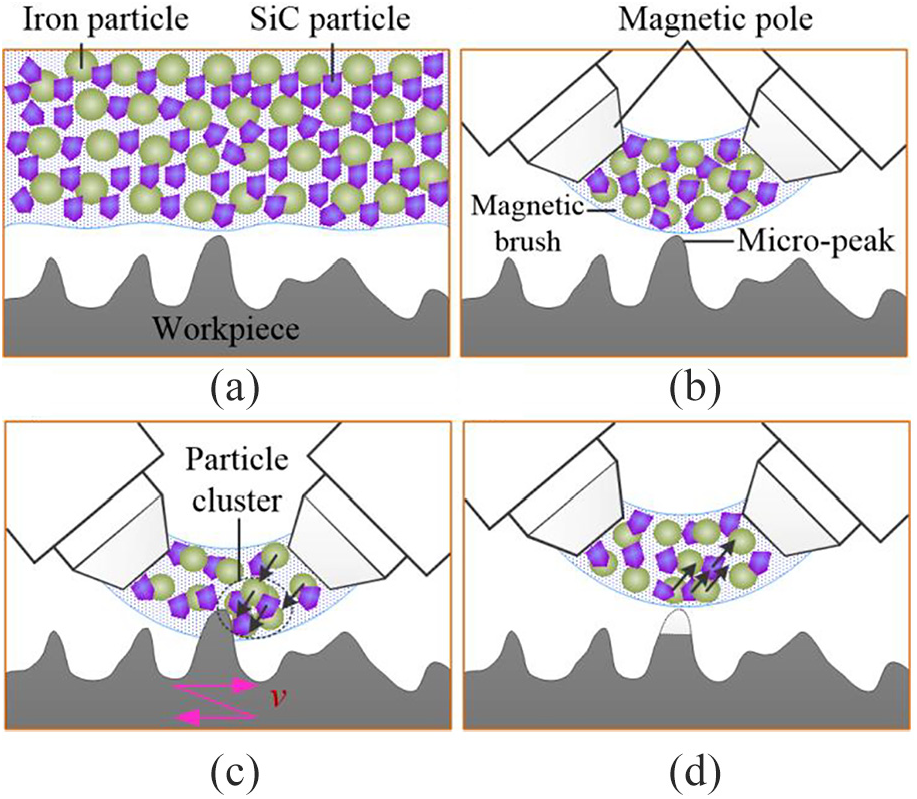
Processes of magnetic shear thickening media–based surface finishing. (a) The MSTF media has no contact with the workpiece, (b) a magnetic brush is formed under the magnetic pole action, (c) a particle cluster is created as the packed particles disorder and aggregate, and (d) the surface peak is removed.
Finishing media preparation
In the sample preparation stage, the MSTF media was prepared based on STFs, carbonyl iron particles, and SiC particles. The base fluid was polyethylene glycol (PEG) with molar mass of 200 g/mol. Fumed silica with primary particle size of 50 nm was adopted and mixed directly with PEG 200. The mixture was mechanically blended for 1 h with the stirring speed of 3000 r/min and heated at a temperature of 80°C. The solid contents of 15 and 20 wt% were fabricated for experimental investigations. Figure 2 shows the rheological behavior of pure STF under steady shear. A rheometer (MCR 302; Anton Paar, Ostfildern, Germany) was used for the measurements at 25°C using 50-mm diameter parallel plates with a testing gap of 0.5 mm. It can be stated that the viscosity acts as a function of shear rate. The viscosity increase occurs at the critical shear rate. Then, the viscosity decreases with shear rate exhibiting a shear thinning behavior. The STFs samples with higher concentrations of fumed silica had a higher initial viscosity.14,15 The shear thickening behavior of STFs was employed for the finishing process.
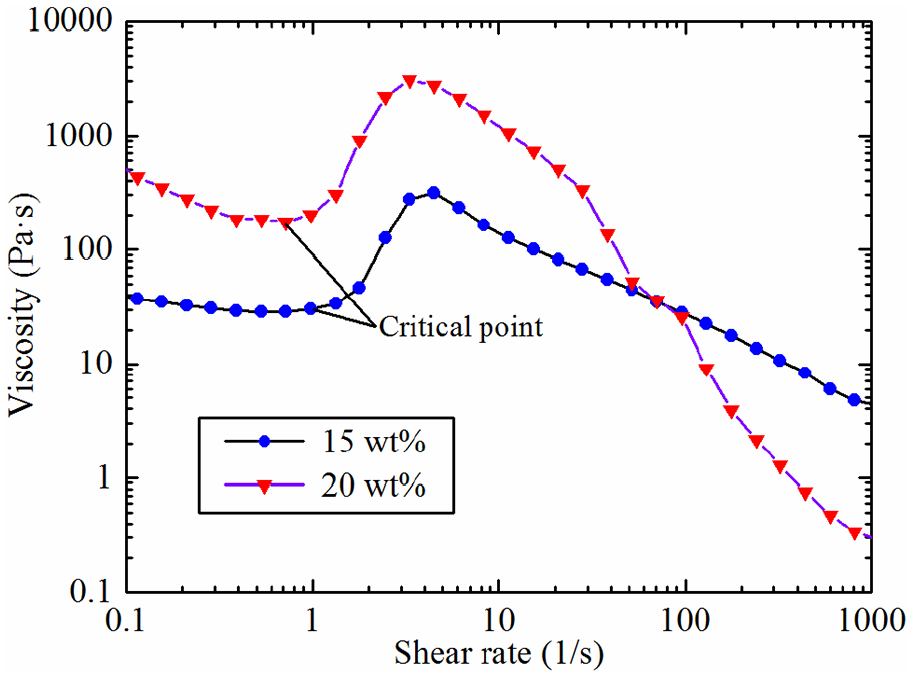
Rheological curves with various solid contents.
Carbonyl iron particles with an average size of 250 µm and SiC particles with an average size of 150 µm were used as additives in the STFs. Carbonyl iron particles and SiC particles loadings were 25 wt% in the MSTF media. The additives were added gradually to the STFs with a stirring speed of 3000 r/min in an ambient environment. From the observations, the viscosity increased as the amount of particles added increased because solid particles exhibit stronger inter-particle adhesion and thus the viscosity of the fluid increases. This is verified by the rheological measurements in previous studies. 16 A coupling agent of 0.1 mL/100 g was added to the mixture to enhance the solid state of MSTF media, which helps to make MSTF media stay on the end of the finishing tool as a stable brush. The STFs were changed to a stiff semisolid. Finally, the MSTF media was obtained after the placement into a vacuum chamber for 12 h to eliminate bubbles. Figure 3(a) displays the images of MSTF media. The particles were thoroughly mixed with STFs. Figure 3(b) shows a photograph of MSTF media attached on a designed finishing tool integrated with four magnetic poles. Four protrusions are formed on a baffle plate as the finishing brush under the action of the provided magnetic field.
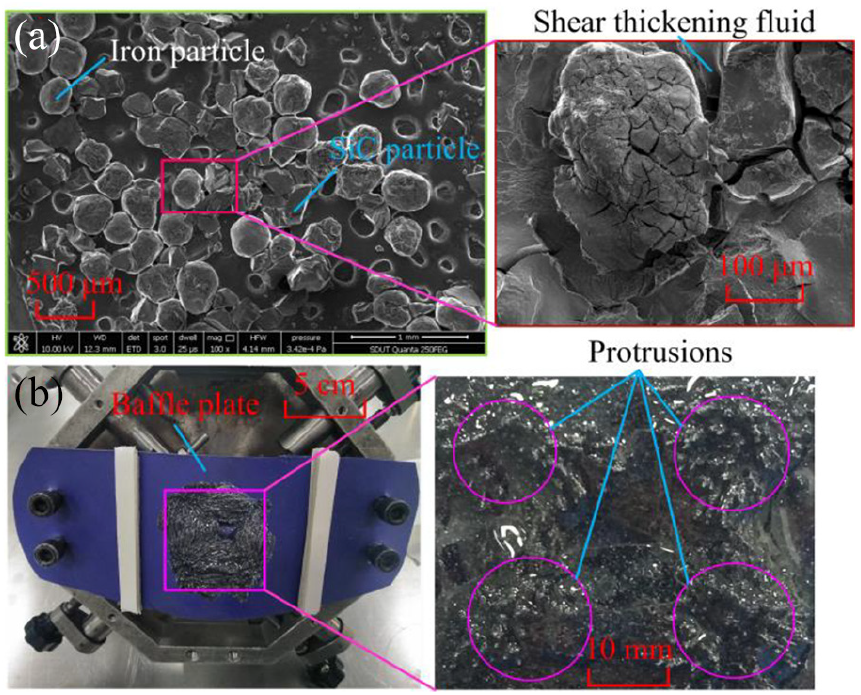
Images of MSTF media: (a) SEM images and (b) four protrusions formation.
Results and discussions
Experiments of surface finishing for Ti–6Al–4V workpiece were conducted to verify the effectiveness of the developed MSTF based on an experimental platform in our previous work. 17 The initial surface roughness value of Ti–6Al–4V workpiece is 1.17 μm. The feed rate is 15,000 mm/min, the spindle rotational speed is 900 r/min, and the working gap is 0.8 mm. Figure 4 states results of surface roughness (Ra) change with various solids contents of STFs. The surface roughness decreases with the finishing time increases. Comparing with finishing media without STFs (0 wt%), MSTF media is effective for surface finishing because of the STFs action resulting in high viscosity. However, a higher solid content (20 wt%) of STFs resulted in a lower finishing efficiency especially in the initial 10 min because of the higher solid content with too big viscosity of MTSF media, which reduces the fluidity of SiC abrasives thereby obstructing the formation of clusters, and the relative friction between workpiece surface and SiC abrasives. The final surface roughness of 54 nm was obtained in 45 min using the MTSF media with 15 wt% STFs.
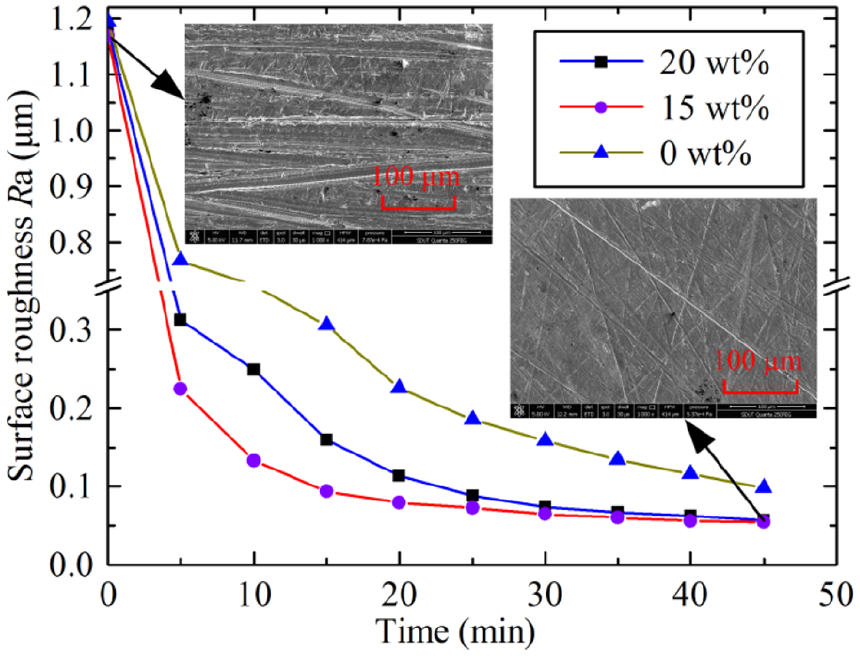
Surface roughness change with various solids contents of STFs.
Surface observations were conducted by a field-emission scanning electron microscopy (FE-SEM, FEI Sirion 200, Hillsboro, OR, USA) for more details. The changes in SEM morphology before and after finishing were shown in Figure 4. It is clearly seen that the initial surface is chiefly characterized by deep scratches and melted–solidified layer was created by wire-electrode cutting. The scratches were removed and a smooth surface was obtained. It is worth to notice that the left behind grinding marks were very shallow and discontinuous on the finished surface because of the friction of abrasive particles. However, if required, smoother surface can be obtained by further finishing with finer abrasives.
Conclusion
A novel finishing media named MTSF media for surface finishing was developed. Carbonyl iron particles and SiC particles were used as the additives in the STFs and the rheological behavior of pure STFs with solids contents of 15 and 20 wt% were investigated. Additives provide an opportunity to modify the fluidity of the MTSF media. A finishing brush was formed under the applied magnetic pole action. Experimental tests were conducted to verify the performance of the developed finishing tool for Ti–6Al–4V workpieces finishing. Experimental results showed that the developed media is effective for surface finishing. Surface roughness value was reduced to 54 nm from an initial value of 1.17 μm. SEM observations demonstrated that there was no obvious scratches left after finishing and a smooth surface was obtained. The findings suggest that this approach could be useful in precision finishing field.
Footnotes
Declaration of conflicting interests
The author(s) declared no potential conflicts of interest with respect to the research, authorship, and/or publication of this article.
Funding
The author(s) disclosed receipt of the following financial support for the research, authorship, and/or publication of this article: The authors gratefully acknowledge financial supports by the National Natural Science Foundation of China (Grant Nos 51875329 and 51905323), Taishan Scholar Special Foundation of Shandong Province (tsqn201812064), Shandong Provincial Natural Science Foundation, P.R. China (Grant No. ZR2017 MEE050), and Shandong Provincial Key Research and Development Project, P.R. China (Grant No. 2018G GX103008), Scientific Innovation Project for Young Scientists in Shandong Prvincial Universities (2019KJB030), Key Research and Development Project of Zibo City (2019ZBXC070).
