



Abstract
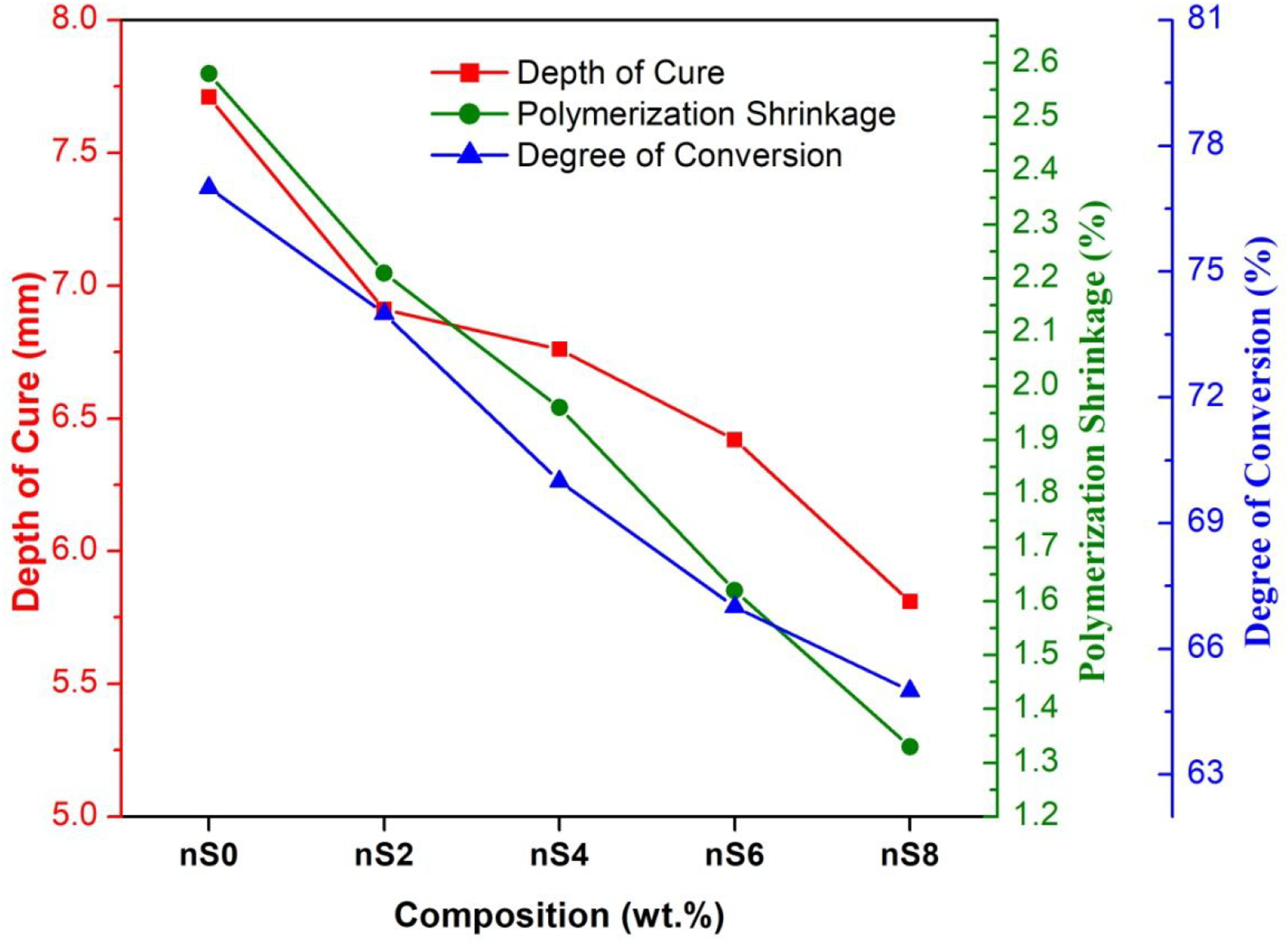
The objective of the article is to explore the fabrication of dental restorative composite materials and the ranking order using the preference selection index (PSI) as a multi criteria decision making (MCDM) technique under a set of conflict performance defining criteria (PDCs). The polymer matrix of the dental restorative composite was prepared using bisphenol a-glycidyl methacrylate (55 wt.%), triethylene glycol dimethacrylate (44 wt.%), camphorquinone (0.3 wt.%), and ethyl 4-(dimethylamino) benzoate (0.7 wt.%). Five different dental restorative composite material compositions were fabricated using hybrid nSiO2-TiO2 particulates with a variation of nSiO2 (0, 2, 4, 6, 8 wt.%) while TiO2 is constant (15 wt.%). The results revealed that an increasing trend has been found in compressive strength, flexural strength, Vickers hardness, etc., while a decreasing trend has been shown in depth of cure, polymerization shrinkage, degree of conversion etc. The performance analysis of five dental composite formulations via the PSI method shows the following ranking order: nS4 > nS6 > nS2 > nS0 > nS8. The obtained experimental results are associated with the ranking order of the different sets of dental composite formulations. Hence, the preference selection index approach is one of the best techniques among MCDM techniques for ranking under different PDCs.
Keywords
Introduction
Due to their aesthetic properties, dental resin composite materials have been widely employed instead of dental amalgam materials. 1 Dental resin composites have good physical, mechanical, chemical, optical, thermal, and tribological (wear) properties with great aesthetic nature than old and amalgam-filled materials. 2 Composite materials have superior properties to the plain polymer matrix. Resin matrix (organic) and ceramic (inorganic) fillers are two major constituents of dental restorative composite materials. 3 The resin matrix’s main elements are monomers, 4 diluents, 5 photo initiators, 6 accelerators, 7 and coupling agents. 8 The hybrid filling technique has been widely employed for dental restorative composite materials. In recent years, nano particles and nano fibers are typically employed as novel fillers due to their excellent aesthetic, bioactivity, and biocompatibility properties. 9
Different composites have been fabricated by adding together polymers and reinforcements with multiple factors and multi-levels. Therefore, it is not very easy to choose the optimal solution from the set of criteria. The optimal performance selection may be found by multi attribute decision making (MADM) or multi criteria decision making (MCDM). MCDM/MADM is a powerful optimization technique employed to select/choose one or more materials from a set of alternatives and also gives a definite configuration for material selection/choice based on the assessment of different conflict criteria. Goh et al. 10 approved the combination of AHP (analytic hierarchy process) and TOPSIS (the technique for order of preference by similarity to ideal solution) for a large pump mill electrical system. It deals with the electric loads ranking order according to the levels of the system and extracts a needless electric load from the system. A study was also investigated about implementing the MCDM (hybrid AHP-TOPSIS) technique for electronic industries to overcome its barriers. 11 Chen and Yang 12 proposed multiple attribute group decision making (MAGDM) for robust rank selection in the fields of economy, environment, and management suppliers. Boran et al. 13 proposed the Fuzzy with TOPSIS technique to provide the right time, right quality, and the right price for the supplier selection problem in the group decision making environment. The Hybrid FAHP-FTOPSIS technique has been widely used in different applications for weight criterion and ranking.14–17 Maniya and Bhatt 18 suggested the application of the preference selection index (PSI) approach for the selection of materials from a set of mechanical results. A study has been investigated into the PSI approach used in the parameter settings on the lesser cutting machine for quality and productivity. 19 Attri and Grover 20 applied the PSI technique to the decision making during the life cycle of the production system. The PSI approach has been applied to give the rank among a set of conflict criteria in alloy composite materials.
Based on the above literature, this paper investigates the design, fabrication, and evaluation of mechanical, physical, and chemical properties, and finally, the use of the hybrid PSI technique to predict the optimal formulation and ranking of the alternatives for dental restorative composite materials.
Experimental details and methodology
Details of dental composites designation and composition structure.

Preference selection index method algorithm18,20,26–30
The PSI technique comprises the following steps:
Determine the objective of the given problem and identify the relevant selection criteria for the evaluation of the set of alternatives. As per previous literature, the hierarchy structure of the complex decision making problem clarifies the problem. The decisive objective must be at the upper portion, evaluating criteria at the middle part and alternatives/options lie at the lower portion of the hierarchy structure (Figure 1).

The hierarchy structure of investigated problem.
Formulate the initial decision matrix, A
Discover the normalized decision matrix (B
ij
) in which the data of the given matrix are expressed using the following equations: • for larger-the-better (beneficial) criteria • for smaller-the-better (non-beneficial) criteria


Calculate the mean values of normalized performance for each criterion using the following equation
Compute the preference variation value for each criterion using the following equation
Calculate the deviations value of the preference for each criterion using the following equation For uniformity, the summation of overall preference value for all the criteria should be unity, that is, Σ ρj = 1.
Compute the criteria weights using the following equation
Express the preference selection index of alternatives using the following equation
According to the preference selection index values of the set of alternatives, compute the ranking of alternatives. The alternative which has the highest preference selection index indicates the best ranked alternative.
Results and discussion
Physical, chemical, and mechanical characterization
Results of different dental composite restorative composite materials for decision matrix.


The variation in compressive strength, Vickers hardness, flexural strength, and flexural modulus of different dental restorative composite materials.
The variation in the density, void content, water sorption, and water solubility of dental restorative composite materials.

The variation in depth of cure, polymerization, and degree of conversion of different dental restorative composite materials.
Determinations of PIS method
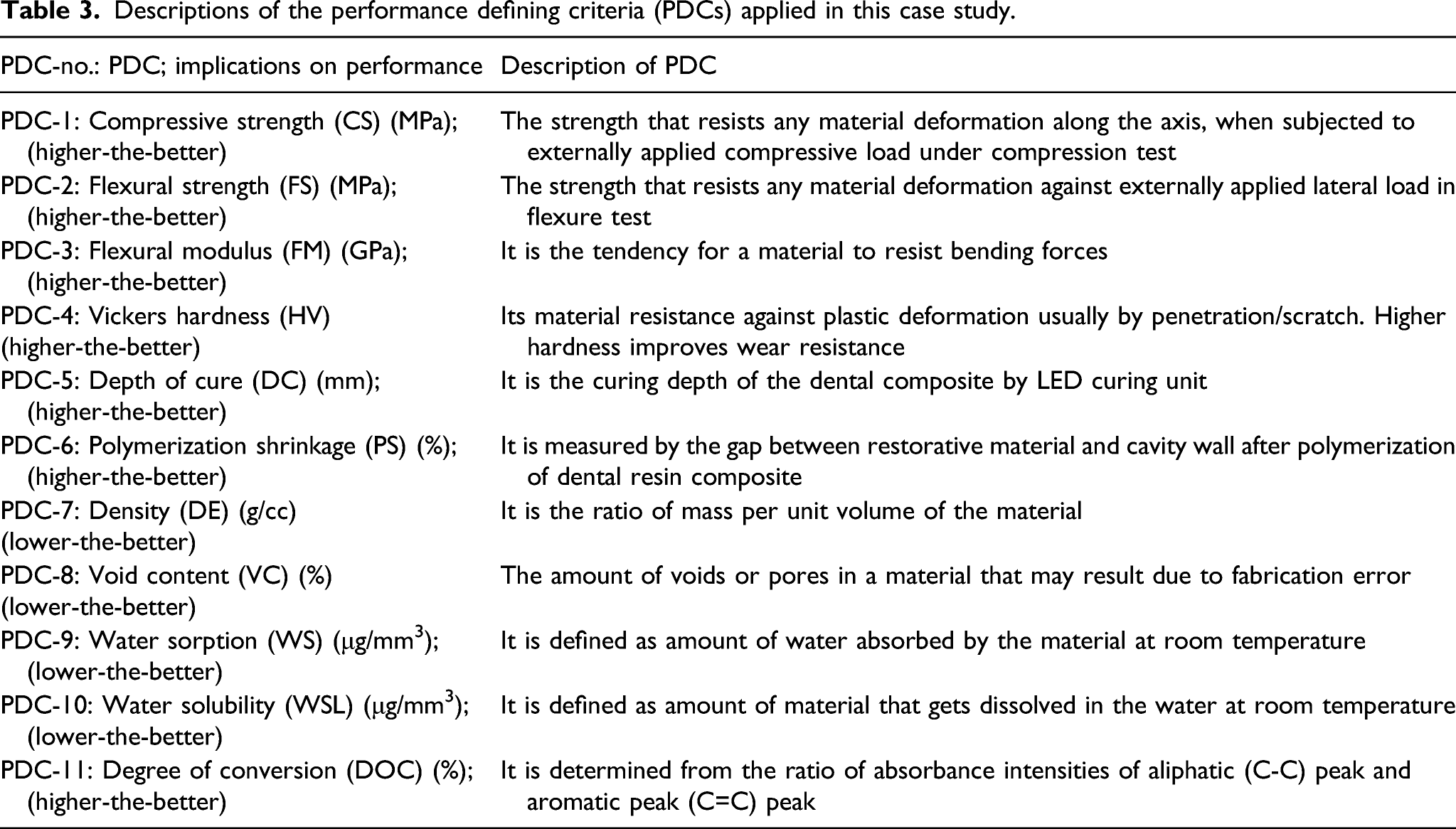
Descriptions of the performance defining criteria (PDCs) applied in this case study.

The hierarchy structure of dental restorative composite materials (case study).
Preference variation value, deviation value, and criteria weights for different PDCs.

Computation of preference selection index (I i ) ranking of alternatives.

Conclusion
The designed, fabricated, and experimental evaluation of physical, mechanical, and chemical characteristics of hybrid ceramic particulate (nSiO2-TiO2) reinforced dental restorative composites are analyzed using the PSI MCDM technique that leads to the following specific conclusions: The formulations have a well disbursement of ceramic particles in the resinous matrix that show superior characteristics like higher compressive strength, lower void content, lower water sorption, a higher degree of conversion etc. The results revealed that an increasing trend has been found in compressive strength, flexural strength, Vickers hardness, etc., while a decreasing trend has been shown in depth of cure, polymerization shrinkage, degree of conversion etc. The performance analysis of five dental composite formulations via the PSI method shows the following ranking order: nS4 > nS6 > nS2 > nS0 > nS8. The PSI method could be employed for ranking orders from a set of alternatives based on performance. This could be a tool in the hands of material scientists in decision making due to the conflicting nature of the different sets of materials. The sensitivity analysis reveals a stable ranking order as PDC weights change from 10% to 30%. Thus, it aids material scientists to validate their subjective ranking of materials with quantity analysis. Hence, it serves as an important tool in decision making.
Footnotes
Declaration of Conflicting Interests
We confirm that no conflict of interest while documenting this manuscript.
Funding
The author(s) received no financial support for the research, authorship, and/or publication of this article.
Ethical approval
We declare that no ethical approval is required for documenting this manuscript.
