



Abstract
The need to simultaneously optimize the structural design properties, and attain a satisfactory vibroacoustic performance for composite structures, has been a challenging task for modern structural engineers. This work is aimed at developing a statistical energy analysis (SEA) based numerical scheme for computing the optimal design parameters of each individual layer of layered curved shells having arbitrary complexities and layering. The main novelty of the work focuses on the computation of SEA properties for curved composite shells and derive the sensitivities of the acoustic transmission coefficient, expressed through the computed SEA properties, with respect to the structural design characteristics to be optimized. A wave finite element approach is employed to calculate the wave propagation constants of the curved shell. The calculated wave constants are then applied to compute the vibroacoustic properties for the curved shell using a SEA approach. Sensitivity analyses are conducted on the vibroacoustic properties to estimate their response to changes in the structural properties. Gradient vector is then formulated and hence the Hessian matrix, which is employed to formulate a Newton-like optimisation algorithm for optimizing the properties of the layered composite shell. The developed scheme is applied to a sandwich shell; optimal design parameters of
Keywords
Introduction
Since the 20th century, remarkable progress has been made in the design, analysis and application of composite shells. Several novel composite shells, including curved panels and cylinders, have been designed for both civil and military applications. The low mass to stiffness index properties of these structures make them suitable to be designed for serving myriads of purposes in the automotive, construction and aerospace industries. However, these comparative mechanical advantages are accompanied by an increase in the sound transmission, governed by the geometry and acoustic properties of the structures. Achieving a trade-off between optimizing the structural properties of the composite shells and attaining a satisfactory vibroacoustic properties for the structure has been a great research interest among structural analysts.
The design modelling of the vibroacoustic behaviour of composite structures has been a field of extensive research whose findings have been greatly applied in the aforementioned industries. According to Chronopoulos et al., 1 wave propagation characteristics are essential in modelling and analysing the vibrational behaviour of a structure. Various classical theories and methods exist for predicting the wave propagation characteristics. The classical laminate plate theory was developed basically for layered thin-shell structures, 2 in which the stiffness properties of the structures can be found by integration of in-plane stress in the normal to the laminates surface. The Mindlin–Reissner theory also known as the first order shear deformation theory of plates, which implies a linear displacement variation through the plate thickness, was developed in 3 for calculating improved transverse shear stresses in laminated composite plates and in 4 to accommodate higher frequencies. Kurtze and Watters 5 firstly developed an asymptotic model for computing the wave propagation properties of symmetric flat thick sandwich structures. The first structural model for an infinite sandwich panel was developed by Dym and Lang 6 and was extended to symmetric sandwiches with an orthotropic core in Ref. 7. Higher order shear deformation theory was developed by Sokolinsky and Nutt, 8 while Cotoni et al. 9 coupled finite element (FE) to periodic structure theory for periodic composite and stiffened structures in a modal approach. Mead 10 introduced the wave finite element (WFE) method which contains the assumption of periodicity to be modelled. The method has applied to one-dimensional11,12 and two-dimensional 13 structures, pressurized structures 14 and complex periodic structures. 15 The main advantage of WFE is the simplicity. WFE formulation predicts all the high order waves propagating within a structure without assumptions of displacement unknowns in contrast to the analytical approaches. 16
Statistical energy analysis (SEA) is another technique for design modelling of the vibroacoustic behaviour of composite structures. It is based on division of a full structural system into subsystems; each one is internally in thermal equilibrium and coupling constant can describe interaction between directly coupled subsystems. Ghinet et al. 17 developed a SEA based layer-wise model on Mindlin theory to predict the wave propagation characteristics and the vibroacoustic behaviour of singly curved composite panels. Ghinet et al. 18 also developed a SEA based model for the computation of the wave propagation characteristics and the modal transmission coefficients of sandwich cylinders under a diffused field condition. A FE model was presented in Refs. 19 and 20 to compute the vibroacoustic response of curved panels; however, the model is not appropriate for large scale structures as it requires much computational cost.
This work is aimed at developing a SEA based numerical scheme for computing the optimal design parameters of each individual layer of layered curved shells having arbitrary complexities, layering and material characteristics. The main novelty of the work focuses on the computation of SEA properties for curved composite shells and derives the sensitivities of the acoustic transmission coefficient, expressed through the computed SEA properties, with respect to the structural design characteristics to be optimized. The design parameters to optimize include the mechanical properties, density and the layer thickness of the curved shell. A WFE approach is employed to calculate the wave propagation constants of the curved shell. The calculated wave constants are then applied to compute the vibroacoustic properties, which include the transmission loss, radiation efficiency and modal density, for the curved shell using a SEA approach. Sensitivity analyses are conducted on the vibroacoustic properties to estimate their response to changes in the structural properties. Gradient vector is then formulated and hence the Hessian matrix, which is employed to formulate a Newton-like optimisation algorithm for optimising the properties of the layered composite shell. The principal advantage of the scheme is the ability to accurately model composite panels of arbitrary curvature and is robust enough to be applied in a broadband frequency range at a rational computational time. The proposed scheme is based on periodic structure theory. Hence, the scheme is limited to structures whose cross sections exhibit the periodicity condition, irrespective of complexity, layering and material characteristics.
The remainder of the paper is as follows: Next section presents the wave-SEA based numerical scheme for the computation of the optimal design parameters of layered curved shells. In the succeeding section, the proposed scheme is validated and then applied to obtain the optimal thickness, density and elastic modulus for each layer of a typical layered curved shell. Finally, concluding remarks are discussed in the last section.
A wave-statistical energy analysis based scheme for structural optimisation
A wave-based methodology in the SEA context for section. The methodology determines the wave propagation characteristics along different axes of the shell structure. The propagation characteristics are then applied to calculate the vibroacoustic quantities whose sensitivity formulations are used to compute the optimisation function. The optimisation function is then solved using a Newton-like algorithm to determine the optimal structural parameters.
Computation of the wave propagation characteristics
The WFE model for the computation of the wave propagation characteristics of layered curved shells is presented herewith. The model assumes a trapezoidal finite element
21
for the curved periodic structure (Figure 1(a)). The trapezoid is modelled using four equal piles of elements, which can be unified into a pile of mid-side nodded elements with internal nodes. This is to avoid numerical errors resulting from the discretization of large segments, especially for calculations at higher frequencies. A curved composite panel (a); its trapezoidal finite element (b) and prismatic mid-layer segment of the trapezoid (c).
As shown in Figure 1(c), a prismatic mid-layer segment of the trapezoid is considered with dimensions





Using node Q as the reference node and applying the Bloch’s theorem, the nodal displacements of all nodal points shown in Figure 1(c) can be expressed as


Computation and sensitivity analyses of the vibroacoustic quantities
The configuration of the system to be modelled is as shown in Figure 2. The configuration comprises of three sub-systems, in which the modelled composite shell (sub-system 2) is flanked on each side by an excited chamber (sub-system 1) and a receiver chamber (sub-system 3). In order to examine the vibroacoustic performance of the modelled shell panel, in-between the two acoustic chambers, the sound transmission coefficient is a crucial quantity and it herewith considered. A schematic representation of the statistical energy analysis analysis for the modelled composite shell.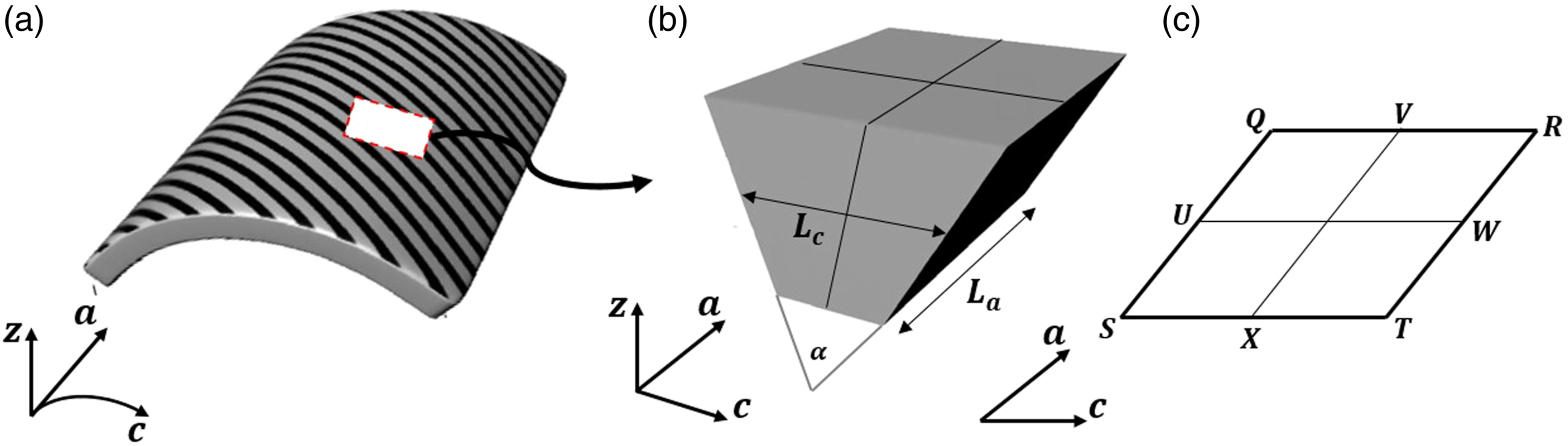
Based on the analysis in Lesueur,
22
the sound transmission coefficient

The sound transmission loss (TL) of the composite shell can then be computed as

The variation (sensitivity) of the sound transmission loss, with regards to the design parameters of the composite shell, is computed as its first and second order derivatives with respect to the design parameters


Radiation efficiency
The radiation efficiency for each propagating wave within the composite shell is calculated using the asymptotic formulae presented in,
24
assuming energy equipartition for the resonant wave modes. The radiation efficiency is expressed as

The sensitivity of the radiation efficiency is also expressed as derivatives, with respect to the design parameters. Introducing a wavenumber dependent index

In the


Modal density
The modal density for each propagating wave within the composite shell is calculated using the Courant’s technique.
25
It is computed as

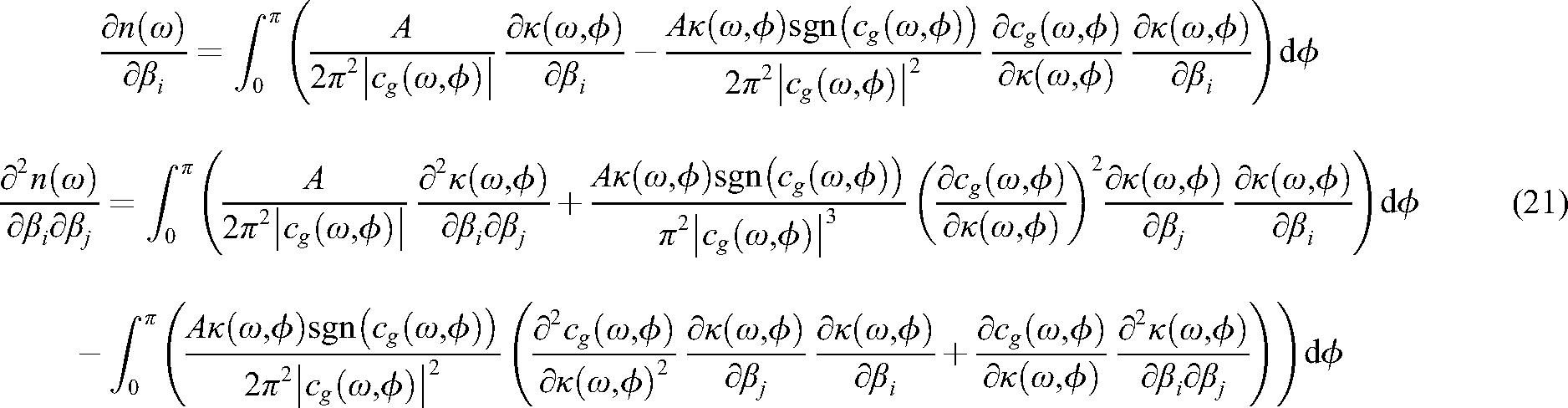
The sensitivity of the modal density, with regards to the design parameters of the composite shell, is computed as its first and second order derivatives with respect to the design parameters. Applying the chain differentiation techniques to the derivatives, the obtained expressions are given as

Combining equations (19) and (20), the modal density sensitivity is given as
Computation of the structural optimisation function
A Newton-like objective model for optimizing the design parameters of composite shells, having arbitrary layering and complexities, is presented in this section. The design parameters to optimize include the layer thickness, density and the mechanical properties of each layer of the curved shell. These parameters can be expressed as


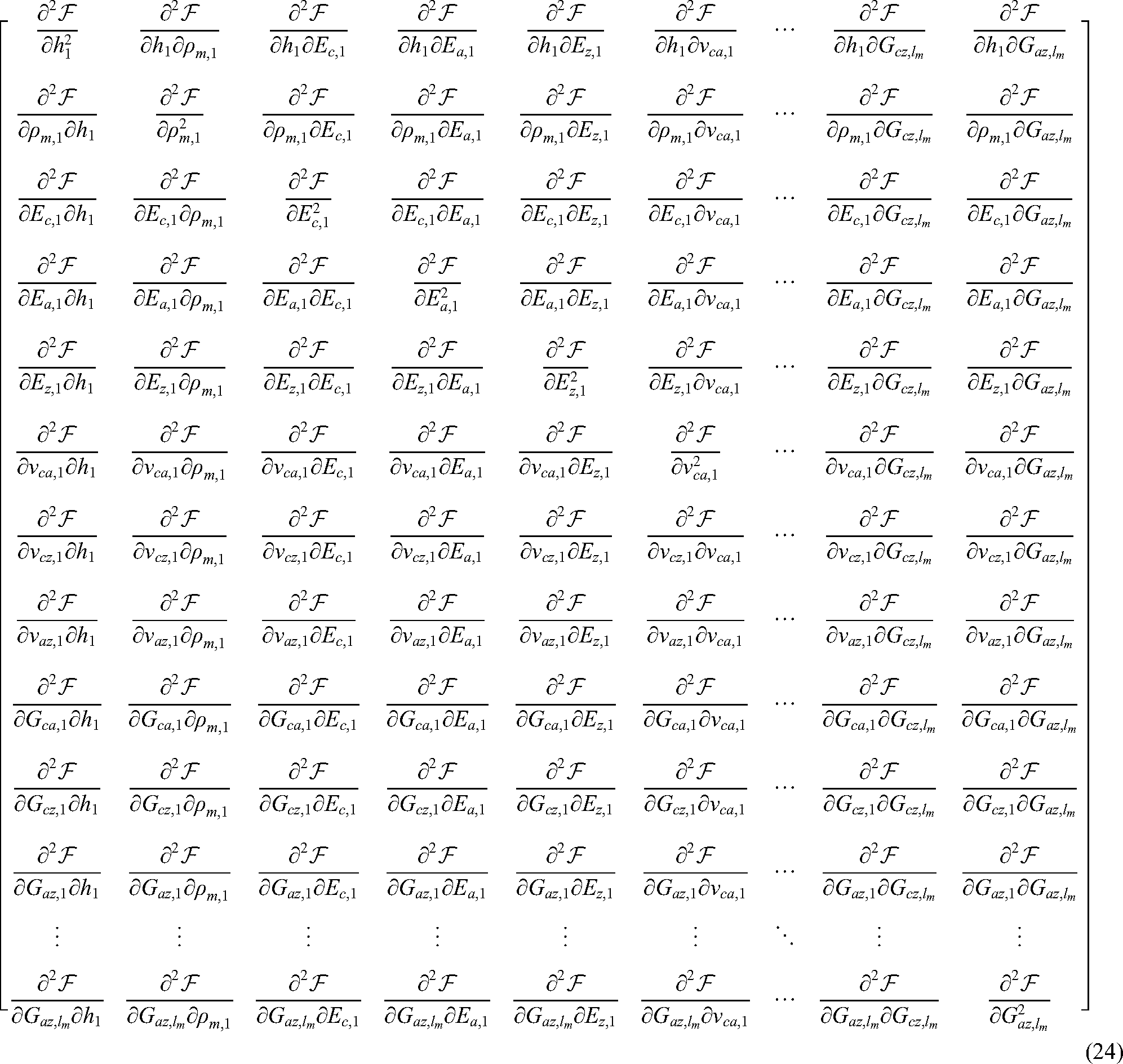
The second order gradients of the objective function
The solution algorithm for the optimisation problem
In the context of the SEA approach, the computed Hessian matrix is applied in a Newton-like algorithm to calculate the optimized design parameters. The optimization problem can be implemented in a standard mathematics software (such as MATLAB) and nonlinear optimization algorithms (such as fmincon) can be employed in order to compute the optimal design parameters Newton-like iterative scheme for optimizing the design parameters of a layered composite shell.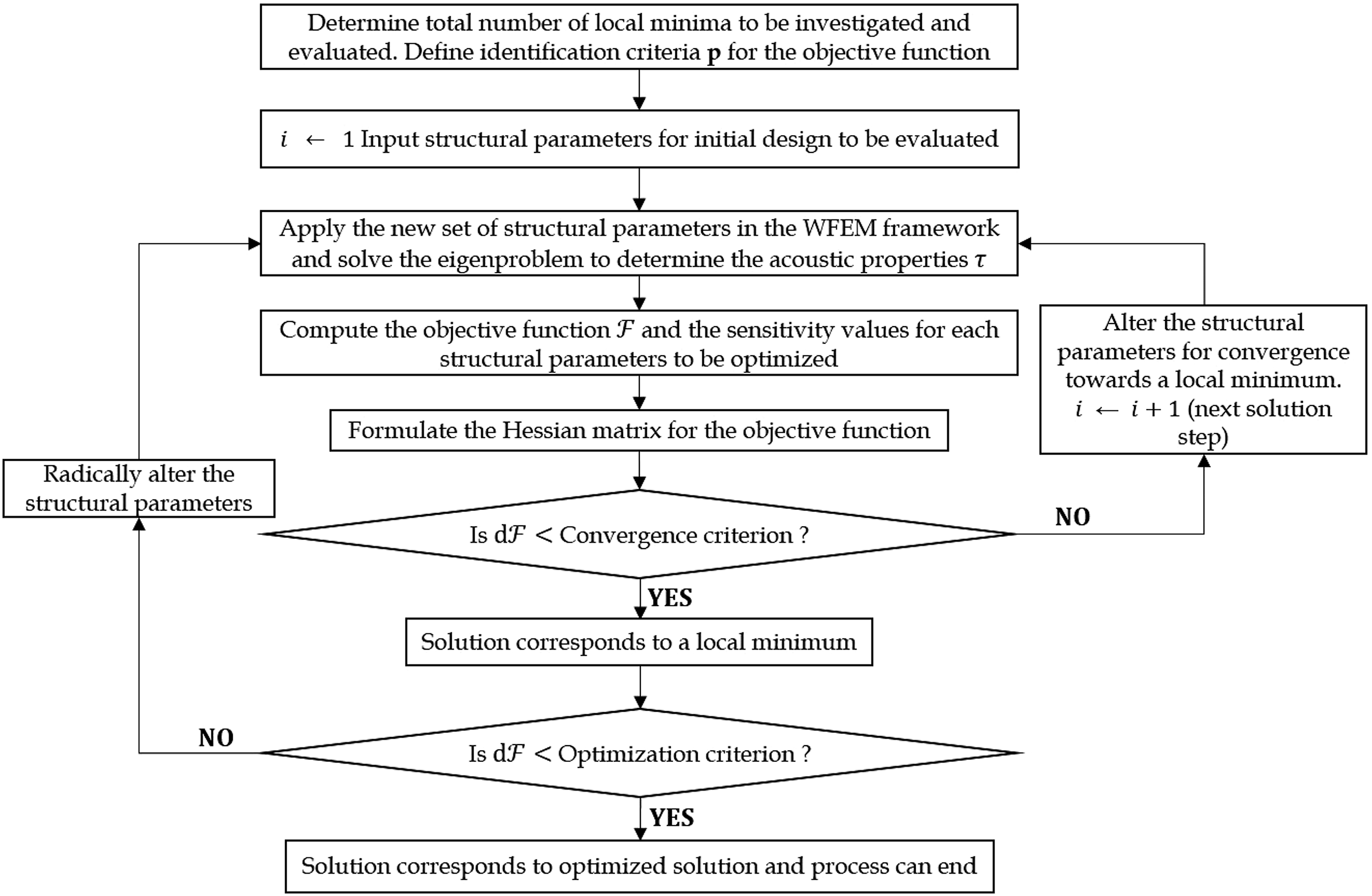
Numerical case studies
The numerical applications and validation of the proposed optimization approach described above are presented in this section. The numerical case studies involve a curved sandwich shell for which the dispersion properties, modal density sensitivity, radiation efficiency sensitivity and sound transmission loss sensitivity are calculated. Optimisation of the design parameters of the shell panel is also computed. The modelled asymmetric sandwich shell comprises of two facesheets and a core. The facesheets are made of a material having the mechanical characteristics: ρ = 1550 kg/m3, vca = 0.3, Ea = 48 GPa, Ec = 48 GPa, Gca = 18.1 GPa, Gaz = 2.76 GPa and Gcz = 2.76 GPa. The core is made of a material having the mechanical characteristics: ρ = 110.44 kg/m3, vca = 0.2, Ea = 0.1448 GPa, Ec = 0.1448 GPa, Gca = 0.05 GPa, Gaz = 0.05 GPa and Gcz = 0.05 GPa. The thickness of each facesheet is
Validation of dispersion curve calculations
The dispersion characteristics of the curved sandwich shell are computed using the proposed WFEM methodology in order to validate the proposed methodology for dispersion characteristics prediction. As presented in Figure 4, the obtained results are compared to the results of a discrete layer model for sandwich panel presented in
26
and a Mindlin type layer-wise model presented in Ref. 18.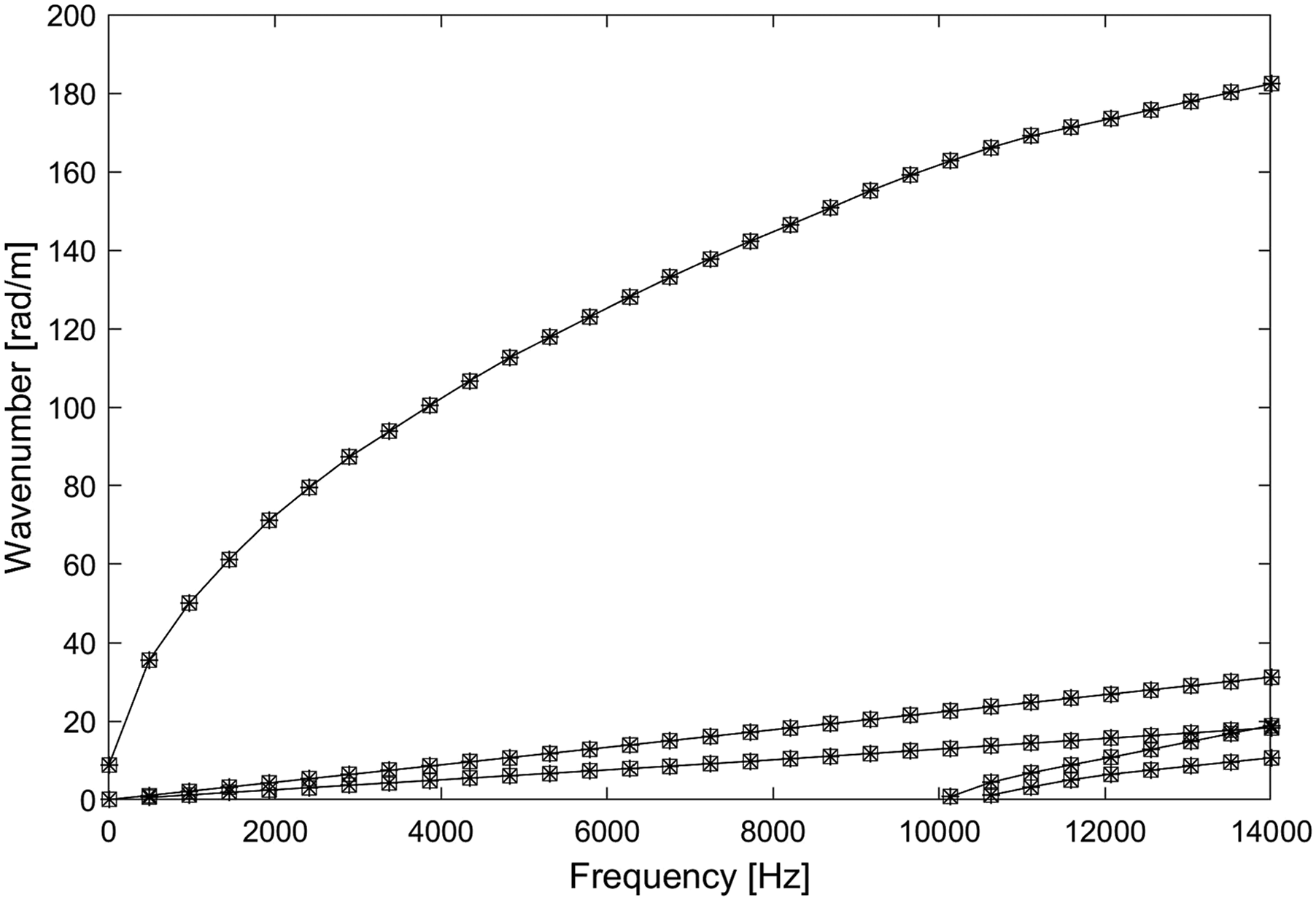
The results presented the wavenumbers for the flexural, shear and axial waves within the sandwich shell for propagation towards the curvature c axis. Excellent agreement is observed for all the wave types. Meanwhile, a minor difference of about 0.06% is observed for the shear wave, especially in the low frequency range. This however contributes an insignificant effect on the vibroacoustic response prediction, as it is the flexural wave which transmits the vast majority of energy through the structural layers. Therefore, the flexural wave will be the main wave type to be considered in the subsequent SEA sensitivity analyses.
Validation of sound transmission loss sensitivity computation
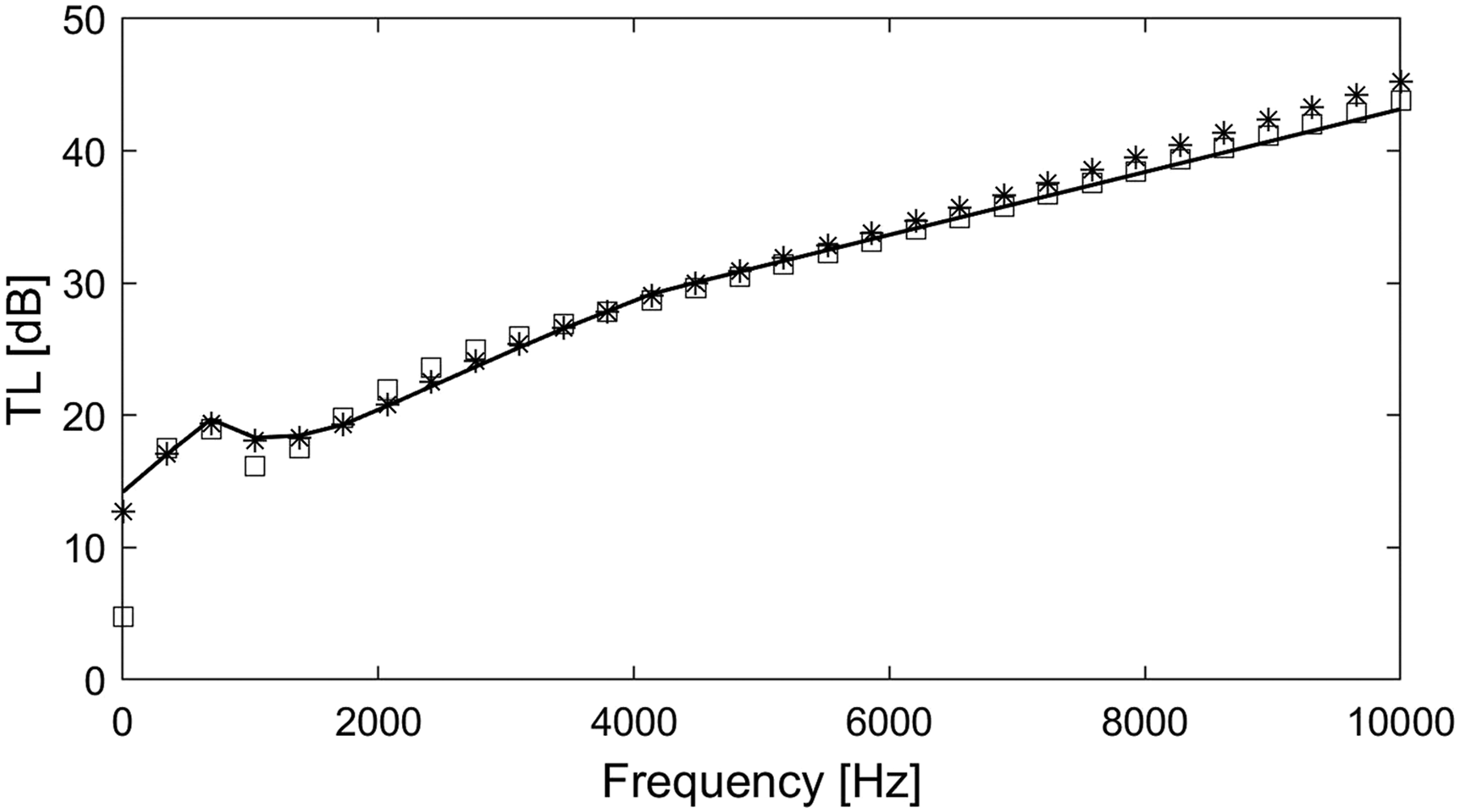
The TL for the sandwich shell is estimated using the proposed methodology. The TL predicted by the current scheme is presented in Figure 5 and it is compared to that of the approach presented in Ref. 18 and the experimental results presented.
17
The predicted result correlates very well with that of Ref. 18 and the experimental results.
17
The sensitivity of the panel’s transmission loss with regards to layer thicknesses is presented in Figure 6. It is observed that highest impact will be induced on the TL, especially within the acoustic coincidence region, when the thickness of the facesheet is altered. Similarly, maximum impact is induced on the TL when the thickness of the core is altered, but at a lower value than what is obtainable with the facesheet. Sensitivity of the TL with regards to the facesheet (-) and the core (- -) thicknesses.
Validation of radiation efficiency sensitivity computation
As discussed in the previous section, the Leppington’s asymptotic formula is applied to estimate the radiation efficiency for the flexural wave mode propagating within the sandwich curve shell. The results obtained are compared to those obtained through the model presented in Ref. 18. As shown in Figure 7, an excellent agreement is observed between the two sets of results. Radiation efficiency of the curved sandwich shell: present methodology (-); model proposed in Ref. 18 (o).
Figure 8 presents the sensitivity curves for the radiation efficiency when the layer thicknesses of the facesheet and the core of the sandwich shell are altered. It is observed that the radiation efficiency sensitivity reaches a peak value at frequency 5730 Hz for both layers. This observed frequency is regarded as the acoustic coincidence frequency (ACF) of the sandwich shell and it is the frequency at which maximum impact on sensitivity is expected. Radiation efficiency sensitivity induced by the core thickness Sensitivity of the radiation efficiency with regards to the facesheet (-) and the core (- -) thicknesses.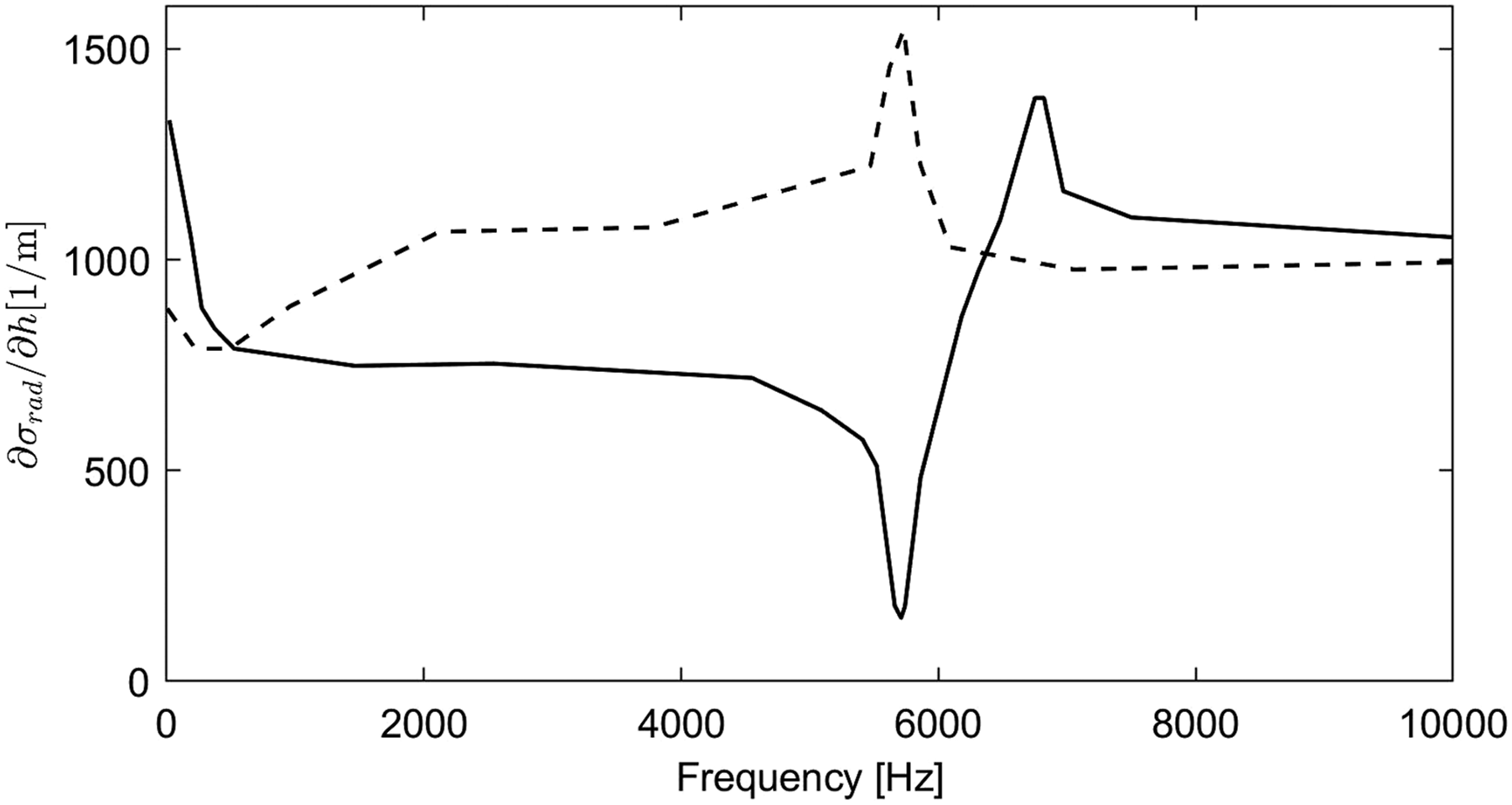
Validation of modal density sensitivity computation
The modal density and its sensitivity analysis are computed for the propagating flexural modes of the sandwich shell, using the proposed methodology. The modal density curve for the sandwich panel is presented in Figure 9 and is compared to the one obtained through the model proposed in Ref. 26. A very good agreement is observed in the results of the two models, as it is obtained in their predictions for the dispersion properties of the curved shell. Modal density of the curved sandwich shell: present methodology (-); model proposed in Ref. 26 (o).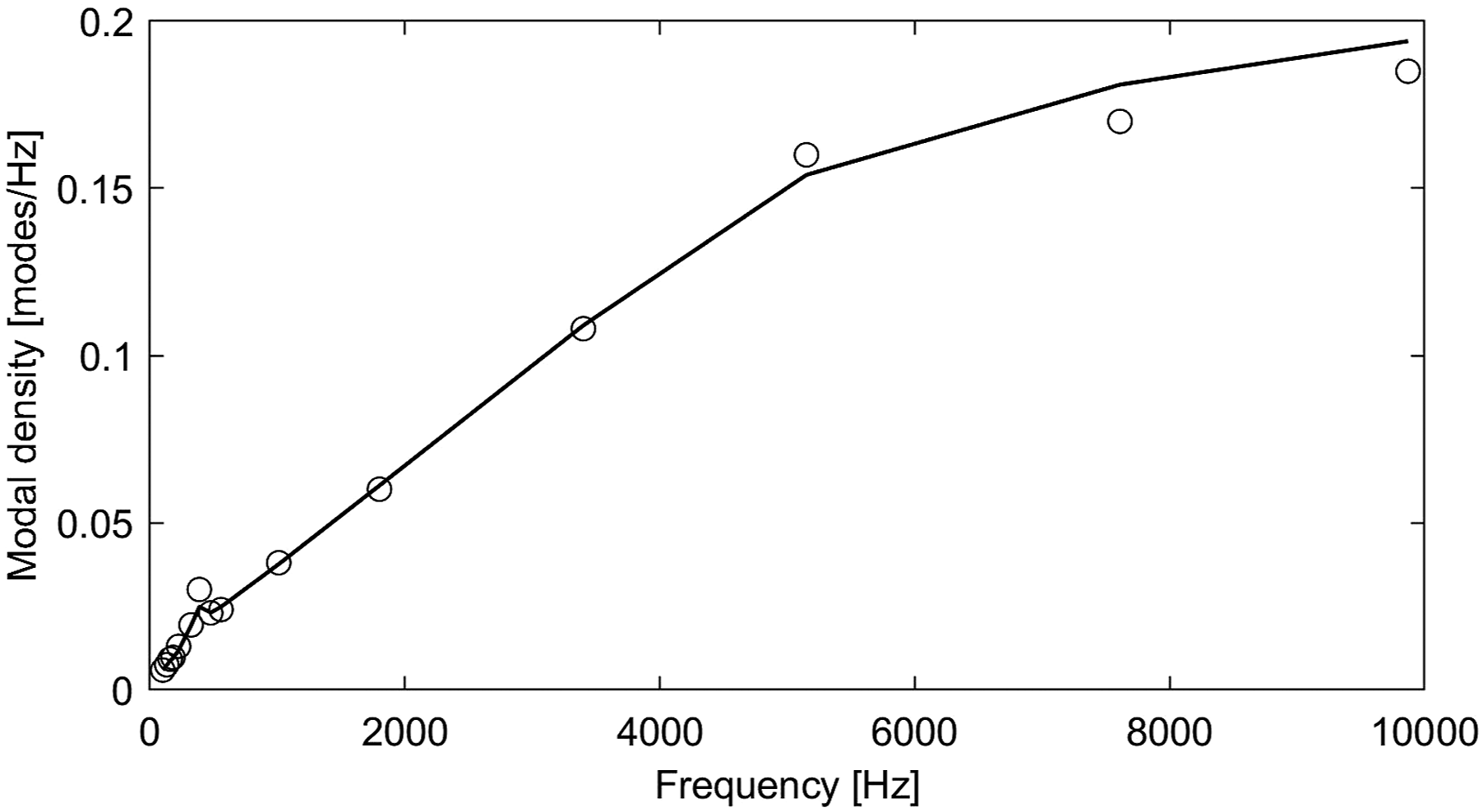
The sensitivity curve for the modal density when the layer thicknesses of the sandwich shell are altered is shown in Figure 10. It is observed that a change in the facesheet thickness Sensitivity of the modal density with regards to the facesheet (-) and the core (- -) thicknesses.
Structural design parameters optimisation
The Newton-like optimisation scheme proposed in is now applied to optimize the mechanical characteristics of the sandwich shell. The process depicted in Figure 3 is programmed and executed in MATLAB, employing the non-linear optimization algorithm fmincon. As demonstrated in the presented algorithm, a new design is generated after each iteration, taking into account the derivative of
The cost function which is a function of the basic criteria of the optimisation process is designed and computed. Based on equation (23), the computed cost functions for the optimisation problem under consideration is given as

Constrained properties for the numerically modelled structural layers.

Optimized design parameters for the modelled structural layers.

In the results presented above, it is observed that the mass density
Conclusions
In this work, a scheme was developed in the wave-SEA context to analyse the sensitivity of SEA quantities and optimize the mechanical and geometric characteristics of layered curved shells. The principal contribution resulting from this work is a robust numerical NDE scheme for optimizing structural parameters of layered composite structures. It can be concluded that: 1. The WFEM was used in order to predict the dispersion characteristics of arbitrarily layered composite shells. 2. The SEA quantities, namely, the modal density, the radiation efficiency and the acoustic transmission loss, for the composite shell were derived using analytic and asymptotic formulae in a wave context. The sensitivity of each of these quantities was derived in the first and second order derivatives. 3. The exhibited scheme was validated through comparison with established numerical models from existing literatures as well as with experimental results. Excellent agreement is observed for the SEA quantities. The impact of the alteration of design parameters on the sensitivities of the SEA quantities was found to be maximum in the vicinity of the acoustic coincidence range. 4. The presented optimisation algorithm is computationally efficient for computing structural design optimisation at broadband frequency range in a rational time period, even with the usage of convectional PC. 5. The presented approach is valid for computing the wave propagation sensitivity of composite shells with arbitrary curvature; however, the SEA model would need to be modified for the specific purpose. 6. The proposed scheme is based on periodic structure theory. Hence, the scheme is limited to structures whose FEs are exhibiting the periodicity condition, irrespective of complexity, layering and material characteristics. For further research, the work can be extended to deal with FEs having arbitrary nodal coordinates.
Footnotes
Declaration of conflicting interests
The author(s) declared no potential conflicts of interest with respect to the research, authorship, and/or publication of this article.
Funding
The author(s) received no financial support for the research, authorship, and/or publication of this article.
