




Abstract
In this work, novel plasticizing biodegradable poly (lactic acid) (PLA) composites were prepared by melt blending of jute and tung oil anhydride (TOA), and the physical and mechanical properties of PLA/jute/TOA composites were tested and characterized. The impact strength of PLA/jute/TOA composites significantly increases with increasing the content of TOA. The SEM images of fracture surface of PLA/jute/TOA composites become rough after the incorporation of TOA. In addition, TOA changes the crystallization temperature and decomposition process of PLA/jute/TOA composites. With increasing the amount of TOA, the value of storage modulus (E′) of PLA/jute/TOA composites gradually increases. The complex viscosity (η*) values for all samples reduce obviously with increasing the frequency, which means that the pure PLA and PLA/jute/TOA composites is typical pseudoplastic fluid. This is attributed to the formation of crosslinking, which restricts the deformation of the composites.
Introduction
Natural fiber reinforced materials are biodegradable and environment-friendly and become attractive to many fields due to the low cost, lightweight, and high specific strength tend.1–5 A lot of natural fibers were used for prepared composite materials just like jute, 6 bagasse, 7 banana, 8 sisal,9,10 flax, 11 aspen,12,13 or ramie,14,15 Among the above natural fibers, jute, an environmentally friendly and 100% biodegradable natural fiber, serves as a potential candidate to produce natural fiber–reinforced composites due to the relatively high tensile modulus and tensile strength. However, the difference of compatibility between fiber and polymer matrix affected properties of plant fiber composites and limited their range of application. Hence, the chemical compounds with functional groups–modified natural fiber–reinforced polymer materials to enhance the interaction between fiber and matrix, which can improve the physicochemical properties of the composites.
Poly (lactic acid) (PLA) is a renewable and biocompatible polymeric material. 16 But the hardness and brittleness properties hinder its further application. 17 A lot of works including chemical modification and physical blending have been executed to overcome its mentioned shortcomings. Among them, the method of blending PLA with plasticizer draws much attention. Epoxidized soybean oil (ESO), 18 maleic anhydride (MA), 19 acrylic acid (AA), 20 methylene-diphenylldiisocyanate (MDI), 21 as common plasticizers are used to improve the toughness of PLA. A problem of the above agents is that the hydrophilic chemicals can accelerate the hydrolysis degradation of PLA and then limit the enhancement effect of toughness.
Tung oil anhydride (TOA) is manufactured through the Diels–Alder reaction of maleic anhydride (MA) and tung oil. 22 Tung oil, as a Chinese traditional medicine name, is extracted from the seed of Vernicia fordii (Hemsl.). Airy Shaw, a plant of the Euphorbia family. The tung oil plant, distributed in China’s Shaanxi, Henan, Jiangsu, Anhui, Zhejiang, Jiangxi, Fujian, Hunan, Hubei, Guangdong, Hainan, Guangxi, Sichuan, Guizhou, Yunnan, and other provinces and regions, also has a distribution in Vietnam. TOA toughen the polypropylene (PP)/plant fiber composites because of the high reactivity of hydroxyl groups. 23 The ready reaction between the maleic anhydride on TOA and the hydroxyl on starch led TOA molecules to accumulate on starch and increased the compatibility of PLA/starch blends. 24 But the effect of plasticizing of TOA in PLA/plant fiber composites has few reports.
In this work, the enhancement of plasticizing of TOA on properties of PLA/jute/TOA composites was investigated. Jute and TOA were combined in PLA using melt blending method which was novel over plasticizing of PLA. The tensile, flexural, and notched impact properties of PLA/jute/TOA composites was tested which could illustrate the extent of TOA and jute toughening PLA. Fracture surface morphologies of the composites were surveyed by scanning electronic microscopy (SEM) and thermal decomposition of the composites were executed by thermo gravimetric analysis (TGA). The primary purpose of this work is to analyze and investigate the novel plasticizing system of PLA/jute/TOA composites.
Experimental
Materials
Poly (lactic acid) (grade PLA4032D, weight-average molecular weight (Mw) 17.62 × 10⁴ g/mol) was supplied by Natureworks (Blair, NE, USA). Jute fibers with 2–6 mm long range were provided by China Shandong Yisheng Co, Ltd. Tung oil anhydride (TOA), 98% purity, was also a commercial product supplied by Jinan Licheng Chengyang Chemical Co, Ltd., Shangdong, China. Valerolactone (GVL, CAS: 108-29-2), 98% purity, was supplied by Shanghai Aladdin Biochemical Technology Co, Ltd., China.
Fiber modifications
First, 200 mL of GVL was pipetted into a three-necked flask. Second, 5 g jute fibers drying at 80°C for 8 h before using were added into the flask and stirred at 130°C for 2 h. Third, jute fibers were taken out from the flask and washed in distilled water for three times in a beaker, and after that split into the oven to dry at 70°C for 24 h in a glass dish.
Preparation of composites
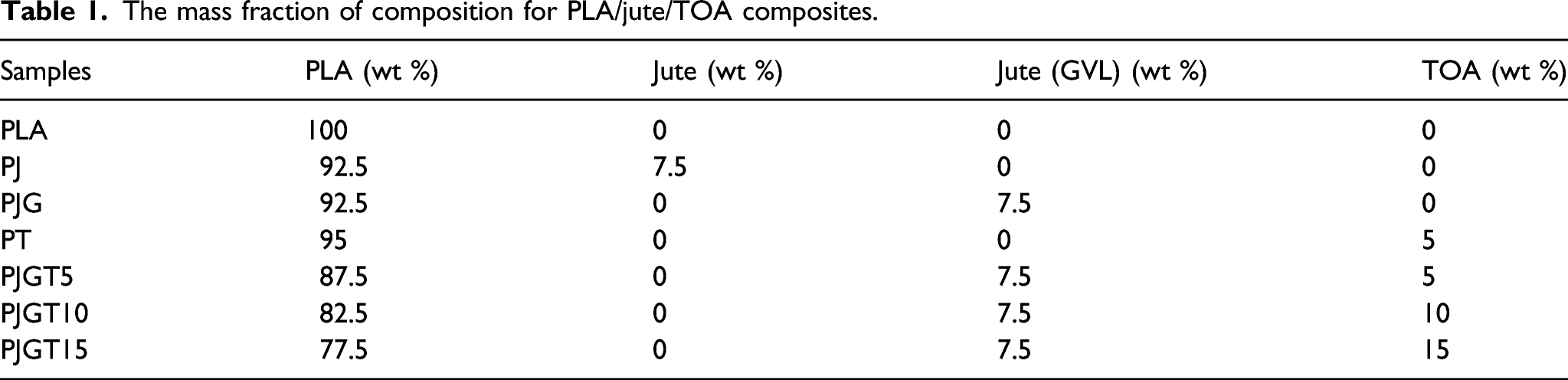
The mass fraction of composition for PLA/jute/TOA composites.
Measurements and characterization
Mechanical properties
The tensile properties were tested by using a WDW-10C testing machine (Hualong Co, Ltd., Shanghai, China) in accordance with ASTM D-638-03 standard on the tensile bars with a cross head speed of 500 mm/min. The flexural properties were carried out by using the WDW-10C testing machine according to the ASTM D-790 standard. Notched Izod impact was performed by a ZBC-4 impact pendulum (SANS Co, Ltd., Shenzhen, China) according to the ASTM D-256 standard. All mechanical tests were obtained from five test samples and recorded at the room temperature of 22 ± 2°C.
Thermogravimetric analysis
A TA instrument Q50 thermal gravimetric analyzer (TA Instruments, Co, Ltd., New Castle, Pennsylvania, USA) was used to execute TGA curves of PLA/jute/TOA composites. The measurements were in N2 environment under 60 mL/min1 gas flows. Sample quality 10 mg was heated to 650°C from room temperature at a heating rate of 10°C/min.
Differential scanning calorimetry
The DSC curves were obtained from a TA instrument Q10 (TA Instruments, Co, Ltd., New Castle, Pennsylvania, USA). All the measurements were tested under a nitrogen atmosphere. The samples were first heated up from 10 to 210°C at a heating rate of 10°C/min, and then maintained at 210°C for 5 min, and finally cooled down to 0°C at a cooling rate of 10°C/min.
Scanning electron microscopy
The fracture surface of the PLA/jute/TOA composites was observed by using a SEM analyzer (KYKY-2800B, KYKY Technology Development Ltd., Beijing, China) All samples were obtained after gold coating surface treating and the morphology micrographs of the composites was obtained at magnifications of 200X with the accelerating voltage of 25 kV.
Dynamic mechanical analysis
DMA was performed by TA Q800 DMA (TA Instruments, Co., Ltd., New Castle, Pennsylvania, USA). Sizes of the test specimens were 60 × 10 × 4 mm3. Tests were recorded at a vibration frequency of 1 Hz and a heating rate of 5°C/min. Range of test temperature was from −40 to 130°C. The low-temperature measurements were tested in a stream of dry air cooled with liquid N2, and the high-temperature measurements were performed in a stream of dry N2.
Rheological analysis
The rheological behaviors were performed by TA rheometer (AR 2000, TA Instruments Co., Ltd., New Castle, Pennsylvania, USA). A strain amplitude of 1% was found to be suitable to ensure linear viscoelastic regime and thus used for both the frequency sweep and temperature ramp sweep modes with a nitrogen purge.
Results and discussion
Mechanical properties
The effect of different ratio of TOA on the tensile behaviors and impact strength of PLA/jute/TOA composites is shown in Figure 1, and the corresponding data are listed in Table 2. Compared with pure PLA, the tensile strength and bending strength of PLA/jute composites both decrease after the addition of 7.5wt% raw jute or 7.5wt% jute (GVL). And the tensile strength of PLA/raw jute composites is higher than that of PLA/jute (GVL) composites, as shown in Figure 1(a). Corresponding to this phenomenon, the impact strength of PLA/raw jute composites is lower than that of PLA/jute (GVL) composites. From what has been discussed above, jute chemical treatment by GVL can slightly increase toughness of PLA/jute composites. Mechanical properties of PLA/jute/TOA composites: (a) tensile stress–strain curves; (b) impact strength; (c) tensile strength; and (d) bending strength. Mechanical properties of PLA/jute/TOA composites.
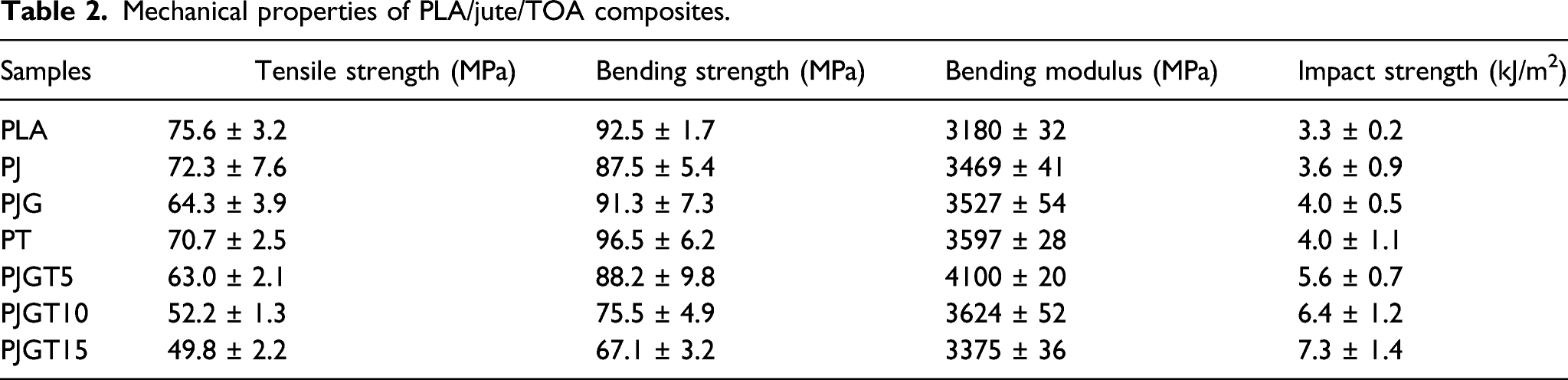
It is obviously observed from Figures 1(b) to (d) that the tensile and bending strengths of PLA/jute/TOA composites decrease while the impact strength increases with increasing the content of TOA. However, with only 5 wt% TOA in PLA/jute composites, the impact strength increases to 5.6 kJ/m2. The impact strength value of PLA/jute/TOA (7.5:5) composites is increased by 41.1% compared with pure PLA. And with increasing the content of TOA, the impact strength of PLA/jute/TOA composites also increases. For example, with the addition of 15 wt% TOA, the impact strength increases to 7.3 kJ/m2. The impact strength of PLA/jute/TOA (7.5:15) composites is increased 55.0% compared with pure PLA. Thus, TOA works might act well as a plasticizer to tune the PLA/jute composites.
Similar with this phenomenon, PLA/starch blends with two other plant oils, castor oil (CO) and epoxidized soybean oil (ESO) also exhibit the improvement of ductility due to plant oil form a flexible layer via the reaction between plant oil and functional starch. 24 The improvement of properties for the PLA/jute/TOA composites is attributed to the formation of the TOA layer on the surface of jute. FTIR spectra show that there is a reaction between jute fiber and TOA. 25 TOA works as the crosslinking agent, which improves the mechanical properties of the composites.
Morphology
Figure 2 shows the SEM images of the fracture surface of PLA/jute, and PLA/jute/TOA composites with different content of TOA. It is obviously found from Figure 2 that the jute and TOA has a great effect on the surface morphologies of PLA/jute/TOA composites. The fracture surface of PLA and PLA/TOA is relatively smooth, meanwhile, PLA/jute (raw) and PLA/jute show very little different structure on the microscopic scale except the appearance of the fiber. A clear gap between PLA matrix and jute (raw) is as many cracks on the surface of jute (raw). The gaps imply that the compatibility between PLA and jute (raw) is poor (Figure 2(a)). Although there are gaps, but the compatibility between PLA and jute is slightly better (Figure 2(b)). The SEM images of PLA/jute/TOA composites after injection molded solid: (a) PJ; (b) PJG; (c) PT; (d) PJGT5; (e) PJGT10; and (f) PJGT15. All micrographs are obtained at 200 × magnification.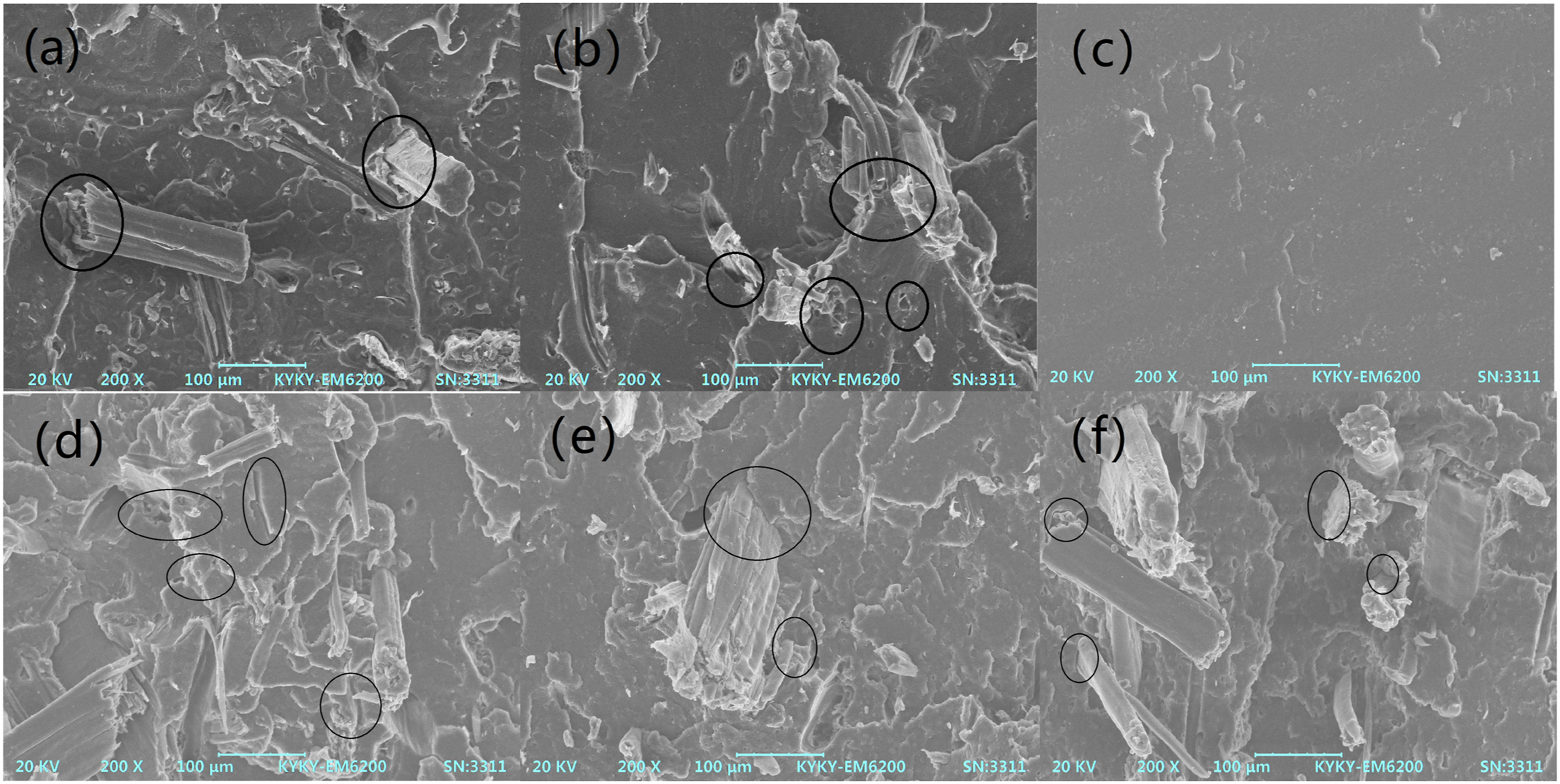
Compared with PLA/jute composites, the fracture surfaces of PLA/jute/TOA composites with different the contents of TOA are coarser, as shown in Figures 4(d–f). Particularly, the fracture surfaces of composites become rough with increasing the content of TOA. TOA works as the crosslinking agent reaction to jute fiber and PLA. 25 Quality of the surface is demonstrated to be a reason for the extraordinary toughening effect of TOA.
Thermal decomposition
Figure 3 exhibits TGA and DTG curves of PLA/jute/TOA composites under nitrogen atmosphere, and the corresponding data are also listed in Table 3. From Figure 3, all the TGA curves of samples studied show one degradation step. DTG curves display that the composites have only one degradation peak center of 360°C. When the 7.5wt% jute and 5wt% TOA are added into the PLA matrix, the ash content of the composites at 580°C increases from 0.6% of PLA to 3.0%. The TGA (a) and DTG (b) curves of PLA/jute/TOA composites. TGA data of PLA/jute/TOA composites. aTemperature at 5% weight loss. bThe maximum degradation rate temperature.

Surprisingly, the thermal behavior of PLA is changed in different way by the addition of TOA/jute combinations in contrast with that of PLA/TOA or PLA/jute composites. With the incorporation of jute into the PLA matrix, the maximum degradation rate temperature of PLA/jute composites decreases from 368.4°C of PLA to 364.8°C. However, with the incorporation of TOA into the PLA matrix, the maximum degradation rate temperature of PLA/TOA composites decreases from 368.4°C of PLA to 348.4°C. With increasing the content of TOA, the maximum degradation rate temperature of the composites becomes to be improved, increasing from 348.5°C to 355.1°C, indicating that the thermal stability of the composites is improved. 26
Crystallization behaviors
The melting behaviors and crystallization of PLA, PLA/jute and PLA/jute/TOA composites are shown in Figure 4, and the corresponding data are listed in Table 4. The formula Хc = (ΔHm/εΔHo) × 100% is used to calculate relative crystallinity, where ε is the mass fraction of polylactic acid in the composites. ΔHo represents the melting enthalpy of 100% crystalline PLA is 93.6 J/g.
27
Increasing the content of TOA, the Tc of the composite migrates to high temperature. However, the crystallinity and ΔHm of the composites has little change. The above phenomena appear in PJGT5, PJTT10, and PJTT15 samples due to the crosslink density and the increase of content of large molecular weight and high viscosity of TOA. TOA combined with jute disperses in the matrix material to block the movement of PLA molecular chain segment, so that the molecular chain cannot move and fold together to form crystals, resulting in the low crystallization of PLA molecular chain.
28
The DSC curves of PLA/jute/TOA composites. The DSC data of PLA/jute/TOA composites. aTg and. bTg values are derived from DMA and DSC tests, respectively.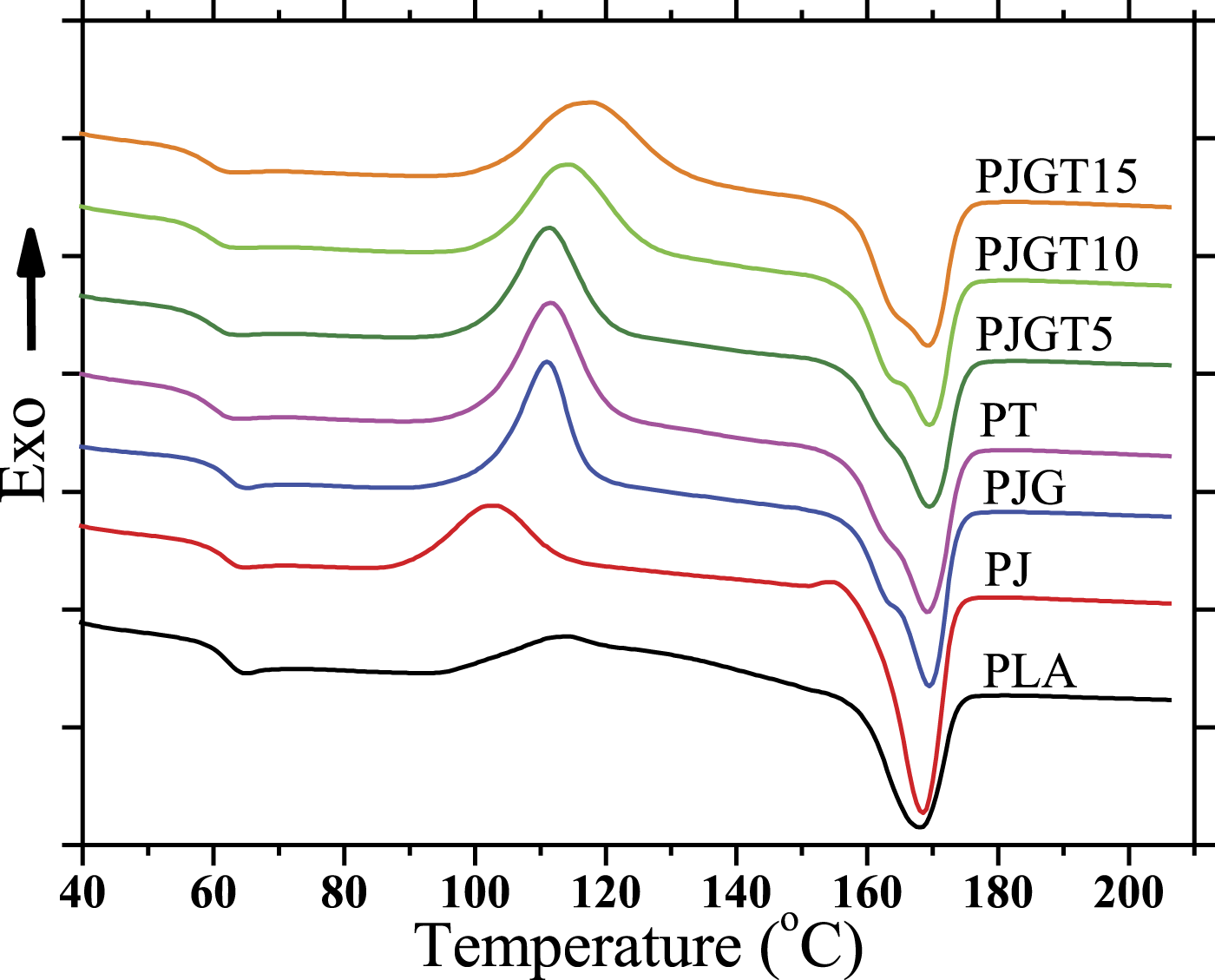

Dynamic mechanical properties
Comparative storage modulus (E′) temperature, tanδ temperature, and loss modulus (E″) temperature curves for PLA/jute/TOA composites are displayed in Figure 5. Jute and TOA play a significant role on the E′ of PLA in Figure 5(a). All samples show clear glass transition temperature relaxation of the PLA matrix. Moreover, over the whole temperature range (−40–120°C), the value of E′ for the PLA/jute/TOA composites augments with increasing the content of TOA. This might be attributed to the formation of crosslinking, which restricts the deformation of the composites while storing larger deformation energy. Note that the E′ values of all samples drop with increasing the temperature. DMA curves of PLA, PLA/jute, PLA/jute/TOA composites: (a) storage modulus (E′) versus temperature; (b) loss modulus (E″) versus temperature; and (c) tanδ versus temperature.
The values of E″ and tanδ of PLA, PLA/jute, and PLA/jute/TOA composites are exhibited in Figures 5(b) and (c). The results clearly show that the composites possess higher E″ and tanδ values than PLA. The lower value of tanδ means lower energy damping behavior or higher elasticity. This increase of elasticity (reduction in tanδ) of PLA/jute/TOA composites can be ascribed to the formation of crosslinking that improves the energy storage ability of PLA. 29
Rheological behaviors
Curves of storage modulus (G′), loss modulus (G″), and complex viscosity (η*) of PLA/jute/TOA composites with different frequency at 180°C were shown in Figure 6. Both the values of G′ and G″ increase according to Figures 6(a) and (b), which is consistent with the linear viscoelasticity theory. The movement toward the PLA molecular chain can chase after the variation of stresses on the low frequency due to the slowly variation on the shear force presented. At high frequency, the value of G′ increases more rapidly and becomes higher than that of G″. Therefore, the composites show elasticity instead of viscosity.
30
The curves of (a) storage modulus (G′); (b) loss modulus (G″); and (c) complex viscosity (η*) of pure PLA and PLA/jute/TOA composites.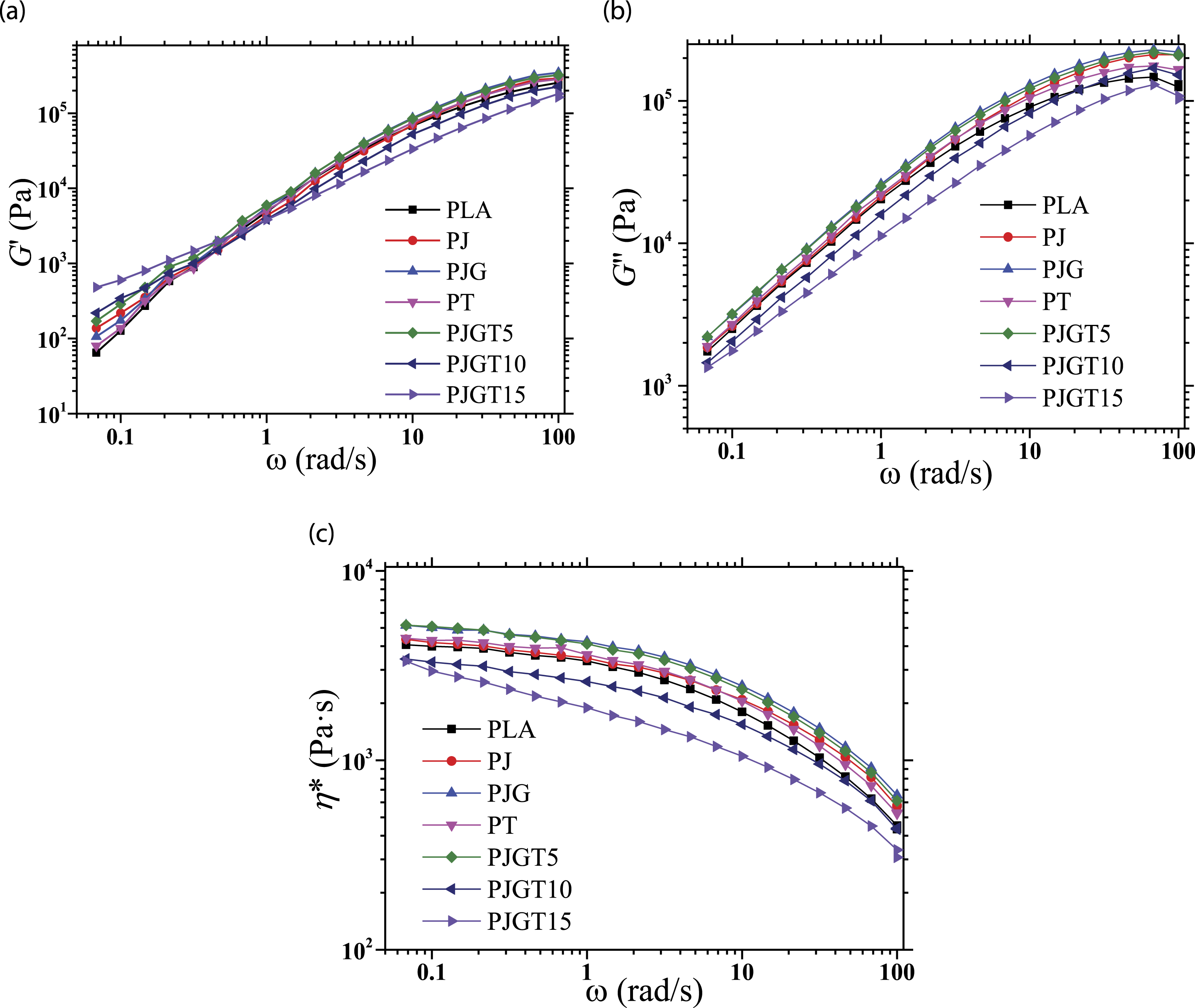
The η* values for all samples decrease distinctly with increasing the frequency, which indicates that PLA/jute/TOA composites are typical pseudoplastic fluid from Figure 6(c). The values of G′, G″, and η* of PJ, PT, PJGT5, and PJTT10 are obviously much higher than those of PLA; however, those of PJGT15 become lower. The relatively worse interface effect of the jute may explain the phenomenon. Overweight TOA will limit the movement of PLA molecular chain due to the TOA as the crosslinking agent. 31
Conclusions
The effects of plasticizing of TOA on the mechanical properties, thermal stability, crystallinity behaviors, dynamic mechanical properties, and rheological behaviors of PLA/jute/TOA composites are investigated and discussed in detail. The tensile strength and bending strength of PLA/jute/TOA composites reduce, while the impact strength increases with increasing the content of TOA. SEM images of fracture surface of PLA/jute/TOA composites become rough with increasing the content of TOA. Quality of the surface is demonstrated to be a reason for the extraordinary toughening effect of TOA. TOA markedly changes the decomposition process of PLA/jute/TOA composites. Enhancing contents of TOA increases its crosslinking density, leading to a higher maximum degradation temperature. The value of E′ for the PLA/jute/TOA composites gradually increases as increasing the amount of TOA. The η* values for all samples decrease obviously with increasing the frequency, which indicates that the pure PLA and PLA/jute/TOA composites are typical pseudoplastic fluid. This can be attributed to the formation of crosslinking, which restricts the deformation of the composites.
Footnotes
Declaration of conflicting interests
The author(s) declared no potential conflicts of interest with respect to the research, authorship, and/or publication of this article.
Funding
The author(s) disclosed receipt of the following financial support for the research, authorship, and/or publication of this article: International Science and Technology Cooperation Project of Sichuan (2019YFH0047), Science and Technology Project of Guizhou (2016/5667), Fundamental Research Key Project of Guizhou Province (20201Z044), Outstanding Youth Program of Guizhou Province (20170439178), Joint Research Program of Guizhou Province (20177251), The Guizhou Science Fund for Excellent Young Scholars (20195665), Open Fund Program of Southwest University of Science and Technology (18zxgk01).
