



Abstract
The composite materials are present in nature since the prehistoric era. Applications of fiber-based composite materials are increasing day by day in our society to overcome the raised environmental and economic concerns. Hence, waste fiber can be utilized as the best resource to develop composites.
The present study deals with the impact of hybridization on the mechanical, thermal, and water absorption behavior of hair and coir fiber-based hybrid composites. The compression molding technique was used to develop the hybrid composites with fixed fiber content (15 wt.%) and was also varied the relative weight percentage of hair and coir fibers [(100% HF), (75% HF/25% CF), (50% HF/50% CF), (25% HF/75% CF) and (100% CF)] in reinforcing phase with HDPE composites S1, S2, S3, S4, and S5, respectively. The composite S2 was achieved superior mechanical attributes as compared to other hybrid/non-hybrid composites. The composite S2 was improved the tensile strength 5% and 35.2% more in comparison to composites S1 and S5, respectively. The thermal behavior (TGA, DTG, and DTA) was also influenced by the blending ratio of fibers of composites. The 5% and 50% weight losses of composite S2 were observed at higher temperature 343.8°C and 465.8°C as compare to other composites, which showed the thermal stability of composites S2. SEM analysis was used to investigate the strength of the fiber-matrix interface, which was shown a significant connection between mechanical and thermal behaviors. The crystallinity of hybrid and non-hybrid composites was examined by using the X-ray diffraction (XRD) analyzer and composite S2 was achieved 326 × 10−9 m crystal size at 21.053° peak position with wavelength 1.5406 × 10⁻¹⁰ m for Cu. The water absorption test was used to examine the moisture resistivity of composite materials, which was helpful to increase the applications of materials in humid areas.
Introduction
The environment and economy both are responsible for the promotion of natural fiber-based reinforced polymer composites. Plant and animal fibers are used to involve the eco-friendly polymer composites. Fiber irregularities (size, variable quality, water sensitivity, etc.) are major factors to decrease the adhesion behavior. The adhesion property of composites was influenced by various surface modification techniques of fibers. Hair fiber (HF) is a sub-part of animal fiber, which has good strength, eco-friendly aspects, and light-weighted. 1 Hair is considered a waste material in rural and urban areas. 2 The major constituent of HF is keratin (65–95%), and others are water and lipid pigments. Normally, HF is divided into cuticle, cortex, and medulla. The coir fiber (CF) also comes from natural fiber, which has good strength, eco-friendly aspects, and light-weighted. It comprises of 43.44% cellulose, 45.84% lignin, 0.25% hemicellulose, and other components. 1
Hair is a low-density fiber with unique strength, which can be used to develop hair fiber-based reinforced polymer composites. HF can be used as a reinforcing fiber for various composites to contribute toward the economy and environments in various products (frames and panels, boards, gadget cases, automobile, and railway coach interiors, etc.).3,4 Oladele et al. examined the mechanical behavior of the animal fiber-reinforced polymer composites. 5 Mittal and Sinha investigated the different behavior of bagasse/wheat straw fiber-based reinforced epoxy composites.6,7 Prasad et al. prepared and examined the various properties of a hybrid composite of CF/BF/LDPE. 8 Devnani and Sinha developed and examine the various mechanical and morphological properties of African teff straw-based epoxy composites. 9 The mechanical attribute was compared with various combinations of fibers in composites. Srivastava and Sinha developed the HF/HDPE reinforced composites and examined the treatments on various properties.10–13 Superior properties (mechanical, thermal, and water absorption kinetic) of the above composites were observed, which was helpful to enhance the application of developed products. Jose et al. developed the hybrid composites of curaua-glass fibers with polyester resin and examined the influence of hybridization on the various behaviors of composites. 14 Duan et al. prepared the hybrid sisal/coir fibers reinforced polylactide biocomposites and examine the mechanical attribute of hybrid composites. 15 Matykiewicz et al. examined the dynamic mechanical thermal analysis of basalt fibers with basalt powder of the epoxy composites. 16 Saw et al. prepared the jute/coir fibers based epoxy hybrid composites and various behaviors (Water absorption, mechanical properties, and thickness swelling test) of composites were examined. 17 Gupta and Srivastava studied the literature of hybrid composites and examined the various behaviors of the composites. 18 Couture et al. prepared and studied the mechanical behavior of flax-based polylactic acid hybrid composites with the unidirectional and additional paper layer flax techniques. 19 Ehi et al. estimated the diffusion mechanism and kinetics of cocoa-pod epoxy composites. 20 Dan-Mallam et al. used woven kenaf with polyethylene terephthalate fiber (PET) for hybrid preparation and investigated the effect of hybridization on mechanical behavior and moisture absorption. 21 Selvakumar and Omkumar developed the jute and human hair–reinforced epoxy composites. And the authors examined the various properties of composites in terms of fiber loading ratio in composites preparations. 22 Wloch et al. developed a hybrid composite with glass fiber-based epoxy composites and they examined the mechanical and thermal properties. 23 Kunrath et al. investigated the mechanical, electrical, and electromagnetic properties of glass fiber-based graphene-epoxy hybrid composite. 24 Sinha et al. prepared the abaca fiber-based composites with red mud and they also examined the modeling of hybrid composites. 25 A fuzzy approach was used to determine the modeling of mechanical behaviors of composites. 26 The aforementioned authors have prepared natural fiber-based composites with synthetic fiber. Various properties of the composites were ameliorated with the help of various techniques such as fiber treatment and fiber hybridization.
In this work, authors used hair and coir fibers with HDPE in different compositions for the growth of low-cost hybrid composites. Mechanical, thermal, and water absorption behavior of hybrid/non-hybrid composites were examined, which was influenced by applying the hybridization of fibers in composites. These properties can be propelled to enhance the applications of the developed materials and it can be used to utilize the waste fibers as resources for product development.
Materials and characterization
Material and preparation
HF and CF were used as reinforcing fibers, and the physical properties of fibers were listed in Table 1. HF was collected from local salon Roorkee, (India) with the age group 18–23 years and CF was supplied from a local market. Both fibers were chopped with a range of 0.005–0.010 m length. High-density polyethylene (HDPE) powder resin and Sodium hydroxide (assay-min. 98.0%) were procured from Rapid Coat Powder Coatings Pvt. Ltd. Ghaziabad, India. and Leonid chemicals Pvt. Ltd. Bengaluru, India. Ethanol absolute (assay-min. 96.4%) and acrylic acid (assay-min. 99.0%) were obtained from Taj pharmaceuticals limited Gujarat, and Loba Chemie Pvt. Ltd. Mumbai, India.
Physical properties of HF and CF.

Optimum chemical treatments were applied to HF and CF for the preparation of hybrid/non-hybrid composites. Chemical treatments with 0.25 N (30 min), alkali followed by 0.07 N acrylic acid a treated HFs for 1 h at ambient temperature and 1.25 N alkali solution (72 h), followed by 0.14 N acrylic acid (20 min.) a treated CFs for 20 min at ambient temperature were used for the preparation of composites.11,12 The distilled water was used several times to remove the unwanted adhering impurities from fibers and a hot air oven was dried the fibers at 70°C for 48 h. 8
The compression molding technique was used to prepare the hybrid/non-hybrid composites with fixed fiber content (15 wt.%) and the relative weight fraction of fibers/matrix was shown in Table 2. The detailed procedure of composites preparation was given in previous articles. 8 The specimens were prepared as per ASTM standards, which were shown in Figure 1.

Flow diagram of composites preparation.
Composition of the studied formulations.

Characterization
Mechanical properties test
Mechanical behaviors of the hybrid/non-hybrid composites were examined through Universal Testing Machine (UTM, INSTRON model 5982) as per ASTM standards (D3039, D790). The test was done with a constant crosshead speed of 0.002 m/min. The average of four composites for each composition was taken to nullify the error of analysis.6,8,10–12
SEM analysis
The morphology of hybrid/non-hybrid composites was studied by scanning electron microscope (SEM, Model LEO-435 VP) with the range of acceleration voltage of 0–30 kV. Gold plated layer of composites were used for the investigation of fractured surfaces.8,10
Thermal properties test
The thermal study (TGA, DTG, and DSA) of the hybrid/non-hybrid composites were examined by using the EXSTAR TG/DTA 6300 (RT instruments Inc., Woodland CA, USA). A constant heating rate (10°C/min) was used with a nitrogen medium (flow rate of 0.2 l/min) from ambient temperature to 800°C. The results of the thermal study were shown in percentage form for the study of composites.8,11
Water absorption test
The water absorption test of the hybrid/non-hybrid composites was studied as per the ASTM D570 standard.8,10,23 The gain moisture of the composite composites was investigated via the high precision balance (Voyager Analytical Balances CPA225D). The following equation was used to measure the percentage of water absorption gain of the hybrid/non-hybrid composites.

where, Wt represents the wet weight specimen at ‘t’ time interval and Wi represents the oven-dry specimen.
Water absorption kinetics and diffusion mechanisms of hybrid/non-hybrid composites were examined by using Fick’s theory. 22 The following equations can be used to investigate the water absorption kinetics of composites.


where Mt is the moisture content at time t; Ms is the maximum moisture content at the equilibrium; k and n are constants.
Fick’s model can predict the diffusion coefficient of the hybrid/non-hybrid composite, which was given in the following equation:

where D is the diffusion coefficient and h is the thickness of the composite.
FTIR spectrometer
FTIR spectrometer (Nicolet 6700 series) was used to examine the bonding groups of the hybrid/non-hybrid composites. Potassium bromide (KBr) was used as a reference substance for preparing the pellets with the range 40–6 m−1 of spectrum resolution of materials.6,9,11–14
X-ray diffraction analysis
X-ray diffraction (XRD, Brucker AXS D8 diffractometer, Germany) was applied to investigate the crystallinity of the hybrid/non-hybrid composites. Cu-Kα radiation (1.5406 × 10⁻¹⁰ m for Cu) was used in the XRD study at 40 kV and 0.030 A. During the study, scan speed was maintained at 0.02°/s with the range 15–50°. 8 Scherrer’s equation was used to calculate the crystalline thickness (L) of composites as follows:

where, K is the Scherrer’s constant, λ is the wavelength, β is the full width at half maximum (FWHM) and θ is the Bragg angle.
Results and discussion
Mechanical properties
The mechanical behaviors of the hybrid and non-hybrid composites are shown in Figure 2. The stress transfer of the composites is dependent upon interfacial adhesion between fiber and matrix. Hair fiber-based reinforced composite had achieved the optimum mechanical properties at 15% fiber loading in HF/HDPE reinforced composite, and the mechanical properties of composites were influenced by changing the weight fraction of fibers in the reinforcing phase.
Figure 2 reveal the mechanical strength and mechanical modulus of the hybrid/non-hybrid composites. The HF-based reinforced composite (composite S1) has 28.7% tensile strength and 11.6% flexural strength more as compared to CF-based composite (composite S5). The mechanical modulus of single fiber-based composites had shown similar results. The tensile modulus and flexural modulus of composite S1 were detected 16.3% and 10% more in comparison to CF-based composite. The hair fiber has low-density as compared to coir fiber, and the density of the fibers was played an important role to transfer the stress from matrix to fiber, which enhanced the strength of the composites. However, it was examined that the incorporation of CF with HF-based HF/CF/HDPE hybrid composite (composite S2) had superior mechanical behavior as compared to other single and hybrid composites. The composite S2 achieved the tensile strength 5% and 35.2% more in comparison to composites S1 and S5, respectively. The optimum ratio of HF/CF in composites was played an important role to enhance the interfacial bonding between fiber and matrix, which was shown in composite results. The present result shows that 8.2% ameliorated tensile strength of the composite S2 in comparison with banana/coir/LDPE composite. 11 The tensile modulus of the composite S2 has 5.6% and 22.8% more improvement as compared to composites S1 and S5, respectively. Similar results were obtained in the case of flexural strength and flexural modulus. The composite S2 was ameliorated the flexural strength 5.1% and 17.2% more in comparison of composites S1 and S5, respectively. Similarly, the flexural strength of the composite S2 was improved 12.6% as compared to the banana/coir/LDPE composite. 8 The flexural modulus of the composite S2 has 2.5% and 12.8% more improvement as compared to composites S1 and S5, respectively. The optimum hybridization of the composite S2 was enhanced the inter-locking and adhesion between fiber and matrix, which led to superior mechanical properties.

Machanical properties of composites (a) Mechanical strength; (b) Mechanical modulus; (c) Load and their extension.
The results of the applied load and their extension of hybrid/non-hybrid composites were shown in Figure 2. The nature of bearing a load of composites depended upon the inter-locking between fiber and matrix. The behavior of load vs extension was found maximum at the hybrid composite S2, which was superior as compared to other hybrid/non-hybrid composites. These results were interconnected with the SEM analysis of composites.
Scanning electron microscopy (SEM) analysis
The morphology of hybrid and non-hybrid composites was shown in Figure 3 respectively. The composite S2 achieved less fiber pulled-out and fiber fractures on the composite surface, which showed the strong interfacial bonding between matrix and fibers. The other hybrid/non-hybrid composite composites were detected more fiber pulled-out and gaps on the composite’s surface, which showed the weak inter-locking between fiber and matrix. The composite S1 represented the HF/HDPE reinforced composite and detected the fiber pulled-out as well as loosely bonded between fiber and matrix. The composite S5 represented the CF/HDPE composite and found the fiber pulled-out. Fiber pull-out showed the poor bonding between fibers and matrix. The fiber pulled-out and gaps were examined in composite S3 due to poor attraction between fiber and polymer. Gaps and poor bonding due to various impurities/smoothness on the fiber surface reduce the adhesion between fiber and matrix. Similar results had been reported in composite S4 due to poor attribution of hybrid composite. Optimum HF and CF with HDPE played an important role in the development of superior quality hybrid composite materials.9,13
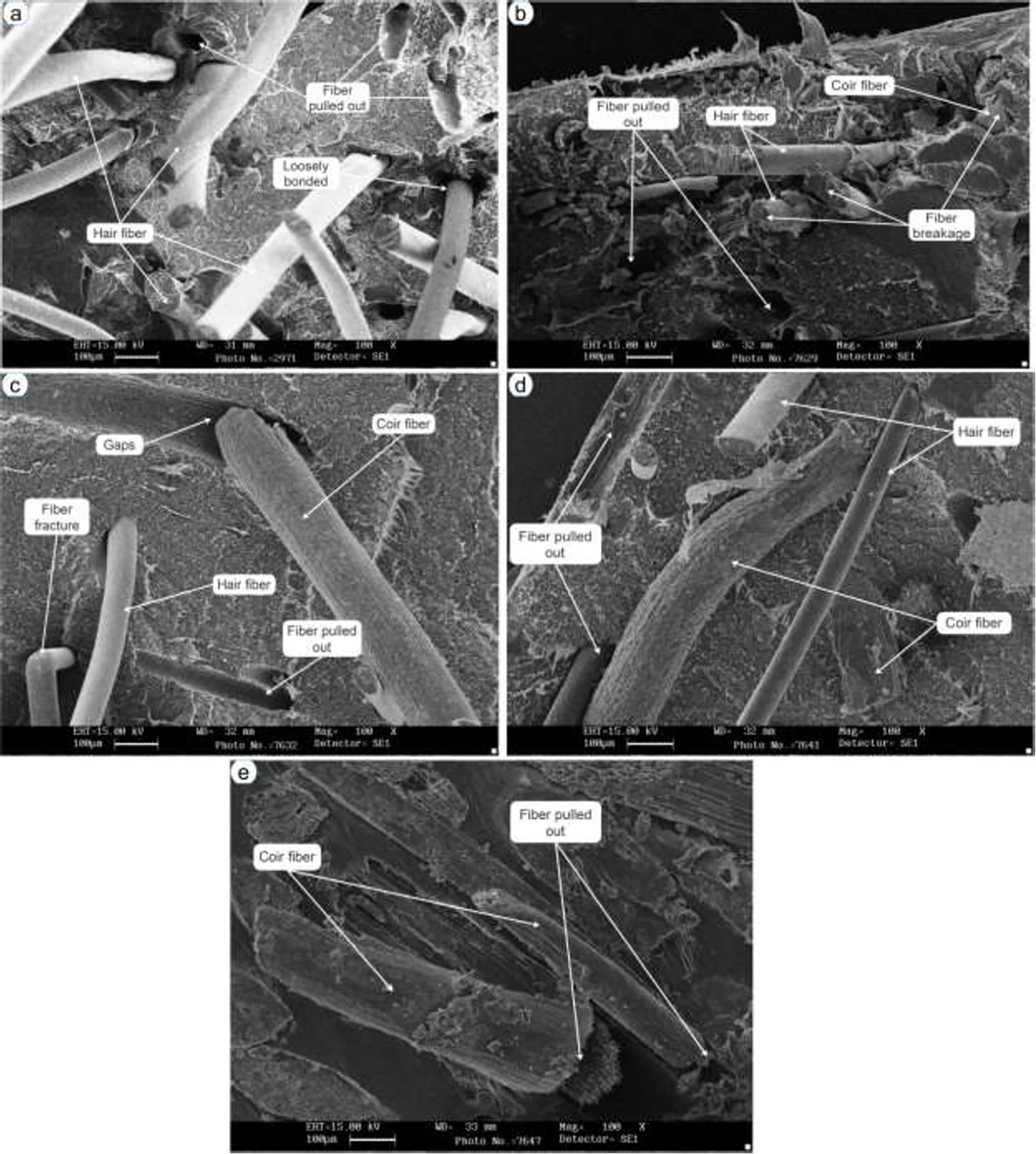
SEM micrograph of composites (a) Sample S1; (b) Sample S2; (c) Sample S3; (d) Sample S4; (e) Sample S5.
Thermal analysis
Thermogravimetric analysis (TGA) curves of non-hybrid and hybrid composites were shown in Figure 4, and the relevant data of the thermal study was simplified in Table 3. In this study, the degradation of non-hybrid and hybrid composites was investigated in three zones. In the first zone, a small weight loss (0.384% wt. loss) was detected at 100°C temperature due to the removal of moisture content from the composite S2. The composite S2 was less degraded as compared to other composites. Thereafter, 5% degradation was detected between 280.5 and 343.8°C for all composites due to the presence of a complex structure of the compounds, and 5% weight loss was detected at peak temperature 343.8°C. In the middle zone, 50% degradation of all composites was detected between 416.6 and 465.8°C, and 50% weight loss was detected at peak temperature 465.8°C. The residue was examined in the third zone at a temperature of 620°C. The composite S2 was detected more residues (0.584% wt. loss) as compared to other composites due to their thermal stability.

Thermal properties of the composites (a) TGA curves; (b) DTG curves; (c) DTA curves.
TGA thermograms of different composite samples.

DTG curves of non-hybrid and hybrid composites were illustrated in Figure 4, which was affected by using the hybridization of the composites. The DTG thermogram of the composite S1 has examined two major degradation peaks 8.14 wt.% loss/min and 28.06 wt.% loss/min at temperature 405°C and 470°C, respectively. 11 The rate of degradation was affected due to the complex chemical structure of HF/HDPE reinforced composite. The major peaks of the composite S2 were detected with a high rate of degradation 33.81 wt.% loss/min and 13.2 wt.% loss/min at 452°C and 478°C, respectively. This degradation rate was almost constant at 578°C. The composite S3 was detected two DTG thermogram 22.25 wt.% loss/min and 20.06 wt.% loss/min at temperature 463°C and 474°C, respectively. A similar pattern was examined for the composite S4 15.86 wt.% loss/min and 11.24 wt.% loss/min at temperature 452°C and 470°C, respectively. The four degradation rates 5.48 wt.% loss/min, 6.43 wt.% loss/min, 9.92 wt.% loss/min and 5.01 wt.% loss/min were examined at 361°C, 407°C, 464°C and 494°C, respectively. The first major peak of the DTG thermogram of the composite S2 was ameliorated due to good interlocking and adhesion between fiber and matrix.
The observation of DTA thermograms of hybrid and non-hybrid composites were shown in Figure 4, which was affected by using the hybridization of the composites. DTA thermograms were helpful to examine the endothermic and exothermic peaks of the composites.
The change in thermal enthalpy (ΔH) was always shown the correlative with the character of the peaks of the composites. The relative ΔH value of the composites and its peaks were shown in Table 4. One endothermic peak and two exothermic peaks were detected in composite S1 during the study of the DTA thermogram. The endothermicity of the composite was detected due to the energy required for the beginning of the reaction. After that, the composite was started to decompose at high temperatures and released the energy in the surroundings due to exothermicity. Similarly, one endothermic and two exothermic peaks were also found in composite S5. The hybridization of the composites had changed the original structure of fibers and various short microfibrils zones had been developed in hybrid composites. These short microfibrils zones were played an important role in the shifting of peaks in the DTA study of composites, which was responsible to improve the thermal stability of the composites. The first exothermic peak of the composite S2 detected at temperature 453°C, which had a superior value of ΔH as compared to other composites. Thus the composite S2 provided better thermal stability.
DTA thermograms of different composite samples.

From the descriptive thermal study of the composites, the composite S2 indicated a strong interfacial adhesion between the fibers and matrix. The ratio of fibers in the reinforcing phase was 75/25 (HF/CF), which provided more thermal stability as compared to other hybrid and non-hybrid composites. The results of the thermal study were well supported by the mechanical and SEM analysis of the composites.
Water absorption behavior
The water absorption study of composites was examined to calculate the percentage gain of water absorption of respective specimens under the specified stipulations. Normally, the percentage gain of water absorption of composites depends on various factors (fiber type, volume fraction, hydrogen bonding sites, temperature, void spaces, and micro-cracks).12,20 The water absorption behavior of the hybrid and non-hybrid reinforced composites was carried out for 188 hours and the percentage gain of water absorption was detected high in the initial stage, after that, it decreased till it reached the equilibrium level. The results can be seen in Figure 5 that the water absorption was directly proportional to the fibers loading in composites and was increased with an increasing fiber loading and time. Water absorption depends upon the fibers and interlocking between the fiber and matrix. The water absorption percentage of the composite S1 was examined 75.64% less as compared to the composite S5, because HF was more in hydrophobic nature as compared to CF. The water absorption of HF/HDPE composites was enhanced with applied the hybridization of coir fiber in composites because the coir fiber has more pits/roughness as compared to the hair fiber. 8

Water absorption curves of the composites.
Equation (3) was used to explain the water absorption results of hybrid and non-hybrid composites in Figure 6. The curve fitting methodology examined the optimum values of parameters (n and k), which was useful to estimate the kinetics. The diffusion mechanism of the composites can be estimated with the help of Fick’s model (equation (4)). The maximum diffusion of composites was detected at the initial stage of water absorption, which was reduced with the saturation of water absorption. 21 The kinetics and diffusion mechanism of hybrid and non-hybrid composites were shown in Table 5. The composite S1 obtained the most favorable results of water absorption which was least diffused in comparison to other hybrid and non-hybrid composite materials. Water absorption kinetics and diffusion mechanism of composites was used to develop well water-resistant and superior composite materials.
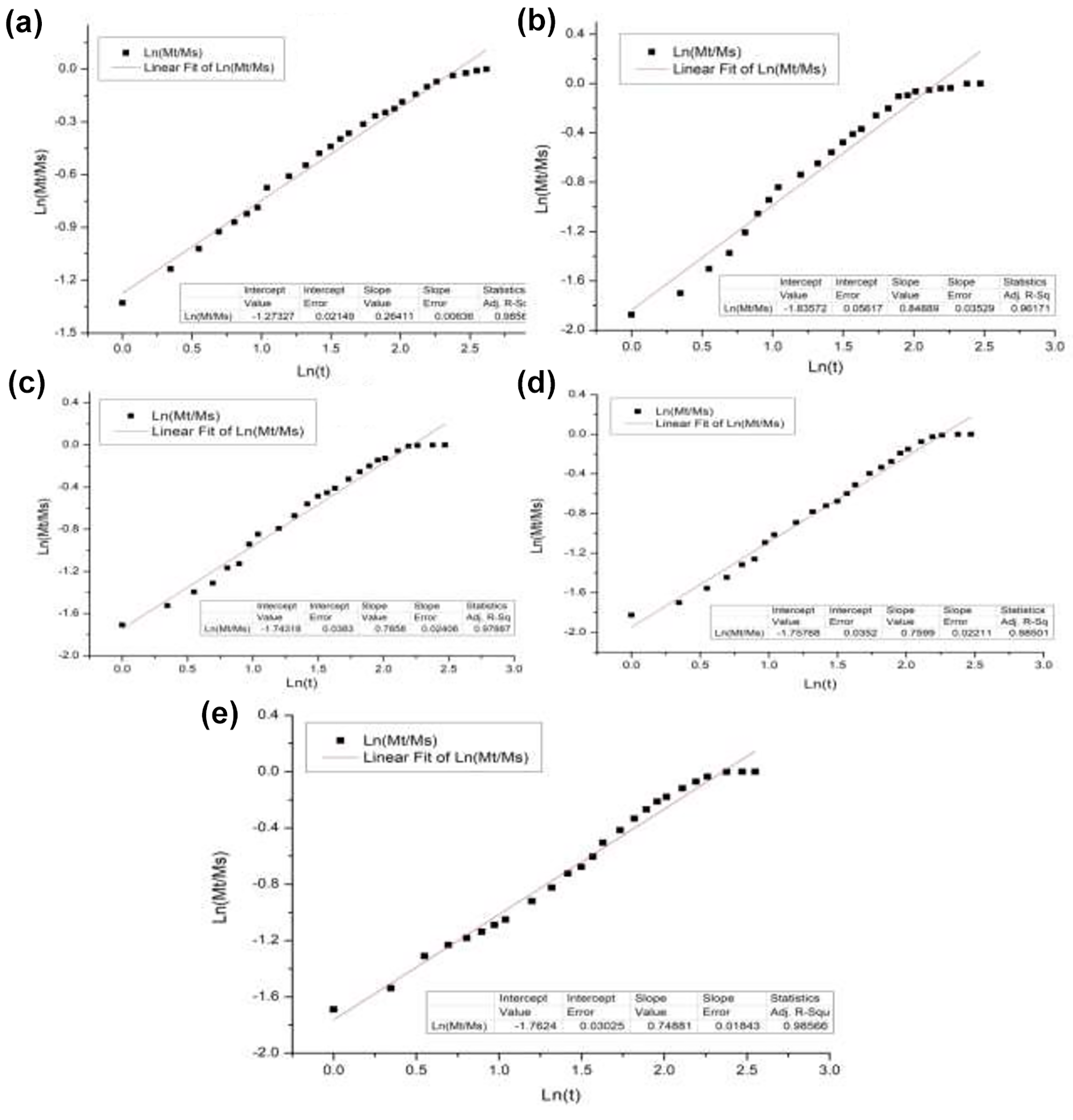
Diffusion curve fitting plot of composites (a) Sample S1; (b) Sample S2; (c) Sample S3; (d) Sample S4; (e) Sample S5.
Water absorption constants and diffusion coefficient of composites.

FTIR analysis
FTIR analysis of the hybrid and non-hybrid composites was shown in Figure 7. FTIR spectra of S1, S2, S3, S4, and S5 hybrid polymer composites were incorporated in the figure. In all hybrid composites, hydroxyl group O-H stretch and alkyl group C–H stretch were found at peak 34.1061 m−1 and 29.2403 m−1, respectively. The attraction between fibers and polymer was played a major role to affect the peaks of hybrid composites. Ester group C=O stretch and anhydride group CO–O stretch were detected at peaks 17.4742 m−1 and 10.4693 m−1. Both two peaks were increased with increasing the CF content in composites. Another group C-H bend was found at peak 7.2448 m−1. This peak was increased by decreasing the HF percentage in hybrid composites. The optimum HF content with CF had ameliorated the adhesion between fiber and polymer with the thermal and mechanical stability of the HF/CF/HDPE reinforced hybrid composites.7,10–12

FTIR spectra of composites.
XRD behavior
X-ray diffraction (XRD) analyzer was examined the crystallinity of the hybrid and non-hybrid composites, which was shown in Figure 8. The peak positions of major reflection crystalline plane (100) were listed in Table 6. The characteristics of the peak position were not changed majorly with the addition of CF composition in HF/HDPE composites. However, the hybridization of fiber influenced the crystalline thickness of the composites. The crystalline part of the hybrid and non-hybrid composites was reflected at the angle ∼21°. Scherrer’s equation was used to detect the crystallite sizes of the composite composites. The major crystallite size was detected 326 nm at 21.053° of composite S2 due to the presence of strong interfacial bonding between the fibers/matrix, which was superior in comparison to other hybrid and non-hybrid composites.8,9
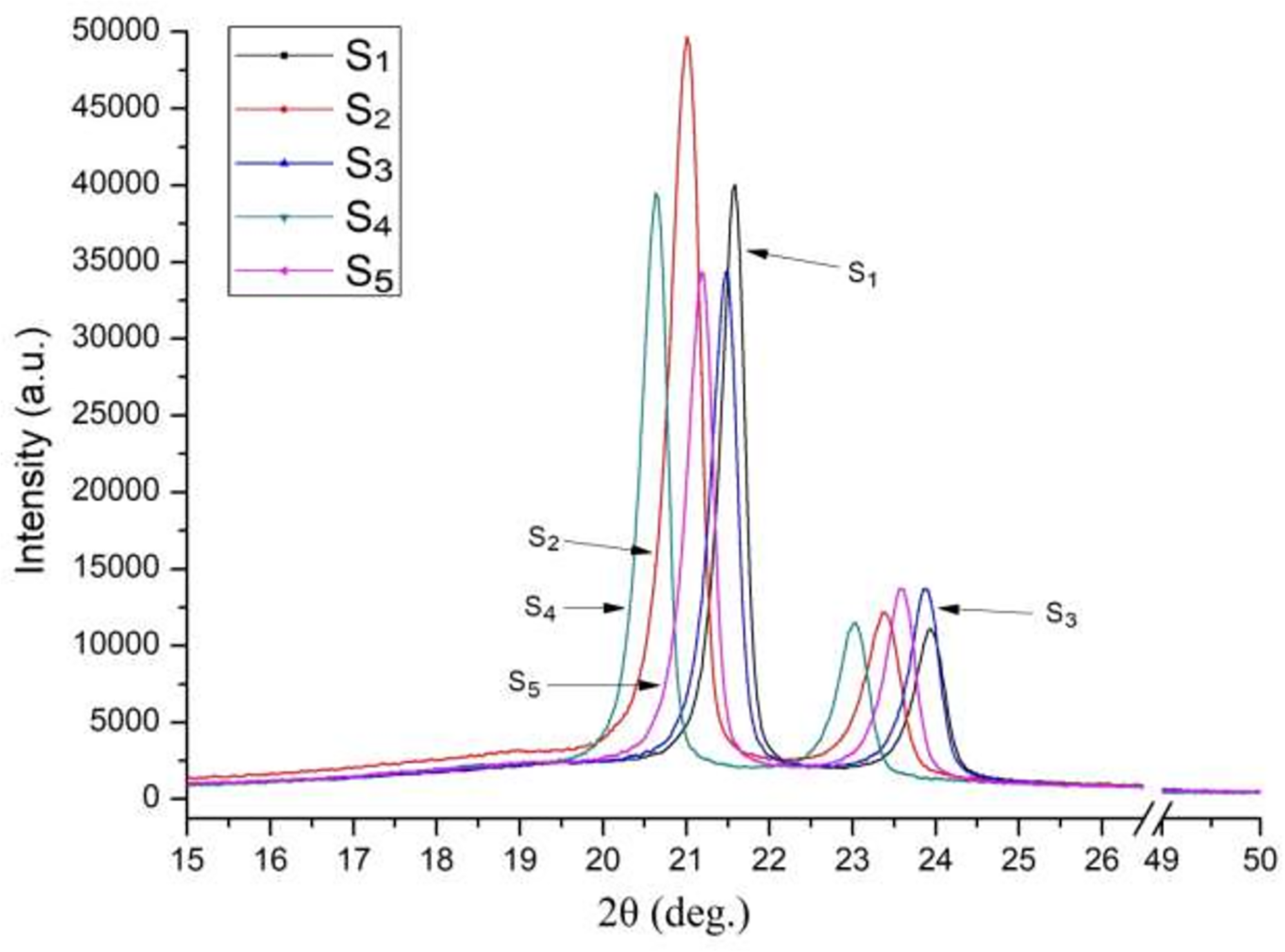
Powder XRD of composites.
Water absorption constants and diffusion coefficient of composites.

Conclusion
In this study, authors have used different characterization techniques (FTIR, morphology, and water absorption test, mechanical and thermal behaviors) to examine the properties of hybrid and non-hybrid composites. The details of the chemical group were studied by using the FTIR analyzer, which was helpful to examine the nature of bonding. The mechanical strength of the composites was effective after the hybridization of fibers, which ameliorated the strength of the composites. The composite S2 was achieved superior mechanical attributes as compared to other hybrid composites. The composite S2 was ameliorated with the tensile strength 5% and 35.2% more in comparison of composites S1 and S5, respectively. Similarly, the composite S2 was achieved 5.1% and 17.2% more flexural strength as compared to the composites S1 and S5, respectively. A similar pattern was detected in the thermal study of the composites, which was affected by applying the hybridization of composites. Thereafter, 5% and 50% degradation of all composites were detected in the range of temperatures 280.5–343.8°C and 416.6–465.8°C, respectively. The optimum thermal stability was investigated for the composite S2. The weight losses 5% and 50% were detected at peak temperature 343.8°C and 465.8°C, respectively. The water absorption percentage of the composite S1 was examined 75.64% less as compared to the composite S5 due to the hydrophobic nature of hair fiber. The major crystallite size was detected 326 nm at 21.053° of composite S2. These characterizations were very helpful for further innovation in this field to develop new natural fiber-based hybrid composites.
Footnotes
Acknowledgments
I gratefully acknowledge the Indian Institute of Technology Roorkee (INDIA) for providing me excellent facilities to carry out this study.
Declaration of conflicting interests
The author(s) declared no potential conflicts of interest with respect to the research, authorship, and/or publication of this article.
Funding
The author(s) received no financial support for the research, authorship, and/or publication of this article.
