




Abstract
This work aims to perform a systematic investigation on the crystallization behavior and morphologies of carbon and glass fiber reinforced PEEK. The nonisothermal and isothermal crystallization behavior was investigated by differential scanning calorimetry (DSC). The resultant morphologies were assessed by wide angle X-ray diffraction (WAXD), small angle X-ray scattering (SAXS), and polarized optical microscopy (POM) to provide details on spherulitic level, crystalline structure at unit cell, and lamellar levels. It was found that the crystallization ability of carbon fiber filled PEEK was better than that of neat PEEK, while the behavior of glass fiber filled PEEK was in an opposite trend. The incorporation of carbon fiber (or glass fiber) led to a looser packing of the unit cell or a less crystal perfection of PEEK but did not change its crystal form as well as its long period of lamellae. The isothermal crystallization kinetics was analyzed by the Avrami model, suggesting that the crystallization mechanism of carbon fiber filled PEEK was different from that of neat PEEK and its glass fiber filled composites. Nevertheless, the POM results showed that fiber-induced transcrystallization in PEEK matrix was not evidenced for either carbon or glass fiber filled PEEK. Finally, the effect of carbon and glass fiber on the crystallization of PEEK matrix was discussed to some extent.
Introduction
Poly(ether ether ketone) (PEEK) is a semicrystalline high-performance engineering plastics and exhibits excellent high-temperature resistant, mechanical, electrical, and tribological properties, being widely used in various applications such as aerospace, automotive and orthopedic implants.1–8 Furthermore, glass fiber and carbon fiber are widely used to improve the properties of polymers including PEEK.9–16
Numerous investigations have compared the properties of carbon and glass fiber reinforced PEEK composites. For instance, Patel et al. 17 investigated the thermal decomposition and flammability of PEEK composites. It was found that the addition of filler improved the thermal stability of neat PEEK, and the composite filled with glass fiber presented higher thermo-oxidative stability than the one with carbon fiber. Moreover, the effect of fillers on the burning behavior of PEEK was quite complicated and strongly dependent on the testing technique applied. Song et al. 18 conducted fretting wear tests on PEEK and its carbon and glass fiber reinforced composites. It was demonstrated that carbon fiber filled PEEK had superior fretting wear characteristics. Chen et al. 19 studied the rate dependence of mechanical properties of short-fiber reinforced PEEK and the relationship between its failure behavior with strain rate and fiber type (carbon fiber and glass fiber). It was concluded that PEEK with carbon fiber revealed the highest tensile strength among neat PEEK and filler filled composites. In addition, fiber-matrix interfacial debonding was the main failure mode of carbon fiber reinforced PEEK, while it was the mode of breakage for glass fiber filled one. Moreover, PEEK with carbon fiber revealed higher energy absorption than the one with glass fiber.
For fiber-reinforced semicrystalline polymer composites, an interesting feature is the formation of transcrystalline interphase layer.20–22 The formation of transcrystalline is usually favorable in improving the interfacial shear strength between the fiber and matrix. 22 Generally, heterogeneous nucleation mechanism is considered to be responsible for the formation of transcrystalline layer, which can be influenced by fiber topography and type. 22 Karsli et al. 23 evaluated the effect of thermal annealing on the fiber-matrix interface of carbon and glass fiber filled PEEK composites by dynamic mechanical analysis. It was found that annealed PEEK composites revealed the lowest intensity of damping peak in comparison with quenched composites. Based on these results, the authors suggested that a transcrystalline layer was formed between the fiber and matrix in the annealed composites. However, no direct evidence of the formation of a transcrystalline layer between the carbon (or glass) fiber and PEEK matrix was provided by the authors. 23
Besides the morphology at spherulitic level, the crystalline structure at unit cell, lamellar levels are also critical for the properties of polymer composites. Regis et al. 24 investigated the effect of thermal annealing on the structure-properties relationship of polyacrylonitrile (PAN) or pitch-based carbon fiber reinforced PEEK composites. The morphologies at multi-scales were probed by various techniques such as wide angle X-ray diffraction (WAXD), and small angle X-ray scattering (SAXS).
In addition, the isothermal and nonisothermal crystallization kinetics of neat PEEK and its fiber reinforced composites have been investigated extensively.25–29 Tardif et al. 26 studied the isothermal crystallization kinetics of PEEK over a large temperature range from 170 to 310°C using a fast differential scanning calorimeter (DSC). Regis et al. 27 compared the nonisothermal crystallization kinetics of PAN and pitch-based carbon fiber reinforced PEEK. It was found that fiber type could either favor or hinder polymer crystallization. Wei et al.28,29 investigated the nonisothermal crystallization kinetics of short or continuous glass fiber reinforced PEEK.
Although the crystallization behavior of fiber reinforced PEEK composites has been addressed extensively, there is little study which compares the effect of glass and carbon fibers on the crystallization behavior and morphologies at multi-scales of PEEK subjected to the same thermal history. This work aims to perform a systematic investigation on the crystallization behavior and morphologies of carbon and glass fiber reinforced PEEK. The nonisothermal and isothermal crystallization behavior was investigated by DSC, while the resultant morphologies were assessed by WAXD, SAXS, and polarized optical microscopy (POM) to provide details on spherulitic level, the crystalline structure at unit cell, and lamellar levels.
Experimental
Materials
Commercial unreinforced PEEK (trade name: 450G) and its 30 wt% carbon and glass fiber reinforced grades (trade names: 450CA30 and 450GL30) were supplied by Victrex. The 450G had a molecular weight of about 1.0 × 10 5 g/mol. 17 The 450CA30 was polyacrylonitrile-based carbon fiber (with a diameter of 7 µm and length of ∼200 μm) reinforced PEEK composites, while the 450GL30 contained glass fibers with a diameter of 10 µm and length of ∼200 μm. 17 The density of 450G, 450CA30 and 450GL30 was 1.30, 1.40 and 1.51 g/cm3, respectively. Consequently, the fiber volume content for 450CA30 and 450GL30 was 25.8% and 22.7%, respectively.
Characterization
A DSC Q2000 (TA Instruments) was used to study the crystallization behavior of the materials. Calibration for the temperature and energy scales was carried out using a pure indium standard. Sample weight was about 4 mg. All the runs were carried out in a nitrogen atmosphere. Each experiment was repeated three times. As relevant to different aspects, different thermal programs were employed as follows: Nonisothermal crystallization. The sample was first heated to 380°C at 20°C/min and held for 5 min to eliminate any previous thermal history. Then, the crystallization behavior was recorded upon cooling at a given rate ranging from 2.5 to 20°C/min. Isothermal crystallization. The specimens were first heated to 380°C at 20°C/min and held for 5 min to eliminate any previous thermal history. Then, the samples were cooled to the designated crystallization temperatures (Tcs) at 60°C/min and the DSC traces were recorded during the isothermal process.
The samples for WAXD and SAXS measurements were prepared as follows. The pellets were hot-pressed into sheets of about 1 mm firstly. Then the sheets were wrapped with aluminium foil and thermal treated by a hot stage (Linkam THMS-600). It was heated to 380°C at 20°C/min and held for 5 min to eliminate the thermal history, followed by cooling down at a rate of 5°C/min and 20°C/min, respectively, to finish the crystallization.
The WAXD measurements were carried out at room temperature by using an X-ray diffractometer (Bruker D8 Discover) with X-ray source of CuKα (λ = 1.54 Å) radiation at voltage of 50 kV and a current of 1000 μA. Two-dimensional WAXD patterns were converted to the one-dimensional data by integration via the Bruker FIT-2D software.30–32
The SAXS measurements were performed at room temperature by a Bruker NanoStar system with CuKα (λ = 1.54 Å) radiation with the generator working at 45 kV and 0.65 mA. The exposure time was 1 h. All the measurements were performed under high vacuum. Two-dimensional SAXS patterns were converted to the one-dimensional data by integration via the Bruker FIT-2D software.
Microscopic observations were performed on a POM (Olympus BX61) with a hot stage (Linkam THMS-600). Firstly, the pellets were hot-pressed. Then the hot-pressed thin films were sandwiched between two glass slides. After melted at 380°C for 5 min or 400°C for 5 or 10 min, it was cooled to the selected isothermal crystallization temperature at a rate of 60°C/min and then the crystallization process was recorded.
Results and discussion
Nonisothermal crystallization behavior and resultant microstructures
The crystallization exotherms of PEEK and its composites at various cooling rates are presented in Figure 1. The resultant crystallization peak temperature (Tp) and the absolute degree of crystallinity (Xc) are illustrated in Figure 2. The Xc was evaluated by 7 :

where ΔHc is the enthalpy of crystallization, ΔHm0 = 130 J/g is the fusion heat of a perfect PEEK crystal,7,27,33 and νm is the polymer content. As expected, the crystallization peak temperature (Tp) shifts to lower temperature with increasing cooling rate for either PEEK or its composites (Figure 2a), indicating that the more supercooled region is needed to activate the crystallization process as the cooling rate increases.34–37 At each cooling rate, the Tp of 450CA30 is higher than that of PEEK. In contrast, the Tp of 450GL30 is lower than that of PEEK. Nevertheless, as shown in Figure 2b, the effect of filler type on the crystallinity of PEEK is ignorable. In addition, the crystallinity of all the materials decreases marginally with the increase of cooling rate.

DSC thermograms of PEEK and its composites upon cooling from the melt at (a) 2.5°C/min, (b) 5°C/min, (c) 10°C/min, and (d) 20°C/min.
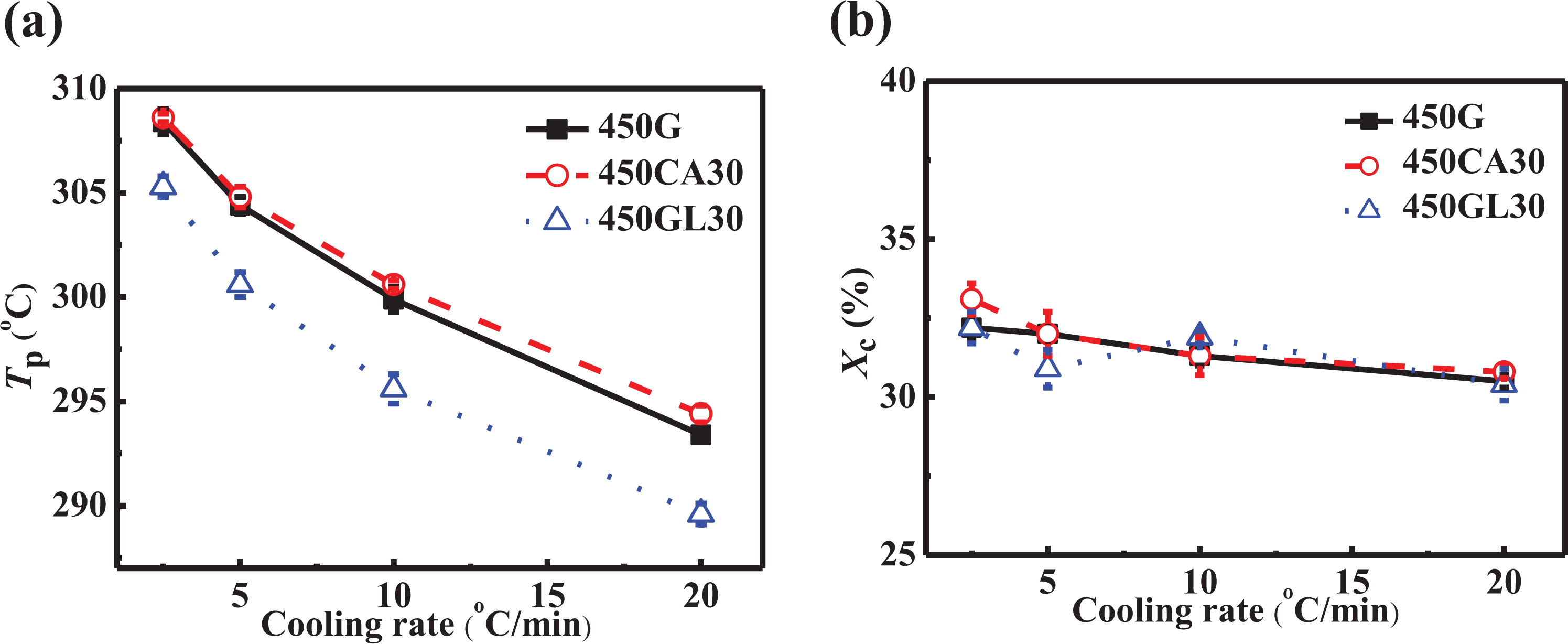
(a) Crystallization peak temperature (Tp) and (b) relative crystallinity (Xc) versus cooling rate for PEEK and its composites.
In order to investigate the effect of fiber types on the crystal structure of PEEK, WAXD measurements were performed for PEEK and its composites crystallized at 5 or 20°C/min from the melt, as shown in Figure 3. Neat PEEK presents diffraction peaks at 2θ = 19.0°, 21.0°, 23.0° and 29.1°, associated with the (110), (111), (200) and (211) planes, respectively, related to the α-crystal of PEEK.9,38 Similar diffraction peaks are observed for 450CA30 and 450GL30, indicating that the incorporation of carbon fiber (or glass fiber) does not change the crystal form of PEEK.

WAXD profiles for PEEK and its composites crystallized nonisothermally from the melt at (a) 5°C/min, and (b) 20°C/min.
In more details, potential changes in the unit cell parameters were evaluated from the WAXD profiles in Figure 3. These parameters were calculated by the equations of 24 :


where λ = 0.154 nm is the X-rays wavelength, and θhkl represents the angular position of the hkl reflection.24,39 The resulting parameters are shown in Figure 4. Obviously, a slight increase in all the unit cell parameters is observed for 450CA30 and 450GL30, compared to neat PEEK, irrespective of the cooling rate applied. This indicates that the incorporation of carbon fiber (or glass fiber) leads to a looser packing of the unit cell or a less crystal perfection of PEEK.

Variations of the unit cell parameters of (a) a, (b) b, and (c) c for 450G, 450CA30 and 450GL30 crystallized under indicated cooling rates.
Further information on lamellar level may be achieved SAXS measurements. Figure 5 shows the Lorentz-corrected SAXS intensity profiles for all the materials crystallized at 5 or 20°C/min from the melt. The most probable value of interlamellar spacing L can be calculated from the acquired scattering data according to Braggs law 40 :

where q is the scattering vector. Clearly, a long period of about 9.5 nm is observed for PEEK and its composites, independent of the cooling rates applied and the presence of carbon or glass fibers. This indicates that the incorporation of carbon fiber (or glass fiber) does not cause significant changes in the long period L of PEEK.

The Lorentz-corrected SAXS intensity profiles for PEEK and its composites crystallized nonisothermally from the melt at (a) 5°C/min and (b) 20°C/min, and (c) the corresponding long period L.
Isothermal crystallization kinetics
The isothermal crystallization kinetics of PEEK and its composites was further studied by using DSC. Figure 6 presents the DSC traces of isothermal crystallization for PEEK and its composites at various Tcs from 310 to 318°C. For each material, the exothermic peak shifts to longer time with increasing Tc, indicating a decrease of crystallization rate. To investigate the crystallization kinetics further, the relative degree of crystallinity X (t) was calculated from the integrated area of the DSC curve from time t = 0 to t divided by the integrated area of the whole heat flow curve. Figure 7 shows the plots of Xc (t) as a function of t for the materials considered. Sigmoidal curves are observed, as reported previously.41–43

DSC exotherms of isothermal crystallization for PEEK and its composites at designated Tcs.

Relative crystallinity as a function of crystallization time at indicated temperatures for PEEK and its composites.
The Avrami equation is the most commonly used theory for the analysis and study of the crystallization kinetics of polymers,44–47 as follows:


where n is the Avrami index, and k is the overall rate constant associated with both nucleation and growth rate parameters. Figure 8 shows the plots of log [− ln (1 − X (t))] against log t for PEEK and its composites. The Avrami parameters n and k are obtained by fitting the linear portion, which are listed in Table 1. The half-time of crystallization t0.5, can be evaluated as follows:

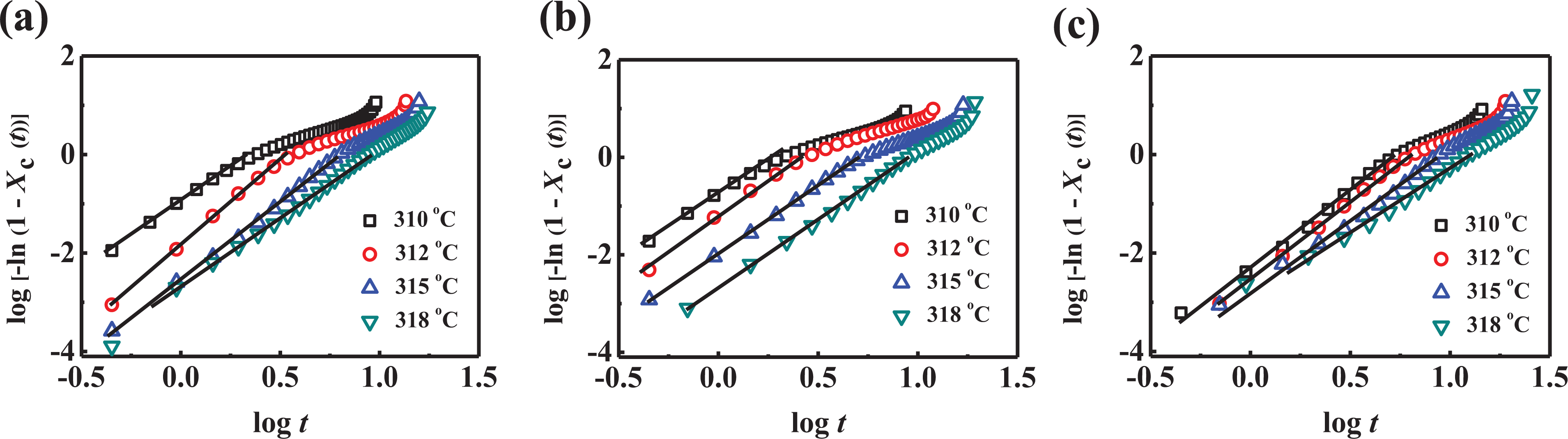
The Avrami plots of PEEK and its composites (a) 450G, (b) 450CA30, and (c) 450GL30 upon crystallization at indicated temperatures.
Kinetics parameters of the samples during isothermal crystallization at indicated temperatures.

The resultant values of t0.5 are included in Table 1. To see more clearly, the values of n and t0.5 as a function of Tc for the materials are illustrated in Figure 9. It is observed that the value of n at each Tc for 450CA30 is lower than that of 450G and 450GL30, indicating different crystallization mechanism. On the other hand, the value of k decreases with increasing Tc generally for all the samples studied, indicating a decrease of crystallization rate. Meanwhile, at a given Tc, the value k of 450CA30 is higher than that of pure PEEK, while that of 450GL30 is lower. Similar conclusion can be drawn from the t0.5 values.

(a) The Avrami parameters (n) as a function of crystallization temperature (Tc) and (b) halftime of crystallization (t0.5) for PEEK and its composites.
Microstructure of PEEK and its composites
Fiber addition to polymeric matrix typically leads to the formation of a transcrystalline layer. PEEK and its composites crystallized isothermally from melt were investigated by POM. Figure 10a shows the POM images of neat PEEK and its composites crystallized isothermally at 318°C after melted at 380°C for 5 min. Fiber-induced transcrystallization in PEEK matrix is not evidenced for glass fiber filled PEEK. In the case of carbon fiber filled PEEK, it is not easy to give a definite conclusion whether fiber-induced transcrystalline layer is formed, due to high density of carbon fiber in the matrix. Similar observation is true in the case of melted at 400°C for 10 min (Figure 10b). To solve this problem, we managed to reduce the density of carbon fiber in PEEK matrix through reducing the thickness of the film. Finally, the isothermal crystallization process of carbon fiber filled PEEK was monitored. Figure 11 shows the optical micrographs of 450CA30 upon isothermal crystallization at 320°C after melted at 400°C for 5 min. No preferential nucleation of PEEK in the surface of carbon fiber is observed, indicating that fiber-induced transcrystallization in PEEK matrix is not evidenced for carbon fiber filled PEEK.

Optical micrographs of PEEK and its composites crystallized isothermally at 318°C after melted at (a) 380°C for 5 min and (b) 400°C for 10 min, respectively.
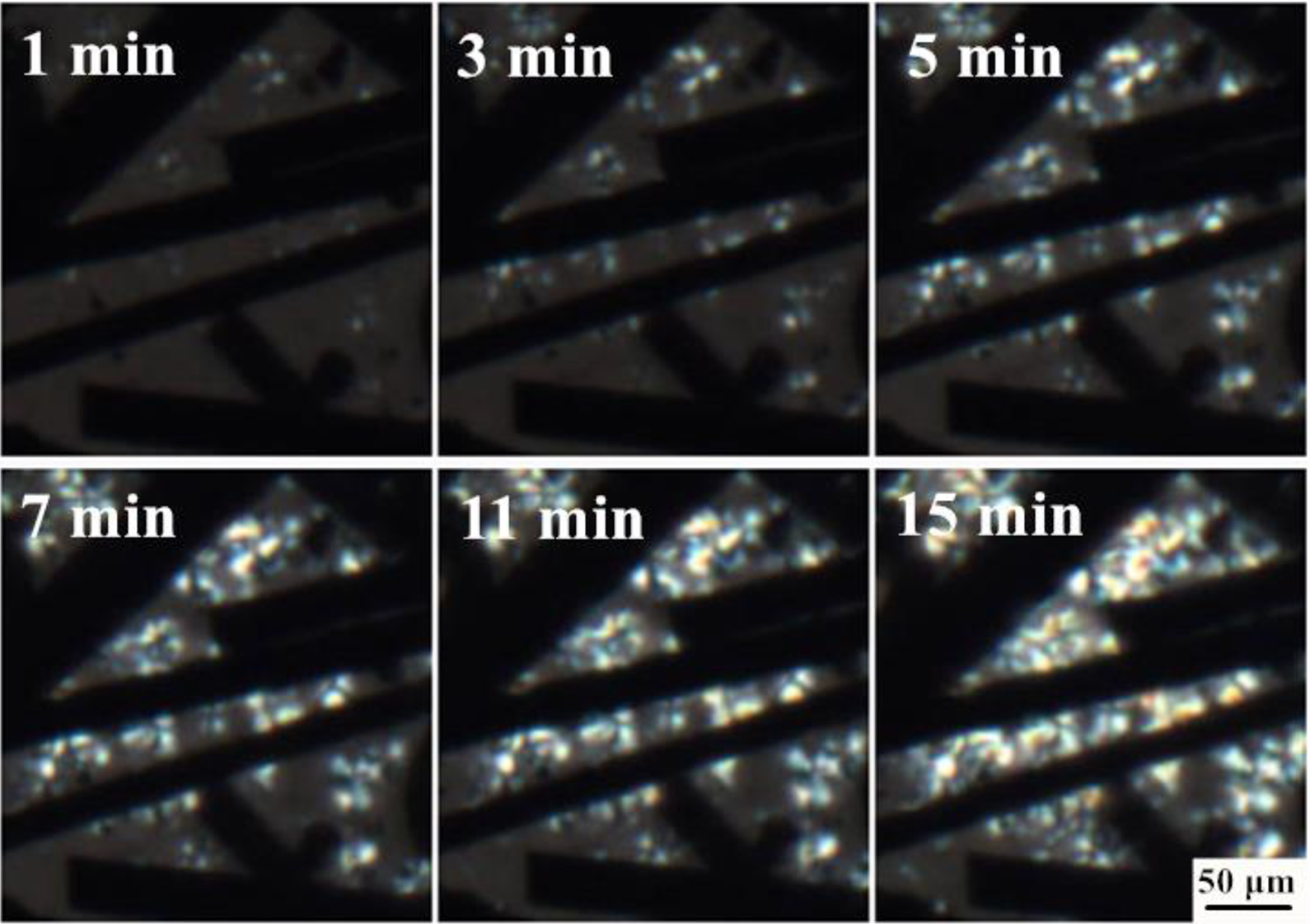
Optical micrographs of 450CA30 upon isothermal crystallization at 320°C at indicated times after melted at 400°C for 5 min.
Discussion
In brief summary, the nonisothermal and isothermal results from DSC reveals that, compared with 450G, the crystallization ability of 450CA30 is better, while that of 450GL30 is worse (see Figures 1 and 6). As reported previously,48–51 heterogeneous nucleation and mobility of molecular chains are the two main factors affecting the crystallization of polymer composites. In this context, the lower crystallization ability of 450GL30 can be ascribed to the hindrance effect of glass fiber on the mobility of PEEK chains. It is noteworthy that the fiber volume content for 450CA30 is higher than that of 450GL30, while the diameter of carbon fiber is lower than that of glass fiber. Consequently, the hindrance effect of carbon fiber on the mobility of PEEK chains should be even stronger than that of glass fiber. It seems that carbon fiber also plays a role of heterogeneous nucleation and enhances the crystallization of PEEK matrix. However, no preferential nucleation of PEEK in the surface of carbon fiber is observed from the POM results (see Figure 11). Therefore, the crystallization mechanism of commercial 450CA30 is quite complicated. The higher crystallization ability of 450CA30 compared with 450G might be ascribed to some unknown additives in 450CA30 which enhances the crystallization of PEEK matrix.
Conclusions
450CA30 reveals better crystallization ability than 450G, being completely different from 450GL30. The lower crystallization ability of 450GL30 in comparison with 450G can be ascribed to the dominant hindrance effect of glass fiber on the mobility of PEEK chains. However, the crystallization mechanism of commercial 450CA30 is difficult to understand. On the one hand, the hindrance effect of carbon fiber on the mobility of PEEK chains is even stronger than that of glass fiber. On the other hand, no preferential nucleation of PEEK in the surface of carbon fiber is observed from the POM results. Therefore, the higher crystallization ability of 450CA30 compared with 450G might be ascribed to some unknown additives in 450CA30 which enhances the crystallization of PEEK matrix. The WAXD and SAXS analyses show that the presence of carbon or glass fibers results in a looser packing of the unit cell of PEEK, while its crystal form and long period of lamellae is not changed.
Footnotes
Declaration of conflicting interests
The author(s) declared no potential conflicts of interest with respect to the research, authorship, and/or publication of this article.
Funding
The author(s) disclosed receipt of the following financial support for the research, authorship, and/or publication of this article: This work is financially supported by the National Natural Science Foundation of China (11432003, 51573170, U1704162) and the 111 Project (D18023).
