




Abstract
The current article aims to develop poly (butyl methacrylate) (PBMA) nanocomposites with enhanced electrical and mechanical properties by incorporating neodymium oxide (Nd2O3) nanoparticles between the PBMA chains. The morphological, thermal and structural profiles of the PBMA nanocomposites reinforced with different loading of Nd2O3 nanoparticles were investigated by scanning electron microscopy (SEM), X-ray diffraction (XRD) and thermogravimetric analysis (TGA). The SEM images revealed that the morphology of the PBMA was significantly influenced by the insertion of Nd2O3. The uniform dispersion of Nd2O3 in the polymer composite was visible at 5 wt% loading of nano-filler. The main crystalline peaks of Nd2O3 nanoparticles in the amorphous PBMA structure were revealed by the X-ray diffraction analysis. The thermal stability of PBMA was greatly enhanced by the dispersion of Nd2O3 in the PBMA matrix. The tensile strength and elongation at break of the composites were measured and both results showed the enhanced mechanical properties of PBMA due to the reinforcement of Nd2O3 nanoparticles. The various parameters affecting the increased tensile strength of composite by the incorporation of nanoparticles were studied by different theoretical modeling. The electrical properties such as dielectric constant and the dielectric loss tangent (tan δ) of PBMA nanocomposites were enhanced with the addition of nanoparticles. Also, the DC conductivity of polymer composites was estimated and the applicability of different theoretical models for predicting the conductivity properties of PBMA/Nd2O3 nanocomposites were examined.
Keywords
Introduction
Polymer composites offer numerous applications in technical fields due to their unique physical and chemical properties as well as their easy processability.1–4 To improve the properties of composites, metal oxide nanoparticles with specific properties are incorporated into the polymer matrix which resulted in polymer nanocomposites with salient features.5,6 Compared to conventional metal oxides, the nanosized metal oxide provides a higher interaction zone to the polymer matrix which results in the significant improvement in mechanical properties of the polymer composites.7,8 However, the mechanical properties are significantly influenced by the size, shape, amount as well as the nature of the nanoparticles within the polymer matrix. Du et al. has investigated the role of MgCl2 nanoparticles for improving the mechanical properties of polyvinyl alcohol polymer. 9 The significantly improved optical properties of PMMA polymer by the dispersion of ZnO nanoparticles were reported by Demir et al. 10 Improved conductivity properties of PMMA polymer by the addition of CeO2 nanoparticles were reported by Rajendran et al. 11
Recently, polymer nanocomposites with remarkable mechanical and electrical properties have great attention due to their interesting applications. Semiconducting metal oxide nanoparticles are used as a reinforcing filler for the fabrication of polymer nanocomposite. The incorporation of these nanoparticles into the polymer matrix enhances the mechanical strength and electrical properties of polymer composite. Among various semiconducting metal oxides, rare earth metal oxides are more interesting due to their immense optical and electrical properties.12,13 Neodymium oxide is an important rare earth metal oxide widely used in various electronic applications due to its low band gap energy and variable valence states. 14 The lightweight polymers with transparent nature have attracted the researchers due to their potential applications in various fields. In automotive and aircraft industries, the materials with lightweight and substantial mechanical properties are more preferred. Therefore poly (butyl methacrylate) polymers are widely studied nowadays, owing to its flexible, transparent and better mechanical properties.15,16 Further, the properties of PBMA can be improved by adding suitable nanoparticles in order to extend their applications to various fields.
The mechanical and electrical properties of polymers are greatly enhanced by the proper insertion of nanoparticles. In such polymer composites, a drastic increase in properties is obtained at certain filler loadings and beyond this loading these properties are decreasing. The changes in mechanical properties are explained on the basis of strong synergistic effects between the polymer and the nanoparticles. 17 The Experimental data and theoretical studies are important for explaining the mechanism behind mechanical and electrical properties of polymer composites. The fillers act as stress-relieving sites at the polymer-filler interface which is responsible for higher mechanical properties of polymer composites.18,19 Generally, the electrical properties of such composite depend on the aspect ratio, volume fraction of filler, nature and polarity of the filler.20–22 Several theoretical studies are carried out to analyze the mechanism of conductivity and tensile strength of polymer composite. Based on this, the present study is focused on the experimental and theoretical studies of electrical properties and mechanical strength of PBMA with different contents of Nd2O3 nanoparticles through free radical polymerization technique. To the best of our knowledge, there is no work reported on the effect of Nd2O3 nanoparticles on the mechanical and electrical properties of PBMA. The influence of Nd2O3 nanoparticles on the tensile strength as well as DC conductivity of the PBMA matrix are studied in detail with respect to different loading of nanoparticles.
Experimental
Materials and methods
n-Butyl methacrylate (HiMedia), neodymium nitrate hexahydrate (Nd(NO3)3.6H2O (Aldrich), azobisisobutyronitrile (AIBN-HiMedia), cetyltrimethyl ammonium bromide (CTAB-HiMedia), toluene and ethanol were the chemicals used for the present study.
Synthesis of PBMA/Nd2O3 nanocomposites
Poly (butyl methacrylate)/ neodymium oxide nanocomposites were synthesized by the in-situ polymerization of butyl methacrylate monomer with different amount of neodymium oxide nanoparticles. The Nd2O3 nanoparticles were prepared by a simple co-precipitation technique as reported earlier. 23 For the preparation of nanocomposites, different contents of Nd2O3 nanoparticles (3, 5, 7 and 10 wt%) were first dispersed with CTAB in toluene to prevent the agglomeration of nanoparticles during in situ polymerization. The purified butyl methacrylate monomer (0.45 mol) was separately homogenized with toluene in a reaction kettle. Then the nanoparticle dispersion was added into butyl methacrylate monomer solution under constant stirring. The whole solution was subjected to ultrasonication to ensure the homogenous dispersion of nanoparticles into the monomer solution. AIBN (3.89 × 10⁻³ mol/L) in toluene was added to the above hybrid solution and the polymerization was carried out at 85°C for 2 h. The prepared polymer composite was separated from the homogenous solution by coagulating with ethanol, washed and dried to get constant weight. Neat poly (butyl methacrylate) was also prepared by the same experimental procedure except nanoparticles for a comparative study.
Characterization
The XRD patterns of Nd2O3 nanoparticle and the developed PBMA/Nd2O3 nanocomposites were recorded by Rigaku Miniflex 600 diffractometer (Japan). The diffractogram was measured at an operating 2θ range from 5° to 80° at a speed rate of 2° min−1. The surface morphologies of all the samples were examined by a Hitachi S-3000 H scanning electron microscope after sputter coating of the fracture surface of the polymer with gold at 0° tilt angle. The tensile strength and elongation at break of the samples were measured by using Zwick Universal Testing Machine (UTM) ASTM D 412-80 at 28°C, and a crosshead speed of 500 mm/min. The tensile measurements were carried out five times for each sample and the average value is reported. The electrical properties of the samples were measured by using polymer sheets (circular shape of 0.3–0.5 mm thick, 1.2 cm diameter). The DC conductivity measurements were done using Keithley 2400 instruments at room temperature. The dielectric properties of the polymer nanocomposites were determined by the impedance analyzer (Hewlett–Packard LCR Meter) in the frequency range of 102–106 Hz at room temperature. The dielectric constant was calculated by the following equations


where d implies the thickness of the sample, C the capacitance, A is the area of cross-section of the sample,
Results and discussion
Morphological studies
Surface morphological assessment of PBMA and PBMA with different contents of Nd2O3 nanoparticles are presented in Figure 1. The synthesized PBMA exhibited a homogenized smooth morphology which became coarser by the in-situ polymerization of Nd2O3 nanoparticles with butyl methacrylate monomer. The SEM picture of 3 wt% Nd2O3/PBMA nanocomposite showed an uneven distribution of nanoparticles in the polymer matrix with smooth morphology. It can be seen from the figure that the sample with 7 wt% nanoparticles containing PBMA shows a uniform structure with several uniformly dispersed nanoparticles which indicated a better adhesion between the polymer and the nanoparticles. The uniform dispersion of nanoparticles in the polymer is attributed to the strong interfacial interaction of PBMA with the Nd2O3 nanoparticles. However, the uniform dispersion of filler in the polymer is significantly changed into an agglomerated structure at higher loading of Nd2O3 nanoparticles (at 7 wt% loading). At higher loading, the coupling of adjacent nanoparticles increased the stress in the polymer composite which ultimately resulted in the clustering of nanoparticles.

FESEM images of PBMA with various loading of Nd2O3.
XRD analysis
Structural information of the prepared PBMA and PBMA/Nd2O3 nanocomposites are analyzed by XRD and the results are presented in Figure 2. As seen in the figure, the synthesized PBMA exhibits an amorphous peak at 2θ = 17.65°. However, the XRD patterns of the composites are distinct from that of plain PBMA. The composite exhibits the characteristic crystalline peaks of Nd2O3 nanoparticles along with the amorphous peak of pure PBMA which implies better compatibility between the polymer matrix and nanoparticles.24,25 It can be seen from the figure that the intensity of Nd2O3 peaks increases with the loading of nanoparticles in the polymer composite. The percentage of crystallinity induced by the addition of 5 and 10 wt% Nd2O3 nanoparticles into the polymer is found to be 50.01% and 54.21% respectively. The increase in the crystalline nature of composites signified the better reinforcement of Nd2O3 nanoparticles into the PBMA.
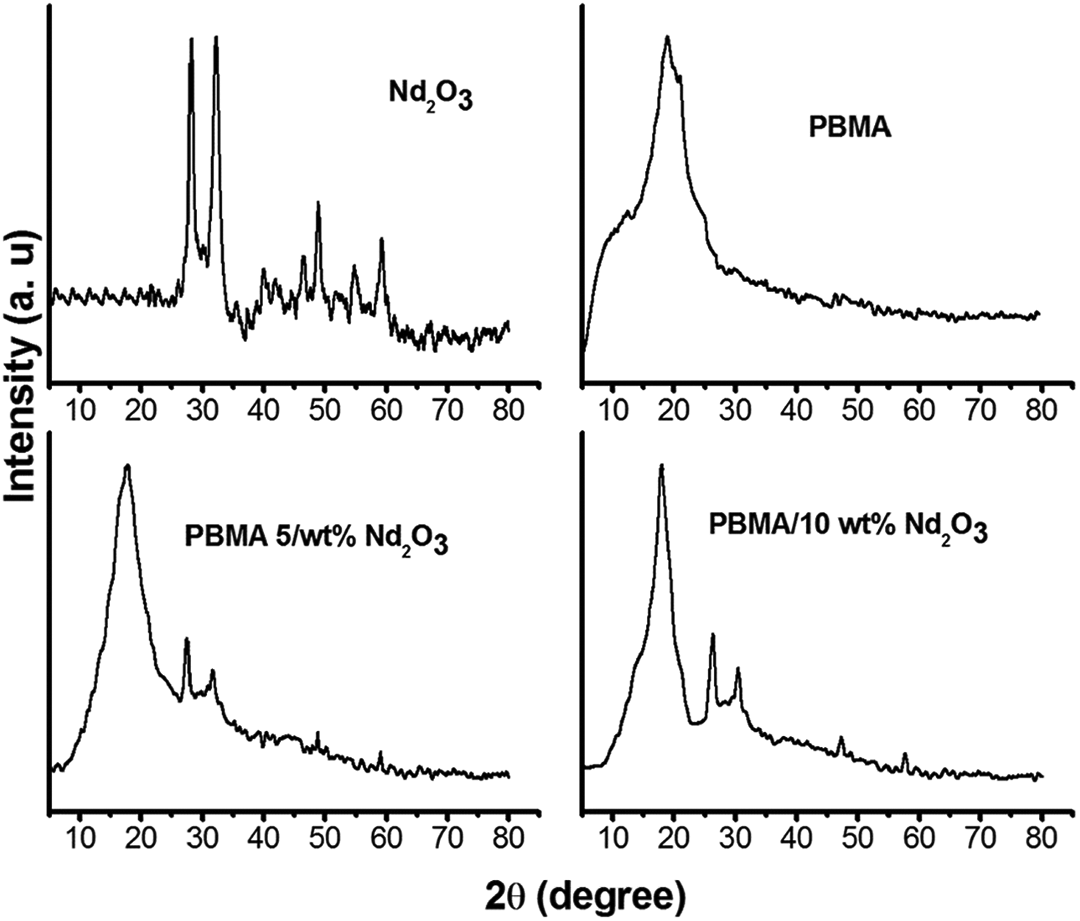
XRD pattern of PBMA with various loading of Nd2O3.
Dielectric properties
The changes in electrical properties such as dielectric loss and dielectric constant of PBMA by the addition of Nd2O3 nanoparticles are measured at different frequencies 102 to 106 Hz. Figure 3 shows the variation of dielectric loss (tan δ) value with frequency for the PBMA and PBMA/Nd2O3 nanocomposites. As seen from the figure, the dielectric loss value of all the composites decreases with frequency up to 103 Hz and then it remains constant. However, the introduction of Nd2O3 nanoparticles increases the dielectric loss value indicate that the nanoparticles brought some modifications in the PBMA matrix obviously by the better interface between them.26,27 But, in the present case, though the dielectric loss value increases with the addition of nanoparticles, the composites with 7 and 10 wt% Nd2O3 nanoparticles exhibit lower dielectric loss value than the PBMA with 5 wt% Nd2O3 nanoparticles. This might be due to poor polymer-filler interface by the presence of agglomerated nanoparticles at higher concentrations, as revealed from SEM images.
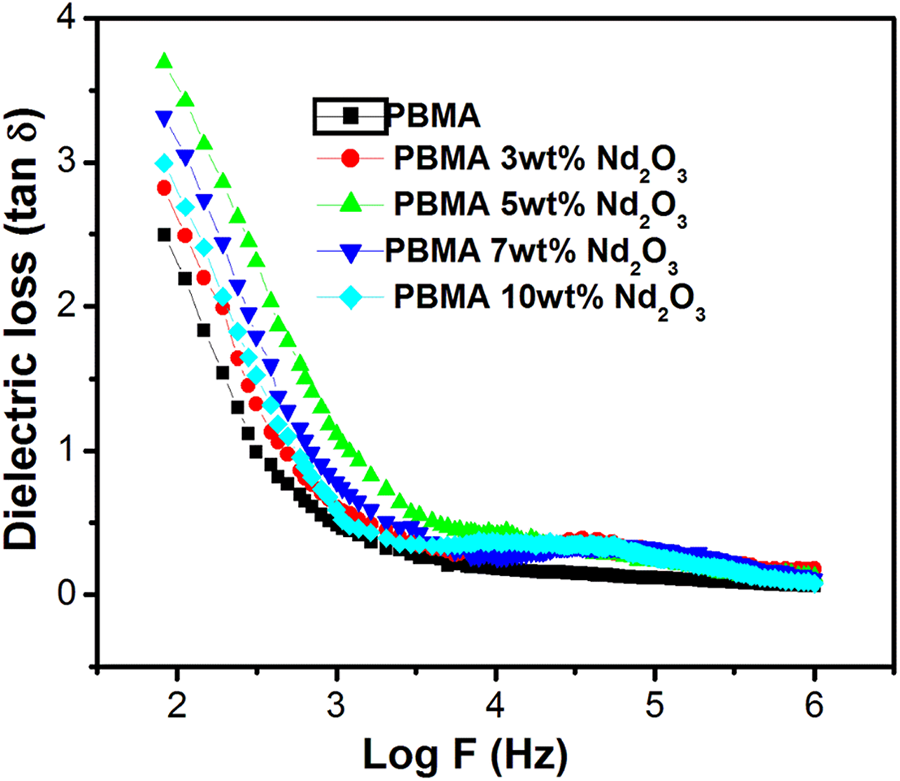
Dielectric loss of PBMA with different content of Nd2O3.
The variation in dielectric constant (εr) with frequency for PBMA and PBMA/Nd2O3 nanocomposites is shown in Figure 4. The dielectric constant decreases with frequency in all cases up to 104 Hz and after it remains independent of frequency. The higher value of dielectric constant at lower frequency is due to the proper alignment of polymer dipoles with the applied frequency. As the frequency increases the dipoles fail to arrange themselves with the applied frequency and so the dielectric constant remains independent of frequency. 28 But, interestingly the dielectric constant increases with the addition of Nd2O3 nanoparticles up to 5 wt% and after it shows a slight decrease in value. The contribution from space charge polarization arises due to the better interfacial interaction between the polymer and filler which results in higher dielectric constant for polymer composites. 29 The slight decrease in dielectric constant at higher loading of nanoparticles (7 and 10 wt%) is due to poor interface between the PBMA and Nd2O3 nanoparticles by the presence of aggregated nanoparticles.

Dielectric constant of PBMA with different contents of Nd2O3.
Mechanical studies
Mechanical properties of polymer composites have a major role in the application of polymer products in many fields. In the present study, the tensile strength and elongation at break (EB) of the pure PBMA as well as PBMA/Nd2O3 nanocomposites are analyzed and the results are given in Table 1. The interfacial interaction and the extent of stress transfer plays a key role in improving the tensile properties of composites29,30 and the schematic representation of the interaction of PBMA with Nd2O3 are given in Figure 5. The tensile strength of nanocomposite increases with the loading of nanoparticles up to 5 wt% loading. The incorporation of nanoparticles creates additional stress-bearing sites and therefore an effective stress transfer from the polymer matrix to the nanoparticles through the better interface between them. 31 So, the increased tensile strength values for PBMA/Nd2O3 nanocomposites is attributed to the better reinforcement effect of Nd2O3 nanoparticles in the PBMA matrix. However, the maximum tensile strength of the composite decreased slightly beyond 5 wt% loading. The decrease in tensile strength at higher loading arises from the incomplete interface between the matrix and nanoparticles due to the presence of agglomerated particles, as revealed from SEM images. The EB of composite is found to decrease with the addition of Nd2O3 nanoparticles due to the presence of brittle nanoparticles in the polymeric chain.
Mechanical properties and DC conductivity of PBMA and PBMA/Nd2O3 nanocomposites.


Interaction of Nd2O3 nanoparticles with PBMA.
Tensile modeling studies
Many theoretical equations are used to predict the effect of various factors (size, shape, aspect ratio, filler concentration, the extent of interfacial interaction between filler and polymer matrix) toward the improved tensile properties of polymer nanocomposites.4,32 In the present work theoretical models suggested by Einstein, Mooney and Pukanszky equations are employed to predict the tensile properties of PBMA/Nd2O3 nanocomposites. The experimental value obtained from the tensile analysis is compared with the theoretical tensile strength to predict the reinforcing factors behind the enhanced mechanical properties of polymers.
Einstein model
Einstein suggested the following equation to predict the tensile properties of polymer composites. 33

where Mc and Mm denote the tensile properties of composite and polymer matrix respectively and Vf denotes the filler volume fraction. The tensile strength of composites is applied to the Einstein equation and the theoretical tensile values are compared with experimental values and the results are given in Figure 6. It shows that the theoretical values based on Einstein model are found to be lower than the experimental tensile values. This is because the Einstein model is applicable to polymer composite at lower concentration of fillers (>1) and hence this model fails in most cases to predict the tensile mechanism of polymer composites.

Theoretical and experimental curve of tensile strength based on Einstein model.
Mooney model
Mooney modified the Einstein equation by introducing a parameter “S” to make it suitable in all concentrations. 34 The value of “S” signifies the strain field around the polymer matrix and the filler. For filler particles the S = 1.35. The Mooney equation can be expressed as

where, the parameters have their usual meanings as explained above. The tensile strength of PBMA/Nd2O3 nanocomposites is calculated using the Mooney equation and the results obtained are given in Figure 7 along with the experimental tensile value. The theoretical value using the Mooney equation and the experimental value shows a close match at lower filler concentrations, but the theoretical tensile values lie far away from that of experimental values at higher filler loading. Mooney model assumes that the filler and polymer matrix have comparable tensile values and so it fails in predicting the tensile properties especially in systems with large differences in tensile properties of components like PBMA/Nd2O3 nanocomposites.
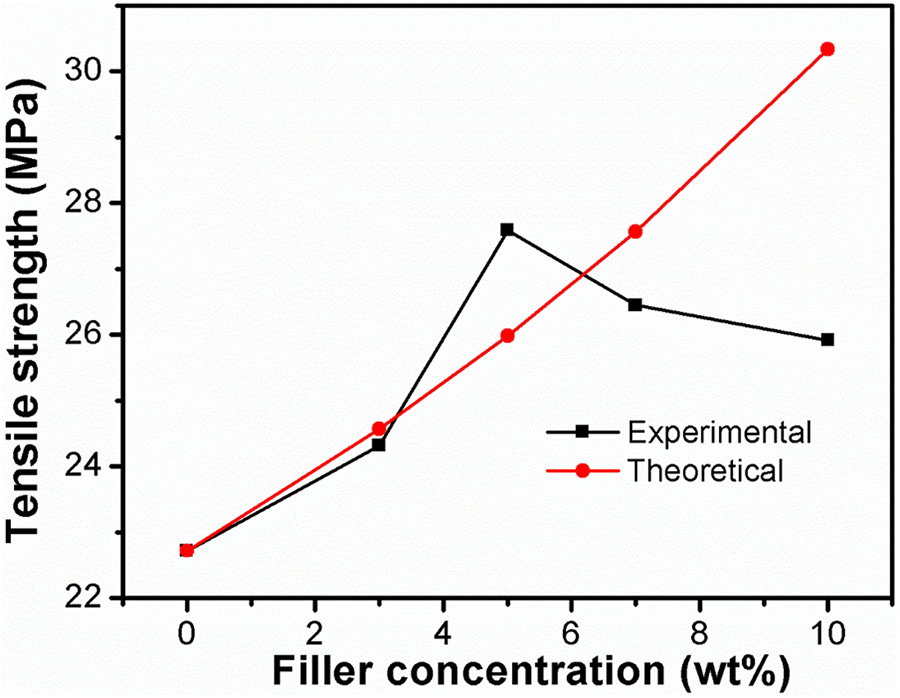
Theoretical and experimental curve of tensile strength based on Mooney model.
Pukanszky model
Pukanszky put forward a theoretical model for the polymer composite in which the interfacial interaction between the polymer matrix and filler plays a major role in the enhancement of tensile strength by the following equation.

where the parameter “B” determines the level of interfacial interaction between the polymer matrix and the filled nanoparticles. The value of B depends on the size and loading of filler as well as on the thickness and extent of interphase.32,35 The correlation graph of experimental tensile value with that of theoretical value obtained using the Pukanszky model is shown in Figure 8. As clear from the figure, the Pukanszky model exhibits a better fit in the case of PBMA/Nd2O3 nanocomposites. Both the theoretical and experimental tensile values using the Pukanszky model shows a close match at entire filler loading. So, it can be concluded that the effective loading of filler in the polymer depends on the interfacial interaction between the PBMA and Nd2O3 nanoparticles and these interactions lead to the improved tensile properties of PBMA/Nd2O3nanocomposites.

Theoretical and experimental curve of tensile strength based on Pukanszky model.
DC conductivity studies
Metal oxide nanoparticles, especially Nd2O3 nanoparticles having considerable semiconducting properties can impart good electrical properties to the insulating polymer. The variation in DC conductivity (σdc) of PBMA with different loading of Nd2O3 is presented in Table 1. It is clear that the σdc of PBMA is substantially improved by the addition of Nd2O3. Further, the σdc value is increasing with the loading of Nd2O3 nanoparticles. The conductivity of PBMA arises from the restricted movement of bipolaron charge centers under the applied voltage. 36 But in the case of composites there is a gradual formation of conducting network within the polymer matrix by the insertion of Nd2O3 nanoparticles, which results in higher conductivity of composites than the bare PBMA. Further the interfacial polarization at the interface between the nanoparticles and PBMA matrix further contributes to the enhanced conductivity of PBMA/Nd2O3 nanocomposites. 37 The maximum conductivity is obtained for PBMA with 5 wt% Nd2O3 and beyond the 5 wt% loading, the conductivity is slightly decreasing which might be due to the presence of agglomerated nanoparticles in the PBMA matrix.
Theoretical modeling of DC conductivity
Several theoretical models have been used to investigate the role of fillers in the conductive mechanism in a polymer matrix. These models have been formulated on the basis of various assumptions. The main focus of these models is to explain how the conducting network is formed in the polymer composite and also to explain the effect of other parameters like the interaction of filler and polymer, nature of fillers, the arrangement and concentration of fillers for enhancing the conductivity properties of the composite materials. In the present work different theoretical models like Scarisbrick and McCullough models are employed to predict the conductivity of PBMA nanocomposites containing different loadings of Nd2O3 nanoparticles.
Scarisbrick model
Scarisbrick assumed that the conductivity is accompanied by inter-particle contact within the polymer matrix and thus conductivity mainly depends on the amount as well as the arrangement of filler present in the matrix. 38 The Scarisbrick model can be expressed by the following equations.



where C2 is the geometric factor, its value defines the dispersion mode of filler in the polymer matrix. The value of C2 lies between 1 and 3 × 10⁻³. Here Φ is the filler volume fraction, σc and σf represent the DC conductivity of the composite and the filler respectively. The conductivity (σdc) of PBMA/Nd2O3 nanocomposites are calculated using the Scarisbrick model (equations (6) to (8)) and the comparative graph of theoretical and experimental σdc is given in Figure 9. From figure, it can be seen that the experimental conductivity is remarkably lower than the theoretical conductivity at the entire loading of Nd2O3 nanoparticles for both C2 values. At lower filler loading, the theoretical conductivity value and experimental conductivity value shows large deviations compared to that at higher loading. The exact value of C2 is difficult to find and also in this model the contribution from the polymer matrix is not considered. Therefore the theoretical conductivity using the Scarisbrick model exhibits large deviations from the experimentally determined conductivity for all composites, especially at lower concentrations.

Theoretical and experimental plots of electrical conductivity based on Scarisbrick model.
McCullough model
McCullough proposed a model for predicting the transport properties of binary systems and it can also be used for calculating the conductivity polymer composites. 39 The equation is as follows.

where λ is the structural factor, indicating the extent of conductive network formation in the polymer matrix and its value can range from 0 to 1, νf and νp are given as


The theoretical conductivity of PBMA/Nd2O3 nanocomposites is determined from the McCullough model (equations (9) to (11)) for different λ values and the comparative graph of theoretical and experimental conductivity is presented in Figure 10. The theoretical conductivity using the McCullough model greatly depends on the λ values which in turn depends on filler properties and so the exact theoretical value of λ is not known. In order to validate the McCullough model the conductivity is calculated for various λ values. Interestingly, in the of PBMA/Nd2O3 nanocomposites, the experimental conductivity shows large deviations from that of the theoretical conductivities. So McCullough model also fails in the case of PBMA/Nd2O3 nanocomposites.

Theoretical and experimental conductivity based on McCullough model.
Proposed model for PBMA/Nd2O3 composites
The electrical conductivity determined from Scarisbrick and McCullough model failed to explain the conductivity of PBMA/Nd2O3 composites because of the difference in conductivity of pure polymer and the nanoparticles. The mismatch between theoretical and experimental conductivity can be overcome by considering the factors affecting the composite properties such as geometry, morphology, aspect ratio, shape and size. Here we suggest a new model by considering the shape factor (S) of the composite system as:

The experimental conductivity values are applied to the above proposed equation and the result is given in Figure 11. The resultant conductivity value from proposed model is in good agreement with the experimentally measured values. This finding has been considered encouraging for developing new and innovative thermoplastic composite materials for using augmented tensile strength and nano-electronics devices.

Theoretical and experimental conductivity based on proposed model.
Conclusions
Poly (butyl methacrylate) nanocomposites with enhanced dielectric constant and mechanical properties were developed by incorporating Nd2O3 nanoparticles via in situ polymerization method. The SEM images showed the homogenous dispersion of nanoparticles in the PBMA chain. The result from XRD revealed a systematic and ordered arrangement of Nd2O3 nanoparticles in the PBMA matrix. The tensile strength of PBMA composites was substantially enhanced with the interaction of nanoparticles, however, the elongation at break decreased with the addition of nanoparticles. The nanocomposite reinforced with 5 wt% Nd2O3 nanoparticles showed the highest mechanical strength compared with other percentage of filler loading. The experimental data of tensile strength was compared with different theoretical assumptions from Einstein, Mooney and Pukanszky models. Among the different theoretical assumptions, Pukanszky model was found to be in good agreement with the experimental tensile values indicating better interfacial interaction between the PBMA and Nd2O3 nanoparticles. The DC conductivity of PBMA was significantly improved with the addition of Nd2O3 nanoparticles. The experimental DC conductivity values were also correlated with the various theoretical assumptions by Scarisbrick and McCullough models. All these models fail to explain the conductivity of composite material and therefore we proposed a new model for theoretical conductivity which is well fitted with experimental conductivity.
Footnotes
Declaration of conflicting interests
The author(s) declared no potential conflicts of interest with respect to the research, authorship, and/or publication of this article.
Funding
The author(s) disclosed receipt of the following financial support for the research, authorship, and/or publication of this article: This work was financially supported by KSCSTE, Government of Kerala, India (Order No. 566/2017/KSCSTE).
